Why Agencies Push Annual Contracts (And What That Tells You)

Annual contracts aren’t built for you. They’re built for the agency.
That’s not cynicism. That’s the model working exactly as intended.
When an agency locks you into 12 months upfront, their revenue is secured before the work starts. The work can underperform. Communication can go dark. Results can flatline. You’re still writing the check every single month until that contract expires.
The structural problem is straightforward: flexible arrangements keep clients longer than locked ones do.
When agencies can’t hide behind contract security, they have to perform. The accountability changes everything downstream.
The Business Logic Behind the Lock-In
Here’s what the agency’s business model actually looks like from where they’re sitting.
Running an agency is expensive. Payroll, tooling, account management, fulfillment – those costs don’t pause when a client’s results stall.
Annual contracts solve that problem for the agency. They decouple financial security from performance obligation. The agency gets paid whether the work works or not.
That’s not a partnership. That’s a subscription you didn’t fully read before signing.
And it worked – until clients started comparing notes.
Over 70% of surveyed brands have already walked away from long-term retainers, choosing shorter scopes because the old model was built around what the agency needed, not what the client was paying for.
The market is correcting. Individual buyers are still getting burned because they don’t know what to look for before they sign.
Why the 12-Month Lock-In Is a Defense Mechanism, Not a Business Model
A 12-month lock-in is a defense mechanism. Not a commitment to your success.
It doesn’t mean the agency is serious about your long-term results. It means they need time they haven’t earned yet.
The first-time buyer who gets burned and the one who doesn’t – the gap between them is almost always this: one of them understood why most agencies can’t sustain results before signing, and one of them found out afterward.
An agency that’s genuinely confident in its work doesn’t need a contract to keep you.
The work keeps you. If it’s strong, you stay. If it isn’t, you shouldn’t be legally trapped.
A long-term contract exists to override that accountability loop. It swaps a performance obligation for a legal one. That’s not a partnership structure. That’s a cage with a payment plan.
The Local AI Authority Engine runs on the opposite premise.
Every month of execution has to earn the next one. Not because a contract demands it – because that’s what genuine authority infrastructure requires.
That’s the difference between an agency that trusts its work and one that trusts its paperwork.
| Agency Motivation | What They Say | What It Actually Means | Risk to You |
|---|---|---|---|
| Revenue security | We need a 12-month commitment to properly plan your campaign. | They need 12 months of guaranteed income regardless of whether your results materialize. | You absorb all the performance risk while the agency absorbs none. |
| Onboarding cost recovery | Setup takes time – a longer contract protects your investment. | Their internal ramp-up costs are being financed by your locked-in payments, not their own margins. | You pay for their learning curve, even if the work never reaches full effectiveness. |
| Preventing client churn | Long-term relationships produce better results. | A contract replaces the accountability loop that good results would otherwise create naturally. | You lose leverage the moment you sign – there’s no exit if performance stalls. |
| Hiding performance lag | Authority building takes time – don’t expect results too soon. | Annual timelines give agencies cover to delay accountability for months before a client can act. | By the time underperformance is undeniable, you’re already nine months into a contract you can’t exit. |
| Locking in discounted pricing | We’re offering you a reduced rate for committing annually. | A small price reduction is used to justify transferring all financial risk from the agency to you. | You trade negotiating power and exit rights for a discount that rarely offsets the cost of a bad engagement. |
| Avoiding performance benchmarks | We’ll review results together at the end of the year. | Annual review cycles remove the pressure to demonstrate momentum every 30 days. | Without monthly accountability, there’s no mechanism to catch – and correct – underperformance early. |
What Month-to-Month Actually Forces an Agency to Do

Month-to-month doesn’t just shift the paperwork. It shifts who holds the power.
When there’s no 12-month agreement to hide behind, an agency has to show up differently. Every deliverable matters. Every communication matters. Every month of results has to justify the next invoice – because nothing is forcing you to stay.
That accountability pressure is exactly what most agencies are trying to avoid when they push annual agreements.
The shift toward agile marketing models didn’t happen because clients got braver. It happened because over 70% of surveyed brands finally recognized what the annual retainer was actually protecting – and it wasn’t them.
Month-to-month doesn’t just change the paperwork. It changes what the agency is incentivized to do every single day.
The Accountability Standard No Annual Contract Can Replicate
A 30-day accountability cycle demands something an annual agreement architecturally destroys.
Here’s what that cycle forces in practice. The agency has to communicate clearly, consistently, and in a way you can actually verify. Early contract terminations trace overwhelmingly to poor communication and a lack of performance transparency.
That failure pattern doesn’t disappear under a month-to-month model. It just costs the agency the relationship immediately instead of eleven months later. So they fix it.
That accountability isn’t a mindset. It’s a structural reality. Annual contracts remove it by design. Month-to-month puts it back.
And if you’re serious about holding any agency to this standard, start by knowing vetting the right questions before you sign anything – long-term or otherwise.
Who Month-to-Month Is Not For
This model isn’t for everyone. Let’s be clear about that.
If you’re hunting a discounted rate in exchange for locking in early, this isn’t the right fit. If you want the comfort of a signed agreement that keeps an agency available regardless of what they actually produce – that preference exists, and there are agencies built exactly for it.
But understand what you’re buying. Security for them. Not results for you.
Month-to-month is for buyers who want control. Who understand that authority infrastructure only compounds when the agency doing the work has real skin in the game – every single month.
If that’s how you think about this investment, a flexible structure isn’t a risk. It’s the only standard that holds.
| Performance Lever | Annual Contract Model | Month-to-Month Model |
|---|---|---|
| Communication cadence | Agency controls the schedule – updates arrive when convenient for them, not when you need them | Agency must communicate clearly and consistently every month or risk losing the relationship immediately |
| Performance accountability | Financial security is locked in regardless of results – underperformance has no contractual consequence | Every deliverable must justify the next invoice – there is no contract absorbing the gap between effort and outcome |
| Quality of execution | Work quality can drift once the contract is signed – the client is obligated to stay either way | Work quality must hold or improve every cycle – the client can leave, so the agency can’t afford to coast |
| Transparency incentive | Limited pressure to show exactly what’s being done – the agency’s revenue isn’t tied to your visibility into it | Full transparency becomes a retention strategy – showing the work clearly is how the agency earns the next month |
| Authority infrastructure investment | Agency may deprioritize long-term compounding work in favor of fast, visible-but-shallow activity that fills reports | Agency must invest in work that compounds – shallow activity won’t survive a monthly accountability review |
| Client leverage | Buyer holds virtually no leverage once signed – exit requires breaking the contract or waiting it out | Buyer holds full leverage at all times – the agency earns continued engagement through ongoing performance, not paperwork |
Contract Clauses That Signal a Red Flag Before You Sign
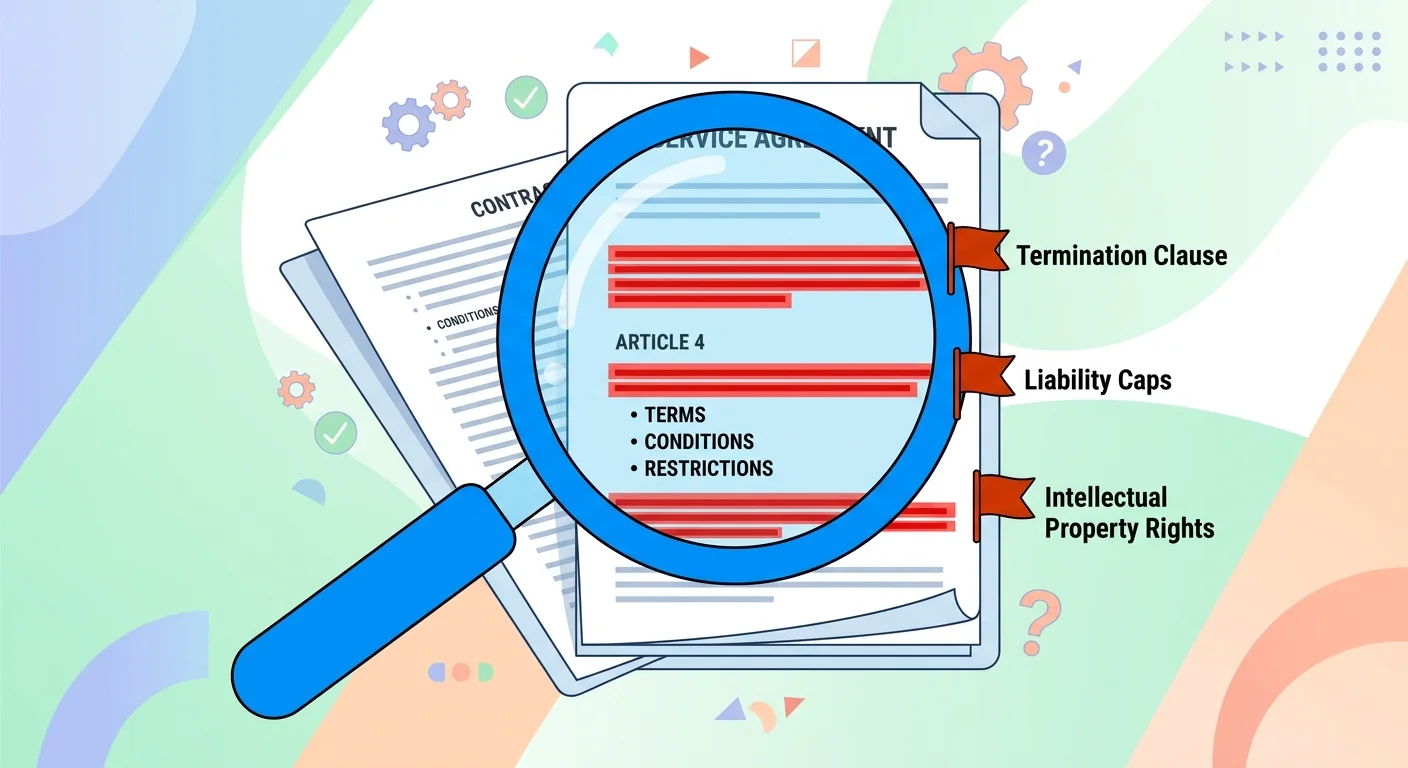
Most agency contracts are written by agency lawyers.
That sentence is the whole answer.
The standard a real contract should hold is simple: you deliver, you get paid. You don’t, I leave. That’s it.
Most agency agreements are engineered to do the exact opposite – to make leaving expensive, confusing, or legally impossible. Buyers are figuring this out on their own: small and mid-sized businesses increasingly prefer month-to-month terms, because flexibility is the only way to keep the power where it belongs.
With you.
Here’s what to look for before you put pen to paper.
Specific language patterns in standard agency contracts signal – clearly, if you know what to find – that the agreement was drafted to protect the agency’s revenue. Not your results.
Language Patterns That Protect the Agency, Not You
Pattern one: the automatic renewal clause.
These clauses roll your contract forward for another 12 months if you don’t cancel within a specific window – often 30 or 60 days before the term ends. Miss that window by a week and you’re locked in for another year.
That isn’t a drafting oversight. It’s the point.
Poor communication and performance transparency drive 43% of early contract terminations. Auto-renewal clauses exist specifically to prevent you from acting on that frustration before the clock resets.
The second pattern: vague performance language that can’t be measured or enforced.
Phrases like "best efforts," "industry-standard practices," and "reasonable timelines" aren’t commitments. They’re legal padding that gives the agency room to underdeliver without technically breaching anything.
If the contract doesn’t define success in specific, verifiable terms – that vagueness is there by design. A contract that can’t be held to account isn’t a partnership agreement. It’s a license to coast.
The Asset Ownership Trap Hidden in Standard Contracts
But there’s a second category of clause that barely gets mentioned.
This one doesn’t hurt you during the relationship. It hurts you after.
Asset ownership language decides who walks away with your website, your content, your authority infrastructure, and your data when the contract ends.
Most agencies default to retaining ownership of everything they built – treating deliverables as their intellectual property until you’ve completed the full contract term. Sometimes even after that.
First-time buyers almost never ask this question before signing. And it’s the one with the highest cost when the answer turns out to be "not you." Who Owns Your Data?
This is where the hotel metaphor breaks down even further.
It’s not just that you’re paying for a room that isn’t ready. It’s that when you finally check out, the agency takes the furniture with them. Every article, every authority infrastructure build, every signal your investment helped create – it can revert to the agency’s control if the contract language allows it.
Read the ownership clause before anything else. If it isn’t explicit, clear, and unconditional – that’s a red flag you can’t afford to ignore. Check The Burned Chiropractor’s Vetting Checklist: 7 Questions to Ask Before Signing before any conversation goes further.
| Contract Clause | What It Says | What It Protects | What to Negotiate Instead |
|---|---|---|---|
| Automatic Renewal Clause | Contract rolls forward for another full term unless you cancel within a narrow window (often 30-60 days before expiration) | Agency revenue continuity – removes the client’s ability to exit at natural term end | Hard stop date with no auto-renewal; require written opt-in to extend, not written opt-out to cancel |
| Vague Performance Language | Obligations defined as ‘best efforts,’ ‘industry-standard practices,’ or ‘reasonable timelines’ with no measurable benchmarks | Agency from being held accountable for underdelivery – legally insulated by undefined standards | Specific, verifiable deliverables with defined cadence; remove all ‘best efforts’ language and replace with concrete output commitments |
| IP and Asset Ownership Clause | All content, infrastructure, and deliverables remain the agency’s intellectual property until (or sometimes after) full contract completion | Agency’s leverage over the client – you can’t leave without losing what your investment built | Unconditional client ownership of all deliverables from day one; no ownership contingencies tied to contract term or payment schedule |
| Early Termination Penalty | Exiting before the contract term ends triggers a fee – often equivalent to the remaining months of the agreement | Agency’s locked revenue even when performance has failed – makes leaving more expensive than staying | No early termination penalty; month-to-month structure eliminates this clause entirely by design |
| Scope Creep Carve-Outs | Contract defines a narrow base scope, then reserves the right to bill separately for anything outside it – often without client approval thresholds | Agency’s ability to expand billable work unilaterally while appearing to offer a fixed-rate agreement | Explicit written approval required for any out-of-scope billing; define scope boundaries clearly with a change-order process |
| Data Access Restrictions | Client access to analytics, platform accounts, or reporting dashboards is gated behind agency-controlled logins or withheld until contract completion | Agency’s control over what you can see – limiting your ability to verify performance or challenge reported results | Full, independent client access to all accounts and data from day one; agency login is additive, not the sole access point |
How to Evaluate Whether an Agency Earns Month-to-Month Renewal

Good. You chose month-to-month. Now the work actually begins.
But month-to-month is only as powerful as the standard you hold it to. No framework means you’re not vetting – you’re just reacting. And reacting without a framework is the pattern that keeps repeating.
68% of small-to-medium businesses already prefer month-to-month terms. Preference alone doesn’t protect you, though. You need a consistent 30-day evaluation loop with one job: answer whether they earned it before you hand over another invoice.
The 30-Day Renewal Standard: What to Measure Each Month
Here’s what that standard actually looks like.
Every 30 days, ask three things. Did they deliver what was scoped? Did they communicate proactively – without you chasing them? Is the authority infrastructure more established than it was last month? All three yes: renew. One missing: have the direct conversation. Two or more missing: don’t renew. You don’t owe a long explanation. The contract terms are the explanation. Learn from our framework to sharpen exactly what those checkpoints look like in practice.
Agencies that perform under this standard don’t fear it – they want it. Their work shows in 30-day windows. The ones pushing for 12-month agreements ‘to see results’ are telling you exactly how much confidence they have in their own execution. Here’s the number that backs that: agencies on flexible models generate 15% higher average client lifetime value than rigid contract structures. Not because clients are trapped. Because the work justifies staying.
Why Authority Compounds Even on a Flexible Term
Here’s what most buyers get wrong: month-to-month doesn’t slow the compounding. It speeds it up.
Authority infrastructure doesn’t reset when you renew month-to-month. Entity trust deepens. AI visibility signals accumulate. Content clusters gain semantic density. Every month of solid execution stacks on the last – and none of that work disappears just because there’s no 12-month lock-in holding it in place. The difference is accountability: on a flexible term, the agency has to keep earning the next layer. That’s elevating client lifetime value the right way – through sustained performance, not contractual obligation. 15% higher average lifetime value. Earned, not locked in.
Run the AI Visibility Check and you’ll see exactly what 30 days of authority execution produces in measurable terms. What’s been built. What AI engines are registering. Where the gaps still are. That’s the accountability a month-to-month model is designed to surface. Not someday. Every single month.
| Month | Authority Milestone | What to Verify | Renewal Decision Signal |
|---|---|---|---|
| Month 1 | Foundation delivery confirmed | Core authority infrastructure scoped and initiated – schema, entity signals, and initial content structure in place; agency communicates proactively without prompting | Renew if all scoped deliverables are complete and communication has been clear and consistent |
| Month 2 | Content execution underway | AI Authority articles published on schedule; internal linking structure is intentional and expanding; agency can explain what each piece is building toward | Renew if content is live, on-brief, and the agency demonstrates strategic reasoning – not just output |
| Month 3 | Authority signals accumulating | Entity trust is visibly deepening – AI engines are beginning to register the practice’s presence; gaps from the AI Visibility Check are being addressed systematically | Renew if measurable progress is visible and the agency can point to specific signals – not just effort |
| Month 4-6 | Semantic density building | Content clusters are cohesive and interlinked; each new article reinforces the authority infrastructure already in place; no orphaned content or disconnected output | Renew if the body of work is clearly compounding – each month stacks on the last with no resets or restarts |
| Month 7-9 | AI visibility establishing | AI engines are surfacing the practice in relevant recommendation contexts; the AI Authority Snapshot shows consistent forward movement; agency reports are specific, not vague | Renew if AI visibility is trending upward and the agency can articulate exactly what is driving the movement |
| Month 10-12 | Authority asset maturing | The infrastructure built over the engagement is owned outright by the practice; authority signals are self-reinforcing; the agency has earned continued partnership through demonstrated results | Renew – or restructure – based on whether the compounding is real and the relationship remains performance-driven |
Frequently Asked Questions
Here’s what actually comes up when someone is close to signing.
Not hypotheticals. These are the real sticking points – the objections, the edge cases, the fears – that keep first-time buyers locked inside bad agreements.
Why do digital agencies insist on 12-month contract lock-ins?
It protects their revenue. Not your results.
A 12-month lock-in secures their income before they’ve earned a single deliverable. Work can underperform. Communication can go dark. You’re still paying until the term runs out – because the contract was written to make leaving more painful than staying.
43% of early contract terminations trace directly to poor communication and performance gaps. A long-term agreement doesn’t solve that. It just raises the exit cost until most buyers give up and wait it out.
That’s not a coincidence. That’s the model.
What are the hidden risks of signing an annual retainer with an agency?
They’re buried in the clauses you skip until the relationship breaks down.
Automatic renewal provisions roll your agreement forward another 12 months if you miss a tight cancellation window – sometimes 30 days, sometimes less. Vague performance language like "best efforts" or "reasonable timelines" hands the agency legal cover to underdeliver without technically breaching anything. Asset ownership provisions mean your content, your authority infrastructure, and your data can walk out the door with them.
Flexible structures reduce early relationship failure by up to 25%. That number tells you exactly what a rigid contract costs when things go sideways – and they do.
How does a month-to-month agreement force an agency to maintain high performance?
It removes the safety net – for them, not you.
When an agency knows you can walk after 30 days, every deliverable has to justify the next invoice. There’s no "we’ll make it up in month four." There’s no built-in coast period. The work earns the renewal or it doesn’t.
Agencies operating on flexible terms generate 15% higher average client lifetime value – not because clients are locked in, but because the work is actually worth staying for. That’s the only accountability structure that produces consistent results.
What specific contract clauses should business owners watch out for?
Three clauses. Read them before you sign anything else.
First: automatic renewal language with 30- or 60-day cancellation windows. Miss the window by a week and you’re locked into another year. That’s not an oversight in the drafting. That’s the point.
Second: vague performance standards – "best efforts," "reasonable timelines." Those aren’t commitments. They’re legal room to underdeliver without consequence.
Third: asset ownership provisions. These determine whether your content and authority infrastructure belong to you when the relationship ends – or to them.
68% of small-to-medium businesses prefer month-to-month terms for exactly this reason. Control belongs with the buyer. Those three clauses determine whether it actually does.
Will choosing a month-to-month model delay my long-term AI visibility results?
No. The compounding doesn’t care what the contract looks like.
Entity trust deepens every month. Authority infrastructure stacks. AI visibility signals accumulate. None of that resets on a 30-day renewal cycle – the infrastructure you build in month one is still working in month twelve.
Agencies on flexible models generate 15% higher average client lifetime value – not because clients are trapped, but because the work justifies staying. Month-to-month doesn’t slow the build. It keeps the agency honest while it happens.
The Verdict on Agency Contracts
Here’s the verdict.
A 12-month contract is a hotel that charges you whether or not the room is ready. Month-to-month is the agency proving it deserves checkout – every single month. That’s not a risk to the right agency. That’s the standard they already operate to.
Authority infrastructure compounds. Entity trust deepens. AI visibility accumulates. None of that needs a locked contract to work. It needs an agency that shows up – accountable, every 30 days. The flexibility isn’t what slows the compounding. It’s what keeps the work honest.
If you’re hiring an agency for the first time – or starting over after one that burned you – don’t sign an annual agreement until you know exactly what you’re buying. Not what the deck says. What AI engines are actually registering about your business right now. What’s missing. What 30 days of real execution could move.
That’s where iTech Valet starts. Not with a contract. With proof.
The agency you hire should earn your business every single month. Not once a year. Every 30 days.
Before you sign anything, find out what ChatGPT, Gemini, and Grok actually say when someone asks who to trust in your market. That’s not a hypothetical. It’s happening right now – and one of your competitors is probably the answer.
Run the AI Visibility Check and see exactly where you stand.