
A review of many studies found a bulging spinal disc on imaging in about 3 in 10 (30%) of 20-year-olds with no pain, and in more than 8 in 10 (84%) of 80-year-olds with no pain. The authors wrote that “Many imaging-based degenerative features are likely part of normal aging and unassociated with pain,” and that these findings must be read in light of the patient’s own health condition. The average reading level of adults in the United States is between the sixth and eighth grades. In one study, word revision meant swapping words of three or more syllables for words with fewer syllables when possible, such as ‘cancer doctor’ in place of ‘oncologist’.
How Often Pain-Free People Show Disc Bulges on Imaging

Here’s where the numbers come from. A Systematic literature review of imaging features of spinal degeneration in asymptomatic populations pulled together thirty-three articles. Those articles reported imaging findings for 3,110 people who had no pain.
A disc bulge showed up in about 3 in 10 (30%) of the 20-year-olds. It showed up in more than 8 in 10 (84%) of the 80-year-olds. Disc degeneration, which is wear and breakdown of the discs, rose from 37% (about 4 in 10) at age 20 to 96% (more than 9 in 10) at age 80. All of these people had no symptoms.
Two more findings tell the same story. A disc protrusion, which is a disc sticking out, showed up in 29% of 20-year-olds and 43% of 80-year-olds. An annular fissure, a crack in the outer ring of a disc, showed up in 19% of 20-year-olds and 29% of 80-year-olds. None of these people had pain.
The table lines up each finding at age 20 and age 80, so you can see them side by side.
| Finding | Age 20 | Age 80 |
|---|---|---|
| Disc bulge | 30% | 84% |
| Disc degeneration | 37% | 96% |
| Disc protrusion | 29% | 43% |
| Annular fissure | 19% | 29% |
The authors say it plainly: “Many imaging-based degenerative features are likely part of normal aging and unassociated with pain.” They added that “These imaging findings must be interpreted in the context of the patient’s clinical condition.”
If you want your disc articles written to this standard, that’s the work of AEO Content Writing. And if you want to see how that work gets done, it’s laid out on iTech Valet Service Plans & Pricing.
Why ‘Disc Bulge’ Alarms Patients More Than Experts
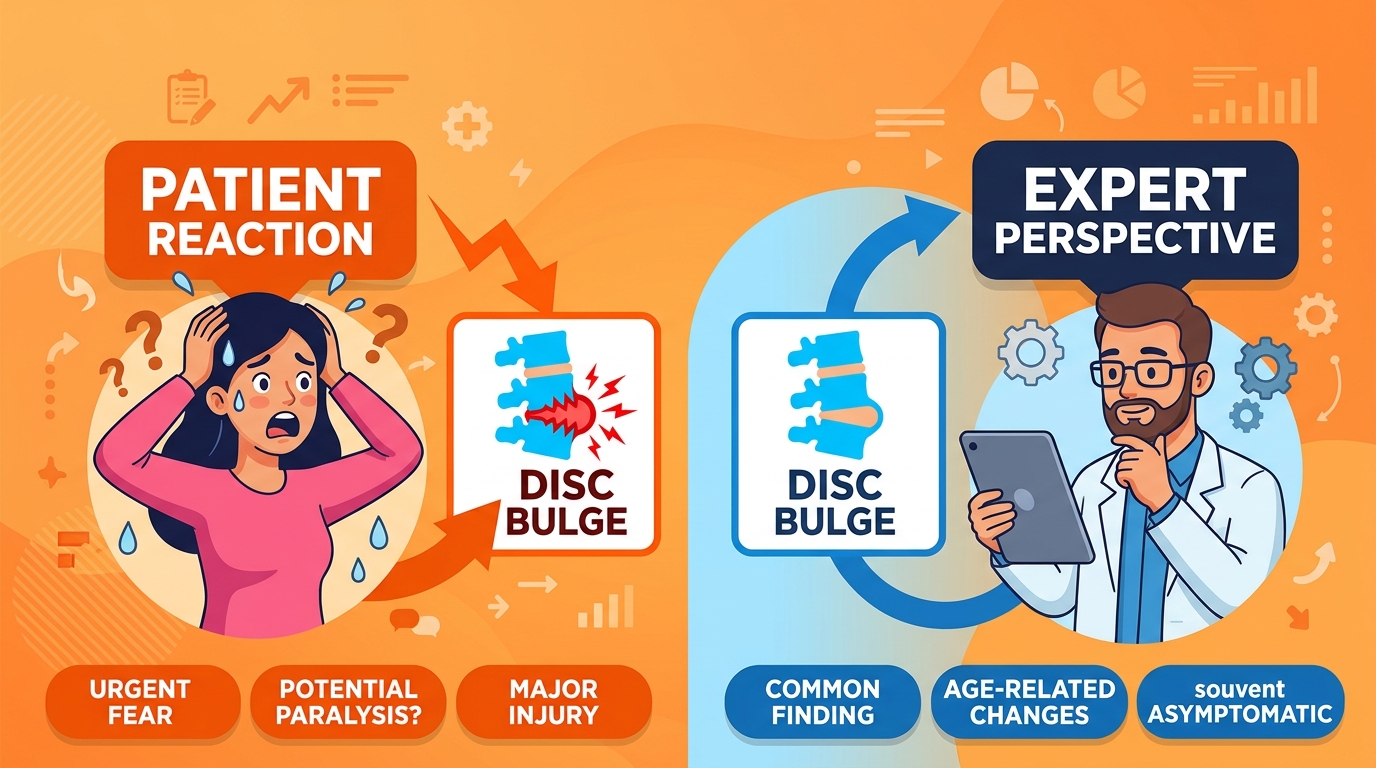
Now look at how your patients react to these words. A survey compared how patients and experts graded their concern over terms found in spine imaging reports. The study is called Low Back Pain Patients’ Perceptions Regarding Their Own Radiology Reports.
Patients’ degree of concern was significantly higher than the experts’ in six of the terms. These included disc bulge, disc extrusion or protrusion, discogenic changes, osteopenia, and ligamentum flavum hypertrophy. It was significantly lower in only one term: spinal cord signal change.
The authors say patients “tended to exaggerate the clinical importance of common radiological findings that have little-to-no clinical significance or relevance to the cause of their back pain.” Disc bulge is one of the findings they name.
So where does the alarm come from? The authors point to how the reports are built. They’re written in a professional language aimed at a medical audience, so patients might misunderstand them.
Spine radiology reports also include long descriptions of all abnormal findings. That holds whether or not the findings are relevant to the symptoms, are disease findings, or are signs of age.
What Reading Their Own Report Does to Patients

Reading the report helps. In a survey of patients with low back pain, 63% said reading their report helped them understand their condition better. That’s about 6 in 10.
And 84% agreed that getting early access to the report helped them talk better with their doctor. More than 8 in 10.
But it comes with a cost. Among the patients who read their reports, 49% reported feeling restless. 48% reported worry. 44% reported thinking more about their pain. That’s about half, about half, and more than 4 in 10.
The authors wrote that “Direct access to radiology reports might provoke anxiety symptoms, especially in patients with a tendency for catastrophic thinking.”
They also warned that unwarranted fear and anxiety might be felt. That could support nocebo effects, which means harm caused by expecting harm. Nocebo effects “can paradoxically intensify patients’ symptoms.”
The Reading Level a Disc Bulge Article Should Hit
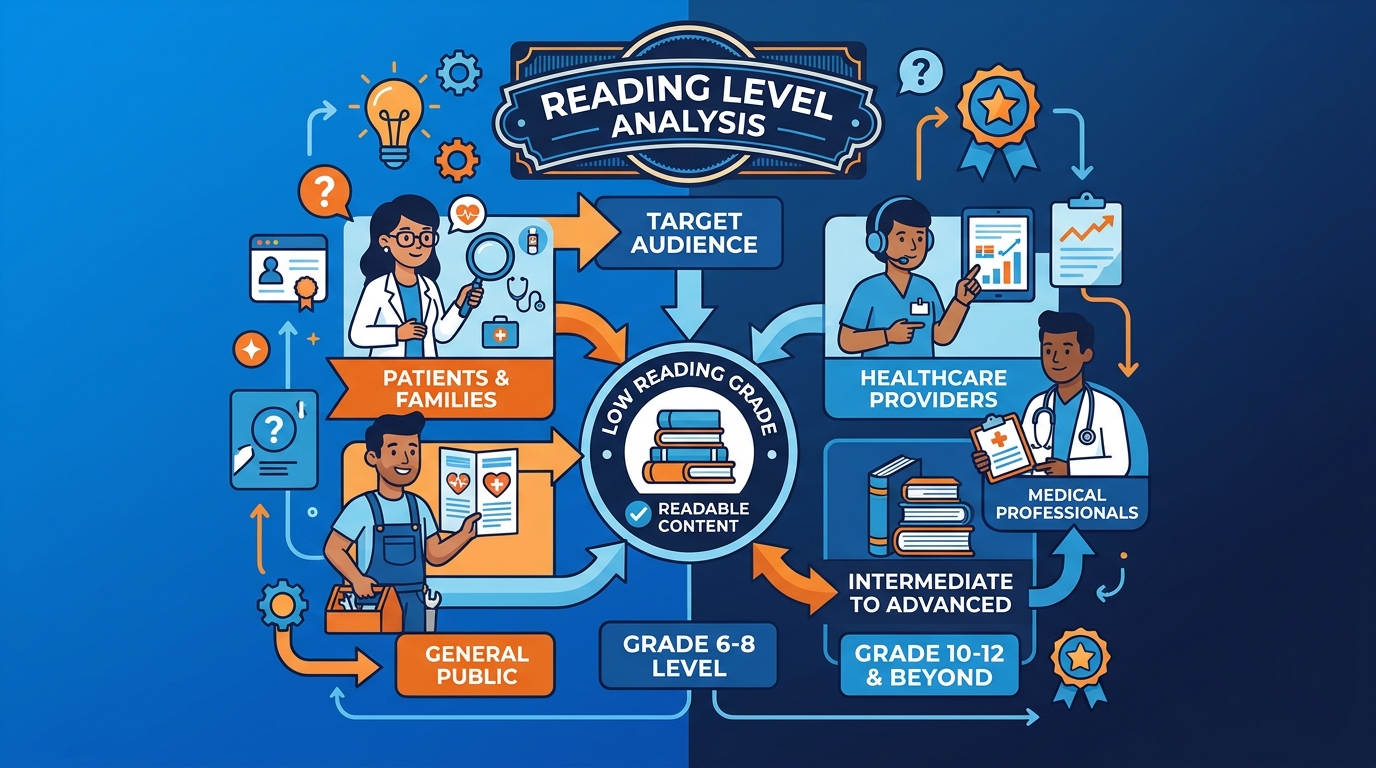
Start with who’s reading. The average reading level of adults in the United States is between the sixth and eighth grades.
Two health agencies gave different targets for patient materials. The National Institutes of Health (NIH) has recommended that patient education materials be written at or below the sixth-grade level. The Centers for Disease Control and Prevention (CDC) has recommended the eighth-grade level.
The same reading-level question applies to other pain topics, like in Structuring a Sciatica Article to Answer Acute Pain Questions.
Tools and Edits That Lower the Grade Level
The formulas and the word-revision method below come from a study of real patient handouts: Improving the Readability of Patient Education Materials in Physical Therapy.
Let me tell you where I stand. I don’t publish more to get your practice recommended by AI. I write so your information is easy to grasp, and I’d take clear, factual writing in a sensible order over more words every time.
I don’t count output. I count whether a reader, or an AI engine, can follow the page from the first line to the last.
Formulas You Can Score by Hand
You don’t need special software to check your reading level. Common readability formulas include the Simple Measure of Gobbledygook (SMOG), the Fry Graph, the Flesch Reading Ease Formula, and the Flesch-Kincaid Grade Level. All of them can be scored by hand.
The SMOG method has two steps:
- Choose 30 sentences in the writing: 10 at the beginning, 10 in the middle, and 10 at the end.
- Count the number of words with 3 or more syllables.
Word Revision, Tested on Real Handouts
Here’s what the researchers tested. The sample was 38 physical therapy handouts from one hospital system in the Midwest.
A large majority of the original handouts were above a sixth-grade reading level. That was 34 of 38, or 89.47%, about 9 in 10. They were also above an eighth-grade level. That was 30 of 38, or 78.95%, about 8 in 10.
Word revision meant swapping words of three or more syllables for words with fewer syllables when that was possible. One example: ‘cancer doctor’ in place of ‘oncologist’.
It worked. The average reading level of the handouts dropped by a statistically significant amount under all three changed versions. The combined version, the one that both removed and revised words, had the lowest average: a reading level of 8.42, give or take 2.07.
Frequently Asked Questions
Why do patients go searching online after reading their report?
To better understand it. In the Journal of Pain Research survey, 70% of patients strongly agreed, a 4 or 5 on the scale, that they wanted to look on the internet or social media to better understand the medical information in their report. That’s 7 in 10.
I’d rather be the source an AI names and draws on than one more name in a list. So I write for the patient who is searching for the page that explains the report.
Do patients understand imaging results sent through a portal?
Few do at first. One study found that only one of every six patients who had an MRI (magnetic resonance imaging) or CT (computed tomography) scan said they had a clear understanding of their results when the results first came through a web portal.
Will word changes alone bring a handout down to the recommended level?
Not in the study tested. Even after the changes, most of the physical therapy patient education materials were still above the recommended reading levels.
How many US adults have proficient health literacy?
Only 12%, about 1 in 8. The 2003 National Assessment of Adult Literacy checked the health literacy of 19,000 adults in the United States. It found that only 12% had the “proficient” skills needed to understand information about their health.
Run the Check on Your Own Practice
Good disc bulge writing for your practice starts with the imaging data. Many imaging-based degenerative features are likely part of normal aging and unassociated with pain, and they must be read in the context of the patient’s clinical condition.
Then weigh the patient-perception research. It warns that direct access to radiology reports might provoke anxiety symptoms, especially in patients with a tendency for catastrophic thinking. And finish with a tested method to bring the reading level down.
iTech Valet writes AI Authority articles for chiropractic practices, so AI assistants have clear, factual pages to draw on. Want to see what AI says about your practice right now? Run My AI Visibility Check.