
Patients and medical professionals use different kinds of language. Medical language uses precise terms to describe a concept. Patients use less precise expressions, which often makes their text inaccurate and longer than one written by a healthcare professional. The Preston Medical Library says to present the most important information first, right at the top of the first paragraph. The International Plain Language Federation says to provide context first, then describe the behavior. For example, write “If you have shortness of breath or pain in your chest, tell your doctor” rather than “Tell your doctor if you have shortness of breath or pain in your chest.”
Patients Describe Conditions Differently From Clinicians
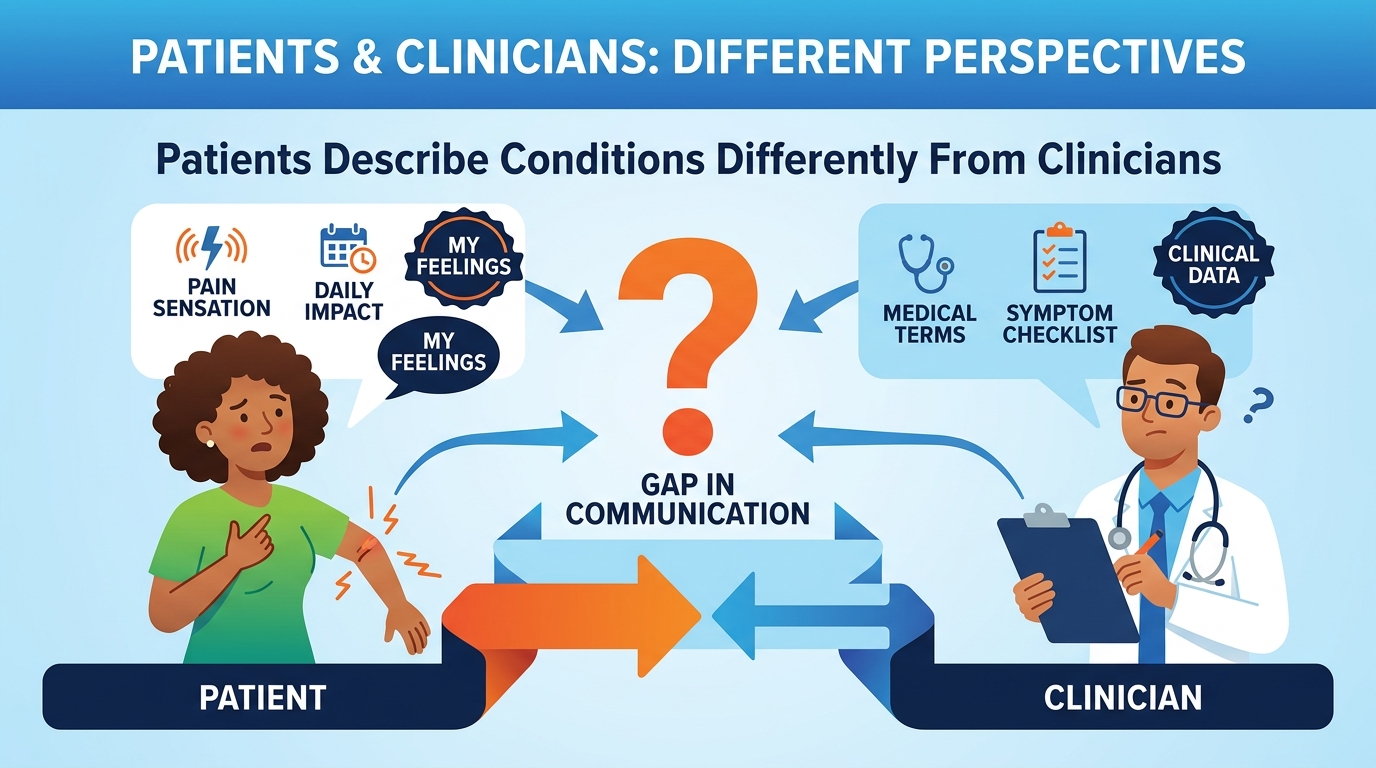
Here’s the gap.
A study from Université Paris-Saclay, CNRS, LISN looked at it: Am I eligible? Natural Language Inference for Clinical Trial Patient Recruitment: the Patient’s Point of View.
Its starting point is simple. Patients and medical professionals use different kinds of language.
Medical language uses precise terms for a concept.
Patients use less precise expressions. That often makes the patient’s text inaccurate. And longer than text written by a healthcare professional.
Look at the numbers.
On average, a patient-language topic held 21 terms taken from the UMLS. The topic’s medical version held 25.
But the patient version ran longer. It averaged 116 words, against 98 for medical language.
Fewer UMLS terms. More words.
The authors say this suggests patients tend to use paraphrase to refer to medical terms.
It wasn’t a close call.
For more than nine in ten topics (92%), the medical-language version had more UMLS terms than its patient-language equivalent.
There’s an emotional side too.
The study says patient language (PL) often conveys a load of negative emotions, such as fear, worry, anger, or anxiety.
AI Models Match Patient Wording Less Accurately
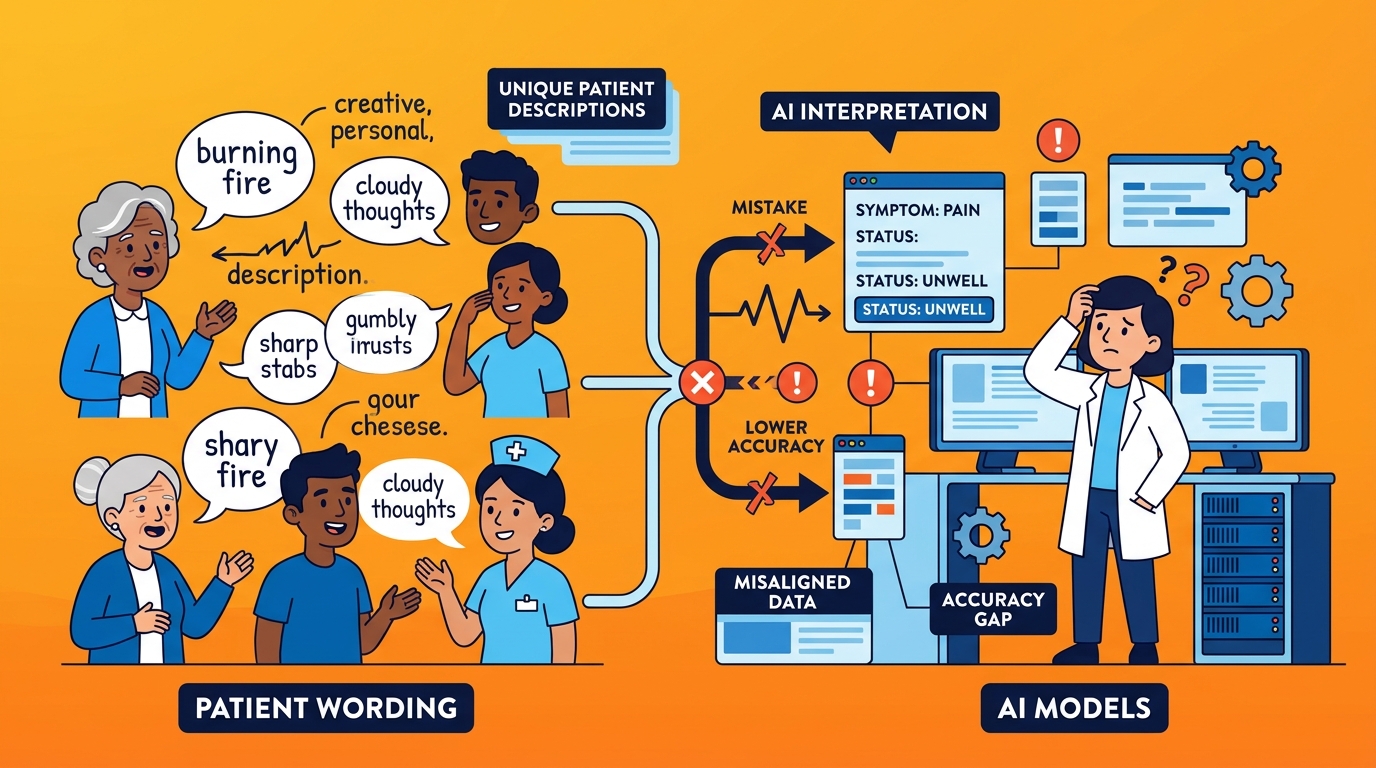
Here’s what happened when the same study put AI to the test.
It prompted several open-source large language models on its task. Using patient language, they scored an F1 of 56.5 to 71.8.
The same task in medical language? 64.7 to 73.1.
And there’s a catch.
When the models rephrased text, they sometimes tended to remove quite important information.
In the study’s example, gender was missing in both cases.
What Gets a Page Cited First by AI Engines
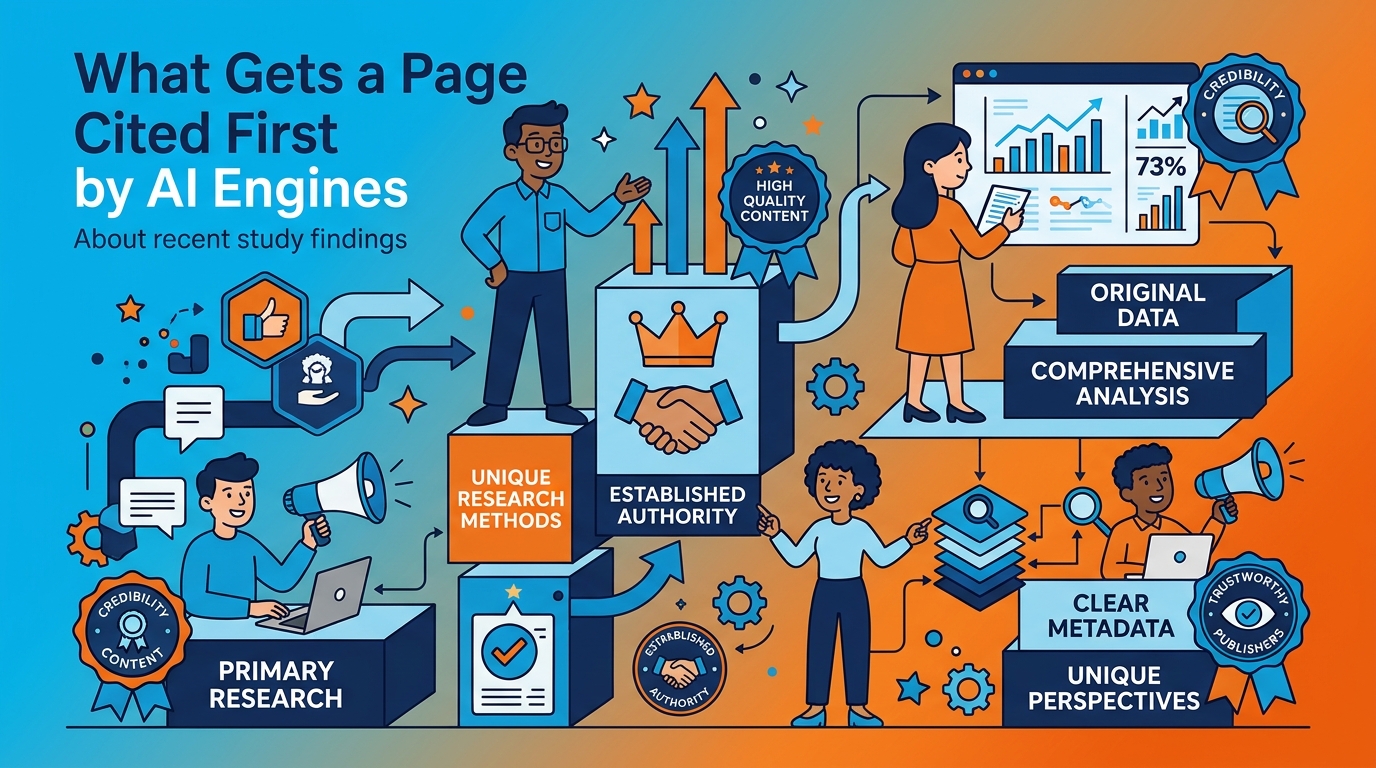
Here’s what one study found.
It compared pages of the same website. There, content mattered in one way. Pages whose title and paragraphs match the questions people ask are cited more.
FAQ blocks, structured data, summary boxes and page speed? They appeared effective only across websites.
High-influence pages tend to be longer, more structured and semantically aligned.
They’re also richer in extractable evidence. Definitions. Numerical facts. Comparisons. Procedural steps.
Structure matters on its own.
Research on LLM systems indicates that content structure, independent of semantic content, significantly influences how large language models process input and generate output.
Here’s what drives the result.
Mixed-effects models show that topical relevance and list position are the biggest drivers of being cited first.
Completeness and trust cues add smaller gains.
Formatting-only edits? Little impact.
I’d rather a practice be the page an AI names and draws on first than one more name in a directory list.
So I write each service page to be relied on. Not just present.
Want to see where you stand? The AI Visibility Check looks at how a practice shows up in AI answers.
Then you need to read the results. That’s covered in Interpreting Practice Diagnostic Results: A Complete Guide.
Plain-Language Rules for Writing a Service Description
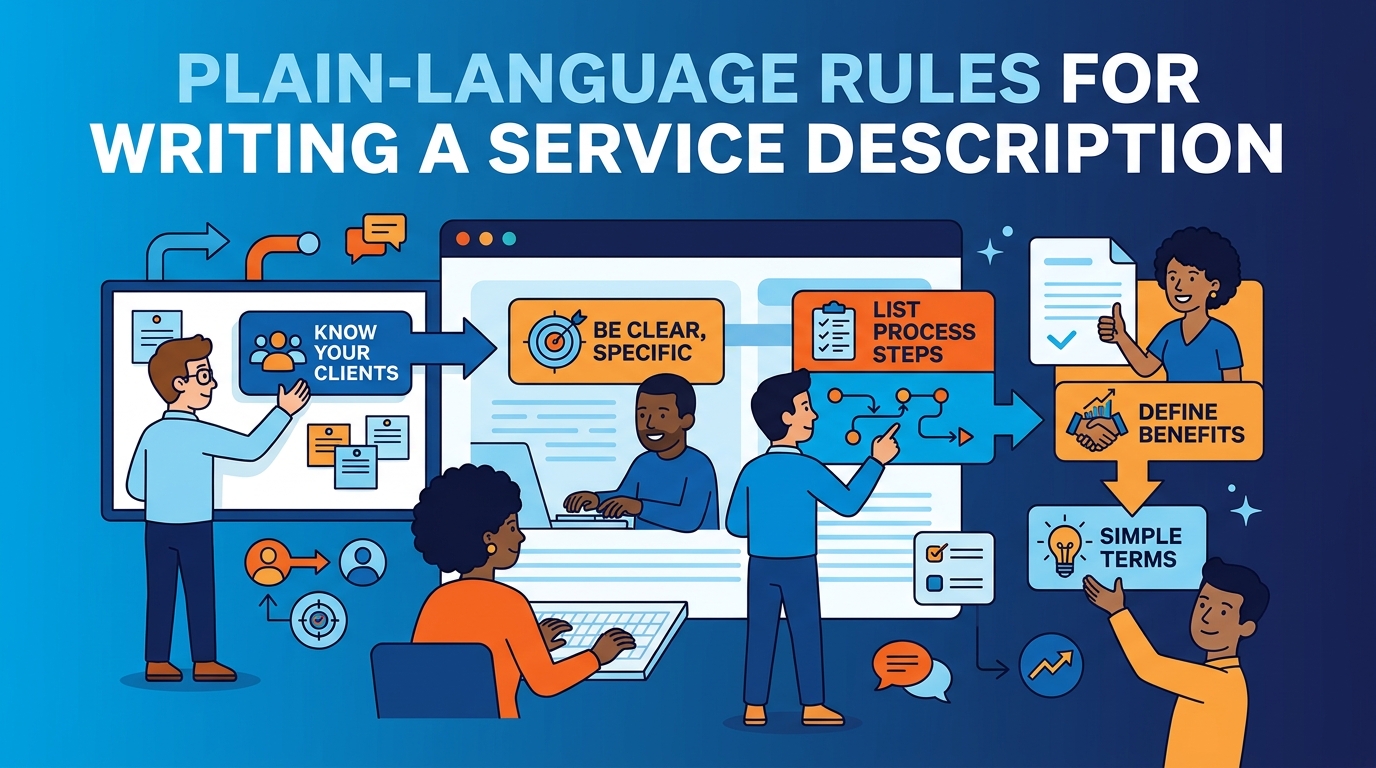
Here’s how I work.
I don’t publish more to get a practice recommended. I write for how easily AI can grasp a practice’s information. Clear, factual service pages. In a sensible order. Not more of them.
Missing definitions cost you. How Missing Service Definitions Hurt Local Voice Search Results lays out what they do to voice results.
The table below lines up each rule with the source behind it.
| Rule | Source guidance |
|---|---|
| Sentences average no more than 15 words | Preston Medical Library |
| Paragraphs contain no more than 5 sentences | Preston Medical Library |
| Sentences average no more than 15-20 words | Center for Health Care Strategies |
| Most important information goes at the top of the first paragraph | Preston Medical Library |
| Provide context first, then describe the behavior | International Plain Language Federation |
| Avoid jargon; define necessary terms when first introduced | Preston Medical Library |
| Headings break up text and give information or ask key questions | Preston Medical Library |
| Limit bulleted lists to between three and seven items | Center for Health Care Strategies |
| Write in second person | Public Health Communications Collaborative |
| Use descriptive links | Public Health Communications Collaborative |
Keep sentences and paragraphs short
Keep it short.
The Preston Medical Library says to use short sentences. No more than 15 words per sentence on average.
It says the same about paragraphs. Keep them short. No more than 5 sentences each.
The Center for Health Care Strategies agrees. Sentences should average no more than 15-20 words.
Keep your messages clear and simple.
Lead with the most important information
Lead with what matters.
The Preston Medical Library says to present the most important information first. Right at the top of the first paragraph.
The Public Health Communications Collaborative says the same in Plain Language for Public Health.
Put the most important information at the front. The top of the document. That’s what you want your audience to read and understand.
Context comes first. Then the action.
That’s the International Plain Language Federation’s rule. Provide context first, then describe the behavior.
Write “If you have shortness of breath or pain in your chest, tell your doctor.”
Don’t write “Tell your doctor if you have shortness of breath or pain in your chest.”
Avoid jargon and define necessary terms
Skip the jargon.
The Preston Medical Library says to avoid medical jargon and technical terms. That’s in Health Literacy: Plain Language.
Need a specific term? Define it the first time you use it.
The Center for Health Care Strategies says to avoid jargon and unfamiliar acronyms.
Tailor your message to what your audience knows.
The Public Health Communications Collaborative says the same about scientific or technical terms.
When you have to use them, define or reword them in plain language. As needed.
Use headings that ask the questions patients ask
Headings do real work.
The Preston Medical Library says to write useful headings and sub-headings. They break up text. They make content more digestible. They give readers information or ask key questions.
The Public Health Communications Collaborative says to break your content into sections. Give each one a header. Readers can then jump to what they need.
It also asks a question. What questions might my target audience have about this topic?
Anticipate them. Include them up front.
Write in second person with descriptive links
Talk to “you.”
The Public Health Communications Collaborative says writing in the second person makes content more conversational and accessible.
It says descriptive links matter too. They help search engines better determine what your webpage is about.
Keep bulleted lists short
Use bullets to break up blocks of information. That’s the Center for Health Care Strategies’ advice.
But keep them tight. Limit lists to between three and seven items.
Plain Language Is Judged by Use, Not Readability Scores
Here’s the problem.
The Center for Health Care Strategies says more than half of adults living in the U.S. have limited reading skills. That’s in Improving Written Communication to Promote Health Literacy.
But most health materials are written at or above the 10th grade level.
Readability formulas look at two things. Average syllables per word. Average words per sentence.
Long words and long sentences push the reading level up.
The International Plain Language Federation sets a different test.
Its Guidance for applying the ISO Plain Language Standard to health information puts it this way: “A communication is in plain language if its wording, structure, and design are so clear that the intended readers can easily: find what they need, understand what they find, and use that information.”
So the focus is use.
Plain language is about how successfully readers can use a document. Not mechanical measures like readability formulas.
The same guidance adds one more thing.
Think about your reader’s state. Are they likely in pain? Stressed? Confused? Afraid?
Each one can affect working memory and comprehension.
Accuracy Comes First for Clinical Content
Accuracy isn’t optional.
Google says some topics could significantly impact people’s lives or well-being. These are YMYL topics.
For those, the content must be highly accurate. And consistent with established expert consensus.
One paper makes the risk plain.
Study 1 found that LLMs failed evidence-based health communication standards.
What Broader Research Says About Writing for AI Engines
Generative engine research gives practitioners four points of guidance:
- Engineer content for machine scannability and justification.
- Dominate earned media to build AI-perceived authority.
- Adopt engine-specific and language-aware strategies.
- Overcome the inherent “big brand bias” for niche players.
Now the numbers.
Researchers tested six generative engines. Citations improved consistently, by just over one in six (17.3%).
Subjective assessments showed perceptual quality up by nearly one in five (18.5%) on average.
Two figures. Two different things. One counts citations. The other is how readers judged quality.
One GEO evaluation goes further.
It reports that GEO can boost visibility by up to four in ten (40%) in generative engine responses.
Here’s my take.
Getting picked by AI answer tools is its own discipline. It’s not classic search work with a new name.
I don’t chase keywords. I don’t chase inbound links. I don’t chase ranking position.
I put the effort into one thing. Making it easy for these systems to work out who a practice is, and whether it’s credible.
Frequently Asked Questions
Does adding a price or a recent date help a service page get cited?
Yes. Add both.
One study found that including explicit price information and a recent timestamp helps consistently. Put a price and a current date on the page.
How many key points should one service description carry?
Two or three.
The Preston Medical Library says most people have trouble recalling more than 2 or 3 key concepts. Build your description around two or three. You’ll stay within that.
Should service pages use terms and examples familiar to the clinic’s patients?
Yes. The International Plain Language Federation says to tailor as much as possible and include culturally relevant and familiar examples or terms.
Do generative-engine writing strategies work the same for every kind of query?
No.
Research shows these strategies vary in how well they work across domains. It says that underscores the need for domain-specific optimization methods. So optimize for your domain.
Writing Service Pages AI Can Match
Here’s what most people miss.
Patient language runs longer and less precise than medical language. It often carries fear or worry. Models matched it less accurately.
That’s why I write service pages in plain, patient-voiced wording. In a clear order. With accurate facts.
Every article is built using iTech Valet’s proprietary two-AI content validation system.
One engine builds. Another audits.
It’s engineered to help AI engines like ChatGPT, Gemini, and Grok recognize and recommend your practice.
Want to see how the work gets done? The iTech Valet Service Plans & Pricing page explains it.
Want to know where you stand today?
Run My AI Visibility Check to see how AI treats your practice today.