
SparkToro says that measuring percent visibility is (probably) a reasonable way to know how prominent or invisible your entity is within the AI’s consideration set. SparkToro’s author wrote that he was swayed from his initial position and now believes visibility % across dozens to hundreds of prompts run multiple times is a reasonable metric, but that any tool that gives a “ranking position in AI” is full of baloney. His takeaway on trustworthiness is that if you really want to know an AI’s set of recommendations, you need to ask over and over again, usually at least 60-100X, then average these out.
AI Answers Change Every Run, So a Score Is a Percentage, Not a Rank
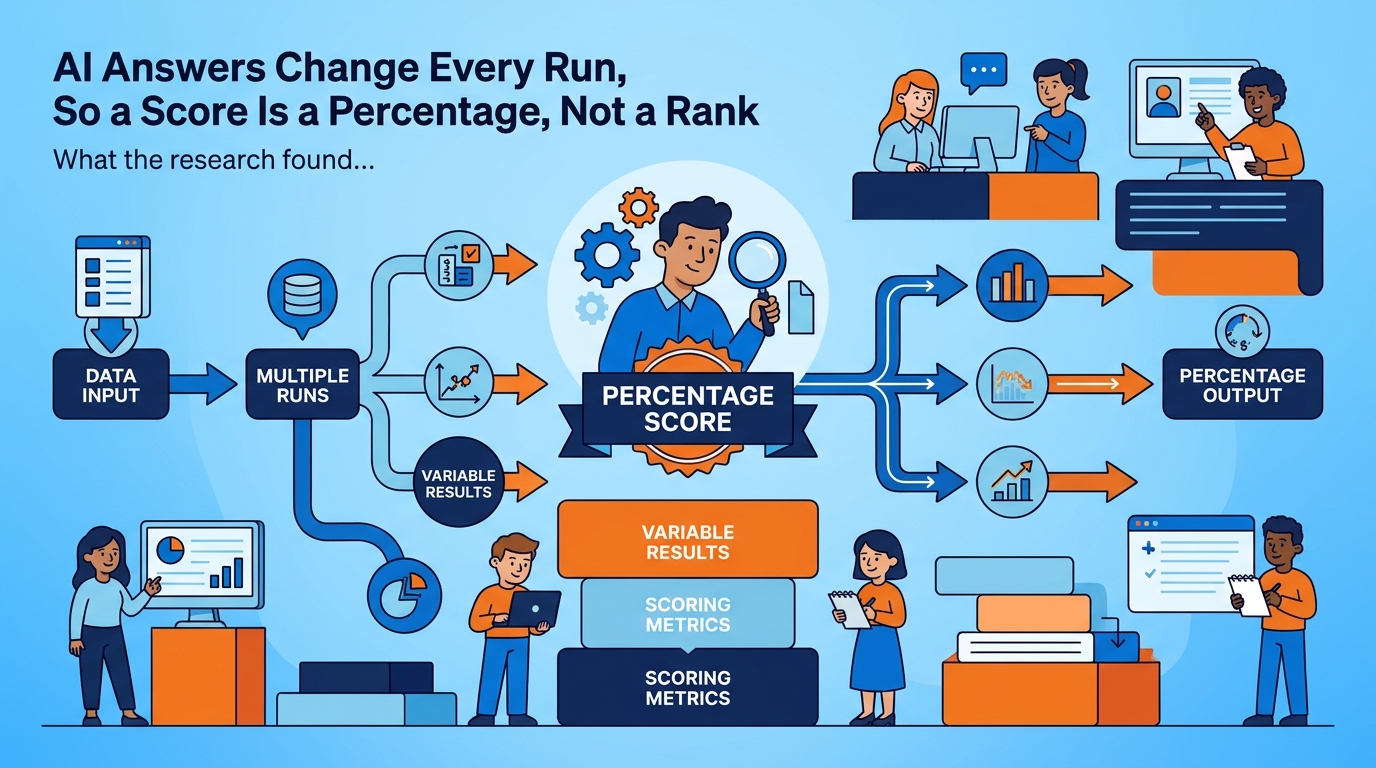
Here’s what the research found.
Ask an AI the same question many times. The list of brands rarely repeats.
SparkToro put numbers on it. There’s a <1 in 100 chance (less than one in a hundred) that ChatGPT or Google’s AI, if asked 100X, will give you the same list of brands in any two responses.
That’s just the same list. Order not included.
For two lists in the same order? More like 1 in 1,000 runs.
Overall, the semantic similarity of the prompts in the study was 0.081.
SparkToro’s author changed his mind.
He was swayed from his initial position. He now believes visibility % across dozens to hundreds of prompts, run multiple times, is a reasonable metric.
But any tool that gives a “ranking position in AI” is full of baloney, he writes.
Measuring that percent visibility is (probably) a reasonable way to know how prominent or invisible your entity is within the AI’s consideration set.
I stopped using position-tracking as a success measure. That happened once AI tools began giving direct answers instead of lists of links.
A rank report can look good and still not tell me if a practice gets found.
So I score a practice by its share across runs. Never by a spot on a list.
A low rating can also be misread.
Common Misreadings of a Low Diagnostic Rating, Corrected covers those.
The study behind these numbers is SparkToro’s NEW Research: AIs are Highly Inconsistent When Recommending Brands or Products.
How Many Runs It Takes Before a Score Means Something
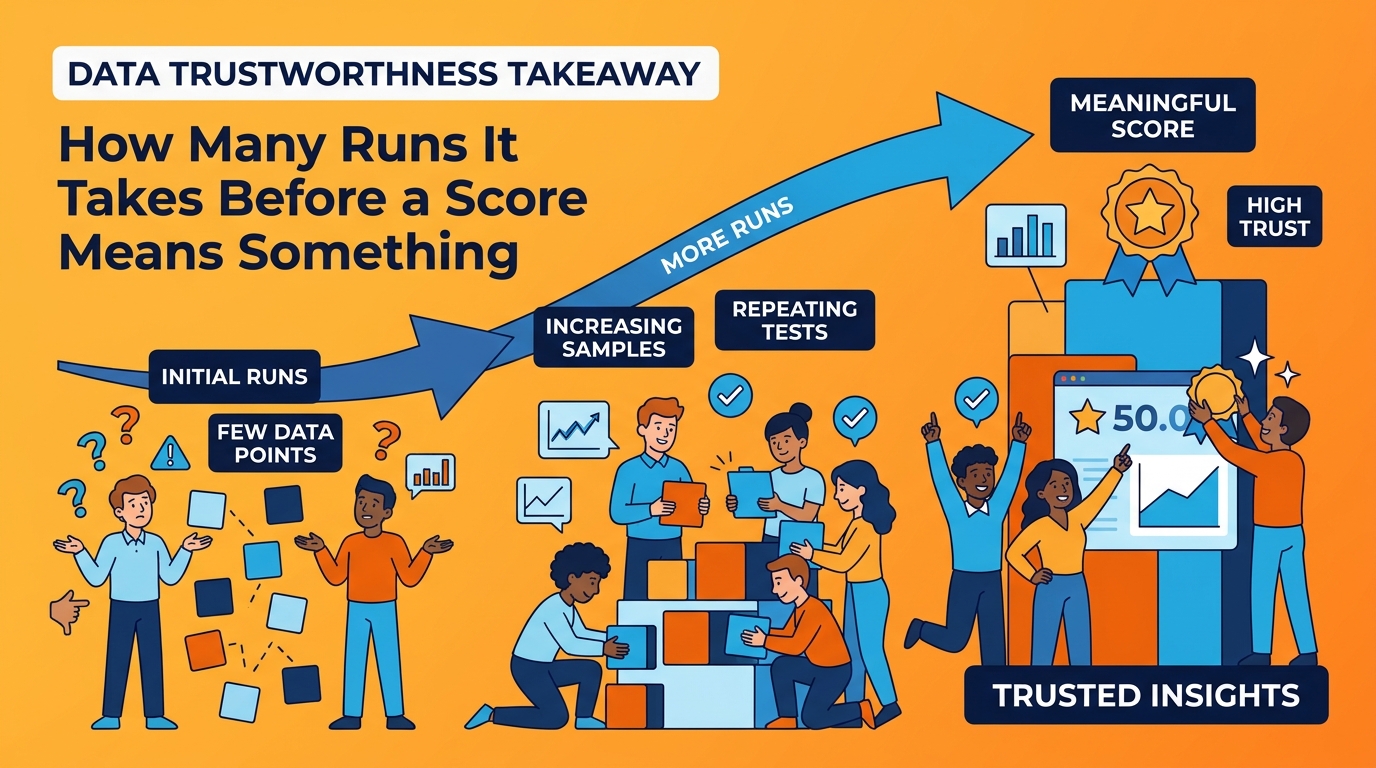
Here’s SparkToro’s takeaway on trustworthiness.
If you really want to know an AI’s set of recommendations, you need to ask over and over again. Usually at least 60-100X. Then average these out.
How the study was run:
- SparkToro reports that 600 volunteers ran 12 different prompts through each of the 3 tools. Combined, that’s nearly 3,000 runs (2,961).
- Search Engine Journal reports that the team ran nearly 3,000 prompts (2,961) across ChatGPT, Claude, and Google Search AI Overviews. AI Mode filled in when Overviews didn’t appear. Hundreds of volunteers, over November and December.
- Survey respondents used their normal AI tool settings. No standardization. The authors said that was intentional, to capture real-world variation.
Some things are still not settled.
The authors left open two questions. How many prompt runs does it take to get reliable visibility data? And do API calls yield the same variation as manual prompts?
One more thing. The report is not peer-reviewed academic research.
The Search Engine Journal write-up is AI Recommendations Change With Nearly Every Query: Sparktoro.
What a Normal Score Looks Like Depends on the Category
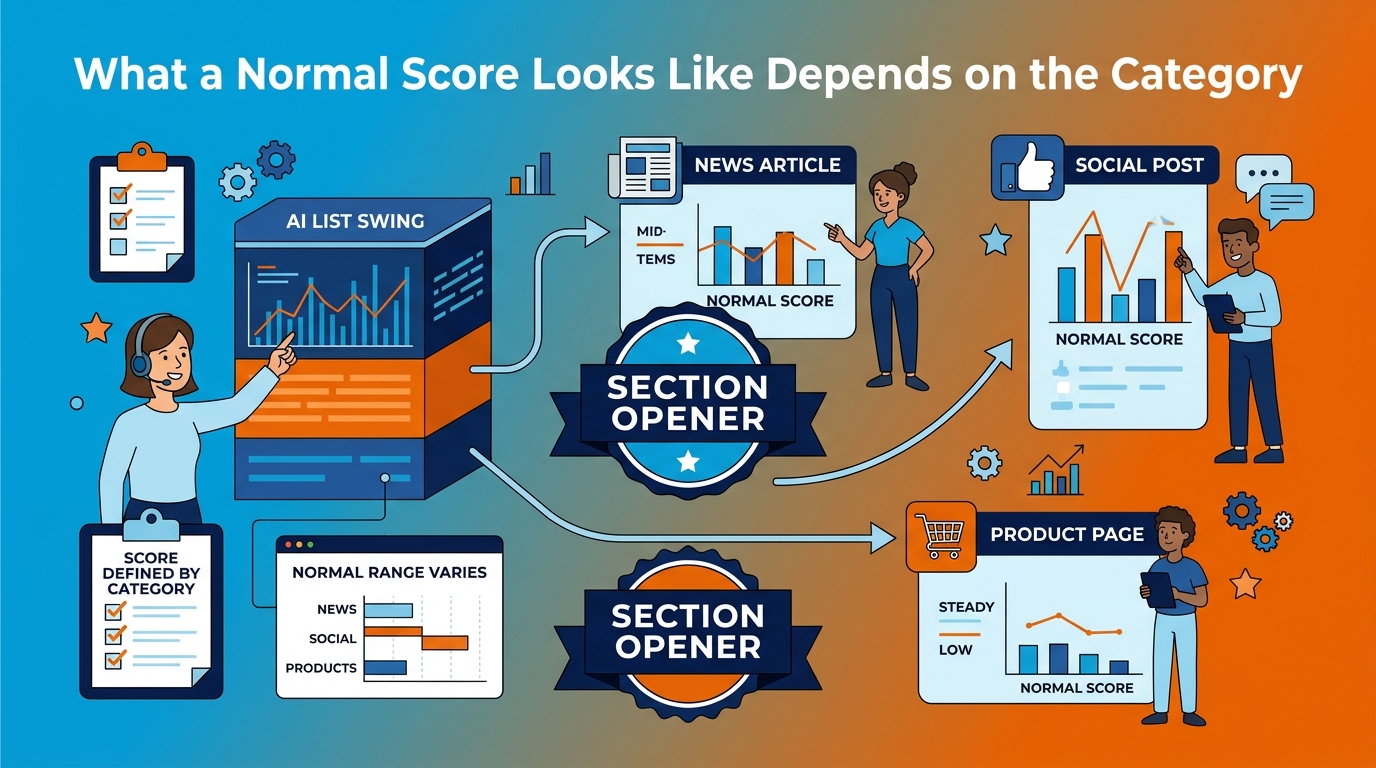
SparkToro saw the number of items on the AI’s list swing.
Sometimes the AI gave as few as 2-3 recommendations. Equally often, 10 or more.
Its further data points to something else.
How often a brand shows up in a topic-space may have much less to do with its relative prominence in that space. Or even the model itself.
It may have more to do with how many potential recommendations the AI is choosing from.
The examples from the study:
- Across 994 AI responses, headphones like Bose, Sony, Sennheiser, and Apple showed up 55-77% of the time.
- The top brands often had 90-100% visibility, while the brand design agencies prompt produced high numbers in the 30%s-40%s.
- In ChatGPT’s results, City of Hope hospital in Los Angeles showed up in 69/71 answers, a 97% visibility rate. Yet in the “rankings” of which hospitals ChatGPT showed, it was the top mention in only 25 responses.
The table below lines up those findings.
| Category type | Example finding | What it means for reading a score |
|---|---|---|
| Prompts led by top brands | Top brands often had 90-100% visibility | A share near 100% is possible for top brands |
| Brand design agencies prompt | High numbers in the 30%s-40%s | The highest shares sat in the 30%s-40%s |
| Headphone brands | Bose, Sony, Sennheiser and Apple showed up 55-77% of the time across 994 responses | These named brands sat between 55% and 77% |
| Hospitals in ChatGPT (City of Hope, Los Angeles) | In 69/71 answers (97% visibility), top mention in only 25 responses | Appearing in an answer and being the top mention are counted differently |
Want to turn a share into a risk level? Read Reading the Omission Rating: High, Medium, or Low Risk?
AI Answers Now Appear on Most Local Searches
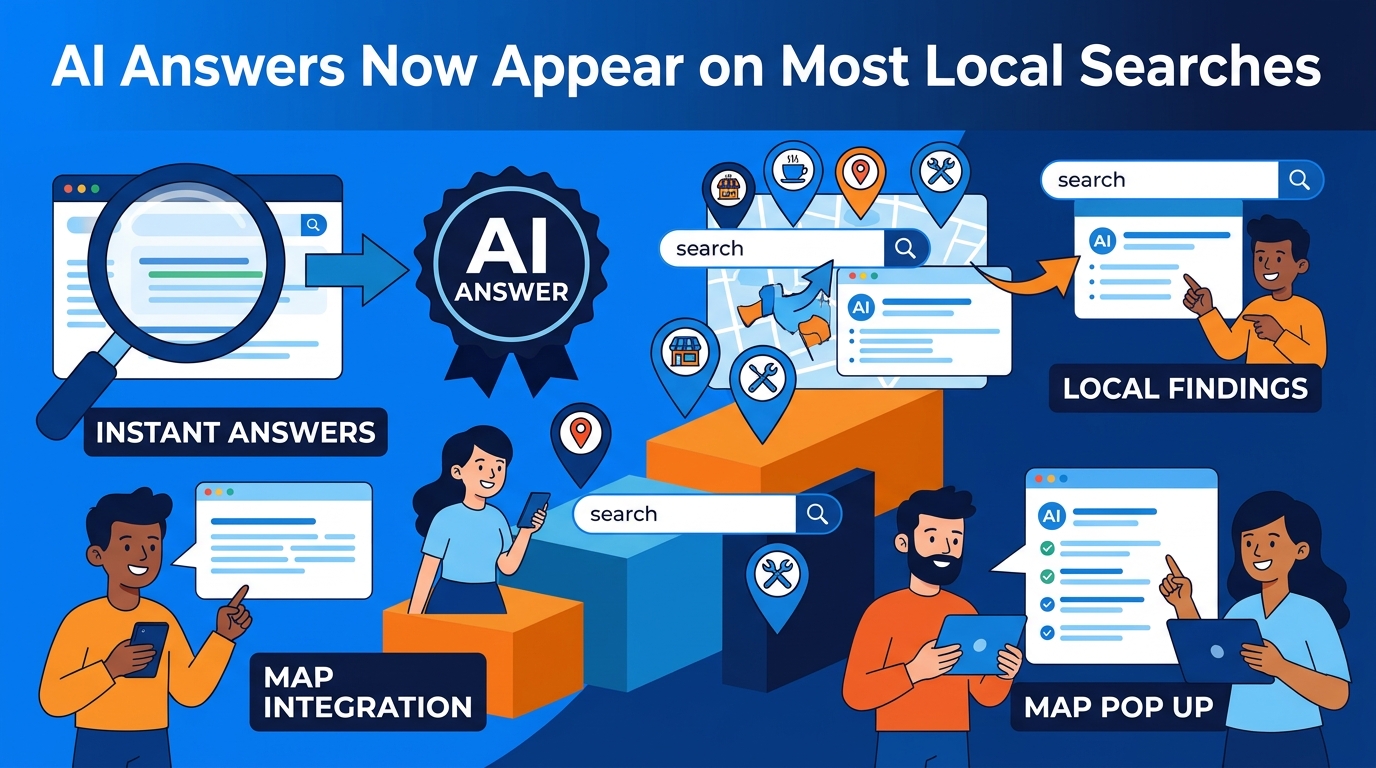
Here’s the Whitespark finding.
AI Overviews appear for about two-thirds (68%) of local searches.
Local packs? Not even four in ten (39%) of the same queries.
The rate changes with the kind of question:
- Informational queries like [how long does an eye exam take near me] trigger AI Overviews 92% of the time, according to Whitespark.
- Hybrid intent searches like [average cost of dental implants in Phoenix] hit 97%, according to Whitespark.
- “Price, cost, and buy” queries trigger AI Overviews more than 80% of the time, and most local businesses refuse to answer them.
The table below lines up those rates.
The local-pack row is the 39% figure. Same queries as the 68% figure.
| Query type | AI Overview appearance rate |
|---|---|
| All local searches | 68% of local searches |
| Informational local queries | 92% of the time |
| Hybrid-intent searches | 97% |
| Price, cost and buy queries | More than 80% of the time |
| Local pack, for comparison | Local packs: only 39% of the same queries |
Search Engine Journal puts it bluntly:
“we’re seeing businesses rank well in the traditional local pack while being completely invisible in AI-generated answers for the exact same queries.”
What does a gap like that mean for patient volume? What an Omission Rating Really Says About Lost Patient Volume covers it.
The source article is AI Overviews Now Answer Most Local Searches.
The diagnostic itself is described on the AI Visibility Check page.
What Google Says Its AI Features Read and Require
Here’s the rule.
To be shown as a supporting link in AI Overviews or AI Mode, your page has to be indexed. It also has to be eligible to appear in Google Search with a snippet. Google says it must fulfill the Search technical requirements.
Google’s guide to generative AI features says the same. To be eligible in generative AI features on Google Search, a page must be indexed and eligible to be shown with a snippet. Search technical requirements met.
Google names two ways these features work:
- Retrieval-augmented generation (RAG). Also known as grounding. It improves the quality, accuracy, and freshness of AI responses. How? It leans on Google’s core Search ranking systems to pull relevant, up-to-date web pages from its Search index.
- Query fan-out. The model fires off a set of concurrent, related queries. It asks for more information and fetches additional relevant search results to address the user’s query.
On markup, here’s what Google says:
- Structured data isn’t required for generative AI search. There’s no special schema.org markup you need to add. Google still says keep using it. It helps with being eligible for rich results on Google Search.
- You don’t need new machine readable files, AI text files, markup, or Markdown to appear in Google Search. That includes its generative AI capabilities. Google Search itself doesn’t use them.
Google also says the best practices for traditional search optimization still matter.
Why? Its generative AI features on Google Search are rooted in its core Search ranking and quality systems.
Where appropriate, generative AI responses can include product listings, product information, and information about local businesses.
I don’t chase publishing volume.
I build clear, factual pages in a sensible order that an AI can grasp easily. Give me a few of those over a big pile of posts any day.
If a page fails those basics, start with The Three Technical Breaks to Repair First After a Low Rating.
Google’s own page is Optimizing your website for generative AI features on Google Search.
Where AI Citations Come From, and What Gets a Page Cited
Here’s what most people miss.
Omniscient Digital’s research analyzed 23,000+ citations. Owned content accounts for only about a quarter (about 23%) of citations in branded queries.
The other 77% comes from off-page sources. More than three-quarters of it.
Other studies name the domains that get cited:
- Averi.ai’s research shows Reddit is the most-cited source in Google AI Overviews. About one in five (21%) of all citations. YouTube is close behind at nearly a fifth (18.8%).
- In a study published on arXiv, YouTube was the most frequently cited domain. It beat established health authorities such as Mayo Clinic, the CDC, and the WHO.
Two analyses looked at which content gets cited:
- Kevin Indig’s analysis of 1.2 million ChatGPT responses found that more than four in ten (44.2%) of citations come from the first 30% of page content.
- Ahrefs’ analysis of 17 million AI citations found that, on average, AI-cited content is about a quarter (25.7%) fresher than traditionally ranked content.
I treat getting picked by AI answer tools as its own discipline. Not classic search work with a new name.
So I don’t chase keywords, inbound links, or ranking position.
I work on the premise that these systems are figuring out who a business is and whether it’s credible. I put the effort into making that easy for them.
I’d rather a practice be the source an AI names and draws on when it answers.
Not one more name in a directory.
Stale and Mismatched Listings: What to Keep Identical
Here’s what went wrong in SparkToro’s project.
The AI tools recommended a good number of inactive social influencers. No-longer-in-existence TikTok accounts. Defunct Seattle luxury real estate offices.
Search Engine Journal gives the rule for listings.
Make sure your business name, address, phone number, service categories, and business description are identical everywhere they appear.
Yelp. Google. Bing. Apple Maps. Industry-specific directories. Every node in your digital presence needs to say the same thing.
Audit these quarterly.
I put a practice’s effort and money into its own listing details before any paid placement.
Why? Those details are an asset the practice controls. They keep paying off.
Visibility bought through ads stops the moment the spending stops.
Next steps are in Turning a Diagnostic Report Into a Repair Roadmap and A Prioritized Repair Order for Schema, Listings, and Content Gaps.
Tracking AI Feature Visibility in Search Console
Here’s the good news.
Google says sites appearing in AI features (such as AI Overviews and AI Mode) are included in the overall search site visits in Search Console. Just like the rest of the search results page.
Two reports apply:
- Search performance report. It shows how many site visits you’re getting from Google Search. Breakdowns by queries, pages, and countries.
- Generative AI performance report. Google says to use it to measure how your content is performing in generative AI features on Google Search and Discover.
Google’s announcement says the new insights include impressions metrics. They also show which pages appear in AI responses and in what countries.
As of August 31, 2026, Google says it has rolled out these features to all websites worldwide.
How long a change takes to register is covered in Why Your Rating Won’t Improve Overnight: The Refresh Cycle Explained.
Google’s announcement is New opportunities, control and insights for website owners.
Frequently Asked Questions
Do AI Overviews show up for every search?
No. Google says AI Overviews only show when its systems decide they’re additive to classic Search. So they often don’t trigger.
One study found overall AIO activation is about one in seven (13.7%). For question-form queries, it climbs to nearly two-thirds (64.7%). Politically sensitive topics see markedly lower rates.
Another study found AIOs are generated for just over half (51.5%) of representative, real-user queries. They’re displayed above the organic search results.
Can a practice opt out of Google’s AI features?
Yes. Google says sites that opt out won’t receive site visits or impressions from its generative AI features.
But Google also says this control won’t be used as a ranking signal. Not for search results outside those generative AI Search features.
Do Google’s AI Mode and AI Overviews cite the same sources?
Mostly no. In December, Ahrefs published data on this.
Google’s AI Mode and AI Overviews cite different sources nearly nine times out of ten (87%) for the same query.
Can one business show up in nearly every AI answer for a prompt?
Yes. Google’s AI was asked to recommend online promotion consultants with expertise in e-commerce.
The Smartsites agency appeared in 85 out of the 95 responses.
Read the Score as a Share, Then Fix the Weakest Areas
Read a score as a share across many runs. Set it against what’s normal for its category.
Then act on the weakest areas first.
I’d never pick who acts on a diagnostic by the lowest monthly price.
In my experience, those low-priced agency deals cost more in the end. Thin work. Little real progress. Money tied up in a contract that builds nothing.
I don’t sell the old search playbook. I steer owners away from offers built for a results page that’s gone.
And here’s the thing. That’s a problem with what the industry sells. Not with the practice owner who bought it.
I’m Gerek Allen, Founder of iTech Valet.
After 20+ years of entrepreneurial experience and building over 100 digital properties, I discovered my own business was invisible to AI search engines.
That led me to create iTech Valet’s proprietary AI Authority System. It’s a data-first methodology that makes service-based businesses the recommended answer in ChatGPT, Gemini, and Grok.
We work with established, service-based businesses. Primarily chiropractors, but also dentists, attorneys, home service companies, coaches, consultants, and other service providers.
How the work is done is laid out on the iTech Valet Service Plans & Pricing page.
The AI Visibility Check is free. It’s diagnostic. It does not sell.