
Why AI Engines Guess When You Only Tell Them What You Are
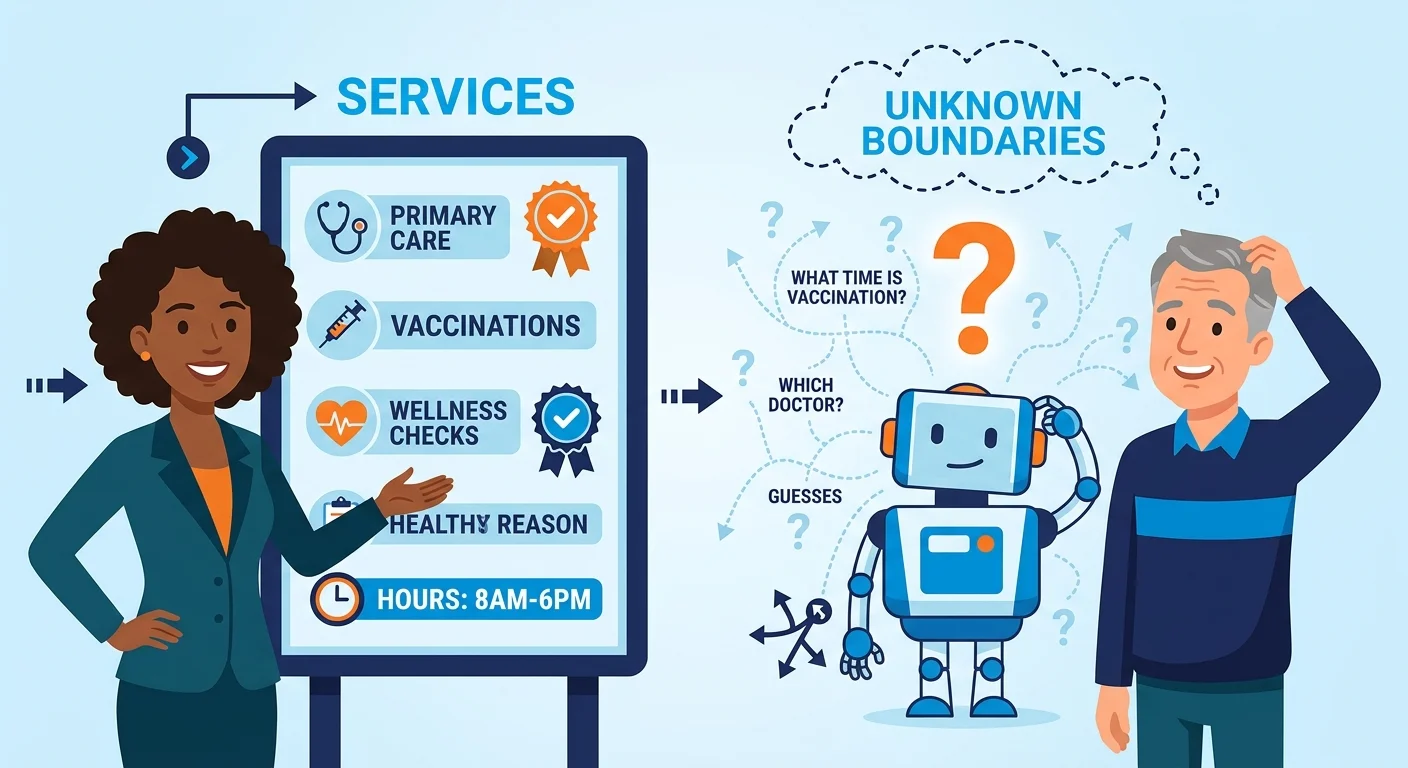
Most businesses build their whole digital presence on positive-only signaling. They spell out what they treat, what they offer, who they serve. Nothing spells out what falls outside that scope.
That habit leaves a dangerous ambiguity gap. Most businesses only ever signal what they are and what they do, never the edges of what they're not. So the AI fills that gap with its own assumption, and you don't get a vote in what it decides.
That's exactly the mess covered in what standalone AEO content boundaries actually protect against, where the same ambiguity gap spreads across a whole content library instead of one lonely service page. A practice can publish dozens of pages showing off its expertise and still leave every AI system guessing about its limits.
In AI-driven search, clarity is the most valuable thing you own. Not more content, not more keyword-targeted articles. Knowing where a practice's scope ends is what separates an entity AI cites confidently from one it cites with caution.
The Ambiguity Gap Most Practices Never Notice
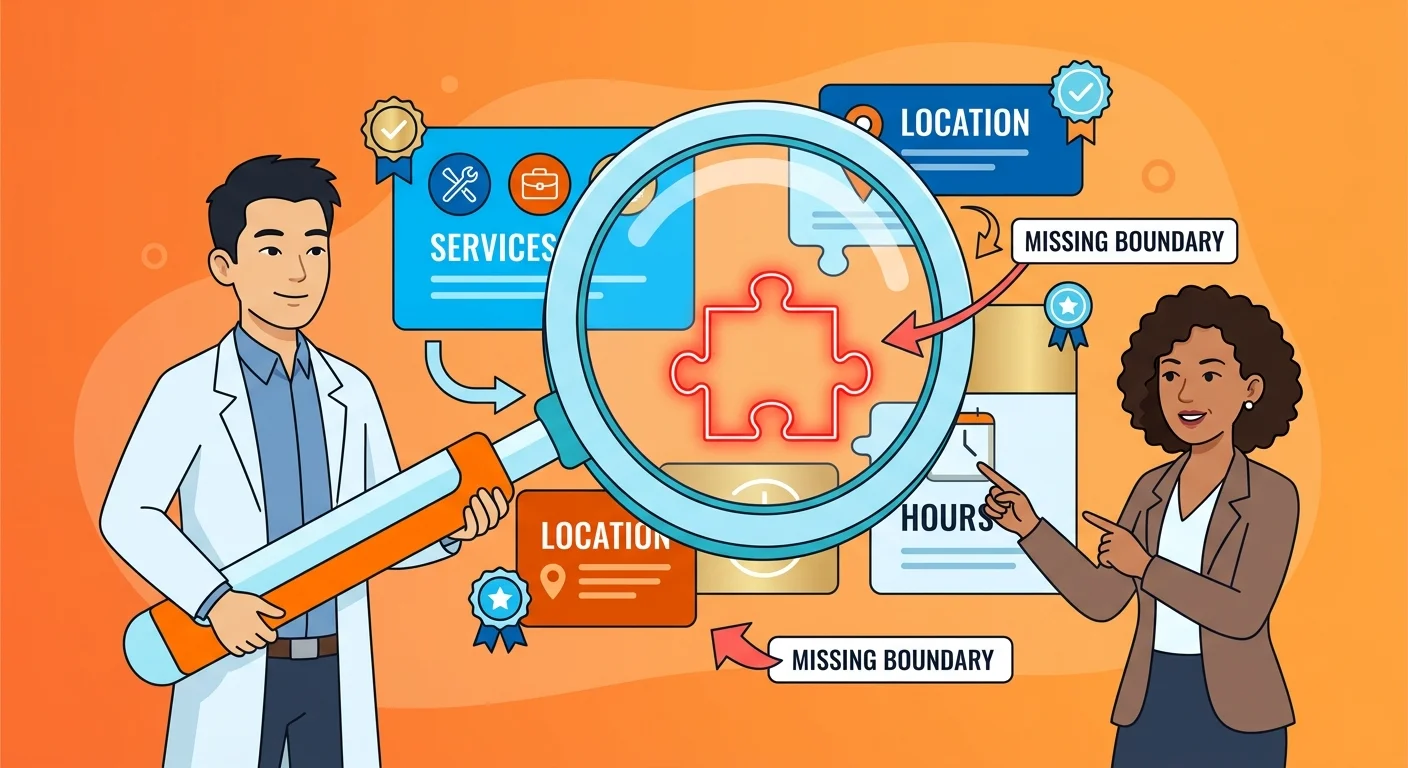
A negative boundary is just you saying, plainly, what your entity is not. What services you don't offer. What conditions you don't treat.
Sounds too simple to matter, right? That's exactly why most practices skip it, and exactly why the ambiguity gap keeps opening up, page after page.
Why Positive-Only Signaling Fails at Scale
Positive-only signaling is the industry default. And it falls apart the second scale walks in the door.
One page describing what a practice treats? Manageable. Ten pages doing the same thing, with not one of them ever saying what it doesn't do, multiplies the same gap ten times over.
Every extra page piles on more positive signal without ever closing the boundary. So the entity gets wider and wider, and never gets a sharp edge.
That's the same structural weakness that shows up when a practice tries to nail down accurate citations across a whole site instead of a single page, the exact challenge dug into in how clinic owners can lock in reliable AI citations across their existing platform.
A library of unbounded pages doesn't read as thorough to an AI. It reads as unresolved. And unresolved entities get cited with caution, or they don't get cited at all.
How AI Systems Actually Build Trust in an Entity
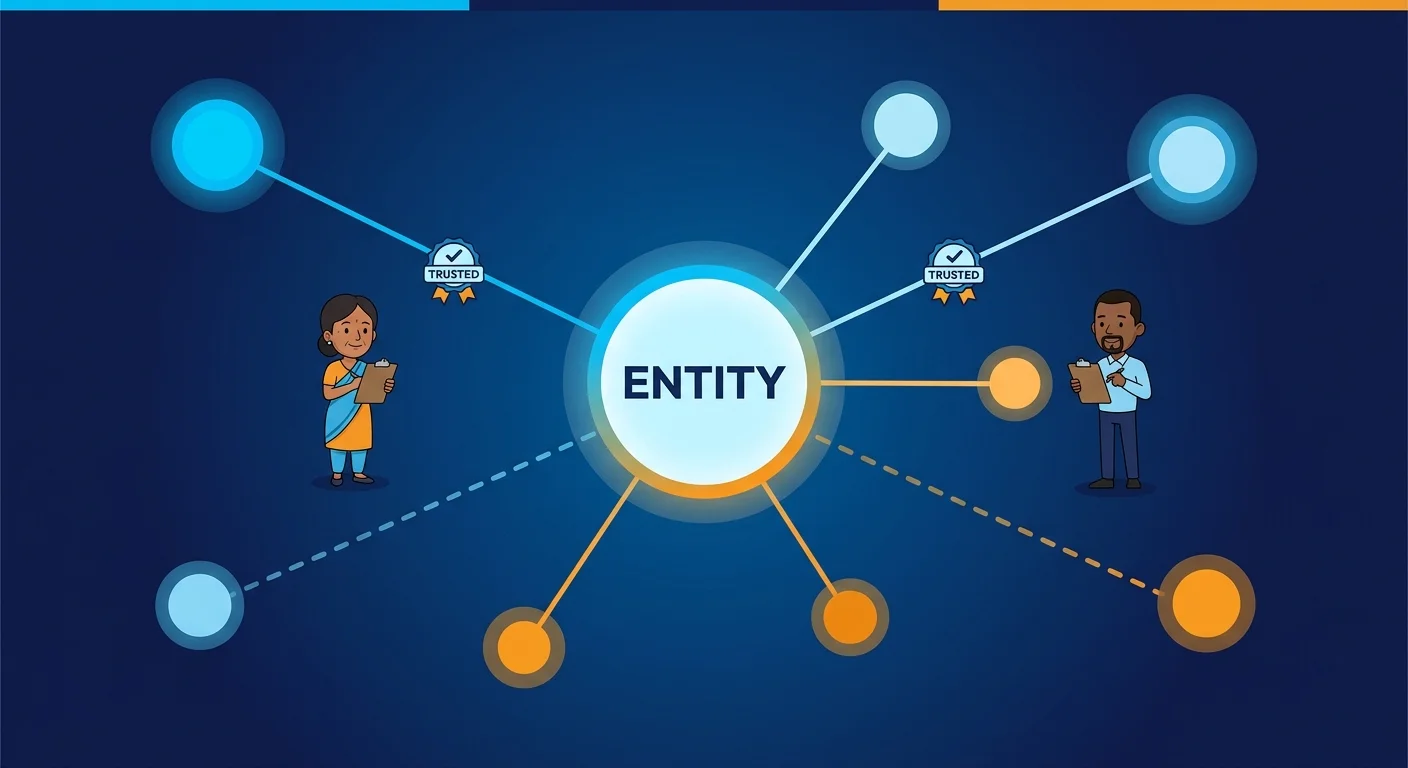
Here's the thing: an AI doesn't read your homepage the way a person does. It reads your business as an entity, a single node with defined attributes, dropped into a giant graph packed with other entities.
And trust in that graph isn't won with slick copy. It's won with facts the system can actually resolve, and every attribute left hanging is one more little crack in that resolution.
| System Type | What It Relies On | Effect of Clear Boundaries | Effect of Ambiguity |
|---|---|---|---|
| Knowledge Graph Systems | Bounded attributes tied to a single defined node | The node reads as fully resolved, so the graph can cite it with confidence | Soft edges force the graph to describe what an entity connects to without ever confirming where it stops |
| Retrieval Ranking Systems | Clear semantic context around each query and its match | A precise scope narrows retrieval to the exact content that answers the query | Multi-part or unclear queries push the system to guess, degrading precision and recall |
| E-E-A-T Weighting Systems | Signals that resolve rather than merely describe expertise | Fully specified scope earns heavier weighting on sensitive health and safety topics | An unresolved scope on a sensitive topic is judged more harshly, not neutrally |
| Generative Answer Engines | A complete picture of what an entity is and is not | A fenced entity can be cited directly, with no need for a follow-up click to verify | An unfenced entity forces the engine to infer, and that inference becomes the citation |
Entities, Nodes, and Why Google's Knowledge Graph Cares About Boundaries
Google's Knowledge Graph holds millions of entries mapping real-world people, places, and things, and each one works as a node the system can query without flinching. Your business earns trust in that graph the same way any node does: attributes spelled out in full, not half-implied.
An entity carrying only positive attributes is a node with soft, blurry edges. The graph can tell you what it connects to, but it can't tell you where those connections stop, and that's exactly the boundary an what happens when AI citations go wrong for local service providers shows off when systems run on assumption instead of fact.
This isn't some clever workaround, either. It mirrors how the Google Knowledge Graph Search API is built in the first place, around defined, bounded attributes rather than open-ended description. Entity Fencing just applies that same bounded logic to a practice's own service scope, so the node reads as resolved instead of half-finished.
What Happens When Retrieval Systems Can't Tell What You Don't Do
Retrieval systems hit a related but separate wall. When a query is ambiguous, the system has to guess which slice of your content actually answers it.
Ambiguous queries in semantic search can wreck the precision of retrieval-augmented generation systems that lean on clear context to work. A query poking at several facts at once can also make a retrieval ranking system miss part of what it needed, a breakdown documented in the arXiv preprint server's work on semantic retrieval failure.
A practice with zero stated boundaries hands the retrieval system exactly that kind of ambiguous query, every single time. And Google's automated ranking systems lean even harder on strong E-E-A-T for anything touching health, money, safety, or societal well-being, so an unresolved medical scope gets judged more harshly, not less. Nowhere does that cost sting like it does in searches shaped by Google's AI Overviews, which cut click-through rates by nearly 60% when they show up, leaving a business almost no room to fix a bad guess after the fact.
Who Entity Fencing Is Not Built For

Let's be straight: Entity Fencing isn't for the practice chasing every search query it can possibly reach.
It's not for a business trying to look relevant to anyone who might click, or one stretching its scope wider just to pull in more site visits at the cost of accuracy.
If you want an AI system to guess generously on your behalf, expanding your apparent scope beyond what you actually deliver, this approach will work against you.
Entity Fencing narrows the story on purpose. It trades reach for resolution, and that trade only makes sense for a practice willing to be cited correctly rather than cited broadly.
Entity Fencing isn't about swatting away site visits you don't want. It's about building a precise, trustworthy digital twin of your practice that AI can cite with confidence. A practice still chasing volume over accuracy will read this boundary work as friction, not authority.
Putting Negative Boundaries to Work: The Practical Mechanics
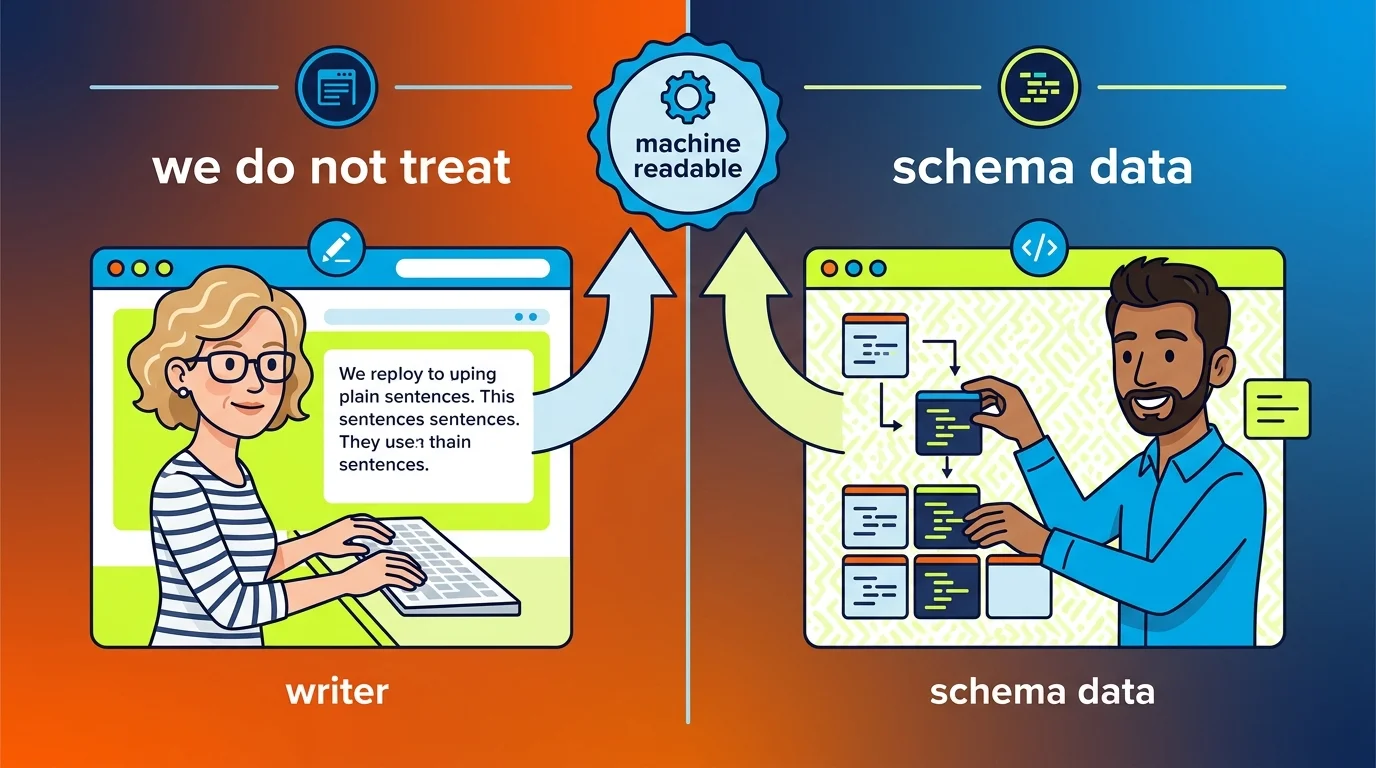
Qualification is the mindset. Implementation is where an AI system finally sees it.
Entity Fencing runs on two mechanisms: plain-language statements a reader grabs in seconds, and structured markup a machine parses without guessing. You need both. One talks to people, and the other talks straight to the systems doing the citing.
| Implementation Method | Where It Lives | Best Used For |
|---|---|---|
| Plain-language scope statement | Services pages, about page, conditions pages | Reassuring a human reader while giving an AI system a readable, unambiguous sentence to extract |
| Structured schema markup declaring scope | Backend page markup invisible to the visitor but readable by crawlers | Giving AI systems a machine-parseable fact rather than an inferred pattern |
| Combined plain-language and schema declaration | Any page describing a treated condition or offered service | Practices ready to trade broad apparent relevance for a sharply resolved entity |
| Boundary review as part of standard content updates | Ongoing editorial process across the existing content library | Practices adding new pages or services that could otherwise reopen the ambiguity gap |
| Component | Function | Source Reference |
|---|---|---|
| Plain-Language Boundary Statement | Declares in ordinary sentences what a practice does not treat, does not offer, or does not serve, so a reader and a scanning system both register the scope | factClaim_08 |
| Structured Schema Boundary Markup | Gives an AI system a machine-readable candidate list of what a service is and is not, rather than a single ambiguous label | factClaim_06 |
| True-Negative Framing Over Inferred Framing | Mirrors the finding that similarity-based negative sampling improves results but still trails models built on explicitly identified true negatives, reinforcing why a declared boundary outperforms a guessed one | factClaim_01 |
Writing Negative Boundaries Into Plain-Language Content
Plain-language boundaries live on the pages a person actually reads. A services page, an about page, a conditions page — each one can carry a short, direct statement of scope.
The earlier definition still holds: a stated boundary is you saying plainly what a practice doesn't treat, doesn't offer, doesn't serve. Write that into ordinary sentences instead of burying it in fine print, and a system scanning for meaning can actually use it.
This isn't a legal disclaimer tucked in a footer. It's a visible, readable sentence sitting right next to what the practice does treat, so the contrast is impossible to miss.
Structuring Negative Boundaries in Schema Markup
Plain language earns trust with a person. Schema markup earns trust with the machine reading the page underneath it.
Medical entity linking pipelines make a handy parallel here. These systems pull a list of candidate concepts from standardized vocabularies, then pick the best one based on surrounding context, a two-stage process documented in research indexed through PubMed Central. Your schema markup does a smaller version of that same job, handing an AI system a candidate list of what a service is and isn't, instead of one ambiguous label.
Genomic research on negative sampling hands us a second, weirder parallel. Predicting transcription factor binding sites, sampling negatives by how close they sat to known positives beat every other technique tested, though it still trailed models built on high-quality datasets with true negatives pinned down from the start, a finding detailed in work archived by PMC.
The lesson transfers straight over. A boundary loosely inferred from context will always lose to a boundary you flat-out declare. Entity Fencing baked into schema markup is the true-negative version of that logic, handing an AI system a fact to cite instead of a pattern to guess at.
Frequently Asked Questions
Once a practice actually starts fencing its scope, a few real questions pop up. Here's the mechanics first, then the objections that always follow.
How does defining what my clinic doesn't treat actually improve its online visibility?
A stated boundary kills the guesswork an AI system would otherwise do on its own. Instead of inferring your scope from silence, it cites a fact you handed it.
Is it better to list non-treated conditions on my website or just leave them off entirely?
List them. Leaving them off just rebuilds the exact ambiguity gap this whole approach exists to close.
Can AI get confused and make mistakes if I only talk about the conditions I do treat?
Yes, and that's the core risk of positive-only signaling. An AI system with no stated boundary fills the gap with an assumption, and sometimes that assumption is flat-out wrong.
What is the difference between defining a negative boundary and using negative keywords in an ad campaign?
Negative keywords just filter which ad queries trigger a paid placement. A stated boundary defines your entity's real scope for an AI system building a citation, which is a permanent structural signal, not a campaign setting.
Will stating what I don't do make my practice seem less capable or scare away potential clients?
A clearly bounded practice reads as more resolved, not less capable. Vagueness is what erodes trust here, not precision.
How can I use my website's schema markup to define these negative boundaries for Google?
Structured data lets a practice declare its service scope in a format a machine parses without interpreting. That candidate-and-context style matching mirrors how medical entity linking systems resolve meaning, handing your boundary a fact to cite instead of a pattern to infer.
How often should I review and update the negative boundaries I've defined for my business?
Review your boundaries whenever services change or a new condition enters the scope of care. An outdated boundary just reintroduces the same ambiguity the fence was built to remove.
Where This Leaves Your Entity Trust
A fence with no boundary line just tells you where the land might be. A fence with a marked perimeter tells everyone exactly where the property starts and stops.
That's the whole gap between a practice hoping AI guesses its scope right and a practice that stated its scope outright.
Entity Fencing closes that gap. It hands an AI system a fact to cite instead of a pattern to guess at.
A fully fenced entity isn't a smaller one. It's the entity AI engines trust enough to cite without hesitation.
This was never about deflecting traffic you don't want. It's about building a trustworthy digital twin of your practice, edges included, that AI can cite with confidence.
In AI-driven search, absolute clarity earns that confidence. iTech Valet's AI Visibility Check shows you where your entity's edges sit undefined, before an AI system fills them for you.