
What Actually Separates Schema-First Content From a Generic AI Authority Article?
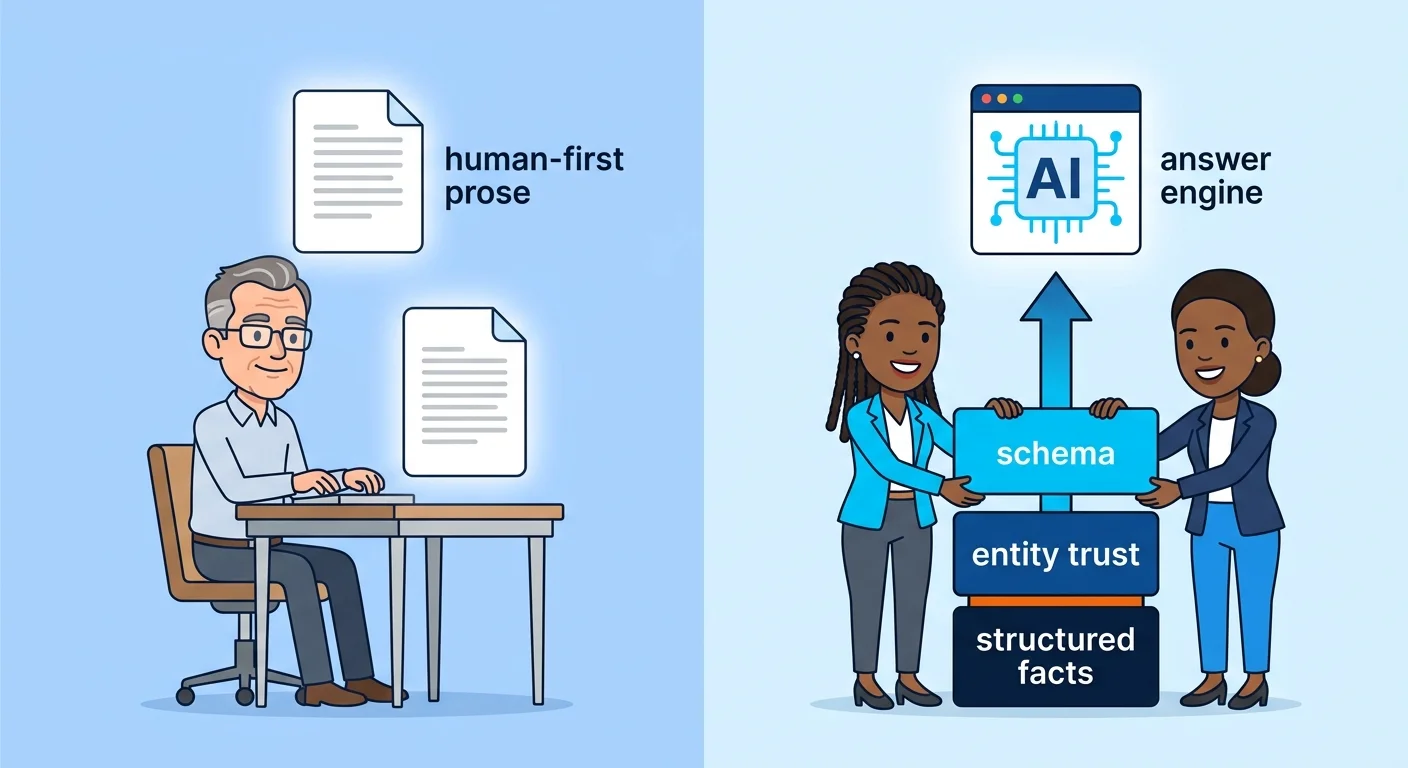
Here's the real split: these are two different products wearing the same format. One's built for a machine reader. The other's built for a human skimmer and hopes the machine tolerates it.
A schema-first article starts with the structured data. It names the entity, the service, the credentials, and the facts in machine-readable properties before a single paragraph gets written.
A generic AI authority article starts with a topic and a word count. Someone writes flowing, human-friendly paragraphs, then bolts a schema tag onto the finished piece like an afterthought.
So the difference isn't polish. It's architecture. One treats the answer engine as the primary reader; the other treats it as a formality after the humans are served.
The Two Content Models Defined
Think of it as testimony versus a notarized document. Generic prose is testimony an AI has to interpret, weigh, and decide whether to trust before it'll cite a single claim.
Schema-first content is the notarized version. The facts are declared, not implied, so the answer engine just accepts them. That's the entire mechanical difference between the two.
Why the Distinction Matters Now
This distinction didn't matter much back when a human was the only one reading your page. Now it does. Because the primary reader of your content is often not a person at all.
In the era of answer engines, the main audience for your content isn't a human reader anymore. It's the machine itself. That single shift is why so many local service sites are pumping out content that reads great and still gets ignored, which is exactly the gap outlined in what standalone AEO content boundaries actually require.
Why Most 'Authority Content' Reads Well to Humans and Says Nothing to a Machine

Here's the friction point. Most local service businesses think they're building authority every time they hit publish on another well-written article.
But readability was never the test an answer engine runs. A page can read beautifully to a person and still hand a machine nothing it can actually verify.
That's the trap. They're churning out commodity content that looks authoritative to humans and stays functionally invisible to the AI running modern search.
The Scaled Content Trap: Why More Articles Isn't the Same as More Authority
So the instinct kicks in: publish more. If one article didn't move the needle, surely ten will.
And generative tools make that instinct dead easy to act on. You can spin up dozens of human-sounding articles in an afternoon, each one flowing, each one seemingly on-topic.
Now look at what actually happens on the machine side. Volume doesn't create verifiable facts. It just creates more prose an answer engine has to interpret and still can't cite with confidence.
Google says using generative tools to spin up many pages without adding value for users may violate Google's documentation on its spam policy for scaled content abuse. That's not a warning about AI writing. It's a warning about pumping out pages that add nothing new for the reader or the machine parsing them.
So scaling generic prose just scales your exposure to that policy. It doesn't scale trust, and trust is the only currency an answer engine spends. Before adding another page to the pile, businesses should see how existing schema and new articles are meant to work together.
Who Schema-First Content Is Not For
Look, this isn't for every business, and it shouldn't pretend to be. If you want twelve keyword-targeted articles out this month and volume's your only scorecard, this model isn't your fit.
Schema-first content is slower per piece. It demands the facts get declared correctly before one sentence of prose exists, and that discipline doesn't squeeze into a batch job.
So if you're just filling a content calendar fast, look elsewhere. If you want to be the source an answer engine trusts enough to cite, this is the only model built for that.
How Answer Engines Actually Read a Local Service Page
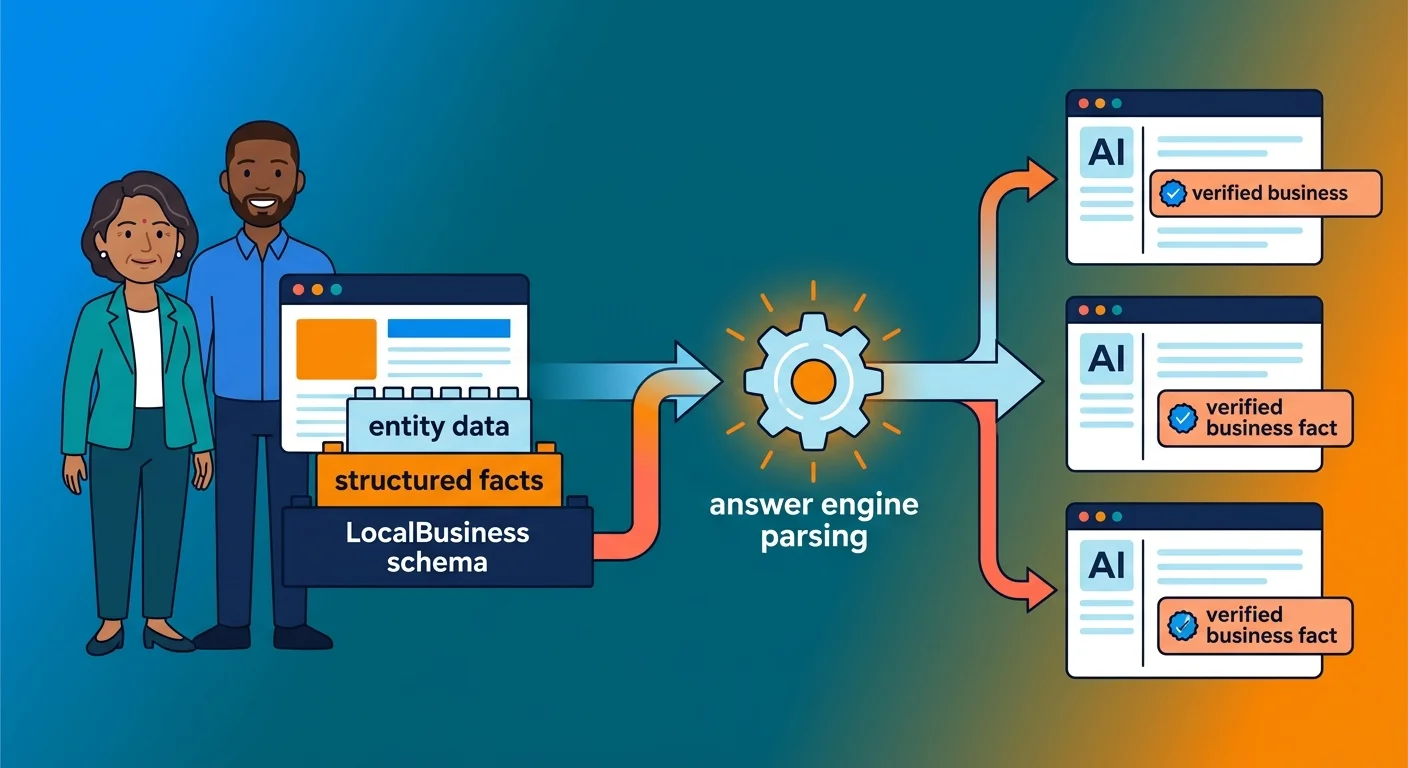
So how does an answer engine actually read a local service page? It scans for structured properties first, long before it weighs a single sentence of prose.
Here's the mechanism. The engine hunts for declared facts up front: business type, service area, credentials, named entities.
Prose comes second, and usually only to plug gaps the structured data left open. That order is the whole game, and most local service sites have it flipped.
| Content Signal | What Generic Prose Provides | What Schema-First Content Provides | Answer Engine Impact |
|---|---|---|---|
| Business Identity | Implied through phrasing and context clues an answer engine has to piece together | Declared explicitly as named entity, service area, and category properties | Answer engine accepts identity outright instead of inferring it from paragraphs |
| Credentials and Expertise | Claimed in prose the reader has to take on faith | Structured as verifiable attributes tied directly to the entity | Answer engine treats credentials as fact rather than as an unverified assertion |
| Service Area Coverage | Described loosely in sentences that may or may not match actual coverage | Declared as a specific structured property attached to the business entity | Answer engine can match local intent to a business with confidence |
| Trustworthiness Signal | Assessed by the machine through interpretation and pattern matching | Established before any interpretation happens, since the fact is already declared | Answer engine spends less effort deciding whether to cite the content |
| Content Longevity | Reads well at publication but drifts out of sync as facts change | Stays aligned with the entity's declared data as long as that data is maintained | Answer engine keeps trusting the source instead of flagging it as stale |
| Metric | Figure | What It Means for Local Service Sites |
|---|---|---|
| Zero Structured Data Markup | 45.3% | Nearly half of audited local businesses hand answer engines nothing to verify, so those sites get crawled but never surfaced in rich results. |
| Rich Results Eligibility Without Markup | 45.3% | That same share of sites can be indexed but cannot display star ratings, hours, or phone numbers directly in search results because the structured layer is missing. |
| Basis of Local Visibility Competition | Keyword position tracking to verifiable facts | Winning a local service page's placement now depends on declaring facts an AI's knowledge base can trust, not on chasing keyword-targeted phrasing. |
The Data Layer: What LocalBusiness Schema Actually Tells an Answer Engine
LocalBusiness schema is the data layer that tells an answer engine what a business is before any article tries to spell it out. It declares the name, address, service area, and category in a format the machine never has to guess at.
Now picture what happens when that layer just isn't there. Among local businesses audited across western US states, 45.3% carry zero structured data markup, which means Google can crawl and index those sites but can't display them in rich results, the enhanced listings that surface star ratings, business hours, and phone numbers right in search results, according to published research data.
That's not a small gap. A business without that declared layer is asking an answer engine to infer facts from paragraphs instead of reading them straight off a label.
Entity Trust: How Structured Facts Build the Authority Prose Cannot
Entity trust gets built differently than article authority ever did. An answer engine doesn't trust a business because its articles read well.
It trusts a business because the facts about that business line up consistently across structured properties it can verify. Prose can claim expertise. Only structured data can prove the entity exists with the attributes it says it has.
This is the shift factClaim_06 actually describes: local visibility has moved from winning keywords on a page to handing an AI verifiable facts for its knowledge base. Businesses still stuck on keyword position tracking are fighting the last war, and the gaps here compound the same way drift between old and new content does when nobody reconciles the two.
But Doesn't a Well-Written Article Still Matter for Human Readers?
But doesn't a well-written article still matter for human readers? Yeah, it does, and nobody here is arguing otherwise.
Here's the actual point. A human reader and an answer engine aren't the same audience anymore, and content built for only one of them will keep failing the other.
Building the Schema-First Content Model: The Components That Have to Be There
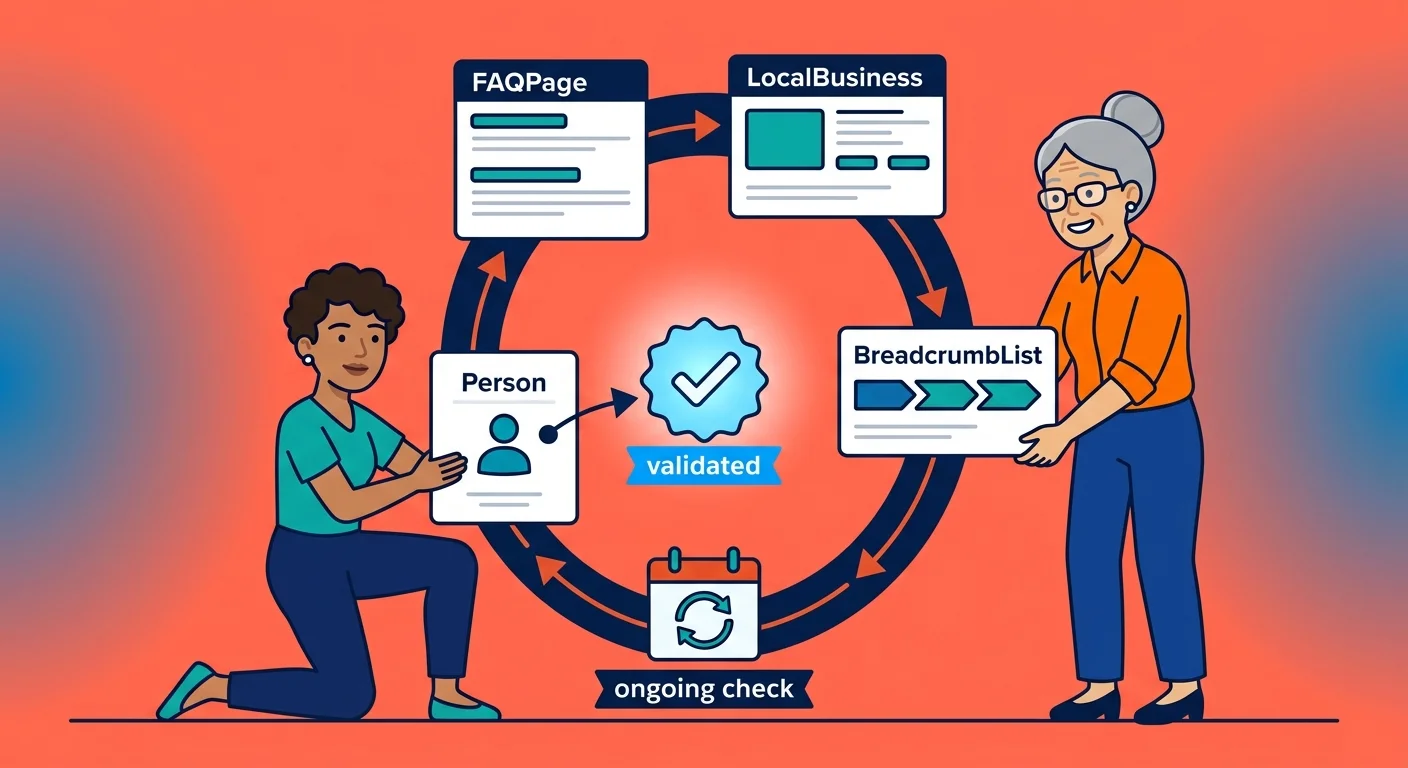
So what's actually inside a schema-first article? Not vague good intentions about structured data. Specific, declared components that hand an answer engine something concrete to parse.
Here's the build order. Entity facts get declared first, in machine-readable properties. Prose comes second, to explain and reinforce what's already declared, not to carry the facts on its own.
And that's the opposite of how most content gets made today. A generic authority article writes the story first, then hopes a schema tag bolted on afterward covers whatever the prose left fuzzy. A schema-first piece never leaves that gap open to begin with.
| Content Type | Schema Type to Apply | Primary Property to Verify | Maintenance Trigger |
|---|---|---|---|
| Service Pages | Service schema | Service name matches the exact offering described in prose, not a generic category label | New service added, service scope changes, or pricing structure shifts |
| Location and Service Area Pages | LocalBusiness schema | Service area boundaries match what the business actually covers, not an aspirational radius | Service area expands or contracts, or a new location opens |
| Staff and Credential Mentions | Person schema | Named expert's credentials and role are current and match public bio details | Staff change, new credential earned, or role change within the business |
| FAQ Sections | FAQPage schema | Every question in prose has a matching structured answer, not just a subset | FAQ content is edited, expanded, or an answer becomes outdated |
| Business Identity Details | Organization schema | Business name, address, and contact details declared in schema match the live site exactly | Business details change, or a discrepancy is found between prose and schema |
Mapping Schema Types to the Local Service Content You Already Publish
Local service content already covers specific ground: services offered, service areas, credentials, the usual FAQs. Each one maps to a specific schema type, and that mapping isn't optional decoration.
Service pages pair with Service schema. Location and coverage claims pair with LocalBusiness properties. Staff credentials and named experts pair with Person schema, which is exactly why entity boundaries matter as much as the properties themselves, a distinction covered in defining where one local entity ends and another begins.
FAQ content pairs with FAQPage schema, and here's where most sites quietly fail. They write a solid FAQ section in prose, then skip the structured markup entirely, leaving an answer engine to re-derive question-and-answer pairs it could've just read.
Validating and Maintaining the Schema Layer Over Time
Declaring the schema once isn't the finish line. Structured data drifts out of sync with the business it describes, and nobody notices until an answer engine starts citing stale facts.
And that drift matters more now than it used to. Nearly half of Google searches, 46.96% of them, ended without a single click to any website between October 2024 and 2025, according to published research data. When the answer engine is the one delivering the answer directly, the structured facts behind it have to be current, not just present.
So validation isn't a one-time setup step. It's a recurring job: confirming the markup still matches the live business, that new services get their own declared properties, that nothing on the page contradicts what the schema claims. Skip that maintenance, and the notarized document starts reading like the outdated testimony this whole model was built to replace.
Frequently Asked Questions
A handful of questions come up every single time this gets explained to a local service business. Here they are, answered straight.
What is the difference between schema-first content and just adding schema to a regular article?
Adding schema to a regular article means you write the story first, then tag it afterward and hope those tags cover whatever the prose left fuzzy. Schema-first content flips that. The facts get declared up front, and the prose comes second to reinforce what's already on the record.
How does Google Search treat content that is 100% generated by AI?
Google doesn't grade content by how it got made. It grades whether the page actually helps the person trying to find an answer.
Will my local business be penalized for using AI to write website content?
Not for using AI. You get penalized for pumping out volume that adds nothing new. That's a spam policy risk no matter who or what typed the words.
Is it more expensive to create schema-first content than a standard blog post?
It costs more time per piece, not more money. Declaring facts correctly before you write takes discipline a batch job can't fake, so the effort per piece runs higher even when the budget doesn't.
How do I know if my website's schema is implemented correctly and being used by Google?
Check that your structured data validates clean, then confirm it matches your live business details exactly. If your rich results aren't showing and your facts have drifted from what's declared, the markup isn't earning its keep yet.
Can I ignore structured data if I'm already ranking well in local map pack results?
No. A strong map pack position today won't stop an answer engine from skipping your listing entirely and building its answer from someone else's declared facts. Ranking well now and getting cited later are two different games.
The Bottom Line
Here's the bottom line. Two kinds of content are being produced right now, and only one survives contact with an answer engine. Testimony gets interpreted. A notarized document gets accepted.
Generic authority articles are testimony, no matter how well they're written. Schema-first content is the notarized document that skips the interpretation step entirely. That's the whole choice, and it isn't a close one.
So the real question isn't whether your content sounds credible to a person reading it. It's whether an answer engine can cite it without deciding to trust it first. If you want to see where your own site's facts stand right now, start with an AI visibility check.