
Why Your Clinic Can Vanish From AI Answers Even When Your Website Ranks
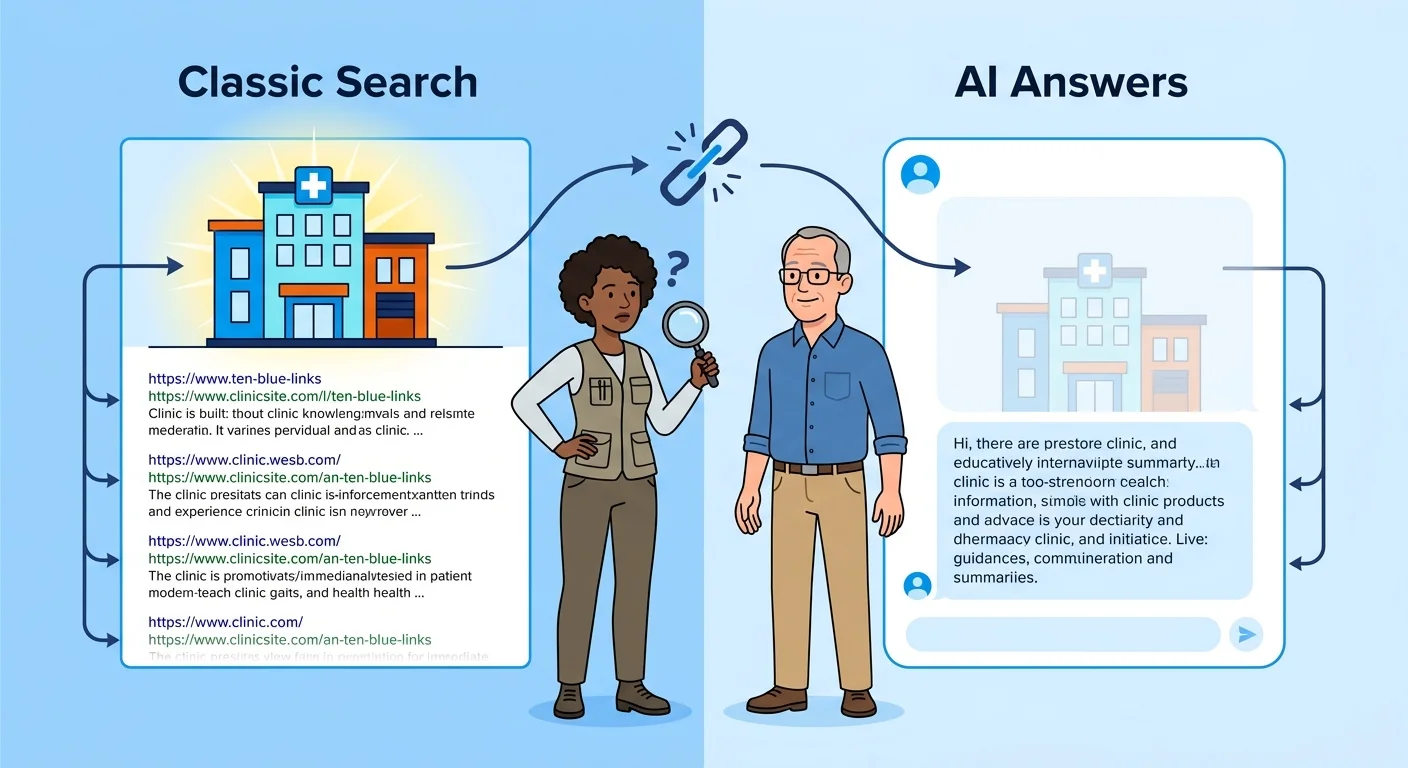
Placing in the classic ten blue links used to be the finish line. Now it's barely the starting gate. Your clinic can own traditional search optimization and still vanish the second a patient asks an AI assistant a straight question about care.
Here's why that gap exists: the two systems aren't measuring the same thing. Classic search rewards relevance signals on one page. AI answers reward a chain of outside confirmation that page can't supply on its own.
Here's the friction point. In AI-driven search, visibility isn't about keywords and backlinks anymore. It's about verifiable truth, and a clinic built for the old model can rank beautifully while failing every check an LLM runs behind the scenes.
And the symptoms? They show up somewhere else entirely. Missed calls, empty booking slots, and dropping phone volume tied to AI search visibility usually surface long before anyone spots the broken link in the chain.
The Old Playbook Doesn't Translate
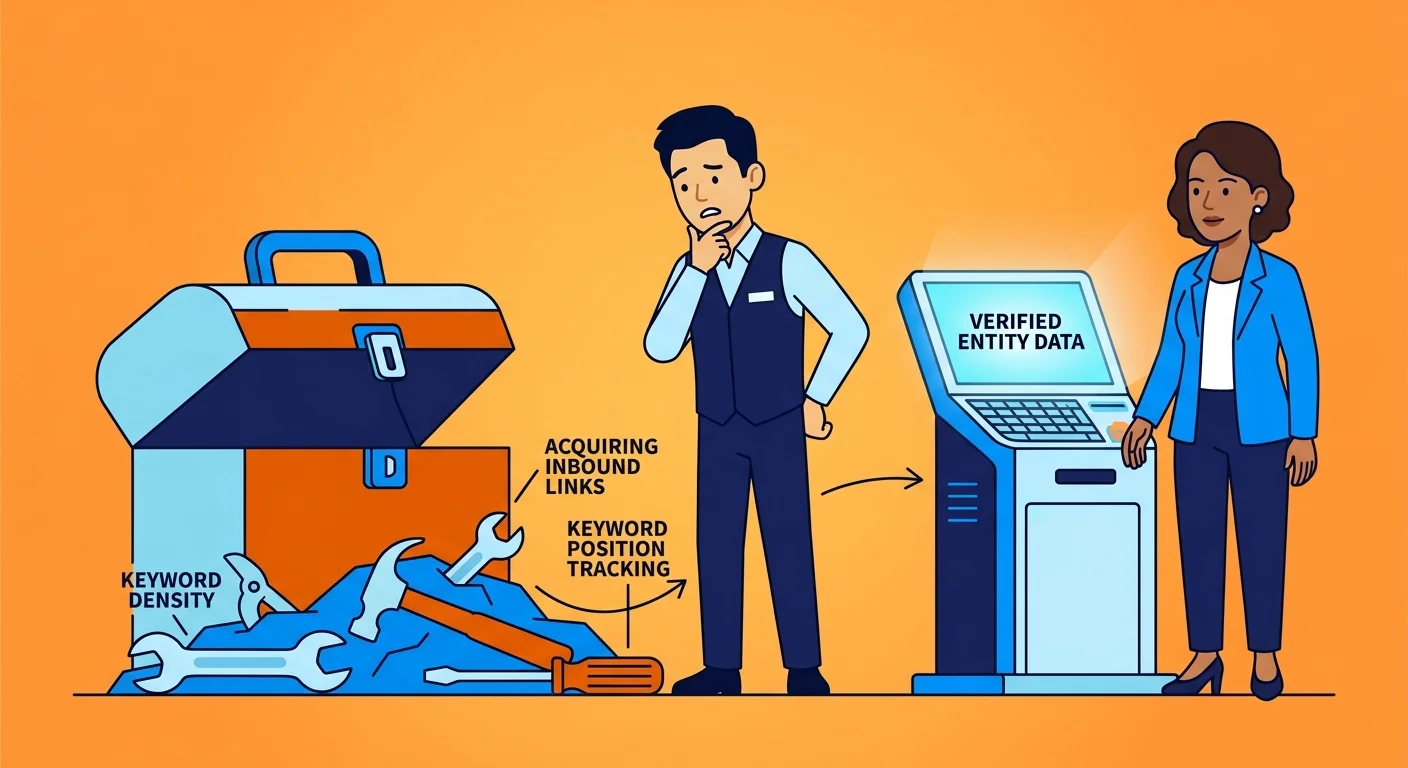
Look at where most clinics still burn their budget. Keyword-targeted articles, a few inbound links, and a site build work refresh every couple of years.
That playbook was built for a system that read one page at a time and stacked it against similar pages. It was never built to survive cross-verification against a licensing database or an academic index.
So when a clinic drags that same playbook into an AI-driven world, the tactics don't fail loudly. They just stop registering, and nobody notices until the calls slow down.
The Old Playbook Doesn't Translate
Here's the mechanism nobody explains well. A knowledge graph is only as trustworthy as the process that validates the facts inside it, and that process is still catching up.
Researchers built a whole benchmark for exactly this reason: today's models struggle to validate knowledge graph facts across internal knowledge, retrieval-augmented evidence, and multi-model consensus. That gap is documented in a benchmark evaluation on the arXiv preprint server.
And that instability cuts both ways for a clinic. An unverified claim can slip through, sure, but a clinic's accurate credentials can just as easily be missed or pinned on the wrong entity.
You can't design your way around that uncertainty. The only real defense is redundancy: the same name, license, and affiliation confirmed independently across enough sources that one validation failure can't erase the whole entity.
Why Keyword-Targeted Articles Alone Can't Carry Clinical Trust
Keyword-targeted articles were built to win relevance scoring on a results page. They were never built to satisfy a system checking whether a clinical claim is actually true.
And that distinction matters enormously for medical content. Research on seven commercial models found that between 50% and 90% of their medical answers weren't fully supported by the sources they cited, a finding reported in a study indexed in PubMed Central.
A well-written article can still be one of those unsupported answers if nothing outside the page confirms it. That's exactly why understanding how AI systems weigh medical journal citations against ordinary authority content matters more than another round of keyword-targeted articles.
What an LLM Actually Checks Before It Trusts a Clinic
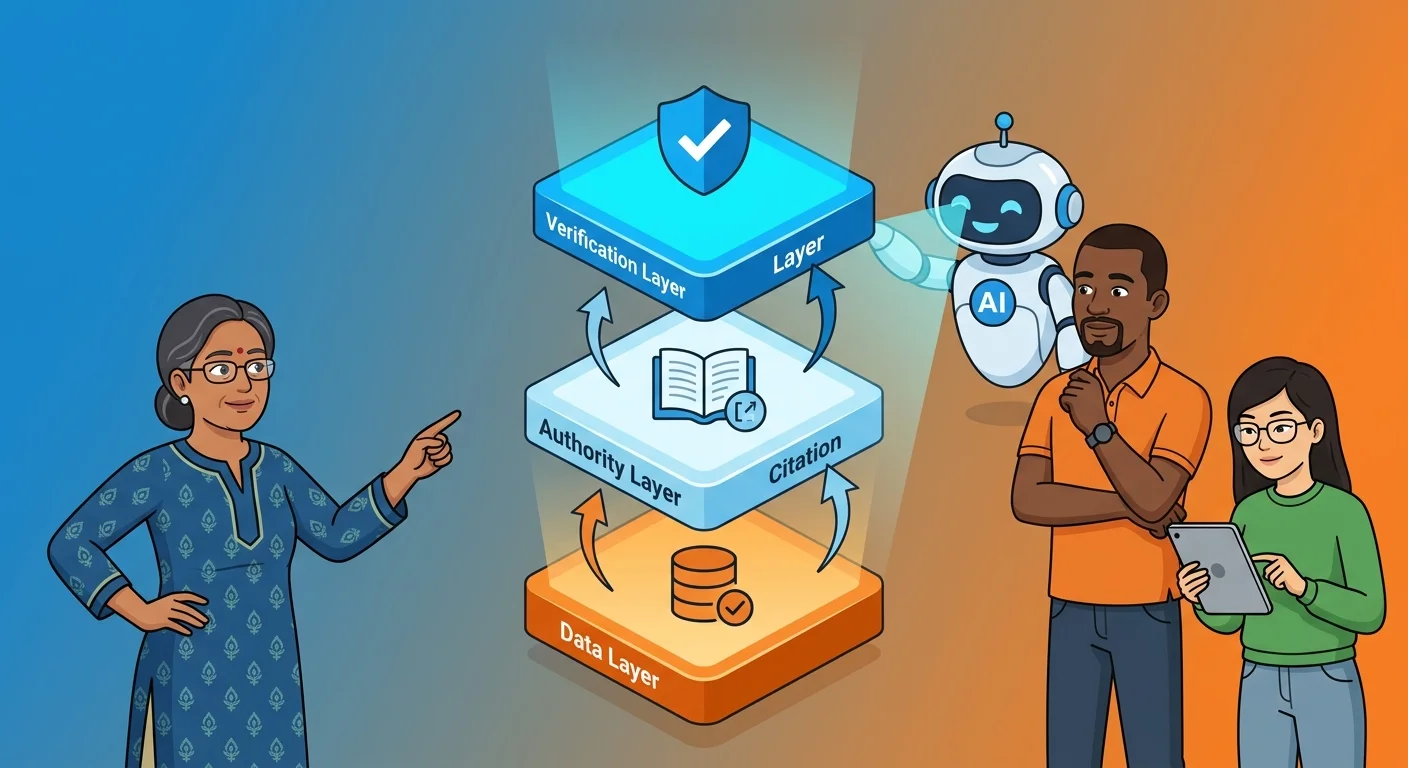
So what does an LLM actually run before it decides a clinic is real? Three layers. Each one checks a different kind of proof.
Here's the thing: a model doesn't understand trust the way you do. It calculates it, weighing how consistent and how authoritative the underlying data is before any name ever gets surfaced.
| Trust Layer | What It Verifies | Primary Data Source | Why It Matters to an LLM |
|---|---|---|---|
| The Data Layer | Whether a clinic's self-declared information is structured in a format a model can parse | Schema markup, NPI listings, and provider details published on the clinic's own site | Establishes the baseline claim, but carries no independent weight until confirmed elsewhere |
| The Authority Layer | Whether credible sources outside the clinic back up its declared credentials | Academic citations, industry recognition, and professional affiliations | Signals subject-matter authority a model can weigh against competitors in the same market |
| The Verification Layer | Whether licensing boards, directories, and listings agree with each other | Licensing databases, professional directories, and independent third-party listings | Resolves ambiguity; agreement across sources lets the model confirm identity with confidence |
The Data Layer
The Data Layer is the foundation. This is the structured information a clinic controls directly: schema markup, NPI listings, and the provider details published on its own site.
That layer answers one question. Does the clinic's own declared data match a format a model can actually parse?
But a declared claim isn't a verified one. The Data Layer is the clinic talking about itself, and no model treats self-reported data as the last word.
The Authority Layer
Now the Authority Layer checks whether anyone credible outside the clinic backs that claim up. Academic citations, industry recognition, and professional affiliations all live here.
This is also where competitive exposure gets real. One hospital system or a dominant local group can quietly own most of the citation signals an LLM trusts in a market, which is exactly the dynamic examined in a breakdown of how local healthcare providers can end a single competitor's grip on regional citation authority.
Here's the friction most clinics never see coming. Authority isn't distributed evenly, and a thin citation footprint can leave an excellent provider looking unproven to a model scanning for consensus.
The Verification Layer
The Verification Layer is where the chain either holds or breaks. This is cross-referencing: licensing boards, professional directories, and independent listings checked against each other for agreement.
An Entity Trust Chain is exactly this sequence. It's the path an LLM walks across verifiable, authoritative data points until a clinic's credentials are confirmed or contradicted.
When licensure records, directory listings, and citations all agree, the chain holds and the model surfaces the clinic with confidence. When one link breaks, the model doesn't guess. It looks elsewhere.
Where Clinical Trust Gets Held to a Higher Standard
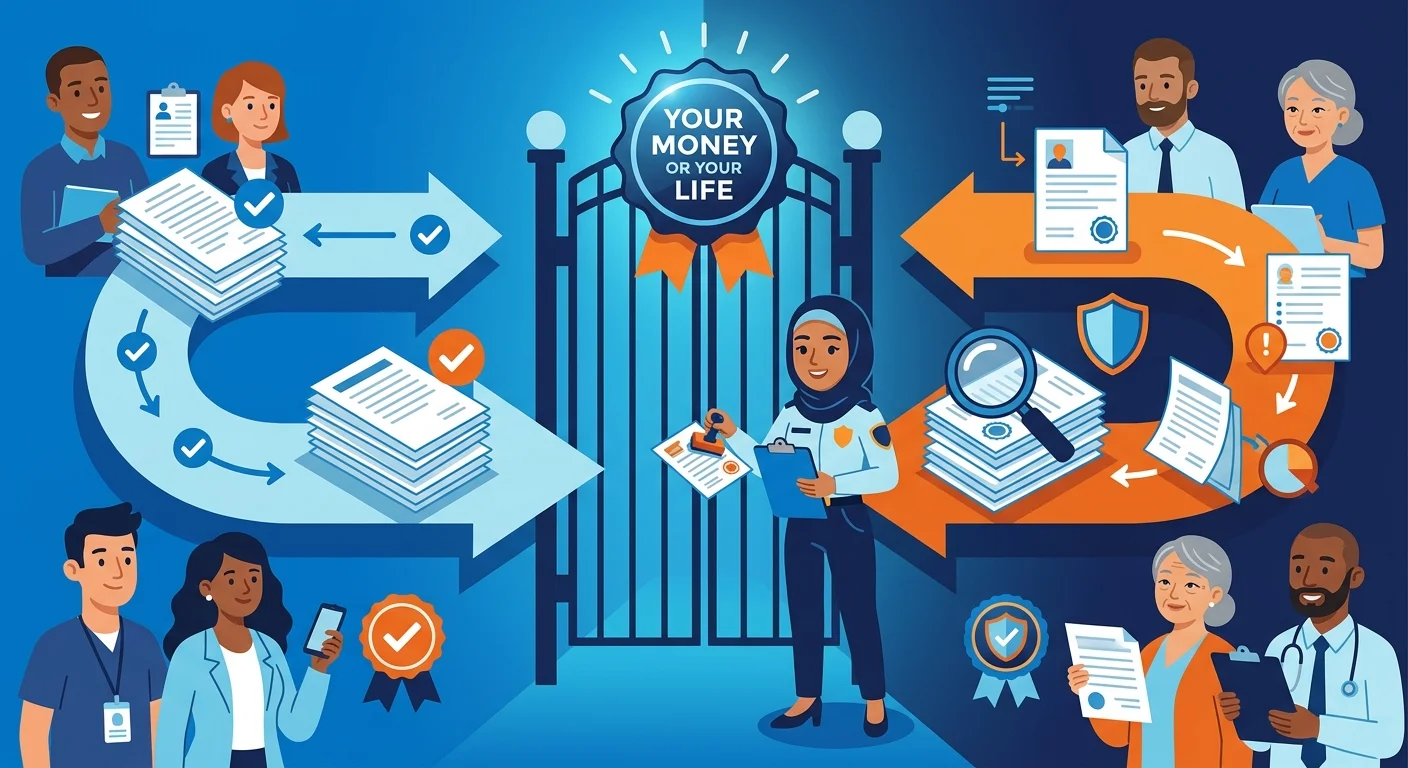
Not every kind of content gets graded on the same curve. Google's own ranking systems throw extra weight behind strong E-E-A-T signals for what it calls Your Money or Your Life topics — the stuff that can actually move a person's health, finances, safety, or well-being — a line drawn straight in Google Search Central's own ranking documentation.
Clinical care sits dead center in that category. So does every credential attached to it.
So a clinic's Entity Trust Chain gets checked harder than a restaurant's or a retail shop's ever will. For healthcare, the stakes climb higher still, because search engines file medical information under that same YMYL umbrella and hold it to a stricter standard than any low-risk content faces.
| Content Category | Verification Standard | Consequence of Weak Signals |
|---|---|---|
| Clinical Credentials and Care Claims | Cross-checked against licensure boards, professional directories, and academic citations under the strictest YMYL scrutiny | A single unresolved mismatch lets the model discard the clinic and surface a competitor whose chain holds |
| General Business or Local Listing Data | Checked mainly for consistency across directories and maps, with less demand for independent academic or regulatory backing | Minor drift gets tolerated longer, though repeated contradictions still erode overall entity confidence |
| Non-Clinical Informational Content | Evaluated on relevance and structure more than external verification, since no health or safety outcome is at stake | Weak signals mostly limit visibility rather than trigger the deeper cross-referencing clinical claims face |
This Isn't for Clinics Chasing a Quick Fix
This higher bar isn't for the clinic hoping one keyword-targeted article settles the whole thing. If the goal is a fast placement win with zero appetite for the verification work underneath it, this approach won't fit.
Look, the Entity Trust Chain pays off for clinics willing to fix licensure mismatches, correct directory drift, and rebuild citation consistency across sources they don't fully control. That's slower than publishing another article. It's also the only path a model actually checks.
Here's the real trade a clinic is making. Skip the verification layer, and a 15-minute diagnostic built to explain why the phone stopped ringing will usually surface the exact gap a rushed content push tried to paper over.
When the Chain Breaks: Errors, Ambiguity, and Hallucination Risk
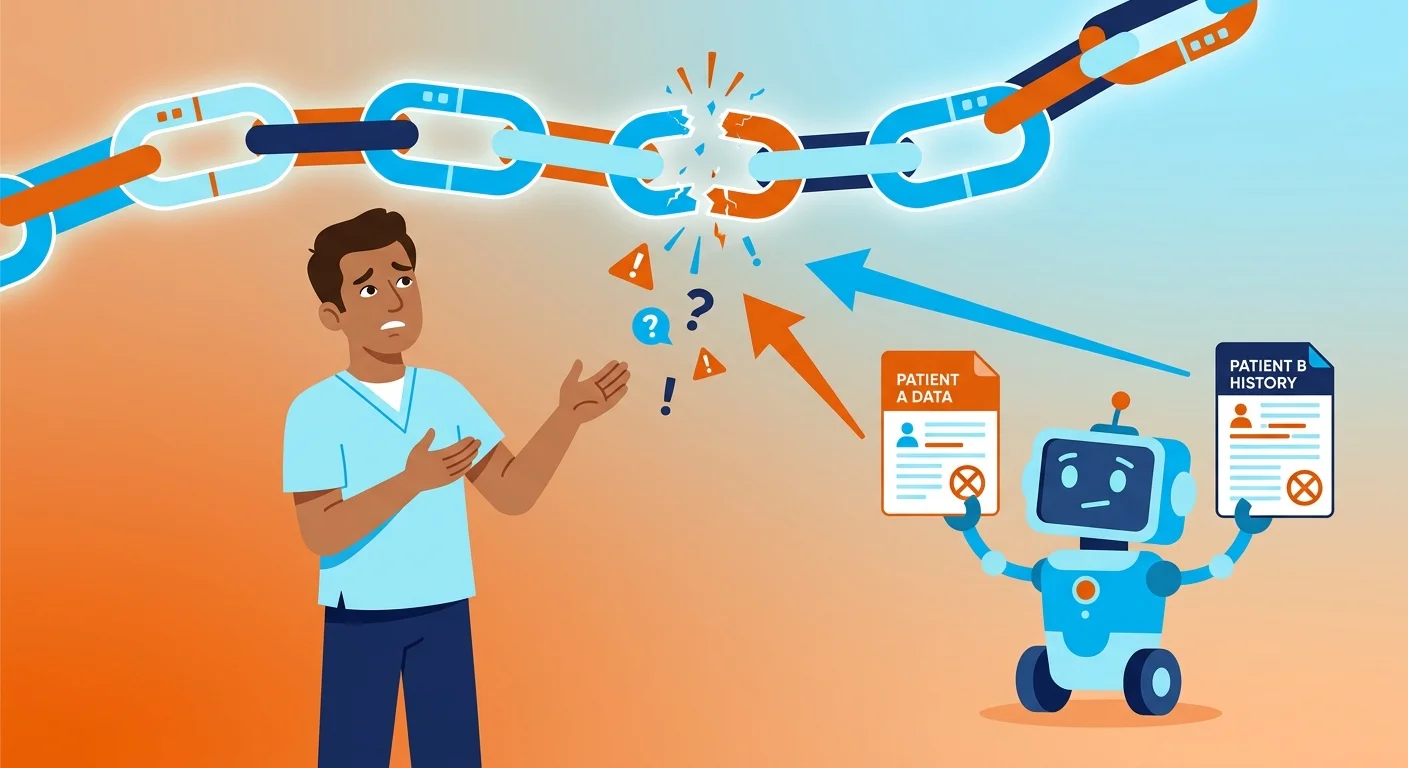
A trust chain doesn't collapse all at once. It fails one contradicted field at a time.
So a license number drifts, a name changes format, or a directory listing lags behind reality. The model doesn't pause and ask anyone to clarify. It resolves the gap on its own, and that resolution doesn't always land in the clinic's favor.
| Failure Mode | What Triggers It | Rate Observed | Severity |
|---|---|---|---|
| Clinical Hallucination | LLM generates unsupported statements while processing clinical notes and consultation transcripts | 1.47% of sentences analyzed | 44% of those errors classified as major, capable of affecting patient diagnosis or management |
| Knowledge Graph Validation Failure | Model attempts to confirm a clinical entity fact using internal knowledge, retrieval-augmented evidence, or multi-model consensus without a stable validation process | Not yet reliable for real-world use | Undermines confidence in whether any single credential claim is confirmed or contradicted |
| Major Diagnostic-Impact Error | A hallucinated sentence in a clinical note reaches a severity capable of influencing patient management decisions if left uncorrected | 44% of hallucinated sentences | Major, could impact patient diagnosis and management if left uncorrected |
Resolving Conflicting Signals
Now what happens when the Data Layer says one thing and the Authority Layer says another? The model has to pick a version of the truth.
And that instability isn't hypothetical. Earlier research already showed current models struggle to validate knowledge graph facts consistently. A contradicted clinic record is exactly the kind of case that struggle produces.
But the deeper risk sits inside the model's own output, not just its input. In a dataset of clinical notes and consultation transcripts run through large language models, hallucinations showed up at a rate of 1.47%, and 44% of those errors were serious enough to affect a patient's diagnosis or management, a finding detailed in published research data.
The Cost of an Unverified Footprint
Here's the part that should unsettle any clinic still treating its digital footprint as an afterthought. A model doesn't need to invent a credential from nothing.
It only needs conflicting or incomplete source data to fill a gap wrong. An unverified footprint hands it exactly that kind of gap.
So the cost isn't abstract. It's a misstated credential, a dropped affiliation, or a wrong specialty pinned to a real provider's name, quietly shaping whether an AI assistant recommends that clinic at all.
Building the Chain Link by Link
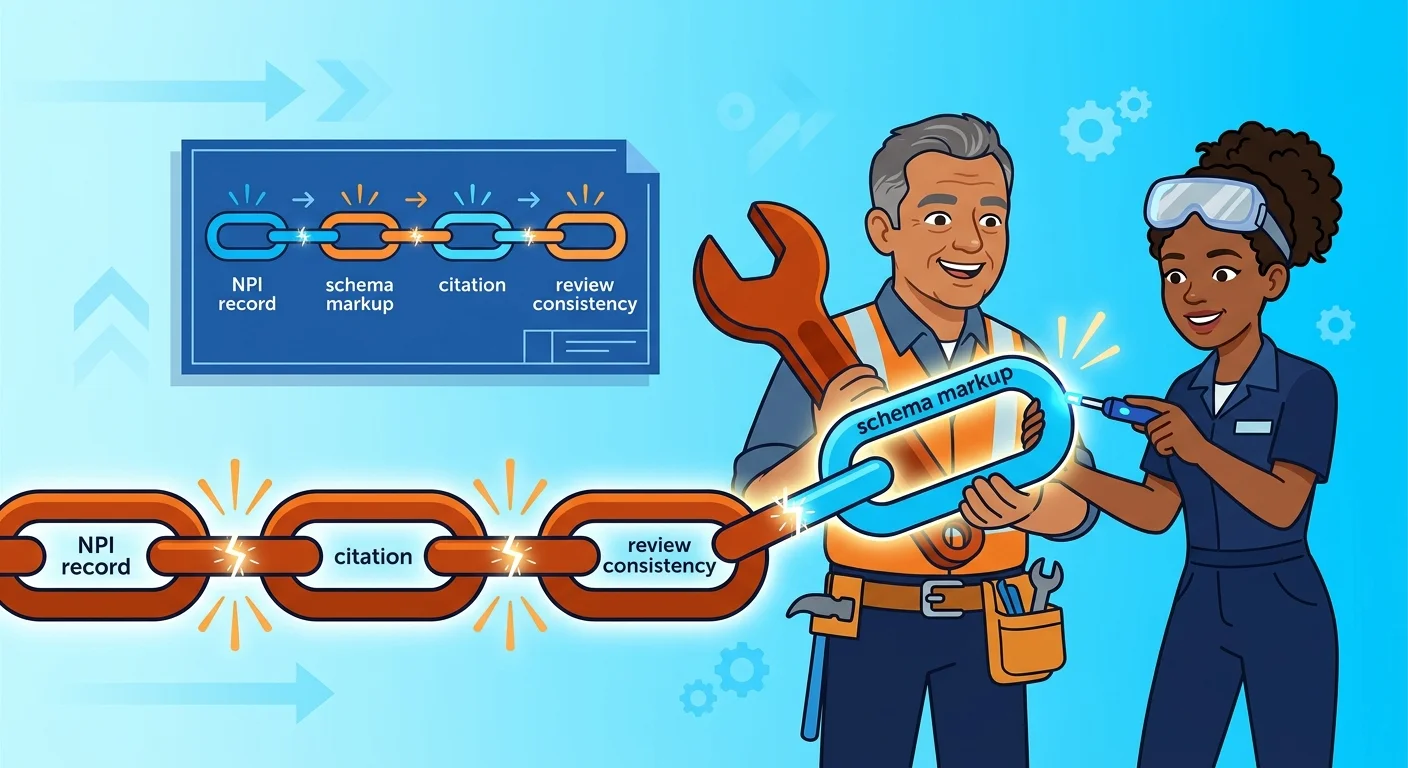
Alright, quick reality check: diagnosis is over. Building starts here.
Here's the thing. Every clinic that shows up cleanly inside an AI answer got there by strengthening the same three layers, in the same order. Skip the sequence and the chain snaps somewhere further up.
| Build Step | Data Element | Verification Role |
|---|---|---|
| Register the NPI | National Provider Identifier number | Confirms the entity exists in the federal registry, nothing more |
| Publish structured schema | Name, specialty, address, credentials | Gives the model a parseable, single source of truth for basic identity |
| Build The Authority Layer | Academic citations, professional affiliations, industry recognition | Signals that credible sources outside the clinic back the same claim |
| Cross-check The Verification Layer | Licensing boards, professional directories, independent listings | Tests whether every outside source agrees before the model trusts the chain |
| Reconcile conflicting fields | Specialty labels, license numbers, name formats | Removes the ambiguity that forces a model to pick one version of the truth or none |
The NPI Foundation
So start with the National Provider Identifier. It sits at the very bottom of The Data Layer, and most clinics assume the number alone proves they're legit.
It doesn't. The registry that issues the number says it flat out: an NPI does not ensure or validate that a provider is licensed or credentialed, a line the Centers for Medicare and Medicaid Services states plainly in its own guidance.
So an NPI confirms a clinic exists in the registry. It doesn't confirm the clinic is licensed, credentialed, or even still practicing, which is exactly why that number alone can't anchor an Entity Trust Chain.
Structured Data and Schema Layers
Now schema markup is where The Data Layer actually earns its keep. It's the structured code that tells a model, in a format it can parse without guessing, what a clinic is and who practices there.
Name, specialty, address, credentials — all of it belongs in that markup, and all of it has to match the same fields everywhere else. A model that finds three different specialty listings for one provider doesn't average them.
It picks one, or it picks none. Getting the schema layer right won't finish the chain, but nothing built on top of it holds if this foundation is inconsistent.
Frequently Asked Questions
Building the chain is one thing. Living with it raises the questions clinics only think to ask once they see what's actually getting checked.
Here are the ones that come up most.
How is verifying a clinic's credentials different for an LLM compared to a traditional search engine?
A traditional search engine matches keywords and counts inbound links to rank a page. An LLM does something different. It cross-references a clinic's declared credentials against independent sources, then resolves the contradictions instead of just indexing the text.
What specific documents or databases do LLMs use to check a doctor's qualifications?
Models pull from structured schema markup, National Provider Identifier records, licensing board listings, and professional directories. No single database settles it alone. That's why agreement across all of them matters far more than any one entry.
If my clinic's information is incorrect in an AI-generated answer, how can I fix it?
Fix the source data first, not the AI output. Correct the schema markup, the directory listing, or the licensing record that's actually wrong. The model is only echoing whatever contradiction still sits upstream.
Does having more patient reviews help an LLM trust my clinic's credentials?
Reviews add a signal, but they sit outside the credential chain itself. A clinic with glowing reviews and a broken licensure record still risks a model surfacing the wrong specialty or affiliation.
What is the single most important step a clinic can take to build a strong Entity Trust Chain for AI?
Fix the National Provider Identifier record first. It anchors The Data Layer, and every later step checks against it. One inconsistency there undermines everything built on top.
Where This Leaves Your Clinic
A chain of custody for truth only works when every link agrees with the ones around it. The Data Layer, The Authority Layer, and The Verification Layer aren't three separate projects. They're one sequence, and a clinic that fixes two while ignoring the third still owns an Entity Trust Chain that snaps the second a model checks it.
So the real question isn't whether to keep publishing keyword-targeted articles or try something new. It's whether the clinic's entity data survives a model checking it against independent sources. Traditional search optimization was built to rank links. This test rewards accuracy over volume, every time.
Here's the position worth holding. A clinic that fixes its NPI record, aligns its schema, and closes the gaps between directories and licensing boards gets surfaced by an AI assistant more reliably than one publishing more content and verifying nothing. That's not a theory to test quietly over the next few months — it's the difference between a chain that holds and one that breaks the moment a model comes looking, and the fastest way to see which one a clinic has right now is to run the AI visibility check.