Why Your Clinic Can Rank and Still Go Unheard by AI Engines
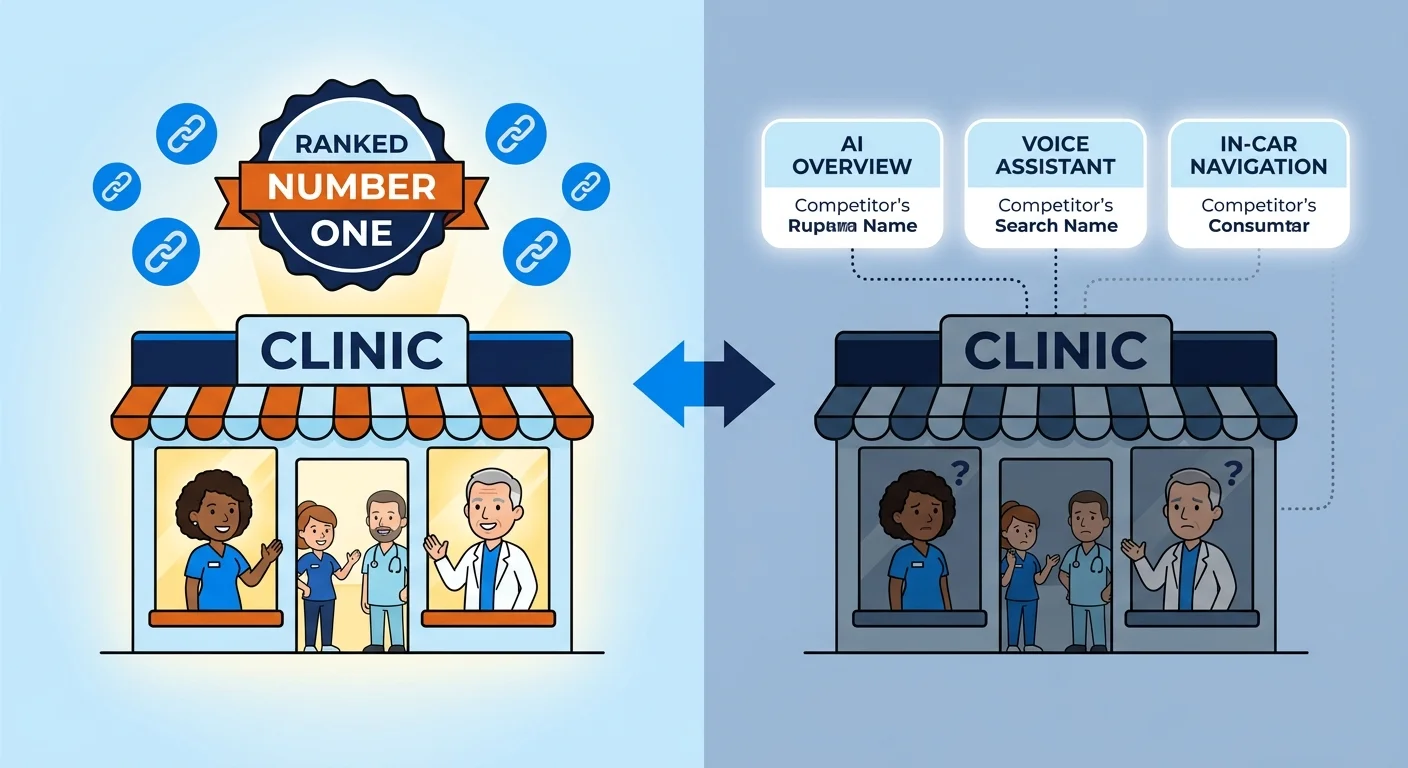
Here's the tension this whole diagnostic exists to explain. A clinic can hold a strong spot in the classic ten blue links and still hit total silence the second a generative AI engine answers the same question. That's not a ranking problem. It's a translation problem — a clinic fluent in the old language of search, mute in the new one AI engines speak.
This exact condition has a name. AI invisibility is a clinic with decent traditional rankings that gets completely overlooked by generative search features, voice assistants, and in-car navigation systems.
So the phone goes quiet while the website still looks healthy on paper. That disconnect is what leaves so many clinics scratching their heads, and it's the same pattern pulled apart in why phone calls quietly drop while competitors dominate AI search results, where visible rankings hide an invisible authority gap.
Now look at what the goal line actually is heading into 2026. Placing in the classic ten blue links is an obsolete win on its own — what matters is being the answer generative AI engines trust enough to cite. A clinic chasing the old goal while the new one quietly overtakes it? That's exactly how a fluent, well-optimized business goes mute.
The Ranking Report Card That Stopped Telling the Truth
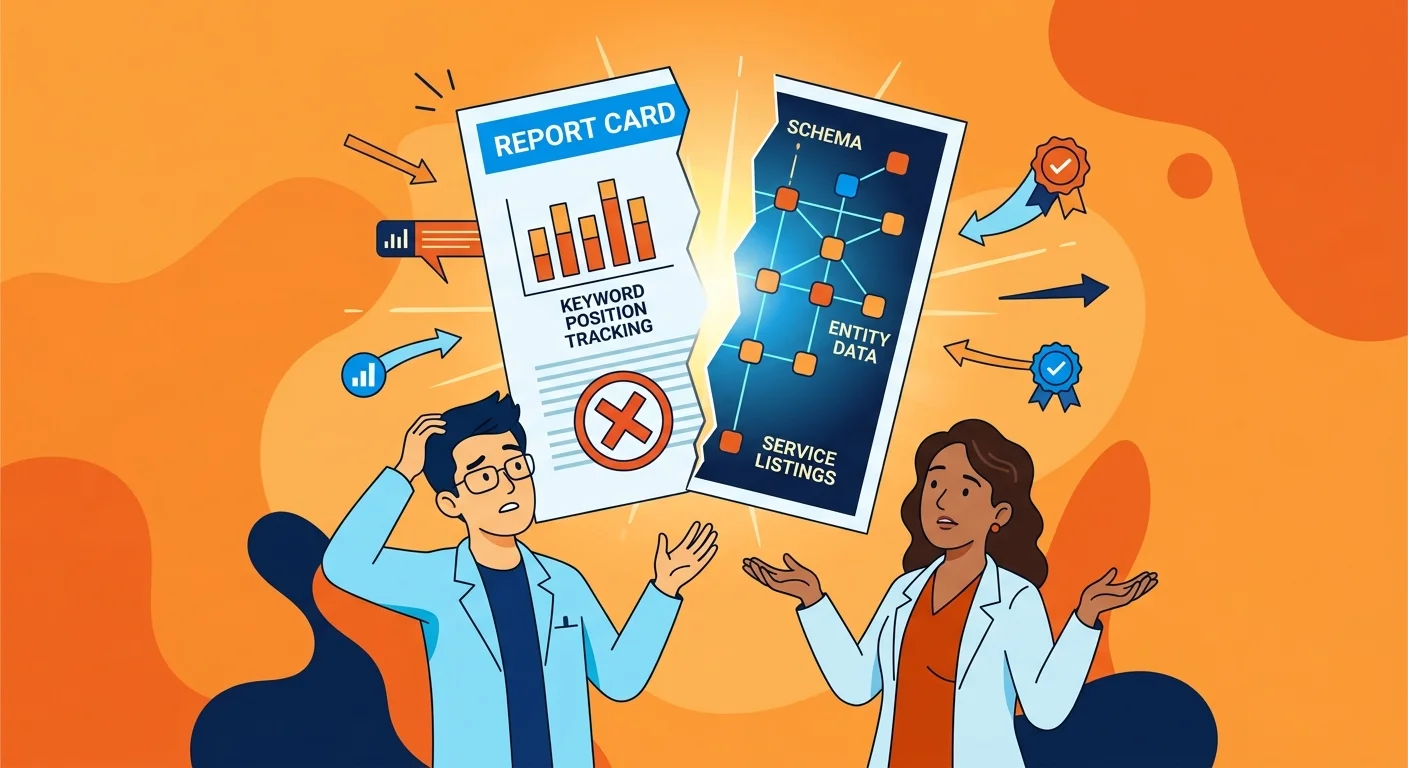
Here's the indictment: the ranking report clinics still trust to measure their visibility was built to grade a test generative AI engines no longer administer.
Most agencies are still selling clinics on outdated keyword position tracking, leaving them exposed to the biggest shift in search in 25 years.
That report card looks fine. Green checkmarks, upward arrows, a tidy summary of where a clinic sits in the classic ten blue links.
But none of it asks whether a generative AI engine can actually read the clinic as an authority worth citing.
The problem was never a lack of online promotion effort. It's a lack of machine-readable authority that AI engines can understand and cite.
A clinic can spend heavily on visibility work and still hand an AI engine nothing it can parse.
| Signal Checked | Traditional Search Optimization Report | AI Visibility Diagnostic |
|---|---|---|
| Structured Data Integrity | Not checked. Traditional reports confirm a page exists and loads. | Verifies whether service and credential data are marked up in a format a generative AI engine can extract and cite. |
| Entity Consistency | Not checked. Traditional reports focus on keyword position tracking, not entity accuracy. | Confirms the clinic's identity, services, and credentials read the same across every platform an AI engine draws from. |
| Knowledge Panel Completeness | Rarely checked beyond confirming a listing exists. | Evaluates whether the panel holds enough depth for an AI engine to treat the clinic as a citable authority. |
| Service-Level Machine Readability | Not checked. Reports measure placement in the classic ten blue links, not how services are described. | Tests whether individual services are written in language a machine can categorize and retrieve. |
| Multi-Engine Presence | Not checked. Traditional reports track a single classic search environment. | Examines whether the clinic surfaces across generative search summaries, voice assistants, and conversational query systems. |
Why Most Local Marketing Reports Miss the Real Problem
Here's why that report survives despite measuring the wrong thing: it was built for a world where a human clicked through ten blue links and judged a business by feel.
That world is shrinking fast.
A standard audit built for classic search results versus a diagnostic built for how AI engines actually read a clinic exposes exactly this gap, because the two tools aren't measuring the same layer of visibility at all.
One counts positions on a page. The other checks whether an AI engine can even extract a coherent fact from that page.
And the local data makes the stakes sharper than most clinics realize. Local searches trigger AI Overviews in only 7.9% of cases, according to Search Engine Journal's reporting on local query behavior.
Sounds like a small slice. It isn't small when a clinic depends on exactly those local moments to turn a search into a phone call.
A clinic that never lands inside that 7.9% has effectively no shot at the synthesized answer, no matter how strong its spot in the classic ten blue links looks.
The report card never flags that miss, because it was never built to look for it.
What Generative Engines Actually Read Before They Recommend a Clinic
Now shift from what the report measures to what the engine itself actually consumes.
Generative engines don't skim a page the way a person does.
They pull structured facts. A service name, a credential, a location, a consistent entity signature across every platform that mentions the clinic.
If those facts are missing, contradictory, or buried in unstructured paragraphs, the engine has nothing solid to cite.
So the recommendation an AI engine gives a patient is only ever as good as the machine-readable authority it found first.
A clinic fluent in the old language of search can still sit mute in front of that engine, simply because nobody translated its authority into a format the engine speaks.
How AI Overviews Decide Which Local Practice Gets Named
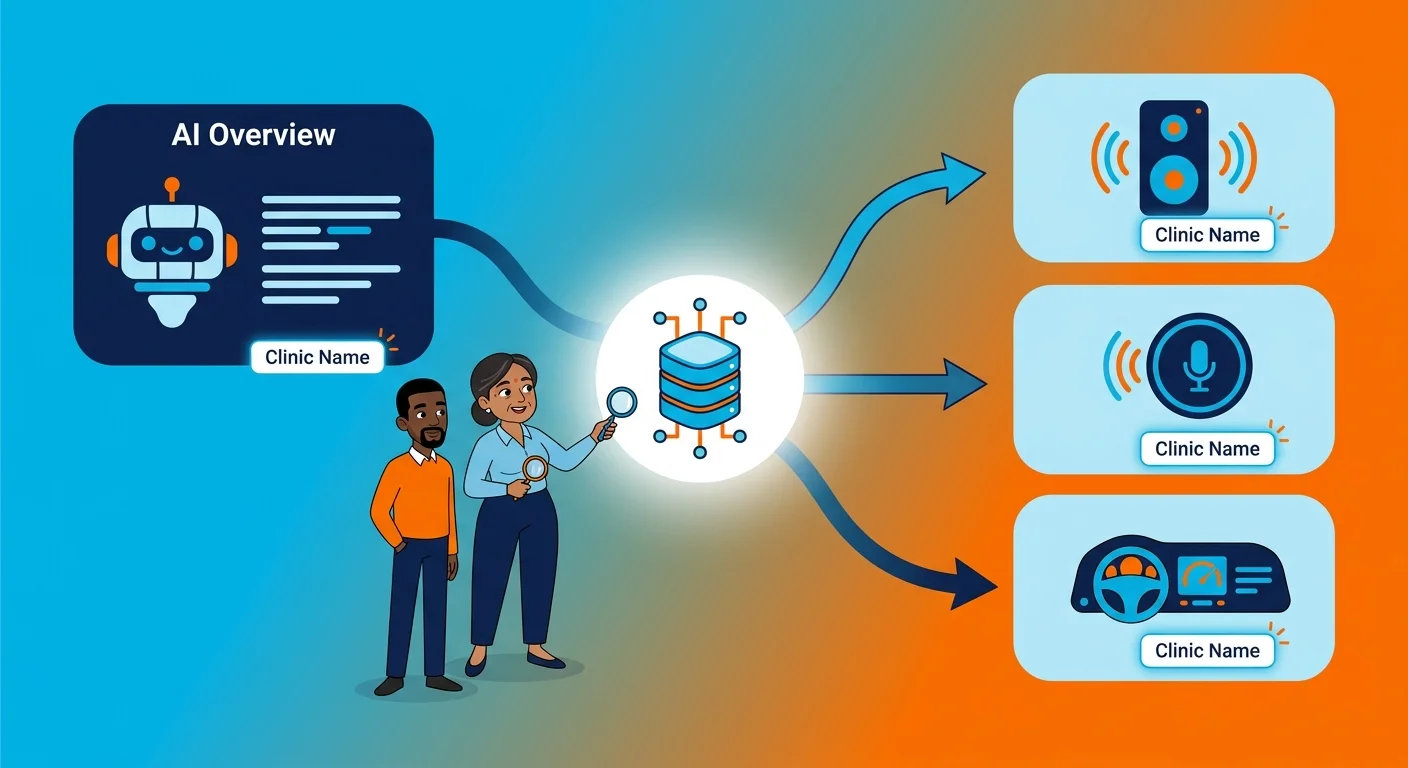
Here's the counter-intuitive part: proximity barely matters anymore. Google AI Overviews show effectively no correlation between distance from a business and where it lands in the results, with a correlation coefficient of 0.001.
Now, that number is about Google AI Overviews ranking position, not classic local pack placement, where distance still pulls real weight. So the clinic sitting closest to the patient holds no built-in edge once a generative engine starts building an answer.
The published research data behind that finding says it plainly: when a business shows up in these results at all, its position has almost nothing to do with geography. What takes geography's place is authority signal density, the machine-readable proof that a clinic is a credible, well-documented entity.
| Engine Type | Primary Data Source | What It Ignores |
|---|---|---|
| Google AI Overviews | Structured entity data pulled from across the web, weighted toward authority signal density | Physical distance from the searcher, since proximity carries almost no weight once an answer is synthesized |
| Conversational voice assistants | Vector representation of the spoken query matched against a structured backend database | Unstructured service descriptions that cannot be converted into a clean vector match |
| In-car navigation systems | Consistent entity signatures paired with structured location and service data | Classic ten blue links positioning, which the system never consults during retrieval |
How Voice Assistants and In-Car Systems Pull Their Answers
Voice assistants and in-car navigation run on the same kind of retrieval logic, just pointed at a different question. Instead of ranking pages, they match an intent to the closest available answer inside a structured database.
Here's how that actually works: conversational AI systems built for local web search turn the original query into a vector representation, then run a nearest-neighbor search against a backend database on the cosine distance metric to surface the closest match. That process is documented in work hosted on the arXiv preprint server.
So a clinic with thin or inconsistent service data never becomes a strong match inside that vector space, no matter how well it does in the classic ten blue links. It's the same silence from earlier, fluent in the old system and mute in the new one, and it's exactly what a prioritized authority infrastructure repair plan is built to reverse.
Inside the 15-Minute Diagnostic: What Actually Gets Checked
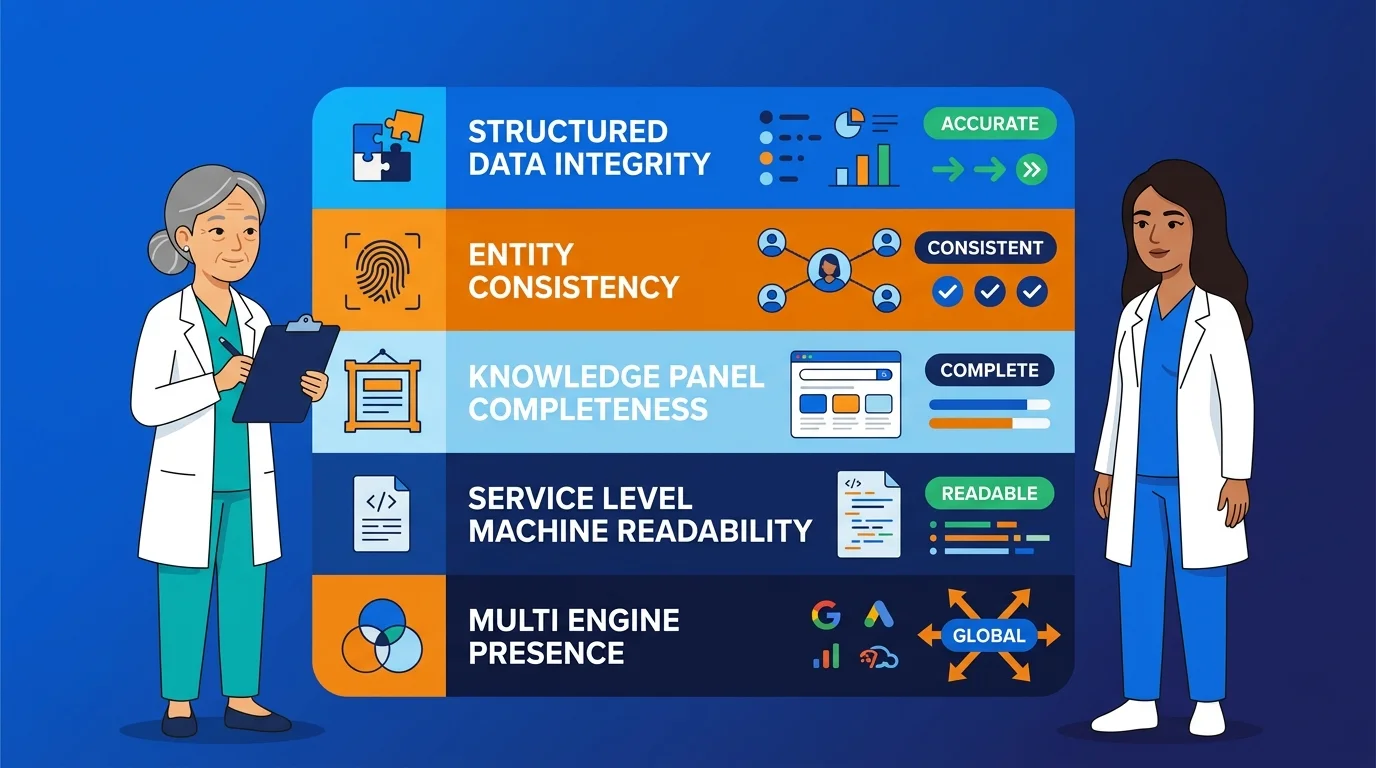
So what actually happens inside those fifteen minutes? The diagnostic isolates the exact signals a generative AI engine checks before it decides whether a clinic is worth citing.
Here's the foundation piece. Providing structured data on a website is what lets local business info show up in Google Maps and Google knowledge panels. That single fact is why a diagnostic starts with markup, not with page content.
Without that structured layer, an engine has nowhere clean to pull a clinic's name, service list, or credentials from. So the diagnostic checks whether that layer even exists before it checks anything else, because the revenue cost of staying invisible to AI recommendations only grows the longer that gap sits.
| Authority Signal | What It Reveals | Why AI Engines Weigh It |
|---|---|---|
| Structured Data Integrity | Whether schema markup exists and is complete enough for an engine to extract a clean fact set | Missing or partial markup leaves an engine with nothing solid to cite, no matter how strong the underlying content reads |
| Entity Consistency | Whether the clinic's name, address, and service claims match across every platform that mentions it | A contradictory entity signature reads as unreliable, so an engine defaults to a competitor whose data lines up cleanly |
| Knowledge Panel Completeness | Whether the public-facing summary an engine draws from is thin or fully populated | A sparse panel gives an engine too little to synthesize into a confident recommendation |
| Service-Level Machine Readability | Whether each individual service is described in language a machine can categorize, not buried inside human-oriented paragraphs | Engines match intent to structured service data, so an unreadable service list simply never surfaces as a match |
| Multi-Engine Presence | Whether the clinic surfaces across generative search, voice assistants, and conversational systems, or only inside classic web search | A clinic invisible to voice and conversational retrieval loses the moments where a patient never touches a page of classic ten blue links at all |
| Finding | Typical Cause | Time-to-Impact After Correction |
|---|---|---|
| Missing or incomplete structured data | Website markup was never built to feed knowledge panels in the first place | Immediate on next recrawl once corrected |
| Clinic absent from local AI Overview results | Local queries surface AI Overviews far less often than non-local ones, so a thin signal gets skipped entirely | Immediate on next recrawl once corrected |
| Schema corrections not reflected in search results | Pages carrying the fix have not yet been recrawled and reindexed | Immediate once Google recrawls and reindexes the corrected pages |
The Five Authority Signals Every Diagnostic Should Isolate
Five signals make up the core of the check. Each one answers a different question an AI engine silently asks before it trusts a business enough to cite it.
Structured Data Integrity asks whether the markup exists and is complete. Entity Consistency asks whether the clinic's name, address, and service claims match across every platform that mentions it.
Knowledge Panel Completeness asks whether the public-facing summary an engine draws from is thin or fully loaded. Service-Level Machine Readability asks whether each service is described in language a machine can categorize, not buried in a paragraph written for a human.
Multi-Engine Presence asks whether the clinic surfaces across generative search, voice assistants, and conversational systems, or only inside classic web search. A gap in any one of these five is enough to keep a clinic mute in front of the engine, even while its keyword position tracking looks strong.
Who This Diagnostic Isn't Built For
Let's keep it real: this diagnostic isn't built for a clinic chasing a quick bump in the classic ten blue links. If the goal is a faster climb up a keyword position tracking chart, this isn't your tool.
It's also not built for a clinic unwilling to fix inconsistent data once the gaps are named. Finding a broken entity signature and leaving it broken defeats the whole point of running the check.
And it's not for a clinic hunting for a vanity report to file away. The diagnostic exists to be acted on, not admired.
What Happens in the Hours and Weeks After the Findings Land
Once the findings land, the technical fixes move fast. Schema markup and rich snippets update the moment Google recrawls and reindexes the pages carrying those corrections, according to Search Engine Roundtable's reporting on how that reindexing actually behaves.
That means a clinic isn't stuck waiting on some vague future update cycle. Fix the structured data, and the engine's next pass over that page can pick it up right away.
The slower work is entity consistency across every platform that names the clinic, which takes coordinated cleanup rather than one quick edit. But the direction holds either way: a clinic that was fluent in the old language of search finally gets translated into the one generative engines actually speak, verified in part through Google Search Central documentation on how structured data feeds knowledge panels.
Frequently Asked Questions
Every time this diagnostic gets explained to a clinic for the first time, the same handful of questions come up. Here are the direct answers, no hedging.
How is an AI visibility check different from a traditional search optimization audit?
A traditional search optimization audit measures where you land in the classic ten blue links. The AI Visibility Check measures something else entirely: whether a generative engine can even extract and cite your authority in the first place. Different layer, different question.
Why can my clinic place in the classic ten blue links but still be invisible to AI assistants?
Because those are two separate systems reading two separate signals. Strong keyword position tracking proves you're fluent in the old one. AI invisibility means the clinic still goes unseen by generative search, voice assistants, and in-car navigation despite that placement.
How long does it take to fix AI invisibility once it's diagnosed?
Structured data corrections move fast once Google recrawls and reindexes the fixed pages. Entity consistency cleanup takes longer. That one spans every platform, so it needs coordinated fixes rather than a single edit.
Can I perform an AI visibility check myself, or do I need a specialist?
Checking all five signals means reading markup, cross-platform entity data, and knowledge panel completeness the way an engine reads them. That's a specialist's read. Not a glance at a homepage.
What's the single biggest mistake clinics make that causes AI to ignore them?
Assuming online promotion effort automatically turns into machine-readable authority. It doesn't. They're two separate problems, and treating them as one is exactly what leaves a clinic mute in front of the engine.
Where This Leaves Your Clinic
Here's the verdict: your clinic doesn't need more online promotion. It needs to stop being mute in a language it never learned to speak.
The old scorecard graded fluency in a system generative AI engines have already stopped grading on. Five signals decide whether that translation happens, and not one of them shows up on a keyword position tracking report.
So the real question in front of every clinic reading this isn't whether the shift is real. It's whether you name the gap now, or discover it later in a lost phone call nobody can trace back to its cause. Start with the 15-minute AI Visibility Check.