
What an Auditable Proof Graph Actually Is (And Why Your Website Isn't One)
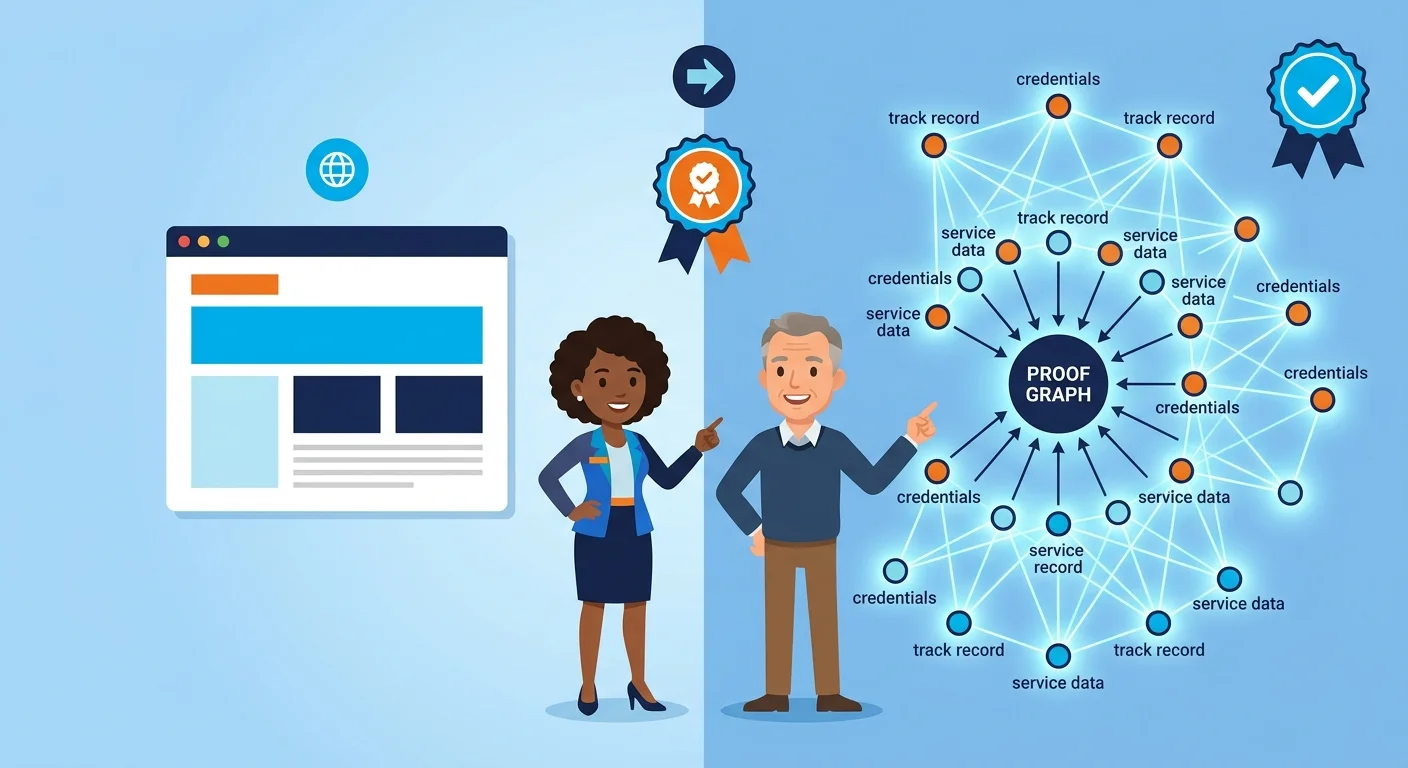
Here's the thing about most local business websites: they're billboards. They shout your credentials, list your services, and prop up a few testimonials, all of it aimed at a human scrolling for a little reassurance.
A proof graph isn't built for that visitor. Think courtroom exhibit binder, not billboard: a billboard just wants to be noticed, but an exhibit binder has to survive cross-examination, where every claim inside it stands or falls on its own.
And that's exactly why an auditable proof graph is a machine-readable network of verifiable claims about your business, your services, and your track record. It's built to be interrogated by a system, not glanced at by a person. We dig into that gap in why AI systems favor citable proof over persuasive copy, where the move from persuasion to verification gets pulled apart directly.
A billboard can say anything it wants. An exhibit binder cannot, because a missing citation or an unverifiable claim gets the whole exhibit thrown out. That is the standard a website has to meet now that generative engines, not just human eyes, are the ones deciding what gets cited as fact.
Why a Pretty Homepage Convinces No One With a Reasoning Engine
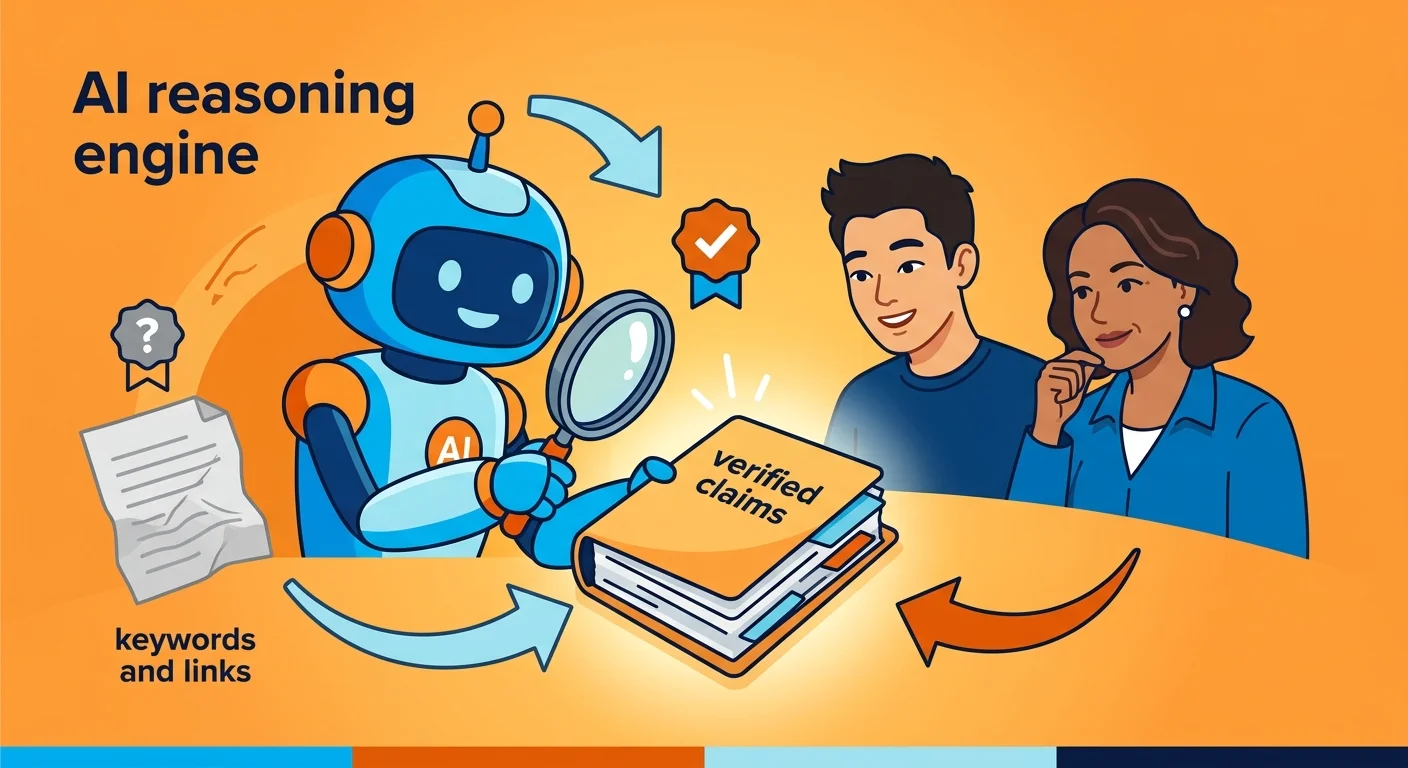
A homepage built for people is chasing one moment: the scroll. Hero image, warm headline, a call to action, all of it wired to earn trust in about two seconds.
But a reasoning engine can't read any of that. It doesn't feel reassured by a clean layout or a confident tagline.
A reasoning engine wants something else. Traditional search optimization was about convincing engines a page was relevant. A proof graph hands them verifiable facts they can check themselves, and the goal shifts from placing in the classic ten blue links to becoming the source cited inside the answer.
Why Keyword Density and Backlink Counts Fail as Proof
For years, ranking ran on proxies. Keyword density stood in for relevance, acquiring inbound links stood in for authority, so businesses chased both.
Here's the problem: neither one verifies a thing. A page packed with the right keywords doesn't prove you hold a license, closed a case, or delivered a documented result.
A backlink count is no different. It counts how often other pages point your way, not whether the claims on your page survive a fact check.
A reasoning engine wants what those proxies never gave it: an evidence trail it can follow on its own. That's the exact gap you close when a business learns to verify that its published case studies are real and traceable instead of just persuasive, and it's where the billboard finally fails the cross-examination a proof graph is built to survive.
How AI Engines Actually Verify a Claim Before They Cite It
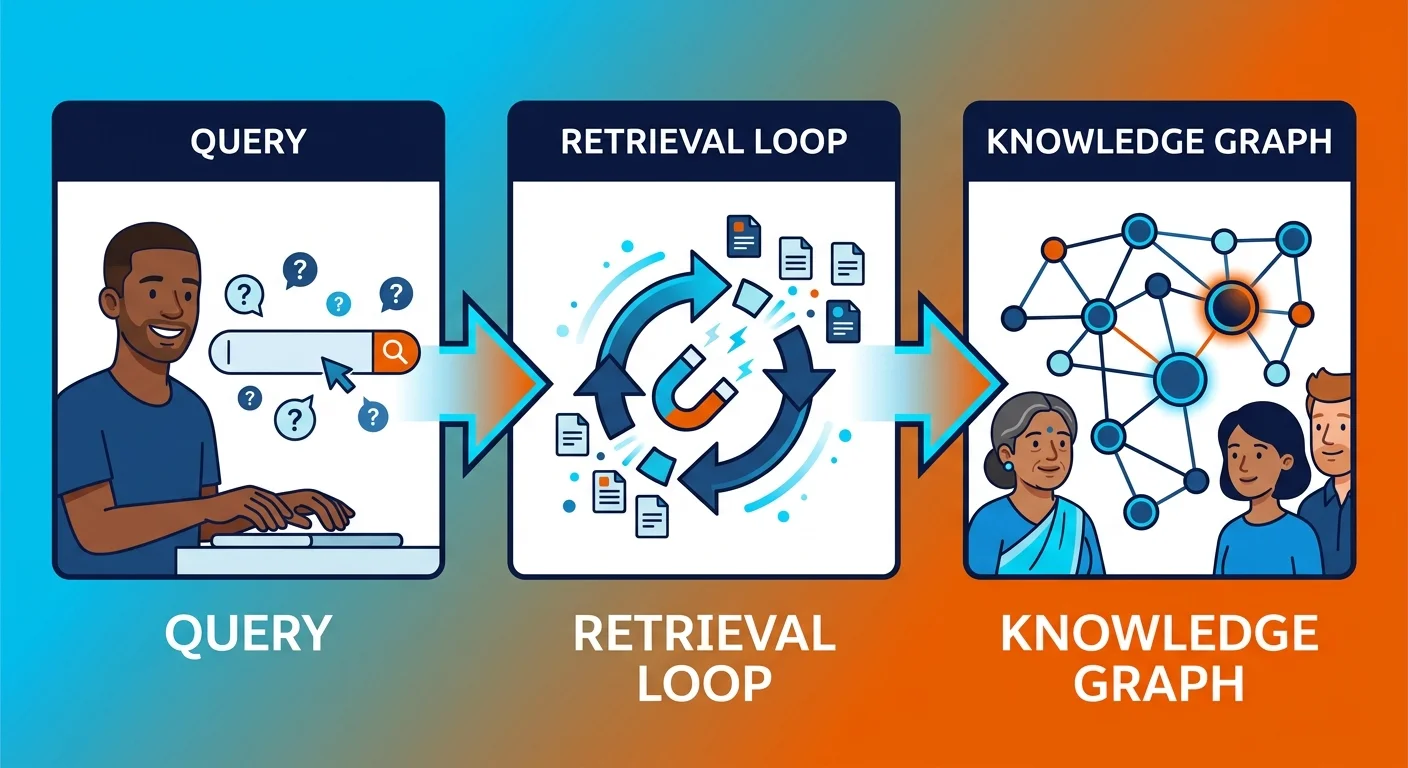
Every claim an AI engine runs into gets held up against one standard before it earns a citation. That standard isn't persuasion. It's confirmation.
Large language models learn from fixed piles of text, so their memory goes stale the second training stops. That's the whole reason retrieval-augmented generation exists: it lets a model reach outside for current information right when it needs to check a fact, instead of leaning on what it memorized months ago.
And that reaching-outward step is exactly what a proof graph is built to satisfy. A model looking for verification needs something structured to land on, not a paragraph it has to squint at and interpret.
| Verification Layer | What It Checks | Where It Lives in the Proof Graph |
|---|---|---|
| Retrieval Verification | Whether a claim can be independently confirmed against current outside information rather than relied on from memorized training text | Structured entity data and credentialing records that a retrieval-augmented generation approach can pull and check at the moment a claim is drafted |
| Entity Relationship Mapping | Whether a license, a business, a reviewer, and a documented outcome all describe the same connected entity rather than isolated, unlinked facts | The node-and-edge structure of the knowledge graph, where each entity and each relationship between entities is represented explicitly |
| Source Traceability | Whether a claimed credential or result links back to an issuing authority or third party capable of corroborating it independently | Relationship mapping between the business and the external parties named as the origin of each piece of supporting evidence |
| Claim-to-Evidence Pairing | Whether every assertion the business makes has a corresponding, machine-readable piece of proof attached to it rather than standing unsupported | The structured pairing layer connecting each stated claim directly to its documented evidence within the graph |
The Fact-Checking Loop Behind Every Generated Answer
Here's how the loop runs. A generative system drafts a candidate answer, spots the factual claims buried inside it, then goes looking for outside confirmation on each one.
Findings on retrieval-augmented generation, documented through a study hosted on the arXiv preprint server, describe that retrieval step as the safeguard against models that would otherwise spit out confident but unverified text. Take away something to retrieve, and the safeguard has nothing to check against.
A business that's already mapped its claims to structured evidence hands that retrieval step exactly what it's hunting for. A business that hasn't leaves the model checking a claim against nothing, which is the fastest way to get skipped. The article on wiring individual claims to their supporting evidence walks through exactly how that mapping gets built.
Where Knowledge Graphs Fit Into the Verification Chain
But retrieval alone doesn't explain how a system knows that a license, a business, and a review all point at the same entity. That connective work belongs to knowledge graphs.
A knowledge graph treats entities as nodes and the relationships between them as edges, giving a business, its credentials, and its documented outcomes a structure a machine can walk through instead of guess at. Research summarized through an overview available via PubMed Central describes this node-and-edge format as what lets computers process real-world connections unambiguously, without leaning on prose interpretation.
That's the structural gap between a claim sitting on a page and a claim sitting inside a graph. A page just states something. A graph shows how that something connects to everything else that confirms it.
The Building Blocks of a Machine-Readable Proof Architecture
A knowledge graph shows a system how entities connect. What it doesn't do is tell that system whether to trust a single word any node says about itself.
That trust question is what this section is here to answer. We're moving from the architecture of connection to the parts a business actually assembles to make each connected claim stand on its own.
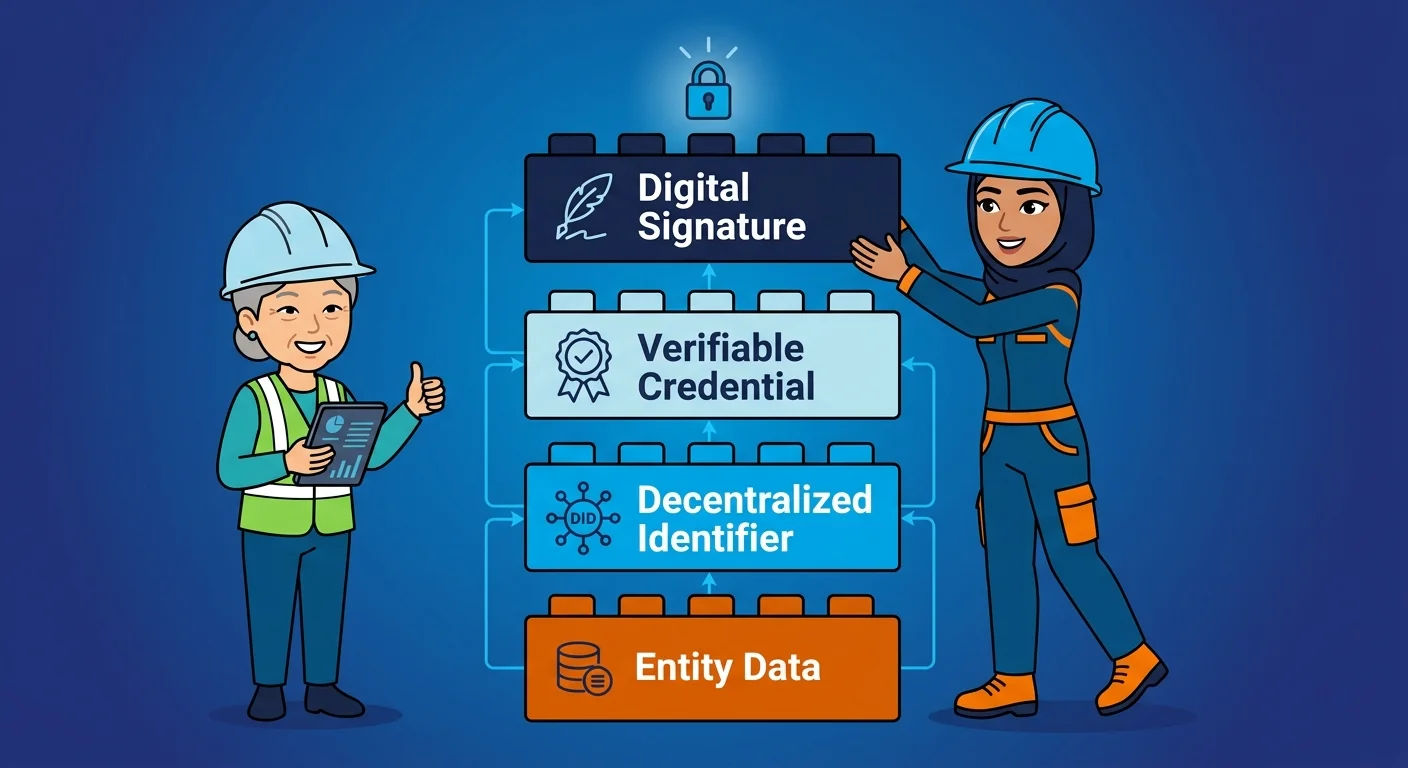
Building a proof graph means stacking four separate layers: structured entity data, credentialing tied to issuing authorities, cryptographically signed claims, and relationship mapping between the business and the parties who can back it up. Each layer answers a different verification question, and the structured entity trust proof stack replacing scattered review pages shows what happens once you assemble those layers into one coherent unit instead of leaving them scattered as fragments.
| Architecture Component | Function | Business Example |
|---|---|---|
| Structured Entity Data | Defines what a business is, what it does, and where it operates in a format a machine can parse without interpretation. | A local service provider tags its licensing, service area, and credentials so a generative system can extract facts instead of guessing from prose. |
| Credentialing Tied to Issuing Authorities | Links a claimed qualification back to the specific authority that granted it, so the claim cannot be checked only against itself. | A contractor's certification links directly to the licensing board that issued it, rather than sitting beside a badge image with no traceable source. |
| Cryptographically Signed Claims | Confirms a claim came from the business itself and was not altered after it was published. | A published case outcome carries a digital signature so a reasoning engine can confirm authorship and detect any later tampering. |
| Relationship Mapping | Connects a business to the parties, platforms, and records that can corroborate its claims, turning isolated statements into a traversable network. | A business links its reviews, credentials, and documented results into one connected structure instead of leaving each proof point stranded on a separate page. |
Cryptographic Layers That Make a Claim Tamper-Proof
Structured entity data and credential links tell a system what a business claims. They don't, on their own, prove the claim came from the business itself and showed up unaltered.
That's the job of a digital signature. It gives assurance that the claimed signatory actually signed the information, and that nobody touched it after signing, working like the electronic version of a written signature a machine can check instead of taking on faith.
Verifiable Credentials push that same guarantee into structured business data. A Verifiable Credential wraps a claim in a digital security wrapper that proves its own authenticity, including who issued it, at the exact second another system checks it, so a license or a certification travels with its proof attached rather than sitting next to an unverifiable badge image. Guidance on this signature model, detailed through published research data and formalized further by the National Institute of Standards and Technology, describes the same underlying mechanism: a cryptographic wrapper standing in for a notary a machine can query instantly.
This is the exhibit-binder standard applied piece by piece. Every credential, every signed claim, every corroborating relationship has to survive being pulled out and checked alone, not just look convincing sitting beside the others.
The Citation Sources AI Engines Already Trust
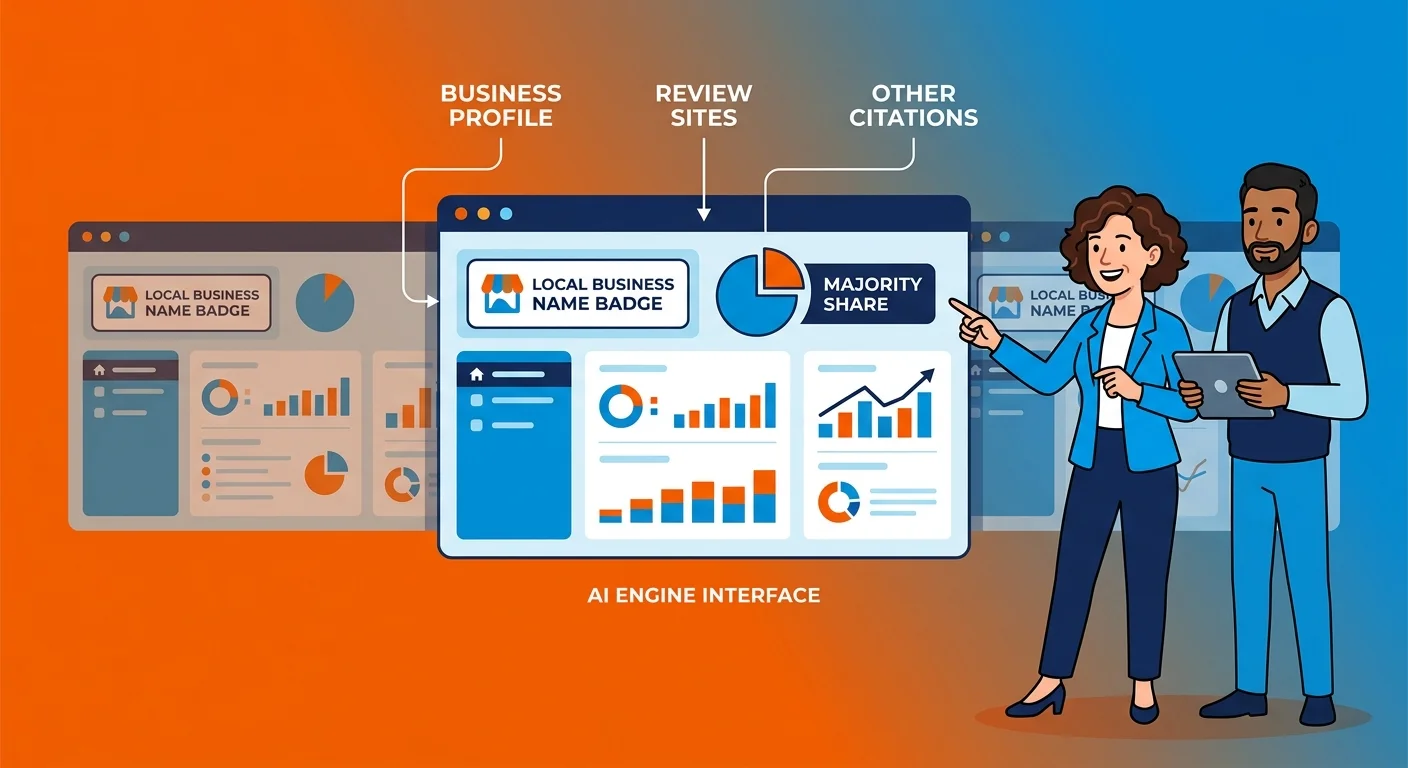
An exhibit binder is only as strong as the sources it cites. And here's the thing: generative engines already play favorites about which sources they trust most. Those preferences aren't spread out evenly.
Google Business Profile accounts for 28.5% of every citation generative AI systems pull when they answer local service queries. That's not a narrow slice, either. It holds across AI platforms and across the full spread of local questions.
Nothing else comes close to carrying that share of the citation weight. So a business that treats its profile as an afterthought is handing away the single heaviest lever it's got for landing inside a generative answer, a pattern dug into further through published research data on how these platforms actually get cited.
| Citation Source | Share of Local Citations | Role in the Proof Graph |
|---|---|---|
| Google Business Profile | Largest single share of local citations | The anchor node most generative engines check first, so structured entity data and current credentials here carry outsized weight |
| Verified review platforms | Meaningful but secondary share | Corroborating evidence that a claim inside the proof graph reflects a documented outcome, not just a stated one |
| Structured entity data on the business's own site | Foundational rather than a citation share on its own | The exhibit itself, since a graph or profile can only point back to something concrete when the underlying page holds structured, verifiable facts |
| Third-party credentialing and licensing bodies | Small but disproportionately trusted share | The issuing authority a signed claim traces back to, which is what lets a credential travel with its proof attached instead of sitting beside an unverifiable badge |
Who This Approach Is Not Built For
This approach isn't built for a business that wants a quick listing update and nothing else. A profile filled in once and left alone doesn't act like an exhibit. It acts like an unverified claim sitting in a folder nobody ever opens.
And it's not built for a business chasing one citation win instead of a structured, ongoing proof trail. Generative engines re-check what they cite. A static profile stops earning that recheck the second its details go stale.
If the goal is a billboard headline inside an AI answer, this framework will feel like overbuilding. But an exhibit binder isn't judged by how loud it is. It's judged by whether every page inside it still holds up the next time someone opens it.
Assembling the Graph Piece by Piece
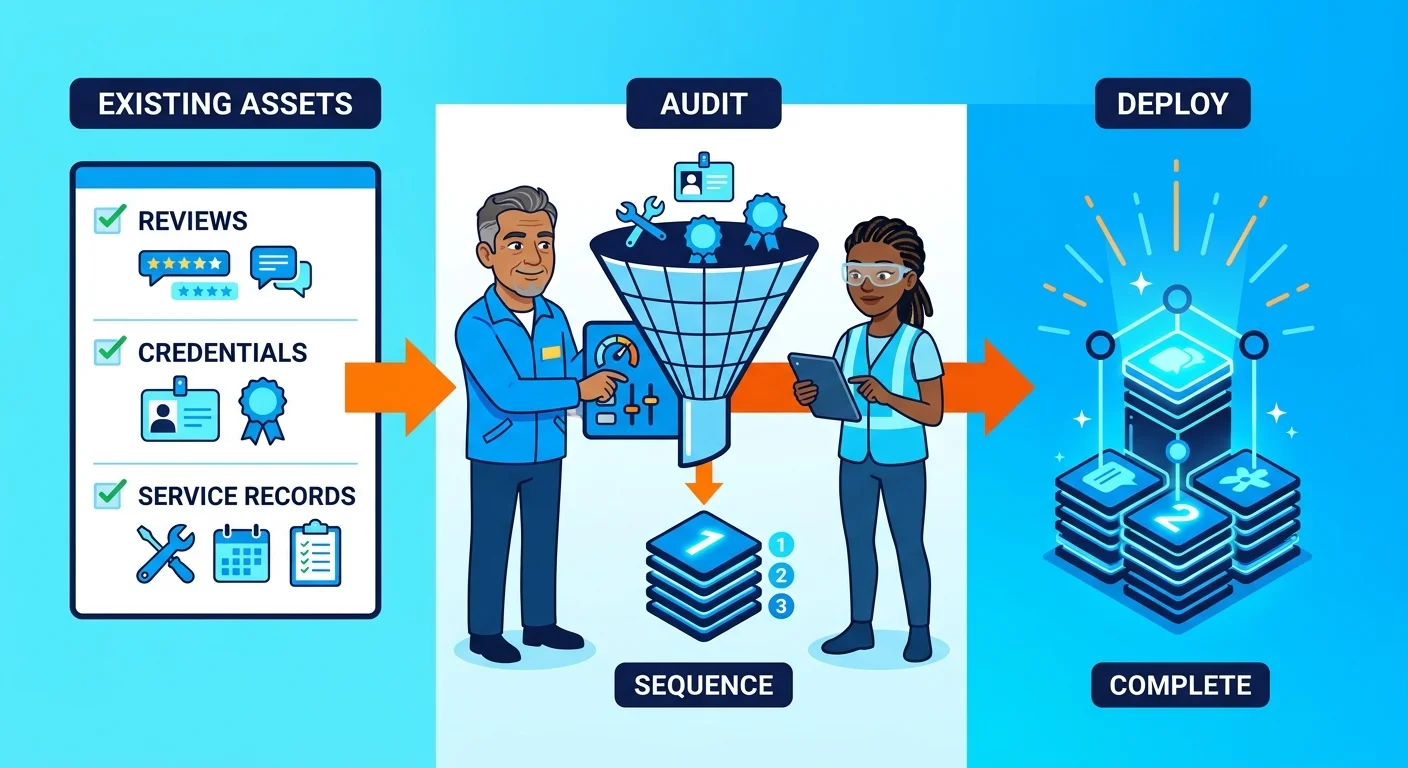
None of this starts with rewriting a homepage. It starts by treating the business you already run as raw material, waiting to be reshaped into evidence.
An auditable proof graph isn't some new asset you build from scratch. It's a machine-readable web of verifiable claims about your business, your services, and your track record — which means most of the raw material is already sitting in your files.
Mapping Your Existing Assets to Proof Nodes
Start with what's already in a drawer or a folder. Licenses, certifications, insurance paperwork, case files, client outcomes — every one of them is a proof node waiting to be structured.
Here's the catch: none of that counts as proof yet. It's a claim sitting there unverified, and that's exactly the gap a reasoning engine won't fill in for you.
The mapping part is easy to describe and real work to actually do. For every public claim your business makes, track down the document, the record, or the issuing authority that backs it up, and note where that backup lives right now.
Sequencing the Verifiable Layers Without Breaking What Already Works
Sequence matters, because a proof graph gets assembled in layers instead of dumped in all at once. Structured entity data goes first — it gives every layer after it something solid to attach to.
Credential links and signed claims come next, once the entity layer holds. Sign everything before the underlying data settles, and you're just re-signing the whole thing the second that data shifts.
None of this means tearing down a working site or ditching a listing that already pulls its weight. It means layering verifiable structure underneath what's already there — the way an exhibit binder gets built page by page, without ever asking the courtroom to close.
Frequently Asked Questions
Same objections come up every single time. So let's knock them out, straight.
What is a proof graph and why does my local business need one in 2026?
A proof graph is a machine-readable web of verifiable claims about your business, your services, and your track record. Local businesses need one because generative engines cite structured proof, not billboard copy, when they answer local questions.
How does a proof graph help my business show up correctly in AI Overviews and other generative answers?
Generative engines hit the retrieval step first, then check what they pull against connected, structured claims before citing a thing. A proof graph hands that retrieval step something concrete to confirm. That's what earns you a spot inside the answer.
Is a proof graph just another name for having good online reviews?
No. Reviews are just unstructured sentiment sitting on a page. A proof graph is structured, credentialed, signed data a machine can traverse — and good reviews alone aren't admissible.
What kinds of business information should be included in an auditable proof graph?
Include structured entity data, licenses and certifications tied to their issuing authorities, signed claims about outcomes, and mapped relationships to the parties who can back you up. Each layer answers a different verification question.
How does a proof graph protect my business's reputation from AI-generated misinformation or fake competitors?
Cryptographically signed claims prove who issued a piece of information and confirm nobody touched it afterward. That same signature model makes it a lot harder for fabricated competitor claims or AI-generated garbage to pass as legit proof.
Can I build a proof graph myself using schema, or does this require a specialist service?
Basic schema markup on structured entity data? A business can add that itself. But layering credential links, signed claims, and relationship mapping into one coherent graph is where most owners call in a specialist.
The Bottom Line
The internet's drowning in AI-generated content, and that's exactly why proving your claims programmatically stopped being a luxury. It's the ground trust stands on now. A billboard doesn't survive that. An exhibit binder does.
So the goal isn't placing in the classic ten blue links anymore. It's becoming the embedded, authoritative source inside the generative answer itself. That's a different game with a different scoreboard, and it rewards the businesses that build structure instead of chasing visibility.
The real question isn't whether your business has a story worth telling. It's whether that story survives cross-examination the second a reasoning engine goes looking for proof. iTech Valet built its process around exactly this kind of proof architecture, and the fastest way to see where you stand is to get your AI visibility checked.