
The Citation Collapse Nobody Is Talking About
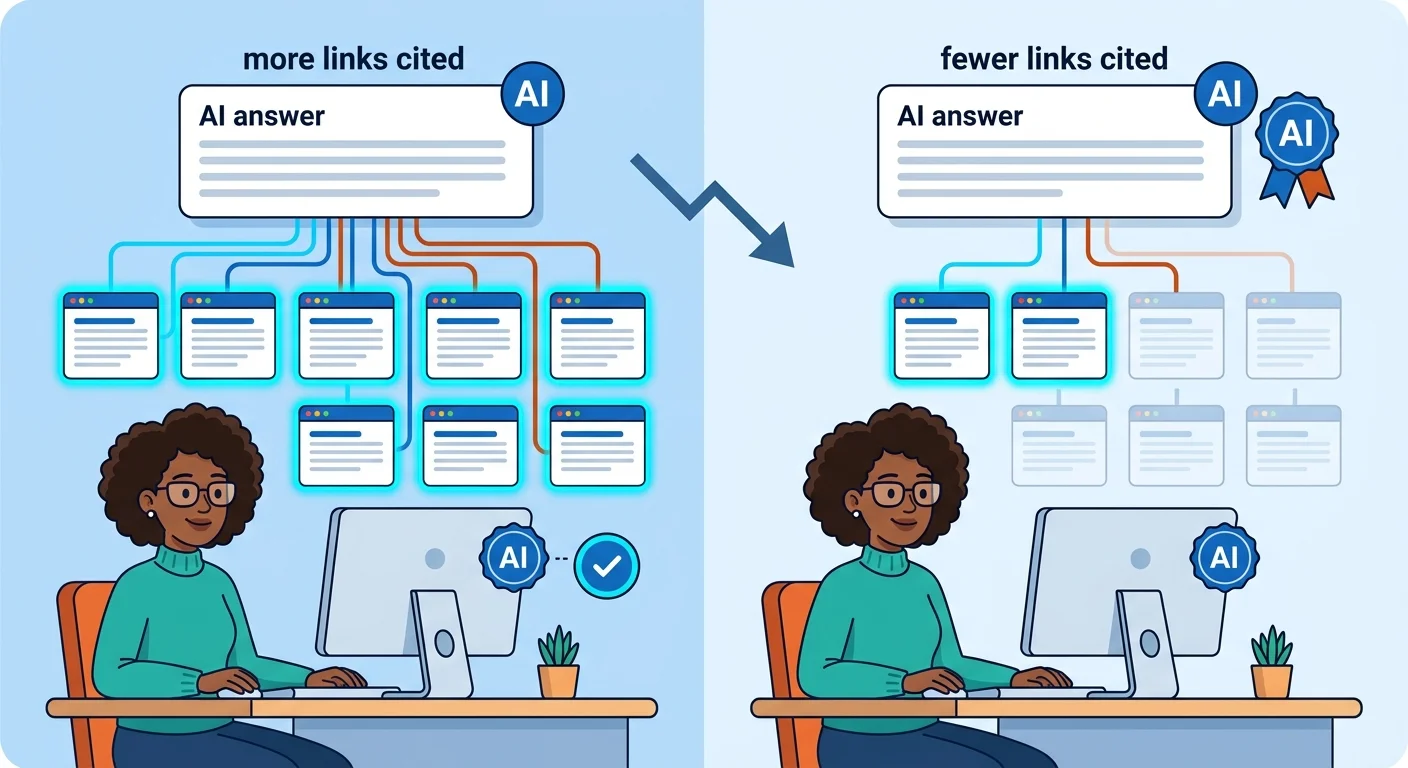
Here's the shift most businesses haven't clocked yet. Google's AI Overviews cited URLs from the top 10 search results just 37.9% of the time, down from 76% back in 2025. That's not a dip. That's a collapse in how often a well-ranked page even gets accepted as proof anymore.
So the courtroom changed its rules mid-trial. A page that used to win by sitting near the top? It doesn't even get called to testify now. The judge wants sworn evidence, not a good seat near the front.
And this tracks with a bigger pattern researchers keep flagging: the move from a list of links to a single synthesized answer is the biggest change in search behavior in over a decade. Businesses still optimizing for placement are fighting for relevance in a system that stopped asking who's closest to the front.
That's the citation collapse. Proof, once built, doesn't hold forever — it decays as models retrain and standards move, which is exactly why preventing proof decay and sustaining citation velocity is now its own discipline instead of a one-and-done task. According to Ahrefs' research, the businesses still trusted as sources are the ones whose evidence was built to be re-verified, not ranked once and left to rot.
Why Keyword-Chasing and Backlink Volume Are Failing You
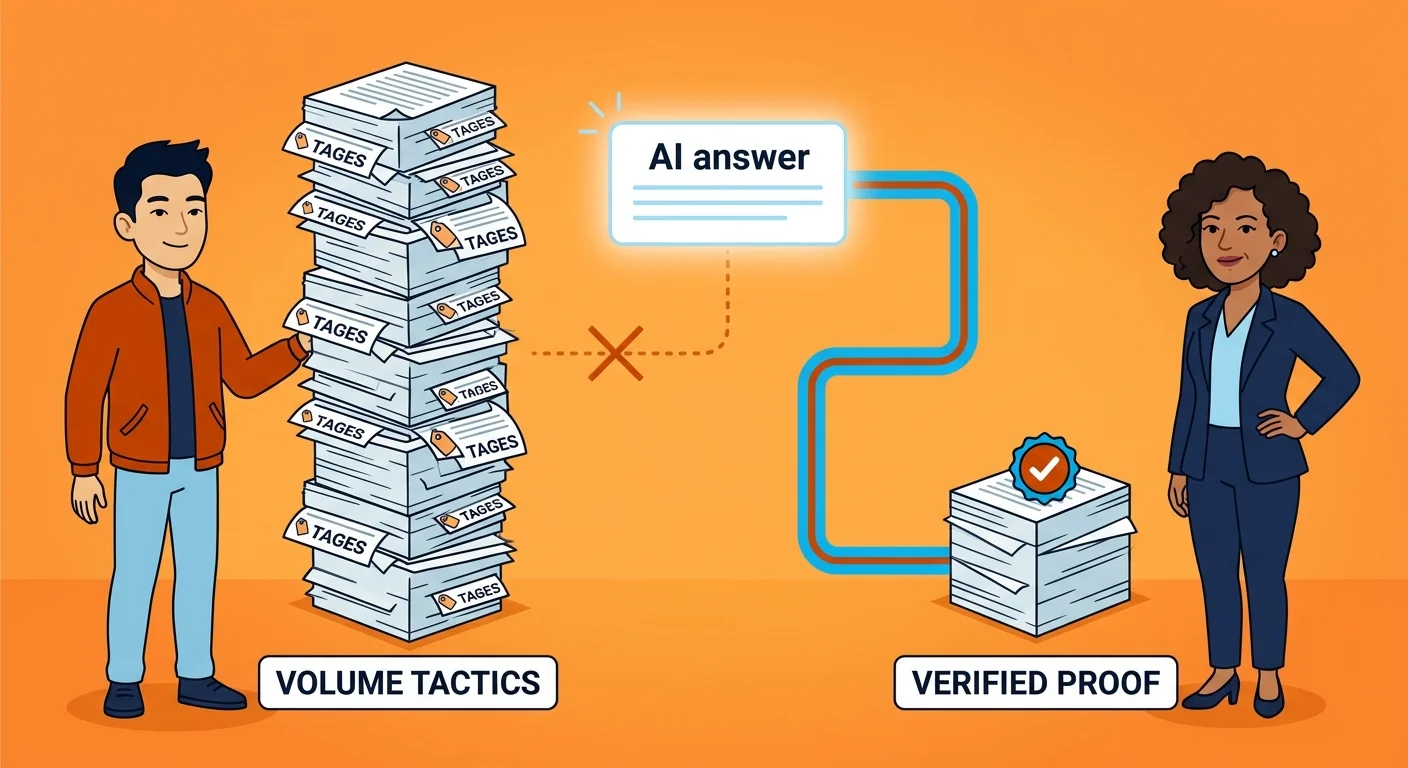
Let's call it straight: chasing keyword position tracking and acquiring inbound links means optimizing for a courtroom that already adjourned. Those tactics only ever won you a seat near the front of a ranked list.
But the judge stopped calling that seat as evidence. A page can rank beautifully and still get skipped when the system is building an answer instead of listing links.
So the failure isn't that these tactics got weaker. They were never built to answer the one thing a generative system actually asks — can this claim be verified?
The Problem With Optimizing for Ranked Lists
Here's the rejected method, plain and simple: treat placement as proof. Acquiring inbound links and keyword position tracking both assume visibility signals equal credibility signals.
And that's exactly backwards. A link points somewhere. It doesn't verify a single thing about what's actually there.
Look at how trust actually erodes, and the mechanism gets obvious. Even a page that once earned its placement can quietly lose standing, which is why understanding how outdated customer feedback stops earning AI trust matters as much as building new proof.
Static signals age. A backlink profile doesn't refresh itself, and neither does stale evidence in front of a judge who keeps re-checking the record.
Why More Keyword-Targeted Articles Won't Fix This
So the gut reaction is to publish more. More keyword-targeted articles, more volume, more surface area for the old ranking game.
That instinct reads the problem completely wrong. Volume was never the currency this system accepts.
A pile of unverified prose stays unverified, no matter how tall the pile gets. Without a machine-readable proof architecture underneath it, every new article is just more hearsay stacked on the last.
How Generative Engines Actually Decide What to Trust
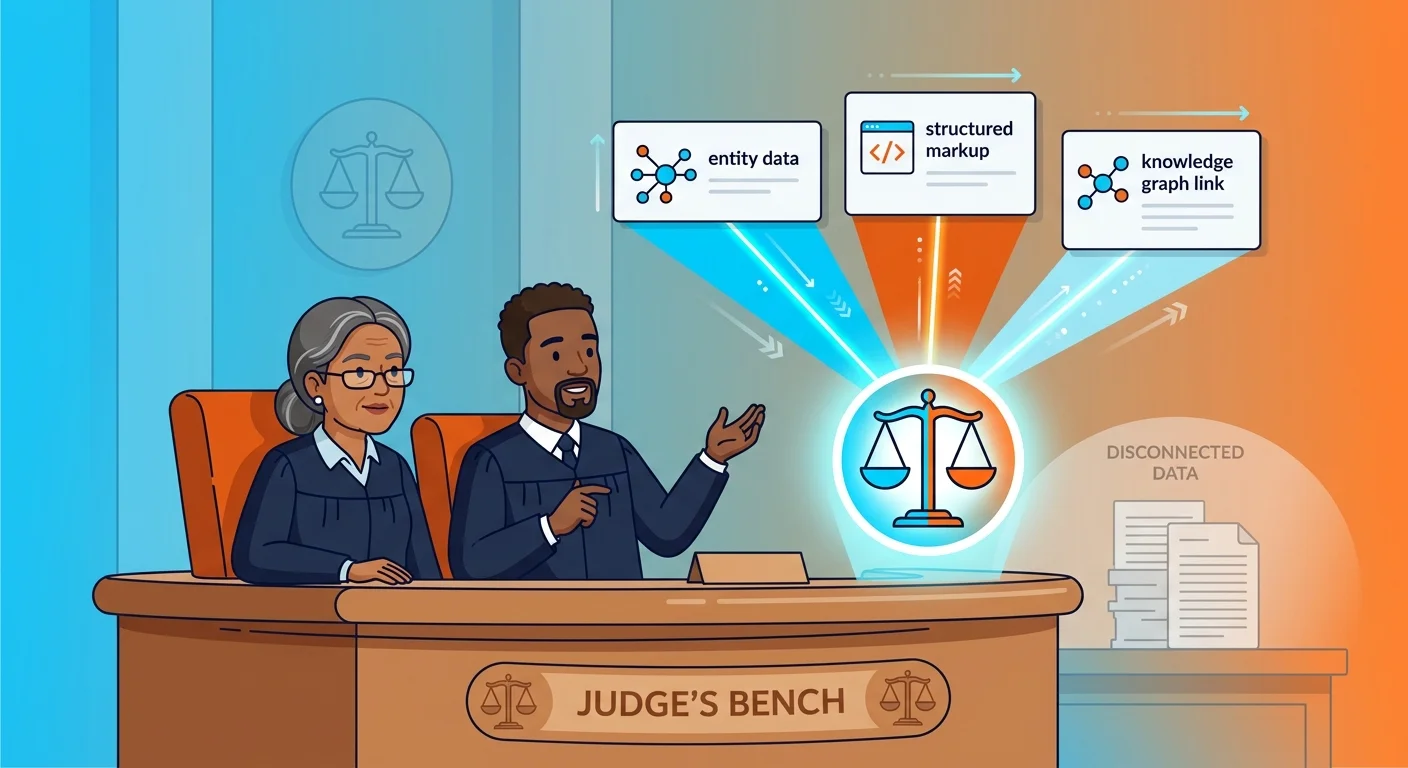
So what actually earns a citation, if placement doesn't? Generative engines weigh a claim the way a judge weighs testimony — by checking it against something else that already exists.
That something else is usually structured data. Google says so directly: it uses structured data found on the web to understand what a page is about, and to gather facts about entities like people, books, and companies.
Here's the mechanic worth sitting with. Markup isn't decoration around a page — it's the sworn statement the judge actually reads, separate from whatever prose surrounds it.
| Domain Type | Citation Influence Score | What This Signals |
|---|---|---|
| Encyclopedia | 0.2144 | Reference-style, entity-dense formatting reads as verified structure, earning the highest citation trust among domain types studied. |
| News Media | 0.0726 | Narrative reporting still appears often in source selection, but its looser structure earns far less programmatic trust than reference formatting. |
| Pages With Structured Markup | Not scored numerically in this dataset | Structured data lets the engine confirm entity details like people, books, and companies, rather than guessing from prose alone. |
| Pages Linked To Knowledge Graph Entities | Not scored numerically in this dataset | Retrieval frameworks like FrOG pull facts from knowledge graphs before answering, making the result more grounded and transparent. |
Where Entities and Knowledge Graphs Fit In
Entities are where this gets concrete. A generative engine doesn't just read a page — it tries to match what the page says to a thing it already recognizes.
That recognition runs through knowledge graphs. Research on retrieval-augmented frameworks like FrOG shows why it matters: pulling relevant facts from a knowledge graph before forming an answer makes the response more grounded, more transparent, and adaptable across languages and domains, according to published research data.
So an entity isn't a keyword. It's a verified node the system can point at and say, this claim traces back to something real.
That's the same reasoning behind structuring practitioner credentials so they read as verifiable entities, rather than leaving it as unstructured biography text a system has to guess at.
Why Structured Data Alone Isn't the Whole Answer
But structured data alone doesn't finish the job. It tells the engine what a page is claiming — it doesn't tell the engine how much to trust the page making the claim.
That's where domain type starts mattering more than most businesses expect. Across the AI Overview platforms studied, encyclopedia pages averaged 0.2144 in citation influence, while news_media pages averaged only 0.0726, according to the arXiv preprint server.
Look at what that gap actually says. It isn't that news is unreliable — it's that reference-style, entity-dense formatting earns more trust than narrative reporting does, and structured data is what makes that formatting legible to the machine in the first place.
Who Should Still Be Cautious Here

Reaction first: this isn't for businesses that want a fully automated front door and nothing behind it. Machine-readable proof architecture feeds the machine layer of trust. It was never built to replace the human one.
So the caution runs both ways. Even after the proof layer is built, 75% of Americans said they find humans much more helpful than AI when they need help on a business's website, according to published research data — and that matters for anyone tempted to rip out human contact entirely.
Here's the qualification: build the structured layer for the machines that synthesize answers, but keep a human reachable for the visitor who lands on the page anyway. Businesses chasing an all-machine experience are solving the wrong half of the problem, and the same split shows up when you weigh scattered star ratings against a properly structured trust stack — one earns the citation, the other still needs a person behind it to close the loop.
Building the Proof Layer: What Actually Belongs in It
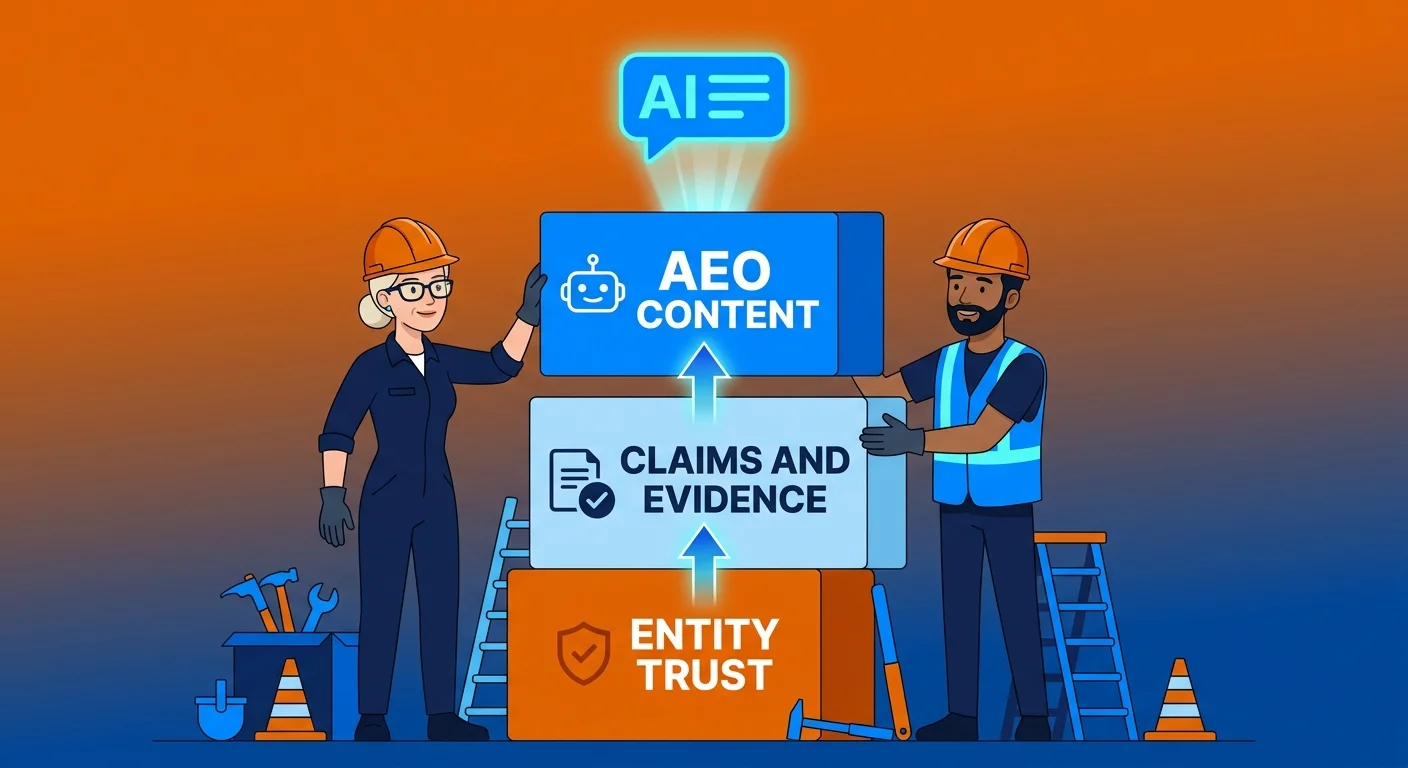
So what actually goes in this layer? Strip the theory away and a machine-readable proof architecture comes down to three things: verifiable claims, entity signals, and a structure that ties them together.
Here's the reaction first. Most businesses skip straight to publishing more prose and skip the proof underneath it entirely — that's building a case with no exhibits.
A judge won't accept a lawyer's summary as evidence. The underlying documents have to exist, and they have to be checkable — which is exactly what this section builds.
| Build Stage | Component | What It Establishes |
|---|---|---|
| Entity Groundwork | Structured identity signals tying the business to a recognized real-world node | That the entity making the claim actually exists and can be cross-checked, not just named |
| Claim Markup | Discrete, structured statements of fact separated from marketing prose | That a specific claim is verifiable on its own, independent of how well the surrounding page reads |
| Domain-Specific Documentation | Detailed, reference-style records extending entity and claim data into the business's actual specialty | That the business's expertise holds up under the kind of scrutiny a generative system applies before citing it |
| Verification Layer | Ongoing checks confirming existing claims and entities still hold after models retrain | That the proof stays trustworthy over time instead of aging into stale, unverified statements |
| Component | Traditional Approach | Proof Architecture Approach |
|---|---|---|
| Claims | Buried inside marketing prose, unstructured and unverifiable | Extracted into discrete, structured statements a system can check |
| Entities | Left as biography text the system has to guess at | Structured as recognized, real-world nodes tied to the business |
| Trust signals | Acquiring inbound links and keyword position tracking treated as proxies for credibility | Verified data grounded in something real, refreshed rather than left to age |
| Sequencing | Content published first, structure bolted on afterward if at all | Entity groundwork laid first, claims and documentation built on top of it |
Claims, Evidence and Entity Signals
Start with the claim itself. Every fact a business wants an AI system to cite has to live somewhere as a discrete, structured statement — not buried inside a paragraph of marketing copy.
And that's different from writing well. A gorgeous sentence can still be unverifiable, and unverifiable content gets read as opinion no matter how confident it sounds.
Entity signals do the next job. They tell the system the business making a claim is a recognized, real-world node — not an anonymous domain repeating text.
This is where the training-data problem sharpens the stakes. Researchers studying language models trained recursively on synthetic data found that model collapse can't be dodged when a model trains solely on that synthetic output, according to research published on the arXiv preprint server, though mixing in real, verifiable data below a certain threshold can help prevent it. That finding is the whole argument in miniature: systems degrade without grounding in something real, and a proof architecture is exactly that grounding, supplied on purpose instead of left to chance.
Sequencing the Build Without Wasting Effort
Sequencing matters more than most businesses assume. Build entity signals before claim-level markup and the claims have nowhere authoritative to attach to.
Flip it, and you get evidence with no verified source behind it. Either order wastes effort if it's reversed.
So the practical path starts with entity groundwork, moves into structured claims, and only then extends into domain-specific documentation — the same logic behind turning treatment results into structured, machine-checkable data rather than leaving outcomes as unstructured narrative a system has to interpret on its own.
Frequently Asked Questions
So here's where the theory runs into the questions readers actually walk in with. The courtroom metaphor is handy — but nobody builds anything off a metaphor. What follows is the tactical stuff: scope, mechanics, and what happens next.
What is machine-readable proof architecture in simple terms?
It's a foundational layer of verifiable data that lets AI engines consume, understand, and cite a business's expertise without a human interpreting it first. Think sworn testimony, not a lawyer's summary.
How is this different from just adding structured data or schema markup?
Schema markup is one piece — not the whole thing. A full proof architecture also needs verified entity signals and discrete, checkable claims. Structure alone won't establish trust in what's being claimed.
Will AI Overviews stop linking to websites entirely?
No. But the bar for earning a link is changing. Citation now hangs on whether a claim is verifiable, not on where a page sits in a ranked list.
What's the first step a business should take to make its claims machine-readable?
Start with entity groundwork, before anything else. Claims need an authoritative, recognized entity to attach to. Skip it, and the system has evidence with no verified source behind it.
Can traditional content marketing still work for AI-driven search engines?
Content still matters. But unverified prose reads as opinion to a generative system. Traditional content marketing works only when it sits on top of a machine-readable proof architecture — never instead of one.
How does a proof architecture affect a company's knowledge graph entity?
It strengthens the entity by handing the system verified, structured facts to match against. That's the same recognition mechanism Google already uses to gather information about people, books, and companies through structured data.
The Bottom Line
So here's the verdict: the courtroom never reopened for content that can't back itself up. Evidence gets cited. Hearsay gets ignored.
So the choice in front of every business is narrower than it looks. Keep arguing for attention with tactics built for a ranked list, or start building the sworn record a generative system can actually check. One side keeps competing for a seat that no longer counts as proof.
That's the whole thesis in one line: durable authority now belongs to whoever built the machine-readable proof architecture first, not whoever wrote the most about it. The businesses still standing when models retrain will be the ones whose claims were verifiable before it mattered. If you want to know where your own evidence stands, start with an AI visibility check.