
What Counts As Structured Data on a Clinic Article
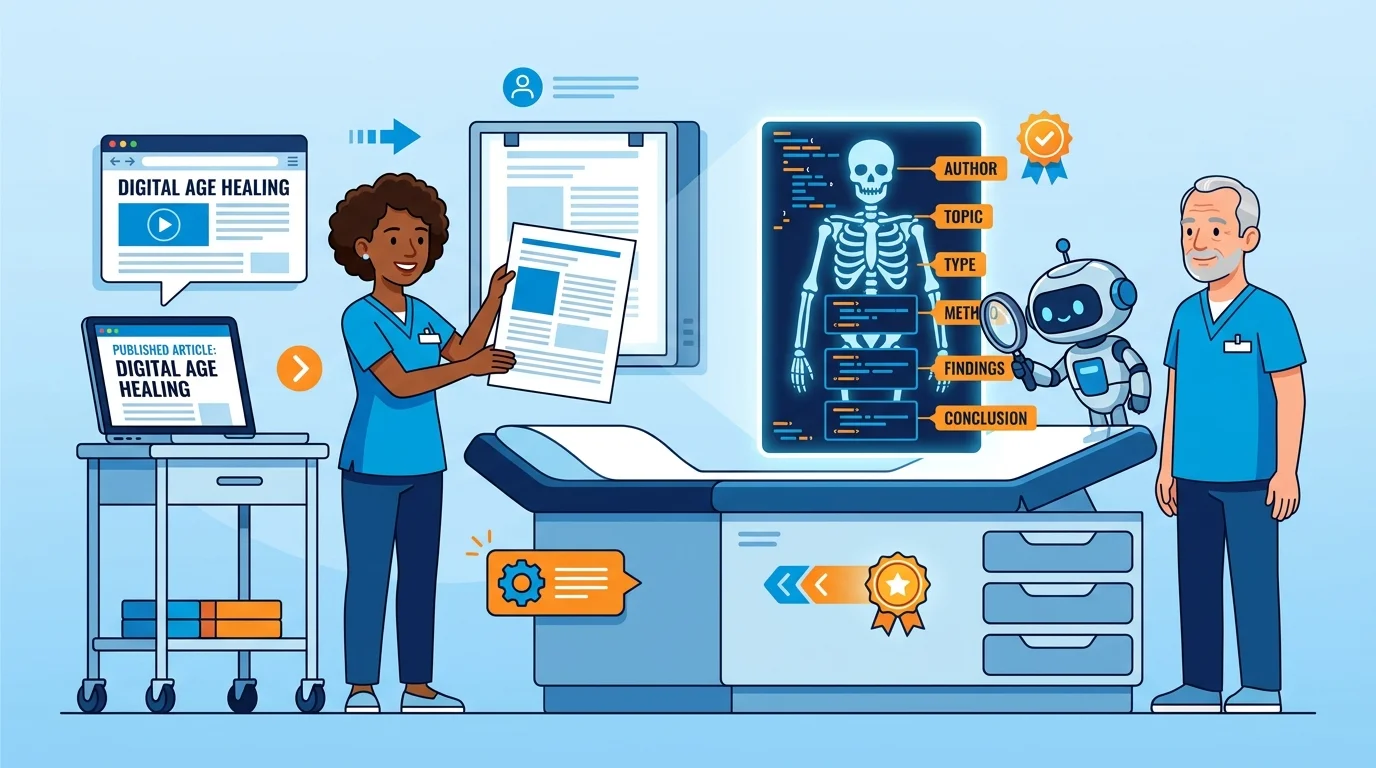
So what's the actual name for this hidden layer? Structured data. Most of the time it's built with the Schema.org vocabulary, a shared library of labels that tells a machine exactly what each piece of content is.
This code stays invisible to anyone reading the article on screen. What it does instead is give an AI assistant explicit context about the page: who wrote it, what it claims, and which specific entities it discusses. That explicit context is the difference between a machine guessing at meaning and a machine extracting it directly, a distinction covered further in how standalone articles earn AI citations on an existing site.
Why Most Clinics Publish Articles an Assistant Still Can't Parse
Here's the thing: most clinic articles are written for a human eye, not a machine reader. They look great on screen. But they carry none of the labels an assistant needs to confirm what the page is actually claiming.
For an AI assistant to understand and cite a new clinic article, the content needs to be framed in a language the AI is built to understand. Prose alone does not supply that language, no matter how clearly it reads to a person.
Why Plain Text Alone
Plain text leans on cues a person picks up without even thinking about it: context, tone and layout. A machine gets none of them.
So an assistant scanning unstructured prose has to guess which sentence is the credentialed claim and which one's just background color. That guess is slower than a labeled extraction. And it's a whole lot less likely to end in a citation.
The Volume Trap in Clinic Content Calendars
Look, plenty of clinic content calendars chase volume, pumping out article after article on a rotating set of topics. The bet behind that habit? More published pages means more visibility across AI-generated answers.
That assumption does not hold once answers are generated rather than ranked. A content library without structured data produces more unlabeled pages for an assistant to guess at, not more cited pages. The real gap closes through in-house versus outside help for markup implementation, not through another unlabeled article added to the stack.
How an Assistant Actually Reads a Marked-Up Article
An AI assistant doesn't open a clinic article and read it top to bottom like you would.
Authority you own compounds. Attention you rent on an unlabeled page expires the second the assistant moves on to the next result.
| Retrieval Step | What the Assistant Does | What the Code Supplies |
|---|---|---|
| Parsing the markup | Locates the structured data block | A labeled map of author, claims, dates, and entities, ready for extraction without interpretation |
| Resolving entities | Matches named entities in the markup against what it already knows, confirming who or what the article discusses | Explicit entity labels instead of a name the assistant must guess at from surrounding sentences |
| Weighing the claim | Checks whether the medical claim is attributed to a credentialed author or source before treating it as citable | Author and credential markup that ties the claim to a verifiable source |
| Deciding to cite | Compares the labeled page against unstructured competitors answering the same question | A structured, extractable answer |
From Crawling to Citation
According to Google's documentation, Google states that AI Overviews and AI Mode have no additional technical requirements beyond being indexed and eligible to be shown in Search with a snippet. For AI Overviews and AI Mode eligibility, that means a page already indexed and eligible for a standard snippet carries no extra hurdle to clear. The remaining question is whether its markup gives the assistant something worth citing, a question this article's companion piece on tracking indexing and citations after publishing answers directly. Google's structured data guidelines say markup must be a true representation of the page content, and not to mark up content that is not visible to readers of the page.
The Schema Types That Matter Most to a Clinical Article
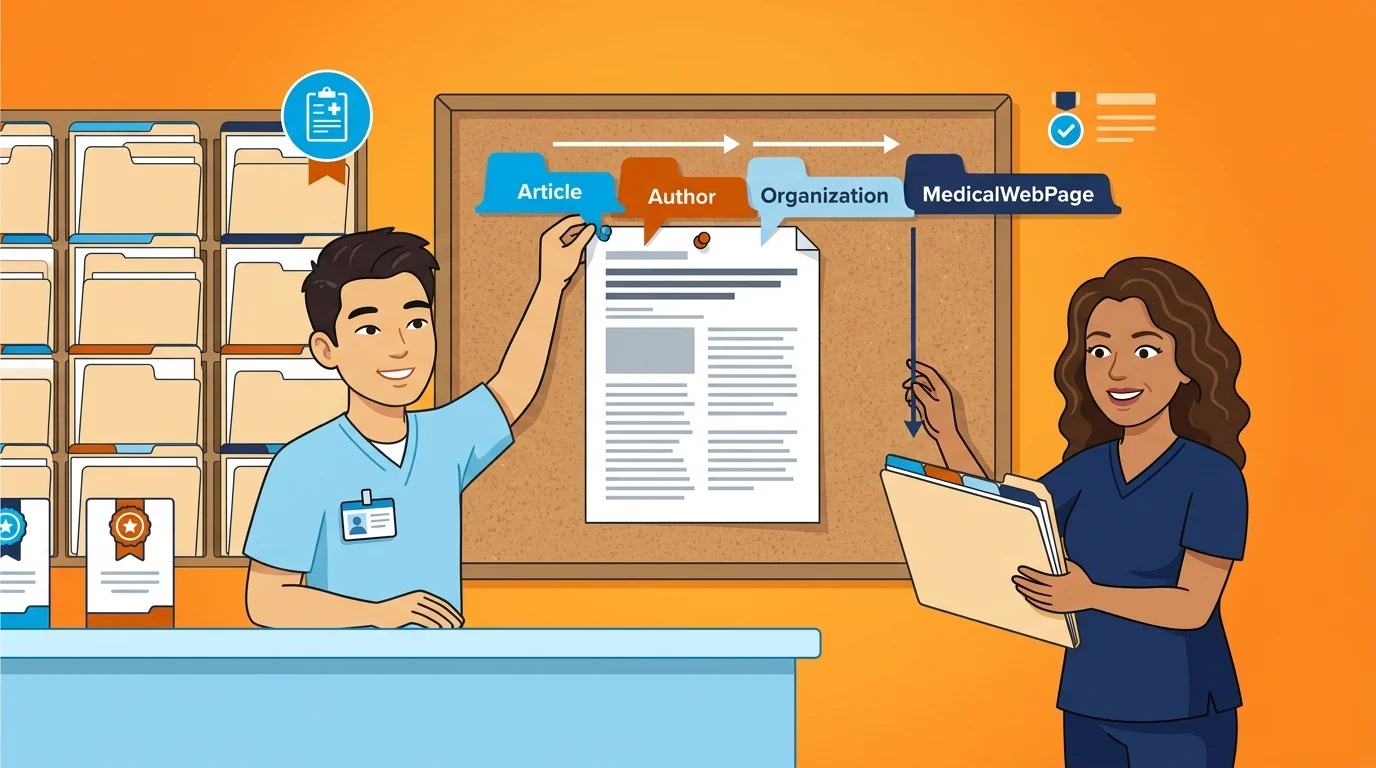
Not every schema type pulls equal weight on a clinical article. Some label who's behind the page, while others label what the page actually says.
| Schema Type | What It Tells the Assistant | Where It Belongs on the Article |
|---|---|---|
| MedicalWebPage | Confirms the page covers a medical topic and defines its clinical specialty for the assistant | Wrapped around the full article, naming the overall subject the page addresses |
| Article | Labels the publication date, headline, and topic so the assistant can place the content in time | Applied at the top level of the piece, alongside MedicalWebPage markup |
| Author | Identifies who wrote the claim, separating a credentialed statement from an anonymous one | Nested inside the article markup, tied directly to the named writer |
| MedicalOrganization | Tells the assistant which practice stands behind the content and its credentials | Linked to the author entry, anchoring the claim to an accountable organization |
| FAQPage | Breaks a question-and-answer section into discrete, extractable pairs | Wrapped around the FAQ section only, never the body prose above it |
Entity and Authorship Markup
Author and MedicalOrganization markup tell an assistant exactly who stands behind the claim. That attribution layer is the line between a credentialed statement and an anonymous one. It's a distinction our AI search optimization services build into every clinic deployment.
Article and Medical Context Markup
Now, Article and MedicalWebPage markup label the content itself: the topic, the publication date and the medical specialty. Stack them together and the assistant gets a translation instead of a guessing game.
Where a Clean Architecture Still Breaks
Clean markup still breaks in two spots: when it contradicts what a visitor actually sees, and when a publishing pipeline treats it as optional. Either way, the assistant ends up holding a page it can't trust. And no, AI visibility isn't old-school search work with new vocabulary, but the accuracy bar that once applied to meta tags now applies to every line of schema.
When Markup Contradicts the Visible Page
Markup that claims one author while the byline shows another gives an assistant conflicting signals. Faced with that conflict, the assistant has reason to discount both the label and the page. A mismatch like this does not just confuse a crawler. It can work against a page that otherwise qualifies.
When a Content Pipeline Treats Markup as an Afterthought
Pipelines that bolt schema on after publication, whenever somebody remembers, leave a site's library with uneven labels: some pages fully marked up, others bare, and no way for an assistant to tell which ones were simply skipped. Google's documentation says crawling to pick up new site name structured data can take anywhere from several days to several weeks, depending on how often Google's systems determine content needs to be refreshed. So for site-name markup, the delay stacks right on top of the inconsistency, because a skipped page stays unlabeled until someone finally notices and fixes it.
Building the Structured Data Into a New Article Step by Step
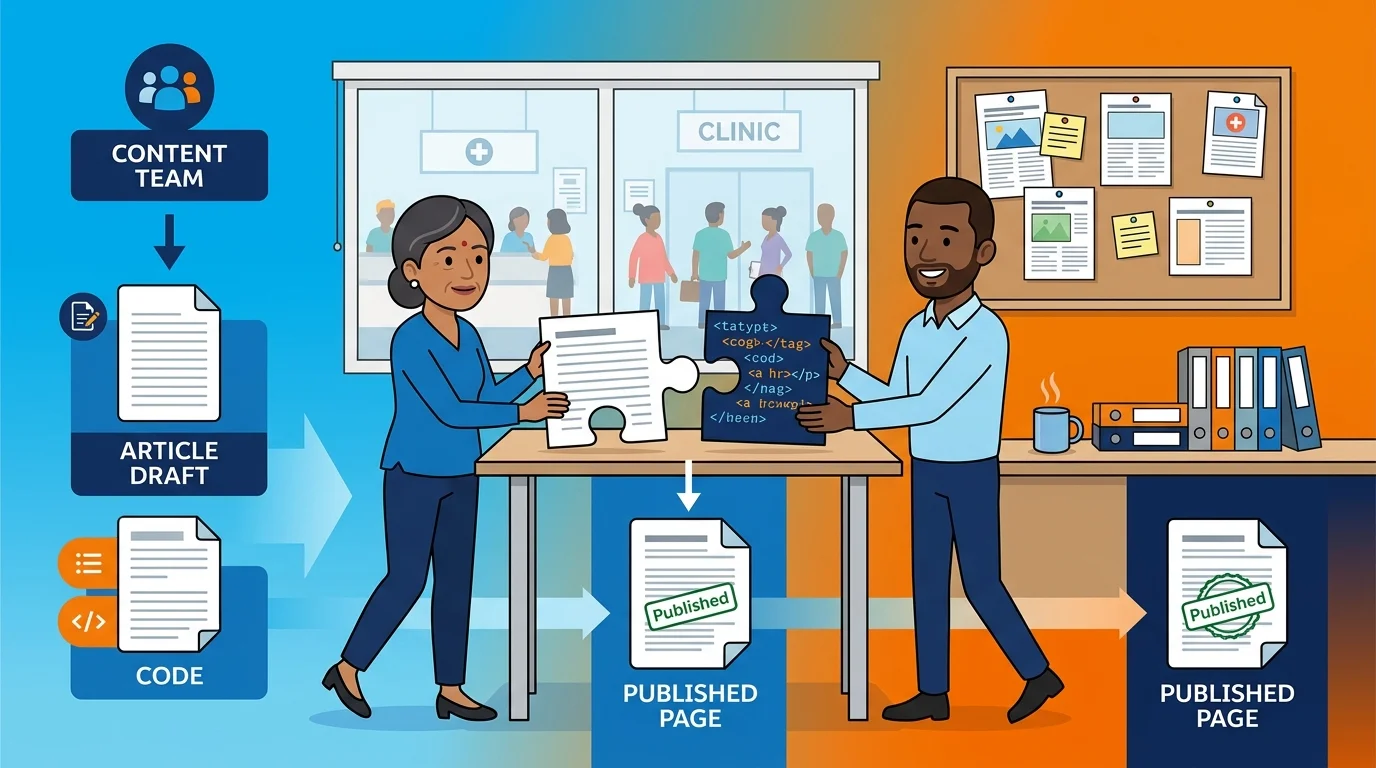
Building markup into a new clinic article follows a sequence, not an afterthought. The code and the prose get drafted together, validated once, then published as a single unit.
| Build Stage | Task | Common Mistake |
|---|---|---|
| Drafting | Writer and developer build the article and its matching schema in parallel, labeling the same author, claims, and publication date the prose states | Schema added after publication, as a separate step disconnected from the writing process |
| Entity Labeling | Assign Author and MedicalOrganization markup to attribute credentials, then Article and MedicalWebPage markup to label topic and specialty | Copying a generic schema template from another page without updating the entities to match this article |
| Validation | Test the markup against Schema.org's structure and check it line by line against the visible article | Publishing markup that claims something the visible page does not show |
| Publishing | Release the article and its schema together as a single unit, so no page goes live unlabeled | Treating markup as optional under deadline pressure, leaving some articles labeled and others skipped |
| Maintenance | Monitor the library for pages missing markup and correct mismatches between byline and schema | Assuming a one-time markup pass covers every future update to the article |
Drafting the Markup Alongside the Article, Not After It
A writer drafts the article. A developer or a trained staff member builds the matching schema alongside it, labeling the same author, the same claims, the same publication date the prose already states. I tell docs the same thing every time I build this into a clinic's pipeline: markup written after the fact is markup that gets skipped once deadlines tighten.
Validating Before Publishing
Before anything goes live, the markup gets tested against Schema.org's own structure and checked line by line against the visible article, because nothing in the code gets to claim what the page doesn't show. Once that check clears? The article publishes with its translation already attached, instead of hoping an assistant guesses right.
Frequently Asked Questions
Once the schema talk gets specific, the same mechanical questions keep popping up. Here are the straight answers.
What is structured data and why is it essential for AI assistants?
Structured data is machine-readable code wrapped around a page's content. It tells an AI assistant what the content means, rather than leaving it to infer meaning from layout alone.
What's the difference between JSON-LD, Microdata, and RDFa?
JSON-LD is a script block separate from the visible page, which is why Schema.org favors it. Microdata and RDFa embed the same labels directly inside HTML tags, which makes them harder to maintain without breaking the markup.
How quickly will AI assistants and search engines recognize new structured data on a clinic article?
There is no fixed clock here, since eligibility for an AI-generated answer depends on a page already being indexed and eligible for a standard search snippet. Beyond that threshold, recognition is a matter of a system revisiting the page, not an additional technical bar to clear.
Can using the wrong schema markup negatively affect a clinic's visibility in generative answers?
Yes. Markup that contradicts the visible page gives an assistant conflicting signals, and the assistant has reason to discount both the label and the page itself.
Which specific schema types are most critical for a medical or clinical article?
Author and MedicalOrganization schema establish who stands behind a claim. Article and MedicalWebPage schema label the content itself, covering topic, publication date, and medical specialty, so the two layers together hand an assistant a complete translation rather than a partial one.
The Bottom Line
A clinic article without structured data is a listed address. It sits in the index, waiting to be found, hoping an assistant reads the prose correctly and guesses right about who wrote it and what it claims.
A clinic article with structured data is a cited source. The markup hands the assistant a translation instead of an inference, and that translation is what gets quoted back to the person asking the question.
That difference is the whole thesis of this article, and it does not resolve itself. If a practice wants its new content treated as an authority rather than an afterthought, the markup has to be built in from the first draft, not bolted on once a page is already live. iTech Valet's AI Visibility Check is where that conversation starts.