
What Actually Happens in the Hours and Days After You Hit Publish
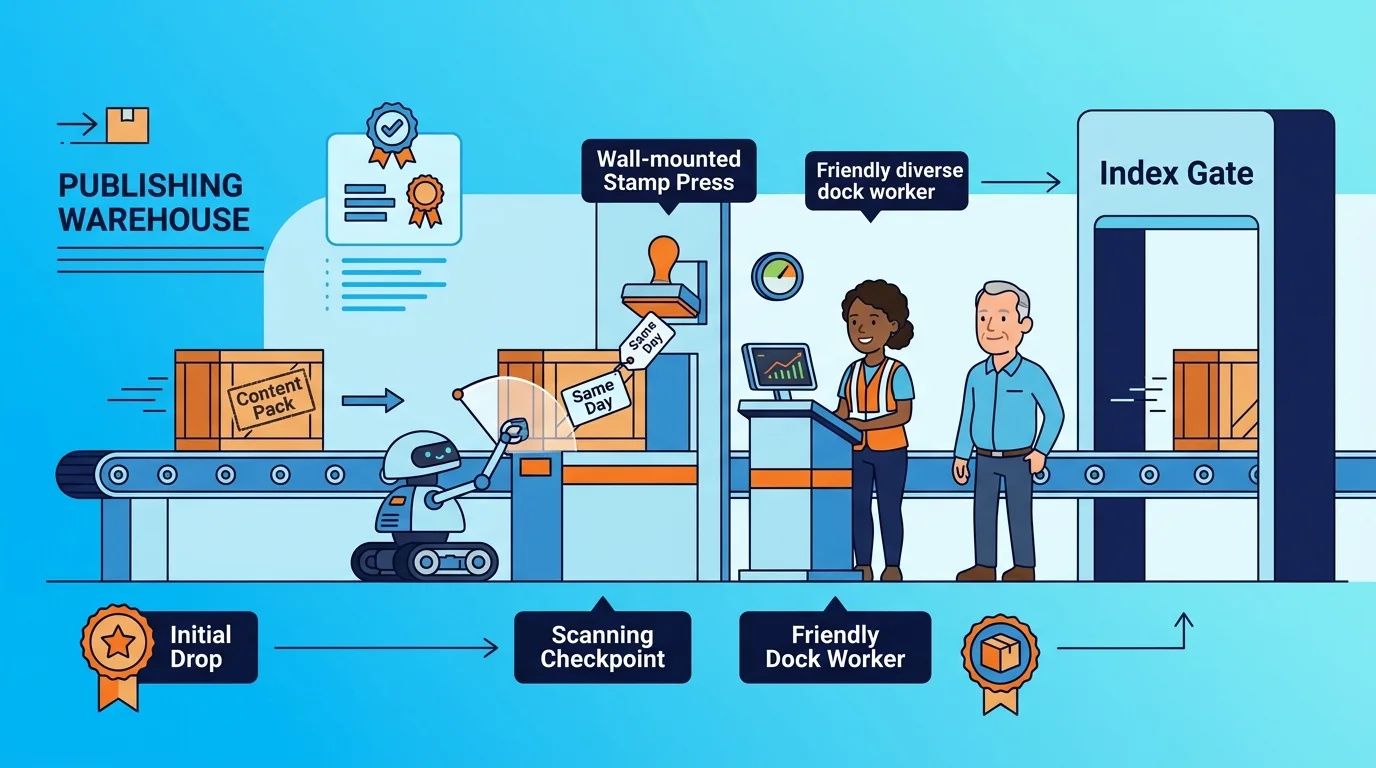
So what actually happens first? A standalone content pack, meaning a set of articles added to an existing site, often one running an older or less integrated CMS, gets crawled before anything else occurs.
But crawling is not the same as appearing anywhere useful. Here's the thing: a crawler discovering a page is only the opening move in a longer evaluation.
That process, of discovery, parsing, and judgment, is what determines whether the page ever becomes something search systems treat as a usable source. Before chasing that outcome, it helps to understand what a clinic should know before pursuing AI citations.
Why 'It's Indexed' Gets Treated as the Finish Line
Why does everyone stop at indexing? Because it used to be the finish line: once a page sat in the index, it could show up in the classic ten blue links, and that was the whole game.
That assumption is dead, and an indexed page is only a candidate for citation, not a guaranteed participant. So the industry habit of calling it done once a URL gets indexed misreads what modern search actually rewards. Being listed and being cited are two separate outcomes.
Why Chasing Page Counts Fails as a Publishing Strategy
More content equals more visibility is a holdover from an era when sheer page volume correlated with search position reports. That correlation has broken down as answer engines prioritize structural clarity over page count.
A content pack built around fitting new clinical writing into an existing CMS still has to earn citation through structure, not through quantity alone.
Google's documentation says Google cannot make predictions about when or whether a site's URLs will be crawled or indexed, since crawling and indexing take time and depend on many factors.
That uncertainty is the same uncertainty every publisher faces after hitting publish. No system promises a timeline, and no volume of pages forces the outcome.
So the practical move is structuring each page to be understood, not padding a site with articles chasing rank-tracking reports. There is more on fitting new clinical writing into an existing CMS if this is the part that matters to you.
Why Counting Indexed Pages Misses What AI Engines Actually Reward
Counting indexed pages treats visibility as a numbers game. That habit carries over from traditional search optimization, where more indexed URLs often meant more chances at placing in traditional ranked results.
An index does not weigh pages, it stores them. What gets cited in a generated answer depends on whether the system can parse the page well enough to trust it as a source, something technical snippets that make articles machine-readable are built to support.
Publishing a standalone content pack is just the first step in a much longer process of getting that information recognized and used by search engines. A high page count never substitutes for that structural work.
| Old Signal Tracked | What It Actually Measured | What AI Engines Evaluate Instead |
|---|---|---|
| Indexed page count | Whether a URL existed in the index, treated as a proxy for total visibility across a site | Whether the page is structured clearly enough to be parsed, trusted, and pulled into a generated answer |
| Rank-tracking reports | Position within traditional ranked results for a specific keyword phrase | Whether the content answers the underlying question well enough to be cited directly, regardless of position |
| Page volume on a site | Raw quantity of published articles as a stand-in for authority or topical coverage | Depth of entity definitions and logical structure within each individual page, not how many pages exist |
| Classic ten blue links placement | A single ranked slot among competing results for one search query | Inclusion inside a synthesized answer, where only the clearest source gets cited at all |
What Separates a Page That Gets Crawled From One That Gets Cited

A crawled page and a cited page are built differently. Crawling asks for almost nothing (a crawler just has to reach the file and parse it).
Citation asks for a lot more. A system has to understand what the page is about, who it concerns, and why it deserves trust as a source. That gap is right where most standalone content packs stall out.
| Page Format Element | What It Adds | Measured Accuracy Gain |
|---|---|---|
| JSON-LD markup alone | Labels page type and basic fields for crawlers | Modest improvement only |
| Entity-defined headings and clear subject framing | Tells an answer engine what the page is about, not just that it exists | Not isolated in testing, but part of the fuller structural approach that shows substantial gains |
| Breadcrumb structure | Shows where the page sits relative to related entities on the site | Contributes to the fuller format's measured gain rather than standing alone |
| llms.txt-style agent instructions | Gives automated readers explicit guidance on how to parse and use the page | Part of the enhanced format shown to reach a 29.6% accuracy improvement for standard RAG retrieval |
| Neural search capability support | Lets retrieval systems match the page against a query by meaning, not just keyword overlap | Included in the same enhanced format measured against JSON-LD alone |
Entity Page Formatting
Entity page formatting is the structural layer that closes that gap. It defines the page's subject as a distinct entity instead of leaving it buried in a block of prose. Clear headings, explicit definitions, and markup that names exactly what the page describes do that work.
So the format itself becomes part of the evidence. When a page states its entity clearly, ties it to related concepts, and shows that structure to machine readers, an answer engine gets a real reason to pull from it over a competing source.
Why Thin Structured Data Alone Falls Short
Cheap retainers built on thin structured data treat a single schema tag as the whole job. That shortcut persists because it is inexpensive to apply and easy to sell as complete, and it is exactly the trap the broader market keeps resetting to whenever page count gets mistaken for structure.
But the measurement says otherwise. A WordLift test on retrieval accuracy found that JSON-LD markup alone provides only modest improvements, while an enhanced entity page format incorporating llms.txt-style agent instructions, breadcrumbs, and neural search capabilities achieved a 29.6% accuracy improvement for standard RAG retrieval across tested domains on Vertex AI. In its own test, WordLift reports adding an enhanced entity page format with llms.txt-style agent instructions, breadcrumbs, and neural search capabilities may yield a 29.6% accuracy improvement for standard RAG retrieval.
That gap is the measurable cost of treating structured data as a checkbox rather than an architecture. It's why our authority infrastructure services are built around the fuller format rather than the minimal tag. There is more on authority infrastructure services if this is the part that matters to you.
How a Flawed Publishing Habit Quietly Erodes a Content Pack's Return
Cheap retainers built on thin publishing schedules don't blow up overnight. They bleed out slowly: a page goes live, gets crawled, maybe even indexed, and the retainer calls that a win. Nothing in that chain proves the page was ever built to be cited.
So why does the model survive? Because the early signals look healthy, with indexed-page counts climbing and reports full of activity, while the gap stays hidden until months later, when not one page in the pack has surfaced in a generated answer. By then the retainer's already been renewed on metrics that never measured citability at all.
The Operational Sequence for Making a New Article Pack Machine-Readable
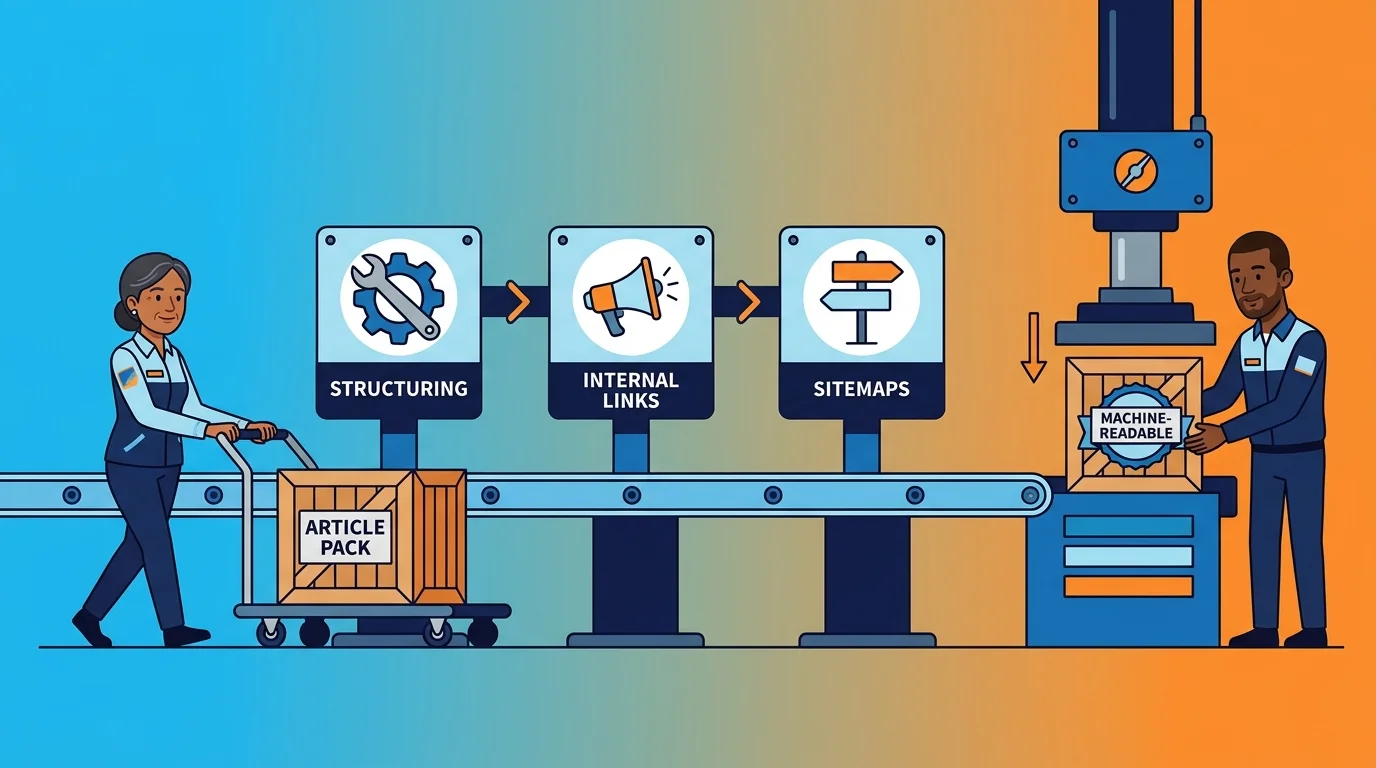
So how do you actually move a page from crawled to cited? The failure mode above already hands us the fix: structure is the deliverable, not something you bolt onto finished prose at the end.
That means sequencing the work in a specific order. Define the entity first, structure the page around that definition second, then signal its importance to the systems deciding what to trust.
| Step | What It Does | Why It Matters for Citation |
|---|---|---|
| Publish and crawl discovery | The new article or page goes live and a crawler locates and parses the file | Confirms the page exists to automated systems, but says nothing about whether it will ever be trusted as a source |
| Entity definition | The page states clearly what subject, service, or concept it is actually describing, using unambiguous terms before any supporting prose | Gives an answer engine a fixed concept to attach the page to, instead of forcing it to infer the subject from scattered text |
| Structural formatting | Heading hierarchy, explicit definitions, and machine-readable markup are built around the entity definition rather than bolted onto finished copy | Turns the format itself into evidence, making the page easier to parse with confidence rather than guesswork |
| Internal signaling | Pages the site already trusts link back to the new article, pointing authority toward it | Tells the system the new page belongs to an established, credible cluster rather than sitting isolated |
| Ongoing evaluation | The page is reassessed over time against competing sources on the same subject | Decides whether the page remains a candidate for citation or gets passed over once better-structured competitors appear |
Structuring the Page
Structuring a page starts with naming what it's actually about, in plain, unambiguous terms, before one line of body copy gets written. The heading hierarchy should mirror that definition, not just chop up text so it looks nice.
Now, explicit definitions, consistent terminology, and markup that names the subject all point at the same entity. Build a page that way and an answer engine gets something firm to parse instead of prose it has to guess at.
Signaling the Page's Importance
But a structured page still needs signals pointing back to it from pages the system already trusts. An isolated article, however clean the formatting, has to earn its way into the site's existing authority (nobody hands it that on day one).
Frequently Asked Questions
Once the structural work gets rolling, a few mechanical questions tend to pop up. Here are the straight answers.
How long does it take for Google to find and index a new content pack after I publish it?
There is no fixed timeline. Crawling and indexing depend on many factors, and no system promises when or whether a given page gets included.
Can I do anything to speed up the indexing of my new content pack?
Not by forcing the system. But clear entity structure gives crawlers a stronger reason to parse the page. Links from pages the site already trusts help it surface sooner.
How can I check if my new articles have been indexed by search engines?
Site-level indexing tools tell you whether a URL is indexed. But that status only confirms discovery. It says nothing about whether an answer engine treats the page as citable.
What's the difference between my content being crawled and indexed?
Crawled means a system reached the page and read it. Indexed means it got stored for possible retrieval. And neither one means the page has been cited.
Does a higher page count in a content pack lead to more AI citations?
No. Page count correlates with old-school search work, not with answer engine citation.
The Bottom Line
A new hire doesn't earn trust just by getting a desk. They show they can do the work, people notice, and only then does anyone lean on them. A page published on a chiropractor's site runs the exact same arc.
Publishing hands the content a desk, not a diploma. The diploma is citation, and it only shows up after the page proves it can be parsed, trusted, and pulled from. That proof lives in structure, never in page count or how often you hit publish.
So the real work starts after the publish button, not before it. If a clinic's content pack needs that structural case made for it, talk it through with us.