
What Actually Happens Inside an AI System When Your Clinic Changes Its Name
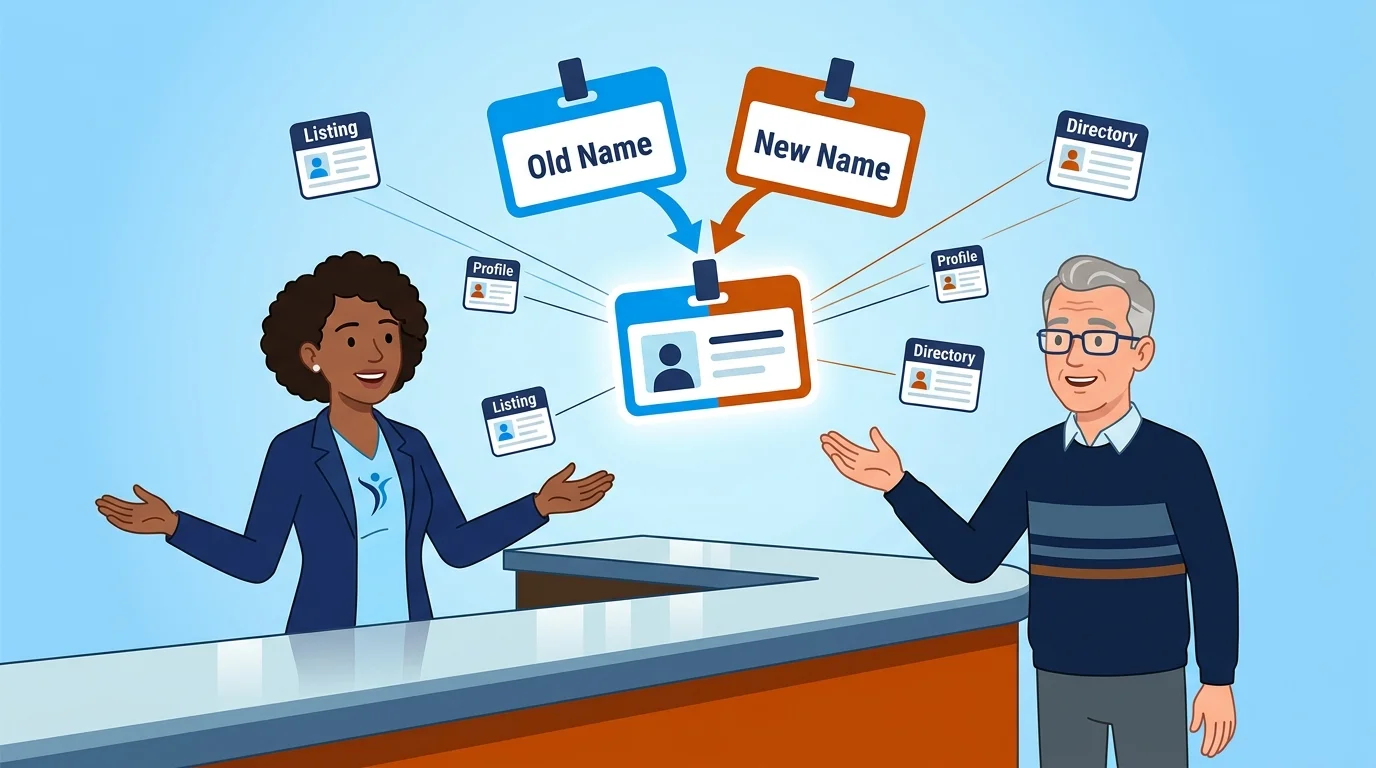
Here's the thing: entity resolution sits underneath every AI recommendation a clinic ever gets. Before a system can answer anything about a local practice, it has to decide which real business a name, address and phone number actually describe. A rebrand drops two candidate identities into that decision at the same time.
So the machine has to pick: merge the old and new records into one entity, or treat them as two competing clinics. Now… this part matters, because that pick can decide whether the new name inherits the authority the old one spent years earning. Or whether it starts from zero.
How Machines Cluster Your Old and New Identity Into One Record
Machines don't read a rebrand announcement and nod along. They may cluster records on overlapping signals like matching address, matching phone number and matching structured markup across sources, the exact ground the guide to clinic entity infrastructure repair walks through. Line those signals up tightly enough and the old and new names can resolve into one entity instead of two strangers.
Let's keep it real: treating AI visibility as old-school search work with new vocabulary misreads what's actually being measured here. Rank-tracking reports never once asked whether a machine could resolve a clinic into one coherent identity. Entity resolution does, and it rewards consistency across sources, not placement on any single page.
Why Updating Only the Website and Google Profile Leaves the Record Broken
The common shortcut treats a rebrand as a two-step job: update the website, update the Business Profile, done. Posting more to those two sources sure feels like progress. It isn't, because volume was never the measure that matters here.
A clinic can rewrite its homepage and its profile a dozen times over, and none of it fixes a data aggregator or secondary directory still carrying the old name. That leftover record can keep entity confusion alive, and AI models may answer confusion with lower trust and lower visibility. So the machine sees two candidate identities fighting it out, not one confirmed entity.
| Record Type | Typical Update Priority | Risk If Left Unupdated |
|---|---|---|
| Website Schema Markup | First — update the site first because it's the part the practice controls | Old name persists as a structured claim, giving machines a competing candidate identity to resolve against the new one |
| Google Business Profile | High — where the clinic manages how it appears on Maps and Search | New name looks authoritative on one surface while every other source still points to the old identity |
| Data Aggregator Records | Moderate, but easy to overlook — these feed dozens of secondary directories at once | Old name propagates outward to directories the clinic never touches directly, reintroducing confusion after a correction |
| Secondary Directory Citations | Low individually, significant in aggregate | Each uncorrected listing becomes another signal arguing for the old entity, diluting consistency across the broader record |
| Third-Party Structured Mentions | Variable — depends on how tightly the source links address and phone to the business name | Lingering mismatched details keep the old and new names from collapsing into a single resolved entity |
The Single-Source Update Habit and Why It Keeps Failing Clinics
Google's documentation says businesses that claim their Google Business Profile may be able to manage how they appear on Google Maps and Search, including their address, contact information, and photos. Fair enough, but that guidance covers one surface and says nothing about the aggregators, citation networks or structured markup living everywhere else.
Here's the kicker: treating that one surface as the whole job is exactly the habit that keeps failing clinics. Pile more updates onto fewer sources and all you get is a louder signal from one place while the rest of the record stays silent or contradicts it. For the source-by-source mechanics, start with what a clinic address change requires across listings.
How a Polluted Record Displaces the Real One in AI-Generated Answers
A polluted record doesn't sit quietly in some directory minding its own business. It fights for the exact entity slot a rebranded clinic is trying to claim.
Once a generative system decides two records describe two different businesses, one may get cited and the other buried. That split is the failure we're digging into here.
| Benchmark Condition | Models Tested | Fooled Rate |
|---|---|---|
| Single polluted page present | 12 commercial and open-weights LLMs | up to 27% |
| Full top-3 results replaced with conflicting pages | 12 commercial and open-weights LLMs | 73.8% |
What Happens When Matching Systems Treat Each Directory as a Separate Decision
Binary matching systems ask one narrow question at a time: does this record match that one, yes or no? Academic entity-matching research by Wang et al. (Chinese Academy of Sciences) notes that many LLM matchers judge pairs of records one at a time. That approach may not ask whether a pile of scattered directory records describes one consistent clinic or several competing ones.
So each directory can turn into its own isolated verdict instead of one piece of a shared picture.
Reading the Failure Rate Numbers Without Panicking About Them
Alright, quick reality check: this exposure has been tested. In a shopping-recommendation benchmark with fake product pages, Luo & Chen (FORGE) found one polluted page fooled models up to 27% of the time, and replacing the top-3 results raised that to 73.8%.
Those numbers come from a benchmark built to test fake brand recommendations, not a forecast for any one clinic. The structural point still lands: a model can be steered toward citing the wrong entity, whether the trigger is a rebrand or removing a departed practitioner from clinic records.
The Signals That Actually Tell AI Systems Your Identity Has Changed

Not every structured signal may carry equal weight.
Zhu et al. (USC ISI) show that entity resolution on multi-type RDF graphs may be formulated as a multi-type graph summarization problem that clusters nodes referring to the same entity into super nodes, an academic method, not a description of how Google or ChatGPT work.
Where sameAs and url Properties Each Carry Different Weight
Now… schema hands a clinic two properties that get mixed up constantly. Schema.org's documentation says the sameAs property may relate a thing to a well known page that indirectly identifies it, while the url property is reserved for more official or authoritative pages. Mixing the two up is where managed AI visibility programs typically start corrective work.
Why the Business Profile Edit Queue Decides More Than People Expect
Claiming the profile is the door the platform expects a clinic to walk through, but owning it doesn't mean controlling what it says next. Google's Business Profile Help says Google may update a Business Profile using information from sources such as user reports and licensed content, and business owners have 4 days to accept or reject a suggested edit; if you don't respond, Google may publish the edit when other public info supports it. That window's short and it runs whether anyone at the front desk is watching or not, so an ignored queue can quietly turn into the platform's best guess instead of the clinic's confirmed record.
The Order Operations Should Follow So the Record Updates Once Correctly
Look, nobody needs a sales pitch to fix an entity record, because the record just needs fixing in the right order. The sequence is mechanical: the clinic's own site first, the profile's acceptance window watched second, aggregators corrected last.
Sequencing the Update So Aggregators and AI Systems Receive One Signal, Not Three
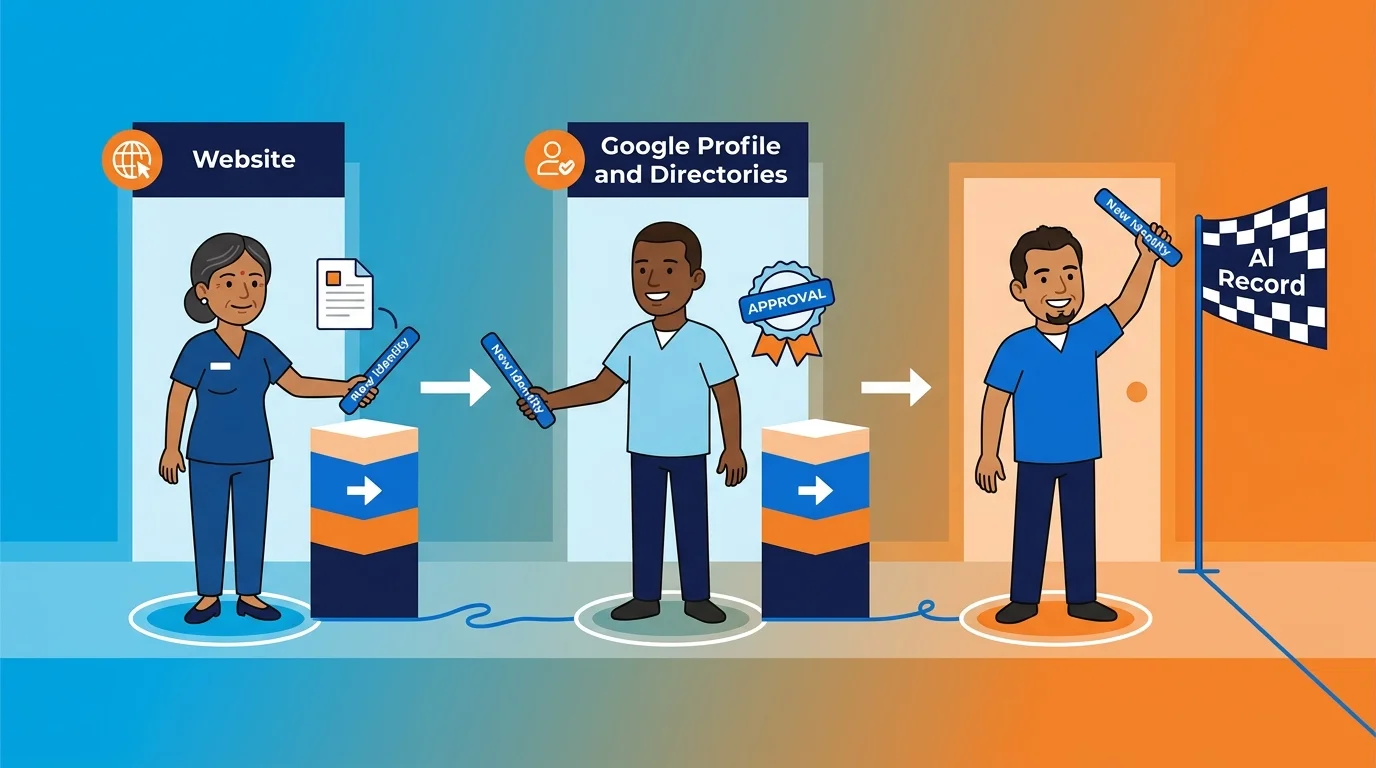
Order matters: update the site first because it's the part the practice controls. Push aggregators first, before the website settles, and they may spread whatever conflicting record they find. That's the exact entity confusion that quietly erodes trust with AI systems.
| Step | Action | Why Order Matters |
|---|---|---|
| Step One | Correct schema markup on the clinic's own site, naming the new identity as the authoritative record. | The clinic's own site comes first; an uncorrected site can carry the old identity forward. |
| Step Two | Review and act on the Business Profile's suggested edits rather than letting the acceptance window lapse. | A queue a clinic does not actively manage becomes a queue the platform resolves on its own, sometimes reinforcing the old name. |
| Step Three | Correct aggregators, directories, and citation sources carrying the old name. | Pushing this step earlier than the site and profile corrections lets aggregators re-propagate whatever conflicting record they still hold. |
| Step Four | Audit remaining mentions of the old name across secondary sources before treating the rebrand as resolved. | A single stale listing can keep competing for the same entity slot, splitting the clustering signal instead of consolidating it. |
Auditing the Old Identity Before Declaring the New One Live
Every surface still carrying the old name gets audited before the new one goes live anywhere. Skip that step and the old and new names may never resolve into one entity.
Frequently Asked Questions
Once the entity resolution problem clicks, the same mechanical questions keep popping up. Here are straight answers to each one.
How long does it take for AI like Google to recognize a clinic's new name?
There's no fixed window, and anyone promising one is guessing. Recognition tracks how fast every record converges on one name, not a calendar date.
Does a rebrand erase old patient reviews and online history?
Nope. Reviews and history stay attached to the entity, not the name string on top. The real risk is an unresolved old name splitting that history across two competing records.
What is the first record that should carry the new clinic name?
Schema markup on the clinic's own site goes first, because it's the part the practice controls. The Business Profile and citation network follow once that signal's right.
Can a name change actually reduce visibility in AI-generated answers?
Yes, when the change leaves two competing records instead of one resolved entity. Stuck between a current record and a stale one, AI may cite neither with confidence. That's what a visibility drop looks like.
Which records besides the website and Google profile need the new name?
Data aggregators, secondary directories and every citation network still carrying the old name. One uncorrected aggregator feed can drag the old identity back. That happens even after the website and profile are fixed.
What does the sameAs property do during a clinic name change?
It points to a well-known page that indirectly confirms who the clinic is. That's separate from the clinic's own authoritative page, which belongs in url.
The Bottom Line
The new sign going up is the easy part. A rebrand is finished when every record of your clinic resolves into one entity instead of two competing ones. That window is where your authority either transfers cleanly or can get lost.
Shouting louder on one surface won't close that window. Re-teaching the internet will. That means schema first, the Business Profile's acceptance window watched instead of ignored, and aggregators corrected last so no stale record fights your new name.
The clinic worth citing is the one whose name resolves the same way everywhere a machine looks for it. That's the position you should be building toward, and the AI Visibility Check is where that audit starts.