
Google says any form of deception makes a page untrustworthy to users and to its automated quality systems, and signals a low-quality page. Google also says that giving credit to other sources does not replace the need for original effort. It rates using generative AI to produce large amounts of text without manual oversight or curation as little to no effort. In the Score framework, a specific detail counts only if it is both present in the claim and verifiable against the knowledge source, and unsupported or contradicted details score no.
What Makes a Case Study Look Fabricated to AI Systems
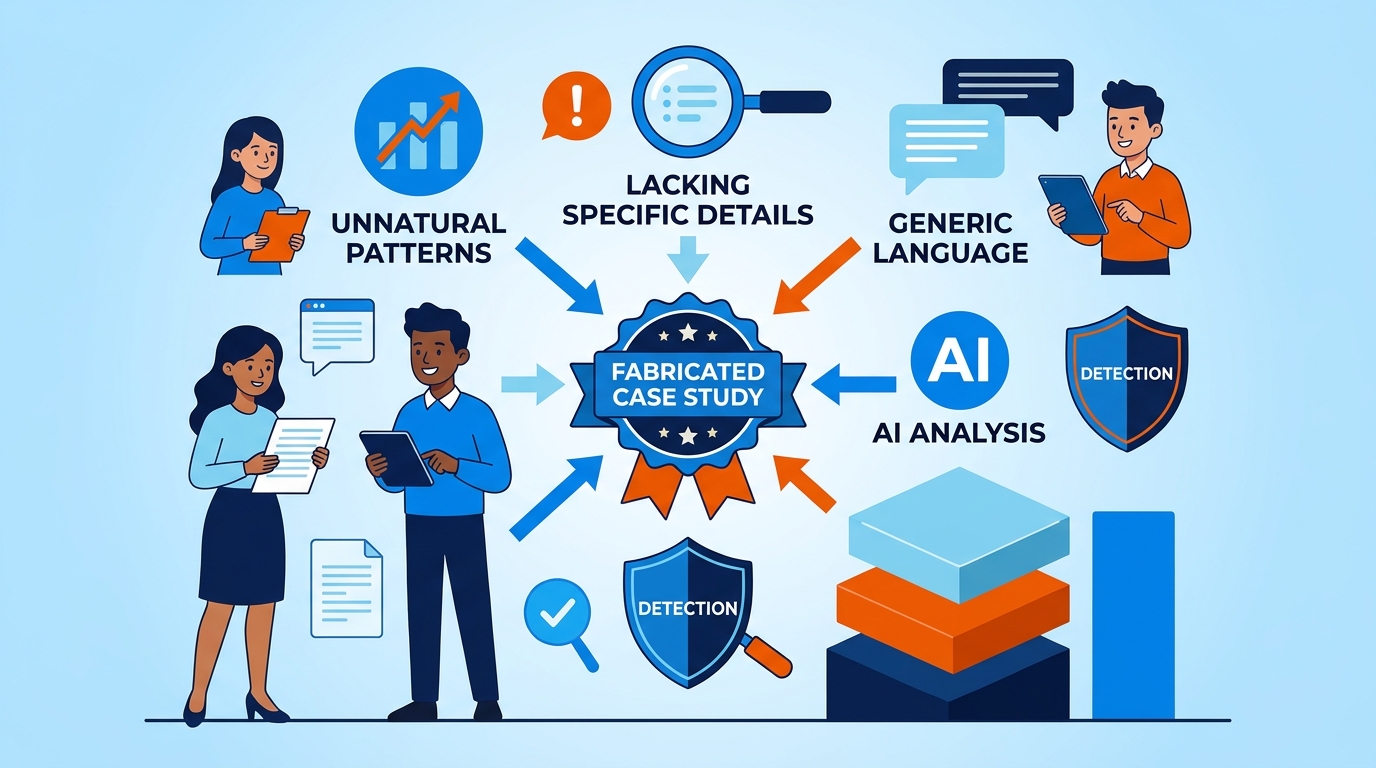
Three things get a case study read as fabricated. Deception. Generic text. No visible effort.
Google says any form of deception makes a page untrustworthy. To users and to its automated quality systems. It also says credit to other sources doesn’t replace original effort.
Quoting other people can’t save a page with nothing original in it.
Generic text is the second problem.
Researchers found that answer relevance metrics can overestimate quality when answers are generic rather than informative. These metrics mostly rely on semantic similarity or LLM-based scores.
So a smooth, vague story can fool a score. That doesn’t make it true.
Here’s what I’d tell you straight. Getting named by an AI engine is a different job from old-school search work.
Keywords, inbound links and results-page position numbers are the wrong tools here. An engine looks for a business it can understand and trust.
That’s why I treat each mistake below as a trust failure an engine can read. Not a keyword problem.
The table below pairs four common mistake patterns with the reason each one reads as low-trust. It also shows what credible proof looks like instead.
| Mistake pattern | Why it reads as low-trust | What credible proof looks like |
|---|---|---|
| Unsupported outcome claims | A detail that lacks support or is contradicted scores no | A detail present in the claim and verifiable using the knowledge source |
| Fabricated author or credentials | Google calls fabricated creator profiles a form of deception | Accurate bylines where readers would reasonably ask, “Who wrote this?” |
| Generic AI-written volume | Google rates large amounts of generative AI text without manual oversight or curation as little to no effort | Original effort; crediting other sources doesn’t replace it |
| Artificially freshened dates | Google lists re-dating pages that haven’t substantially changed as a search-engine-first warning sign | No new date unless the content has substantially changed |
Mistake: Claims With No Verifiable Source Behind Them
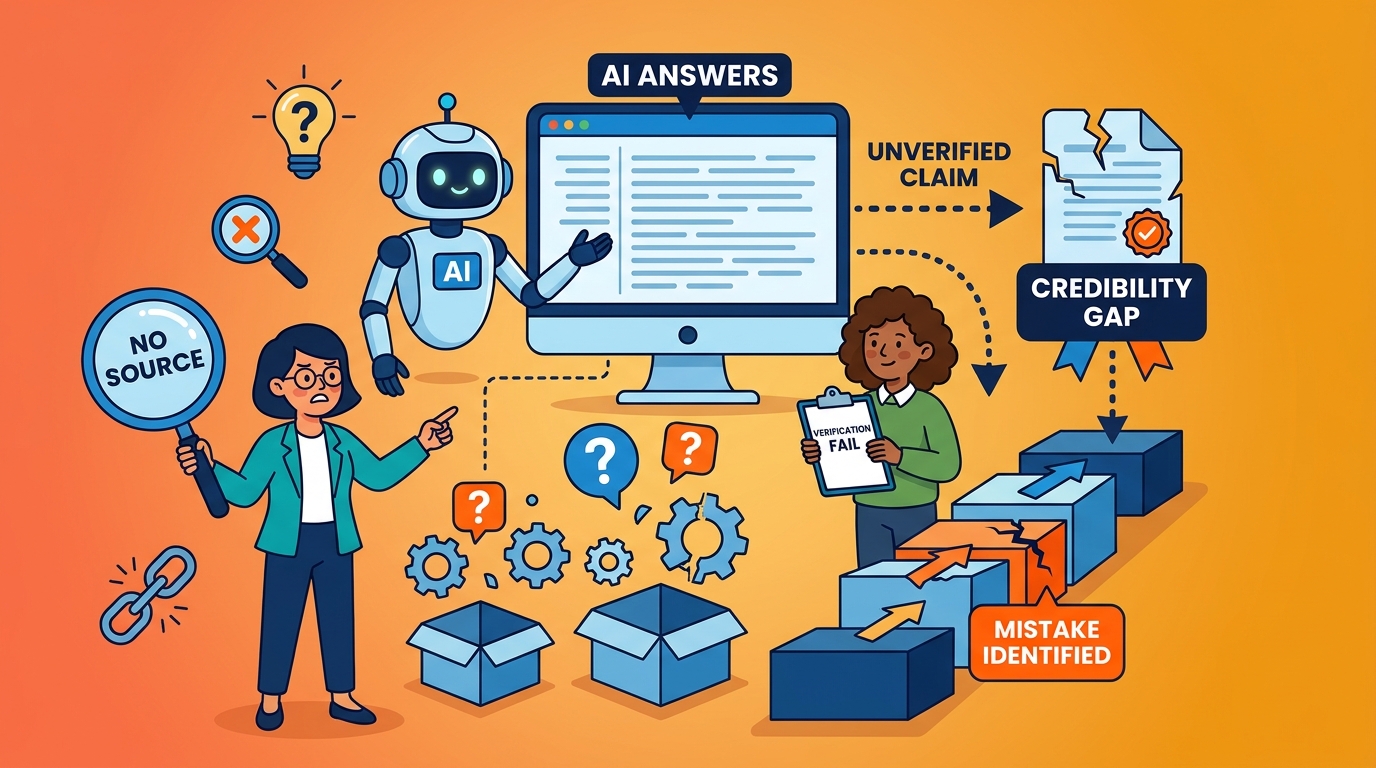
AI answers already outrun their sources.
A Stanford study looked at four generative search engines. They answered 1,450 search queries. About half (50%) of the statements they generated had no supportive citations.
And the citations they did give? Only about three-quarters (75%) truly supported the statements.
Other tests found the same problem:
- The HALoGEN benchmark checked about 150,000 generations from 14 language models. Even the best performers were riddled with hallucinations. Depending on the domain, up to 86% of generated atomic facts were hallucinated.
- One paper notes that LLMs hallucinate. They also can’t detect factual inconsistencies, even when authoritative sources are provided.
- A medical study found that between half (50%) and nine in ten (90%) of LLM responses aren’t fully supported by the sources they cite. Sometimes the sources contradict them.
- Even GPT-4o with web search left about three in ten (30%) of its individual statements unsupported. Count by whole response instead of by statement, and nearly half weren’t fully supported.
Against that background, an unsupported claim in a case study doesn’t stand out. It just adds to the pile.
Here’s how a check works. The Score: Specificity, Context Utilization, Robustness, and Relevance for Reference-Free LLM Evaluation framework shows it. A detail gets a yes only if it’s in the claim and can be verified using the knowledge source.
A detail that lacks support, or is contradicted, gets a no.
Links and citations carry their own risk.
A preregistered, randomized experiment used a sample representative of the U.S. population. On average, participants trusted generative AI search less than traditional search. Even so, reference links and citations significantly increased their trust. That held even when the links and citations were incorrect or hallucinated.
A citation that looks good isn’t a citation that checks out.
Mistake: Outcomes Stated Without Measurable Detail
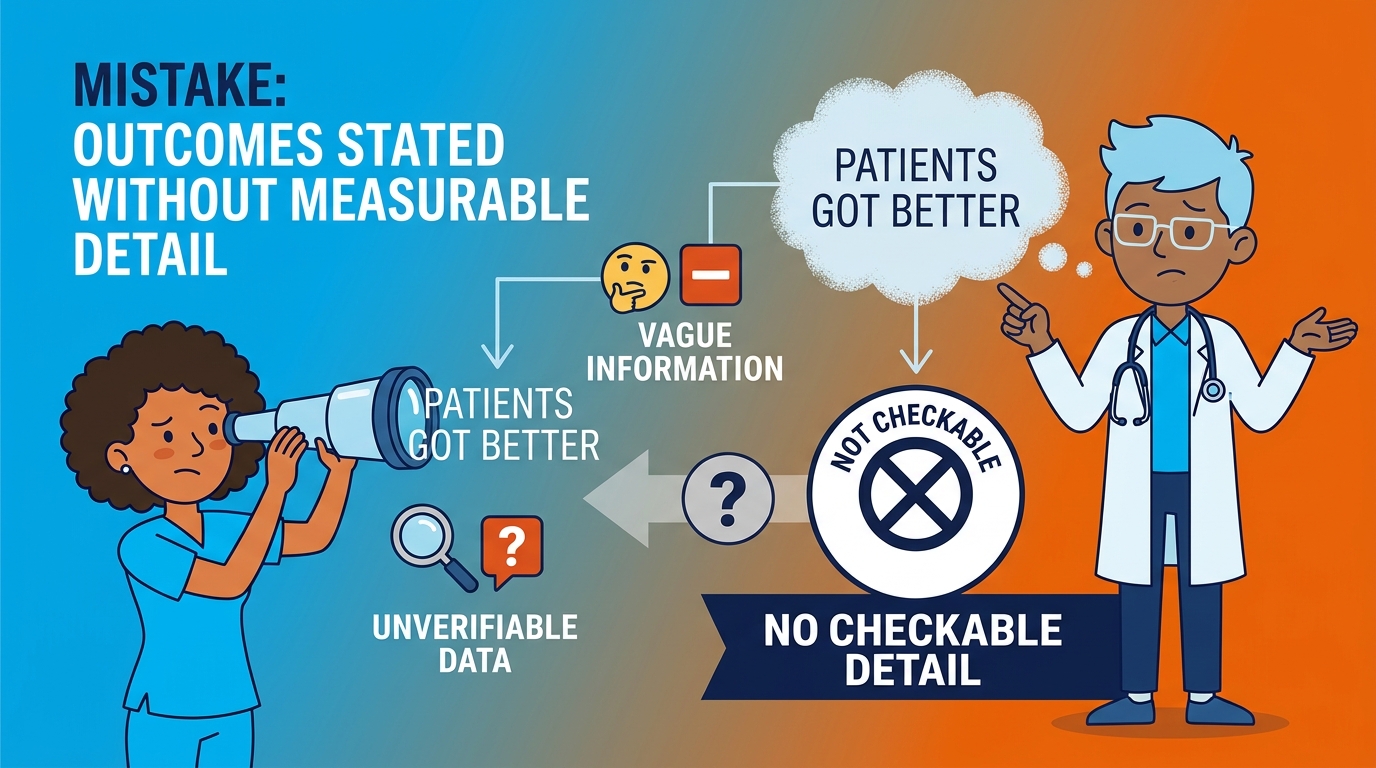
“Patients got better” gives no one anything to check. It reads as generic. Not as evidence.
Google makes the point about product reviews. Readers trust them more when they can see how many products were tested, what the results were and how the tests were run. Evidence of the work helps too, such as photographs.
I think the same holds for a case summary. A count, a method and proof of the work give the reader something to check. That guidance is on Google’s Creating Helpful, Reliable, People-First Content page.
Data work has its own checks.
Formal systems for judging data quality look at veracity, completeness, timeliness, coverage, accessibility, lineage and provenance. A case study that offers none of these gives a reviewer nothing to measure.
Sample size matters too.
A study with a very small sample is much less reproducible. It has lower statistical power than the same results from a larger sample.
One patient story is a small sample. Write it like one.
What Separates a Credible Case Summary From Promotional Hearsay? sets out what separates a checkable summary from hearsay.
Mistake: Results Too Clean or Too Many to Be Plausible
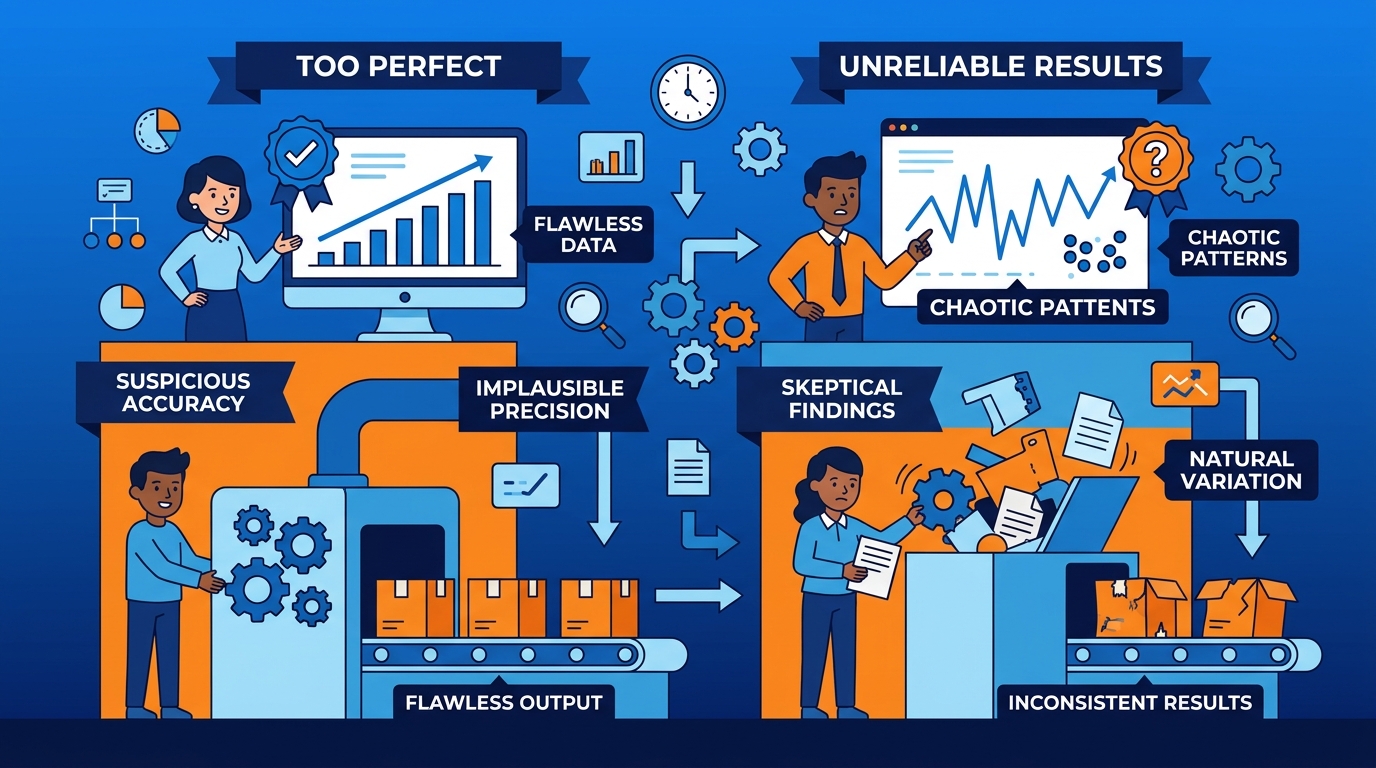
Perfect results look wrong.
In an interview study, some chiropractors worried their patient-reported outcome (PROM) data were positively skewed. They said many patients wouldn’t report feeling dissatisfied. One chiropractor thought satisfied patients are more likely to complete the questionnaires and report a positive result.
Collect data like that and a page of nothing but good news says little about the whole picture.
Too much output is also a warning sign.
The Sato fraud case raises a question. How did he publish more than 200 papers? Many were ambitious studies that would have taken most researchers years to complete.
A case study page stacked with wins invites the same question. Especially when there’s no way to see how they were collected.
Questionable practices aren’t rare in research either.
In one cited survey, about a third (33.7%) of scientists admitted to questionable research practices of their own. Nearly three-quarters (72%) said they’d seen such practices in their peers’ work.
The gap comes from who’s being reported on. Scientists reporting on themselves. Versus scientists reporting on their peers.
No access to patient files? Proving Chiropractic Outcomes Without Health Records: A Complete Guide explains how to prove results. Worcester Polytechnic Institute’s Data Fabrication and Falsification covers the research on fabrication.
Mistake: Credentials and Authorship That Can’t Be Checked
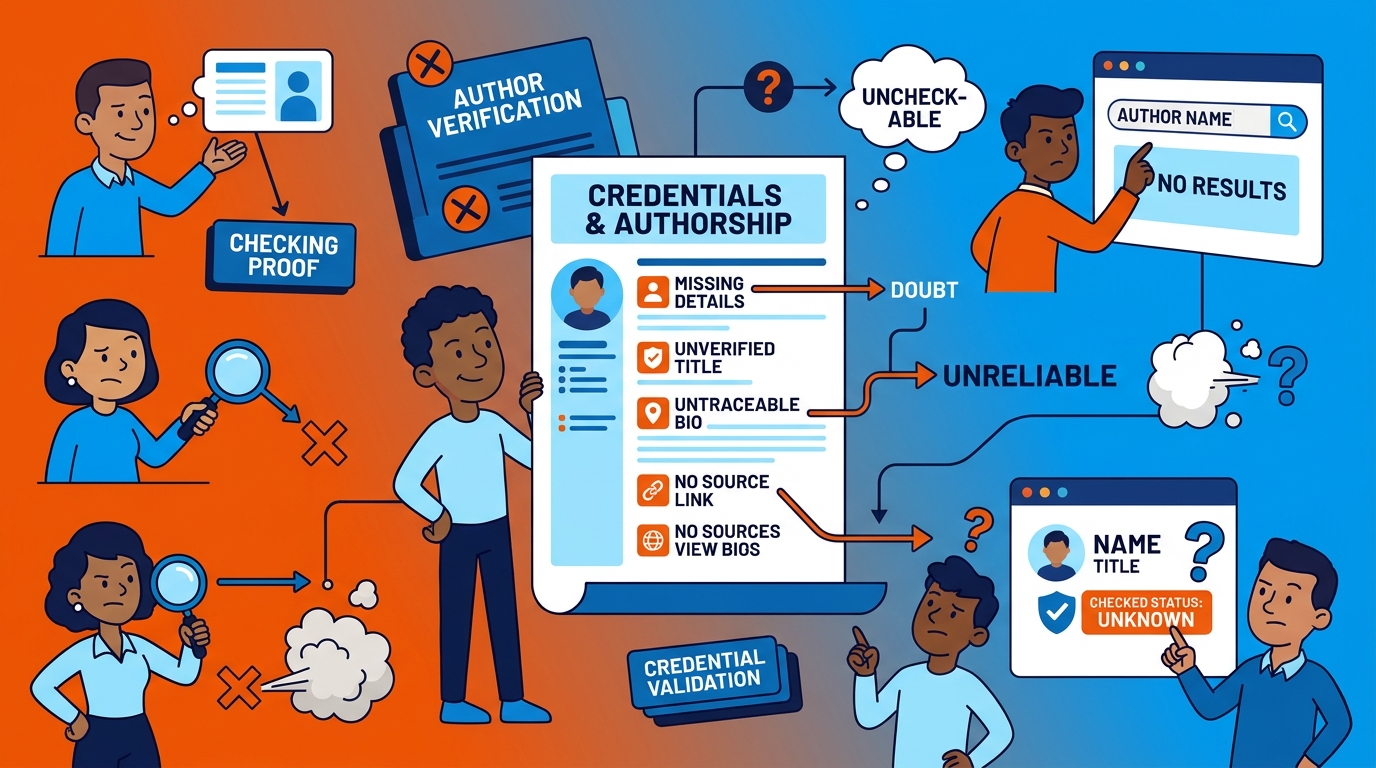
A name and a title prove nothing unless someone can check them.
Google is blunt about fake ones. It calls fabricating creator profiles a form of deception. That includes AI-generated headshots, made-up names and false credentials. All used to make content look like human experts wrote it.
Google’s other advice:
- Make sure every author shown on the page is also in the markup.
- Use accurate author bylines when readers would reasonably ask, “Who wrote this?”
- Think twice before giving AI an author byline. Google says that’s probably not the best way to tell readers AI was part of creating the content.
The byline advice comes from Google Search’s guidance about AI-generated content.
There’s a second problem.
A medRxiv paper notes that a conversational AI system gets statements about who’s speaking, with no hard evidence of competence. The systems it tested couldn’t authenticate those cues.
To the system, a claimed credential is just a statement.
Mistake: Leaning on Source Confidence or Popularity as Proof
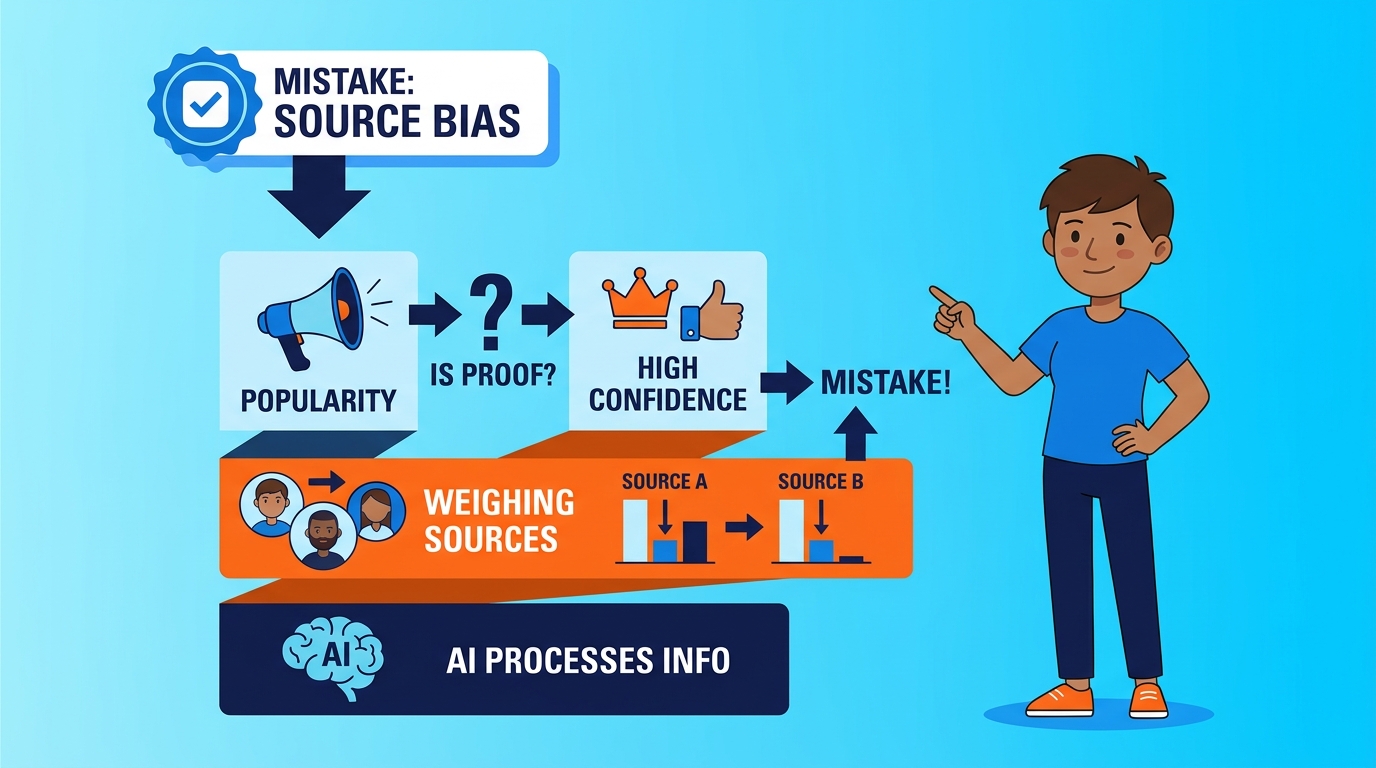
AI models do weigh who says a claim. And how confidently they say it.
That’s a weakness in the models. Not a lever to pull.
A study of 13 open-weight LLMs shows the pattern:
- Compared with information that had no source, all the models preferred information tied to a source. Across every source type.
- 11 of the 13 models preferred both institutional sources (government and newspaper) over both individual sources (person and social media).
- When conflicting information came from sources of different popularity, the models preferred the more popular one.
- Repeating information from low-credibility sources could flip the models’ source preferences. The researchers call this a critical vulnerability to disinformation.
The full paper is Whose Facts Win? LLM Source Preferences under Knowledge Conflicts.
A second study points the same way.
Its authors cite earlier work showing that how a source is described can shift a model’s answer. So can the confidence it expresses. Even when the message content stays the same.
Then they ran their own test. ChatGPT, Claude and Gemini adopted an incorrect option more often from a specialist described as 2/10 accurate than from a student described as 8/10 accurate. That’s 10.2% versus 7.6%.
Still, they adopted correct suggestions far more often than incorrect ones. By 35.7 percentage points. The authors read this as selective rather than indiscriminate compliance. The paper is When medical credentials conflict with stated accuracy: source credibility in medical LLM interactions.
I wouldn’t build proof on a big name or a confident tone.
Models can be swayed by both. That makes both weak foundations.
In my view, a claim that can be checked is what holds up.
Mistake: Freshening or Recycling Content Instead of Adding Evidence
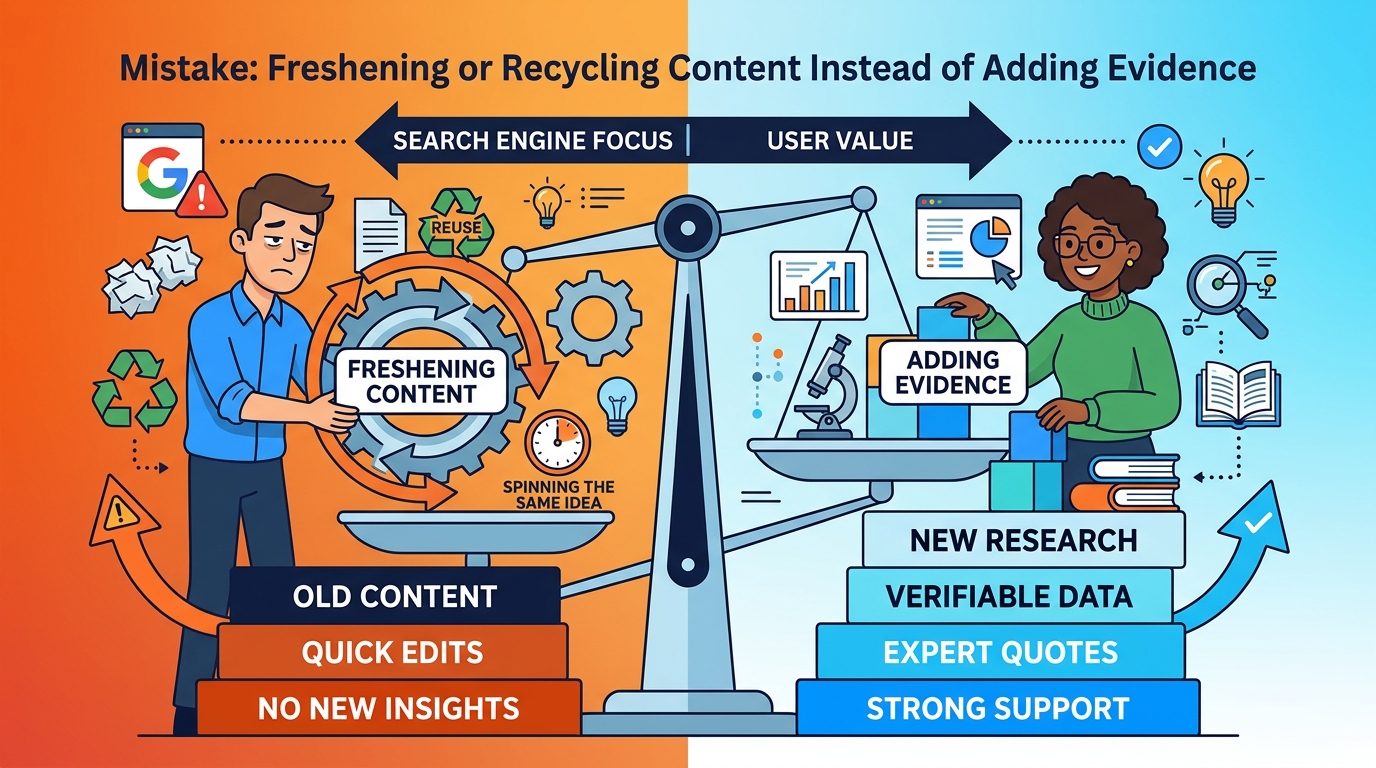
Google lists a warning sign of content made for search engines first. It asks: “Are you changing the date of pages to make them seem fresh when the content has not substantially changed?”
A new date on old words adds no evidence.
The full list is on Google’s Creating Helpful, Reliable, People-First Content page.
Volume brings its own problems:
- Google says using generative AI tools to generate many pages without adding value for users may violate its spam policy on scaled content abuse.
- Google rates using generative AI to produce large amounts of text without manual oversight or curation as little to no effort.
Google doesn’t rule out AI. It says appropriate use of AI or automation isn’t against its guidelines.
It also says using AI doesn’t give content any special gains: “It’s just content.”
Here’s my view. An engine names the business it can understand. Not the one that publishes most often.
A handful of clear facts, laid out in a sensible order, does more than a stack of recycled pages.
Ten pages telling the same vague story give an engine nothing to check. One page of facts it can confirm gives it something to use.
Mistake: Publishing Proof Where Anyone Can Edit or Plant It
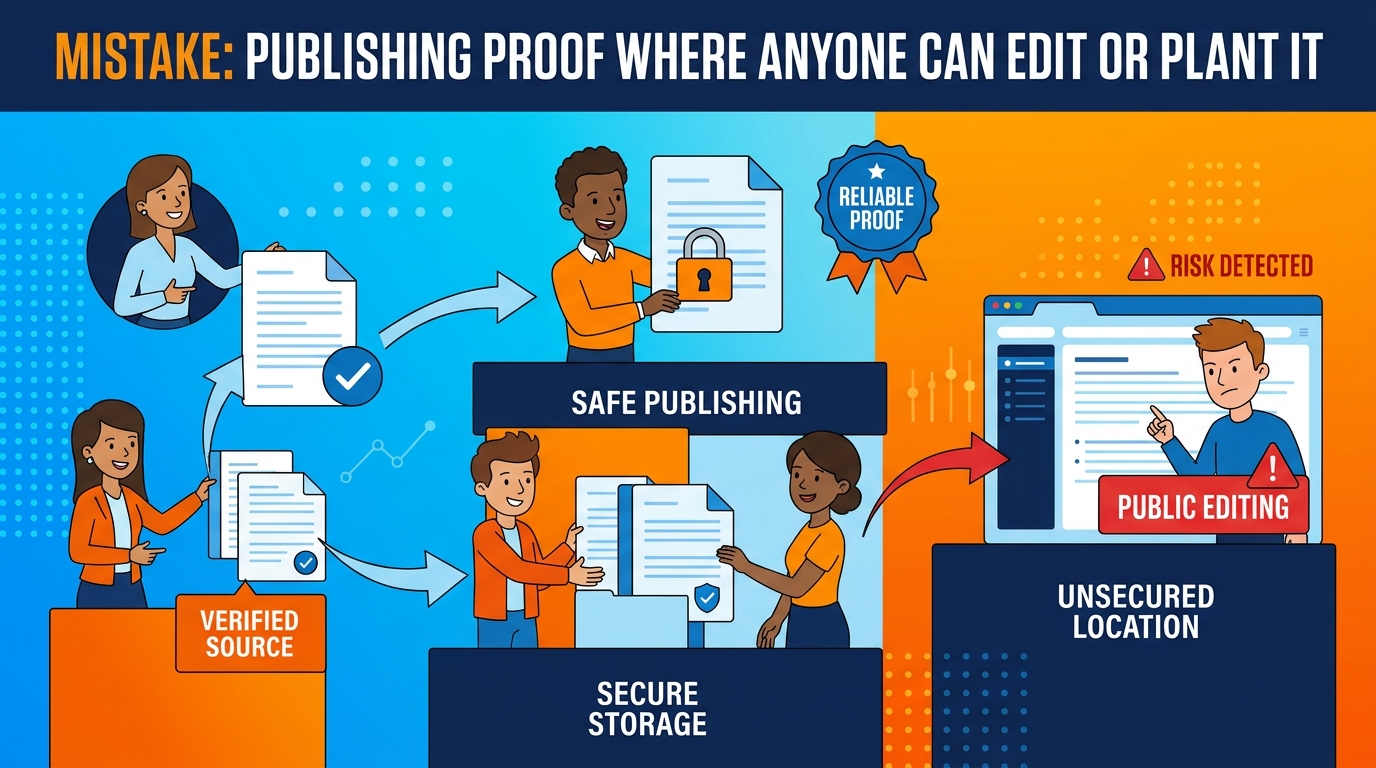
Where proof lives matters.
One study calls user-generated content pages the cheapest surface for placing fake content. Such a page gets retrieved on the standing of the domain that hosts it. Meanwhile its text stays open to anyone.
The numbers are large.
Across 12 commercial and open-weights LLMs, every model was vulnerable. A single polluted page fooled them at rates as high as roughly a quarter (27%). Replace all of the top three results and that jumped to nearly three-quarters (73.8%).
Google’s spam policies cover common spam practices. Google says it may act against any type of spam practice it detects.
Put proof somewhere anyone can edit and the page can’t help an engine. It has no way to tell your real result from a planted one.
That’s why, in my view, proof belongs on a page you control.
What a Credible, Verifiable Case Study Looks Like Instead
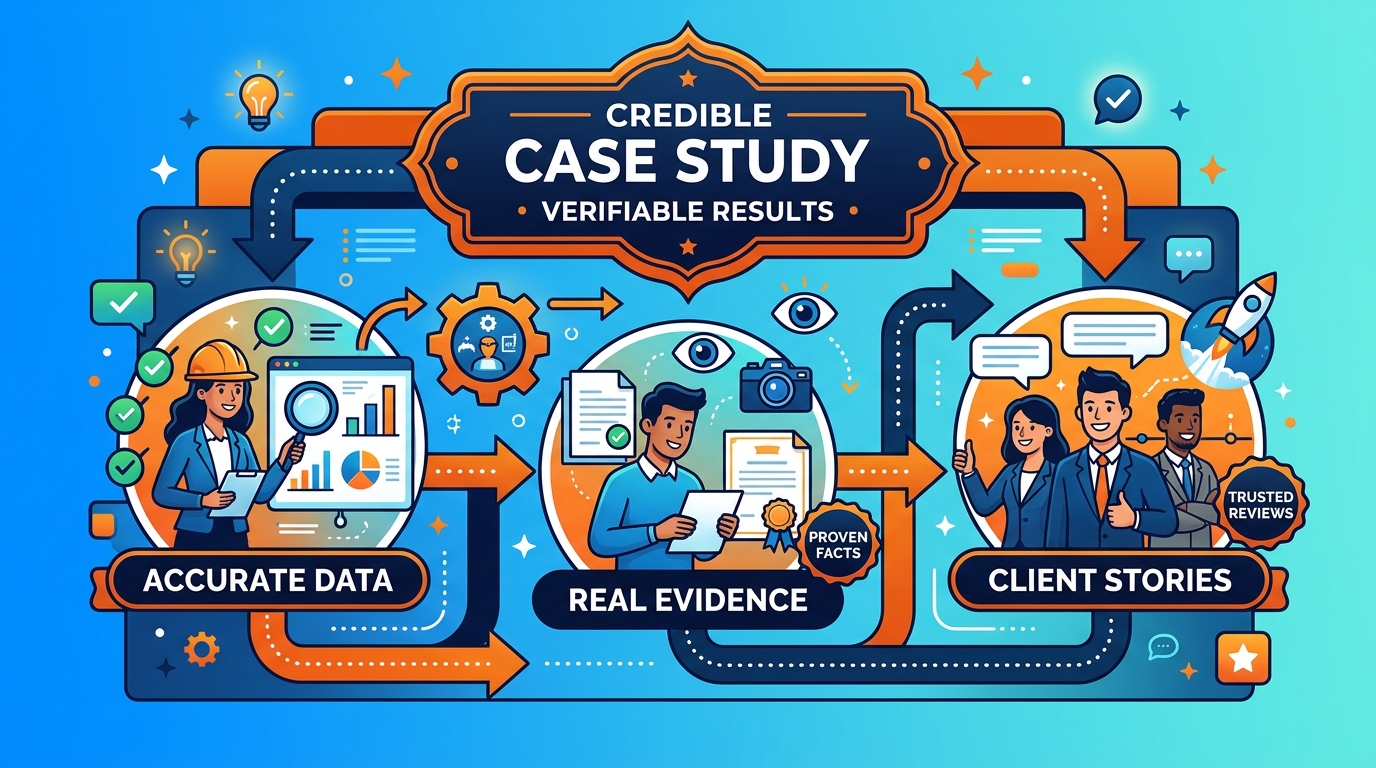
A credible case study is accurate. Consistent with expert consensus. Checkable.
Google says trust is the most important part of E-E-A-T. The other parts contribute to trust. But content doesn’t have to show all of them.
The bar is higher on some topics.
Google’s systems give even more weight to strong E-E-A-T on topics that could significantly affect people’s health, financial stability or safety. For these YMYL topics, Google says content must be highly accurate and consistent with established expert consensus.
Elsewhere it says the same about topics where information quality is critically important, health among them. There, its systems place even greater emphasis on signals of reliability.
LLMs also struggle to judge sources.
One study looked at media background checks. These are summaries of things that may affect how trustworthy a source seems: political orientation, factual reliability, editorial practices and ownership. It found that generating these checks with LLMs is still hard. Fact recall was relatively low across all the models tested. That study is MEDIAREF: A Public Knowledge Store for Media Background Checks.
Separately, researchers who evaluated LLM answers found that no single metric captures answer quality on its own. They argue high-stakes uses need structured evaluation across several metrics.
My reading? Proof that holds up on several fronts at once stands the best chance.
Want a way to show real results without exposing patients? See Building an Anonymized Proof Profile: A Step-by-Step Walkthrough.
In my view, being the source an engine quotes is worth far more than being one more name in a directory.
A listing says a business exists. Checkable facts give an engine something to quote.
Frequently Asked Questions
Why do AI engines treat case studies with suspicion even when the results are real?
Because the engines have a weak record with sources themselves.
A medical study found that between half (50%) and nine in ten (90%) of LLM responses aren’t fully supported by the sources they cite. Sometimes the sources contradict them. Even GPT-4o with web search left about three in ten (30%) of its individual statements unsupported. Nearly half of its whole responses weren’t fully supported.
Another paper notes that LLMs hallucinate and can’t detect factual inconsistencies, even when authoritative sources are provided.
With that much noise, a real result no one can check looks a lot like a fake one.
Does citing sources actually make AI trust a case study more?
Yes, but not always for good reasons.
In one experiment, reference links and citations significantly increased people’s trust in generative AI search. Even when the links and citations were incorrect or hallucinated. On average, those same participants still trusted generative AI search less than traditional search.
Models lean the same way. In a study of 13 open-weight LLMs, all the models preferred information tied to a source over information with no source. 11 of the 13 preferred both institutional sources (government and newspaper) over both individual sources (person and social media).
Can a confident-sounding claim override a correct one in AI answers?
It can shift the answer. Not every time.
Earlier studies show that how a source is described can shift model answers. So can the confidence it expresses. Even when the message content stays the same.
In one test across ChatGPT, Claude and Gemini, an incorrect option was adopted more often from a specialist described as 2/10 accurate than from a student described as 8/10 accurate. That’s 10.2% versus 7.6%. Correct suggestions were still adopted far more often than incorrect ones. By 35.7 percentage points.
The authors call that selective rather than indiscriminate compliance.
Does using AI to write the case study automatically hurt credibility?
No. Google says appropriate use of AI or automation isn’t against its guidelines. It also says using AI doesn’t give content any special gains. It’s just content.
The trouble starts when no one’s overseeing the output. Google rates using generative AI to produce large amounts of text without manual oversight or curation as little to no effort.
What data quality checks make a case study harder to dismiss as fabricated?
Start with the formal checks. Systems for judging data quality look at veracity, completeness, timeliness, coverage, accessibility, lineage and provenance.
Sample size is another. A study with a very small sample is much less reproducible. It has lower statistical power than the same results from a larger sample.
Self-report is a weak check on its own. In one cited survey, about a third (33.7%) of scientists admitted to questionable research practices of their own. Nearly three-quarters (72%) said they’d seen them in their peers’ work.
Credibility Comes From Proof That Can Be Checked, Not Polish
In my view, a shiny story does little for an engine.
What it can use are claims it can verify. Kept consistent from page to page.
Proof you hold yourself keeps building trust year after year. Polish you pay for fades once the paying stops.
iTech Valet builds for that with a proprietary two-AI content system. Every article is built using its two-AI content validation system: one engine builds, and another audits.
The system is engineered to help AI engines like ChatGPT, Gemini and Grok recognize and recommend your practice.
The iTech Valet Service Plans & Pricing page explains how the work is done. To see how AI describes your practice today, Run My AI Visibility Check.