
If the areas your locations serve overlap a lot, such as two locations serving the same city area, Google may show the one it thinks is closer to the person searching and bury the other. Google says local results are based primarily on relevance, distance, and prominence. Its system might rank a business that is farther away higher if it seems more likely to have what the searcher wants. Locations that sit close together can also end up with service area settings that overlap in Google Business Profile or on their website landing pages.
How Google Picks One Clinic When Service Areas Overlap
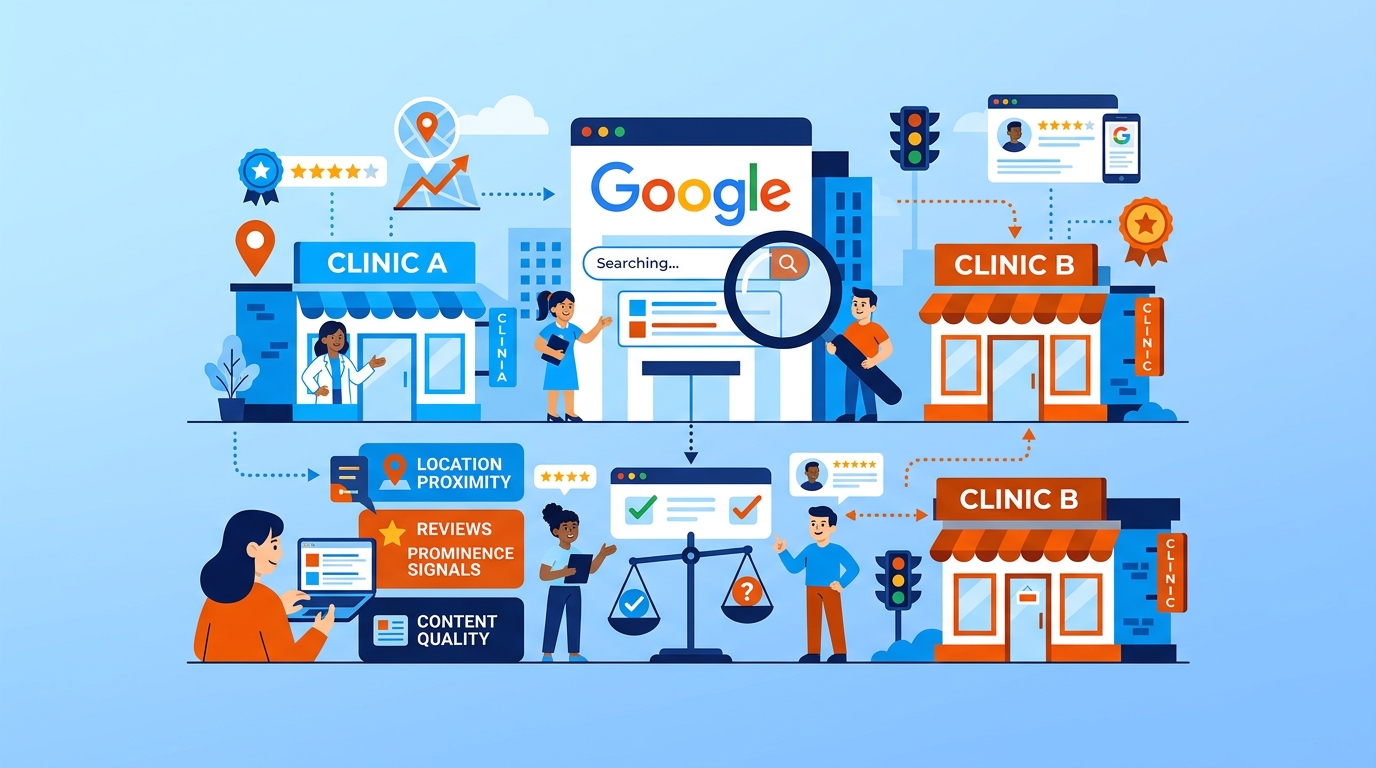
Here’s how Google decides.
Google says local results rest mainly on three things. How well a business matches the search. How far away it is. How well known it is.
Together, those find the best match. Its system might decide a business farther from the searcher is more likely to have what they want than a closer one. Then it ranks the farther one higher in local results.
The three terms are laid out in Are Relevance, Distance, & Prominence Google Ranking Factors?.
Now picture two of your clinics covering the same ground.
Stackmatix describes what happens. If the service areas overlap a lot, say two locations serving the same metro area, Google may show the clinic it thinks is closer to the searcher.
The other clinic can get buried.
On prominence, Google says more reviews and positive ratings can improve a business’s local ranking. It also says to verify each of your business locations, to increase the likelihood that your business is close to the right people searching.
The table below puts each signal next to what it means for your clinics.
| Signal | What It Means |
|---|---|
| Relevance, distance, prominence | The primary basis for local results |
| Reviews and ratings | Part of prominence; more reviews and positive ratings can improve local ranking |
| Verified location | Increases the likelihood a location is close to applicable searchers |
| Geographic closeness when areas overlap | Google may show the closer of two overlapping locations and bury the other |
Want to know how AI assistants choose among clinics across a county? It’s in What Shapes Which Clinic Assistants Name Across a County.
Why Two of Your Own Location Pages Can Cannibalize Each Other
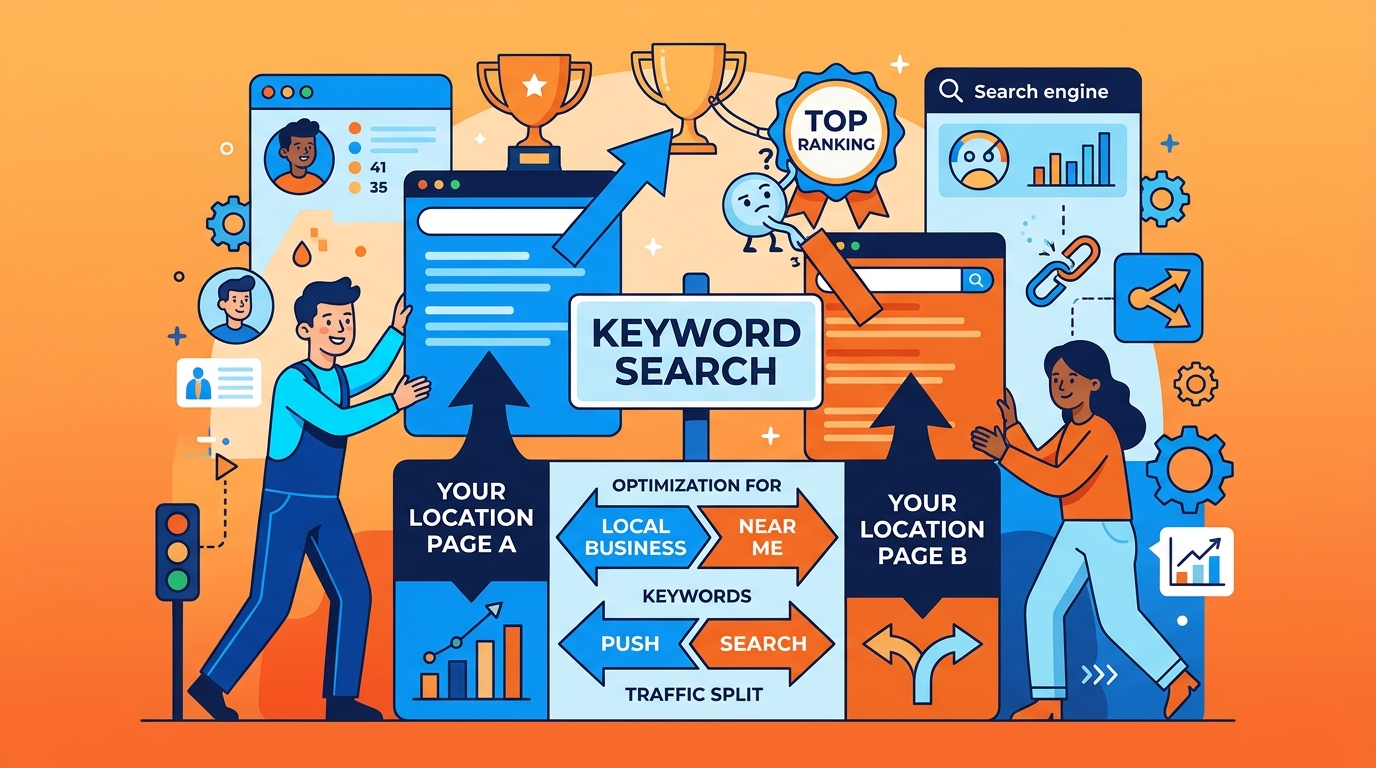
Here’s the problem.
Semrush defines keyword cannibalization as multiple pages on a site targeting the same keywords and harming each other’s search visibility.
Two clinic pages can do exactly that.
Your Digital Gurus describes the city-level version.
Say two pages are both built for the exact same city-level keyword and the same audience. They fight for the same click. They don’t capture separate demand.
That splits the relevance signals for both pages. And it can push one down in favor of the other in Google’s results.
Semrush notes that ChatGPT cites 1.26 pages per domain in a response. Since it cites so few, overlapping or highly similar pages may compete to be picked.
Here’s my rule.
I don’t publish a second page for the same city just to show up more often.
I write each clinic’s page to be clear and factual. In a sensible order. Because I’d bet on information an AI can grasp easily over sheer volume. Every time.
Semrush gives a fix in Keyword Cannibalization: How to Find, Fix, and Prevent It.
Pick one preferred page for each affected keyword. Then use one of five techniques to signal that preference.
The most reliable way to prevent the problem? Semrush says it’s mapping keywords and AI prompts to URLs before you publish.
Each page gets its own angle. And you catch overlaps before they go live.
What Causes Overlap Between Nearby Clinic Profiles
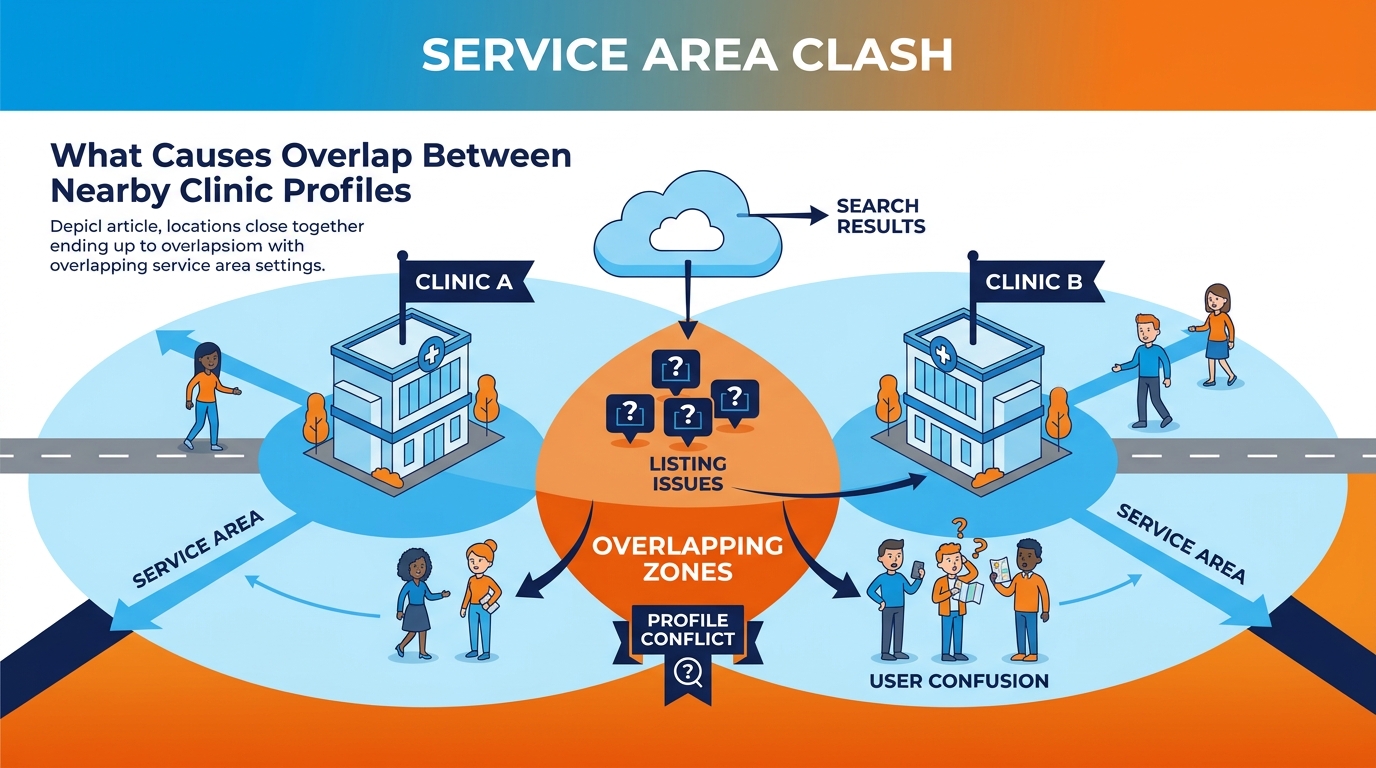
Locations close together can end up with overlapping service area settings. In Google Business Profile or on site landing pages.
Local Traditional Search Optimization for Multi-Location Businesses: Common Pitfalls and Fixes describes it.
Your Digital Gurus says three habits create most of the overlap. Here are two of them:
- Google Business Profile service-area settings overlap between two nearby locations. Both then show up as candidates for the same radius of searches.
- Location pages carry identical keyword targeting because they were built from the same template.
Here’s a quick fix.
Stackmatix says each profile should have its own phone number. Even if calls are routed to one central call center.
That keeps Google from mistakenly merging two locations.
The table below shows each cause and where it appears.
| Cause | Where It Shows Up |
|---|---|
| Overlapping service-area settings | Google Business Profile or site landing pages |
| Overlapping Google Business Profile radii plus identical page templates | Both locations show up as candidates for the same radius of searches; location pages carry identical keyword targeting |
| Shared phone number across locations | Google may mistakenly merge two locations |
Thinking about opening another clinic? Here’s what to weigh first: Multi-Clinic Expansion and AI Recommendations: What to Know Before You Start.
Setting Non-Overlapping Service Areas for Each Clinic
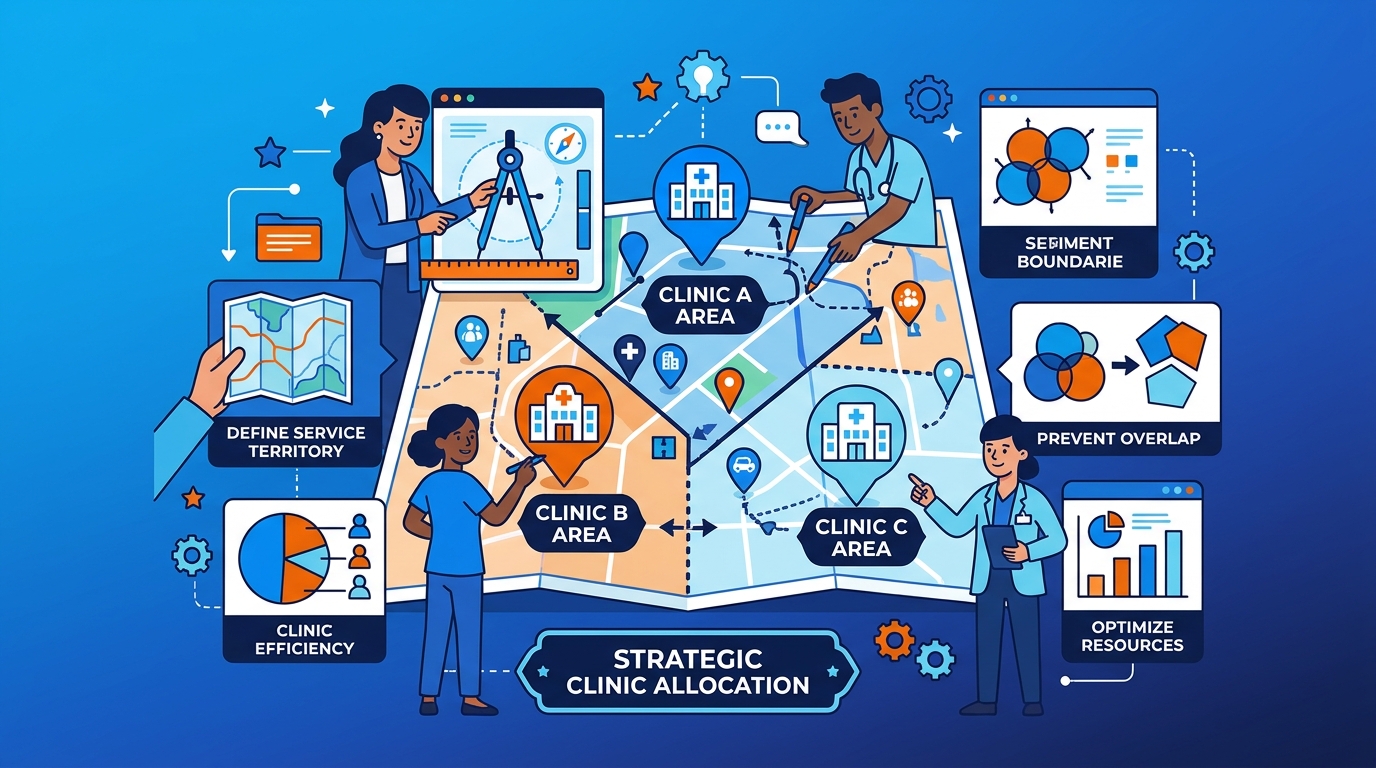
Give Each Clinic Its Own Zone and Profile
Give each location its own service zone. No overlap.
Show it on your site in serviceArea schema. Show it in your Google Business Profile settings too.
Each physical location also needs its own verified Google Business Profile. That’s how it shows up right in the Map Pack and in local searches.
Set the Category and Shrink the Circles
Set each location’s primary Google Business Profile category to the most specific true description of what that location does. Not the broadest one that technically fits.
Then shrink your service-area circles. Two nearby locations shouldn’t both claim the same overlapping zone.
This step and the two below come from Your Digital Gurus’ The Local Traditional Search Optimization Playbook for Multi-Location Businesses.
Split the Work Between Brand Page and Location Pages
On each location page, aim for neighborhood or suburb words. Don’t repeat the same city name on every one.
Let your main brand page own the broad, informational searches.
Let each location page own “near me” and transactional searches.
Review Neighbors as a Set
Whenever a nearby location opens, closes, or relocates, review the categories and service-area radii of the neighboring locations together, as a set, not one at a time. The overlap is the whole problem.
Here’s where I stand.
I treat getting picked by AI answer tools as its own discipline. It’s not classic search work with a new name.
I don’t chase keywords, inbound links, or ranking position for a clinic. I put the effort into making it easy for AI systems to work out who each clinic is and whether it can be trusted.
So each clinic gets its own identity. And its own zone.
Why AI Tools Name Different Businesses From One Run to the Next
AI Recommendations Change With Nearly Every Query: Sparktoro reports on a SparkToro study of AI brand lists. The data showed less than a 1-in-100 chance that ChatGPT or Google’s AI in Search (AI Overviews or AI Mode) would return the same list of brands across repeated runs of the same prompt.
How the Test Was Run
The team asked almost 3,000 questions (2,961). They ran them across ChatGPT, Claude, and Google Search AI Overviews. When Overviews didn’t show up, they used AI Mode.
Hundreds of volunteers helped during November and December.
Each question was asked 60 to 100 times on each platform.
Almost every answer was different. Three ways. Which brands were listed. What order they came in. How many there were.
What Stayed Steadier
Here’s the good news.
The data suggests one thing holds up better. How often a brand shows up across many tries of similar questions.
In tight groups like cloud computing companies, the top brands showed up in most answers.
What the Limits Are
The report is not peer-reviewed academic research. Fishkin acknowledged methodological limitations and called for larger-scale follow-up work.
A paper on arxiv.org ran a distribution-wide rank stability analysis. It found citation rankings unstable across samples, not only among top-ranked domains but throughout the frequently cited domain set. It also found AI Overviews less consistent when processing two runs of the same query, and less robust to minor query edits. The paper argues that citation visibility metrics should be treated as sample estimators of an underlying response distribution.
Want the local numbers for ChatGPT? They’re collected in ChatGPT Local Business Recommendation Statistics (2026).
AI tools now give direct answers. Not lists of links.
So I’ve stopped treating a site’s position as proof a business gets found. I don’t use rank-tracking reports to measure success.
I’d rather know how often a clinic shows up across many tries. Not where it landed in one answer.
Tracking and Auditing Each Clinic on Its Own
Track rankings and Google Business Profile insights for each location, not only in aggregate. A company-wide average can look perfectly healthy while two or three specific locations quietly lose visibility.
Stackmatix suggests a quarterly audit. Once a quarter, check across all your locations for:
Matching name, address, and phone details. Duplicate-profile risk. Slow replies to reviews. Old content.
Use one checklist. Nothing gets missed.
The full approach is in Local Traditional Search Optimization for Multiple Locations: How to Scale Without Cannibalizing.
Here’s how it splits by industry.
In healthcare, listings made up about half (52.6%) of cited sources.
Reviews and social hit their biggest share in food service. About one in eight (13.3%).
Here’s the gap.
Only about two-thirds (68%) of the business contact details ChatGPT and Perplexity show match the Google Business Profile.
Frequently Asked Questions
Can one clinic’s bad reviews hurt the other clinic nearby?
Usually no. Each Google Business Profile stands on its own. Mix reviews between locations and you confuse search engines. You mislead customers too. Keep them separate.
Do review counts change which businesses ChatGPT names?
In one test, yes. 8ight.AI tested 39 trades in 49 cities. ChatGPT named about six and a half times (6.5) as many businesses with 1,000 or more Google reviews as businesses with fewer than 25. The middle named business had 175 reviews. The ones left out had 97. Star ratings? No difference. The middle rating was 4.9 in both groups.
Will ChatGPT and Google’s AI features recommend the same clinic?
Not reliably. ChatGPT’s local answers overlap with Google’s AI Overviews or AI Mode only 19% to 20% of the time. In December, Ahrefs published data showing that Google’s AI Mode and AI Overviews cite different sources 87% of the time for the same query. A research paper found low average similarity in the sources retrieved for each query by traditional Google results, Gemini, and AI Overviews, with Jaccard similarities between 0.11 and 0.18.
Why does ChatGPT name a different clinic when the same question is asked again?
Because the answers shift from run to run. Ask ChatGPT the same question twice, about 39 minutes apart. The typical share of named businesses that showed up both times was a bit under a third (29%). A business named once has about a fifty-fifty chance (about 50%) of showing up again in later tries.
How many businesses does ChatGPT typically name in a local answer?
Only a handful. The reported numbers per answer are about four (4.1), about three and a half (3.5), and about two and a half (2.5).
Keep Your Clinics From Competing With Each Other
Separate zones. Separate profiles. Separate pages. That’s how your clinics stop competing with each other.
Each clinic gets its own verified profile, its own category, and its own page.
AI points people to your competitors. Not to you. We fix that.
Here’s what I won’t do.
I won’t sell overlap fixes from the old search playbook. Many agencies still sell them. The conditions that playbook relied on have changed. I won’t charge clients for tactics aimed at a landscape that’s gone.
That’s a problem with the industry’s offer. Not with yours.
iTech Valet Service Plans & Pricing explains how we do the work instead.
Want to see how AI describes your clinics today? Run My AI Visibility Check.