
Across the full set of data, about 1 in 8 (12.5%) of listings using a specific main category reached the top 10, compared with about 1 in 11 (9.2%) for general ones. Whitespark counts a category as specific if it is more exact than a broad label like Restaurant or Attorney. The 36% is the relative gap between those two rates, so the specific group did roughly a third better. Whitespark also found that adding a second category that fits well with the main one, like Veterinarian plus Emergency veterinarian service, improved average rank by 6 to 17 spots compared with profiles that had only the main category. SOCi says general profiles, thin local web pages and unclear service descriptions make it harder for a brand to match exactly what someone is asking an AI tool for. SOCi also says detailed local web pages, clear organized descriptions of services and amenities, clear brand traits, and very relevant social posts give AI enough detail to tailor its recommendations.
How Often Niche Brands Get Named in AI Answers, and What GEO Research Advises
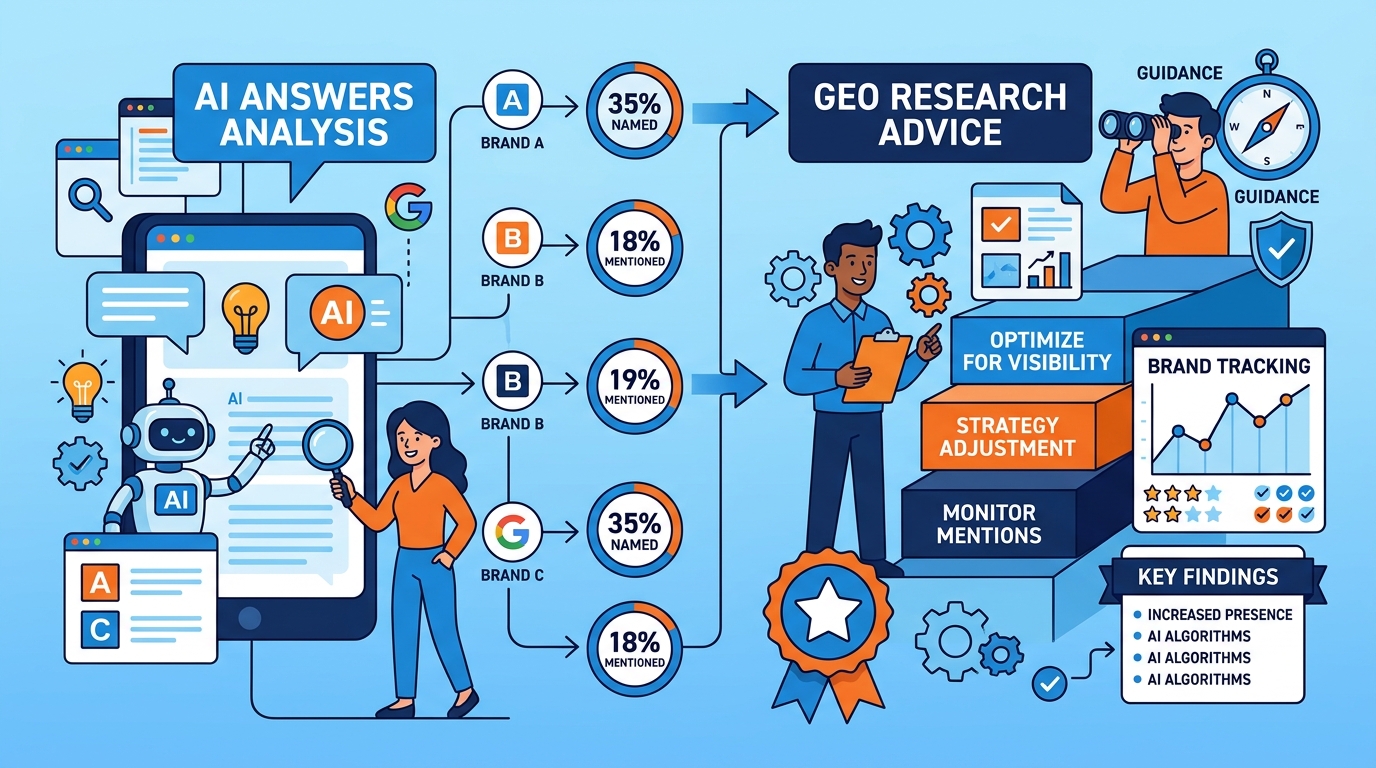
One study looked at over 100,000 prompt answers across more than 100 brands tracked on Ranqo between March and May 2026. On the very first tracking run, the brands fell into three tiers. Well-known global brands like Stripe and Nike showed up in about three out of four (73%) related AI answers. Established mid-size and regional brands like Olipop and Klaviyo showed up in under half (44%). Niche and small brands showed up in only about one in ten (11%). Each tier sat about 30 percentage points below the one above it.
The table below lines up the three tiers. It shows how often each one showed up on its first tracking run.
| Brand tier | Share of relevant AI answers |
|---|---|
| Global household names | 73% |
| Established mid-market and regional brands | 44% |
| Niche and small brands | 11% |
I build for a practice to be the source an AI names and draws on. Not just one more name in a list of businesses.
I aim to be relied on. Not merely present.
The paper also gives practical advice. It says it’s very important to:
- Build content so machines can easily scan it and see why to use it.
- Lead in coverage on other trusted sites to build authority in the eyes of AI.
- Use plans that fit each AI engine and plans that fit each language.
- For smaller niche businesses, get past AI’s built-in leaning toward big brands.
The authors show one more thing. How well these strategies work changes from one subject area to another.
That points to the need for methods built for each subject area.
I treat getting picked by AI answer tools as its own discipline. Not old-school search work with a new name.
I don’t chase keywords, inbound links or a spot in a ranking list.
Here’s how I see it. These systems are trying to work out who a business is and whether it’s credible. So I put the effort into making that easy for them to see.
What AI Recommendation Research Says About Generic vs Detailed Service Descriptions
Here’s how SOCi measured AI visibility.
They asked each AI tool to recommend 10 local businesses in a market that matched the same main category.
A business counted as likely recommended if it showed up in the first five answers.
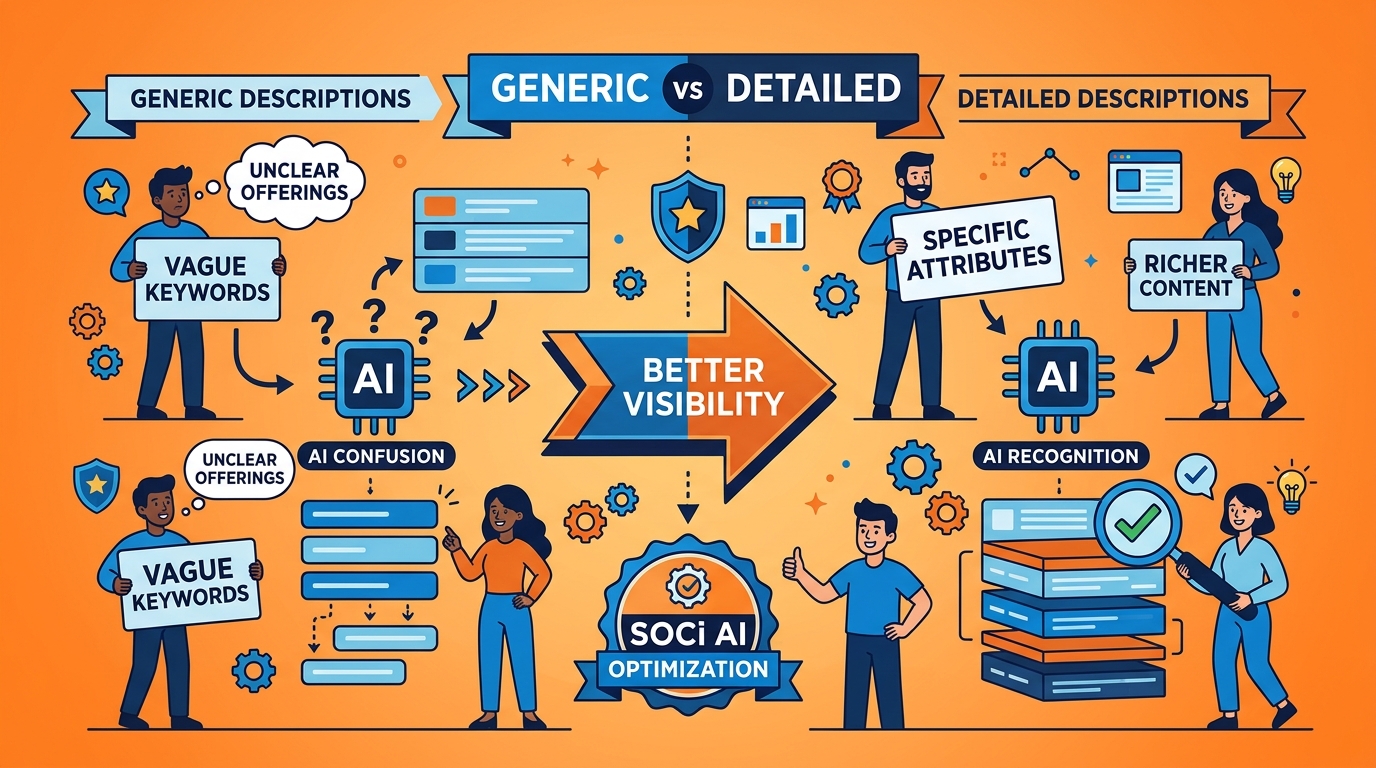
SOCi says general profiles, thin local web pages and unclear service descriptions make it harder for a brand to match exactly what someone is asking for.
The fix? SOCi says detailed local web pages, clear organized descriptions of services and amenities, clear brand traits, and very relevant social posts give AI enough detail to tailor its recommendations.
Across industries, SOCi found that fewer than half of the brands that lead in regular local search also show up among AI’s top local recommendations.
Leading in search doesn’t mean getting named.
AI tools now give direct answers instead of lists of links. So I’ve stopped using position in a results list as a measure of success.
I treat rank-tracking reports as outdated. A good-looking one doesn’t tell me whether a business gets found.
In SOCi’s 2026 Local Visibility Index, healthcare and medical practices are grouped under Local Services, along with other community businesses you book appointments with. SOCi’s public 2026 report doesn’t give a separate close look at healthcare the way it does for retail, restaurants and financial services. SOCi’s figures here come from Local Visibility Benchmarks for Healthcare: 2026 Data.
How do these signals play out across several locations? That’s the subject of Multi-Clinic Expansion and AI Recommendations: What to Know Before You Start.
What Whitespark’s Profile Data and Expert Survey Show About Category Choice
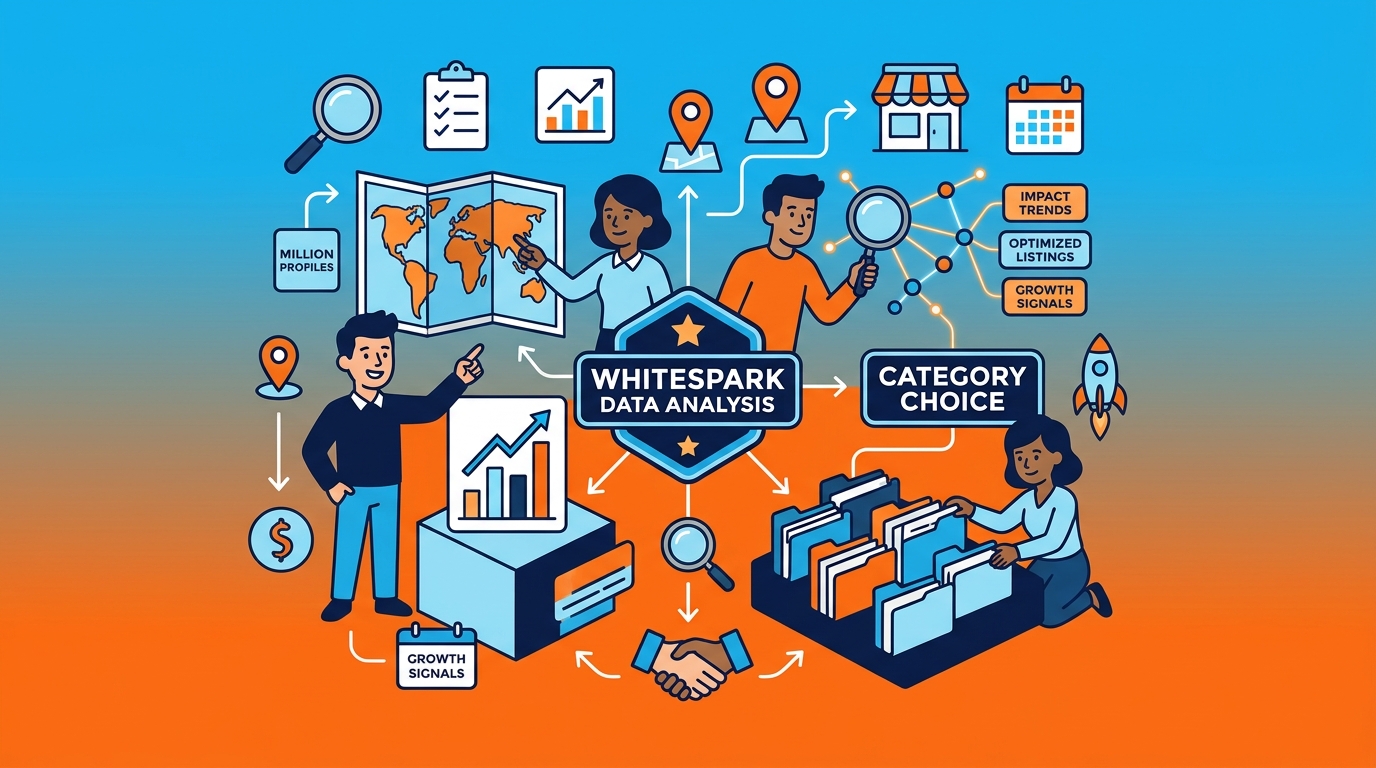
Whitespark looked at about 1.8 million Google Business Profiles. About 4,200 (4,209) categories.
In nearly every industry they tested, the pattern held. Businesses whose main category exactly matched the search words ranked above businesses in close-but-different categories.
Look at the full set of data.
About 1 in 8 (12.5%) of listings using a specific main category reached the top 10. For general ones, it was about 1 in 11 (9.2%).
That 36% is the relative gap between those two rates. Roughly a third better for specific categories.
Whitespark counts a category as specific if it’s more exact than a broad label like Restaurant or Attorney.
A second category helps. If it fits well with the main one.
Adding one improved average rank by 6 to 17 spots compared with profiles that had only the main category. Veterinarian plus Emergency veterinarian service is one example.
One added category actually hurt rankings. Service establishment.
It’s a general label Whitespark says almost nobody types into a search bar.
The table below shows what Whitespark found for each category choice.
| Category choice | What Whitespark found |
|---|---|
| Specific primary category | Reached the top 10 for 12.5% of listings |
| Generic primary category | Reached the top 10 for 9.2% of listings |
| Well-matched additional category added | Average rank improved by 6 to 17 positions compared with profiles carrying only the primary |
| Generic ‘Service establishment’ category added | Actively hurt |
Here’s the catch.
Google hasn’t confirmed in its own documents that matching categories or a complete profile helps ranking. Whitespark’s data alone can’t answer that question.
Now the expert view.
Whitespark’s 2026 survey came out on November 6, 2025. It lists “Primary GBP Category” as the first local pack factor.
Next come proximity and “Keywords in GBP Business Title.”
For 2026, it notes an increased importance of review signals and behavioural signals.
What Google’s Category Rules Allow
Here’s what Google says.
The categories you pick change how you place in local results on Google.
Pick a main category that best describes your business. Then choose a specific one from the list that shows up. For example, pick “Nail salon” instead of “Salon.”
Google also has a test.
Pick categories that finish the sentence “This business IS a,” not “This business HAS a.”
The goal is to describe your business as a whole. Not to list every service, product or extra you offer.
Google’s edit page says you can pick up to 9 more categories.
But its rules also say to use as few categories as you can from the list to describe your main business.
I describe a practice the same way.
I don’t publish more to win AI recommendations. I make your practice’s information easy for AI to grasp. Clear, factual content. In a sensible order.
Volume isn’t a win. I don’t count it as one.
Your category unlocks things.
Google says that, based on your business category, you might see special features for your Business Profile. Restaurants can add links for online orders, reservations and menus.
Health and beauty businesses can add a booking button.
Be careful when you change a category.
If you add or change a category you already have, Google might ask you to verify your business again. That helps Google make sure your business info is correct.
GMB Club says changing your main category can move your ranking within a few days. Up or down.
So note your position before you change it.
Here’s where these points come from.
The source is Google Business Profile Categories: How to Choose Them, With Data.
What Neck and Back Pain Patients Seek From Chiropractors and Other Providers
Start with the size of the problem.
One in four adults in the U.S. had neck or back pain bad enough that they saw a health care provider for it in the past 12 months.
Now, who do they go to?
Neck and back pain sufferers who saw a health care professional in the past 12 months most often went to a medical doctor (about six in ten, 62%).
Or a chiropractor (about half, 53%).
A very large share of neck and back pain patients who saw a chiropractor in the past year say their chiropractor listened to them (93%), made care easy and quick to get (93%), showed care and kindness (91%), and explained things well (88%).
Chiropractors aren’t the only option patients try.
Many people with neck and back pain also used non-drug treatments that need a health care worker. Massage (about half, 53%). Spinal adjustment (just under half, 47%). Physical therapy (about four in ten, 42%).
Fewer got cortisone shots (about one in five, 18%). Even fewer tried acupuncture (about one in ten, 9%).
Here’s where the numbers come from.
A Gallup Panel study, done online and by mail. About 5,400 (5,377) adults across the country, ages 18 and up, finished it. About 4,900 (4,882) did it online. About 500 (495) did it by mail.
It ran from March 12 to April 10, 2018.
The source page is Medical Doctors, Chiropractors Top Choices for Spine Care.
Here’s one more data point.
SOCi’s 2026 Local Discovery Index groups brand name, staff credentials and certifications as “brand and credentials.” They peak with two groups. About a third (34%) of U.S. consumers choosing a bank, financial advisor or insurance provider. And about a third (32%) of those choosing a healthcare provider.
That survey reached more than 1,000 U.S. consumers, weighted to match the U.S. population. The median age was 39. The group was close to half men and half women (50/50).
The median household income was about $82,000 (roughly $81,600).
Which specialty claims justify a longer drive for a patient?
That’s covered in Specialized Care Claims That Justify a Longer Patient Drive.
Frequently Asked Questions
Can I create a custom category if none fits my specialty?
No. You can’t make up your own category. Google says if the specific one you want isn’t there, pick a broader category that describes your business. Simple as that.
Can a category or the business name be used to carry keywords?
No. Google says not to use categories only as keywords or to describe features of your business. And stuffing keywords into your listing name to make up for a poorly chosen category? That breaks Google’s rules. It can get your listing suspended. Don’t risk it.
Do I need to add general categories alongside a specific one?
No, you can skip them. When you pick a specific category like “Golf Resort,” Google quietly counts broader ones too, like “Resort Hotel,” “Hotel” and “Golf Course.” You can leave out any category that seems to repeat a more specific one you already picked.
Does filling in the whole Business Profile go with better local rank?
Yes, in Whitespark’s data. On its 0-to-5 scale for how complete a profile is, profiles scoring 5 averaged position 43. Profiles scoring 0 averaged position 62. The 5-score profiles made the top 10 at roughly triple the rate of sparse, low-scoring listings.
But here’s the catch. Google hasn’t confirmed profile completeness as a ranking input. And Whitespark’s data can’t settle that on its own.
Do third-party business datasets record a practice’s category correctly?
Not always. Advan, Data Axle and FourSquare did fairly well at sorting businesses into the right categories. They got between 70% and 97% right. NETS did the worst.
Do back pain patients see more than one type of provider?
Yes, most do. About four in five (81%) people with this kind of pain saw more than one type of health care provider for it in the past year. They’re willing to try different kinds of care.
Be Specific, Then Be the Practice AI Recommends
Here’s where the evidence points.
Name your specialty exactly. Describe your services in detail. Don’t chase general breadth.
In Whitespark’s data, about 1 in 8 (12.5%) listings with a specific main category reached the top 10. For general ones, it was about 1 in 11 (9.2%).
SOCi says general profiles, thin local web pages and unclear service descriptions make it harder to match exactly what someone asks an AI tool for.
Here’s who we work with.
Established service businesses. Mostly chiropractors. But also dentists, attorneys, home service companies, coaches, consultants and other service providers.
The buyer we aim for wants to be the one choice AI recommends when someone asks it who to trust.
iTech Valet Service Plans & Pricing explains how the work is done.
I steer practices away from cheap monthly deals that stuff categories.
I count them as costing more than they save. Thin work. Little real progress. Money tied up in a contract that builds nothing.
To be the practice AI names, Run My AI Visibility Check.