
Among patients who actively searched for a doctor in the past year, AI tools like ChatGPT and Claude were cited as an influence by 36 percent, edging out Google search (34 percent) and doctor recommendations (32 percent). Last year, the comparable “conversational AI assistants” response from patients tallied a mere 17 percent. Among patients who actually switched providers, AI’s influence was even higher at 39%. When an AI tool recommends a business, 81% of consumers take some kind of verification step before contacting the business directly. Only 19% go straight from an AI recommendation to contacting the business.
Patients Now Ask AI Who to See
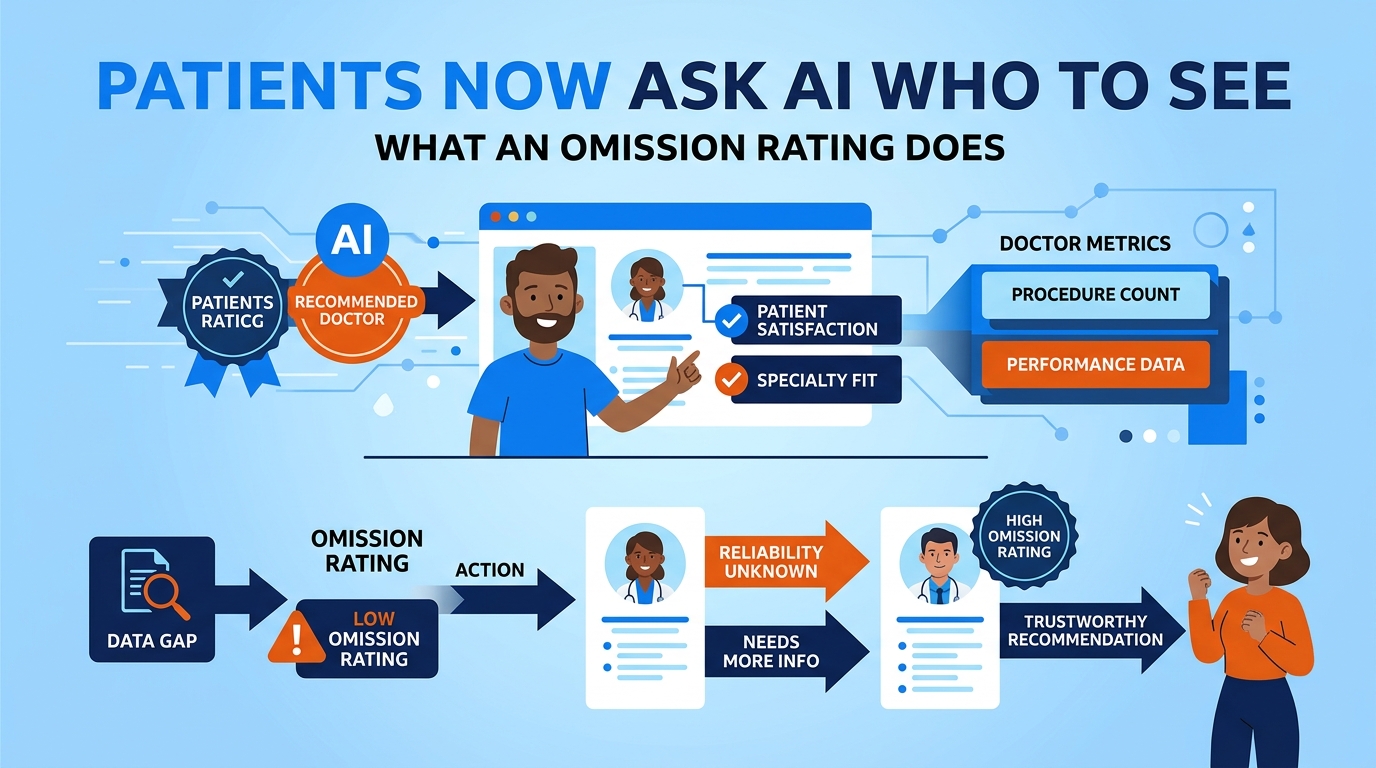
Here’s what an omission rating does.
It watches whether AI tools name a practice when a patient asks who to see.
Look at patients who actively searched for a doctor in the past year.
More than a third (36 percent) cited AI tools like ChatGPT and Claude as an influence. That edged out Google search (34 percent) and doctor recommendations (32 percent).
Last year? The comparable “conversational AI assistants” response tallied a mere 17 percent. Barely one in six.
And among patients who actually switched providers, AI’s influence was even higher. Nearly four in ten (39%).
Nearly half (47%) of patients have used an AI tool to research healthcare providers. In 2025, it was about three in ten (31%).
This isn’t a niche habit. OpenAI reports that health is one of the most common ways people use ChatGPT.
Their de-identified analysis of conversations says over 230 million people globally ask health and wellness related questions on ChatGPT every week.
I’d rather a practice be the source an AI names and draws on for its answer than one more name in a list of businesses; I build for being relied on, not merely being present. How diagnostic results read is set out in Interpreting Practice Diagnostic Results: A Complete Guide.
How Many Patients Ask AI First, by Age and Tool
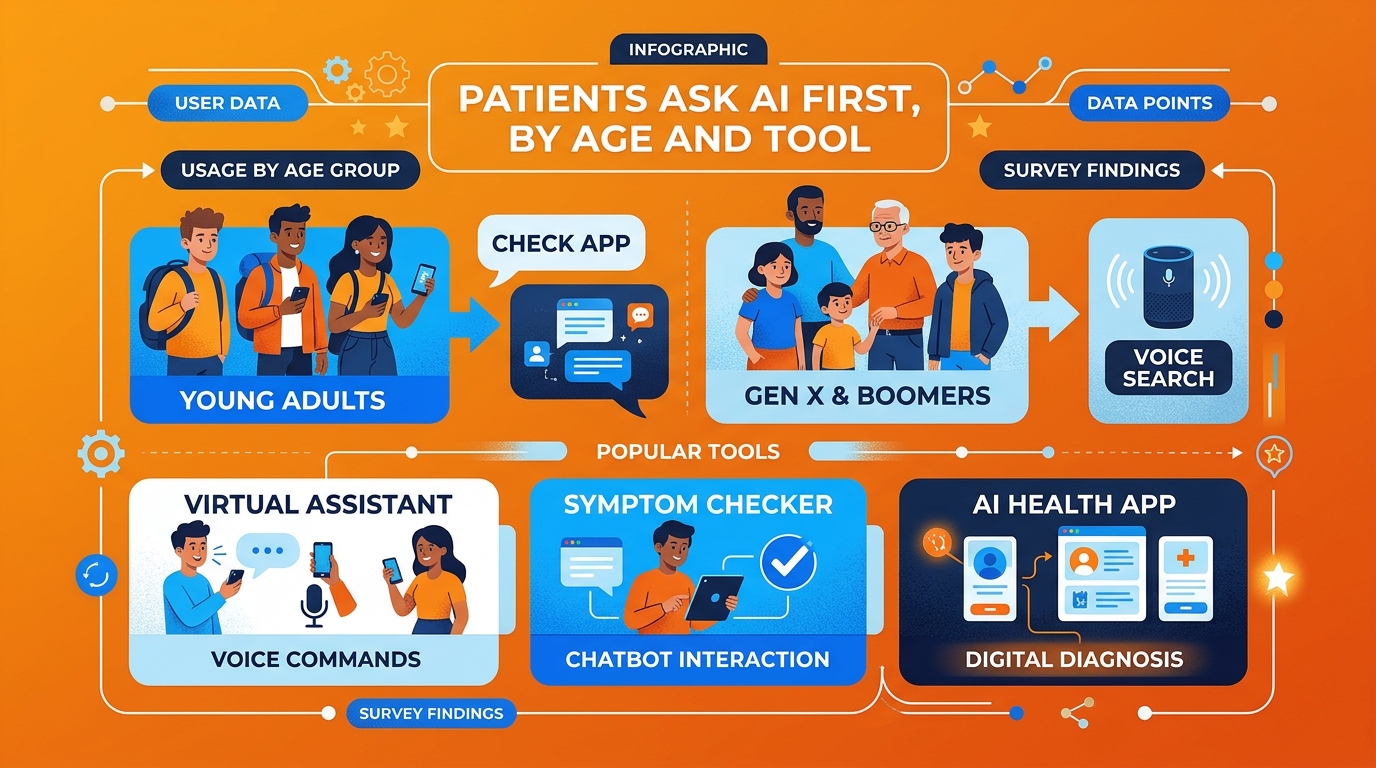
Here’s the surprise.
Adults ages 45 to 60 lead AI use for provider research. Nearly two-thirds (64%).
That’s ahead of every other demographic. Including 18-to-29-year-olds, at about a quarter (28%).
Now the wider health picture, from KFF:
- About a third (32%) of adults nationally say they turned to AI chatbots in the past year for health information.
- Three in ten (29%) adults now say they use AI tools or chatbots like ChatGPT, Google Gemini, or Claude for health information and advice monthly. That’s nearly double in two years. In June 2024, it was roughly one in six (17%).
Don’t mix up the two KFF numbers.
They count different things. The 32% is any use in the past year. The 29% is monthly use.
Here’s KFF’s poll: KFF Tracking Poll: Use of Social Media and AI For Health Information and Advice.
Now look at how fast this moved.
Consumers who used an AI tool to find a local business in the last 30 days? In 2025, fewer than one in ten (9%). In 2026, just over half (52%).
Close to a sixfold jump in a single year.
People reach AI two ways. They seek it out directly. Just over half use ChatGPT (57%), and about half use Gemini (51%).
Or they run into it inside tools they already use. About half (51%) have seen an AI answer at the top of Google results. And about a third (35%) have clicked into Google’s AI Mode.
Source: Americans are using AI to find local businesses. Most don’t trust it yet.
AI-first journeys are most common in healthcare. About one in five (21%). Grocery is right behind at nearly one in five (19%).
Want to see how AI treats your practice? iTech Valet’s AI Visibility Check looks at exactly that.
Where AI Answers Appear, Fewer Searchers Click Through
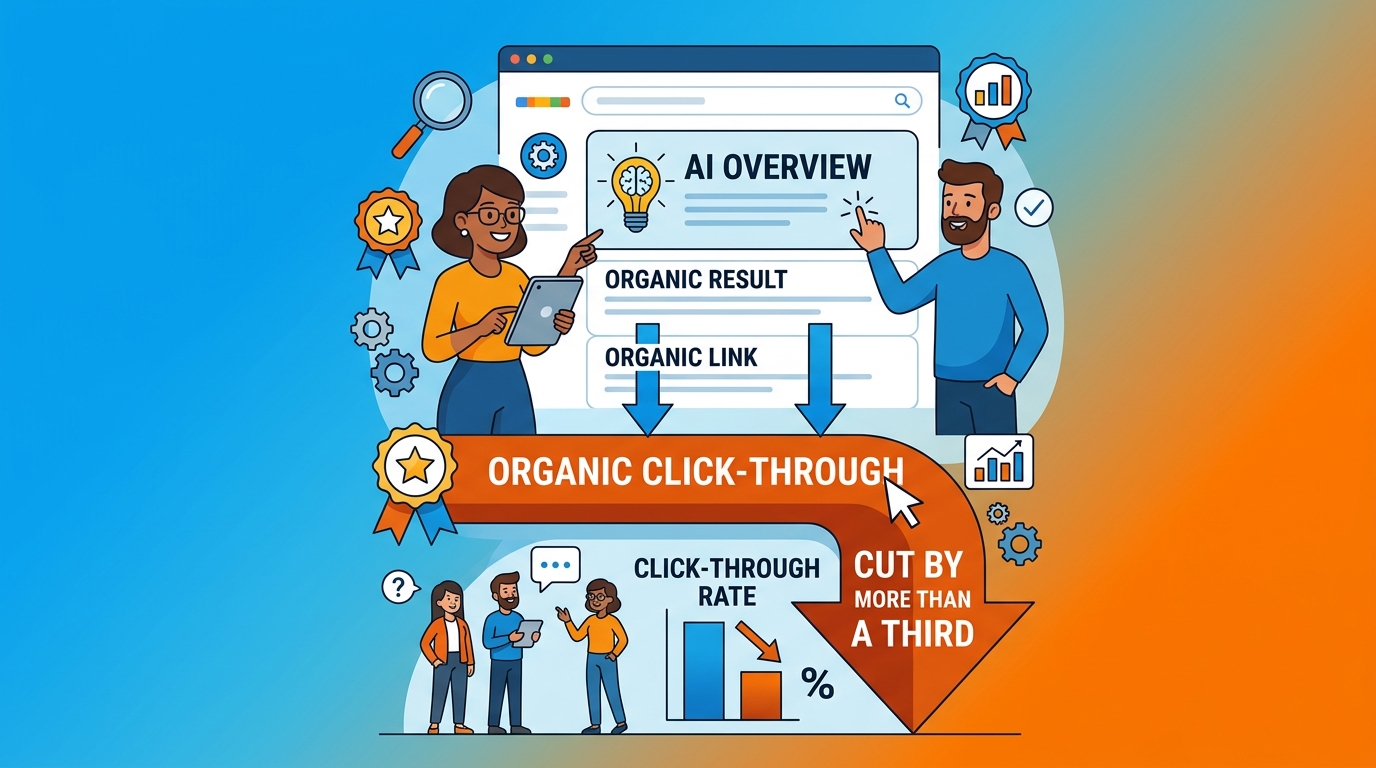
- A randomized field experiment found that AI Overviews (AIOs) cut organic click-throughs by more than a third (38%). They pushed zero-click searches up by about a third (33%). And users reported no better satisfaction to make up for it.
- Recent industry analysis says organic click-through rates for position-one results fell from 28% to 19% because of AI Overviews. Zero-click searches now make up well over half of all queries (over 58%).
- Pew Research Center found that users who saw an AI summary clicked a traditional result in just 8% of visits. Those who didn’t see one clicked nearly twice as often (15% of visits).
- Pew also found users ended their browsing session on just over a quarter (26%) of pages with an AI summary. With only traditional results, it was about one in six (16%).
One more piece of proof.
Research on arXiv shows that removing AI Overviews and AI Mode increases click-through rates to publishers.
But an AI Mode-only experience? It reduces click-through rates. It also erodes user experience and trust in information found on Google.
Here’s Pew’s write-up: Google users are less likely to click on links when an AI summary appears in the results.
Most Patients Verify an AI Recommendation Before Calling
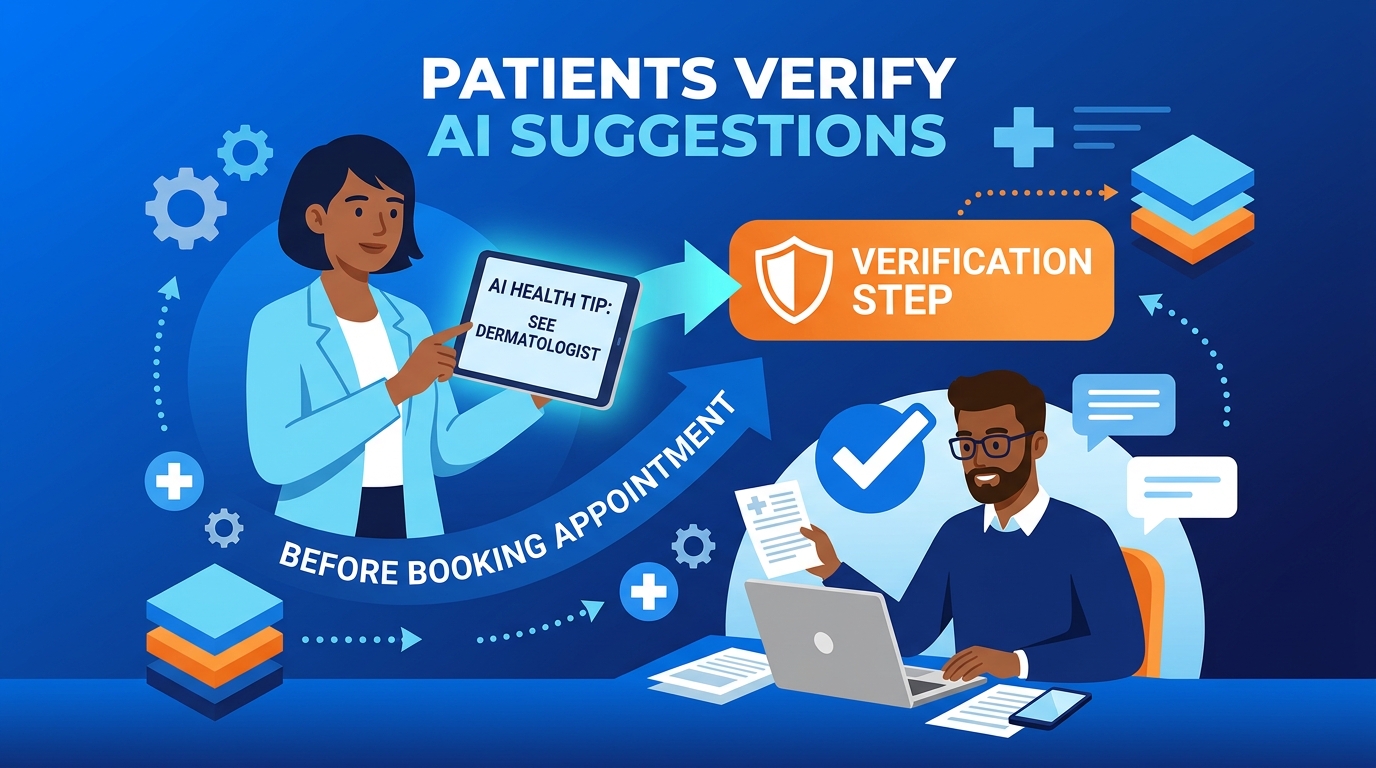
A mention is not a booked visit.
When an AI tool recommends a business, more than eight in ten consumers (81%) take some kind of verification step before contacting the business directly.
Only about one in five (19%) go straight from an AI recommendation to contacting the business.
And patients have reason to double-check.
Among consumers who use AI tools, two-thirds (67%) say they’ve been given wrong information about a local business at least once.
Three in ten (30%) say that bad information caused a real inconvenience.
So where do they check? Reviews.
- Reviews and word of mouth lead in five of the eight categories studied, from restaurants (41%) to healthcare (38%).
- According to the Local Discovery Index, 99% of consumers read reviews before a first visit at least some of the time, and 68% do so always or most of the time.
- Seventy-two percent are more likely to choose a business that responds to its reviews, up from 65% in 2025.
How Many Back and Neck Pain Patients See a Chiropractor
Here’s the baseline.
Any omission gets measured against the patients who actually exist. These figures come from older Gallup surveys.
Here’s the picture:
- One in four adults in the U.S. have neck or back pain bad enough that they saw a healthcare provider in the past 12 months. See One in Four Adults Sought Care for Neck/Back Pain Last Year.
- Sufferers who saw a professional for this pain in the past 12 months were most likely to pick a medical doctor (62%) or a chiropractor (53%).
- Most patients with this kind of pain (81%) saw more than one type of provider in the past year.
- Roughly one-fourth of U.S. adults say they’ve seen a chiropractor in the past five years, with more than half (35.5 million) doing so in the past 12 months.
- More than half (53%) of U.S. adults say they’d most like to see a medical doctor about their neck or back pain. Ranking second, 28% say they’d most like to see a chiropractor.
Don’t mix up these two numbers.
The 53% for chiropractors counts sufferers who actually saw a professional. The 28% is what all U.S. adults say they’d most like.
Different groups. The preference figures appear in Medical Doctors, Chiropractors Top Choices for Spine Care.
Which Searches Produce AI Answers, and Google’s Health Guardrails
Here’s what Pew found.
Nearly one in five searches (18%) in its study generated an AI summary. Question-word and longer searches produced one far more often:
| Query pattern | Share producing an AI summary | Source |
|---|---|---|
| Question-word queries (who/what/when/why) | 60% | Pew Research Center |
| One- or two-word searches | 8% | Pew Research Center |
| Searches of 10 or more words | 53% | Pew Research Center |
| All Google searches in Pew’s study | 18% | Pew Research Center |
Those summaries rarely lean on one source.
The vast majority (88%) cited three or more sources. Only 1% cited a single source.
Now Google’s side.
Google says that for topics like news and health, it already has strong guardrails in place.
Here’s how I see it.
Getting picked by AI answer tools is its own discipline. It’s not classic search work with a new name.
I don’t chase keywords. I don’t chase inbound links. I don’t chase ranking position.
I put the effort into making it easy for these systems to work out who a practice is. And whether it’s credible.
How Trust Shapes Whether Patients Act on AI Answers
Trust drives behavior.
In one study, people who trusted generative AI more clicked more. They also spent less time evaluating generative AI search results.
Here’s the twist.
A preregistered, randomized experiment used a large sample representative of the U.S. population. On average, participants trusted generative AI search less than traditional search.
But reference links and citations significantly increased trust in it.
Even when those links and citations were incorrect or hallucinated.
Why do people ask AI about health? Speed.
About two-thirds (65%) of users told KFF that a major reason was to get quick or immediate information or support.
Substantial shares have other reasons too. Roughly four in ten (41%) want to look up information before deciding whether to see a provider. Over a third (36%) feel more comfortable looking up information privately.
Want the source? KFF’s polls: Poll: 1 in 3 Adults Are Turning to AI Chatbots for Health Information and KFF Health Misinformation Tracking Poll: AI and Health Information.
Why AI Exposure and Click Quality Vary Too Much for an Exact Patient Count
Here’s the problem.
Exposure figures measure different things.
In one study, more than a third of searches (36%) triggered AI Overviews. Participants used AI Mode for 0.6% of their searches.
Pew counted people instead. About six in ten respondents (58%) ran at least one Google search in March 2025 that produced an AI-generated summary.
One is a share of searches. The other is a share of respondents.
Google makes a claim about quality.
It says clicks from search results pages with AI Overviews are higher quality. Meaning users are more likely to spend more time on the site.
So the rating is a direction. Not a count of missed patients.
Here’s what changed for me.
AI tools started giving direct answers instead of lists of links. So I stopped reading a site’s spot in a results list as a sign of whether a business gets found.
I treat rank reports as measuring something that looks good without driving outcomes.
I’ve retired position tracking as a measure of success.
Want to read a rating right? Start here: Reading the Omission Rating: High, Medium, or Low Risk? and Common Misreadings of a Low Diagnostic Rating, Corrected.
Frequently Asked Questions
Do searchers click the links inside Google’s AI summaries?
Rarely. Pew found that Google users who saw an AI summary clicked a link inside it in just 1% of all visits to pages with such a summary.
Don’t expect many clicks from inside the summary.
Which patients are most likely to use AI for health information?
Adults 30 to 49, mostly. KFF found they’re more likely to turn to AI. The youngest cohort leans much more on social media.
AI use is also more common among those with higher incomes or more advanced education.
About one in six adults (17%) use AI chatbots at least once a month to find health information and advice. Among adults under age 30, it’s one quarter (25%).
Do people who ask AI about a health problem still see a provider?
Many do not. KFF found that many people who consult AI for health information did not follow up with a doctor or other health professional afterward, including most (58%) who asked about mental health and 42% who asked about physical health.
Do patients trust AI chatbots for health information?
Few do. Fewer than three in ten adults (29%) say they trust chatbots to provide reliable health information.
Even among people who use AI, only a small share (36%) say they trust chatbots to provide reliable information about health.
What the Rating Points To
An omission rating points in a direction.
Toward patients who ask AI first. And verify before they call.
AI-first journeys are most common in healthcare (21%) and grocery (19%).
Reviews and word of mouth lead in five of the eight categories studied. Healthcare included (38%).
Want to know how the work gets done? It’s on the iTech Valet Service Plans & Pricing page.
Want to see where your own practice stands? Run My AI Visibility Check.