
Generative search engines are stochastic: the same query submitted on different occasions can produce different responses and cite different sources. A single observation therefore cannot tell you much about an underlying visibility rate. ChatGPT recommends just 1.2% of brand locations, compared to an average 35.9% appearance rate in Google’s local 3-Pack, making AI visibility nearly 30 times more selective than traditional local search.
Misreading #1: Treating One Low Score as a Permanent Verdict
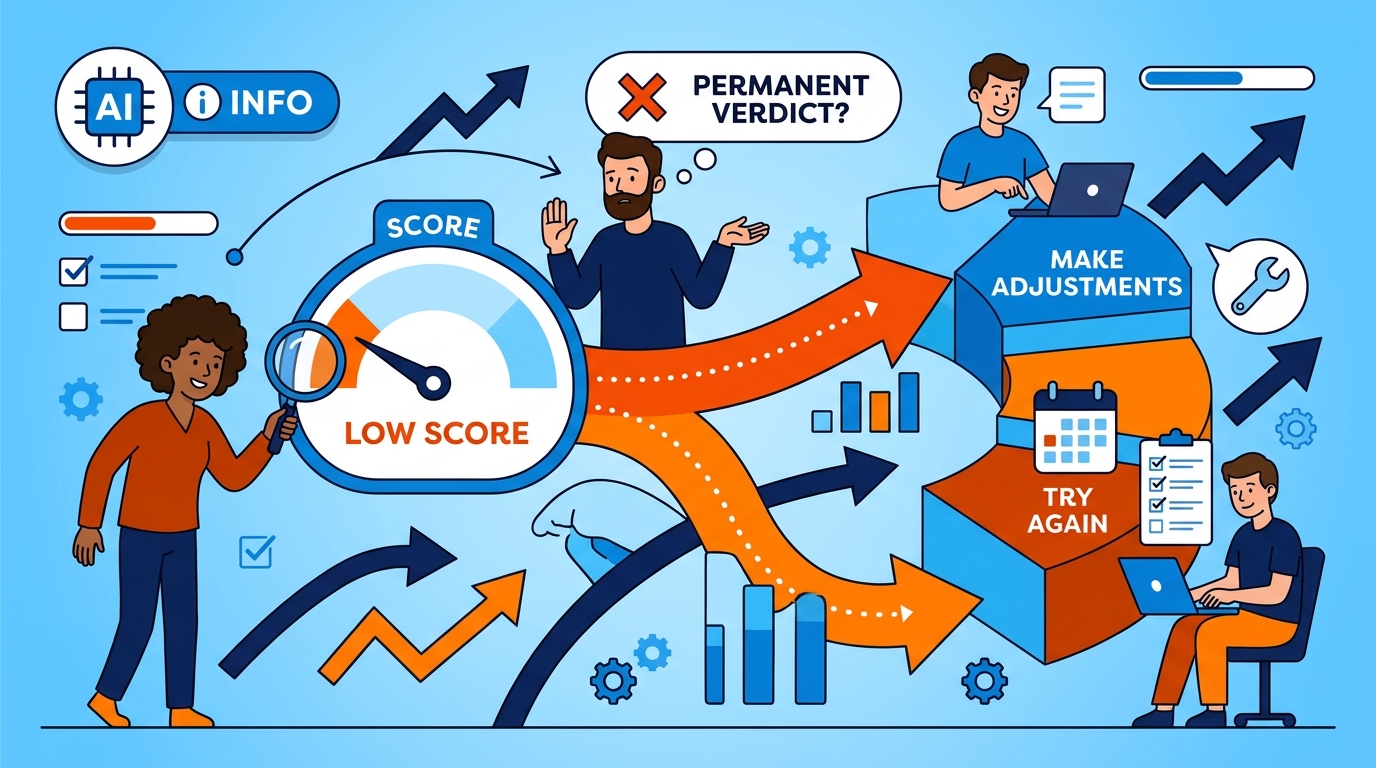
Here’s the thing about AI search.
Generative search engines are stochastic. Ask the same query on different days and you can get different responses. Different cited sources, too.
So one check is one draw.
Answer Engine Land says a single observation can’t tell you much about an underlying visibility rate.
Here’s their example.
Say a brand shows up in six of ten controlled repetitions. The observed per-run mention rate is six in ten (60%).
That doesn’t mean the next ten runs will also produce exactly six mentions.
Want to read the full set of results? That’s covered in Interpreting Practice Diagnostic Results: A Complete Guide.
The research on run-to-run swings is From Stochastic to Stable: Rank Stability and Structural Sufficiency in AI Visibility Measurement.
Misreading #2: Assuming the Score Measures What a Search Ranking Measures
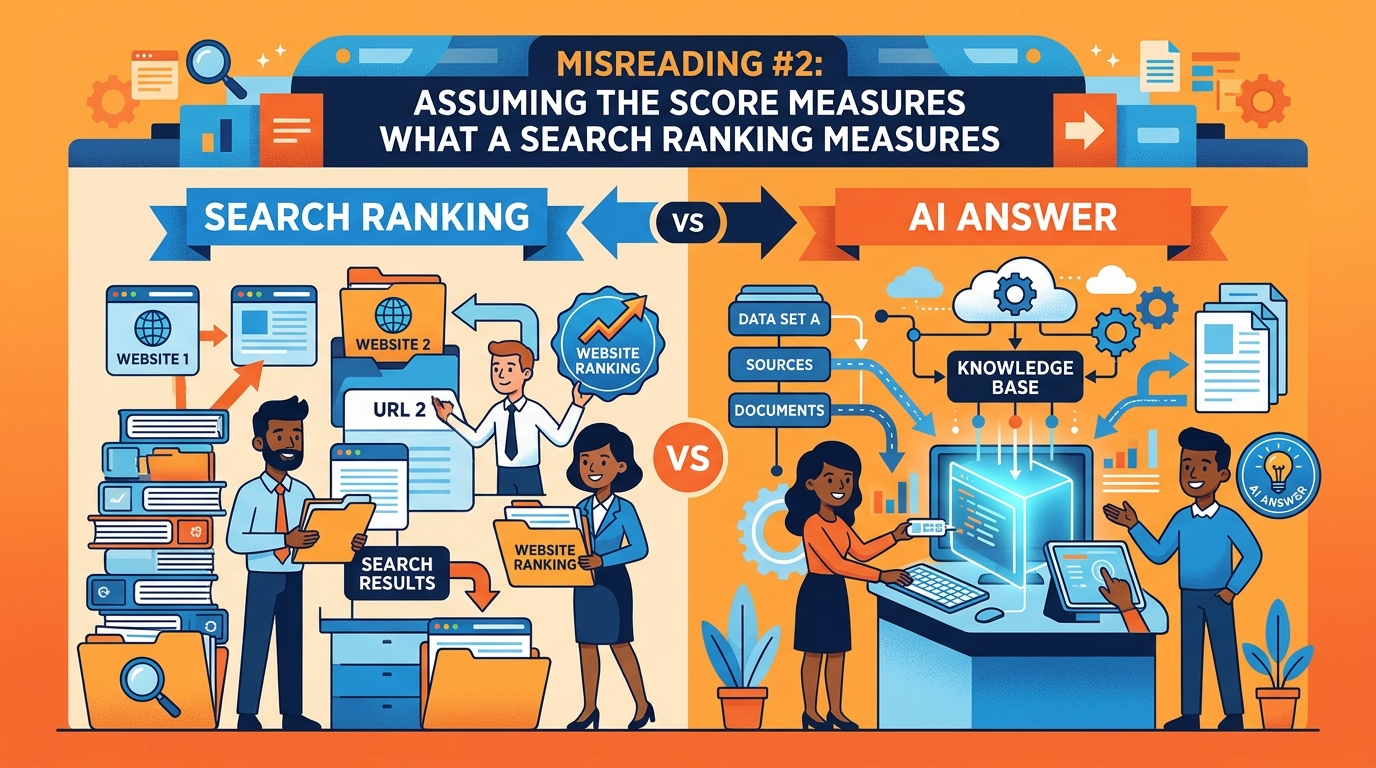
A Google ranking and an AI answer don’t start from the same pile of pages.
One study found the retrieved sources are substantially different for each search engine. Under 0.2 average Jaccard similarity.
Research also confirms it. AI search engines cite domain resources with greater diversity than traditional search engines.
The mix of sources is different too.
Researchers found AI Search shows a systematic and overwhelming bias toward earned media. That’s third-party, authoritative sources. Brand-owned and social content lose.
Google? A far more balanced mix.
Here’s where AI citations actually point:
- 85.7% of citations point to sites the brand does not own. 14.3% point to owned sites.
- A brand’s own website is a minority source even for the best self-cited brand. For many brands, it is a non-source.
- When AI search engines cite any sources, about 78% of those citations go to corporate websites. That includes the brand’s own pages and third-party pages from companies in the same space.
Here’s my rule.
I stopped using a site’s spot in a results list to judge whether a business gets found. That ended once AI tools started giving direct answers instead of lists of links.
Rank reports look good. They don’t drive outcomes. I’ve retired position tracking as a measure of success.
I don’t treat getting picked by AI answer tools as classic search work with a new name.
I don’t chase keywords, inbound links or ranking position to get there.
I put the effort into making it easy for these systems to work out who a practice is. And whether it’s credible. Through the outside sources they cite.
More on AI visibility measurement: From Stochastic to Stable: Rank Stability and Structural Sufficiency in AI Visibility Measurement.
Misreading #3: Believing More Repeated Checks Always Remove the Noise
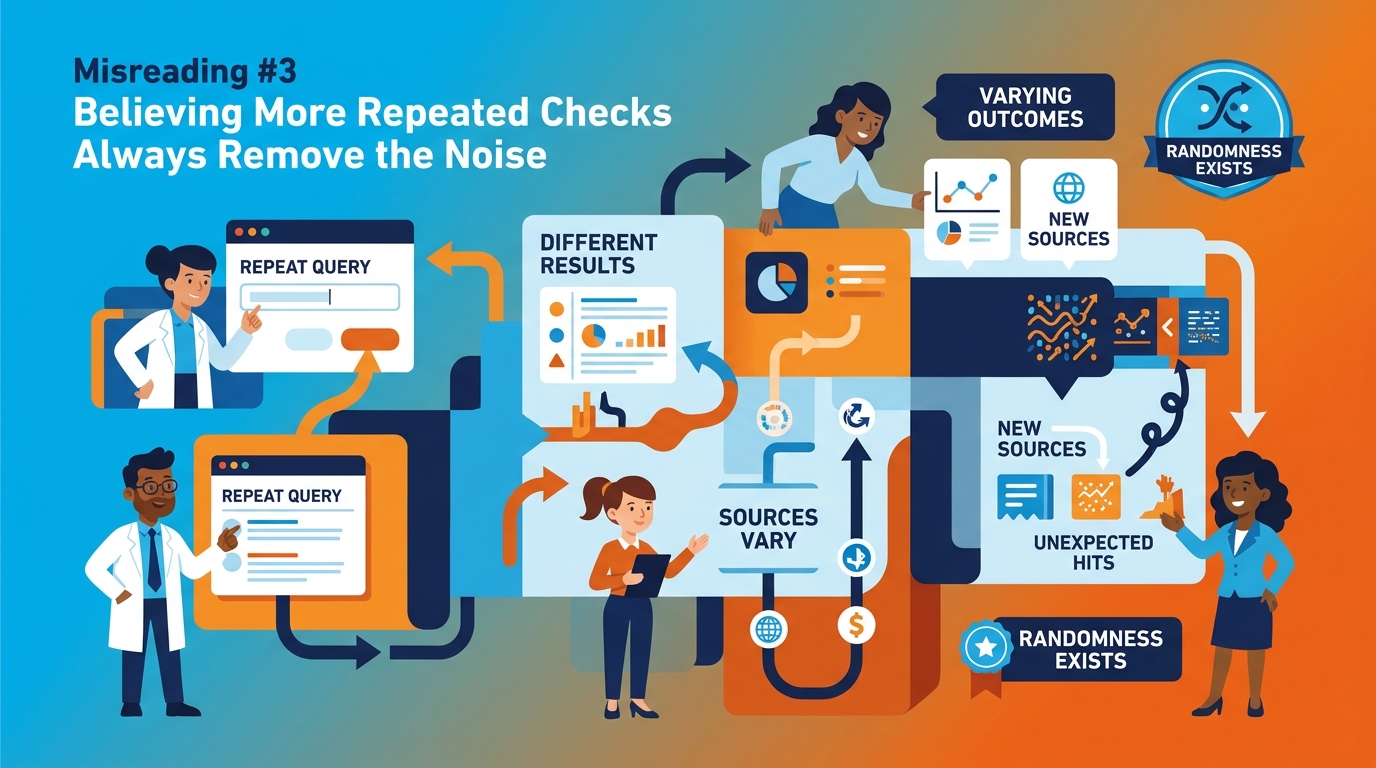
Repeat a query and you won’t get the same sources back.
Platform-level Jaccard similarity across repeated runs of the same query is approximately 0.30 for Gemini. About 0.40 for SearchGPT. About 0.50 for Perplexity.
Even the most consistent platform shares only half its cited domains across repeated samples.
More data narrows the uncertainty. Slowly.
Each doubling of data yields only approximately 29% improvement in CI width.
For the most frequently cited domains on SearchGPT, 95% CI spans range from 3 to 6 percentage points.
And the apparent differences between many adjacent domains? Statistically indistinguishable from sampling noise.
Early results can fool you.
During early collection, the first 20 to 60 queries (depending on topic and platform), the rank ordering changes substantially with each additional response.
Generative engines cite only a handful of sources per response. SearchGPT, for example, cites between 4 and 6.
So the eventual leaders may not show up at all in the first several responses.
Some orders never settle.
That 20-to-60 figure describes early collection. The next figure is about convergence under a fixed ρ ≥ 0.95 criterion.
Under that criterion, convergence response orders range from 40 responses to never. That’s across the 30 platform-topic combinations studied.
No platform converges at a rate that’s consistently fastest or slowest.
Read the full study: From Stochastic to Stable: Rank Stability and Structural Sufficiency in AI Visibility Measurement.
Misreading #4: Reading a Flat Score as Proof a Fix Failed
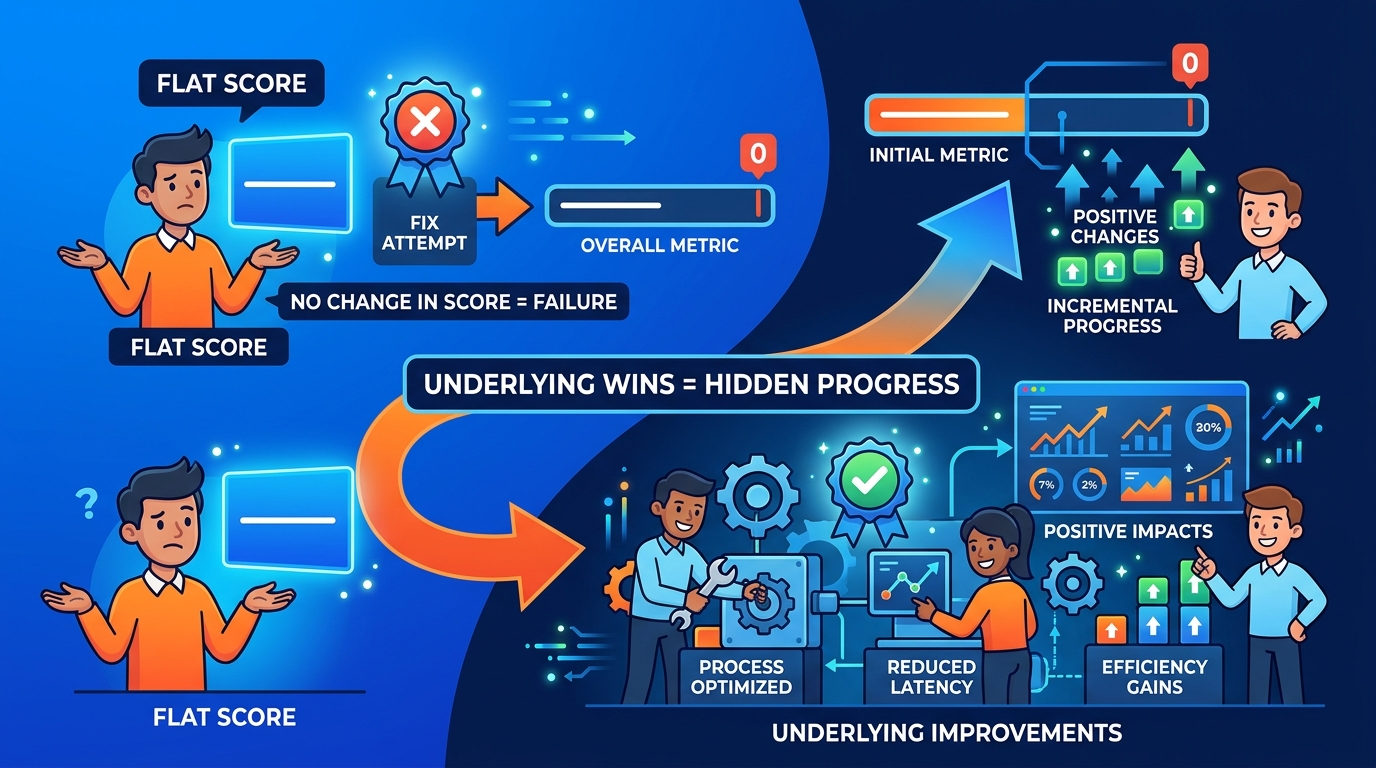
A flat reading isn’t proof that nothing changed.
Answer Engine Land lists these errors:
- Interpreting non-significance as no effect. A wide interval often means insufficient precision. Not evidence of equivalence.
- Two individual intervals can overlap even when the difference interval excludes zero.
- Changing prompts between periods. The apparent trend may reflect a different prompt mix.
- Prompt coverage generally rises as you add repeated runs. So don’t compare it across studies using different repeat counts.
Pair the interval with counts.
Write “31 citations in 80 valid runs.” Not merely “38.8% citation visibility.”
A clean technical setup doesn’t close the case either.
Neither crawler access nor markup guarantees inclusion in a generated answer.
Which technical breaks to repair first? That’s covered in The Three Technical Breaks to Repair First After a Low Rating.
The source for these points is AI Search Visibility Confidence Intervals from Answer Engine Land.
Misreading #5: Assuming AI Citations Mostly Come From Top Organic Results
Here’s what Google says about how it built AI Overviews: “Because accuracy is paramount in Search, AI Overviews are built to only show information that is backed up by top web results.”
The data says the reach goes well past the top of the page.
seoClarity looked at 362,000 keywords. 94% showed at least one overlap between AI Overview citations and the top 20 organic results. On average, each AI Overview included 3 URLs from the top 20 organic results as of October 2025, down from 5 URLs in May 2025. seoClarity also found 44% of AIO citations come from URLs outside the top 20 results.
BrightEdge found more than half (54.5%) of AI Overview citations now rank organically. That’s up from about a third (32.3%).
Most of that overlap growth comes from pages ranking 21-100. Not the top 10.
That’s why the figures differ. The 54.5% covers citations that rank organically. Only about one in six (16.7%) of citations come from top 10 results.
Originality.ai found that overall, nearly half (48%) of citations in AI Overviews overlap with the top-100 organic search results.
Healthcare sits higher. BrightEdge puts it at about three-quarters (75.3%).
It started high. It saw modest gains.
Here’s the lineup.
The table matches each overlap finding to its source.
| Overlap finding | Scope |
|---|---|
| 94% of keywords showed at least one overlap between AI Overview citations and the top 20 organic results | 362,000 keywords, seoClarity |
| 54.5% of AI Overview citations now rank organically, up from 32.3% | BrightEdge |
| Only 16.7% of citations come from top 10 results | BrightEdge |
| 48% of citations overlap with the top-100 organic search results | Originality.ai |
| Healthcare: 75.3% (started high, modest gains) | Healthcare, BrightEdge |
Want the studies? Here they are.
The Overlap Between AI Overviews and Organic Rankings from seoClarity.
AI Overview Citations Now 54% from Organic Rankings from BrightEdge.
52% of AI Overview Citations Appear in the Top-10 Google Search Results from Originality.ai.
Misreading #6: Assuming a Low AI Score Means the Business Isn’t Credible
The AI filter is narrow.
SOCi’s 2026 Local Visibility Index measured businesses across all industries. They appear in Google’s local 3-Pack about a third of the time (35.9%) on average. But only about one in a hundred (1.2%) are recommended by ChatGPT. Gemini recommends about one in nine (11.0%).
SOCi says that makes AI visibility nearly 30 times more selective than traditional local search.
Retail tells the same story.
SOCi found only 45% overlap between the most visible enterprise brands in traditional local search and those most frequently recommended by AI platforms.
Less than half.
Where do healthcare and medical practices land? In the index’s Local Services industry grouping. Alongside other appointment-based, community-facing categories.
Now, what’s a local visibility benchmark? It measures how the average brand in your category performs online.
It’s the minimum bar to clear just to outperform a typical competitor. Based on real data. Not assumption.
Some gaps close fast.
For most healthcare organizations, review response consistency and profile completeness are the fastest, lowest-risk places to close a gap. Neither requires touching clinical content.
And the bar is low. Across all industries, the average business responds to under half (46.9%) of Google reviews. Response times average more than four days (4.3 days).
Inconsistent or incomplete listings reduce AI confidence. They can remove brands from consideration entirely.
Here’s Google’s guidance on credibility.
E-E-A-T itself isn’t a specific ranking factor. But using a mix of factors that can identify content with good E-E-A-T is useful.
I’d rather you be the source an AI names and draws on. Not one more name in a directory.
So I aim the work at being relied on. Not just being present.
I don’t sell the old search playbook many agencies still offer.
The conditions it relied on are gone. I’m sure of that.
If a client is paying for those tactics, that’s a flaw in the agency’s offer. Not in the practice.
Want to know how these ratings are read? Start with Reading the Omission Rating: High, Medium, or Low Risk?.
The data is in Local Visibility Benchmarks for Healthcare: 2026 Data and In AI-Driven Discovery, Few Brands Are Chosen, Most Disappear. Both are from SOCi.
And iTech Valet’s diagnostic page is the AI Visibility Check.
Misreading #7: Assuming Citation Sources Stay Stable Week to Week
They don’t.
Distribution-wide rank stability analysis shows citation rankings are unstable across samples.
And it’s not just the top-ranked domains. It holds throughout the frequently cited domain set.
It gets worse.
Research on AI Overviews found they’re less consistent when processing two runs of the same query. They’re also less robust to minor query edits.
Same question twice. Different answers.
So how should you read the numbers?
One paper argues that citation visibility metrics should be treated as sample estimators of an underlying response distribution.
Estimates. Not facts.
Frequently Asked Questions
If my practice ranks well in Google, will AI Overviews cite my page?
Not every time.
Per seoClarity, position 1 URLs appear in AI Overviews 43% of the time. Originality.ai found that by the top-3, the chance drops to about 50%. By the first page (top-10), it falls further to 38%.
Originality.ai also finds about half (52%) of organic citations come from top-10 results. Different number, different question. The 38% is your chance of being cited. The 52% is the share of organic citations that come from the top 10.
A strong Google position is one input. Not a promise.
How many times does a prompt need to be checked before a score is reliable?
More than you’d think. And repeats don’t count.
At 95% confidence, a worst-case calculation needs about 97 independent observations for a margin of error of ±10 percentage points. For ±5 points, you need about 385.
Twenty repetitions of five prompts give you 100 observations. But that’s not 100 independent prompt needs.
Ignore that correlation and your standard errors come out too small. Your confidence intervals come out too narrow.
So count independent observations. Not repeats.
Do all AI platforms cite the same number of sources?
No. Not even close.
Citation density differs by more than sixfold between platforms. The concentration of the distribution and the rate at which rank order stabilizes follow suit.
So don’t stack their counts side by side. Read each platform on its own terms.
If my practice drops from 10th to 20th in AI citations, did something change?
Maybe. Maybe not.
A domain that moves from rank 10 to rank 20 between two measurement periods may have undergone a meaningful competitive shift.
Or it may be oscillating within the band of sampling noise. At its share level, that’s indistinguishable from stability.
Two readings alone don’t settle it.
Do healthcare searches behave differently in AI Overviews?
Yes. In one way.
When seoClarity analyzed citation overlap by industry, Healthcare stood out. It had the highest average number of overlapping URLs between AI Overviews and organic results. That’s as of May 2025.
A Low Rating Is a Signal to Act On
Here’s how I read a low rating.
It’s a signal about process. Not a verdict on your practice.
I treat authority-building as process inputs. Not guaranteed outputs.
I can’t promise an AI engine will name you. But I can tell you which inputs to work on.
I steer your effort and money toward clear, credible information you control. Not ads. Not paid placements.
Why? The first keeps paying off and grows over time. The second stops the moment the spending stops.
I count on one. I expect the other to vanish.
I steer practices away from low-priced monthly agency deals.
They look like a bargain. In my experience, they usually cost you more.
Thin work. Little real progress. Money tied up in a contract that builds nothing.
I won’t sell a cheap fix aimed at the wrong score.
How the work is done is laid out on the iTech Valet Service Plans & Pricing page. To see where your practice stands, Run My AI Visibility Check.