
Google Assistant reads Google Business Profile. Siri reads Apple Business Connect and Yelp. Alexa reads Bing Places and Yelp. If your business only exists in one of these systems, you’re invisible to whichever assistants don’t use it. With Ask Maps, when a customer asks “do they do bathroom installations?” — Gemini looks at your Services section. If bathroom installations aren’t listed, the AI may tell the customer you don’t offer it. Gemini uses your category to decide which customer questions to answer with information about your business. “Best wedding photographer near me?” will only surface you if Google understands you do weddings, and the category is one of the strongest signals. If your business doesn’t select a category that correlates with a service, you might not see the option to add services.
Each Voice Assistant Reads a Different Listing Source
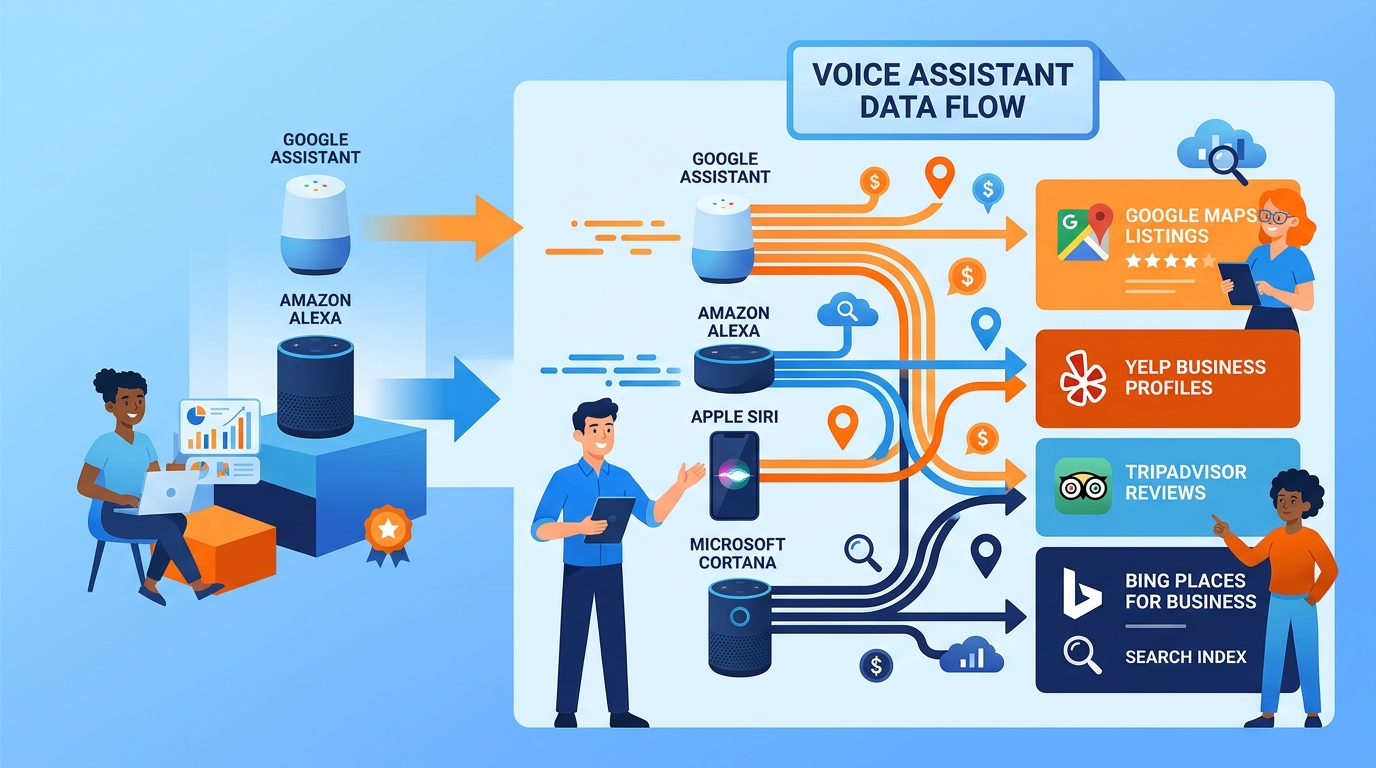
Here’s the split. Where Alexa, Siri & Google Assistant Get Local Data lays it out.
Google Assistant reads Google Business Profile. Siri reads Apple Business Connect and Yelp. Alexa reads Bing Places and Yelp.
Exist in only one of these systems? You’re invisible to whichever assistants don’t use it.
There’s no separate “voice database” here.
It’s the identical profile. Your hours. Your reviews. Your categories. Your photos.
The table below shows which listing source each assistant answers local requests from.
| Assistant | Listing source it reads |
|---|---|
| Google Assistant | Google Business Profile |
| Siri | Apple Business Connect and Yelp |
| Alexa | Bing Places and Yelp |
| Microsoft Copilot and Bing local results | The same Bing Places for Business data that feeds Alexa |
| ChatGPT and Gemini | Training knowledge combined with live web and answer-engine retrieval, not a single local-business API |
Microsoft Copilot and Bing’s own local search results run on the same Bing Places for Business data that feeds Alexa.
ChatGPT and Gemini work differently. They mix training knowledge with live web and answer-engine retrieval. They don’t query a single local-business API.
Someone asks Siri “where’s the closest urgent care?” Or types “hardware store” into Spotlight. Or pulls up Apple Maps in CarPlay.
The place graph they see is built on Apple Business data. That same graph is what Apple Intelligence draws from to compose local answers.
Apple Business: What It Is & Why It Matters for Local Visibility adds one more thing.
Apple Maps and Google Maps are completely separate systems. Separate data. You need to manage your presence on both independently.
Here’s a sensible baseline. Four free listings.
A complete Google Business Profile. A claimed and complete Yelp listing. A claimed Apple Business Connect listing. A claimed Bing Places for Business listing.
Roughly four out of five (80%) voice search answers come from the top three organic search results.
Pages that win voice answers also tend to be fast, secure, and detailed.
And voice answers are short. About 29 words on average.
I treat getting a clinic picked by these assistants as its own discipline. It’s not classic search work with a new name.
I don’t chase keywords, inbound links or ranking position for it.
I make it easy for each assistant to work out who the clinic is. And whether it’s credible. From the listing systems that assistant reads.
Google’s Ask Maps Answers From the Profile’s Services and Category
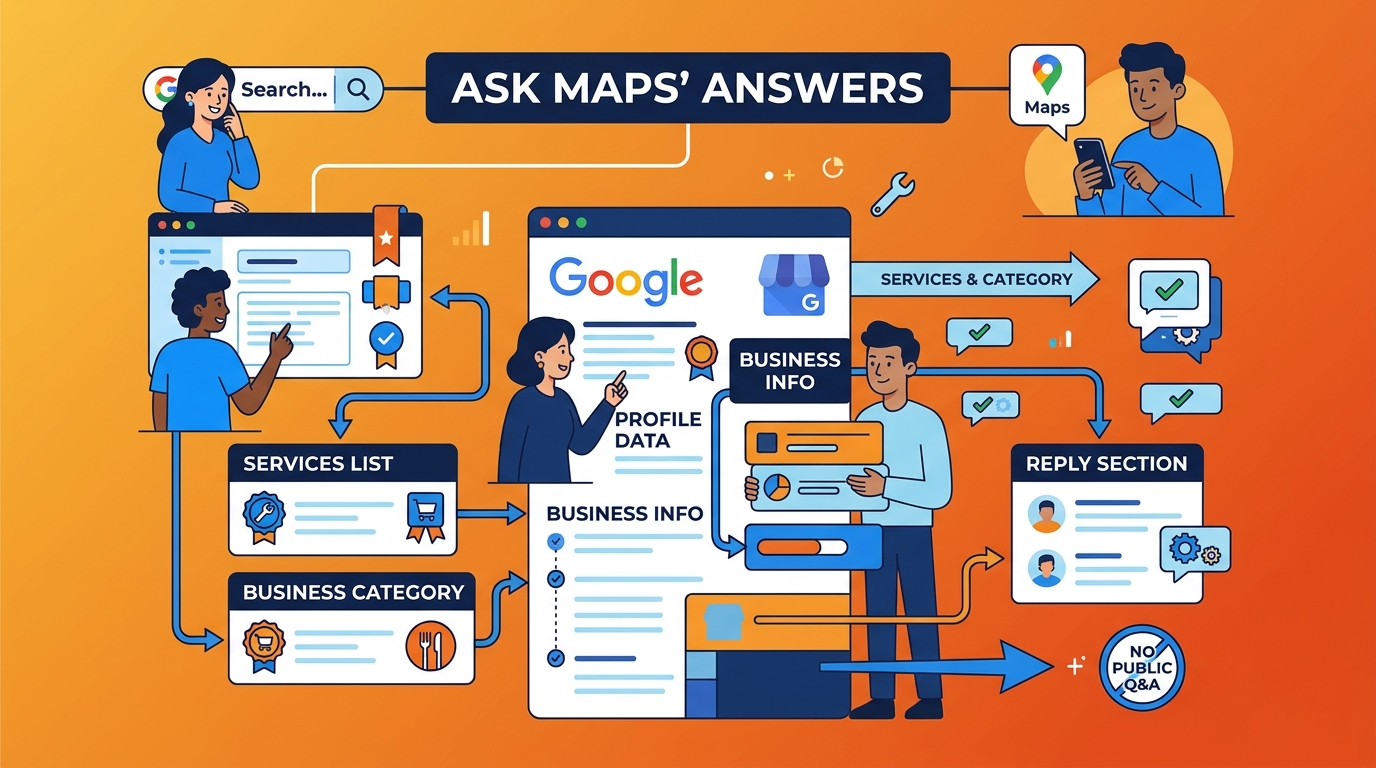
Google killed the public Q&A feature on Business Profiles. Ask Maps replaced it.
It’s an AI-powered feature built on Google’s Gemini model. It answers customer questions about your business automatically, in real time.
5 Silent Mistakes Killing Your Google Business Profile describes the change.
The answers are AI-generated. And when information is missing, the AI may say it doesn’t have enough to answer.
So what does it pull from? Google Business Profile Q&A is gone reports what Whitespark’s testing found.
Your Google Business Profile details. Services, attributes, hours, description.
Here’s what that looks like.
A customer asks, “do they do bathroom installations?” Gemini checks your Services section.
Bathroom installations aren’t listed? The AI may tell the customer you don’t offer it.
Gemini uses your category to decide which customer questions to answer with information about your business. “Best wedding photographer near me?” will only surface you if Google understands you do weddings, and the category is one of the strongest signals. Your primary category also appears to affect whether the feature shows. Some regulated and spam-prone categories are excluded.
I set up a clinic’s profile so it’s the business Ask Maps answers with. Not just a pin on the map.
Being the source the AI relies on is worth more to me than being listed somewhere.
The Category Decides Whether a Profile Can List Services at All
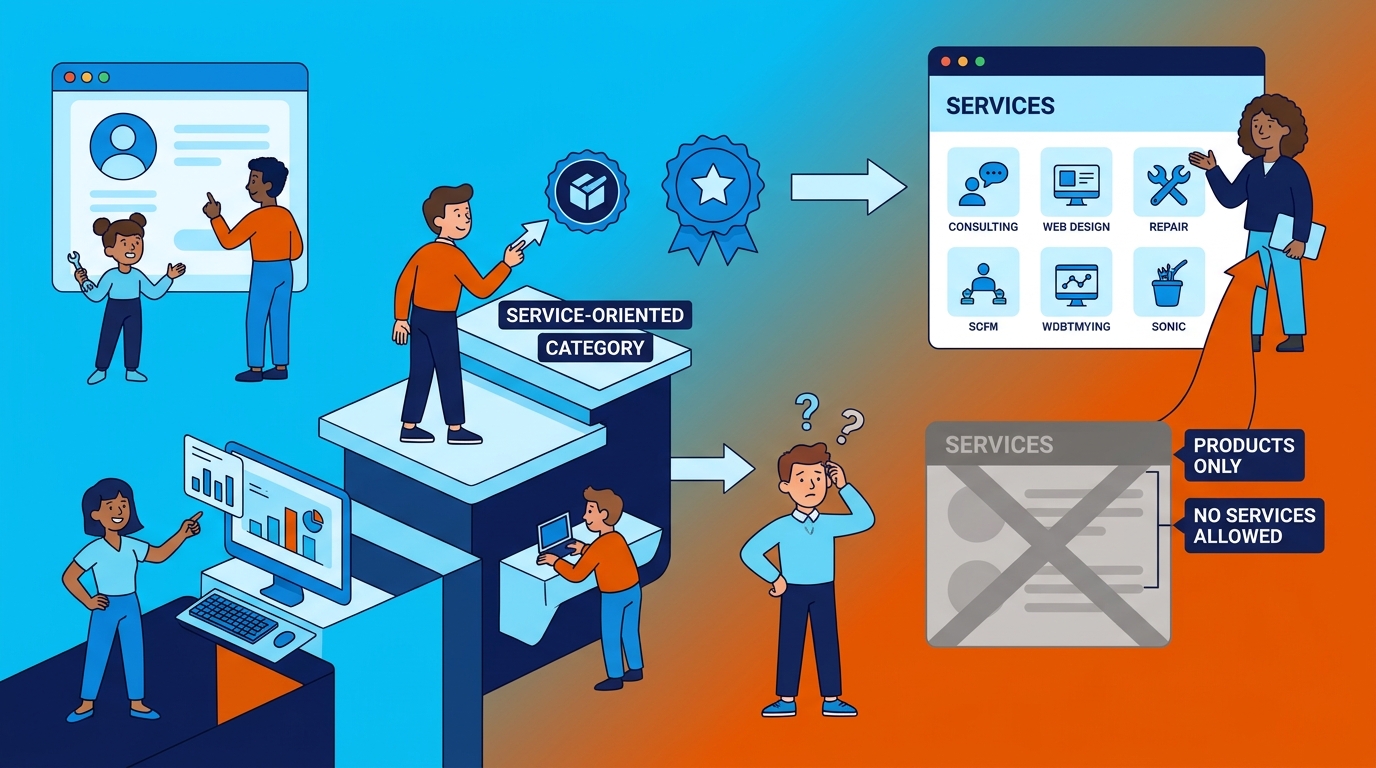
Listed services can do real work. How to Add Services to Your Google Business Profile explains how.
“in [your] Business Profile, you may get an option to add your services, along with their description and prices. When local customers search on Google for a service you offer, that service may be highlighted on your profile.”
Notice the “may get an option.”
That option can depend on the category. Pick a category that doesn’t correlate with a service, and you might not see the option to add services.
You can select new services and edit existing ones. Just choose from a list of suggested types of services.
Correct service not on the list? You can create your own.
Your business description is a free text field on your Google Business Profile. It holds 750 characters.
I don’t chase volume on a profile.
I’ll take one precise service entry over extra description text every time. I write for what an AI can grasp easily. Not for how much gets published.
For how to write those entries, see Writing Service Definitions AI Can Match to Patient Voice Queries.
On Apple Devices, Siri Answers From Apple Business Place Data
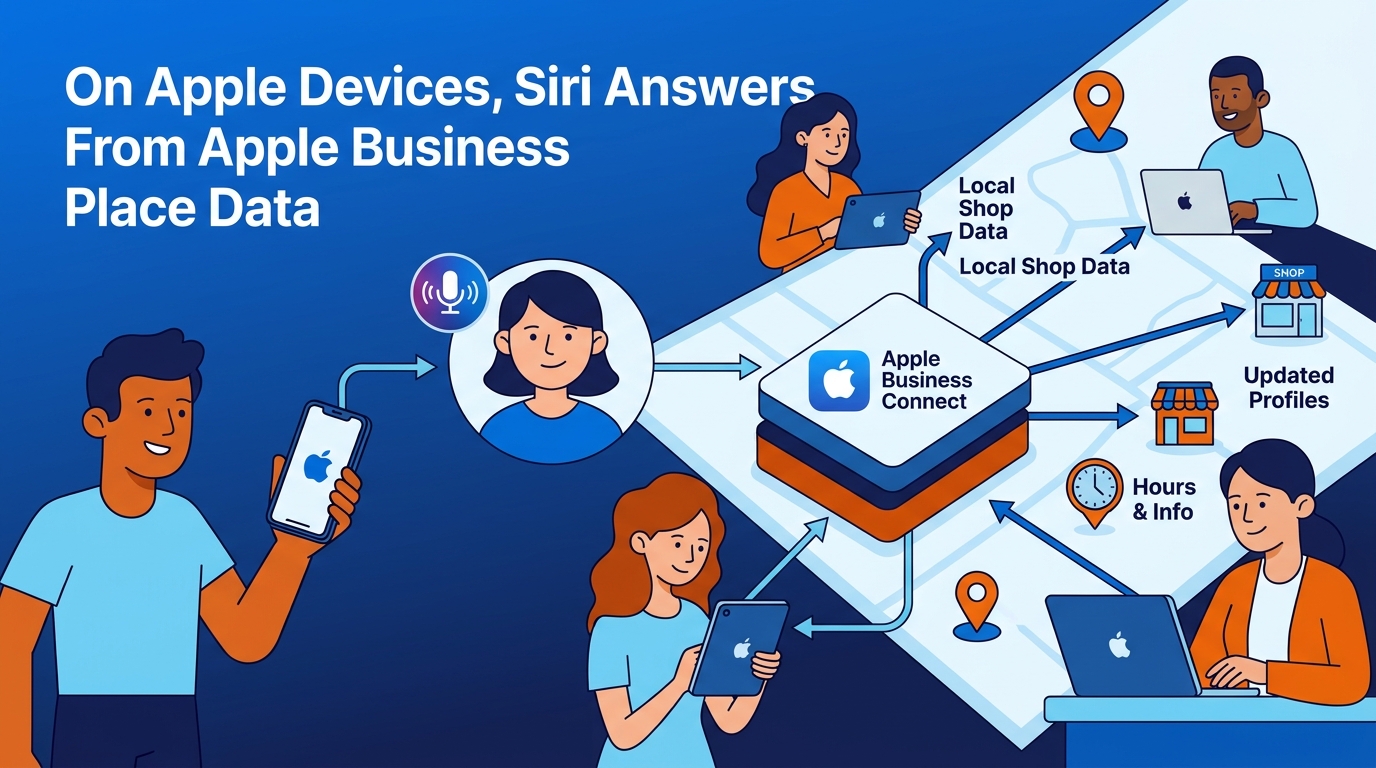
Claiming and completing the place card, including categories
Start with what Apple did to its own tools.
According to About categories in Apple Business Connect, Apple Business combines Apple Business Manager, Apple Business Essentials and Apple Business Connect. One comprehensive offering.
Introducing Apple Business Connect announced it this way.
Apple Business Connect is a free tool. Businesses of all sizes can claim their location place cards. They can customize how key information appears to more than a billion Apple users. Across Apple Maps, Messages, Wallet, Siri, and other apps.
Log in. Get verified by Apple. Then claim your location(s) and start updating and personalizing your place card.
All for free.
Apple Business Connect: How to Put Your Business on Apple Maps says what you can do after verification.
Edit the core details. Name, address, hours, phone number, website, and categories.
The program also supports special features. Showcase offers. Highlight services. Businesses get to communicate timely information without turning Maps into an ad-driven platform.
Apple Business Connect: The 2026 Guide to Local SEO on Apple Maps reports that Apple favors fully completed place cards.
What does that mean? Hours, including holiday hours. All relevant categories, primary plus secondaries. Attributes like parking, accessibility, payment types, pet-friendly. Photos. Description. Action Links.
Empty fields hurt.
The same source has two numbers worth knowing.
Nearly six in ten (58 percent) of U.S. businesses haven’t claimed their Apple Business Connect listing. Only about one in six (16 percent) actively manage it.
And Apple Maps holds roughly a quarter (25 percent) of U.S. mobile navigation share. Google Maps sits at around two-thirds (67 percent).
What Apple weighs: matching data, distance and Yelp reviews
Apple cross-references your Google Business Profile, Yelp, Tripadvisor, your website schema, and other public sources.
Hours or addresses that conflict across them? The listing gets down-weighted. Apple’s confidence drops.
Apple doesn’t host its own reviews.
It syndicates them from Yelp, Tripadvisor, Vagaro, and similar partners. Volume, recency, and average rating all feed Apple Maps rank.
For Siri, distance is the biggest ranking factor.
Next comes the number of Yelp reviews. Then the star rating. Then pricing.
“Best” searches flip it. Siri gives the highest star rating more weight than distance.
The Schema.org Properties That Define a Clinic’s Services
Here’s why schema.org exists.
It pushes sites to add structured data to their pages. That helps search engines make sense of what’s on them.
It’s working. Today, more than four in ten web pages (over 40%) include Schema.org markup.
MedicalClinic adds two fields of its own. On top of everything it inherits.
availableService and medicalSpecialty.
Here’s the quick view.
The table below lines up three schema.org service properties and types. What each one does. And how many domains use it.
| Property or type | What it does | Domains using it |
|---|---|---|
| availableService: a medical service available from this provider | Used on Hospital, MedicalClinic and Physician | 10K-100K domains |
| Service: a service provided by an organization | Its properties give the geographic area where the service is provided, the type of service, and the service provider | 1M-10M domains |
| OfferCatalog: an ItemList of related Offers from the same provider | A matching property indicates an OfferCatalog listing for an Organization, Person, or Service | 100K-1M domains |
The availableService property for medical providers
Start with the definition.
availableService – Schema.org Property calls availableService a medical service available from this provider.
Its values have to be one of these types: MedicalProcedure, MedicalTest, MedicalTherapy.
You’ll find it on Hospital, MedicalClinic and Physician.
Schema.org lists its usage at 10K – 100K domains. That’s based on monthly aggregations from Google’s web index.
The Service type and its descriptive properties
Now the broader type.
Service – Schema.org Type defines Service as a service provided by an organization, e.g. delivery service, print services, etc.
Its usage is 1M – 10M domains. Also based on monthly aggregations from Google’s web index.
Its descriptive properties cover three things:
- Where: the geographic area where a service or offered item is provided.
- What: the type of service being offered, e.g. veterans’ benefits, emergency relief, etc.
- Who: the service provider, service operator, or service performer; the goods producer.
Listing multiple services with OfferCatalog
Got more than one service? This is the one.
OfferCatalog – Schema.org Type defines an OfferCatalog as an ItemList. It holds related Offers and/or further OfferCatalogs that are offeredBy the same provider.
The matching property points to an OfferCatalog listing for this Organization, Person, or Service.
Its usage is 100K – 1M domains. Same source. Monthly aggregations from Google’s web index.
What Service Markup Can and Cannot Do
Here’s what most people miss.
Google has no distinct rich result for MedicalClinic, Physician or Dentist.
And Google says in writing that you need no special schema or markup to show up in AI Overviews or AI Mode.
So what do you do with markup?
Which schema markup should a clinic website actually use? lays out the rules for the markup you do add:
- Google’s own guidance is clear. Structured data must reflect the visible page. Don’t add facts that aren’t there.
- Keep the phone number, address and name in the markup identical to what’s on your Google Business Profile. And everywhere else your clinic is listed.
- Don’t invent a medicalSpecialty or availableService you don’t actually offer.
Markup has limits too.
It doesn’t replace a complete Google Business Profile. The profile drives most local search and Maps results. Not your website’s JSON-LD.
And neither testing tool can tell you if a rich result will show up for a real search. Both only tell you if your page is technically eligible.
Here’s where I stand.
I don’t count a rich result as proof that anything worked. And I no longer use position reports as my measure of success.
AI tools now give direct answers instead of lists of links. So a spot in a results list stopped being proof that a clinic gets found.
Need help reading practice diagnostic results? See Interpreting Practice Diagnostic Results: A Complete Guide.
How Many People Now Search Locally by Voice
Start with Google’s scale.
How to Add Services to Your Google Business Profile reports that Google processes over 8.5 billion searches daily.
Nearly half of them (46 percent) are linked to something local.
Now voice.
Voice Search Statistics 2026: Adoption, Devices & SEO Data reports that nearly one in six AI Mode queries are now non-text. They use voice or images, per Google.
An estimated 112 million Americans age 12 and older own a smart speaker. That’s from Edison Research’s January 2026 survey.
And Google reported in August 2026 that nearly two-thirds (63%) of Gemini app users now talk directly to Gemini.
Voice Search Statistics 2026 gives more numbers.
The US will have about 157 million (157.1 million) voice assistant users in 2026. That’s 15.1 million more than in 2022. Up about 11% (10.6%).
Google Assistant leads in the US, with nearly 89 million users (88.8 million) in 2024. Siri follows with about 84 million (84.2 million). Alexa has about 76 million (75.6 million).
Now the local side. The same source reports:
- Nearly six in ten consumers (58%) have used voice search to find information about a local business.
- Among smart speaker users, about three in four (76%) run local voice searches at least once a week. Nearly half (46%) do it every day.
- Local topics make up roughly one in five (about 22%) of all voice queries.
- Just over one in four consumers (28%) call the business they found through voice search. A phone call is the most common next step.
Ask people for their single most common voice task and the weather still comes first, at 17%.
Local “near me” searches are a close second. 16%.
Here’s the gap.
Few businesses have prepared. Only about one in eight marketers (13%) actively optimize for voice. And just 4% of US businesses are ready for voice search.
For what an omission rating says about lost patient volume, see What an Omission Rating Really Says About Lost Patient Volume.
The AI Visibility Check page covers how iTech Valet looks at a business’s presence in AI answers.
Frequently Asked Questions
How do I add services to a Google Business Profile?
You do it from the Edit Profile screen. Select “Edit Profile,” then click “Services.” To add a new one, select “Add More Services.” When you finalize your changes, click “Save.” Don’t skip that last step.
Is FAQ markup still worth adding for rich results?
No. Google stopped showing the FAQ rich result in Search from 7 May 2026. Keeping FAQPage markup is harmless. But it earns you no extra space on the results page any more.
How accurate are commercial business datasets at categorizing a business?
Depends on the dataset. Advan, Data Axle, and FourSquare did moderately well at categorization (70% to 97%). NETS did the worst. Don’t trust any single one blindly.
What do the sameAs and mainEntityOfPage properties add to a clinic’s markup?
They do two different jobs. The sameAs property ties a thing to a page that indirectly identifies it. It leans on well known pages. The mainEntityOfPage property clarifies which of several entities is the main one for that page.
Can a clinic pay to appear in Apple Maps instead?
Yes. Starting summer 2026, businesses in the US and Canada can create ads on Apple Maps directly through the Apple Business platform. So it’s a paid channel now. As well as an organic one.
Here’s my rule. I put a clinic’s effort and money into the listings it claims and owns before any ad.
I build on clear, credible information. It keeps paying off. It grows over time.
Bought visibility? It stops the day the spending stops.
Define Every Service in Every Source the Assistants Read
Here’s the problem.
Google Assistant reads Google Business Profile. Siri reads Apple Business Connect and Yelp. Alexa reads Bing Places and Yelp.
A clinic that exists in only one of these systems? Invisible to whichever assistants don’t use it.
It gets sharper with Ask Maps. Gemini looks at your Services section. If a service isn’t listed, the AI may tell the customer you don’t offer it.
Markup on your website doesn’t replace a complete Google Business Profile. The profile drives most local search and Maps results. Not your website’s JSON-LD.
So define your services and categories in every source the assistants read.
The page that explains how the work is done is iTech Valet Service Plans & Pricing.
Want to see where your clinic stands today? Run My AI Visibility Check.