
Search Engine Journal defines an entity as “a single, unique, well-defined, and distinguishable thing or idea,” and its examples include your organization, employees, products, services, and blog articles. One motivation for the development of schema.org is to encourage putting structured data (labeled facts about the page) in web pages, which helps search engines understand the contents of those pages. Search Engine Journal also says your schema markup (code that labels what is on a page) is only as good as the content on the page. It adds that a content knowledge graph (an organized map of the facts on your site and how they connect) gives both search engines and artificial intelligence (AI) an accurate layer of meaning-based data, so they can fully understand your brand and the content on your website.
The Entity Layer: Facts That Identify the Practice
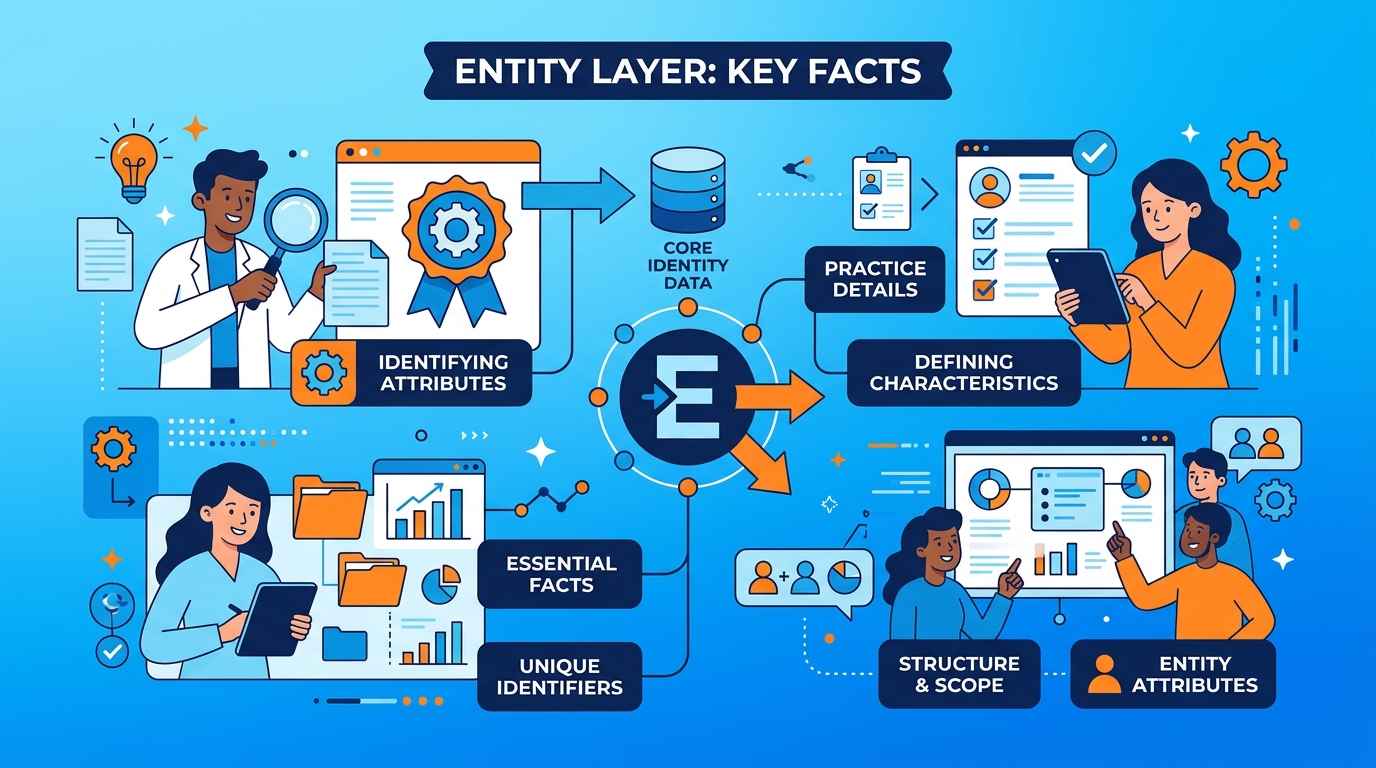
Start with the word itself. An entity is a single, unique, well-defined, and distinguishable thing or idea. Search Engine Journal says examples on your website include your organization, employees, products, services, and blog articles.
For your practice, that’s the clinic, each doctor, each service, and each article.
There’s a name for the hard part. Entity resolution is the problem of figuring out which real-world person, place, or thing is behind the references found in data. Researchers in many communities have studied it for many decades.
Google says its algorithms (its computer programs) find information that is publicly available on the web. Its examples are your site’s name, your company’s contact information, and your social profiles.
So the details you already publish are the details it picks up.
Google’s Knowledge Graph is a system that learns facts about entities (people, places, and things) from materials shared across the web and from open source and licensed databases. Google says it has collected over 500 billion (500,000,000,000) facts about five billion (5,000,000,000) entities.
Your practice is one of the things a system like that has to get right.
Here’s what that looks like for patients. Rater8 reports that 66 percent (66%) of patients said they ran into wrong provider information from an artificial intelligence (AI) tool.
Even so, most of them, 60 percent (60%), still said they trusted the AI summary without checking it further.
Here’s where I stand. I treat getting picked by AI answer tools as its own job, not old search work with a new name.
I don’t chase keywords, inbound links, or ranking position, because I think that’s aiming at the wrong target. I put the effort into making it easy for these systems to work out who your practice is and whether it’s credible.
I’d also rather build a practice that AI names and draws on than one that just sits in a list. Being the entity the engines rely on is worth more to me than simply being present.
The Schema Layer: Putting Those Facts Into Code
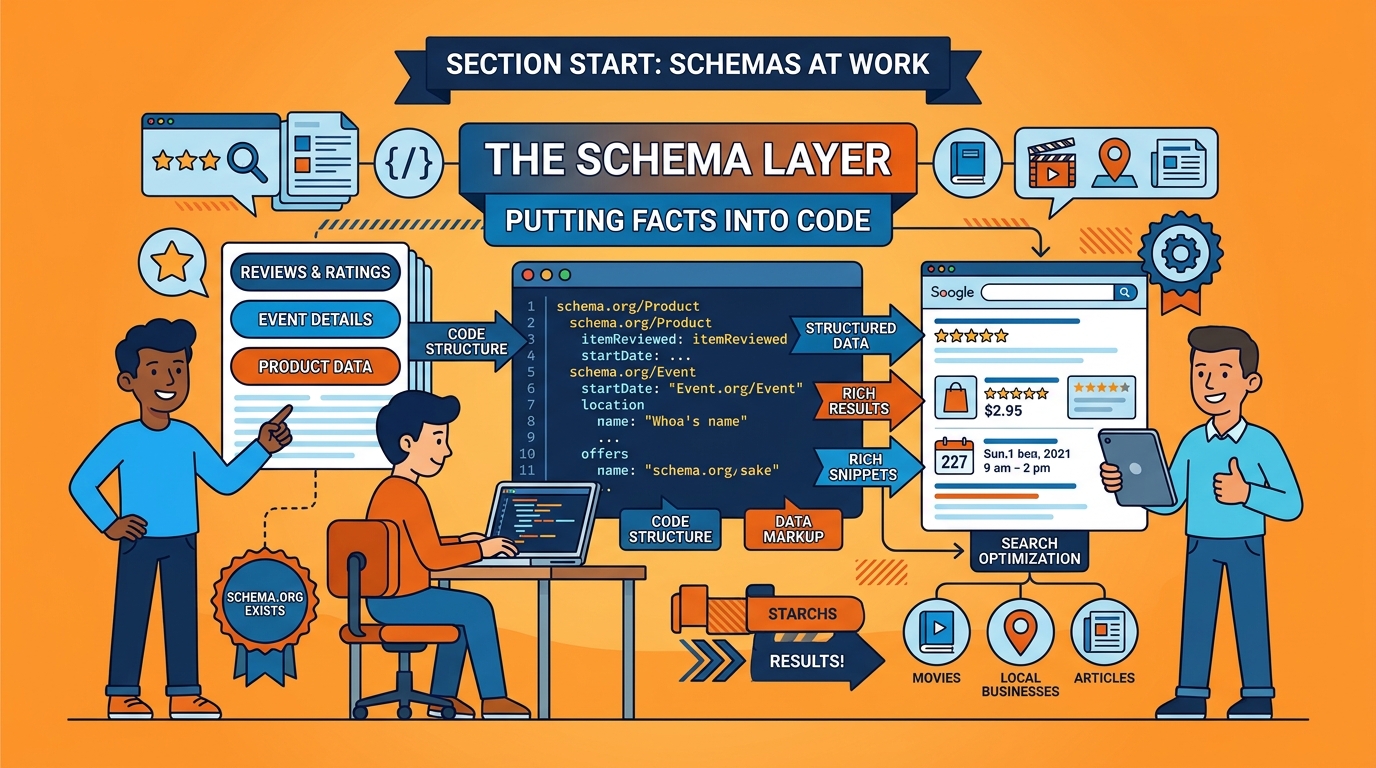
Schema.org exists for a reason. One motivation for its development is to encourage putting structured data in web pages, which helps search engines understand the contents of those pages.
Google says structured data is a standard format for giving information about a page and sorting what is on the page. Its example is a recipe page, where the data can say what the ingredients are, the cooking time and temperature, the calories, and so on.
Google also says Google Search works hard to understand what is on a page. Structured data is how you help it along.
Now bring it home to your practice. Google says that if you add organization structured data (special code that labels facts about your organization) to your home page, it can help Google better understand your organization’s administrative details. It can also help tell your organization apart from others in search results.
There’s one more piece. Wikipedia’s Schema.org article says some schema markups, such as Organization and Person, are commonly used to try to influence the results that Google’s Knowledge Graph returns.
Google also tells you how to pick your types. In General Structured Data Guidelines, it advises using the most specific applicable type and property names from schema.org.
It also advises including the main type of structured data that matches the page’s main focus, so Google Search understands what the page is mainly about. And Google Search understands multiple items on a page, whether you nest the items (put them inside a main item) or specify each item individually.
Want to see how your address and specialties get tied together? I walk through it in How Schema Code Links Your Clinic’s Address to Its Specialties.
The table below lines up each schema choice with what its source says about it.
| Schema choice | What the source says |
|---|---|
| Organization markup on the home page | Google: can help Google better understand administrative details and tell the organization apart in search results |
| Most specific type and property names | Google: try to use the most specific ones that apply |
| Main type for the page’s focus | Google: include it so Google Search understands the page’s main purpose |
| Several items on one page | Google: Google Search understands them whether nested or specified individually |
| Organization and Person markup | Wikipedia: commonly used to influence search results returned by Google’s Knowledge Graph |
Linking the Practice to Outside Definitions
You can also point outward. Search Engine Journal says you can make a topic clearer by linking an entity mentioned on your page to its matching definition on Wikidata, Wikipedia, or Google’s knowledge graph (Google’s map of facts about people, places, and things).
That takes some skill on the build side. In Factors To Consider When Implementing Schema Markup At Scale, Search Engine Journal says your team or vendor needs the ability to do Named Entity Recognition (NER), which means finding and picking out named things in text.
That’s how you identify your internal and external entities (things or ideas on your own site and on other sites) and nest them in your schema markup to show how they relate.
One more step. Once the entity is identified, you also need the ability to look up its definition in a reference knowledge base (a trusted source of facts).
The Content Layer: What the Markup Must Match
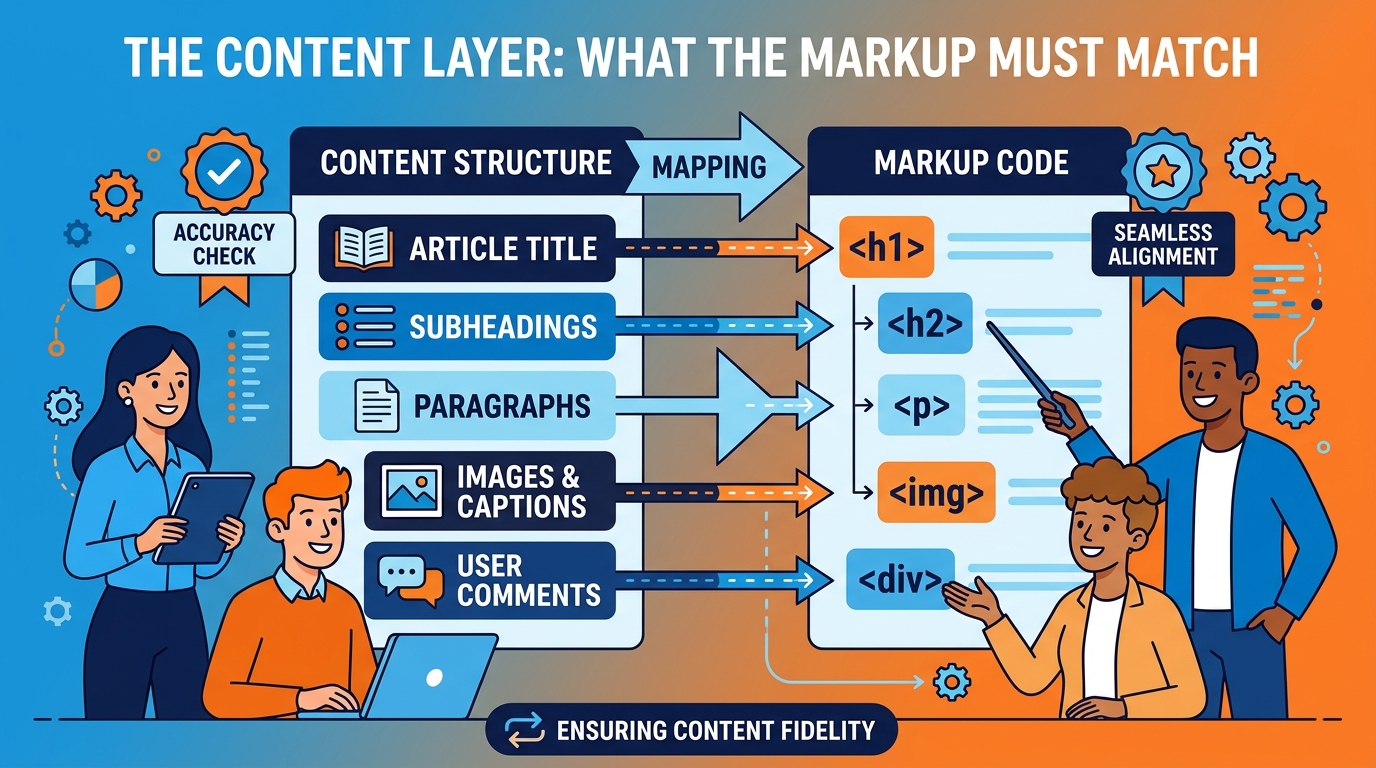
Here’s the thing. Your schema markup, the code that labels what’s on a page, is only as good as the content on the page.
Google lists making sure your structured data matches the text people can see on the page. In AI Features and Your Website, Google names it as one of the basics of traditional search optimization that still matter for its AI Overviews and AI Mode. Those are its artificial intelligence (AI) features. Search Engine Roundtable covers Microsoft’s view of schema in Microsoft Confirms Schema Helps Its LLMs (Copilot) Understand Your Content.
In 2017, John Mueller of Google said that if you add structured data to a page, that data should match the content people can see on that page. Google’s guidelines say not to mark up content that is not visible to readers of the page.
I don’t publish for volume, and I don’t count output as a win. I write for what an AI can grasp easily: clear, factual content in a sensible order, with the markup matched to it. I’d take one clear page over a stack of loose ones.
Where the Connections Break: Common Markup Errors
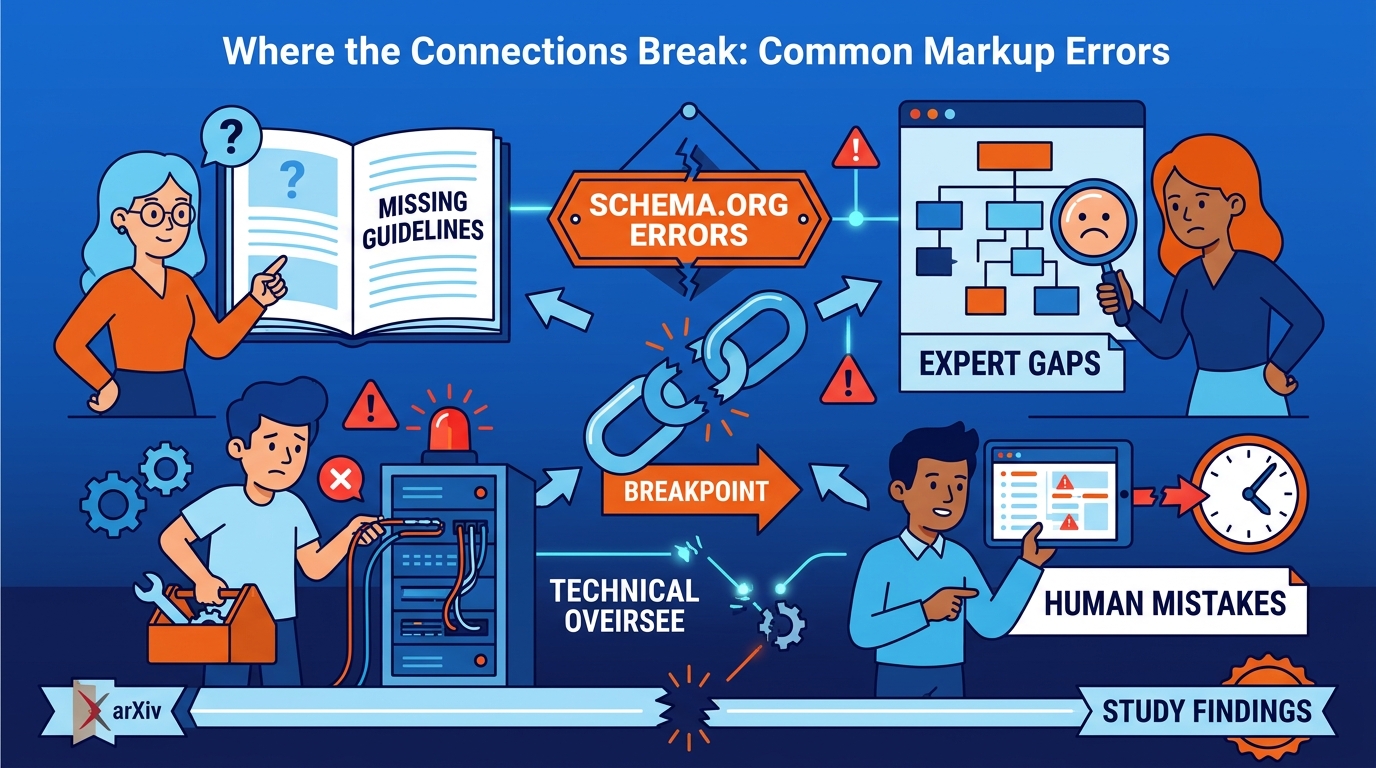
An arXiv study says errors in schema.org labels on websites may be caused by missing guidelines, not enough expertise, and technical or human mistakes.
Some breaks are about access. In its General Structured Data Guidelines, Google says not to block the pages that carry your structured data from Googlebot, Google’s page reader. That means not using robots.txt, noindex, or any other way of limiting access.
Some breaks are about completeness. Google says that if a structured data item is missing required properties, it is not eligible for Google rich results (search listings with extra details).
What AI Systems Do With a Connected Build
Ryan Levering is a Google engineer who works on structured data. He spoke at Search Central Live New York and said that “a lot of our systems run much better with structured data.” He added that “it’s computationally cheaper than extracting it.” In plain words, labeled facts take less computer work than pulling the same information out of the page.
Reportedly, Fabrice Canel of Microsoft Bing confirmed, in his talk at the Search Marketing Expo in Munich, that schema markup helps Microsoft’s large language models (LLMs, the AI programs that read and write text) understand your content. That comes from a LinkedIn post by David Mihm, as reported by Search Engine Roundtable. Search Engine Roundtable also reports Google’s position that markup should match what the page shows, in Google: Your Structured Data Should Match Visible Content.
A 2023 study by Data.world found that enterprise knowledge graphs, which are organized maps of a company’s facts and how they connect, improved the accuracy of large language model answers by up to 300%.
In one audit of what goes with getting cited, the areas most strongly linked to citation were Metadata & Freshness, Semantic HTML, and Structured Data. HTML is HyperText Markup Language, the code that builds web pages.
Search Engine Journal says the benefit of building a content knowledge graph is that it gives both search engines and AI an accurate layer of meaning-based data. That lets them fully understand your brand and the content on your website.
I compare one installed system with separate tools in One Installed System vs. Separate Tools for Listings and Content. And I show how the pieces fit together in Setting Up a Full AI Authority Engine: How the Pieces Fit Together.
Keeping the Layers in Step Over Time
Search Engine Journal says your schema markup has to be dynamic to stay accurate and effective. That means it changes as needed, and it has to stay up to date whenever your content changes. Its Factors To Consider When Implementing Schema Markup At Scale also says the long-term value comes from making sure your markup stays valid and accurate across all your key pages.
In AI Features and Your Website, Google lists checking that your Merchant Center and Business Profile information is up to date. It’s one of the best practices for traditional search optimization that matter for its AI features.
Fabrice Canel of Bing said that generative AI programs value fresh content in particular, partly as a way to double-check what they learned in training. He recommended using the API at indexnow.org (IndexNow) to push your content out as it’s published or updated. An API is a way for software to talk to other software.
I put a practice’s money and effort into assets it controls: clear, credible information about itself, kept accurate. I count on that kind of visibility to keep paying off and grow over time. I steer away from visibility bought through ads or paid placements, which I’ve seen stop the moment the spending stops.
Want to see how the work gets done? It’s laid out on iTech Valet Service Plans & Pricing.
Frequently Asked Questions
Does a markup error hurt the page’s position in Google web search?
Not through a structured data manual action, which is a penalty applied by a Google reviewer. Google says that action means a page loses its eligibility to show up as a rich result, the search listing with extra details. It does not affect how the page ranks in Google web search. So fixing the markup is about getting rich result eligibility back, not about ranking.
How can a practice check that its markup is valid?
Google says the Rich Results Test and the URL Inspection tool let you test whether your structured data follows its technical guidelines, and that they catch most technical errors. Wikipedia notes that Google Search Console (formerly webmaster tools) has a report section for unparsable structured data, meaning data Google can’t read. If any Schema code on your site is incorrect, it shows up there. Run the tests, then look at that report.
What happens if a site ignores Google’s structured data guidelines?
Search Engine Roundtable says that if you don’t follow them, your site can lose the ability to show rich snippets, the extra-detail listings, in Google’s search results. Read the guidelines before you add markup. Then keep your pages in line with them.
Can a provider keep its NPI record out of public view?
No. The Centers for Medicare & Medicaid Services (CMS) says there’s no way to opt out of, or suppress, the record data for health care providers with active National Provider Identifier numbers (NPIs). That record lives in NPPES, the National Plan and Provider Enumeration System, the federal provider record system. Plan on that record staying in view.
Entity Facts, Markup and Content as One Matched Build
Search Engine Journal says the benefit of a content knowledge graph is an accurate layer of meaning-based data for both search engines and AI. That lets them fully understand your brand and the content on your website. It also says your schema markup is only as good as the content on the page. So your entity facts, your markup, and your content only work when they match as one build.
I won’t sell the old search playbook that many marketing agencies still offer. The conditions it relied on have changed, and clients end up paying for tactics aimed at a landscape that’s gone. I count that as a problem with the industry’s offer, not with the practice owner who bought it.
I run iTech Valet. We build Authority Infrastructure and write AI Authority articles for chiropractic practices and other local service businesses. Want to see how AI reads your practice? Run My AI Visibility Check.