
The authors of one study say the fast adoption of AI-powered search engines like ChatGPT, Perplexity, and Gemini is fundamentally changing how people find information. It is moving from traditional ranked lists to written answers that cite their sources. Google describes retrieval-augmented generation, which it says is also known as grounding. It uses Google’s core Search ranking systems to pull relevant, up-to-date web pages from its Search index, improving the quality, accuracy and freshness of AI answers. Google says to make sure your content is crawlable, because its generative AI models use publicly accessible, crawlable content to learn patterns and give relevant, grounded answers. Google also says LocalBusiness structured data lets you tell Google about business hours, different departments within a business, reviews (if your site captures reviews about other businesses), and more. To check what AI tools say about you, ask the questions a customer would ask. Write down the date, the tool and the answer. Do it again next month.
How AI Answers Are Built From Retrieved Sources
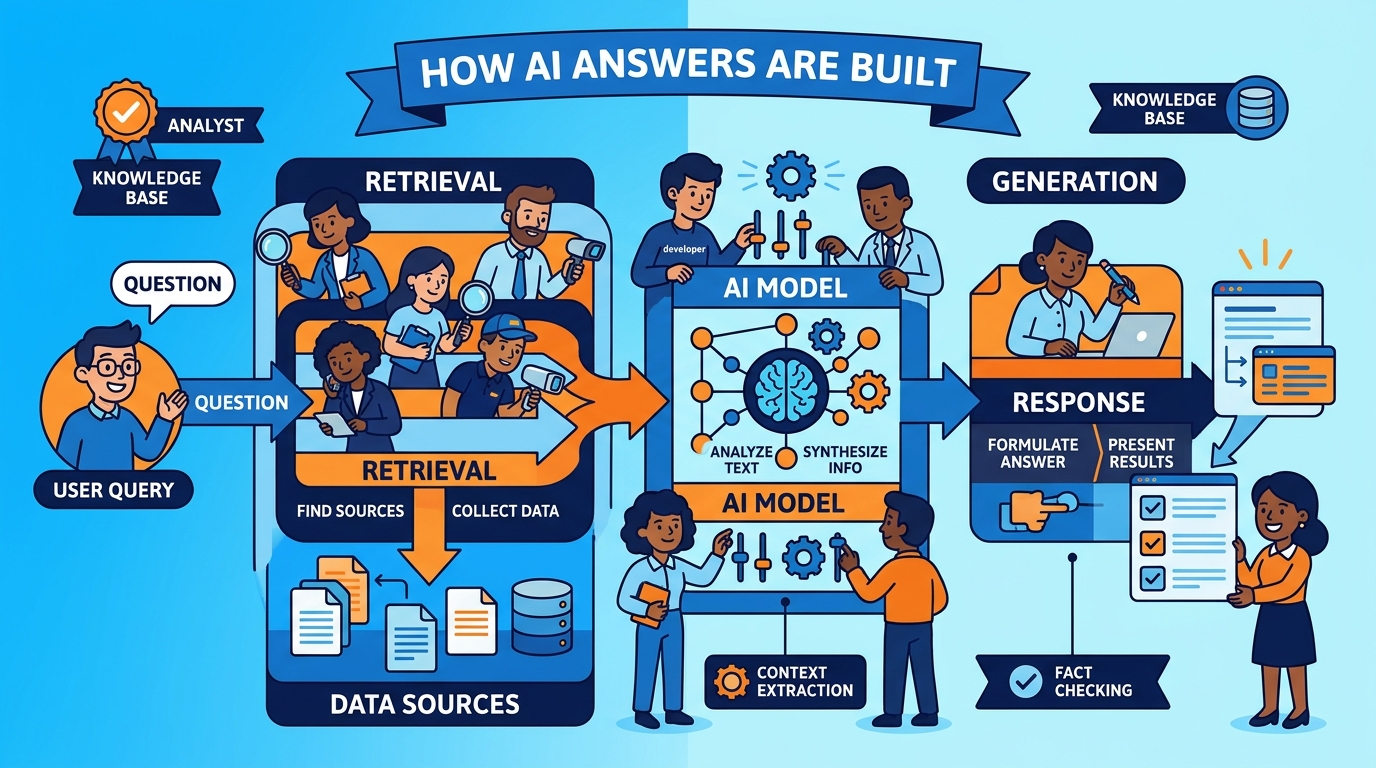
Here’s what’s shifting. The authors of one study say the rapid adoption of artificial intelligence (AI) search engines like ChatGPT, Perplexity, and Gemini is moving information retrieval away from traditional ranked lists. What people get now is written answers that cite their sources.
Retrieval-augmented generation (RAG) is a family of techniques where a large language model (an AI tool that writes answers) can pull in data from outside sources when it answers a question. Google describes the technique, which it says is also known as grounding. It relies on Google’s core Search ranking systems to retrieve relevant, up-to-date web pages from its Search index. Google says this improves the quality, accuracy and freshness of AI answers.
Google also describes something called query fan-out. The model runs a set of related searches at the same time. The goal is to request more information and fetch more relevant search results for the question.
Google says accuracy is paramount in Search. So AI Overviews (the AI-written summaries in Search) are built to show only information backed up by top web results. Google also says AI Overviews show only when its systems decide they add something to classic Search, so they often don’t trigger. Google lays out its own advice in Optimizing your website for generative AI features on Google Search.
One study found that AI grounds brand answers overwhelmingly in third-party sources, meaning sources the brand doesn’t own. About 86 out of 100 citations (85.7%) point to sites the brand does not own. About 14 out of 100 (14.3%) point to sites the brand owns.
Here’s how I see it. Getting picked by AI answer tools is its own discipline, not classic search work with a new name. I don’t chase keywords, inbound links or ranking spots. These systems are trying to work out who a business is and whether it can be trusted. So I put the effort into making that easy for them to see across the sources they retrieve.
What Google and ChatGPT Require Before They Can Show a Page
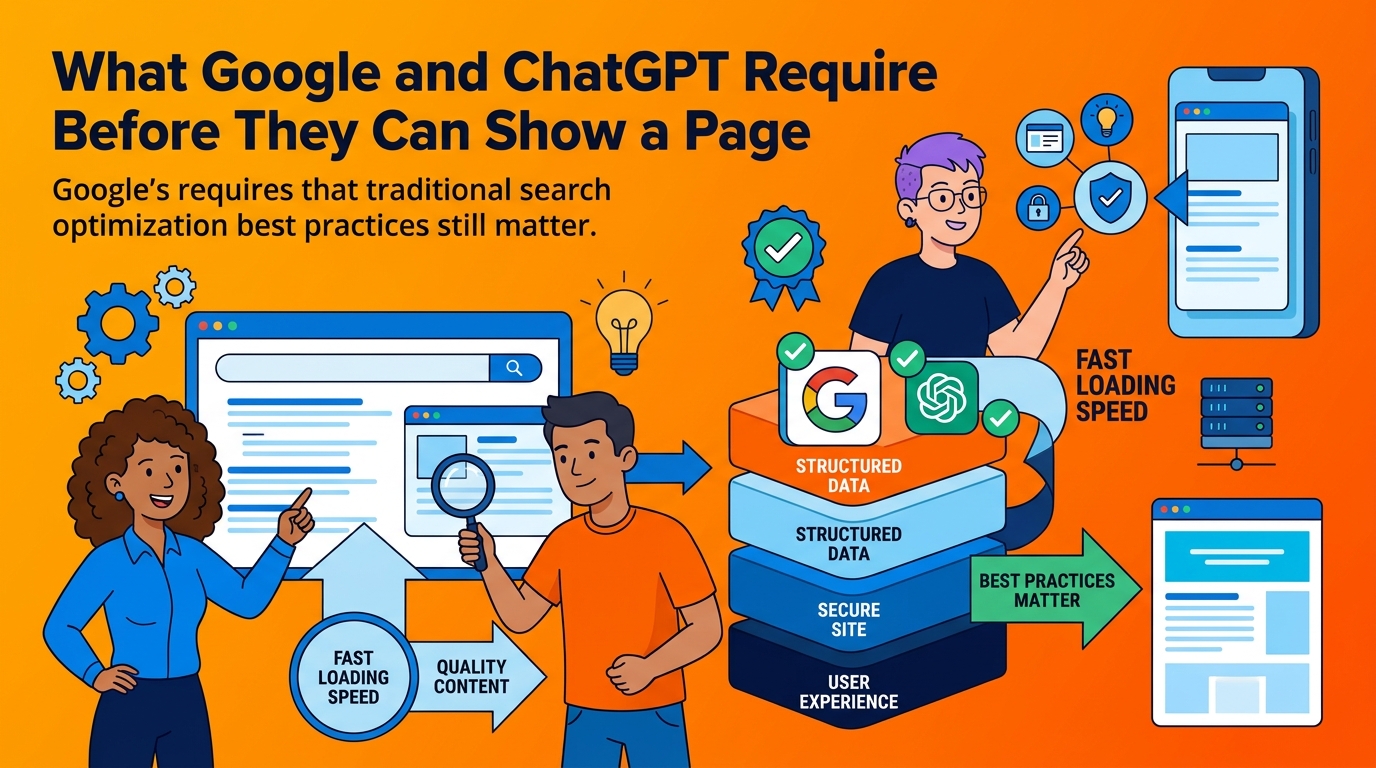
Google says the best practices for traditional search optimization still matter. Its generative AI features in Google Search are rooted in its core Search ranking and quality systems.
Google’s AI features and ChatGPT search each set their own access rules before they can show your page.
| Requirement | Google generative AI features | ChatGPT search |
|---|---|---|
| Crawler access | Make sure content is crawlable; generative AI models use publicly accessible, crawlable content | Recommended: allow OAI-SearchBot in robots.txt and allow requests from OpenAI’s published IP ranges |
| Eligibility | Page must be indexed and eligible to show in Google Search with a snippet | Sites opted out of OAI-SearchBot are not shown in ChatGPT search answers; they can still appear as navigational links |
| What an opt-out removes | Site visits and impressions from those generative AI features | Disallowing GPTBot signals that content should not be used to train generative AI foundation models |
Google’s Eligibility Rules for Its AI Features
To show in Google’s generative AI features, a page has to clear three bars. It must be indexed, which means stored in Google’s Search index. It must be eligible to show in Google Search with a snippet, a short text preview. And it must meet Google’s Search technical requirements.
Your site must also be included in the “Search generative AI features” setting in Search Console to be eligible to show in generative AI features on Google Search.
Google says to make sure your content is crawlable, meaning Google’s programs can find and read it. Its generative AI models use publicly accessible, crawlable content to learn patterns and give relevant, grounded answers. Google sets these rules out in Optimizing your website for generative AI features on Google Search.
Google says sites that opt out will not get site visits or impressions from its generative AI features.
OpenAI’s Crawler Rules for ChatGPT
OpenAI sets its rules by bot. Sites that have opted out of OAI-SearchBot will not be shown in ChatGPT search answers. They can still appear as navigational links, which are links that take people to the site.
To help make sure a site appears in search results, OpenAI recommends two things. Allow OAI-SearchBot in the site’s robots.txt file. And allow requests from OpenAI’s published IP ranges, which it lists in Overview of OpenAI Crawlers.
Disallowing GPTBot signals that your site’s content should not be used to train generative AI foundation models.
ChatGPT-User actions are started by a user, so OpenAI says robots.txt rules may not apply. OpenAI also says ChatGPT-User is not used to decide whether content may appear in Search.
How LocalBusiness Markup States the Practice’s Facts
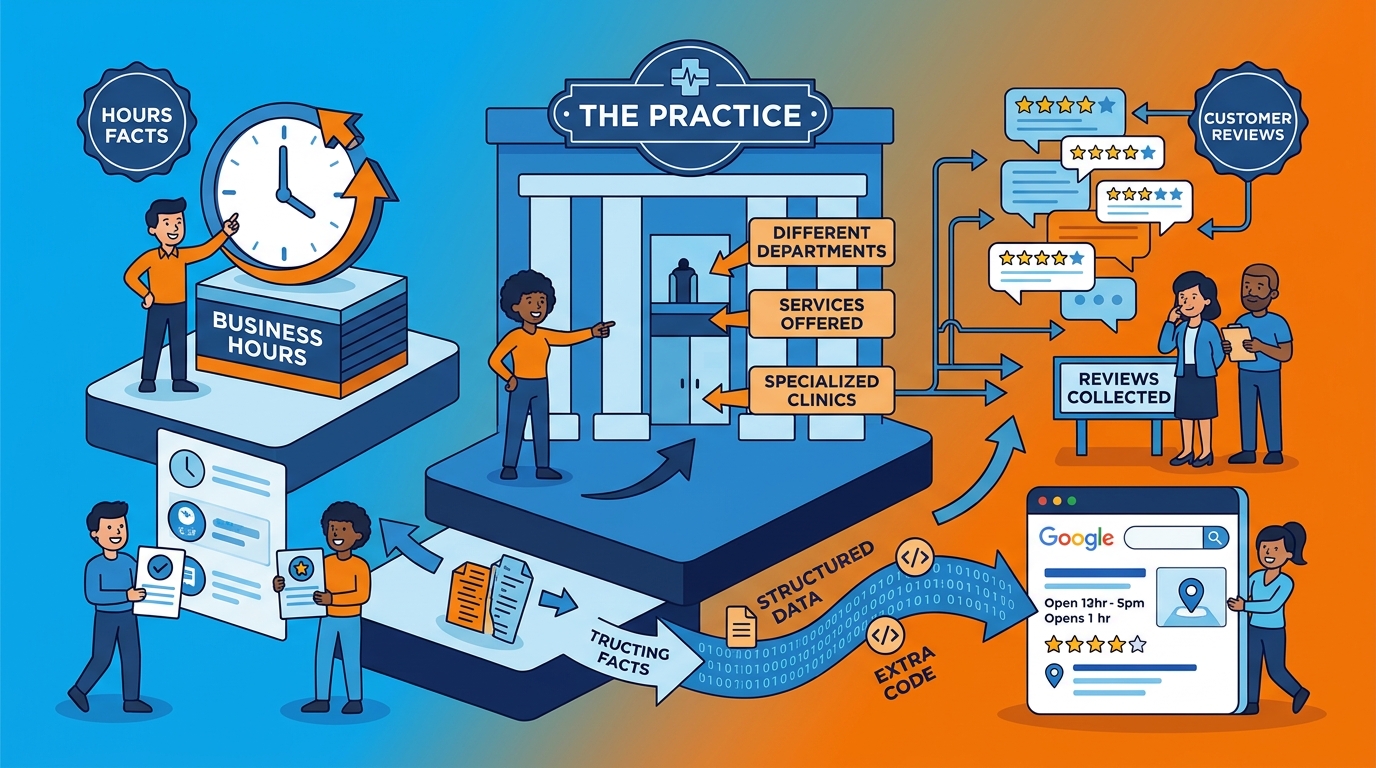
Google says that with LocalBusiness structured data, which is extra code that labels facts about your business, you can tell Google about business hours, different departments within a business, reviews (if your site captures reviews about other businesses), and more.
Google says you can add LocalBusiness structured data to any page on your site. It may make more sense to put it on a page that contains information about your business.
Here are Google’s rules for the markup:
- The more properties (details) you provide, the higher quality the result is for users.
- You must include the required properties for your content to be eligible to show as a rich result, which is a search listing with extra features.
- Be sure to include the country code and area code in the phone number.
- Validate your code with the Rich Results Test and fix any critical errors.
- To keep Google informed of future changes, Google recommends submitting a sitemap, which is a list of your site’s pages.
One limit to know. Google does not guarantee that features that use structured data will show up in search results. The details are in Local Business (LocalBusiness) structured data.
I put a practice’s effort and money into the facts it publishes and controls, not into bought placements. Clear, credible information about your practice is an asset that keeps paying off and grows. Ad-bought visibility is rent that ends the moment the spending stops. I’d build the asset every time.
Two related reads show how the pieces connect: How Schema Code Links Your Clinic’s Address to Its Specialties and How Entity Data, Schema and Content Work Together in One Build.
What Google’s Rules Say About the Content Layer
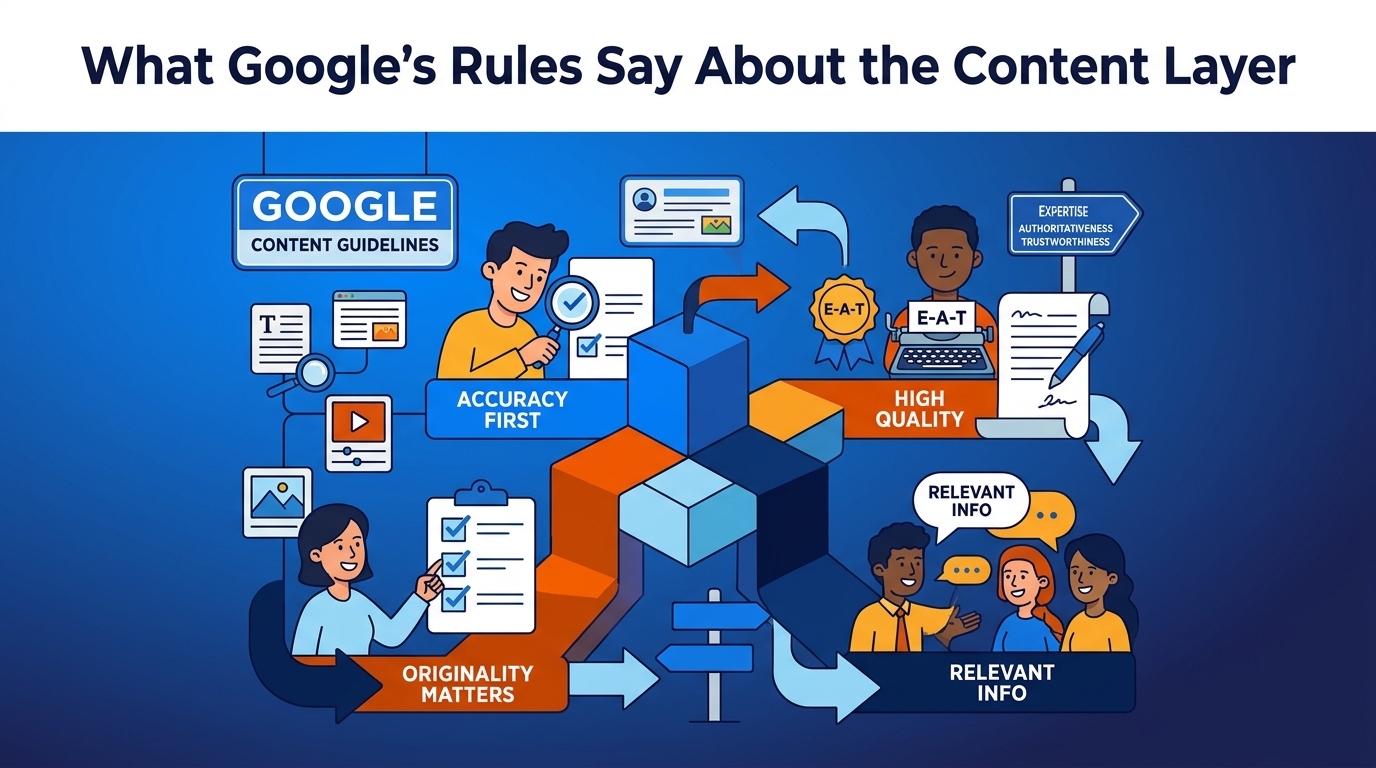
Here’s what Google says matters most. Making content people find unique, compelling and useful will likely affect whether your website shows up in generative artificial intelligence (AI) search over the long run more than any other suggestion in its guide.
Google draws a hard line on volume. Making many versions of content mainly to manipulate rankings or generative AI responses in Google Search breaks its scaled content abuse spam policy. Using generative AI tools or similar tools to make many pages without adding value for users may break that same policy on scaled content abuse (mass-producing content).
Google says generative models don’t retrieve facts; they predict a likely sequence of words based on their training data. Google also says it is critical to manually fact-check and review all AI-generated content for accuracy and trustworthiness before publishing. Google’s full advice is in Google Search’s guidance on using generative AI content on your website.
I still see a lot of agencies selling the old search playbook, and I won’t sell it. I hold that mass-produced content is aimed at a landscape that’s gone. If you were sold it, I don’t blame you. I blame the offer.
I don’t measure content by how much gets published. I write for AI that, in my view, favors businesses whose information it can grasp easily. So I’d take a few clear, factual pages in a sensible order over a pile of output every time. For what that content covers, see What Topics Should Monthly Content Actually Cover?
How Patients Now Use AI to Choose a Provider
The rater8 2026 Patient Choice Report asked patients who actively searched for a doctor in the past year what influenced them. AI tools like ChatGPT and Claude were named by 36%. That edges out Google search at 34% and doctor recommendations at 32%. Last year, the comparable answer, “conversational AI assistants,” was named by only 17%.
rater8 also found that 47% of patients have used an AI tool to research healthcare providers, up from 31% in 2025. Don’t mix up the two numbers. The 47% counts patients who have used AI for research. The 36% counts active searchers who named AI as an influence.
The age group that uses AI most to research providers is adults ages 45 to 60, at 64%, about two in three. That’s ahead of every other age group, including 18-to-29-year-olds at 28%, a little more than one in four. And among patients who actually switched providers, AI’s influence was even higher, at 39%.
| Measure | Figure |
|---|---|
| Patients who actively searched for a doctor in the past year citing AI tools as an influence | 36% |
| Patients who have used an AI tool to research healthcare providers (up from 31% in 2025) | 47% |
| Adults 45-60, the age group leading AI use for provider research | 64% |
| Patients who switched providers: AI’s influence on their choice | 39% |
OpenAI says that, based on its own analysis of conversations with names and personal details removed, over 230 million people around the world ask ChatGPT health and wellness questions every week.
Google says AI Overviews, its artificial intelligence summaries in search, now has over 2.5 billion monthly active users. AI Mode, its artificial intelligence search mode, has surpassed one billion monthly users.
BrightLocal’s Local Consumer Review Survey 2026, published on February 11, 2026, found that AI tools like ChatGPT have surged into third place among the places people go for local business recommendations, behind only Google and Facebook. BrightLocal found that 40% of consumers trust AI platforms for business recommendations and 32% don’t. In the survey, 42% said they trust AI recommendations as much as traditional reviews. More is in What BrightLocal’s 2026 survey says about AI and local search.
I’d rather your practice be the source an AI names and draws on when a patient asks than one more entry in a directory or list of businesses. I count being relied on above being present.
What Patients Check Beyond the AI Answer: Reviews and Local Results
Here’s what BrightLocal’s survey shows about where consumers read reviews. Google is still far ahead, but its share as a review source fell from about 8 in 10 (83%) in 2025 to about 7 in 10 (71%). Apple Maps use nearly doubled, from about 1 in 7 people (14%) to a little over 1 in 4 (27%).
Your reviews also get read through a summary. According to the survey, only about 1 in 5 consumers or fewer (18%) skip the summaries written by artificial intelligence (AI) that show above a business’s reviews.
The survey also shows where consumers draw their lines on reviews.
On recency, about 3 in 4 consumers (74%) only care about reviews from the last three months. On count, almost half (47%) won’t use a business that has fewer than 20 reviews. On rating, about 3 in 10 consumers (31%) will only use a business rated 4.5 stars or higher. That’s up from about 1 in 6 (17%) the year before.
Google’s own help page for Business Profiles says local results depend mainly on three things: relevance (how well a listing matches the search), distance (how far the business is from the person searching) and prominence (how well known the business is). The survey details are in What BrightLocal’s 2026 survey says about AI and local search.
Running the Engine: Checking What AI Says Each Month
To check what artificial intelligence (AI) tools say about you, ask the questions a customer would ask. Write down the date, the tool and the answer. Then do it again next month.
Nobody decides which businesses ChatGPT or Google’s AI names. So an honest report says what was seen, on which date, and with which questions.
BrightLocal tells businesses to keep their website up to date and check their listings for mistakes. It also says to look at the sources AI tools use, and to ask for a correction when something is wrong.
To see how your content is doing in generative AI features on Google Search and Discover, Google says to use the Generative AI performance report in Search Console. Google says its new Search Console insights include impressions metrics (counts of how often your site is shown). They also show which pages appear in AI answers and in what countries. Google says that as of August 31, 2026, it has rolled out these controls and insights to all websites worldwide. Google explains them in New opportunities, control and insights for website owners.
Once AI tools began giving direct answers instead of lists of links, I stopped reading a site’s spot in a results list as a sign of whether a business gets found. I don’t use position reports as a success measure. I read them as numbers that look good without driving outcomes. I’d rather read the monthly answer checks.
Two related reads cover what comes after setup: Entity Hubs vs. Monthly Content: Where One Ends, the Next Begins and What Happens If Monthly Content Publishing Stops After Setup? How the work is done is laid out on the iTech Valet Service Plans & Pricing page.
Frequently Asked Questions
Does Google need an AI text file or special markup to show a practice in AI answers?
No. Google says you don’t need to create new machine-readable files, artificial intelligence (AI) text files, markup or Markdown to show up in Google Search, including its generative AI features. Google Search itself doesn’t use them.
Should pages be split into small chunks so AI can read them?
No. Google says you’re not required to break your content into tiny pieces so artificial intelligence (AI) can understand it better.
Do mentions planted around the web help AI recommend a practice?
No. Google says that seeking fake, inauthentic mentions of your business across the web is not as helpful as it might seem.
Can Google’s AI answers name a local practice directly?
Yes, where it fits. Google says its generative artificial intelligence (AI) answers can include product listings, product information and information about local businesses.
Does turning off Google’s AI features affect regular search results?
No. Google says the opt-out control for its generative artificial intelligence (AI) features will not be used as a ranking signal for search results outside of those generative AI Search features.
Putting the Engine Together
The parts make one picture. Your practice needs pages AI systems can retrieve and business facts stated in code you control. It needs content that’s reliable and useful rather than mass-produced. And it needs a monthly check of what AI actually says.
iTech Valet’s main service is the Local AI Authority Engine. It’s a full rebuild of the whole authority system, plus ongoing monthly content work for AI answer engines, for local service-based businesses, mainly chiropractors. That led to iTech Valet’s own AI Authority System, a method that starts with data and makes service-based businesses the recommended answer in ChatGPT, Gemini, and Grok.
The way we build authority is steady growth that adds up over time, in infrastructure and in how deep the content goes. Not hacks. Not tricks. Not shortcuts. I’m Gerek Allen, the founder, and iTech Valet points to more than 20 years of hands-on experience running businesses as part of its proof.
AI tools recommend your competitors. Not you. We fix that.
When I advise you on picking a provider for the full system, I steer you away from price-led choices. I judge low-priced monthly agency deals as costing more in the end: thin work, little real progress, and money tied up in a contract that doesn’t build anything. I’d pay for work that builds an asset.
Want to see who AI names when someone near you asks who to see? Run My AI Visibility Check.