
AI Authority Articles vs. Traditional Blog Posts: The Core Structural Divide
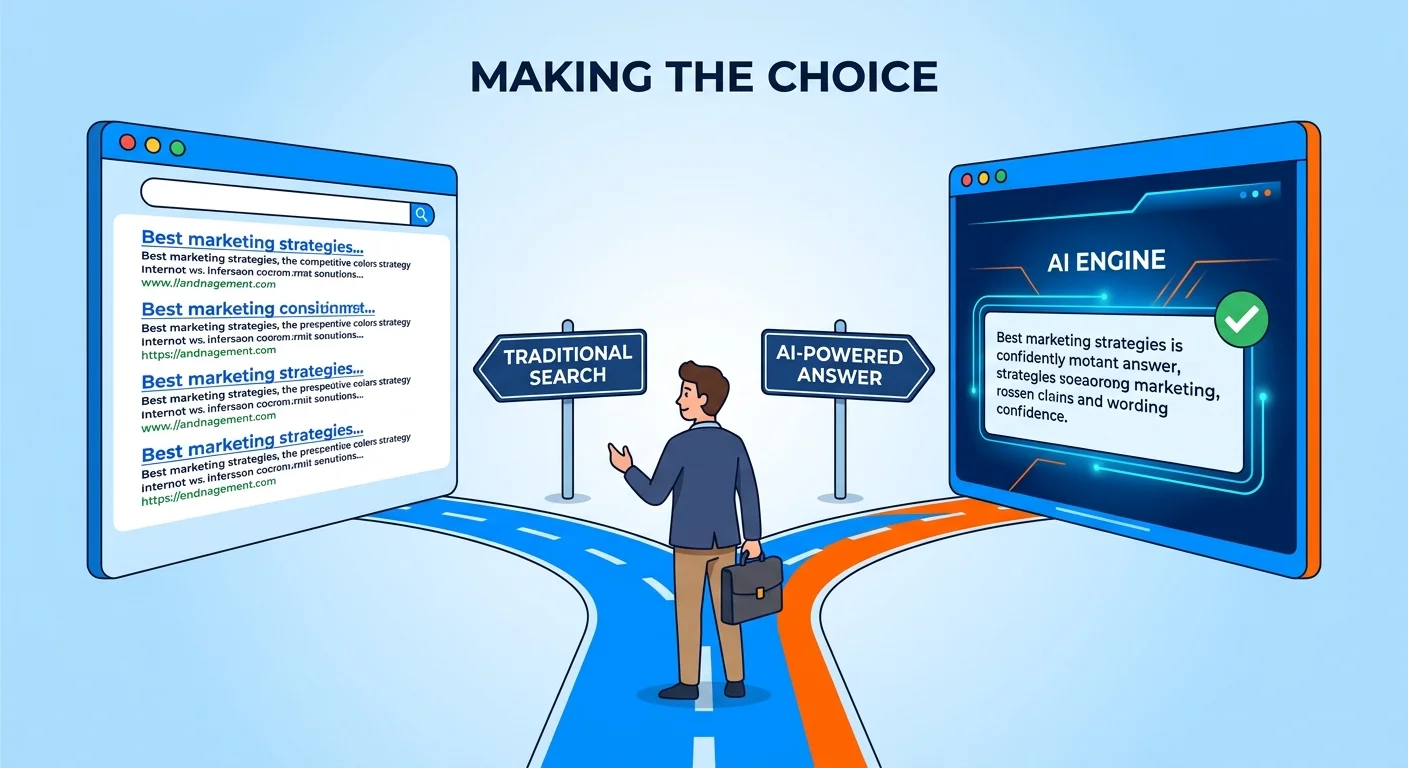
This isn’t a subtle distinction. It’s a hard architectural fork. One format is built for a ranking algorithm that hands humans a list to sort through. The other is built for a reasoning engine that delivers a verdict – no list, no navigation, no second guesses.
That divergence isn’t cosmetic. It runs through every decision – how content is formatted, how entities are defined, how facts are cited, and what signals a machine uses to decide whether a source is trustworthy enough to name out loud.
The businesses that get this are building compounding authority. The ones still treating these two formats as interchangeable are optimizing for a list that’s actively shrinking. And while they do that, their competitors are being named as the answer by the AI engines those same customers are already using.
What a Traditional Blog Post Is Built to Do
Here’s what a traditional blog post is actually doing. It’s earning a position on a ranked list. It targets a keyword, stacks supporting content around it, and leans on volume and backlinks to push high enough that a human clicks through. The whole model depends on a searcher who’s willing to evaluate options – read the title, scan the description, pick a link. That searcher has to do the work. The blog post just has to show up.
And here’s where the ceiling shows up. Even when it works, traditional blog content produces traffic – not trust. The AI engine never sees the click. It never registers the visit. Harvard Business Review documented the shift directly: generative AI is pulling consumer search behavior away from lists of links and toward direct, synthesized answers, as published analysis confirms. A high-ranking traditional article is invisible to that process. It doesn’t matter how well it ranks if the engine doing the recommending never reads it.
High-volume content mills made this worse. They flooded the list with generic, keyword-stuffed articles that satisfied an algorithm but built zero entity trust. The result: a massive library of content that competes for rankings worth nothing, verifies nothing, and disappears the moment the algorithm shifts.
What an AI Authority Article Is Built to Do
An AI Authority Article is built to earn a verdict. Every structural element – the Direct Answer block, the internal content hierarchy, the schema markup, the verified citations – exists to give a conversational AI engine the confidence to say your name out loud when someone asks who to trust. That’s what the infrastructure shift away from traditional content toward AI Authority content looks like at the architecture level. Not a content refresh. A foundation rebuild.
Where a traditional article targets a keyword, an AI Authority Article targets an entity signal. It defines who the business is, what they do, and why they can be trusted – in machine-readable language that AI engines can extract, verify, and cite. The content isn’t written for a human to stumble upon. It’s structured for a machine to reference with confidence. ITech Valet builds every article on exactly that foundation.
That’s the list vs. verdict divide made concrete. Gartner projects traditional search engine volume will drop 25 percent by 2026 as conversational AI agents absorb the queries that used to produce a list. Every article built for that list is competing for a shrinking surface. Every article built for a verdict is compounding – earning machine trust that accumulates month over month, whether or not anyone ever clicks a blue link again. The math here isn’t subtle.
| Format | Optimized For | Primary Audience | Success Signal | Shelf Life |
|---|---|---|---|---|
| Traditional Blog Post | A position on a ranked list that humans must manually evaluate and navigate | Human searchers scrolling through results and choosing a link | Click-through rate, page views, and keyword ranking position | Tied to algorithm cycles – visibility decays when rankings shift or the algorithm updates |
| AI Authority Article | A definitive verdict delivered directly by a conversational AI engine | Machine reasoning engines extracting trusted answers to serve users directly | Named as the answer by AI engines – no click required, no list to compete on | Compounds over time – entity trust accumulates independently of algorithm changes |
| Traditional Blog Post – Content Structure | Keyword density and topical volume designed to satisfy a ranking algorithm | Search crawlers scanning for relevance signals tied to specific query strings | Index position and organic impressions on a search results page | Dependent on continuous backlink acquisition and ongoing keyword optimization to hold position |
| AI Authority Article – Content Structure | Entity trust signals, schema markup, and verified factual citations readable by AI engines | Conversational AI engines evaluating source credibility to generate a confident recommendation | Inclusion in AI-generated answers as the named, trusted authority on a topic | Builds a machine-readable authority record that deepens with each published article |
| Traditional Blog Post – Authority Model | Volume-driven publishing designed to capture a wide range of keyword variations | Algorithm filters prioritizing link equity, domain authority metrics, and content freshness signals | Traffic volume and session data interpreted as proxy indicators of relevance | Requires constant republishing and re-optimization as algorithm priorities shift |
| AI Authority Article – Authority Model | Structured entity definition and semantic density that teaches AI engines who the business is and why it can be trusted | AI reasoning layers evaluating factual accuracy, source credibility, and entity coherence | Consistent citation by multiple AI engines as the authoritative answer in a defined domain | Compounds as a durable authority asset – each article reinforces the entity record built by every article before it |
Why the Blog Post Model Breaks Down in an AI-First Search Environment
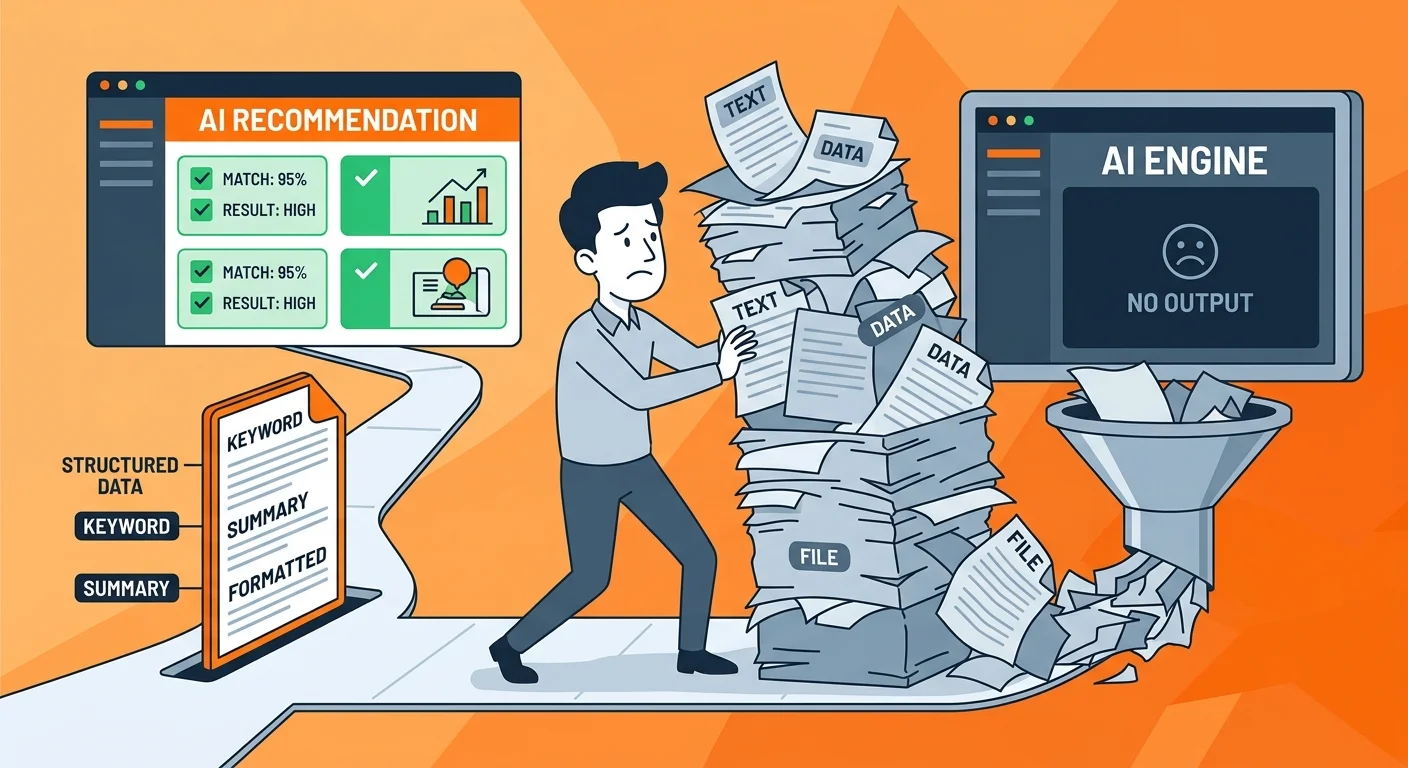
The blog post model doesn’t fade. It breaks. And it breaks the moment someone stops scrolling a list and starts asking a question out loud.
Traditional search handed you a list. Nine other results sat beside yours. A human picked one.
Conversational AI doesn’t hand anyone a list. It picks one answer, states it with confidence, and moves on.
If your content isn’t built to earn that answer, you don’t place second. You don’t exist.
That’s not a traffic problem. That’s not a ranking problem. The list itself is contracting.
Gartner projects a 25 percent drop in traditional search volume by 2026 as conversational AI agents absorb those queries. The businesses still optimizing for list placement are doubling down on a surface that’s actively shrinking – month over month, irreversibly.
Lists shrink. Verdicts compound.
Why Traditional SEO Blog Content Falls Short of AI Citation Standards
Traditional content was engineered for an algorithm. Keyword density. Backlink volume. Publishing frequency. Those signals told the algorithm where to rank you on the list – and the list handed you to a human who decided what to read.
None of that has anything to do with whether a machine can extract a complete, verifiable answer and cite it with confidence.
Those are two different jobs. Traditional content was only ever built for one of them.
AI citation isn’t a keyword match. It’s an architectural evaluation. The engine asks: is this content structured enough, specific enough, and factually grounded enough to cite with confidence?
Most traditional content fails that test before the first paragraph ends. Not because the writing is bad. Because the architecture was never designed for machine extraction.
That’s not a rewrite problem. That’s a rebuild problem.
Practices that discovered traditional blog posts failed to convert into patient bookings weren’t sitting on bad content. They were sitting on content built for a list. Their patients were asking AI engines for a verdict.
Those two things don’t meet. They were never going to.
The FTC’s guidance on AI claims makes the standard concrete: every assertion an AI engine surfaces must be scientifically supportable and traceable to a verifiable source.
Keyword-volume content doesn’t clear that bar. It was never designed to.
Content built around entity trust signals, verified citations, and structured semantic density does. That’s the citation standard. And the gap between what traditional content delivers and what that standard requires isn’t a matter of degree – it’s a matter of design.
The High-Volume Content Mill Problem
High-volume content mills made this worse at scale. The logic was simple: publish more, target more keywords, outrank through volume.
What that produced was enormous libraries of interchangeable content. Enough to satisfy a ranking algorithm. Nothing for an AI engine to cite.
Entity trust wasn’t built. It was buried.
Some of that content still ranks. That’s beside the point.
Ranking on a shrinking list isn’t the same as earning a verdict on a growing one. Harvard Business Review documented the shift directly: generative AI is pulling consumer search behavior away from link lists and toward direct, synthesized answers.
Volume-based content has no mechanism to earn machine trust. It wasn’t built to.
The volume model didn’t just fail to build authority. It displaced it.
Every generic article published under that model is noise. And AI engines are getting better at ignoring noise – and better at recognizing what isn’t.
Who This Section Is Not Written For
Here’s the thing: this section isn’t written for businesses that want a faster version of the old model.
If the goal is more keyword articles, a bigger publishing calendar, or a higher volume of generic content – this isn’t that conversation.
This is for the business that already suspects the old model isn’t working – and wants to know exactly why before deciding what to build instead.
If you’re still measuring success by list position on a surface that’s contracting by the month, the rest of this article will be uncomfortable.
Good. That’s the point.
| Blog Post Approach | Why It Fails AI Citation | What AI Engines Need Instead |
|---|---|---|
| Targets a keyword to earn a position on a ranked list | AI engines don’t serve ranked lists – they deliver a single verdict to the person who asked | Content structured around a specific entity signal that defines who the business is and why it can be trusted |
| Relies on backlink volume and publishing frequency to signal authority | Backlink counts and publish cadence are invisible to conversational AI citation logic – they evaluate structure and verifiability, not volume | Verified factual citations and semantic density that a reasoning engine can extract and confirm independently |
| Written for a human to scan, click, and evaluate against competing results | No human evaluation step exists in a conversational AI response – the engine makes the judgment call before the user sees anything | Machine-readable content architecture built for direct extraction – The Direct Answer Block, structured hierarchy, schema markup |
| Optimizes for keyword density to satisfy a ranking algorithm | Keyword density provides no verifiable entity signal – AI engines require specific, structured claims they can trace to a trustworthy source | Entity Trust Architecture that defines the business, its credentials, and its subject matter authority in language AI engines can parse |
| Measures success through traffic, impressions, and click-through rate | Click-based metrics have no relationship to AI citation – a piece of content can rank on a list and never appear in a single AI-generated answer | Authority signals – Citation Velocity and Compounding Authority – that accumulate over time and increase the likelihood of being named as a trusted source |
| Published as a standalone article with no structural connection to the broader entity | Isolated content gives AI engines no web of verified, interconnected claims to evaluate – a single article without entity context is structurally ignorable | Schema and Semantic Density layered across an interconnected content infrastructure that reinforces the same entity signals from multiple angles |
What Defines an AI Authority Article: The Four Non-Negotiable Signals
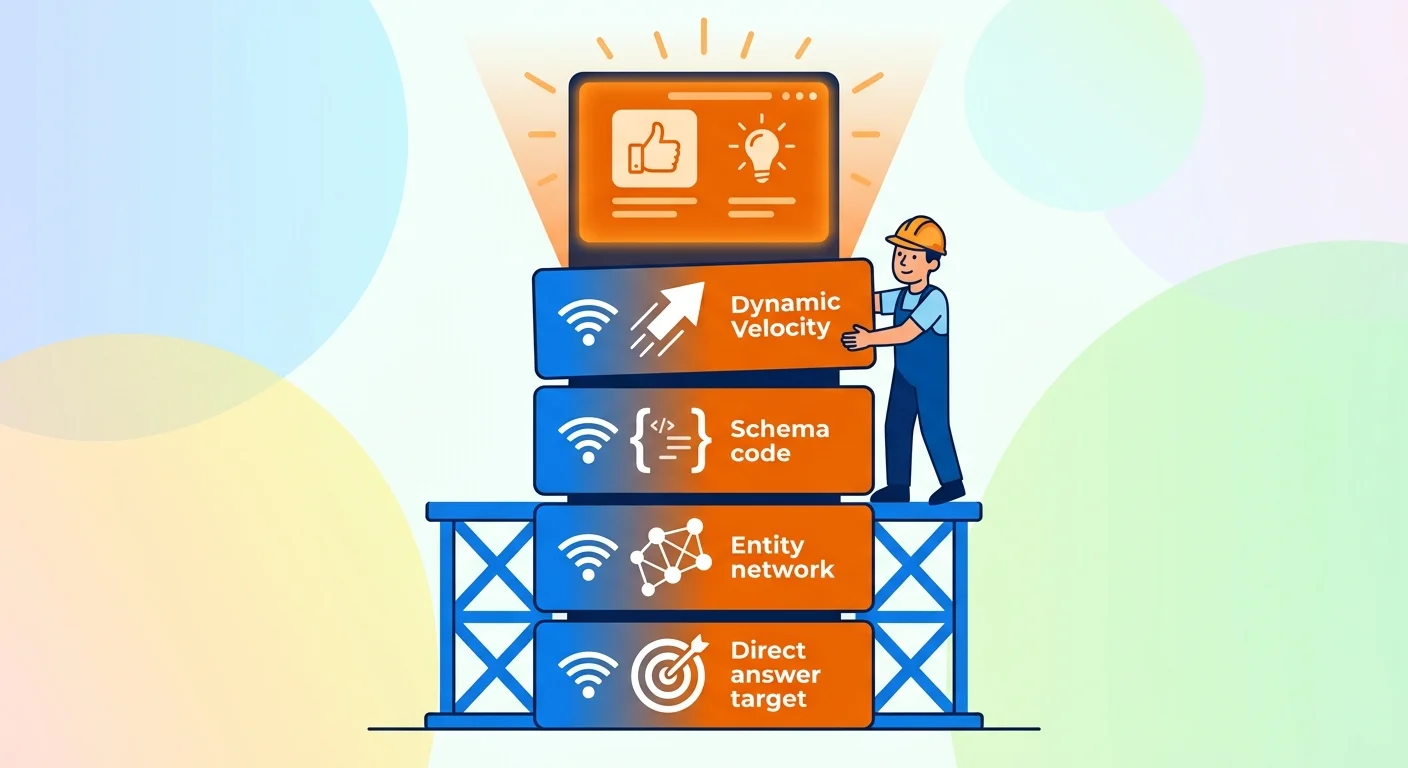
Four structural signals. Not writing style. Not publishing frequency. Not keyword density. Four specific architectural decisions that determine whether an AI engine trusts a source enough to name it out loud.
These aren’t optional enhancements. Miss one, and the machine has a reason to pass. Get all four right, and the content compounds – earning citation trust that builds on itself every month, whether or not a human ever clicks a link.
The Direct Answer Block
The Direct Answer Block is the first thing a conversational AI engine scans for. It’s a standalone answer to the article’s primary question – plain, encyclopedic, stripped of brand voice, stripped of promotional framing, stripped of self-referential transitions. It has to function as a complete unit of truth with zero surrounding context. Not a gateway to the article. The answer itself.
Here’s where the list vs. verdict gap becomes physical. A traditional article opens with a hook – a story, a scene-setter, a promise of what’s coming. That framing works on a human reader who chose to click. It fails immediately with an AI engine scanning for an extractable answer it can state with confidence. If the answer isn’t in the first two sentences, the content gets passed over. No second chances. No partial credit.
The detailed breakdown behind this format goes deeper than most businesses expect. But the principle is simple: write the answer first, then support it. Every word before the answer is a tax on machine extraction. Eliminate the tax.
Entity Trust Architecture
Entity Trust Architecture is the second signal – and the one most completely absent from traditional content. An AI engine doesn’t just read your content. It evaluates whether your content confirms a consistent, machine-readable identity across every surface where your business appears. Name, credentials, service area, specialty – all of it has to align, and all of it has to be verifiable. Ambiguity here is disqualifying.
That’s why template-based content fails at the infrastructure level. It can target a keyword. It can’t define an entity. And without a coherent entity definition, an AI engine has no stable identity to cite – it can describe a category, but it won’t name a specific business.
Stanford HAI confirms it: grounding AI outputs with specific verification nodes – a core principle of retrieval-augmented generation – directly reduces hallucination rates and establishes verifiable context. Entity Trust Architecture is how that works in practice. It gives the machine something specific, stable, and confirmable to point to. Without it, the AI has no anchor. It moves on.
Schema and Semantic Density
Schema markup tells a machine what type of content it’s reading – not through inference, but through explicit declaration. FAQ schema. Article schema. Organization schema. These aren’t SEO tricks. They’re the machine-readable metadata that lets an AI engine categorize, extract, and confidently cite a source. Without them, the machine guesses. Guesses don’t produce verdicts.
Semantic density is what surrounds the schema. It’s the concentration of verifiable, specific, contextually relevant information in the content itself – facts that are traceable, claims that are grounded, language precise enough for a machine to extract without ambiguity. The FTC is direct: every assertion surfacing through AI must be scientifically supportable and traceable to a verifiable source. Semantic density is how content clears that bar. Volume-based content never does.
High-volume content mills failed on both counts. Generic content has low semantic density by design – written to appeal broadly, which means it says nothing specifically. Unpopulated schema is standard inside template-built content pipelines. The machine gets vague language with no structural declaration. Nothing to cite with confidence.
Citation Velocity and Compounding Authority
Citation Velocity and Compounding Authority is the fourth signal – and the one that makes AI Authority Articles a fundamentally different investment than anything in the traditional content model. Each properly structured article adds to the machine’s confidence that this entity is a reliable source. More articles, stronger signal. Stronger signal, more citations. More citations, harder to displace. That’s not a publishing calendar. That’s a compounding authority position.
This is the compounding mechanism that makes the list vs. verdict divide a widening gap, not a static one. McKinsey projects the economic impact of generative AI on marketing and sales productivity at up to $4.4 trillion annually. The businesses capturing that value are the ones whose content is being cited. Not the ones still chasing positions on a contracting list. Lists shrink. Verdicts compound.
Traditional content doesn’t compound this way. A keyword article might hold a rank for a while. But rank is rented – it shifts with every algorithm update and disappears when publishing stops. Citation Velocity builds owned authority. Every verified, schema-structured, entity-grounded article makes the next citation more likely. That’s not a list. That’s a verdict that keeps getting confirmed.
| Signal | What It Is | What a Blog Post Does Instead | AI Engine Impact |
|---|---|---|---|
| The Direct Answer Block | A structured, standalone answer written in plain encyclopedic language – extractable by an AI engine with zero surrounding context | Opens with a hook, a scene-setter, or a promise of what’s coming – framing designed for a human reader who clicked, not a machine scanning for a citable answer | AI engine scans the opening, finds no extractable answer in the first two sentences, and passes the content over in favor of a source that leads with the verdict |
| Entity Trust Architecture | A consistent, machine-readable identity confirmed across every surface where the business appears – name, credentials, service area, and specialty all aligned and verifiable | Targets a keyword without defining an entity – content describes a category but gives the machine no stable, confirmable identity to cite by name | AI engine can describe the category but cannot name the specific business with confidence – the citation goes to whoever has a coherent entity definition |
| Schema and Semantic Density | Explicit machine-readable metadata (FAQ, Article, Organization schema) combined with a high concentration of specific, traceable, verifiable claims throughout the content | Relies on broad, appeal-to-everyone language with little structural declaration – generic framing and unpopulated schema are the norm in template-built content pipelines | Machine receives vague language with no structural declaration – low semantic density gives it nothing specific enough to extract and cite with confidence |
| Citation Velocity and Compounding Authority | Each properly structured article adds to the machine’s confidence that this entity is a reliable source – citations accumulate and reinforce each other over time | Earns a rank position that shifts with every algorithm update and disappears when publishing stops – authority is rented, not owned | Traditional content cannot compound – a keyword article holds a rank temporarily while AI Authority Articles build owned citation trust that makes the next citation more likely with every article added |
Side-by-Side: How Each Format Performs Across 8 Critical Dimensions
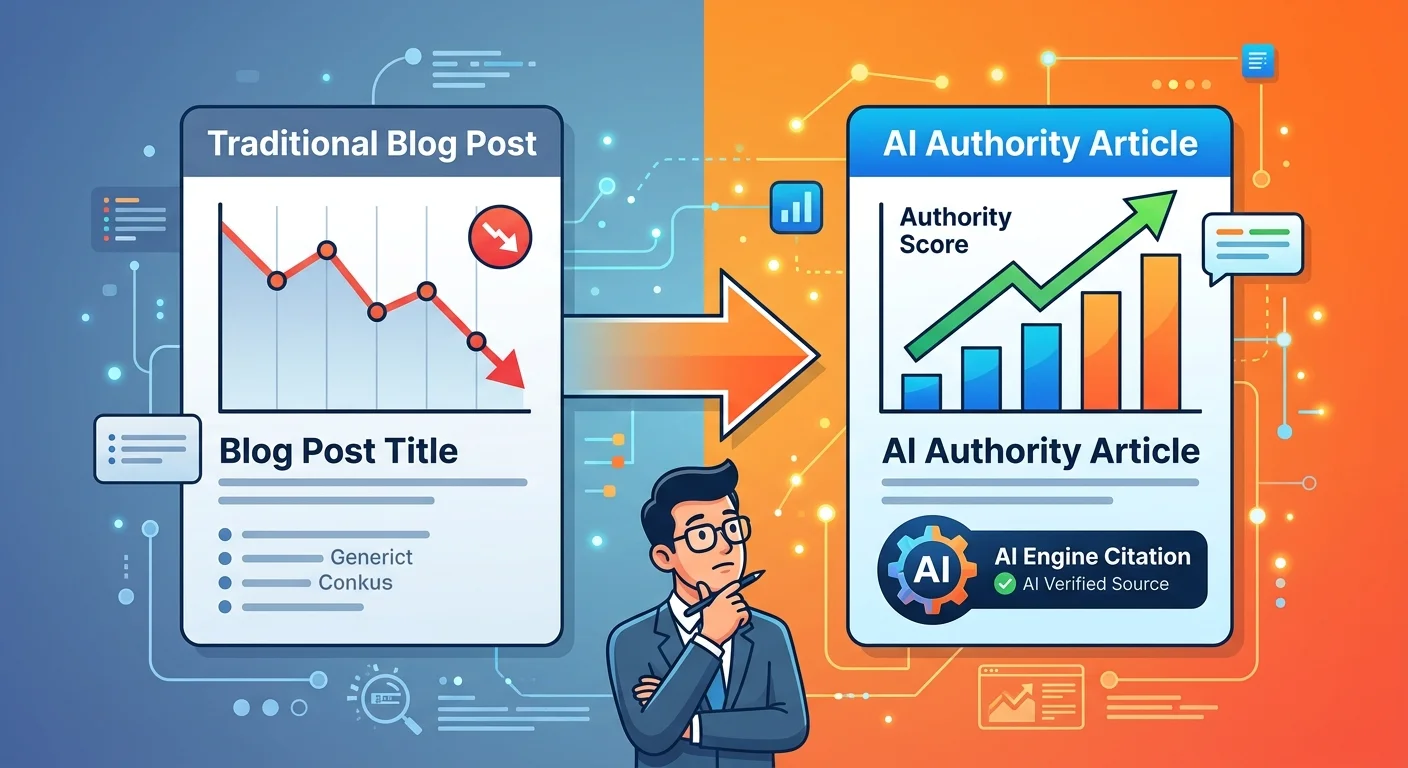
Eight dimensions. One table. No more rationalizing which format is winning.
Gartner projects traditional search volume will drop 25% by 2026 – and that contraction doesn’t hit evenly. It hits hardest on content built for lists. AI Authority Articles aren’t competing in that contraction. They’re operating in a different category: one where the machine issues a verdict, not a ranking. Published survey data puts roughly 58% of Americans who’ve heard of ChatGPT already using it for conversational tasks like learning and discovery. The audience has migrated. The question is whether your content did.
These eight dimensions aren’t picked to favor one format. They’re the exact variables AI engines run when deciding whether to name a source or skip it. Read each one against what you’re publishing right now. Be honest about which column you’re actually in.
Reading the Comparison: What Each Dimension Measures
Each dimension maps to a decision an AI engine makes during retrieval. It’s not grading your prose quality or how often you publish. It’s asking one question: can this source be cited with confidence, or does it require too much guesswork to be safe? Structural trustworthiness is the only test that matters here.
The first four dimensions track the structural signals already covered – Direct Answer Block, Entity Trust Architecture, Schema and Semantic Density, Citation Velocity and Compounding Authority. The remaining four track what each format actually produces when run at full scale over twelve months: authority, patient acquisition, competitive position, and long-term asset value. Practitioners who’ve studied how foundation models are reshaping patient education and trust will recognize the framework immediately. The machine uses the same criteria.
Where the Gap Compounds Over Time
The list vs. verdict divide isn’t a fixed gap. It moves every month. Every month a practice publishes AI Authority content, Citation Velocity builds and the machine’s confidence in that source deepens. Every month it publishes traditional keyword content instead, that content earns a spot on a list that’s actively contracting. Both trajectories are compounding – just in opposite directions.
Here’s the thing most businesses get wrong when they compare these two formats: they look at a single article. Not twelve months of consistent execution. Not the compounding opportunity cost of running the wrong format for a year. Authority built through Citation Velocity gets harder to displace with every article added. Authority chased through volume publishing gets less valuable with every algorithm shift. Those aren’t comparable outcomes. Dig into valuable resources on building entity trust and you’ll find the same principle from every angle – compounding authority is the only kind that survives.
By dimension eight, there’s nothing left to debate. The list vs. verdict gap isn’t a content preference. It’s a structural outcome – and it locks in harder every month it goes unaddressed.
| Dimension | Traditional Blog Post | AI Authority Article | Why It Matters for AI Visibility |
|---|---|---|---|
| The Direct Answer Block | Opens with a narrative hook, scene-setter, or story – optimized for a human reader who chose to click | Opens with the answer in the first two sentences – structured for immediate machine extraction with zero surrounding context required | AI engines scan for extractable answers; content that buries the answer behind setup gets passed over regardless of quality |
| Entity Trust Architecture | Targets a keyword or topic – does not define a consistent, machine-readable business identity across structured data surfaces | Defines the entity explicitly – name, credentials, service area, specialty – aligned and verifiable across every surface the machine evaluates | Without a coherent entity definition, an AI engine can describe a category but cannot name a specific business with confidence |
| Schema and Semantic Density | Schema is absent or unpopulated by default in template-built pipelines; language is broad to appeal widely, reducing specific extractable claims | Schema explicitly declares content type (FAQ, Article, Organization); every claim is traceable, specific, and structured for confident machine citation | Schema is the machine-readable metadata that allows an AI engine to categorize, extract, and cite a source – vague language with no declaration produces nothing to cite |
| Citation Velocity and Compounding Authority | Each article earns a position on a list – authority is rented, resets with algorithm changes, and disappears when publishing stops | Each article adds a verified signal to a compounding authority asset – every new article makes the next citation more likely and the position harder to displace | Compounding authority is the only kind worth building; volume publishing on a contracting list produces diminishing returns, not a durable competitive position |
| AI Engine Retrieval Outcome | Returns a ranked position in a list that a human must navigate and evaluate – the engine does not issue a recommendation | Returns a named verdict – the AI engine cites the entity directly as the trusted answer to the user’s question | The shift from list to verdict is the core structural outcome this format is engineered to produce; the two formats are not competing for the same result |
| Competitive Position Over Time | Position is contested with every algorithm update; competitors publishing at higher volume can displace rankings without producing better answers | Authority compounds with every additional verified article; displacement requires a competitor to outpace the accumulated citation signal, not just outpublish | The competitive moat widens with time when Citation Velocity is active – it narrows when publishing stops, making consistency the primary strategic lever |
| Patient Acquisition Model | Drives clicks to a page a patient must read and evaluate – acquisition depends on the patient choosing to engage further after landing | Delivers the practice name as the AI engine’s stated recommendation – the patient arrives with the engine’s endorsement already attached | Trust is pre-established at the point of discovery when the AI issues a verdict; a click-through from a list requires the content to earn trust from zero |
| Long-Term Asset Value | Content depreciates – keyword relevance decays, rankings shift, and the asset has no structural value independent of the algorithm that ranked it | Content appreciates – each verified, schema-structured, entity-grounded article strengthens the authority infrastructure it is built on | Authority as a compounding asset is a fundamentally different investment category than rented visibility; the value of one accrues, the value of the other erodes |
Frequently Asked Questions
Hard landing. But a hard landing doesn’t close the loop – not if you’ve spent years building content the old way and you’re still not sure what to do next.
Here are the real questions. The ones you’re actually asking. Each one gets a straight answer – no hedging, no fine print.
What is the primary difference between an AI Authority Article and a traditional blog post?
One earns a spot on a list. The other earns a verdict.
A traditional blog post competes for rank. It gets a position in a search result – then a human has to evaluate it, click through, and decide if it was worth the trip. An AI Authority Article is built to be cited directly. The Direct Answer Block, entity definition, schema declarations, and Citation Velocity work together so a conversational AI engine can name it with confidence. No list. No navigation. No human sorting required.
These two formats are not optimizing for the same outcome. They’re not even operating in the same environment.
Why does traditional SEO optimize for lists while AEO optimizes for verdicts?
Because they’re different machines doing different jobs.
Traditional search engines rank documents. Keyword relevance, backlink signals, engagement patterns – then a list for a human to sort through. AI answer engines retrieve a verdict. They evaluate structural trustworthiness – entity definition, schema declarations, semantic density, verifiable citations – and name a single answer.
Keyword density doesn’t make content more citable. It makes it more rankable in a system Gartner projects will shed 25% of its volume by 2026. AEO restructures content around what the verdict engine actually evaluates. Those signals aren’t a variation of ranking signals. They’re a different standard entirely.
How does a Two-AI Validation System prevent hallucinations in AI Authority content?
Every claim gets a verified source before it enters the content. That’s the mechanism.
Stanford HAI confirms that grounding AI outputs with specific verification nodes – the core principle of retrieval-augmented generation – directly reduces hallucination rates and establishes verifiable context. The Two-AI Validation System applies that principle to every article: Gemini researches and sources every claim, Claude writes against verified data, Gemini validates before anything publishes.
The FTC is direct: every assertion surfaced through AI-assisted content must be scientifically supportable and traceable to a verified source. The Two-AI Validation System isn’t an occasional safeguard. It’s the operational mechanism that meets that bar every single time.
Will traditional blog posts completely lose their value as conversational AI engines grow?
Not completely. But that’s the wrong thing to worry about.
The risk isn’t that traditional content vanishes overnight. The risk is that it stops being the primary discovery mechanism – and every month that shift continues, the gap between formats compounds. Gartner projects traditional search volume will drop 25% by 2026. That contraction hits hardest on keyword-optimized content built for list placement, not on content built to earn AI citations.
Practices that wait for the shift to be obvious will find that the businesses who moved early have already locked in Citation Velocity. Waiting isn’t neutral. It’s choosing to let someone else claim the verdict while you keep competing for a shrinking slice of a contracting list.
What specific schema signals do AI engines look for when deciding what content to cite?
Four signals do most of the work.
FAQPage schema creates extractable Q&A pairs an AI engine can surface as a direct answer. Article schema declares content type explicitly – no inference required. Organization schema anchors the entity definition a machine needs to cite a specific business with confidence. And Citation Velocity – the compounding weight of verified, traceable claims across every published article – gives the machine something it can safely cite with authority over time.
The FTC is direct: every assertion surfaced through AI must be scientifically supportable and traceable. Schema is how content declares its structure. Citation Velocity is how content proves it deserves to be named. Without both, even well-written content asks the machine to make a leap it won’t make.
How long does it take for an AI Authority Article to start building citation velocity?
That’s the wrong question – and understanding why matters.
Citation Velocity isn’t a switch. It’s a compounding mechanism. Each properly structured AI Authority Article adds to the machine’s confidence that this entity is a reliable source. The first article establishes the entity definition. The next reinforces it. The one after deepens semantic density. The signal strengthens with every verified publication – not on a calendar, but with every article that goes live.
The practices building Citation Velocity today are the ones AI engines will cite with confidence when Gartner’s projected 25% contraction in traditional search volume hits by 2026. There’s no shortcut to that position. There’s only starting now – or ceding more ground to whoever already did. Lists shrink, verdicts compound – and the compounding has already started.
The Verdict
The list vs. verdict divide has a winner.
And it isn’t close.
Traditional content earns a position on a shrinking list – one that shifts with every algorithm update and disappears the moment you stop publishing. AI Authority Articles earn a machine-issued verdict. One that compounds every month execution continues. One that gets harder to displace with every verified article added.
Those aren’t two strategies. They’re two different outcomes.
Gartner projects traditional search volume drops 25% by 2026. That contraction doesn’t hit everyone equally.
It lands hardest on content built for lists – articles with no entity definition, no schema, no Direct Answer Block, no Citation Velocity. Just keywords pointing at a format the market is walking away from.
The businesses moving now are the ones whose names AI engines will state when that contraction is complete. The ones still publishing for lists are fighting over a smaller slice of something already being replaced.
Here’s the verdict: AI gives one answer. If your content isn’t built to earn that answer – no Entity Trust Architecture, no Schema and Semantic Density, no Citation Velocity – the machine names someone else.
That gap widens every month it goes unaddressed.
The only play that changes the outcome is building infrastructure that makes your name the one AI states with confidence. Your competitors are making that call right now. Some are building. Some are waiting. But the math doesn’t care which camp you’re in – lists shrink, verdicts compound.
The compounding has already started. The only question is whether your name is in the answer or a competitor’s is. Run the AI Visibility Check and find out exactly where you stand – Run My AI Visibility Check.