
Why High-Volume AI Content Mills Don’t Build AI Visibility

Content mills build volume. Not authority.
That used to be enough. More pages meant more chances to appear on a list. But AI engines don’t produce lists. They produce one answer. And that answer isn’t determined by how many articles you’ve published.
Here’s the thing: this isn’t a rare mistake. Generative AI has become a commodity production tool across marketing and sales pipelines – McKinsey has tracked this scaling across entire business units. Every practice in your market can now pump out fifty articles a month with a few prompts and a subscription.
So if volume is your strategy, your competitor has the exact same strategy. And none of you are getting recommended.
The practices AI engines recommend aren’t the ones that published the most. They’re the ones that published content AI can verify, structure, and trust.
That’s a completely different problem. And a content mill is structurally incapable of solving it.
What Content Mills Optimize For (And Why It’s the Wrong Target)
Content mills optimize for output speed and keyword presence. When the goal was appearing on a scrollable list, that was the right target.
It’s not the right target anymore. When AI engines name a single practice in response to a patient’s question, keyword density doesn’t move the needle. Not even a little.
And this isn’t a trend that cycles back. The AI content paradigm shift why AI authority articles have replaced blogging for healthcare practices in 2026 makes clear why: AI engines don’t scan for keyword density. They evaluate whether an entity is structured, cited, and verifiable.
Content mills don’t produce any of those signals. They produce text. Text isn’t authority.
Here’s a simpler way to see it. Imagine a door with beautiful trim, a fresh coat of paint, and a polished handle – that nobody can open.
That’s what most practices have built. The content mill delivered more decorations – more articles, more words, more keyword-rich pages – without touching the structural problem underneath. AI engines can’t read the door. They can’t verify who’s behind it. So they recommend someone else.
Why Publishing More Unverified AI Content Makes the Problem Worse
But the volume problem doesn’t just fail to help. It actively makes things worse.
Published analysis from McKinsey tracking generative AI’s rise as a commodity content tool shows unverified material is now flooding every industry – and healthcare isn’t exempt. Harvard Kennedy School research confirms it from the other direction: algorithmic distribution structures rapidly propagate health misinformation without strict entity validation. When a practice pumps out generic, unverified AI content, it doesn’t strengthen its entity signals. It dilutes them.
Healthcare carries a risk other industries don’t face at the same level. Harvard Kennedy School research shows algorithmic distribution structures rapidly propagate health misinformation without strict entity validation.
AI engines are already operating in an environment saturated with unreliable health content. The practices that stand out aren’t the ones adding to that noise. They’re the ones structured well enough that AI can verify them – and trust them.
So here’s what publishing more unverified AI content actually signals: that this entity can’t be distinguished from the noise floor.
No schema. No verified claims. No structured entity reinforcement. Just more text that looks like every other unverified source the engine has learned to deprioritize. More of that isn’t a strategy. It’s a faster path to invisibility.
And understanding what is an AI authority article – structurally, not just definitionally – is to understand why the content mill model was never going to get a practice recommended.
| Content Attribute | High-Volume Content Mill Output | AI Authority Article Output | What AI Engines Actually Reward |
|---|---|---|---|
| Factual Accuracy | Generic claims with no source verification – pulled from existing web content and rephrased | Every claim traced to a verified institutional source before publication – citations embedded in structure | Entities whose content can be cross-referenced against trusted sources – not content that merely sounds authoritative |
| Schema Markup | Absent or minimal – plain text output with no machine-readable structural signals | Structured schema built into every article – signals entity type, topic authority, and factual scope to AI engines | Content that can be parsed, categorized, and verified by AI engine backends – not just read by human eyes |
| Entity Reinforcement | Generic authorship – no named entity, no credential signals, no location or practice specificity | Deliberate entity signals woven throughout – practice name, credentials, service area, and structured identity markers | A clearly defined entity that AI engines can distinguish from the noise floor and consistently associate with a topic |
| Content Purpose | Optimized for volume and keyword presence – designed to appear on a ranked list of many results | Optimized for a single verified recommendation – designed to be the one answer an AI engine names with confidence | Content that answers the question completely, accurately, and verifiably in one place – not content that competes for a position in a list |
| Validation Process | No validation step – output goes directly from AI generation to publication with no accuracy check | Two-step AI validation before publication – research verified by one AI engine, prose validated by a second before anything is published | A demonstrable verification standard that separates credible entities from the mass of unverified content AI engines have learned to deprioritize |
| Trust Signal Output | Dilutes entity signals – adds undifferentiated text to an already saturated information environment | Compounds entity trust over time – each article reinforces the same verified entity, building citation velocity across AI engines | Cumulative, compounding authority that makes an entity progressively easier for AI engines to identify, verify, and recommend |
Why the Old Content Playbook Can’t Be Fixed With More Content
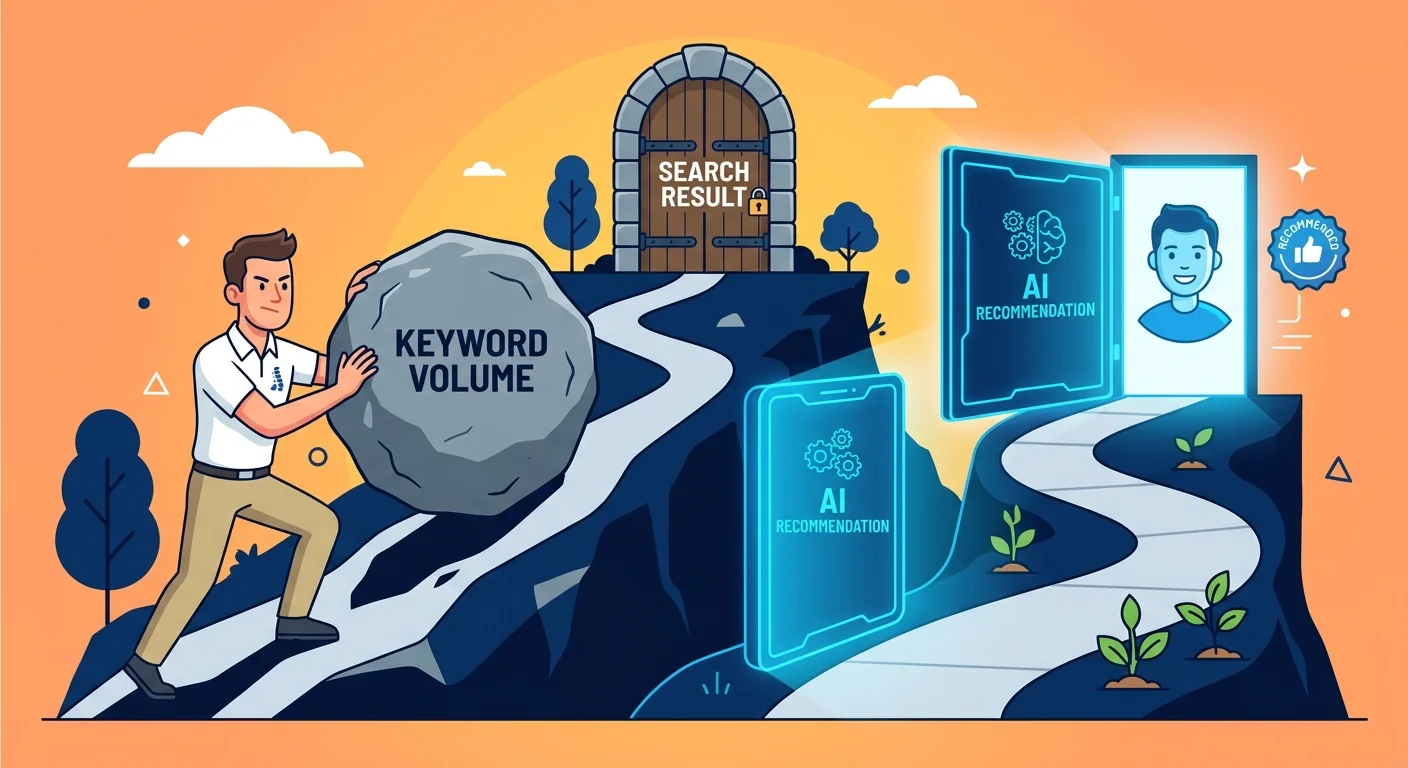
The instinct makes sense on the surface. Content isn’t working, so publish more content. But that instinct was trained by a playbook built for a search environment that no longer exists. Gartner projects traditional search engine volume will drop 25% by 2026 as patients shift to conversational AI tools that skip the list and name one answer.
Publishing more content into a dying format isn’t a growth strategy. It’s a faster way to go in the wrong direction.
Here’s what more content actually does when the architecture underneath is broken: it amplifies the problem.
Every new article from a content mill adds another unverified, unstructured page to an entity AI engines already can’t read. You’re not building credibility. You’re building a bigger version of something the engine has already decided to ignore.
The fix isn’t volume. It’s verification, structure, and machine-readable entity signals – the exact components content mills skip by design, because they slow output and can’t be templated at scale.
That’s not a patchable limitation. It’s a structural incompatibility. And understanding how an AI authority article vs traditional blog post differs from the commodity alternative is where the gap starts to close.
How Keyword-First Content Fails in a Zero-Click Search World
Keyword-first content was built on a single assumption: a human would scan a ranked list, evaluate options, and click through. Every tactic in the old playbook – keyword density, backlink profiles, optimized page titles – was engineered to win that list.
AI engines don’t produce a list. They produce a verdict.
That distinction ends the keyword game entirely. When a patient asks an AI engine who to trust for chiropractic care, the engine isn’t scanning for keyword frequency. It’s evaluating whether your entity is structured, cited, and verifiable enough to stake its own credibility on.
And that credibility bar is high. Pew Research Center findings show that only 2% of Americans who’ve heard of ChatGPT express high trust in its accuracy on complex, high-stakes topics. AI engines know patients are skeptical. That’s exactly why they default to entities they can structurally verify – not entities that published the most.
Keyword-first content doesn’t just underperform in a zero-click world. It misses the target completely.
It’s solving for list position in an environment that has no list. Every hour spent chasing keyword rankings is optimization pointed at a mechanism AI engines don’t use.
The playbook can’t be patched. It has to be replaced.
This Is Not the Right Practice – The Anti-Persona Qualification Gate
Now – a direct word on fit. If you’re looking to flood your schedule in the next sixty days, this isn’t it.
If you want a vendor who’ll produce fifty articles a month at low cost with no verification, no schema, no entity reinforcement – that vendor exists. It’s not us. Authority is built in layers. It compounds. And it requires infrastructure that content mills aren’t built to provide.
This isn’t for the practice that shops on price, needs a guarantee by end of quarter, or thinks the system can be reverse-engineered after a single conversation. If that’s the framework you’re working from, there’s no version of this that ends well for either side.
But if you’re tired of publishing content that AI engines ignore – and you’re ready to build verified, machine-readable authority that actually gets your practice named – then what iTech Valet does is worth understanding.
| Metric | Traditional Keyword Strategy | AI Answer Engine Strategy | Why the Gap Is Widening |
|---|---|---|---|
| Primary optimization target | Keyword frequency and density across page content | Entity trust, schema structure, and verified citations | AI engines evaluate entity credibility – not word repetition |
| Output model | High volume – more pages, more posts, more indexed content | Verified depth – fewer, structured articles that AI can read and cite | Volume without verification dilutes entity signals rather than strengthening them |
| End goal | Appear on a ranked list that humans scroll and evaluate | Be named as the single trusted answer in a conversational AI response | AI engines produce one verdict – list position no longer exists as a target |
| Validation process | No verification step – publish and index as fast as possible | Two-step validation confirms factual accuracy before publication | Unverified content in a healthcare context signals noise, not authority |
| Schema and structure | Optional or absent – content is formatted for human readers only | Machine-readable schema is foundational – built before content is written | Without structured schema, AI engines cannot parse or trust the entity |
| Competitive durability | Erodes as soon as competitors match volume or the algorithm shifts | Compounds over time – each verified article strengthens the entity layer beneath it | Authority infrastructure is cumulative; volume-based content is not |
What AI Engines Actually Read Before Recommending a Practice

Volume and keywords answer the wrong question.
They were built for a world where the goal was appearing on a list that humans scrolled. AI engines don’t produce lists. They produce a verdict. And the inputs that drive that verdict have nothing to do with how many articles you’ve published – or how many times your primary keyword shows up on the page.
Here’s the thing: AI engines are recommendation engines operating under extraordinary public scrutiny. Pew Research Center survey data shows that only 38% of Americans believe AI in healthcare will lead to better health outcomes. The engine knows trust is thin. So it doesn’t reward whoever published the most. It defaults to what it can verify – structured entity data, consistent citations, schema-readable content. That’s not a preference. That’s a survival mechanism.
So what does an AI engine actually read before it recommends a practice?
Not keyword density. Not page count. It reads entity trust, semantic density, and citation velocity – three structural signals that content mills are architecturally incapable of producing.
Entity Trust: How AI Engines Verify That Your Practice Is Real and Credible
Entity trust is the AI engine’s answer to one question: is this practice real, consistent, and verifiable enough for me to stake my credibility on?
That verification runs across multiple data layers at once. Name, address, phone number, service description – the engine checks whether those are consistent across structured data sources. It checks whether your schema markup matches what your content actually claims. It looks for third-party corroboration: directories, citations, mentions from sources it already trusts.
A beautifully written article with zero structured entity signals doesn’t pass that check. It just looks like more unverifiable text in an environment already drowning in it.
Here’s where the digital brochure problem hits hardest.
A practice can have a polished, professionally designed presence and still fail every entity trust check an AI engine runs. The door looks great. The engine still can’t verify who’s behind it. So it names the practice down the street – the one whose entity signals it can actually read.
Semantic Density and Citation Velocity: The Two Signals Most Practices Are Missing
Semantic density and citation velocity are the two signals that separate a machine-readable AI Authority article from a generic content mill output.
Semantic density means the article covers a topic with enough depth, specificity, and structural clarity that an AI engine can extract a reliable answer from it. Citation velocity means the entity is referenced, cited, and corroborated by sources the AI engine already considers authoritative. Both are measurable. Both are buildable. Neither comes from a template.
Content mills produce neither.
A templated article written at scale can look like it covers the topic. It uses the right words. It hits the right subjects. But it doesn’t deliver the structured, verifiable specificity that AI engines use to separate authority from noise. That’s not semantic density. That’s the surface-level appearance of it.
And citation velocity? No credible source cites generic AI-produced content as a reference. It doesn’t get mentioned. It doesn’t get corroborated. It just sits there – adding volume without adding a single signal.
That’s the structural incompatibility at the center of this whole problem.
Content mills were engineered to satisfy human readers scrolling a list. AI engines aren’t human readers. They’re verification systems. The only content that passes their verification is content deliberately engineered to be read, parsed, and trusted by a machine – not content engineered to look good at a glance.
| AI Recommendation Signal | What It Measures | Common Gap in Practice Profiles | Impact If Missing |
|---|---|---|---|
| Entity Trust | Whether a practice is real, consistent, and verifiable across structured data sources – name, address, phone, service description, schema markup | Inconsistent NAP data across directories, missing or mismatched schema, no third-party corroboration from sources the engine already recognizes | The engine cannot stake its credibility on an unverifiable entity – it recommends a competitor whose signals it can actually read |
| Semantic Density | Whether content covers a topic with enough depth, specificity, and structural clarity that an AI engine can extract a reliable, citable answer from it | Templated articles that use correct vocabulary at the surface level but lack the structured, verifiable specificity that separates authority from noise | The engine treats the content as undifferentiated background text – it won’t extract or cite an answer it can’t verify as structurally sound |
| Citation Velocity | Whether the entity is referenced, cited, and corroborated by sources the AI engine already considers authoritative | Generic AI-produced content generates no external citation because credible sources won’t reference unverified, templated material | Without corroboration from trusted sources, the entity remains a self-declared authority – the engine has no third-party signal to validate the recommendation |
| Schema Markup Alignment | Whether the structured data embedded in a page’s code matches what the content itself claims – service type, credentials, location, specialty | Schema is absent entirely, or it’s present but populated with generic boilerplate that doesn’t reflect actual clinical specialization | The engine detects a mismatch between declared signals and page content – a trust failure that disqualifies the entity before human-readable copy is ever evaluated |
| Verified Clinical Specificity | Whether content demonstrates genuine expertise through structured, fact-anchored claims – not broad category coverage, but verifiable depth on specific conditions, treatments, or patient outcomes | High-volume content mill output covers topics at a category level, producing breadth without the factual precision that signals clinical authority to a verification-first engine | The engine can’t distinguish the practice from dozens of other generic sources covering the same topic – it defaults to whoever has built verifiable depth, not volume |
| Consistent Content Cadence | Whether authority signals are being actively maintained and reinforced over time – not built once and abandoned, but compounding through ongoing structured publication | Practices treat content as a one-time infrastructure project rather than a compounding authority asset, allowing entity signals to stagnate while competitors continue building | Authority decays without ongoing execution – an entity that stops publishing verified, structured content cedes ground to competitors who keep compounding, month after month |
The Anatomy of an AI Authority Article That Gets a Practice Recommended
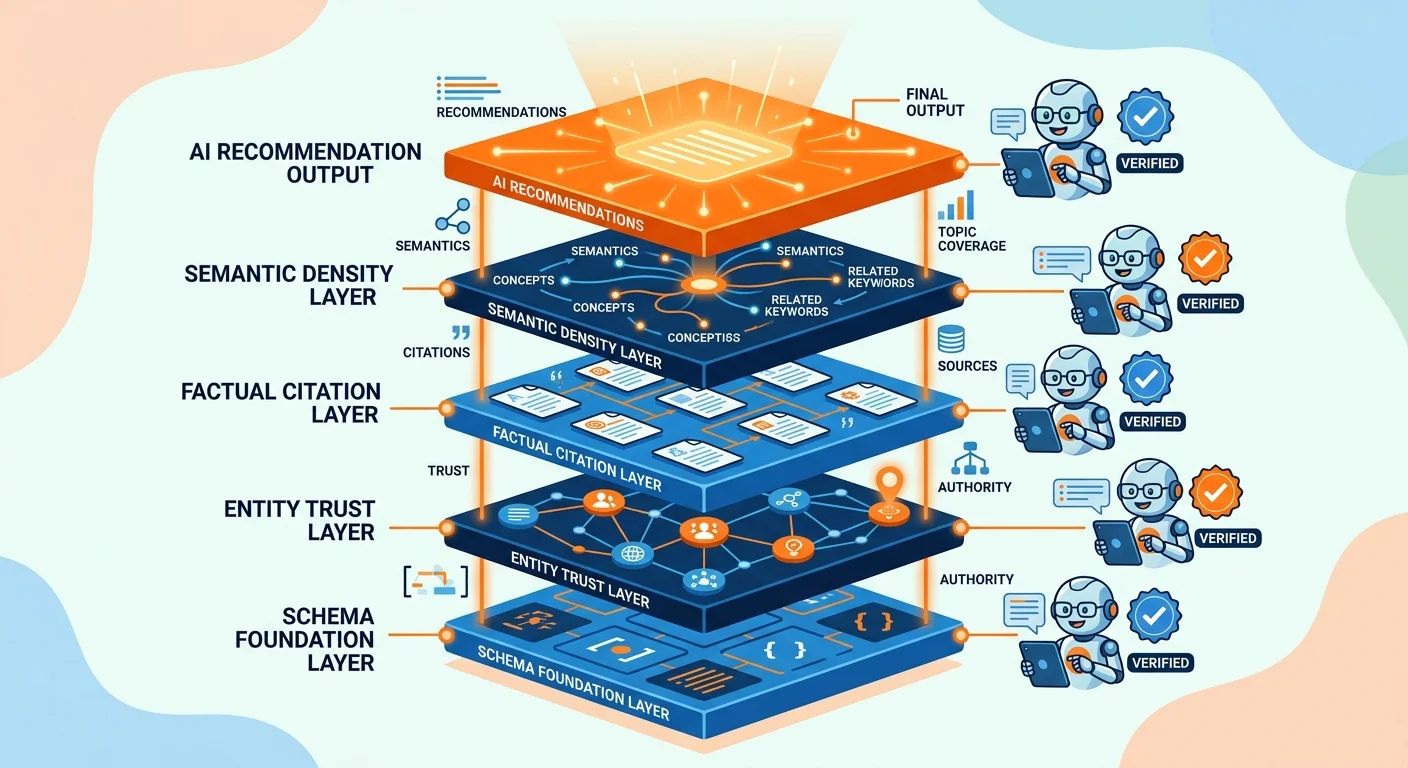
So what does a content asset that actually gets a practice recommended look like? Not theoretically. At the component level – the parts an AI engine actually reads.
It’s not longer. It’s not prettier. It isn’t stuffed with more keywords or chopped into more subheadings.
An AI Authority article is a different kind of document entirely. Engineered for machine parsing first, human reading second. Built around the three signals that determine whether an AI engine will stake its credibility on your name – or move on to someone else.
Your current content looks fine. That’s the problem.
No schema. No verifiable claims. No structured entity data. When an AI engine scans your site, that’s what it finds – a surface that reads well to a human and says nothing to a machine. That’s why it recommends someone else.
Structural Requirements: Schema, Factual Validation, and Machine-Readable Formatting
Schema markup is the foundation. It’s the structured data that tells an AI engine’s backend not just what your article says – but what it is.
Without it, the engine guesses. With it, the engine reads a machine-authored declaration: this entity, this service, this claim, this location.
That’s not a minor processing difference. That’s the difference between a source an AI engine can verify and one it has to ignore.
Factual validation is the next layer. And it’s where the gap between AI Authority articles and content mill output gets impossible to close.
Every claim in a properly structured AI Authority article traces to a verifiable, institutional source. Not because it reads better – because regulatory bodies require exactly that standard. The FTC is explicit: marketing claims tied to AI performance must be substantiated with rigorous proof or they invite enforcement action.
The engine knows this standard exists. It defaults to content that can survive the scrutiny.
Machine-readable formatting closes the loop. Consistent heading hierarchies. Structured internal linking. FAQ schema. Entity-level consistency across every data point in the document.
Here’s what most practices miss: authority isn’t self-reported. It’s verifiable – and how you measure that visibility has changed completely in the AI era. The AI Authority articles that actually move the needle are built to pass verification at every layer, not just look credible on the surface.
The Two-AI Validation System: Why Every Claim Must Be Sourced Before Publication
Verification isn’t a proofreading step. It’s the architecture.
The Two-AI Validation System behind every piece of content at iTech Valet exists because publishing unverified claims inside the AI health information ecosystem isn’t just ineffective – it’s dangerous. Harvard Kennedy School research confirms that algorithmic distribution structures rapidly propagate health misinformation without strict entity validation.
The engine amplifies what it finds. Unvalidated content doesn’t just fail to build authority – it actively tears down the entity signals a practice has spent years trying to establish.
So every AI Authority article runs through two AI systems before publication.
Gemini handles the research – sourcing every claim against verified institutional references, cross-checking data points, flagging anything that can’t be traced to a verifiable origin. Claude handles the writing – translating that verified research into prose structured for machine parsing, semantically dense, and formatted for AI extraction.
Neither works alone. That’s the point. One without the other gives you either well-sourced gibberish or beautifully written noise.
We don’t publish vibes. We publish receipts.
That’s not a tagline. It’s the operational standard that separates a verified AI Authority article from the noise content mills produce at scale.
Every claim sourced. Every schema element placed deliberately. Every entity signal engineered to pass the verification check an AI engine runs before it decides whose name to say – and whose to skip.
| Article Component | Generic AI-Generated Content | AI Authority Article Standard | Verification Method |
|---|---|---|---|
| Schema Markup | Absent or auto-generated boilerplate with no entity-level specificity | Hand-placed, entity-specific structured data declaring practice identity, service type, and claim sources to AI backends | AI engine cross-references schema declarations against content claims and third-party entity data sources |
| Factual Sourcing | Claims written from training data or generic research with no institutional trace | Every claim traced to a verified, institutional source – government, peer-reviewed, or accredited industry authority | Source URLs checked against live institutional references; unverifiable claims are rewritten or removed before publication |
| Entity Consistency | Practice name, address, and service descriptions may vary across content – no cross-document alignment | NAP data, service descriptions, and credential language are consistent across every document, schema block, and citation layer | AI engine compares entity signals across structured data sources, directories, and cited references simultaneously |
| Semantic Depth | Surface-level topic coverage optimized for keyword appearance rather than verifiable specificity | Topic coverage structured for machine extraction – specific enough that an AI engine can isolate a reliable answer from the document | AI engine parses heading hierarchies, FAQ schema, and internal linking patterns to assess whether the content can answer a query authoritatively |
| Citation Velocity | No external corroboration – content exists as a self-contained, unverified unit with no third-party references pointing to the entity | Entity is referenced and corroborated by sources the AI engine already trusts, building a network of verifiable inbound credibility signals | AI engine tracks whether the entity is cited by authoritative third-party sources, directories, and institutional references it has already validated |
| Validation Process | Single-pass generation – one AI system writes and publishes without independent verification of claims or structured data | Two-AI Validation System – one AI researches and sources, a second AI writes and structures, with no claim published without a verified origin | Cross-system verification means no single AI blind spot survives to publication; every output is checked against what the other system flagged |
Frequently Asked Questions
Good. You’ve got questions. Here they are – answered straight.
These aren’t small questions. What most practices are doing and what AI engines actually reward aren’t close. It’s not a tweak. It’s a structural rebuild.
What is an AI Authority Article and why are my current content pieces failing to get my practice recommended?
An AI Authority article is engineered for machine parsing first. Human reading second.
It’s built around schema markup, structured entity data, and verified claims traced to institutional sources. The kind of depth an AI engine needs to extract a reliable answer – and stake a recommendation on it.
What’s failing isn’t the writing. It’s the architecture underneath it. Most content your practice has published is a digital brochure. Polished. Keyword-consistent. And completely unverifiable to an AI engine.
No structured data. No claim-level sourcing. No entity signals a machine can read.
AI engines don’t scroll content. They run verification checks. If your content can’t pass those checks – schema present, claims traceable, entity signals consistent – it doesn’t get cited. It gets skipped.
How do conversational AI engines like ChatGPT and Gemini decide which healthcare practices to recommend?
They don’t rank. They verify.
ChatGPT and Gemini are evaluating whether your entity – your practice, your credentials, your claims – is consistent, corroborated, and trustworthy enough to stake a recommendation on.
Here’s what makes that bar even harder to clear: public trust in AI-curated health information is already fragile. Only 38% of Americans believe AI in healthcare will lead to better health outcomes, according to Pew Research Center. The engines carrying those recommendations know trust is thin. So they don’t reward whoever published the most. They default to what they can structurally verify.
The practices that get recommended are the ones whose schema, structured data, and third-party corroboration tell a consistent, verifiable story. The ones that don’t aren’t being ignored. There’s just nothing structurally there for the engine to trust.
Why aren’t traditional keyword-focused tactics working anymore for practice visibility?
Because the search behavior they were built to serve is changing – fast.
Traditional keyword tactics were engineered for a ranked list that a human clicks through. AI engines don’t produce lists. They produce one answer. And the entity named in that answer isn’t the one with the most keyword-optimized pages. It’s the one the engine can verify.
Keyword density doesn’t signal entity trust. Backlink counts don’t signal verifiable claims. Generic content volume – no matter how consistent the terminology – doesn’t produce the structured, machine-readable signals that determine whose name an AI engine says.
So the tactics didn’t fail because an algorithm updated. They failed because the entire decision architecture changed. AI engines are verification systems. You can’t optimize for verification with tools built for ranking.
The playbook can’t be patched. It has to be replaced.
What replaces high-volume AI content mills for practices that want to attract and convert patients?
Verified, structured AI Authority articles. Built one at a time. Every claim sourced. Every entity signal deliberately engineered.
Content mills are production systems. Built for volume – templated outputs optimized for human readers who might click a link. That model is structurally incompatible with what AI engines actually reward.
Harvard Kennedy School research shows that algorithmic distribution structures rapidly propagate health misinformation without strict entity validation. AI engines are actively filtering out unverified, high-volume content – because their credibility depends on it.
What works is the opposite of scale for its own sake. It’s depth. Specificity. Claims that trace to verifiable sources. Schema that tells a machine what the document is, not just what it says.
A practice that publishes twelve verified AI Authority articles built to pass machine scrutiny will outperform a practice that publishes a hundred templated pieces that can’t.
How does a Two-AI Validation System prevent the hallucinations and unverified claims that get practices ignored – or penalized – by AI engines?
It catches problems before they become entity signals.
Unverified claims don’t just fail to build authority. They actively damage it. The FTC is explicit: marketing claims tied to AI performance must be substantiated with rigorous proof to avoid enforcement action. An AI engine operating in a high-scrutiny information environment defaults to content that can withstand that standard. Anything that can’t gets filtered out.
The Two-AI Validation System runs every claim through two independent systems before anything gets published. Gemini handles research – sourcing every data point against verified, institutional references, flagging anything that can’t be traced to a credible origin. Claude handles the writing – translating that verified research into structured, machine-readable prose built for AI extraction.
Neither system works alone. That’s the architecture.
The result isn’t content that looks credible to a human skimming an article. It’s content that is verifiable – to a machine running the exact checks that determine whether your practice gets recommended or ignored.
Only 2% of Americans who’ve heard of ChatGPT express high trust in its outputs on complex topics, according to Pew Research Center. The engines know that problem exists. The Two-AI Validation System is built to be part of the solution – not another source of noise.
The Door AI Can Actually Open
Here’s the real diagnosis: this isn’t a content problem. It’s a verification problem.
Practices have spent years building a presence that looks credible to a human – polished, professional, consistent. And zero minutes engineering the structural signals that tell an AI engine it’s credible enough to stake a recommendation on.
The door looks great. The engine still can’t open it.
And the window to fix that is closing fast. Gartner projects traditional search engine volume will drop 25% by 2026 as patients move to conversational AI tools that name one answer. Not a list. One answer. The practices missing from that answer aren’t on page two – they’re nowhere.
So what replaces the brochure? Not more content. Different content.
Built on schema. Validated claims. Structured entity data. And the Two-AI Validation System that turns every AI Authority article into a document an engine can actually read, parse, and trust.
That’s the door AI can actually open. Not a beautifully decorated door that no one can walk through – but a structurally sound authority signal that passes every verification check an AI engine runs before it decides whose name to say.
Those aren’t variations of the same thing. They produce completely different outcomes.
The practices AI engines recommend aren’t the ones that published the most.
They’re the ones that built what AI engines are designed to reward – verified, structured, machine-readable, and impossible to dismiss.
ITech Valet exists to build that infrastructure. One AI Authority article at a time.
So here’s the only question left: right now, when a patient in your market asks an AI engine who to trust – is your name the answer, or is your competitor’s?
Here’s the only question that matters right now: when someone in your market asks ChatGPT, Gemini, or Grok who to trust – is your name the answer?
Find out.