The Website You Have Is Not What You Think It Is
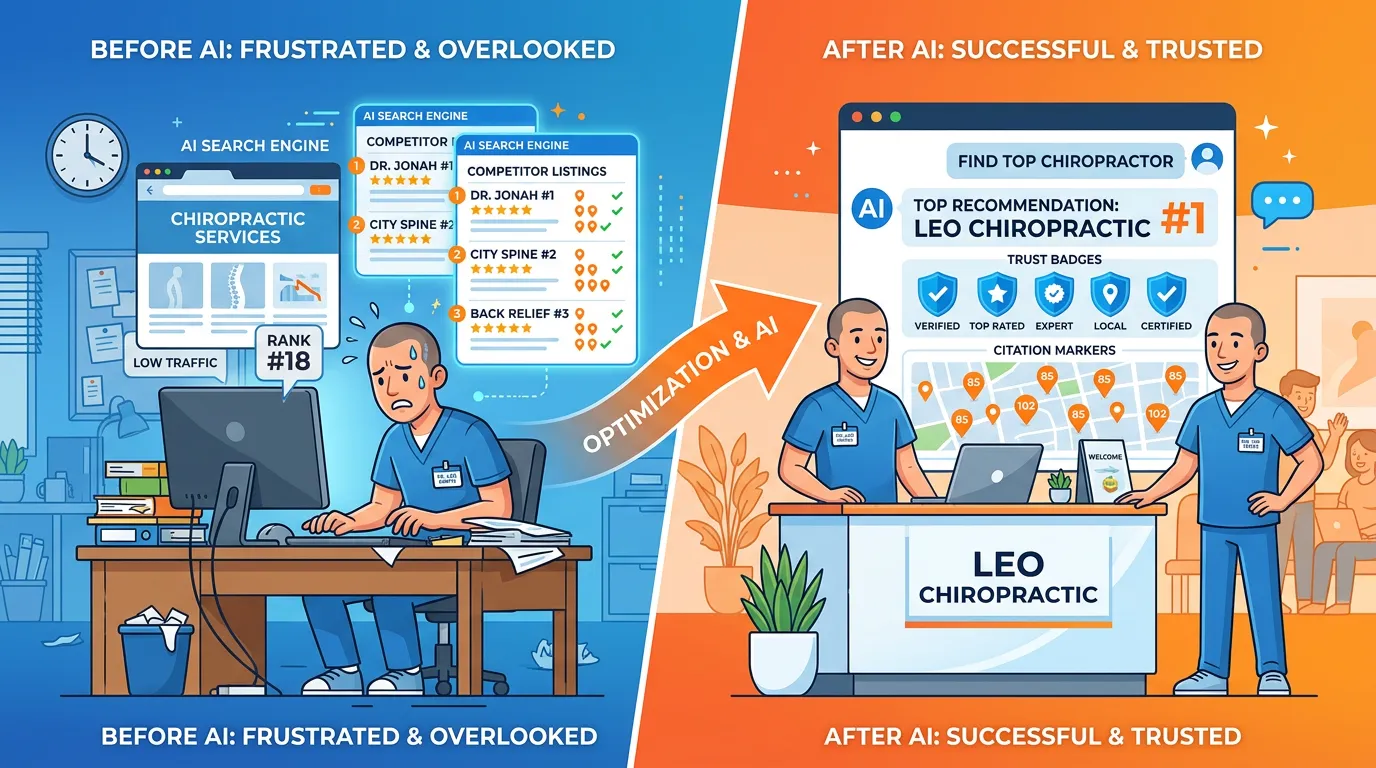
Picture this.
A patient’s shoulder has been locking up for three weeks. She grabs her phone and asks ChatGPT who to see. It gives her a name, an address, a reason they’re the right fit.
She books. Next tab. Done.
You’re two miles away. Eleven years in practice. A hundred and forty five-star reviews.
AI never said your name.
That’s not a marketing problem. That’s infrastructure. And it’s the problem the AI authority agency exists to fix.
Why Most Chiropractic Websites Are Invisible to AI
Nobody told you this was happening. That’s the part that gets me every time.
Your site looks great. Clean layout. Good photos. Maybe you spent $5,000 on it. You’re proud of it.
To an AI engine, it doesn’t exist.
Here’s why. AI doesn’t read your website the way a patient does. It parses structured data signals to verify whether your practice is a confirmed, trusted entity – or a placeholder it can’t validate. Three things kill you immediately:
- No schema depth – Entity signals fail to resolve. AI can’t verify who you are, what you treat, or where you are.
- Inconsistent citations – Trust filter rejects you. Contradictory directory listings read as an unconfirmed entity.
- Content that doesn’t map to patient intent – You’re not in the answer pool. AI cites answers, not keywords.
A beautiful website AI can’t read is an expensive digital business card.
Gartner projects a 25% decline in traditional search volume by 2026 as AI chatbots absorb the queries that used to land on Google. The practices that built for that shift will own the pipeline. The ones that didn’t will spend years trying to figure out why the phone got quiet.
I’ve watched this happen to practices with genuinely great reputations. The reviews were there. The results were there. The digital footprint was a mess. To the AI, that reads as a practice that can’t be confirmed. If you want to see what that structural gap actually looks like, the full comparison of authority infrastructure vs. pretty websites is the number I use every time someone tells me their site looks fine.
The 30-50% Patient Leak You Can’t Measure
The worst part? You can’t see it happening.
There’s no dashboard showing you the patients who asked AI and got someone else’s name. The recommendation was over before your site was ever involved. They searched. AI answered. They booked. You weren’t in the room.
According to ClickVision, more than 80% of searches that trigger AI Overviews end with zero clicks to any website – the answer lives inside the AI response itself. If you’re not the answer, you were never a consideration.
That’s the patient leak. Not rejection. Invisibility.
And it compounds every month you stay that way.
What $15,000 Actually Builds
I get this question constantly.
“What am I actually paying $15,000 for?”
Fair. Here’s the honest answer.
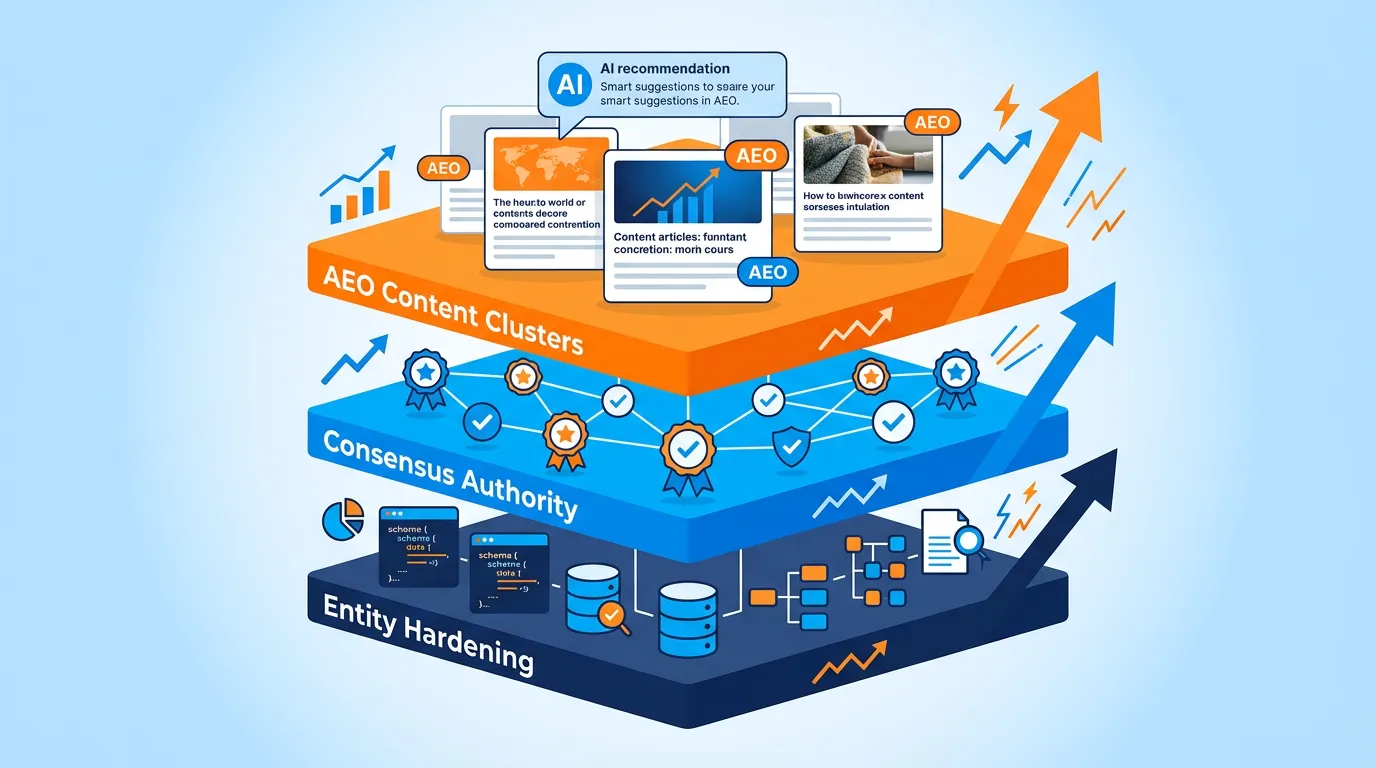
| Layer | What It Does | Why AI Requires It |
|---|---|---|
| Technical Entity Hardening | Implements deep schema markup so AI can parse your credentials, specialty, location, and services with machine precision | AI engines use structured data to verify entity accuracy – without it, your practice cannot be confirmed |
| Consensus Authority Building | Aligns citations across 15+ medical directories to create a consistent, cross-verified identity signal | AI’s Entity Trust filter requires multiple independent sources to agree before it will recommend you |
| AEO Content Clusters | Builds 12+ Authority Nodes – articles architected around patient search intents and optimized to be cited as AI answers | AI citation requires content that matches conversational query patterns, not keyword density |
Layer 1: Technical Entity Hardening
This is the floor. Nothing above it works if this isn’t right.
Schema markup isn’t the generic JSON snippet your developer added from a tutorial. I’ve seen that version. It does almost nothing. The real architecture is specialty-specific, credential-verified, location-precise – the difference between AI knowing exactly who you are and AI shrugging.
According to Augusta Hi-Tech, structured data gives AI up to 99.9% processing accuracy on entity information. That number drops the moment something’s wrong. I’ve watched practices lose the recommendation over a single NAP mismatch – one address formatted differently between their website and Google Business Profile. That’s it. AI flagged them uncertain. Moved on.
Your competitor probably got it right. That’s how they keep getting recommended.
Layer 2: Consensus Authority Building
Think of AI as a judge reviewing witness testimony.
Fifteen witnesses talking about your practice. If every one of them says the same thing – same name, same address, same specialty, same credentials – you clear the trust filter.
If five contradict each other? Uncertain. The judge moves on.
That’s consensus authority. AI search applies consistent entity signals – clear business information and coherent branding – as core trust filters for local providers. Most practices have no idea how many directories they appear in – or how many of them have wrong information. I’ve seen practices with five different phone numbers floating across the internet. AI reads all of them.
This is the work that never gets done under a $500/month retainer. There’s no margin for it. So it doesn’t happen. And the practice stays invisible.
Layer 3: AEO Content Clusters
Blog posts aren’t dead.
I hear that take constantly. It’s wrong. The format isn’t the problem. The depth is.
Content written for traditional SEO is engineered for a keyword ranking algorithm. Content built for AEO is architected to be cited as a verdict – the single recommendation inside a conversational AI response. Those are not the same product.
Each Authority Node is built around a real patient question – the ones they’re actually typing into AI right now, not the ones you wish they’d ask. And the answer has to be structured exactly the way AI needs it before it will cite anything. That’s not the same thing as a well-written blog post. Not even close.
According to BrightEdge, AI search visits are growing at double-digit monthly rates. The practices with AEO-built content are already in that stream. The ones with keyword blogs from 2021 aren’t. Understanding how AI actually decides which chiropractor to recommend is the conversation that ends the debate about whether this still matters.
The Real Cost of “Cheap”
Let me show you the math that never makes it into the pitch deck.
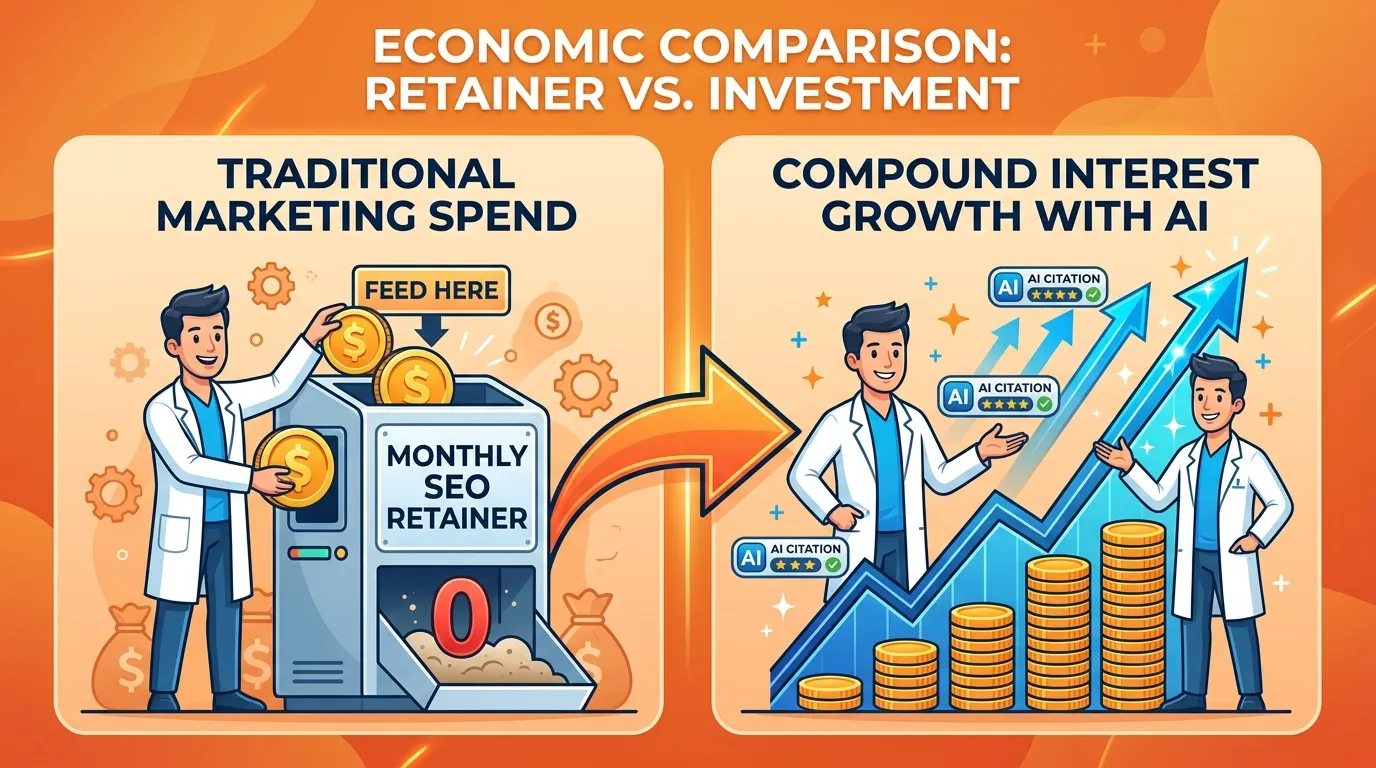
The Monthly SEO Retainer: A 24-Month Autopsy
I’ve had this conversation more times than I can count.
Doc walks in. Two years of monthly retainers. $500 a month. Nice-looking dashboard. Green reports. Rankings on keywords nobody’s searching anymore.
Zero patients from AI.
Twenty-four months. $12,000. Nothing compounding. Nothing owned.
Here’s the brutal part: traditional SEO optimizes for a list. AI search produces a verdict. Those aren’t variations of the same thing.
Gartner projects traditional search will lose 25% of its volume by 2026 as AI chatbots absorb those queries. That’s the channel the $500/month retainer is still optimizing for. And the day you stop paying, the rankings decay. Not eventually – immediately. Zero residual authority. Zero asset. Nothing left behind.
That’s what why the old SEO playbook is dying means in practice – not an argument, just what you own when the invoice clears. Which is nothing.
| Cost Factor | Monthly SEO Retainer (24 months) | AI Authority Engine |
|---|---|---|
| Total Investment | $12,000 | $15,000 |
| Builds AI Visibility | No | Yes |
| Patient Leak Addressed | No | Yes – 30-50% patient leak closed |
| Asset Value at Month 24 | $0 – stops when you stop paying | Compounding authority moat |
| AI Recommendations | None | Built for AI citation |
| Authority Compounds | No | Yes |
| What You Own After 24 Months | Nothing | Permanent infrastructure asset |
The $3,000 gap between those two numbers isn’t the story.
The story is what exists at month 25.
Billboard vs. Building: Only One Is Equity
Here’s the analogy I use every time.
A billboard rents you attention. You pay for the window. Visibility while you’re paying. Stop paying – ad comes down. Nothing left behind.
A building is equity. It appreciates. Generates value independent of whether you’re paying attention or not.
Traditional SEO is a billboard.
An AI Authority Engine is a building.
That’s not a line from a sales deck. That’s the actual economic structure of what you’re buying. Most docs don’t want to run the calculation on what renting their reputation actually costs over time. They should.
This Is Not for Everyone
I need to be direct about something before we go further.
Not everyone reading this should buy an AI Authority Engine. I mean that.
If Your First Question Is the Price, Stop Here
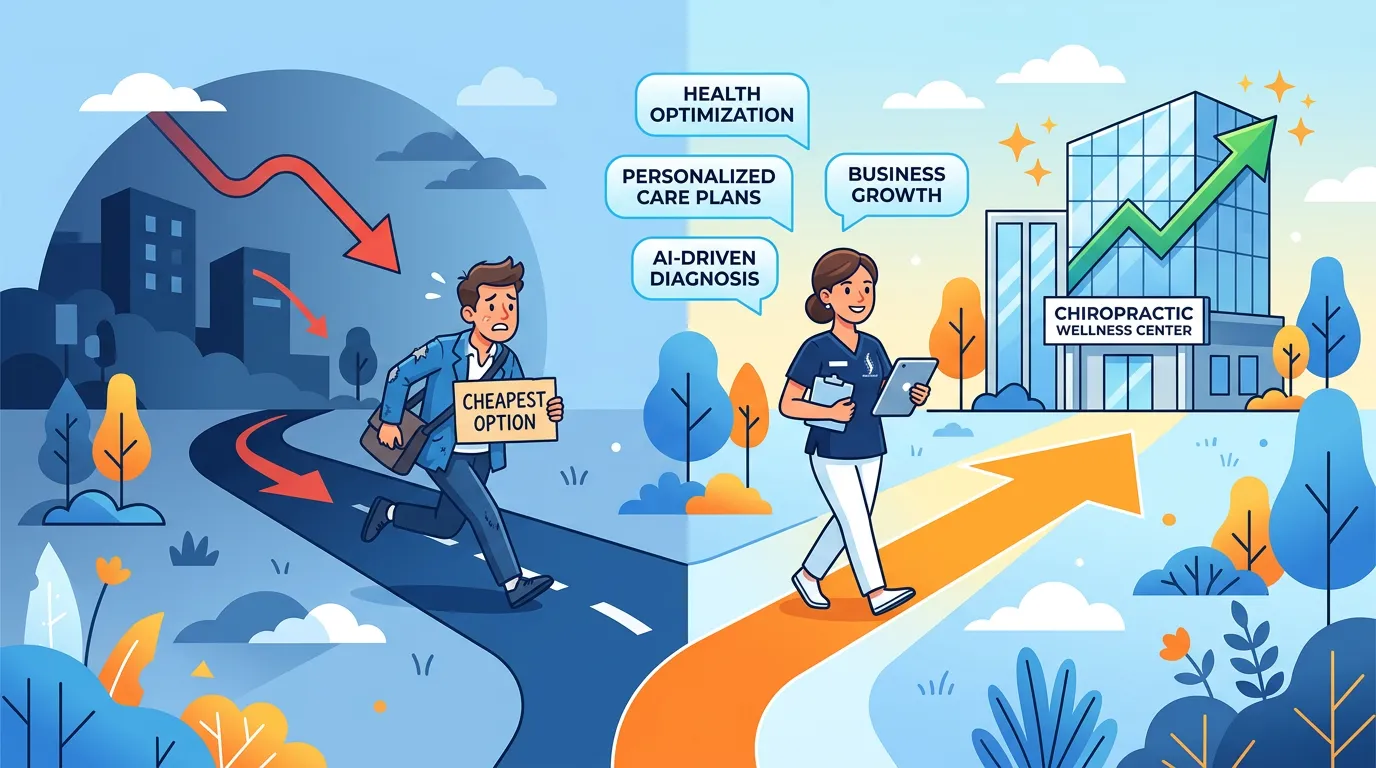
The Budget-First Buyer has one question.
“What’s the cheapest way to do this?”
Not: what actually works. Not: what does it cost to stay invisible. Just: cheapest.
If that’s where you are right now, this isn’t for you – and I say that genuinely, not as a tactic. Authority infrastructure is an ownership decision. You can’t comparison-shop your way into it.
The docs who get the most out of this have already burned through the cycle. They know what wrong looks like:
- Multiple agencies – each one promising something new, delivering the same green reports with an empty waiting room
- Years of retainers – money spent, nothing owned, no compounding asset to show for it
- The realization – that they’ve been renting attention on a channel that’s being replaced
They’re done with that. They want to own something that doesn’t reset every time they stop paying.
I tell every doc who reaches out: the $15,000 question is the wrong question. The right one is what the next three years of AI-first patient discovery looks like if you’re in it – and if you’re not.
But Can’t I Just Wait for AI Marketing to Get Cheaper?
This comes up in almost every conversation.
Here’s what I know.
AI authority trust isn’t like keyword rankings where a new tool can close the gap overnight. It’s accumulated, cross-verified signals. What your competitor builds this month is there next month. And the month after.
Every month you wait, the gap costs more to close.
According to BrightEdge, AI search visits are growing at double-digit monthly rates. The window isn’t closed. But it’s narrowing every month while you’re thinking about it. The doc who builds first is exponentially harder to displace in year two than in month one.
That math runs in your favor or against you. There is no neutral position.
If you’re still working out whether now is the right time, what an AI Authority Engine actually is – not a pitch, an infrastructure description – is where I’d send you before any other conversation.
AI Authority Engine vs. Digital Brochure: At a Glance
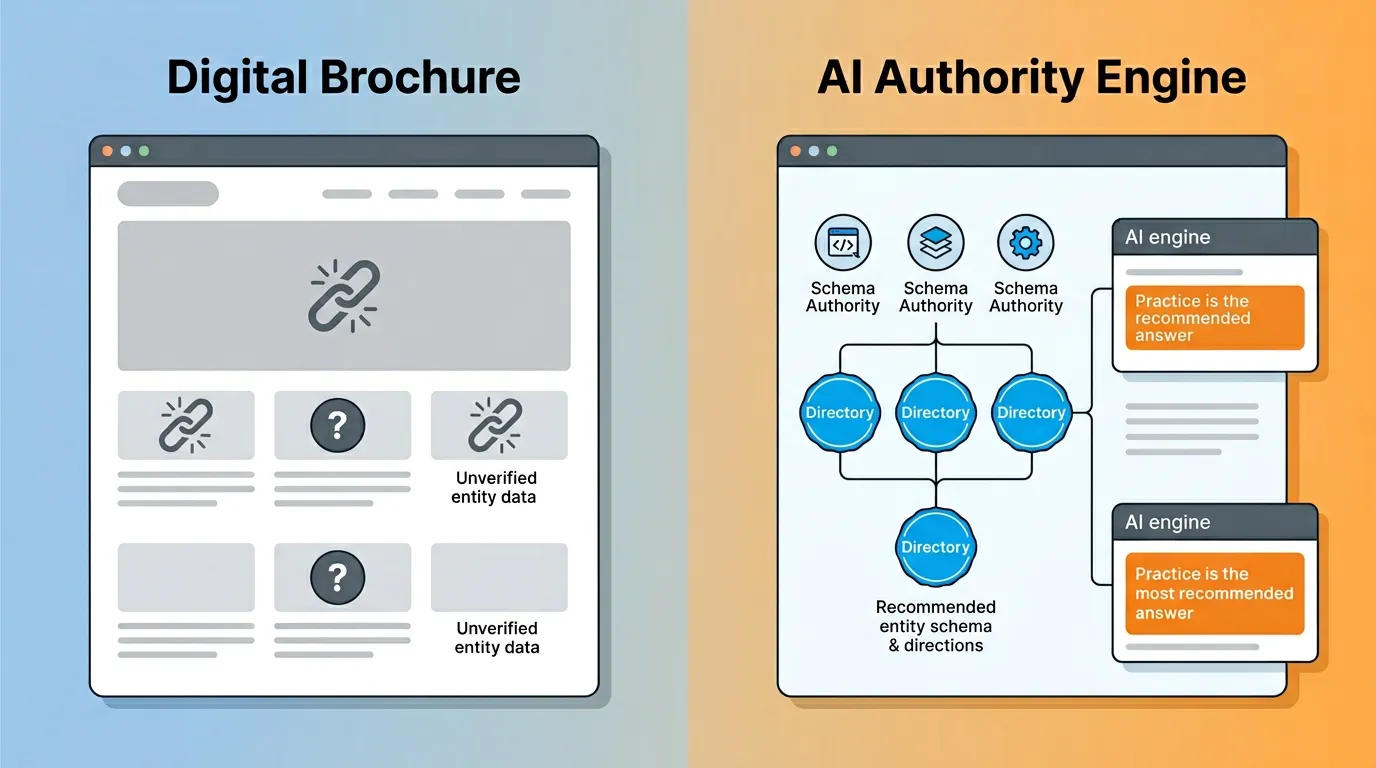
One table. The full architectural gap – side by side.
| Feature | Digital Brochure | AI Authority Engine |
|---|---|---|
| Schema Markup Depth | Basic or none | Custom, specialty-specific, credential-verified |
| Citation Network | Inconsistent across directories | Aligned across 15+ medical directories |
| AEO Content | Keyword-optimized blog posts | 12+ Authority Nodes built for AI citation |
| Entity Verification | Not achievable without proper infrastructure | Cross-verified across all major platforms |
| Patient AI Visibility | Invisible – fails machine-readability thresholds | Built to pass AI entity trust filters |
| Asset Value Over Time | Zero – no compounding | Compounding authority moat |
| What You Own | Nothing | Permanent infrastructure |
One of those structures gets you recommended. The other doesn’t exist to the machine making the call.
Frequently Asked Questions
Is the $15,000 price tag a one-time fee or a recurring expense?
The $15,000 is an authority infrastructure investment, not a monthly retainer.
The bulk of the cost covers the full-stack rebuild: technical entity hardening, citation network alignment, and the initial AEO content architecture.
The ongoing work deepens what’s already there. It doesn’t reset. That’s the difference between an asset and an expense.
Why can’t my current SEO agency just “add AI” to my $500/month plan?
Because AEO isn’t a feature you bolt onto traditional SEO. It’s a structural rebuild.
Traditional SEO is engineered for a list. AEO is engineered for the verdict – the single recommendation AI delivers inside a conversational response. Adding “AI” to a monthly retainer is like painting racing stripes on a bicycle and calling it a motorcycle. Same bike. Different outcome. That’s why why the old SEO playbook is dying isn’t a theory – it’s the explanation for why your waiting room is quieter than it should be.
What is the ROI of a $15,000 AI Authority Engine?
We measure ROI in new patient deposits and displaced competitors – not in rankings or traffic.
Authority infrastructure compounds over time.
We don’t promise specific numbers. Anyone selling you a guaranteed ROI figure on AI recommendations is selling something that doesn’t exist in a verifiable format. What I know from watching this build: the patients AI sends are different. They’ve already been told you’re the answer. They come in pre-sold. One relationship like that can cover a meaningful portion of this investment. Then it keeps compounding.
Does the $15,000 price include a new website design?
Usually, no.
We typically keep your existing design and replace the engine underneath it.
You’re paying for what the AI reads – not what patients see on the first scroll. Most practices already have a decent-looking site. That’s not the gap. The machine-readable architecture underneath it is.
What if I just wait for AI marketing prices to come down?
Waiting is the most expensive option on the table.
Every month a competitor builds citations, earns entity verification, and accumulates AEO content, they deepen the moat around their market position.
That moat doesn’t reset when you decide to move. You’re building from behind an opponent who’s had months – maybe years – of compounding head start. I’ve watched that math turn into a conversation nobody wants to have. Understanding how AI actually decides which chiropractor to recommend makes it real before it’s too late.
What’s the difference between an AI Authority Engine and a traditional chiropractic website?
A traditional chiropractic website is a digital brochure built for human readers. An AI Authority Engine is a structured, machine-readable authority system built for AI engines.
One gets you recommended. The other doesn’t exist to the machine making the call.
The gap isn’t design. It’s schema depth, consensus authority, and AEO content architecture. EEAT trust signals – consistent entity information and coherent branding – are the core filters AI applies to local providers. One of these structures passes. The other doesn’t.
How long does it take to see results from an AI Authority Engine?
We don’t promise timelines.
Anyone who gives you a specific guarantee on AI recommendation timing is selling you something that doesn’t exist in a reliable, trackable format.
Authority builds in layers. Each one compounds the one before it. This infrastructure is designed to last years – not sprint to a 90-day vanity metric and plateau. The 90-day expectation is the exact mindset that keeps docs cycling through agencies looking for a shortcut that doesn’t exist. Authority is not claimed. It is built.
AI Gives One Answer. Make Sure It’s You.
Here’s what I keep coming back to.
AI gives one answer.
Not a list. Not a shortlist. One. If that answer isn’t you, the patient never thought about you. The machine decided before they had a chance.
That gap widens every month you’re not in it.
I’ve watched this play out more times than I want to count. The doc who waits another six months, then another six, and one day realizes the competitor they’ve been watching has built a moat twice as expensive to close. That’s not a story I’m inventing. It’s a pattern.
The $15,000 isn’t a marketing expense. It’s the cost of owning the most valuable real estate in your market right now – the AI recommendation.
Run the other math. Twenty-four months. $500/month. $12,000. Nothing owned. Nothing compounding. And a competitor who just answered the patient that should have been yours.
You already know which story ends better.
Most practices that contact us are convinced their online presence is probably fine.
Most of them are wrong.
The free AI Visibility Check shows you the actual picture – where you stand across ChatGPT, Gemini, and Grok right now. Not a guess. Not a report from your current agency. The real gap.
Some practices are in better shape than they expected.
Most aren’t.
See where you actually stand before someone else in your market builds a moat you can’t afford to close.