
What AI Search Engines Actually Read
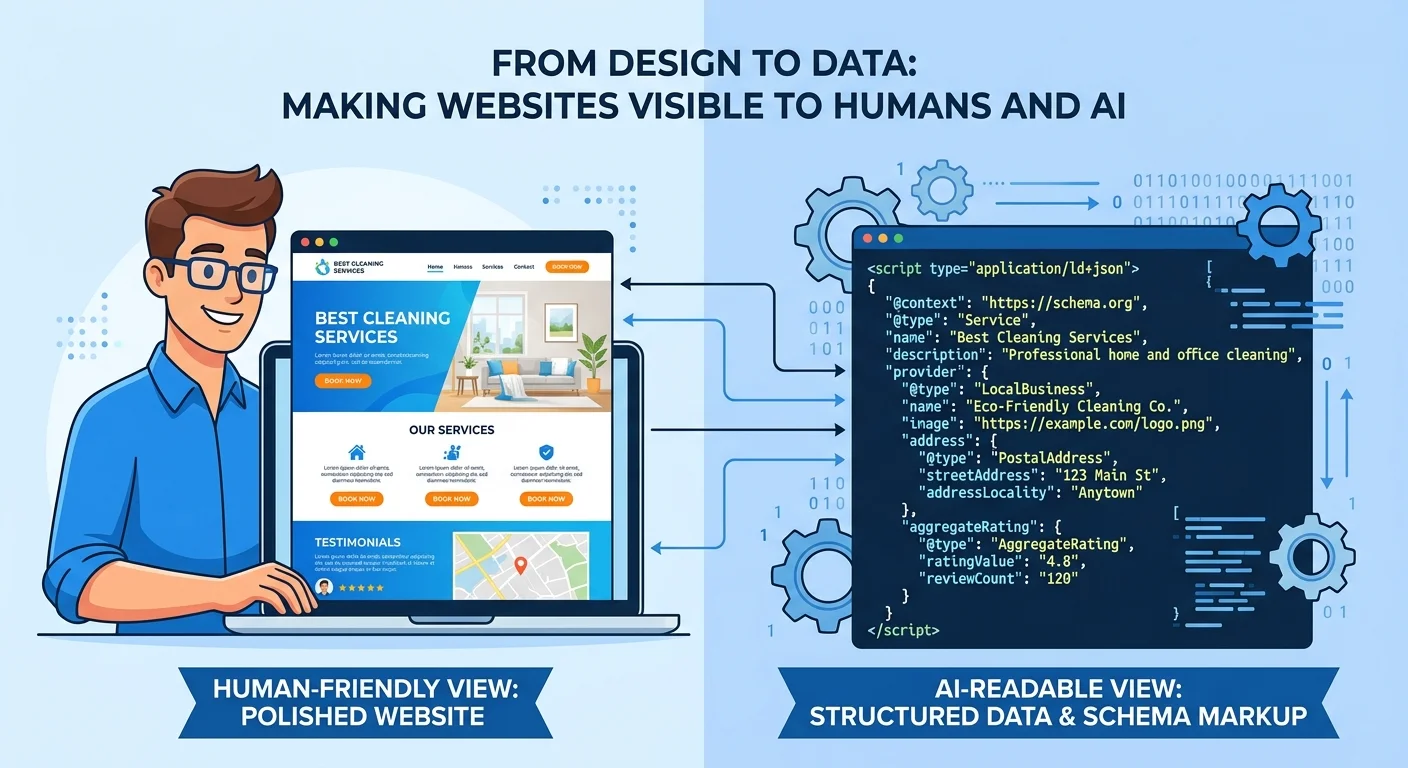
AI search engines don’t browse your site the way a human does. They don’t scroll. They don’t admire your typography. They parse code.
What they’re hunting for is structured data – the machine-readable layer that declares who you are, what you do, where you’re located, and how you connect to other entities in your industry. Google explicitly uses structured data found on the web to understand the content of a page and to enable special search result features.
Without that layer, your site is a visual artifact. Beautiful to look at. Impossible to interpret.
Most CMS templates don’t ship with this infrastructure built in. They give you drag-and-drop page builders, pre-styled sections, mobile responsiveness. All valuable for human visitors.
None of it helps an AI engine confirm that you’re the authoritative chiropractor in Orange County or the litigation firm in employment law.
That confirmation comes from structured data – JSON-LD markup that tells AI your business name, address, credentials, service categories, and how you relate to other trusted entities. Your template doesn’t include it. That’s the gap.
Here’s the thing: if AI can’t read the data, it won’t cite you. It’ll cite whoever bothered to make their authority machine-readable. That’s not a design problem. It’s an infrastructure problem.
How AI ‘Sees’ Content
When an AI engine evaluates your site, it’s scanning for entity signals. Not keywords. Not backlinks. Entities.
An entity is a concept AI can definitively identify and connect to other concepts – your business, your founder, your services, your location. If those entities aren’t declared in structured data, AI has to guess.
And when AI guesses, it defaults to whoever didn’t make it guess.
So a visually stunning homepage with zero entity markup reads as ambiguous. A plain-looking page with Schema.org’s vocabulary reads as authoritative.
AI doesn’t care about aesthetics. It cares about certainty. Can it confidently say who you are, what you do, and whether you’re credible?
If the answer is no, you’re invisible.
This is why two practices in the same city with identical service offerings get wildly different AI visibility. One invested in design. The other invested in entity infrastructure. AI recommends the latter.
What Structured Data Actually Does
Structured data is the semantic layer that translates your website into machine-readable instructions. Schema.org provides a shared vocabulary for structured data that major search engines rely on to understand content.
When you implement Schema markup correctly, you’re telling what Google’s systems understand exactly what each piece of content represents. You’re not forcing it to infer from context clues.
That specificity is what enables rich snippets, knowledge panels, and AI citations. It’s also what separates Authority Infrastructure from a standard website.
A website displays information for humans. Authority Infrastructure declares that information for machines. Same content. Entirely different delivery mechanism.
And because Schema is a collaborative effort supported by Google, Microsoft, Yahoo, and Yandex, implementing it correctly doesn’t just optimize for one AI engine. It optimizes for all of them. That’s the compounding advantage most CMS templates don’t deliver.
| What Humans See | What AI Reads | Result for AI Visibility |
|---|---|---|
| Homepage hero image with professional headshot and branded color palette | No structured data declaring business entity, credentials, or service categories | AI cannot confirm identity or authority-site is visually impressive but semantically invisible |
| Services page listing treatment options in clean, readable paragraphs | No Schema markup defining each service as a distinct entity with relationships to the business | AI sees text but cannot parse which services you actually offer or how they connect to your expertise |
| About page with founder biography and practice history | No Person schema linking founder credentials, education, or professional affiliations to the business entity | AI cannot validate founder authority or connect their expertise to the practice’s credibility |
| Contact page with address, phone number, and embedded Google Map | No LocalBusiness schema declaring NAP data, service area, or geographic entity relationships | AI cannot reliably cite your location or recommend you for local queries |
| Blog post with 2,000 words of well-written content on a relevant topic | No Article schema, no author entity markup, no topical entity connections to core service offerings | AI reads the text as generic content-cannot attribute it to your authority or use it as proof of expertise |
| Testimonials page with client quotes and star ratings | No Review schema aggregating ratings or linking reviews to the business entity | AI cannot parse social proof or factor reputation signals into trust calculations |
Why CMS Templates Fail the AI Test
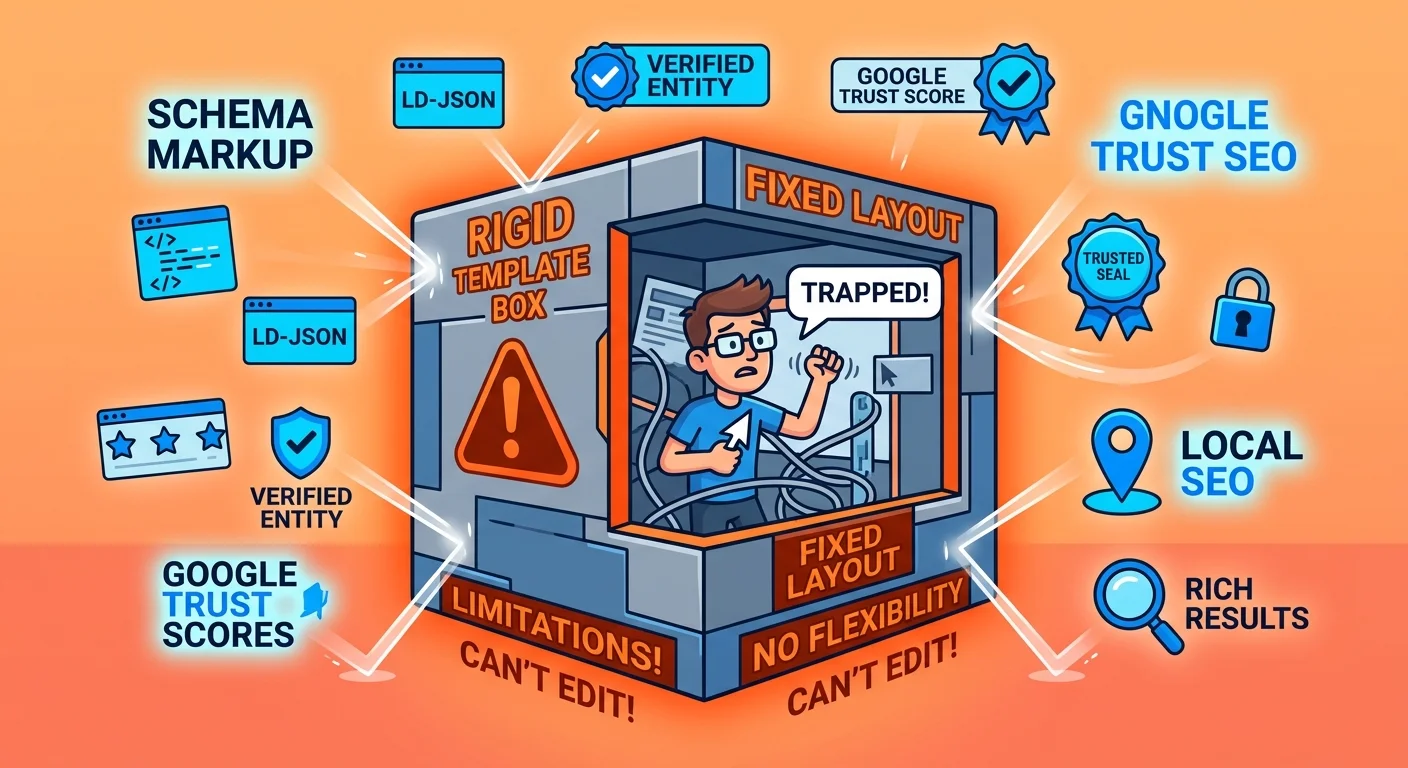
Now that we know what AI reads and how it interprets structured signals, the failure mode of template-based sites becomes obvious.
They optimize for the wrong audience entirely.
A Content Management System uses templates to control the look and feel of a site. Templates handle design – not the semantic markup AI needs to understand what you do.
That’s the invisible brochure metaphor in action.
Your expensive website is a beautifully designed brochure sitting in a locked filing cabinet that AI can’t open.
Design for human eyes and data structure for machine interpretation are entirely different construction projects.
The Template Trap
Templates handle the aesthetics. Fonts, layouts, sliders, parallax effects, visual polish.
But they don’t handle the semantic markup AI needs to understand your authority. They weren’t designed to.
The trap is believing that a premium template solves the visibility problem.
It doesn’t.
What’s Missing in WordPress, Squarespace, and Wix
Here’s what the major platforms miss.
WordPress, Squarespace, and Wix ship with basic structured data – enough to tell Google you’re a business with an address.
That’s not enough.
AI engines need entity-based SEO – optimization around topics and concepts that helps search engines understand the relationships between your services, your outcomes, and your authority.
JSON-LD is used by 39.5% of websites whose structured data format is known.
Most of those implementations are shallow – a LocalBusiness schema block with a name, phone number, and hours.
That gives AI a business card.
It doesn’t give AI authority signals, topical depth, or entity trust.
The Difference Between Decoration and Infrastructure
Decoration is what you see.
Infrastructure is what AI reads.
A decorated site has custom fonts, branded colors, high-res images, smooth animations.
An infrastructure-built site has schema markup connecting every service to its outcomes, every claim to its evidence, every page to its semantic neighbors.
One looks good in a screenshot.
The other becomes the answer AI cites.
| CMS Platform | Out-of-Box Schema Support | Entity Markup Depth | AI-Readiness |
|---|---|---|---|
| WordPress | Plugin-dependent (Yoast, Rank Math) | Basic LocalBusiness, FAQ if configured | Low – requires manual entity architecture |
| Squarespace | Minimal auto-generated markup | Contact info, logo only | Low – no entity relationship support |
| Wix | Basic structured data via apps | Generic business schema | Low – shallow entity declarations |
| Shopify | Product-focused Schema via apps | E-commerce entities, limited service markup | Low – product-centric, not authority-centric |
| Custom-Built Sites | Developer-dependent | Varies wildly based on implementation | Variable – can be high if entity SEO is prioritized |
What Authority Infrastructure Actually Is
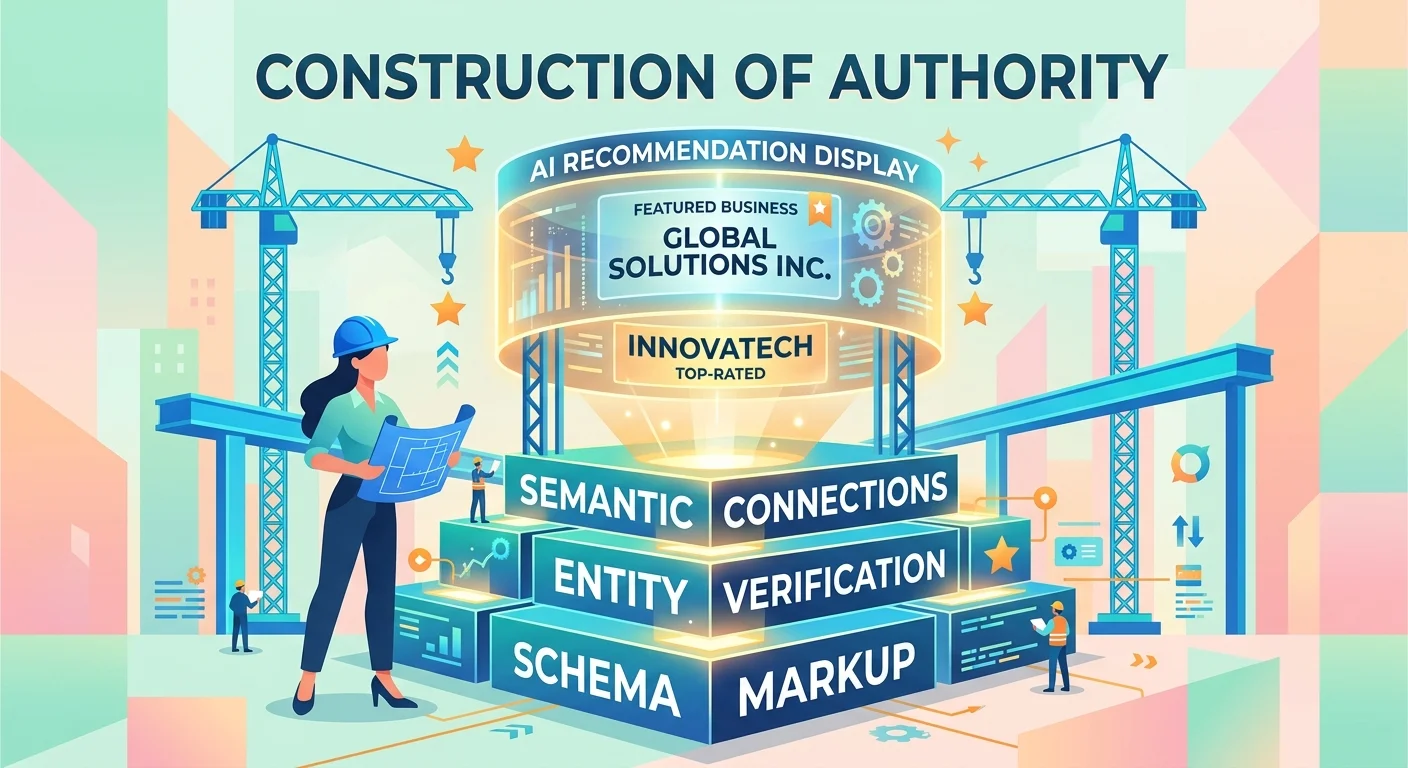
Authority Infrastructure is a machine-readable digital asset engineered to become the answer AI engines cite.
Not a website dressed up with a few schema plugins.
Not a template with better SEO settings.
A purpose-built entity architecture where every page, every content piece, and every structural element declares what it represents in a language AI systems can parse with zero ambiguity. Structured data isn’t decoration. It’s the foundation.
The construction logic flips the template model entirely.
Instead of starting with design and bolting on data structure later, Authority Infrastructure starts with entity relationships as the primary design constraint. Schema markup isn’t an afterthought-it’s the blueprint.
The business identity, service taxonomy, founder credentials, content authority signals, and external validators are all declared in structured data before a single pixel gets placed.
Design wraps around the infrastructure. AI reads certainty. Humans see polish.
This is what unlocks the filing cabinet.
Your content isn’t trapped behind a beautiful interface AI can’t interpret. It’s declared at the entity level, semantically connected to every relevant concept in your market, and structured so that when an AI engine evaluates authority, your business reads as the definitive source.
That’s not decoration. That’s infrastructure.
Entity Trust as the Foundation
Entity Trust is what AI engines measure when they decide whether to cite you.
It’s not your domain age, backlink count, or keyword density.
It’s the machine-readable proof that your business is a legitimate, credible, authoritative entity in your field. AI builds that trust by connecting your entity to other verified entities–professional credentials, institutional affiliations, geographic markers, service categories, and the content you publish that demonstrates depth.
Building Entity Trust requires declaring those connections explicitly in structured data.
Who founded the business. Where they trained. What credentials they hold. What services the business offers. What problems those services solve. What geographic area the business serves.
Every one of those declarations is a signal.
The more signals you provide, the more confident AI becomes that you’re authoritative. The fewer signals you provide, the more AI treats you as ambiguous-and ambiguous entities don’t get cited.
This is where entity-based SEO diverges from traditional keyword optimization.
Entity SEO is the practice of building authority around topics and concepts AI can recognize-not chasing search volume. You’re building a semantic identity that AI engines can map to user intent.
When someone asks an AI engine for the best option in your category, Entity Trust is what determines whether your name appears in the answer.
Templates don’t build Entity Trust because they don’t architect entity relationships.
They mark up surface-level contact info.
Authority Infrastructure builds the full entity graph-declaring not just who you are, but how your expertise connects to every adjacent concept a prospective client asks about. That depth is the foundation.
Semantic Connectivity and Depth
Semantic connectivity is how AI understands that your business isn’t just another name in the directory-it’s the authoritative hub for a specific set of interconnected topics.
When you publish content that defines those topics, links them to your services, ties them back to your founder’s expertise, and references external validators, you’re building a semantic entity hub that AI engines can traverse.
Every piece of content becomes a node in the network. Every internal link reinforces a relationship. Every external citation adds validation.
The denser the network, the more authoritative the hub.
Sparse connectivity-a homepage, a services page, and a contact form-gives AI almost nothing to work with.
Deep connectivity-dozens of content pieces addressing every angle of your market, all semantically linked, all declaring their entity relationships in structured data-gives AI a complete map of your authority. That map is what gets cited.
Templates can’t build semantic depth because they’re not designed to.
They’re designed to launch fast and look professional.
Authority Infrastructure is designed to compound. Every new content piece adds semantic density. Every schema implementation strengthens entity signals.
Over time, the infrastructure becomes exponentially more citable. That’s the competitive moat decoration can’t replicate.
| Infrastructure Layer | What It Does | Why AI Needs It |
|---|---|---|
| Entity Schema Layer | Declares your business identity, service taxonomy, founder credentials, and geographic scope in JSON-LD markup that major search engines parse to build your entity profile | AI engines can’t infer authority from visual design or persuasive copy-they need explicit declarations of who you are, what you do, and where your expertise comes from |
| Semantic Content Network | A library of interconnected content pieces that define every concept in your market, linked semantically to demonstrate depth and topical coverage across your entire service area | AI measures authority by semantic density-sparse content signals limited expertise, while deep topical coverage signals you’re the definitive source |
| Entity Relationship Graph | Structured connections between your business entity, external validators, professional credentials, institutional affiliations, and the content authority you’ve built over time | AI builds trust by verifying entity relationships-your business must connect to other verified entities that confirm your legitimacy and expertise |
| Citation Architecture | Internal linking structure that reinforces semantic relationships between your services, content, and authority signals, creating traversable pathways AI engines follow to understand scope | AI engines navigate your site by following structured links-broken or shallow link architecture leaves your authority fragmented and uncitable |
| Machine-Readable Proof | Every page carries structured data that declares its purpose, topic, author credentials, publish date, and relationship to your core entity-leaving zero ambiguity for AI interpretation | AI doesn’t guess or infer meaning from context clues-it reads explicit declarations, and ambiguous pages get skipped in favor of competitors who declared their authority clearly |
Why AI Recommends One Answer Over Another
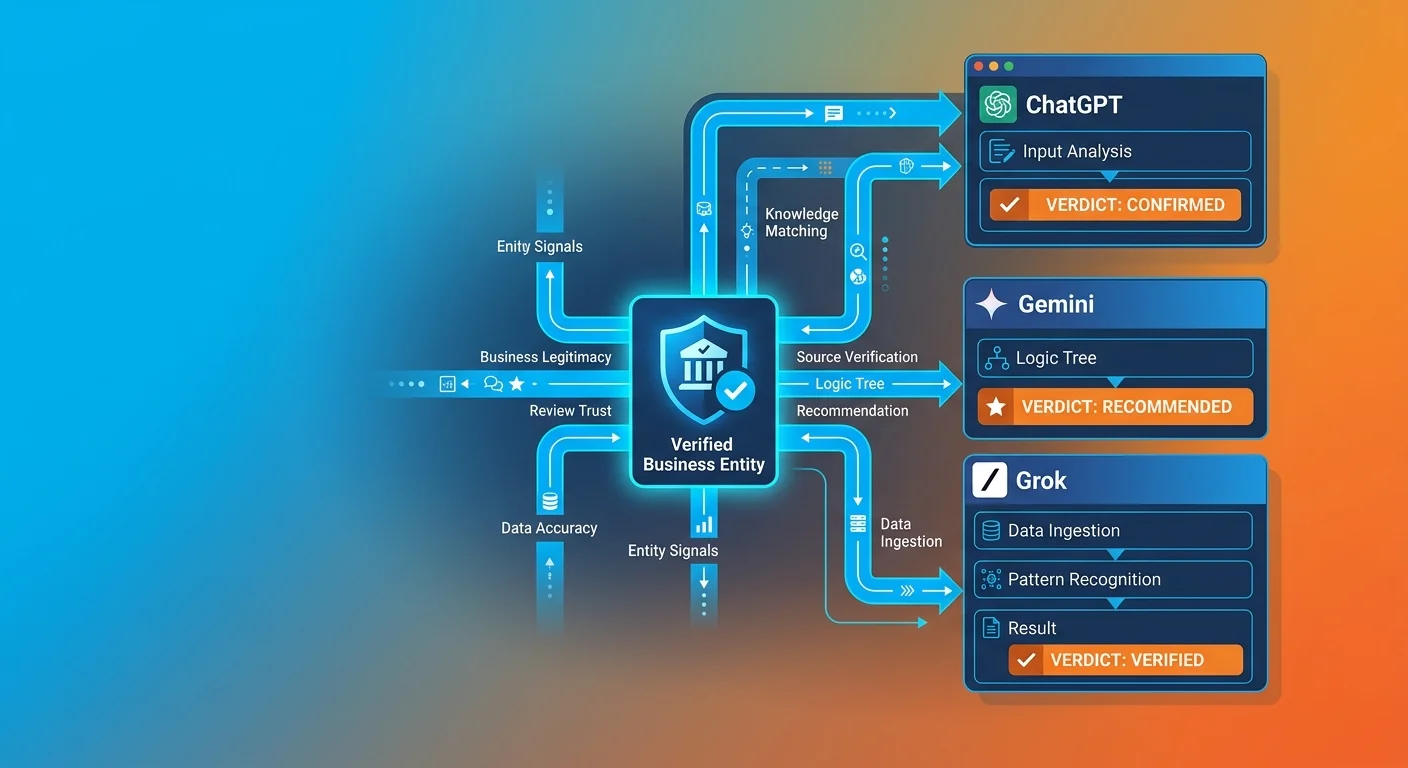
AI doesn’t flip a coin when it decides which business to recommend.
It evaluates entity signals – the structured data that declares who you are, the semantic relationships that prove you know your field, and the content that shows you’re not faking it. The more complete your entity architecture, the more confident AI becomes.
The less complete it is, the more you disappear into the pile of generic businesses AI can’t tell apart.
Here’s where Search Generative Experience (SGE) changed the math. AI-powered search provides direct, conversational answers. No list of links. No ten blue options. A single verdict.
You’re not competing for position three on page one anymore. You’re competing to be the only name AI says.
That’s a different construction problem.
Templates can’t win that competition because they don’t speak the language AI uses to measure authority. They speak HTML and CSS. AI speaks entities, relationships, and structured data.
So the AI engine moves past your site and cites whoever built the infrastructure it can actually read.
That’s not a design failure. It’s an architecture gap.
How Search Generative Experience (SGE) Works
SGE doesn’t browse your site the way a human does. It doesn’t scroll. It doesn’t read your about page. It doesn’t care about your color palette.
It parses structured data to determine what your site represents at the entity level. Then it counts how many authoritative signals back that up.
Then it decides whether you’re worth citing.
Google explicitly uses structured data found on the web to understand the content of a page. That structured data is the input layer for the generative snapshot SGE produces.
If your entity signals are weak – generic schema, thin content, no semantic depth – SGE has nothing to work with. It can’t confidently name you as the answer because it can’t confidently tell what you’re an authority in.
So SGE defaults to whoever gave it clear, unambiguous, deeply structured entity data. The business that declared their identity in machine-readable terms. The one that published content proving topical authority and built semantic relationships across every relevant concept in their market.
That business becomes the snapshot.
Everyone else becomes invisible – not because their content is bad, but because AI can’t parse it with confidence.
What Makes an Entity ‘Trustworthy’ to AI
Entity Trust isn’t subjective. AI doesn’t feel like you’re authoritative.
It measures whether you’ve declared the structural proof of authority in a format it can verify. That proof includes your founder’s credentials, your service taxonomy, your geographic footprint, your content depth, and the external entities that validate your expertise.
Entity SEO helps search engines understand the relationships between different concepts on your site. Those relationships are what AI engines traverse when they evaluate whether you’re a hub or a dead end.
A hub has dozens of semantically connected content pieces. Every one declares its entity relationships in structured data. A dead end has a homepage and a contact form.
AI cites hubs. It skips dead ends.
But here’s the thing. Most businesses don’t know what signals they’re missing until they run an Authority Infrastructure Audit.
The audit exposes every gap in your entity architecture – missing schema, ambiguous identity markers, sparse semantic connectivity, weak content authority signals. It’s the diagnostic that tells you exactly why AI isn’t naming you.
Not your competitor. You.
Once you see the gaps, you can fix them.
That’s the difference between guessing why you’re invisible and engineering the infrastructure that makes you citable. Templates guess. Authority Infrastructure engineers.
Frequently Asked Questions
Quick pause. Let’s tackle the objections that come up every time a business owner hears this distinction for the first time.
These aren’t hypotheticals. They’re the exact friction points that surface when you realize your CMS template was never built to be machine-readable – and that the money you spent on design doesn’t translate to what AI engines need before they’ll cite you.
What is the actual difference between a website and an Authority Infrastructure?
A website is a digital brochure designed for human eyes. Authority Infrastructure is a machine-readable data asset designed for AI evaluation.
The website shows your services. Tells your story. Displays your credentials.
Authority Infrastructure declares those same facts in structured data AI can parse, maps semantic relationships between your expertise and every adjacent concept in your market, and builds entity signals that prove you’re the authoritative hub.
One is decoration. The other is engineering.
AI engines cite infrastructure. They scroll past brochures.
Why can’t AI search engines ‘see’ my expensive WordPress or Squarespace template?
Because your template was built to render pixels, not declare entities.
WordPress and Squarespace optimize for visual appeal and ease of setup. They don’t architect the structured data layer AI uses to measure authority.
The template might have generic schema for your business name and address. That’s it.
It doesn’t declare your founder’s credentials, your service taxonomy, your content authority signals, or the semantic relationships that prove topical depth.
AI can’t see design. It reads data structure.
Your expensive template didn’t build that structure.
How does structured data (Schema) make my business visible to AI?
Schema is the vocabulary AI uses to understand what your content represents at the entity level.
Google explicitly uses structured data to understand the content of a page and enable special search result features. When you implement Schema, you’re translating your business identity from human-readable prose into machine-readable entity declarations.
You’re telling AI this page represents a MedicalBusiness entity with a Physician founder who has these credentials, offers these services, and publishes authoritative content on these topics.
Without Schema, AI sees unstructured HTML.
With Schema, AI sees an entity it can evaluate, map, and cite.
Is my old blog content useless for AI answer engines?
Not if it addresses real user intent and demonstrates expertise.
But most old blog content is keyword-stuffed commodity writing with no semantic connectivity, no entity relationships, and no structured data.
AI engines don’t reward content volume. They reward topical authority and semantic depth.
If your old posts are orphaned pages with no internal linking strategy, no entity schema, and no connection to your service taxonomy, they’re not contributing to your authority architecture.
But if you retrofit them with proper schema, connect them semantically to your hub, and ensure they answer real questions in depth, they become assets.
The content itself isn’t the problem. The architecture around it is.
If my website looks professional, why isn’t it being recommended by AI?
Because professional appearance and machine-readability are completely different construction projects.
AI doesn’t evaluate typography, color palettes, or responsive breakpoints. It evaluates entity signals, semantic relationships, and structured proof of authority.
Your site looks professional to humans.
To AI, it’s a locked filing cabinet with no index.
The design quality doesn’t compensate for missing entity architecture. AI-powered search provides direct, conversational answers, fundamentally changing the user’s interaction from a list of links to a single verdict.
That verdict is based on which business gave AI the clearest, deepest entity data.
Design doesn’t factor into that calculation.
Will fixing my website’s structure guarantee I become the AI’s #1 answer?
No.
Authority Infrastructure is the foundation, not the finish line.
Fixing your structure makes you citable – it gives AI the entity signals and semantic depth it needs to evaluate your authority with confidence. But becoming the #1 answer also depends on competitive density, content depth, external validation, and time.
If your market has ten competitors with strong entity architecture, you’re not automatically #1 the moment yours goes live. You’re competing on depth, consistency, and citation velocity.
Here’s what I’ll say – without the infrastructure, you have zero chance of becoming the answer.
With it, you’re in the race.
The gap between invisible and citable is the biggest gap. The gap between citable and #1 is execution.
The Filing Cabinet Is Still Locked
Your expensive website is still sitting in a locked filing cabinet.
AI can’t open it.
The design is immaculate. Clean layout. Professional photography. Flawless responsive breakpoints.
None of that matters if the machine can’t read the data structure underneath.
The filing cabinet doesn’t care how good the brochure looks. It only cares whether the drawer is labeled, indexed, and accessible.
Your CMS template didn’t build those labels. It built the brochure.
Every day your infrastructure stays invisible to AI is a day a competitor’s name gets recommended instead of yours. And that gap compounds. It doesn’t plateau.
The business that built machine-readable entity architecture six months ago is being cited as the authoritative answer right now. Their semantic density is deeper. Their Entity Trust signals are stronger. Their content network is more connected.
AI engines favor them because they gave AI what it needed to measure authority.
You gave AI a locked drawer.
The longer you wait, the wider that gap becomes. Authority Infrastructure isn’t a switch you flip. It’s a foundation you build and a network you deepen over time.
The competitor who started early is compounding.
You’re still optimizing a brochure for human eyes while the machine evaluates entities you never declared.
iTech Valet doesn’t build websites. We build Authority Infrastructure-an AI Authority Engine designed specifically to become the trusted, citable answer.
Not a template that looks professional. Not a brochure that wins design awards.
A machine-readable digital asset that AI engines can parse, evaluate, and cite with confidence.
The filing cabinet unlocks when you stop decorating the brochure and start architecting the data structure AI uses to measure authority.
You can keep investing in a CMS template that AI will never read. Or you can build the infrastructure that makes your business the answer AI gives.
One is decoration. The other is engineering.
The choice is yours. But the AI engines have already made theirs.
Want to know if your business is sitting in that locked filing cabinet right now? Run the AI Visibility Check. It takes fifteen minutes and shows you exactly what ChatGPT, Gemini, and Grok say when someone asks who to trust in your market. If the results don’t make the problem self-evident, walk away. But if they do, you’ll know exactly what to do next.