
Why Most Content Still Gets Built Like It's 2015

Most businesses still grade their content by word count and how often they hit publish. That's a leftover from an older era of search, back when more pages and more keyword-targeted articles reliably meant more site visits.
But that whole volume-and-keywords playbook is fundamentally out of step with how modern AI-driven answer engines actually work. Answer engines don't read a website the way a person skims a blog feed.
They parse structure, pull out entities, and decide whether a page is even worth citing. A pile of loosely related articles gives them nothing solid to stand on.
So the real question isn't whether a business publishes enough. It's whether that content was engineered to be found, understood, and reused by a machine — a distinction what standalone AEO content boundaries mean for local businesses digs into in depth.
The Word Count Trap
Here's the thing: word count was never a real measure of visibility, even under the old rules. It just felt like one, because more pages meant more shots at showing up.
The actual numbers tell a different story. Among the pages sitting in Ahrefs' research index, 96.55% get zero site visits from Google, and another 1.94% get somewhere between one and ten monthly visits.
That means the vast majority of published content, no matter how long, never gets seen. Cranking out more of the same commodity content package doesn't fix a structural problem — it just buries the business under more unread pages.
What Actually Changed: Entities Replaced Keywords
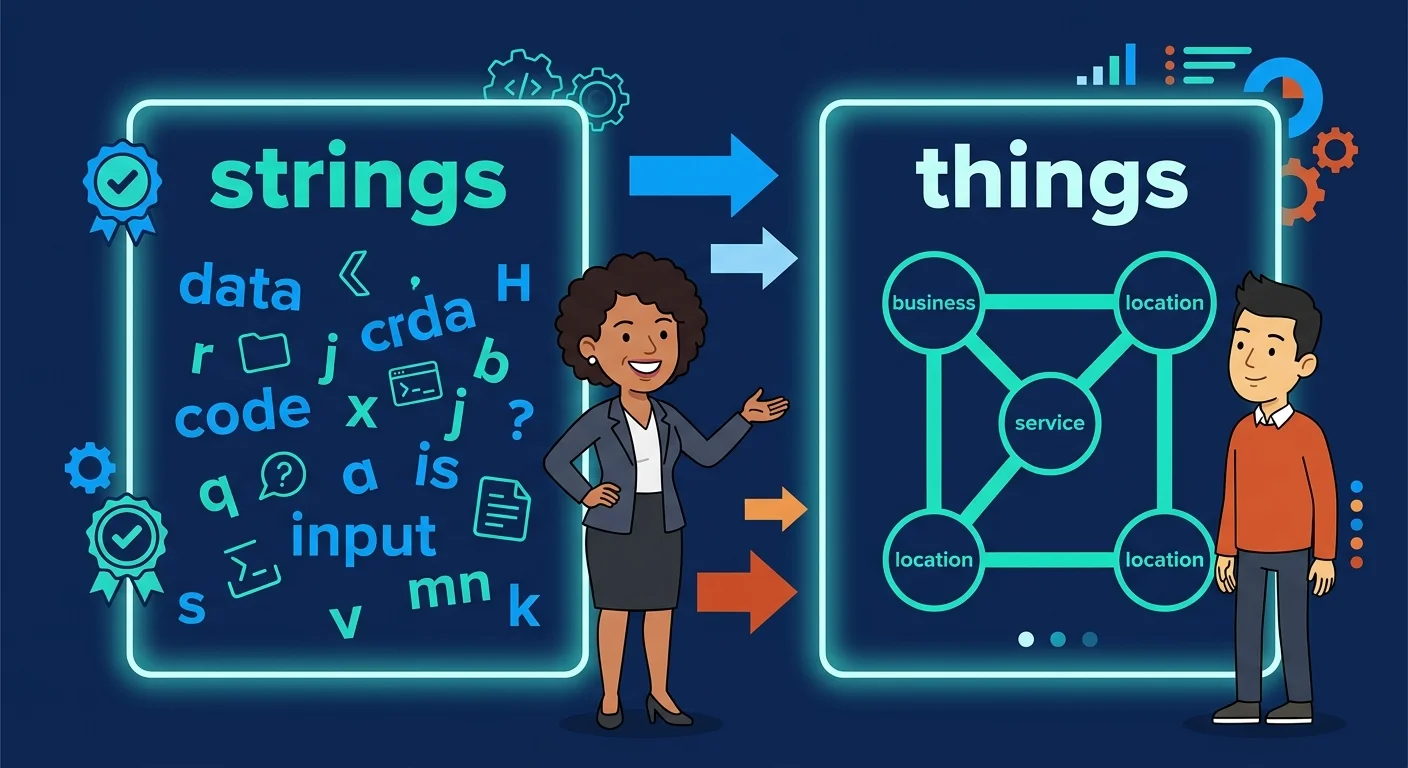
So what actually changed? Search systems used to match strings of text against a query, and the page that repeated the right phrase most often won.
That model is dead. Modern ranking and answer-generation systems identify entities — defined things, with defined attributes and defined relationships to other things — instead of matching keyword strings.
A commodity content package was built for the old model. It was never built to define an entity clearly enough for a machine to pull it out, which is exactly the gap a structured audit exposes — a process explained further in auditing how standalone content performs inside conversational search.
| Old Model | New Model | What It Means for Content |
|---|---|---|
| Keyword string matching, where a page is scored on how often it repeats a target phrase | Entity recognition, where a page is scored on whether it clearly defines a thing and its relationships to other things | A page must name what it is about in structural terms, not just in repeated phrasing, or a machine has nothing to extract |
| Trust inferred loosely from backlinks and domain age, with little regard for how the content itself was structured | Trust signaled through structured data, explicit entity definitions, and topical boundaries a machine can verify directly | Structured markup becomes a trust signal in its own right, not a technical afterthought layered on after publication |
| Content treated as a unit of volume, judged by word count and publishing frequency | Content treated as a data asset, judged by whether an answer engine can parse, trust, and cite it independently | Publishing more commodity content package output does not fix the underlying problem of unclear machine-readable structure |
| Pages competing for placement in the classic ten blue links through keyword-targeted articles | Pages competing for direct citation inside an AI-generated answer through content engineering | A business must design for extraction and reuse, not for matching a query string against a page |
From Strings to Things
Traditional search optimization treated a page as a string of words to match against a query. Structured semantic content engineering treats it as a description of a thing — a service, a condition, a process — with a name, a category, and a set of relationships to other named things.
That's why schema markup, entity definitions, and topical boundaries now carry more weight than keyword density ever did. A machine can't cite a string. It can only cite a thing it has correctly identified.
Why Trust Now Outweighs Keyword Density
Trust decides what gets cited. Google's automated ranking systems weigh a mix of signals tied to experience, expertise, authoritativeness, and trustworthiness — and among those, Google's documentation states trust is the most important.
That one fact reorders the whole content strategy. Keyword density never measured trust. It measured repetition, and repetition isn't credibility.
So the discipline that wins here isn't writing more. It's content engineering — structuring content not just for human readers but for machine comprehension and reuse, so the trust signals are legible to the system deciding what to cite.
How Answer Engines Actually Choose What to Cite
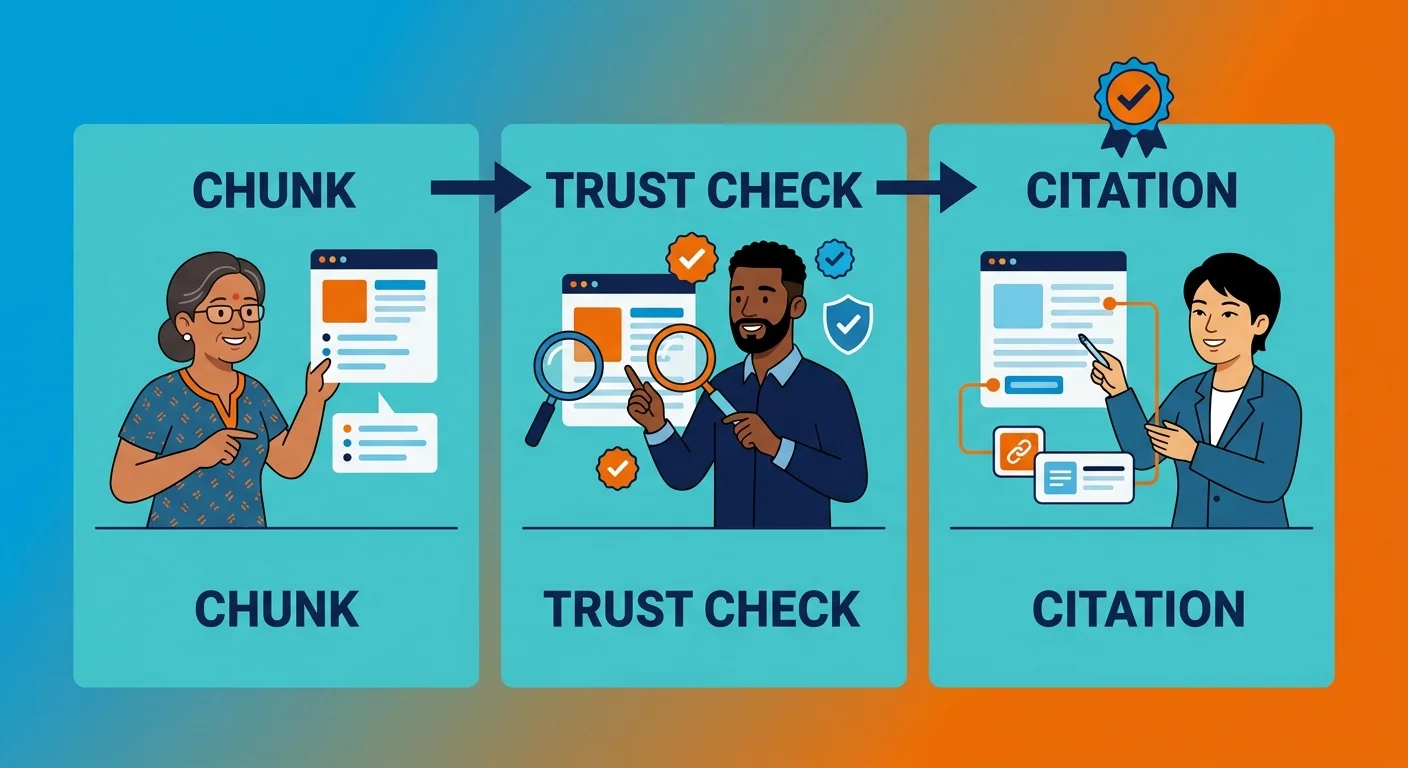
An answer engine doesn't read a page top to bottom the way you do. It chops the page into smaller pieces, sizes up each one for meaning, and decides on its own whether that piece is worth surfacing.
That process has a name: chunking. A structured page with clear entity boundaries produces clean chunks, while a loose commodity content package produces fragments that point at each other and stand for nothing on their own.
So the real question isn't whether an article is well written. It's whether each section can get yanked out of context and still make a complete, citable claim.
| Factor | Traditional Search Results | AI-Generated Answers |
|---|---|---|
| Source Material | Consulted for keyword strings that match a query, favoring pages with repeated target phrases | Consulted for source domains and typology, weighing where information comes from as heavily as what it says |
| Query Intent | Matched against a static page ranking, with limited regard for the specific phrasing of a question | Interpreted directly, with the engine reconstructing intent before deciding which chunk actually answers it |
| Content Freshness | Rewards a page that ranks well over time, regardless of how recently it was verified or updated | Weighs freshness as a distinct factor, favoring content that reflects current, verifiable information |
| Unit of Evaluation | Evaluates a full page as a single ranking unit tied to a URL | Evaluates individual chunks independently, citing a section without needing the whole page for context |
| What Gets Rewarded | Rewards volume and keyword-targeted articles that repeat a target phrase across many pages | Rewards structured, entity-defined content that can be trusted and extracted as a standalone claim |
Chunking, Trust Signals, and the Citation Decision
Chunking rewards precision. A paragraph that names a thing, defines it, and states a fact about it becomes a self-contained unit an answer engine can lift without needing the rest of the page.
Now, a paragraph written for narrative flow, the kind you find all over a keyword-targeted article, fights that extraction. Its meaning leans on the sentence before it and the sentence after it, which is exactly what a retrieval system can't carry forward.
Once a chunk is pulled, trust decides whether it gets cited or tossed. That's the mechanical link between the entity work in why structured entity boundaries outperform word count and the citation call an answer engine makes the moment a query lands.
Why AI Answers Pull From Different Sources Than Search Results
Here's the thing: an AI-generated answer isn't just a summary of the same pages that would rank in a classic search results page. The two systems pull from different material entirely.
Research comparing the two, documented in the arXiv preprint server, found that AI-generated answers and web search results diverge significantly in their consulted source domains, the typology of those domains, query intent, and the freshness of the information. So a business optimizing for Google Search and leading generative AI services as if they were one audience is already building for half the system.
This Isn't For Everyone: Who Should Stick With Commodity Packages

Let's be honest: this isn't for everyone. Not every business is ready to walk away from a commodity content package, and pretending otherwise would be dishonest.
So let's be blunt about who this actually fits. A business that's never published a single article, has no defined services, and can't yet say what makes its offering different has bigger gaps than schema markup can close.
That business needs foundational clarity first. Structured semantic content engineering assumes there's something worth structuring — a defined entity, a real claim, a service you can describe precisely enough for a machine to trust it.
The Behavior That Signals a Mismatch
Here's the behavior that signals a mismatch. A business chasing volume for its own sake, treating a stack of published pages as proof of effort instead of a strategic, engineered asset, will find a commodity content package feels plenty — right up until the site visit numbers say otherwise.
But if a business already senses its content isn't converting into cited answers, that instinct is worth following. Confirming it usually starts with an audit, and one useful reference point is how schema inconsistencies quietly undermine clinic content credibility inside a package that was never engineered to carry structured claims in the first place.
Building the Machine-Readable Layer: Schema, Structure, and Entity Definitions
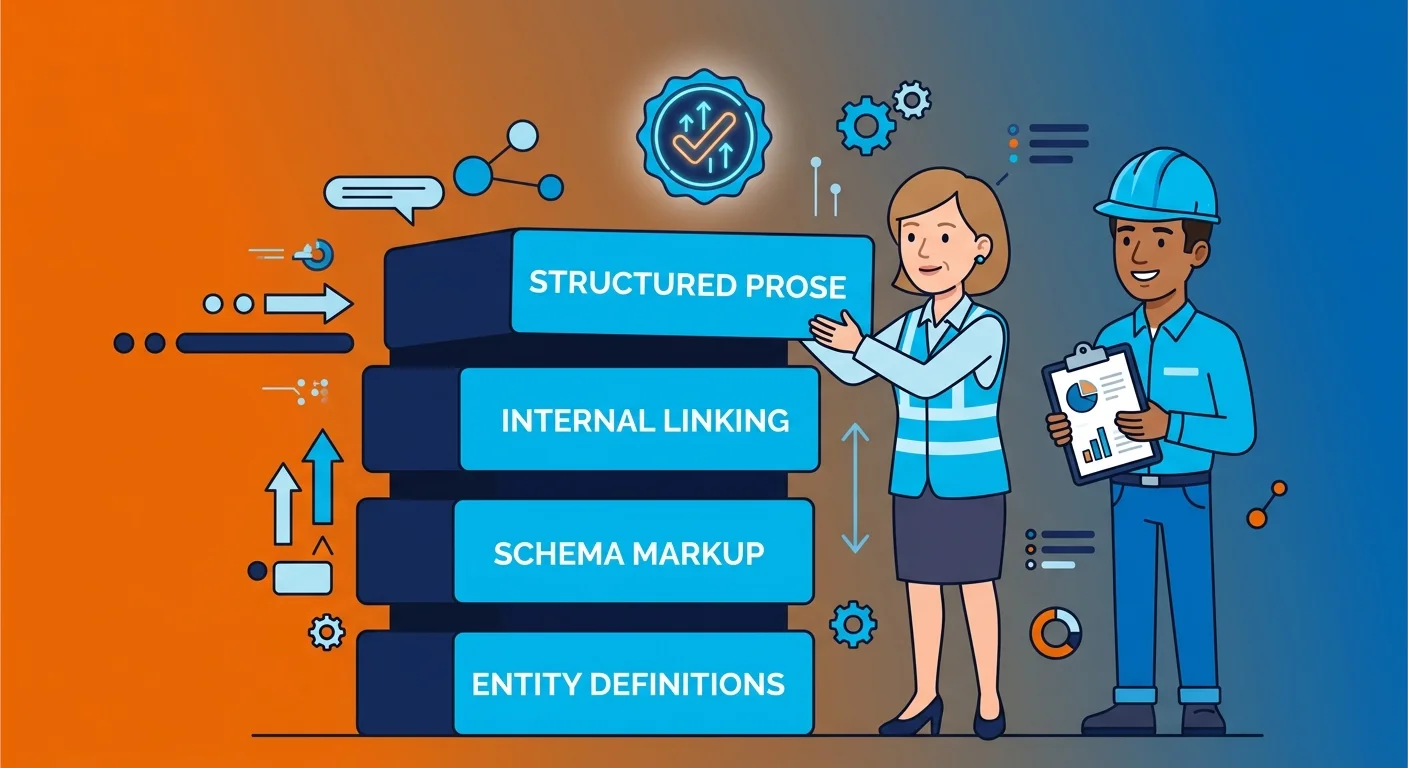
So let's get concrete about what practitioners actually need to build. A commodity content package barely touches schema markup, and when it does, the markup gets bolted on as an afterthought.
Structured semantic content engineering works the other way around. The schema, the entity definitions, the internal semantic relationships — those are load-bearing. They carry the page's meaning instead of decorating it.
That distinction matters, because schema markup isn't a formality. It's the machine-readable layer that tells an answer engine exactly what a page describes, and how confidently it can trust that description.
| Implementation Stage | What Happens | Common Failure Point |
|---|---|---|
| Entity Definition | The business, service, or condition the page describes gets named, categorized, and connected to related entities before any prose is written. | Skipping this stage and writing narrative content first, then trying to retrofit an entity structure onto pages that were never built to hold one. |
| Schema Markup | Structured markup is added to declare what the page describes and how it relates to other pages, matching the actual visible content exactly. | Markup that overstates or misrepresents the page content, which risks the structured data being rejected or marked as spam instead of displayed. |
| Internal Relationship Mapping | Pages are linked to each other in ways that reflect real topical relationships, so an answer engine can trace how one entity connects to another. | Treating internal links as a formality added at the end, rather than as the structural map that defines how entities relate to each other. |
| Chunk-Level Verification | Each section is checked to confirm it can stand alone as a complete, citable claim if lifted out of the page entirely. | Leaving paragraphs dependent on surrounding narrative context, which produces fragments an answer engine cannot extract cleanly. |
Where Structured Data Earns Its Keep (and Where It Backfires)
Here's the thing: structured data can turn on a business too, if it's done carelessly. Schema markup isn't a guarantee — it's a set of claims Google's automated systems check against what's actually on the page.
Break a quality guideline and even syntactically correct structured data can get shut out of a rich result in Google Search Central entirely. Worse, sometimes that violation gets the markup flagged as spam.
That risk is exactly why structured data can't be a checkbox tacked onto a commodity content package after the fact. Markup that overstates what the page really contains does more damage than no markup at all.
Retrofitting an Existing Site Versus Building Structure In From Day One
Now consider the practical question most businesses actually face. Very few start from a blank site — most already have years of published pages sitting there with no structural layer underneath.
Retrofitting structure onto an existing site is real work. You audit what's already there, define the entities those pages should represent, and rebuild the internal relationships that were never there to begin with.
But building structure in from day one is a completely different project. Every new page starts with its entity defined, its schema correct, and its relationships already mapped — the engineered foundation standing before a single article ships, rather than lumber dropped on the lot and sorted out later.
Frequently Asked Questions
A handful of questions come up every single time this argument gets made. Here are the straight answers, no hedging.
How is structured semantic content different from a well-written blog post?
A blog post gets written to be read front to back by a person. Structured semantic content engineering gets written to be torn apart, where each section stands on its own as a citable claim a machine can trust.
What is the real cost difference between buying a content package and investing in content engineering?
A commodity content package is priced by the word and the deadline. Content engineering is priced by the entity work, the schema, and the structural planning under the words. Those are costs a word count invoice never itemizes.
Can I apply semantic structure to my existing website content, or do I have to start over?
You don't have to start over, and most businesses shouldn't. Retrofitting means auditing what's already there, defining the entities those pages represent, and rebuilding the relationships nobody mapped the first time around.
How do you measure the ROI of content engineering if not by keyword position tracking and site visits?
Keyword position tracking and site visits measured a search model that no longer decides what gets surfaced. The real measure now is citation. Does an answer engine actually pull a page's claims and attribute them?
Why do cheap commodity content packages often have a negative impact on AI search visibility?
Cheap packages skip entity definitions and schema completely, cranking out pages built for repetition instead of trust. An answer engine can't cite a fragment it can't identify, so those pages just get passed over.
The Bottom Line
So here's the bottom line: a commodity content package is lumber dropped on a lot, cheap and indistinguishable from every other pile nearby. Structured semantic content engineering is the foundation underneath it. Only one of those is still standing when an answer engine comes looking for something to cite.
So it comes down to this: a foundation stays standing when the answer engine shows up, and a lumber pile doesn't. Word count and keyword density belonged to a search model that's already gone. Entity clarity, schema integrity, and citable structure belong to the one deciding what gets cited now.
Keep buying commodity content packages and you're betting on a model that already stopped paying out — the lumber pile nobody's coming to cite. Structured semantic content engineering is the foundation still standing when an answer engine goes looking. Want to see where your own content stands against that? Start with an AI visibility check.