
Dominating the Condition: How to Become the AI-Recommended Answer for Sciatica and Disc Herniation
To become the AI-recommended answer for sciatica and disc herniation, your practice needs Condition-Based Authority — a machine-readable infrastructure that tells AI engines exactly what conditions you treat, how you treat them, and why you're the most verified authority in your market.
That's the answer. Here's why it's harder than it sounds.
AI answer engines like ChatGPT, Gemini, and Perplexity don't rank pages. They build a verdict. That verdict is based on Entity Trust — a composite signal assembled from schema markup, directory citations, topical content depth, and cross-platform consistency. If any layer is missing or inconsistent, AI won't recommend you. Not for generic back pain. Definitely not for high-stakes, specific conditions like sciatica or herniated discs.
In healthcare specifically, the AI Overview rate sits at 51.6% — the highest of any industry. Long-tail clinical queries like "non-surgical treatment for disc herniation" trigger AI responses 73.9% of the time. Patients asking those questions aren't getting a list of results to scroll through. They're getting a recommendation. One name. One practice.
Sciatica and disc herniation aren't niche edge cases. They're high-intent, high-value conditions where patients are actively seeking AI recommendations right now. The practices showing up as the recommended answer aren't winning on traditional search rankings. They're winning on authority infrastructure — structured schema that identifies their clinical specialties, verified citations across authoritative medical directories, and interlinked AI Authority content that maps the entire patient intent journey from symptom onset to non-surgical treatment options.
The gap almost always comes down to three signals: clinical schema AI can parse, citation consistency across medical directories, and interconnected condition-specific content structured for AI extraction.
This article breaks down why most practices — despite websites, blogs, and page-one rankings — are structurally invisible to AI evaluating clinical conditions.
Last Updated: April 10, 2026
- The Clinical War Nobody Sees Coming
- What Condition-Based Authority Actually Means to an AI Engine
- The Three-Layer Stack: How to Engineer Condition-Based Authority
- The 1.2% Rule: Why "Good Enough" Gets You Erased
- Frequently Asked Questions
- Why doesn't my Google ranking guarantee an AI recommendation?
- What specific schema do I need for disc herniation?
- How does the 1.2% Rule affect my practice?
- Can AI hallucinate my treatment methods?
- Is AEO just expensive traditional SEO?
- What's the right first step?
- Can I build authority without all three layers?
- The Gap Widens Every Month You Do Nothing
The Clinical War Nobody Sees Coming
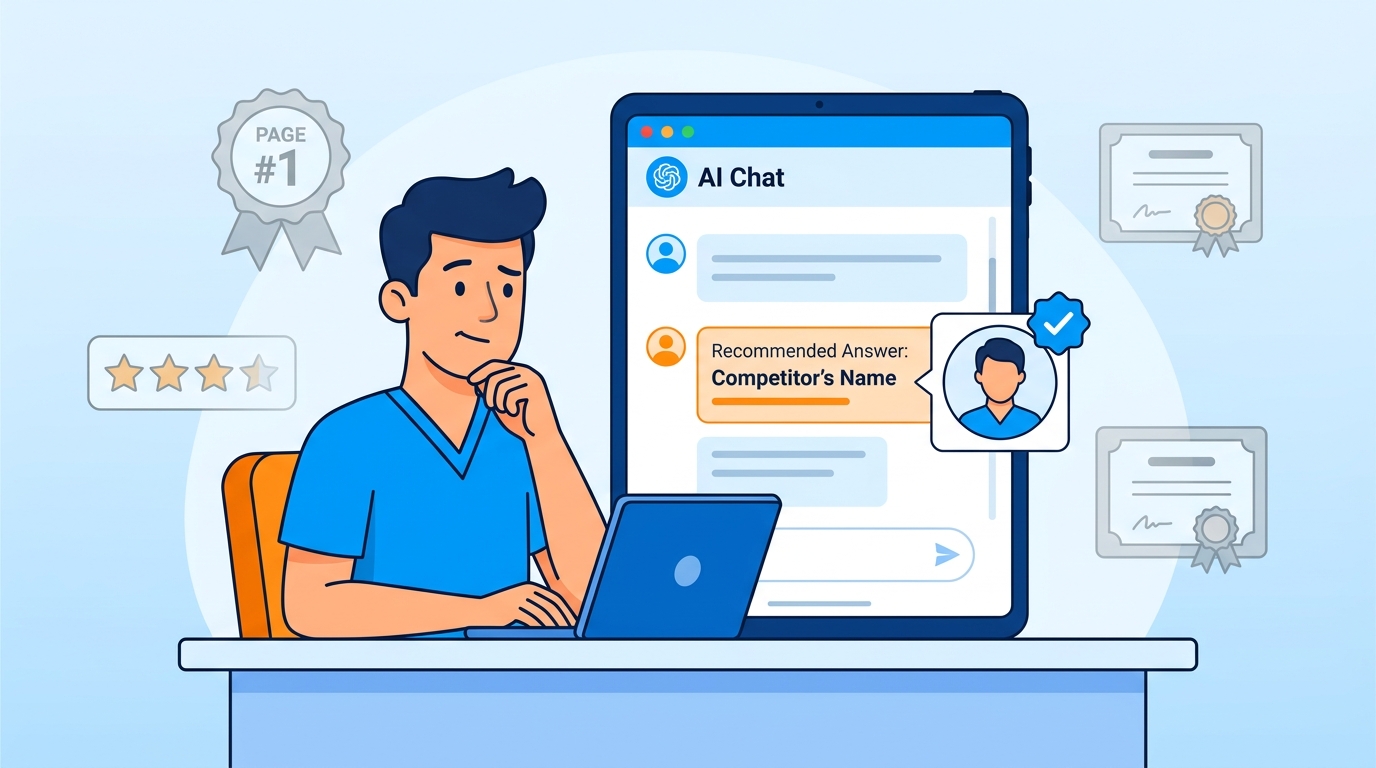
Picture a doc who's been in practice for twelve years. Page one for "sciatica chiropractor" in his city. He pulls up ChatGPT one afternoon and types that exact phrase. His name isn't there. A practice he's barely heard of is.
His first instinct is that something's wrong with the AI.
Most chiropractic websites are Digital Brochures — professional to humans, invisible to AI evaluating clinical depth. This isn't a traffic problem. It's infrastructure. And it's what an AI Authority Agency is built to fix.
Why Your Sciatica Blog Post Won't Get You Recommended
Here's what I've watched happen over and over.
Practice publishes a sciatica post. It ranks. Traffic ticks up. They feel like the work is done. Then they ask ChatGPT who treats sciatica in their city. Their name isn't there.
Traditional SEO optimizes for a ranked list. AI search produces a verdict. Those aren't two versions of the same thing.
Keyword-chasing worked when Google was the only gatekeeper. You stuffed terms, built backlinks, earned page one. It worked — for a channel that's losing control of where patients actually look for care. Traditional search volume is projected to drop 25% by 2026 as AI answer engines absorb that intent. Your sciatica post is optimized for a channel patients are quietly walking away from.
AI doesn't evaluate pages the way Google does. It evaluates entities. Who is this practice? What conditions do they specifically treat? Have I seen consistent, verified signals of their clinical expertise across multiple authoritative sources?
A blog post answers the first question. It doesn't touch the other two.
That's the gap. And it's why understanding how AI identifies and trusts your practice as an entity has to come before any content strategy. Build on a shaky entity base and every article you publish compounds the problem.
What AI Is Actually Solving For
AI answer engines are risk-averse by design.
They're not surfing results for the most popular answer. They're building a recommendation — and for medical queries, that bar is higher than almost any other category. Think about the stakes. A patient acts on that recommendation. If it's wrong, they have a bad outcome and stop trusting AI recommendations entirely. AI engines understand that risk. They build it in.
What they're actually solving for: Who is the most verifiable, clinically specific authority for this condition in this market?
- Verifiable — AI can't recommend what it can't confirm. Your name, your specialties, your clinical focus — they need to show up the same way in every place AI checks. One inconsistency breaks it.
- Clinically specific — One post about sciatica isn't depth. AI knows what depth looks like because it's seen it. A library on a condition looks completely different from a single overview.
- Consistent — Same name. Same specialties. Same information. Everywhere AI looks. The moment it finds a conflict between your Healthgrades profile and your website, it starts second-guessing everything else.
Not traffic. Not domain authority. Not how many reviews you've collected.
What Condition-Based Authority Actually Means to an AI Engine

Condition-Based Authority isn't a content strategy. It's an infrastructure designation.
When AI evaluates whether to recommend your practice for sciatica or disc herniation, it's running a multi-layer verification check. Most practices fail at layer one — without knowing it.
Entity Hardening: The Technical Foundation
Before AI will recommend you for any condition, it needs to establish you as a trustworthy entity for that condition.
That's Entity Hardening. Locking your practice's clinical identity across every signal AI can read — schema markup, NAP consistency, directory citations, structured data that explicitly names your specialties. For sciatica and disc herniation, that means clinical schema. Not just business schema.
Schema.org's MedicalEntity specification identifies the properties AI uses to extract condition-specific information when it detects clinical intent. For a chiropractic practice, the relevant markup includes:
MedicalConditionschema — Explicitly names which conditions your practice treats using terminology that matches what AI was trained on. "We treat back pain" in your website copy is not the same signal as structured markup identifying sciatica and lumbar disc herniation by their clinical names.MedicalProcedureschema — Names the specific protocols you use. Without it, AI guesses your approach from unstructured text. That guess is frequently wrong. Naming spinal decompression creates a verified, machine-readable link between the condition and the treatment — in AI's model of your practice specifically.MedicalOrganizationschema — Establishes your practice as a recognized medical entity, not a generic local business. This changes the category of trust signal AI assigns to everything else you publish.
Most chiropractic websites have LocalBusiness schema at best. That tells AI your hours and address. It tells AI nothing about what you're clinically qualified to treat.
Now here's the part people don't talk about enough. When entity data is incomplete, AI doesn't quietly pass on recommending you. It fills in the gaps. Wrong specialties assigned to real practices. Services invented wholesale. Founders named that have nothing to do with the business. Not because AI is broken — because a fragmented footprint gave it nothing accurate to work with. It filled in the blanks.
Consensus Trust: How AI Verifies Your Clinical Credentials
Schema alone doesn't get you recommended.
AI doesn't just read your website. It cross-references it. Medical directories like Healthgrades, Zocdoc, Vitals, and WebMD are verification anchors — platforms AI treats as independent confirmation of your clinical identity. If those platforms don't confirm what your schema says, the verification fails.
53% of patients now feel comfortable using AI for health queries. That number keeps climbing — and it climbs because AI is sourcing from platforms patients already recognize as credible. Healthgrades. WebMD. Zocdoc. If your data on those platforms is outdated, missing, or inconsistent, you fail the check before the recommendation ever starts.
Consensus Trust failures look mundane. A phone number that's three years out of date. Specialties listed as "chiropractic" instead of naming sciatica or herniated disc. Your business name formatted three different ways across three different directories.
None of it feels like a big deal individually.
Combined, it tells AI: this entity cannot be verified with confidence.
That's enough to get passed over.
Topical Depth: The Content Architecture That Signals Specialization
One sciatica blog post is not topical depth.
Here's what topical depth actually looks like. Symptom content for the patient still figuring out what's wrong. Treatment comparison content for the patient weighing surgical vs. non-surgical options. Protocol-specific content for the patient who's already decided and just needs a verified provider. All of it linked to each other. AI reading that cluster doesn't see a practice that knows how to write about sciatica. It sees a practice that knows sciatica.
That's where building condition authority beyond a single market begins. You can't expand what you haven't established. Establish the condition, own the cluster, then scale.
AI rewards structural completeness. Not frequency. Not length. Completeness.
Table 1: Traditional SEO vs. Condition-Based AEO for Sciatica
| Dimension | Traditional SEO | Condition-Based AEO |
|---|---|---|
| Primary target | Search engine algorithm | AI answer engine verdict |
| Core signal | Keyword relevance + backlinks | Entity Trust + schema + citation consistency |
| Content goal | Rank a page | Build a condition-based authority library |
| Patient discovery | Click-through from results list | Single AI recommendation, no competing options |
| Durability | Expires with algorithm updates | Compounds with each new verified authority signal |
| What breaks it | Competitors outranking you | Inconsistent entity data, thin topical coverage |
The Three-Layer Stack: How to Engineer Condition-Based Authority
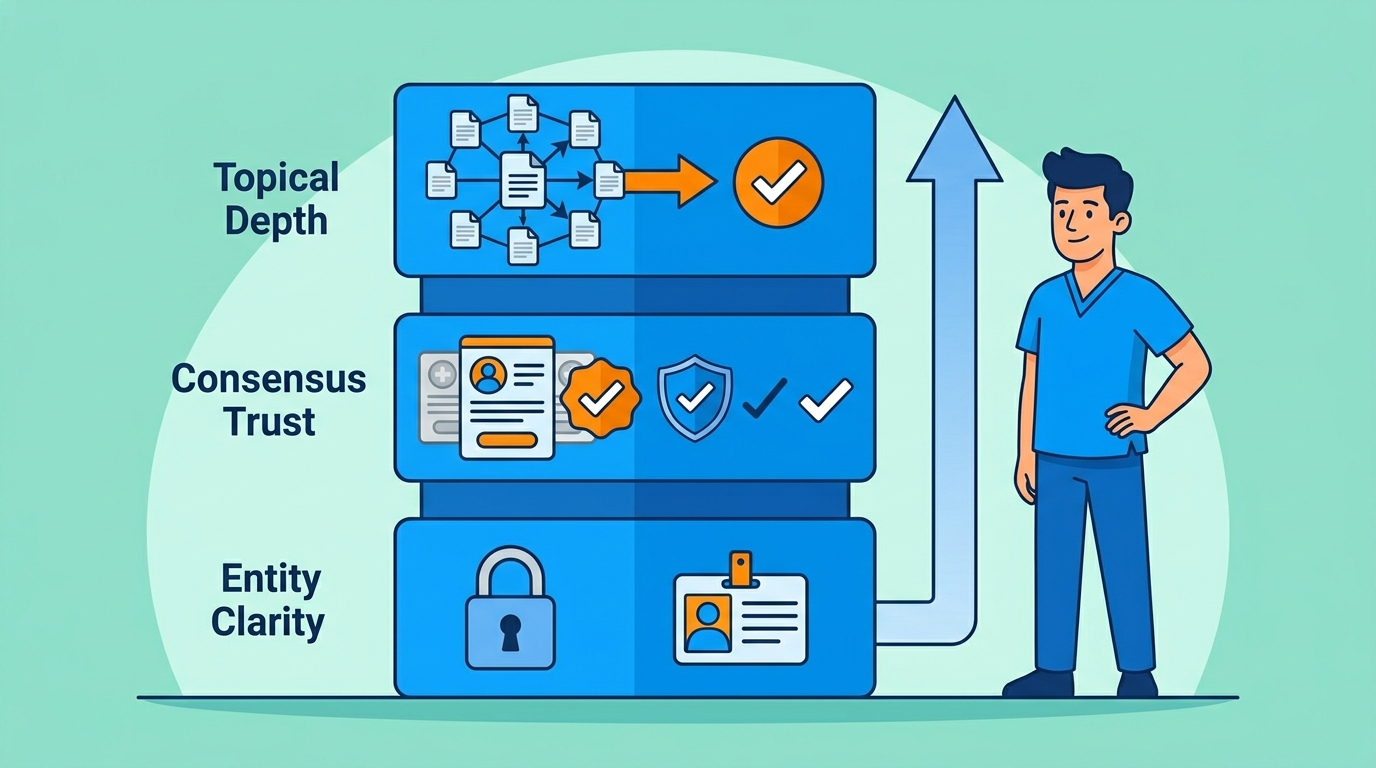
There's no shortcut here.
Every layer depends on the one beneath it. Add content on top of a broken entity foundation and you're not building authority. You're building a more detailed version of something AI still can't verify.
Layer 1: Entity Clarity — Lock Your Identity Before You Own the Condition
You can't own sciatica authority if AI doesn't know who you are.
Entity Clarity is the foundation. Your practice's name, address, specialties, and clinical protocols documented consistently — in machine-readable format — across every surface AI checks. Until that's locked, nothing else you build holds.
Here's where it gets uncomfortable. When entity data is missing, AI doesn't say "I don't know." It guesses. And it publishes that guess. Wrong specialties assigned to real practices. Services invented wholesale. Founders named that have nothing to do with the business. Not because AI is broken — because a fragmented footprint gave it nothing accurate to work with. It filled in the blanks.
The two-AI validation system we use at iTech Valet is designed to catch this before content goes live. Every entity signal cross-validated. Every claim verified by two independent AI systems before it gets published. By the time a practice's content is public, their digital identity is locked — not left open for AI to infer.
Layer 2: Consensus Trust — Build the Verification Network
Layer 1 establishes who you are. Layer 2 gets other authoritative sources to confirm it.
That confirmation comes from the medical directory ecosystem — Healthgrades, Vitals, WebMD, Zocdoc. AI treats these as independent validators. The goal isn't just to be listed. It's to have the exact same, accurate, specialty-specific information on every one of them.
This is where practices quietly fail.
Healthgrades profile from four years ago. Phone number's wrong. Specialties listed as "chiropractic" instead of naming sciatica or disc herniation. Business name formatted differently than it appears everywhere else AI checks.
Each inconsistency is small. The combined pattern is a problem. It signals to AI that this entity can't be confidently verified. And AI will not recommend what it can't confidently verify.
Layer 3: Topical Authority Clusters — Map the Full Patient Intent Journey
Layers 1 and 2 confirm you exist and that you're verified. Layer 3 is where you prove you know the condition better than anyone else in your market.
That proof comes from how the content is built. Symptom articles link to treatment articles. Treatment articles link to protocol articles. Every piece connects back to the others. AI reading that cluster doesn't see scattered sciatica content. It sees a practice that owns the topic.
- Symptom-level content — Captures early-intent patients still figuring out what's wrong; establishes your practice as the trusted source before the high-value decision moment arrives
- Treatment comparison content — Serves patients weighing surgical vs. non-surgical options, where AI recommendations carry the most influence over the final call
- Protocol-specific content — Targets high-intent queries from patients who've already committed to a treatment direction and need a verified provider for something like spinal decompression
- Authority cluster linking — Every article in the cluster connects to the others, creating the internal link architecture AI uses to confirm specialization rather than scattered coverage
Table 2: The Three-Layer Authority Stack for Condition-Based AI Recommendations
| Layer | Name | What It Does | What Breaks It |
|---|---|---|---|
| Layer 1 | Entity Clarity | Locks practice identity in machine-readable format | Inconsistent NAP, missing clinical schema, fragmented specialty declarations |
| Layer 2 | Consensus Trust | Gets authoritative medical directories to confirm your identity | Outdated listings, mismatched specialties, name formatting inconsistencies |
| Layer 3 | Topical Authority | Signals clinical depth through interconnected content | Thin single articles, missing condition coverage, no internal cluster linking |
The 1.2% Rule: Why "Good Enough" Gets You Erased
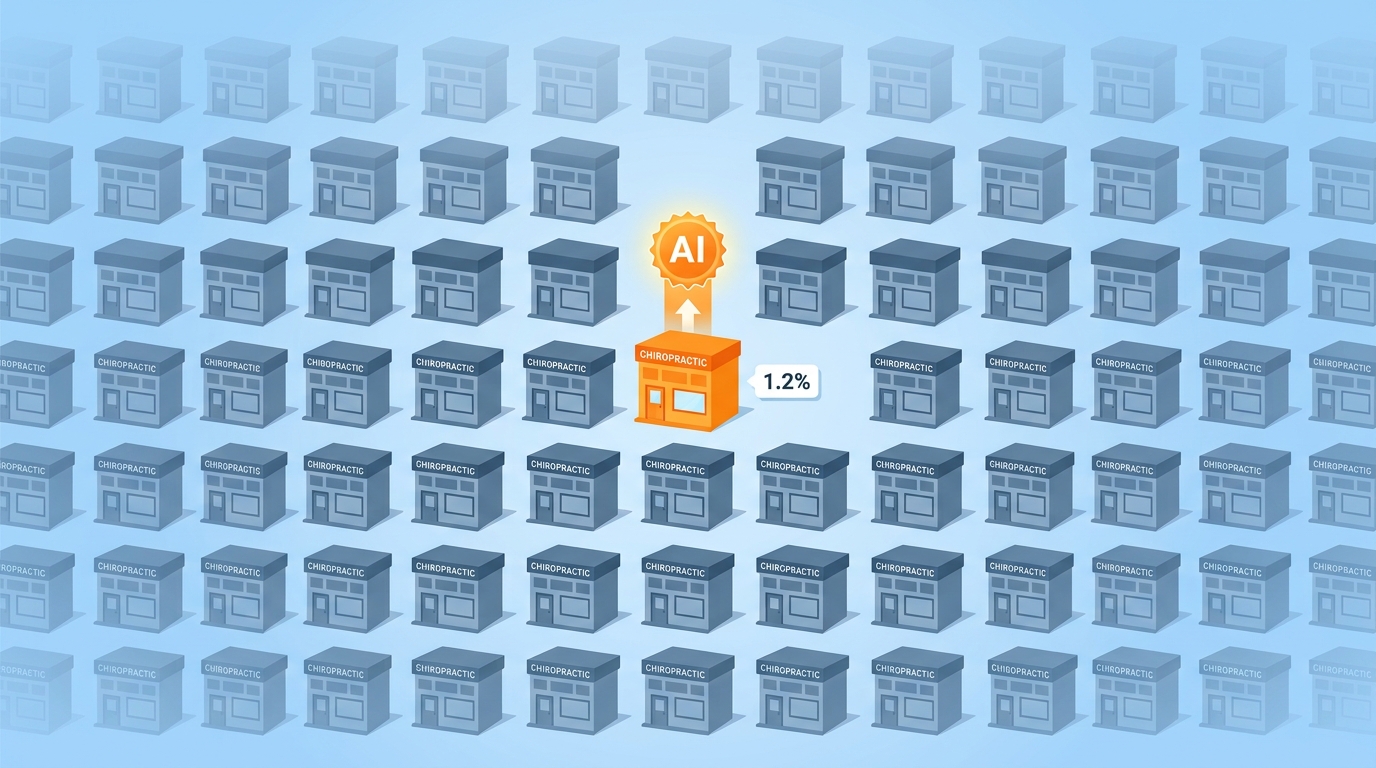
ChatGPT recommends roughly 1.2% of all verified business locations when a user asks for a local recommendation.
1.2%.
For specialized clinical conditions like sciatica and disc herniation, the selectivity is even sharper. Medical recommendations carry higher downside risk if they're wrong — so AI filters harder. It's not looking for the most popular practice in your zip code. It's looking for the most verifiable one.
Being close doesn't count. You're either in that 1.2% or you're not on the list.
This Is Not for the Budget-First Buyer
Let me be straight with you.
If your first question when evaluating this is "how much does this cost, and can I find something similar for $500 a month" — this isn't for you. Not because we don't want your business. Because Condition-Based Authority can't be built on a budget-first evaluation.
The three-layer infrastructure — clinical schema, medical directory citations, interconnected content built for AI extraction — isn't a commodity service. Agencies pricing it at $500 a month aren't offering a discounted version of this. They're offering something that doesn't do what you're reading about. The economics don't allow for it.
The Budget-First Buyer rotates through two or three agencies in two years. Spends the same money. Ends up further behind than when they started. I've watched that play out. The problem isn't price. It's treating authority infrastructure like a monthly marketing bill instead of an asset.
If you want to rent authority visibility from a platform that charges you every month to exist — there are options for that. If you want to build something that compounds while your competitors keep renting — keep reading.
Not sure where you currently stand? The free AI Visibility Check is the right starting point. Diagnostic, not a pitch. You'll know quickly whether you have a gap worth solving.
"But I Rank on Page One for Sciatica."
I hear this one constantly.
Page one for a high-intent clinical phrase feels like a complete win. And it is a win — for a system that's steadily losing control of where patients actually search for specialized care.
Over 80% of searches now end without an external click. The patient's question gets answered inside the interface. By an AI summary built on Condition-Based Authority signals — not your keyword ranking. Your page one result sits behind that summary. It might as well be page three.
Here's the position worth saying out loud: high-volume traffic doesn't grow a clinic when most patients never click. Consensus trust from AI engines matters more than click volume. Full stop.
Healthcare leads every industry in AI Overview rate at 51.6% — long-tail clinical queries trigger AI responses 73.9% of the time. The patient typing "best non-surgical treatment for herniated disc" is getting an AI answer. Either your practice is in it or it isn't. Your page one ranking doesn't enter the calculation.
What actually moves the AI recommendation needle:
- Condition-specific schema — AI can't recommend what it can't parse; structured
MedicalConditionmarkup is the baseline that keyword rankings never establish - Citation consistency across medical directories — every discrepancy in your Healthgrades, Zocdoc, or Vitals profile costs you verification weight with AI
- Linked condition content depth — a single sciatica post signals nothing about specialization; a content cluster linked around the condition does
Table 3: What Triggers AI Recommendations vs. What Drives Google Rankings
| Signal | Google Ranking | AI Recommendation |
|---|---|---|
| Schema markup | Helpful | Critical |
| Keyword density | Important | Irrelevant |
| Clinical specificity in schema | Ignored | Required |
| Medical directory citation consistency | Minor | High-priority |
| Backlinks from high-authority domains | High-priority | Minimal weight |
| Topical content cluster depth | Helpful | Required |
| Entity Trust (cross-platform consistency) | Not evaluated | Core criterion |
| Page-one keyword ranking | Result of SEO | Does not transfer |
Frequently Asked Questions
Why doesn't my high Google ranking for "sciatica" guarantee an AI recommendation?
Google ranks pages based on keyword relevance. AI recommends entities based on verified trust.
Completely different systems. A page can rank because of backlinks and solid keyword work while having zero clinical schema, zero verified citations, a fragmented entity footprint AI can't make sense of.
Your page wins on Google. Your practice doesn't exist in the AI verdict.
Both are true at the same time. Most practices are living this right now without knowing it.
What specific schema do I need for disc herniation?
At minimum, you need MedicalCondition schema explicitly identifying disc herniation as a condition your practice treats, paired with MedicalProcedure schema naming the specific protocols you use — like spinal decompression, if that's part of your treatment model.
Specificity is the point. Generic LocalBusiness markup tells AI where you're located. Clinical schema tells AI what you're qualified to do. For a query like "herniated disc non-surgical treatment," AI filters for the second type. Most chiropractic sites don't have it.
How does the 1.2% Rule affect my specialized practice?
The 1.2% Rule is already brutal for general recommendations. For specialized clinical conditions, AI applies an even higher selectivity threshold.
Not the most popular. The most verifiable. For clinical conditions specifically, that bar goes up because the downside of a wrong recommendation is higher.
Second place doesn't get cited. There's no runner-up mention in an AI answer.
Can AI hallucinate my treatment methods?
Yes. And this is one of the most underestimated risks in the condition authority conversation.
When entity data is fragmented — incomplete schema, inconsistent directory citations, missing specialty declarations — AI doesn't pass on recommending you. It fills the gaps. Wrong specialties. Services you don't offer. In some cases, entirely wrong founders attributed to your practice.
Entity Hardening is the fix. Lock the footprint. AI verifies rather than invents.
Is Answer Engine Optimization for sciatica just expensive traditional SEO?
No. The structure is completely different.
Traditional SEO is a monthly expense for rented authority visibility. Stop paying, it disappears. AEO is an authority asset — trust signals that compound with every verified addition. The analogy I use: traditional SEO is renting a billboard. AEO is building a landmark. One comes down when you stop paying. The other stands.
What's the right first step for a practice starting from zero?
The first step is always diagnostic.
Know where your infrastructure actually stands before deciding what to build. Check how AI describes your practice — what conditions it associates with you, whether your citations are consistent, what signals your schema is actually sending.
Most practices that run this check are surprised. A polished site, strong reviews, a ranking sciatica post — and complete absence from AI's condition-based verdict. That gap is invisible until you look directly at it.
That's what the AI Visibility Check surfaces.
Can I build condition-based authority without addressing all three layers simultaneously?
You can improve individual signals. But you can't build the full picture by addressing layers in isolation.
Entity Clarity without Consensus Trust: AI can find you but can't confirm you. Consensus Trust without Topical Depth: verified, but not a recognized specialist. Topical Depth without Entity Clarity: content that exists but isn't reliably attributed to a practice AI trusts.
They're interdependent. Patch one, the other two keep the gap open.
The Gap Widens Every Month You Do Nothing
Here's what I keep coming back to every time I talk to a doc about this.
AI doesn't wait.
Every month a competitor builds condition authority in your market, that signal compounds. More verified. Harder to displace. AI isn't getting less selective — it's getting more. The early-mover window is real. It doesn't stay open.
AI gives one answer. If you are not the answer, you do not exist.
Not a metaphor. The architecture. One patient, one query, one practice recommended. The 80%+ zero-click reality means most of those patients never reach a second option. Every other practice in that market doesn't exist in that moment. Not ranked lower. Not less preferred. Doesn't exist.
The practices building now are locking in authority positions that compound for years. The practices waiting are about to find out their competitors already made that call. I've watched that realization hit. It's not a good moment.
Your clinical expertise in sciatica and disc herniation is real. The question is whether AI can verify it — or whether it's sitting inside a digital footprint machines can't read.
Ask ChatGPT or Gemini who treats sciatica in your market. If your name doesn't come up, the infrastructure gap is confirmed. The AI Visibility Check shows you exactly where the signal is breaking down and what it would take to close it.
Condition-Based Authority isn't built overnight. But the practices that start now lock in their clinical position before competitors realize the window has closed.
Find out where your condition authority actually stands — before someone in your market locks it permanently.
621 Enterprises, Inc. | Copyright 2026 | All rights reserved