
What Actually Separates a Generalist Agency From an Answer Engine Specialist

Here's the thing: the real split is scope. A generalist agency spreads its attention across a pile of disciplines inside one retainer. An answer engine specialist crushes all of that down to a single outcome.
That outcome is citation inside a generated answer, not placement on a results page. The arrival of generative AI at the top of the results page represents the most significant shift in online promotion in over a decade, and the two agency models answer that shift in opposite ways.
| Dimension | Generalist Agency | Answer Engine Specialist |
|---|---|---|
| Core Focus | Divides attention across many disciplines, from social media management to site build work to traditional search optimization | Narrows entirely to one outcome, becoming the citable source an AI system quotes directly |
| Measure of Success | Treats position on a results page as the primary signal of progress | Treats citation inside a generated answer as the only signal that matters |
| Service Structure | Bundles unrelated disciplines under one retainer, run in parallel | Builds entity signals, structured data, and content architecture around a single generative-answer goal |
| Underlying Assumption | Assumes the searcher still scrolls through a list of links to choose one | Assumes a generative system now sits between the query and the click, answering before the list ever loads |
What a Generalist Agency Delivers Across a Service Lineup
A generalist agency provides a wide array of services under one roof. Social media management, site build work, and traditional search optimization all sit on the same retainer, run in parallel.
That breadth was built for a stage with a live audience, scrolling the results page one link at a time. Anyone comparing providers can check the foundational AEO primer to see how that broad lineup stacks up against a narrower, citation-focused scope.
What an Answer Engine Specialist Builds Instead
An answer engine specialist goes narrow on purpose. Its whole job is making a brand the citable, authoritative source that AI-driven search pulls its answers from.
Every structural choice serves that one goal. The robot now sits in the front row writing the review before the audience even finds a seat, and this specialist is building for that reviewer, not the empty seats behind it.
Why the Search Results Page Stopped Rewarding a Wide Service Menu
Remember when the results page rewarded whoever covered the most ground? More service lines, more content, more inbound links. Breadth itself was the signal.
That signal quit paying out the moment a generative system started writing the answer before the searcher ever scrolled. Once answers replaced links, results-page position stopped predicting who gets cited, and stacking on more service lines won't bring that connection back.
| Measurement | What It Shows | Source |
|---|---|---|
| Query fan-out technique | AI Overviews and AI Mode may issue multiple related searches across subtopics and data sources to build one response. | |
| Content-side visibility lift | Generative Engine Optimization can boost visibility by up to 40% in generative engine responses on tested queries. | IIT Delhi and Princeton University |
How Query Fan-Out Changed What Counts as Being Found
Google says AI Overviews and AI Mode may use a query fan-out technique, firing off multiple related searches across subtopics and data sources to build a single response. So one query now kicks off a bunch of searches behind the curtain, each one pulling from a different source before the system stitches its answer together.
That mechanism rewards depth on a narrow topic, not a long service roster. A generalist retainer built to cover a pile of disciplines at once has no natural way to feed a process that runs on subtopic coverage. If you want the operational picture, the guide to post-switch changes lays out what shifts once a business stops optimizing for the old single-query model.
Why Spreading a Budget Across Ten Services Fails Inside an AI Overview
Split a budget across ten disciplines and each one gets a thin slice. Research from IIT Delhi and Princeton University shows generative engine optimization, a black-box framework for improving content visibility in generative engine responses, may boost that visibility by up to 40% — a laboratory finding rather than a study in people. That research tested content changes, not agency budgets.
Treating AI visibility as old-school search work with new vocabulary misreads what changed — the content-side discipline behind citation is a distinct skill, not a repackaged line item on a broader retainer.
How an Answer Engine Specialist's Scope of Work Is Actually Structured
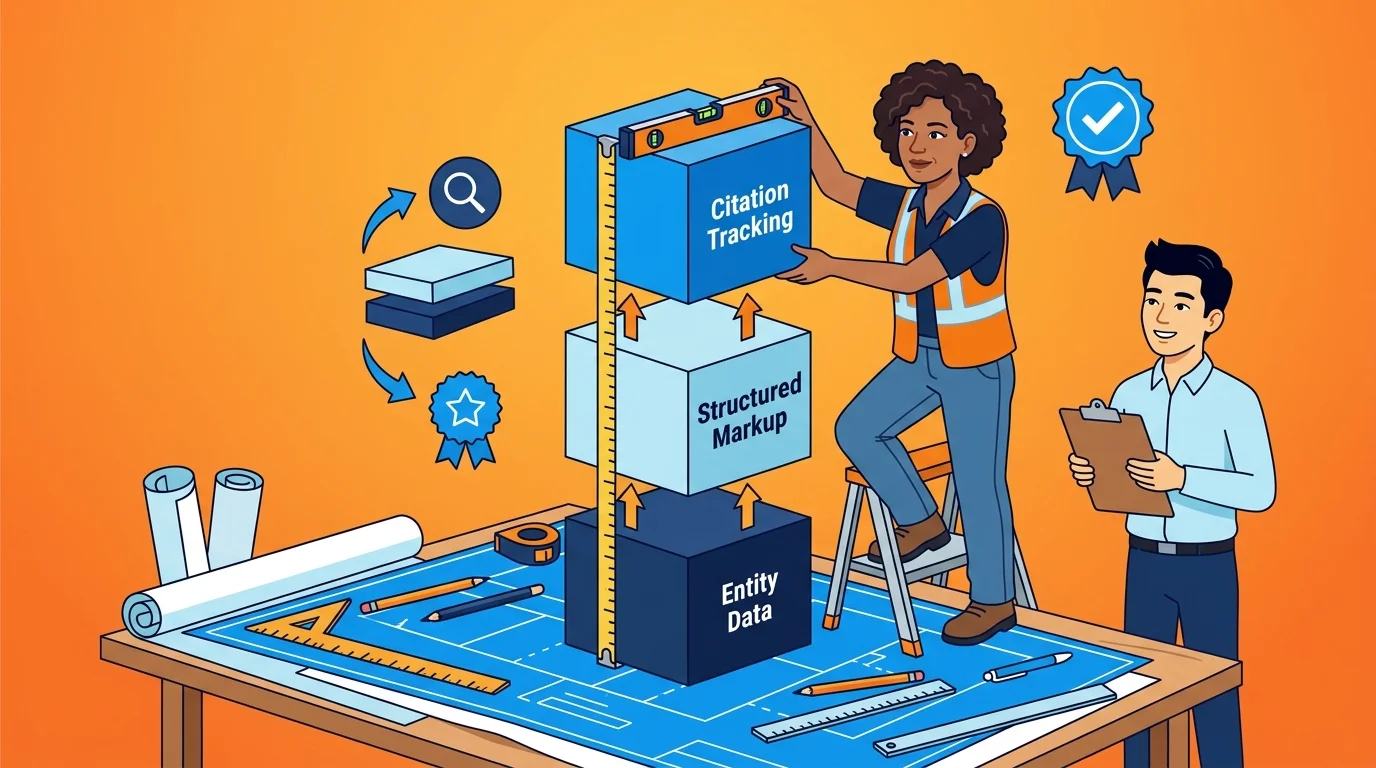
The work itself has a structure, not just a stated goal. An answer engine specialist builds in layers, starting with the entity itself and ending with how success gets measured. Most agencies are selling a game that ended, and this architecture is what replaces it.
Entity Clarity as the Load-Bearing Layer
A generative system has to confirm who is actually speaking before it will quote anyone. That confirmation runs through structured data describing the organization behind the content, not the content alone.
According to Google, adding organization structured data to a home page may help Google better understand an organization's administrative details and disambiguate it in search results.
That layer disambiguates a brand from every similarly named entity competing for the same query. Get entity clarity wrong and a specialist's narrower focus on citable authority has nothing stable to attach to. A business evaluating providers can work through the hiring-readiness checklist before committing to either model.
The Reporting Layer: What Gets Measured and Why
Reporting follows the same split. A generalist retainer reports search position reports and site visits because those are the metrics its service lines were built to move. A specialist reports citation appearances instead, since that is the outcome its entire scope was narrowed to produce.
Where a Mixed-Service Retainer Quietly Breaks Down
Here's where a mixed-service retainer quietly breaks: the moment its reporting has to explain a citation it never aimed for. The generalist model spreads budget across disciplines built for a results page that rewarded breadth. So it's no surprise that plenty of businesses now wonder whether that long-standing relationship was ever built for the system that replaced it.
The Reporting Gap That Hides the Failure
The failure shows up first in what gets measured, not in what gets delivered. A retainer built for old-school search work reports search position reports and site visits, because those metrics match its service lines. Neither metric explains why a competitor gets quoted inside a generated answer and a client does not.
Research from UNC Charlotte, USTC and the University of Washington shows AI Overview may predominantly cite content exhibiting significantly lower perplexity than content prioritized by conventional search algorithms.
A business can work through AI visibility services to see what a citation-first scope reports instead. Agencies still selling the old results-page game have no mechanism built to measure the thing that now decides visibility.
How to Evaluate a Scope of Work Before Committing a Budget to It

Choosing the right agency partner is a critical decision, but the criteria for that choice have fundamentally changed. A scope of work built on more deliverables used to signal more value. That assumption breaks down once a generative system rewards depth on a narrow topic rather than a wide roster of line items — a longer scope document is not a stronger one.
| Scope Line Item | Question to Ask | What a Vague Answer Signals |
|---|---|---|
| Keyword-targeted articles | Which subtopic or entity signal does this piece build, and how does it connect to the others | A vague answer signals the line exists to fill a quota, not to feed a system that rewards depth on a narrow topic |
| Acquiring inbound links | What does each link confirm about the entity behind the content | A vague answer signals the line is chasing volume instead of the disambiguation a generative system checks before it quotes a source |
| Site build work | How does this structural change help a generative system parse or trust the content on the page | A vague answer signals the work targets visual appeal, not the parsing and trust mechanics citation depends on |
| Search position reports | What does movement on this report prove about whether a generated answer will quote the brand | A vague answer signals the retainer is still measuring the old results page, not the outcome it claims to chase |
| Organization structured data | Does this markup match what is actually visible on the page, and does it disambiguate the brand from similarly named entities | A vague answer signals nobody has checked the markup against the page, leaving the entity unclear to the system deciding who gets cited |
Reading a Proposed Scope Line by Line
Start by counting what each line actually produces. A scope naming more articles, more inbound links, or more service categories is describing volume, not citation depth. Run the same test on every line: does it build authority a generative system can verify, or does it just add another item to the retainer.
Frequently Asked Questions
Once the scope split gets clear, a few practical questions always follow. Here's how they shake out.
What is the core difference between the work a generalist agency does and what an answer engine specialist does?
A generalist agency splits attention across many disciplines on one retainer. An answer engine specialist narrows its entire scope to one outcome: making a brand citable inside a generated answer.
If a specialist handles Answer Engine Optimization, is traditional search optimization still part of the work?
Yes, and a specialist doesn't walk away from it. Traditional search optimization still matters for being found in the standard list of results. It just becomes one input feeding the citation strategy, not the whole plan.
Do answer engine specialist agencies structure pricing differently than generalist agencies?
Pricing follows scope, not some fixed formula. A narrow, citation-focused engagement is built around different deliverables than a multi-line retainer. So what gets billed, and how, changes right along with it.
Can an answer engine specialist also manage social media and email alongside AEO work?
A specialist can coordinate with other service providers. But social media and email sit outside its narrowed focus. That's on purpose: the work stays locked on entity clarity and citation.
How do the reporting metrics differ between a generalist agency and a specialist AEO agency?
A generalist retainer reports search position reports and site visits because those match its service lines. A specialist reports citation appearances instead, since that is the one outcome its scope was built to produce.
What does Google's query fan-out technique mean for how a scope of work gets built?
Query fan-out means one search triggers several related searches across subtopics before an answer assembles. A scope of work has to cover a topic in depth, not spread thin across a wide service roster, to feed that process.
The Bottom Line
So here's where the stage story lands. The results page used to need an audience scrolling seat by seat, and a generalist agency was built to perform for that crowd. Now the robot sits in the front row, writing its review before anyone else even finds a seat.
The evidence points one way, and it's the specialist. Cited authority decides visibility now, and that's a narrower discipline than any broad retainer was built to deliver. If your business still grades itself on results-page position, you're performing for an audience that already left the room.
Want to know which model your business is still running for the empty seats? Get an AI Visibility Check.