
Why AI Engines Quietly Stop Trusting Your Business Facts
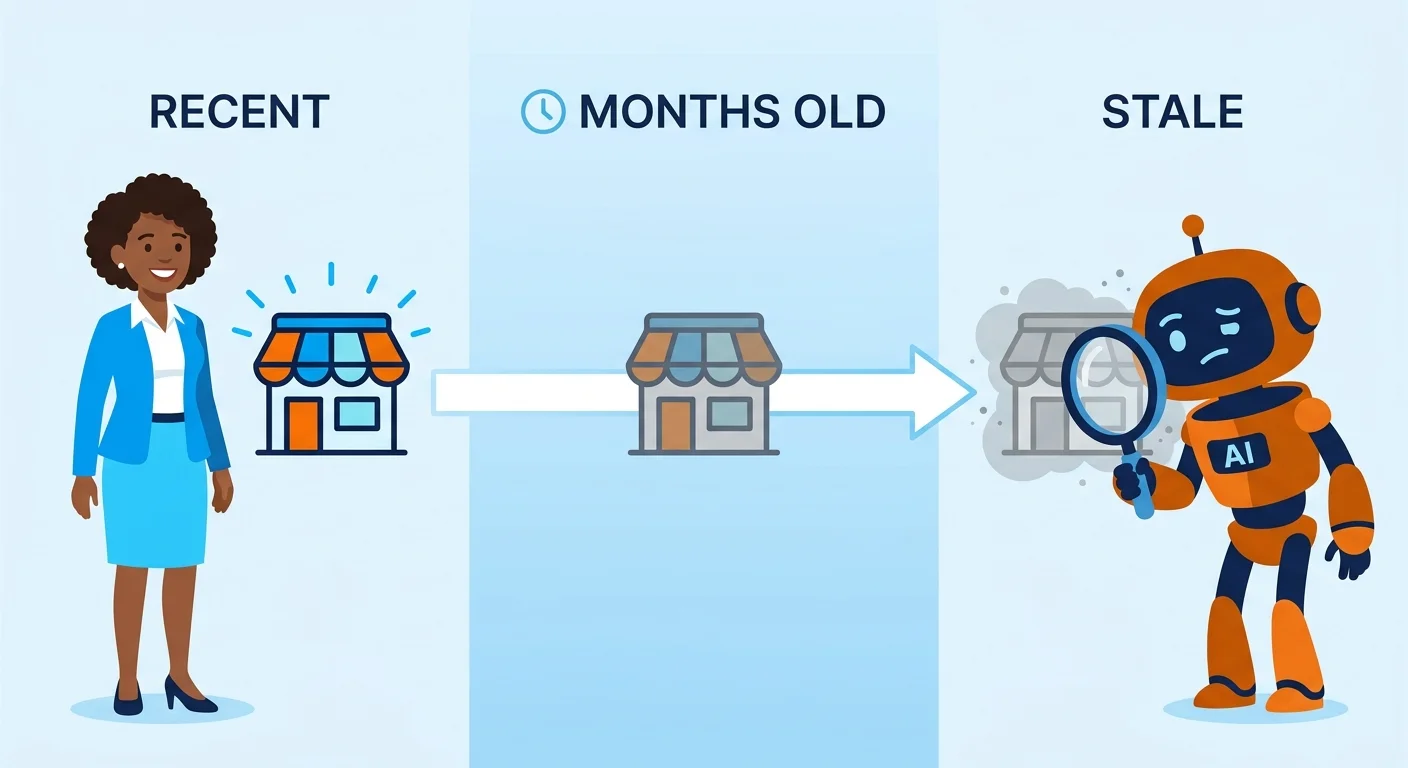
Trust doesn't vanish overnight. It erodes in silence, one unchecked fact at a time. And an AI engine never sends a notice when it quits believing you — it just stops citing you, and you don't notice until the site visits and inquiries have already dried up.
Proof decay is the slow bleed of trust and visibility when a business's facts go stale or get contradicted online. No single disaster sets it off. A changed service area, a stale credential, an old hours listing left uncorrected — small mismatches pile up until an AI engine can't tell which version of you is real.
This isn't new to AI. Freshness has always mattered in modern web search, and a search engine that misses the timing of a query looks stale fast. Generative engines inherited that instinct and sharpened it — they don't trust a page once and forget it, they keep asking whether its facts still hold.
Here's the thing: in the age of generative AI, the old rules of traditional search optimization are done. Publishing once and walking away used to survive that world. Not anymore, and why Machine-Readable Proof Architecture matters for AI citation lays out the gap between a page that once ranked and a fact an AI engine will actually cite.
The Static Website Problem Nobody's Solving
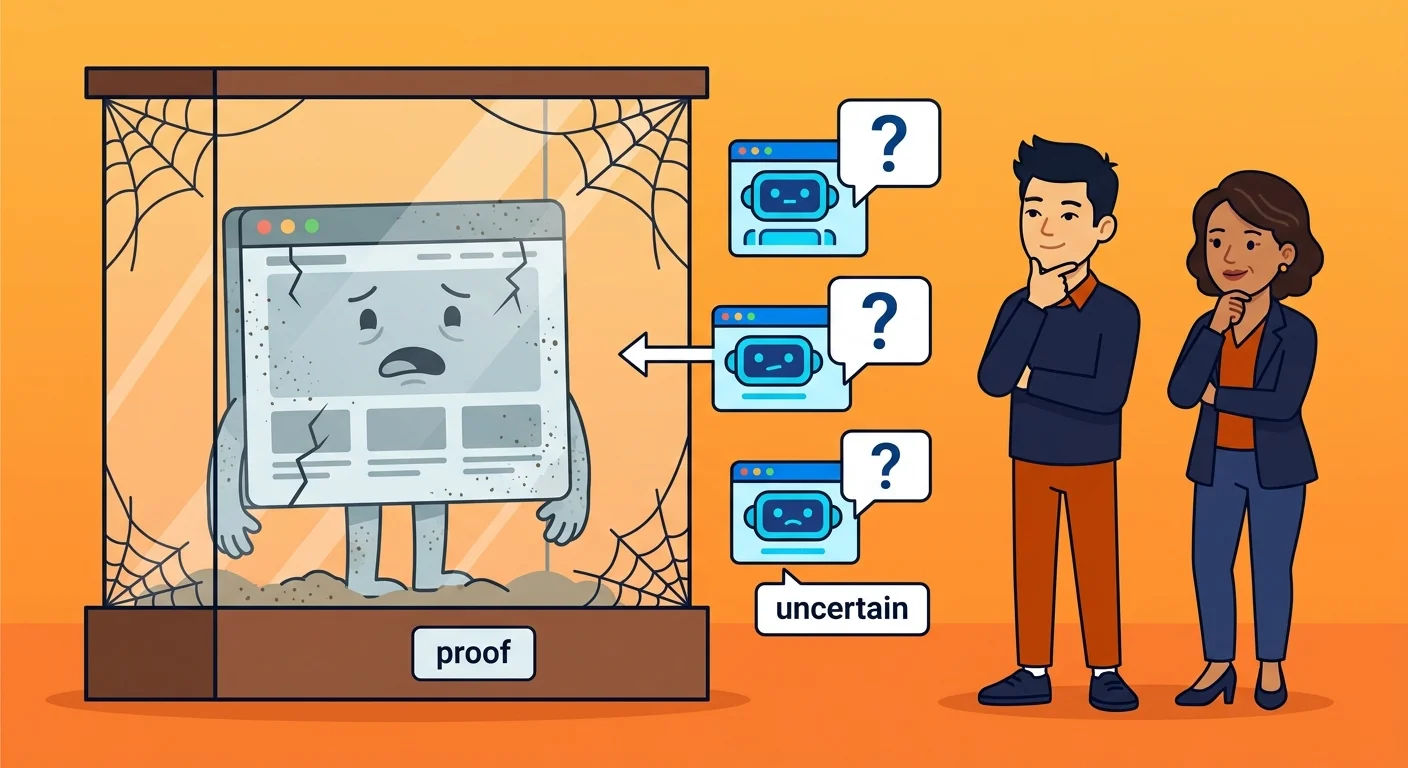
Most businesses still treat their factual footprint like a monument. Built once, carved in stone, and left to stand there.
That instinct is exactly the problem. Proof isn't stone — it's produce. It's got a shelf life, and it spoils quietly the second nobody restocks it.
Here's the thing: most businesses are still chasing a ranked webpage. What they miss is that AI engines aren't ranking pages anymore — they're ranking individual facts and verifiable claims.
Why 'Just Updating Your Website Once a Year' Doesn't Work
A once-a-year website refresh feels responsible. But it doesn't come close to satisfying a generative engine that re-checks your facts constantly, not annually.
The gap between updates is where decay gets to work. A credential lapses, a service shifts, a listing goes stale — and nothing fixes it for months.
And it compounds quietly, right alongside old reviews nobody thought to touch. Understanding how outdated customer reviews quietly undermine AI search engine confidence shows you exactly how this plays out with proof left to rot.
A yearly schedule assumes trust gets earned once and kept forever. Generative engines don't work that way.
They ask the same verification question every single time a query touches your business. Waiting twelve months to answer isn't a maintenance plan. It's a slow surrender of citation velocity.
What Actually Makes Content Machine-Readable to AI Engines
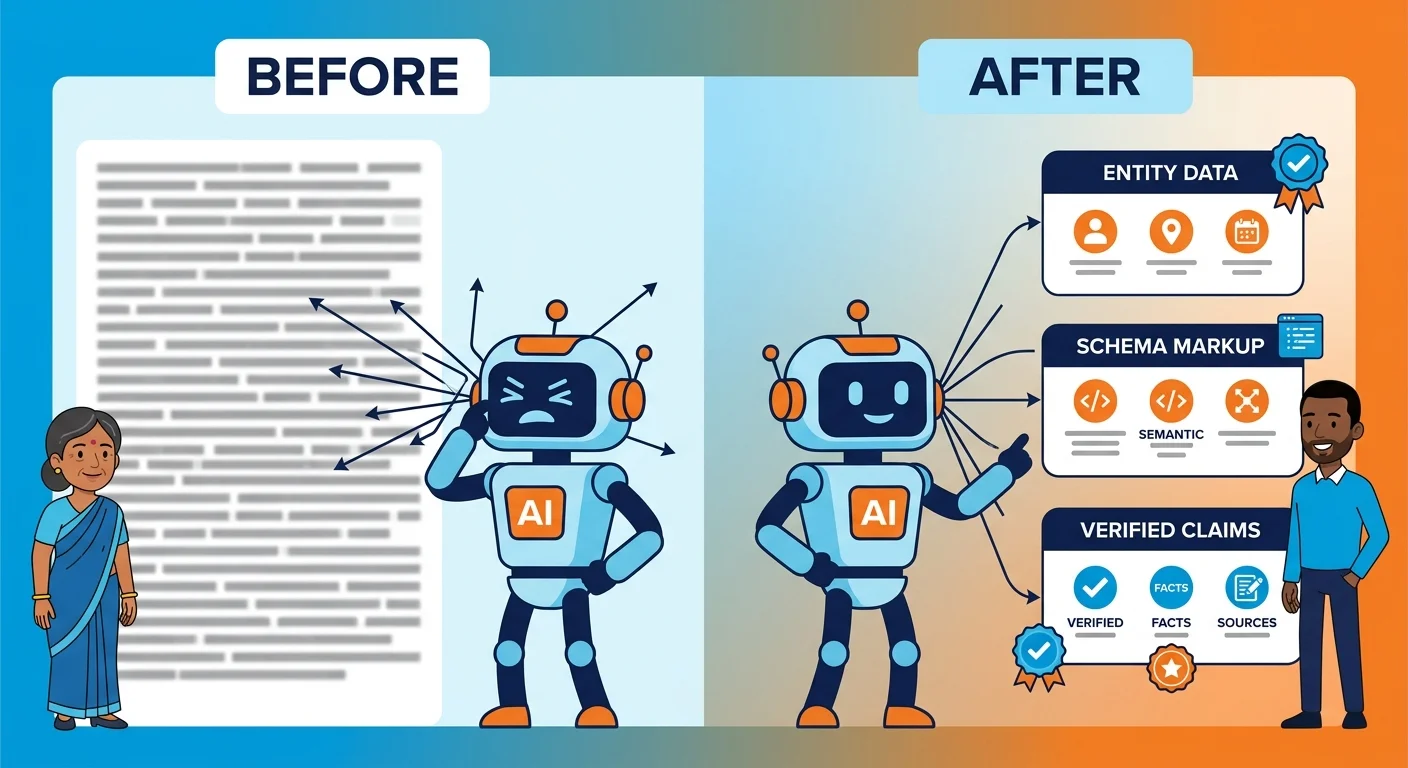
Machine-readability isn't a formatting preference. It's the thing that decides whether a generative engine can verify your claim at all.
Bury a fact in flowing prose, and an AI engine has to guess your meaning from context. Wrap that same fact in structured markup, and it states the meaning outright — no guessing required.
That's where most business content quietly falls apart. It reads great to a person and says almost nothing a machine can verify.
| Content Format | Machine Readability | Typical Use | AI Engine Benefit |
|---|---|---|---|
| Unstructured Prose | Low — meaning must be inferred from surrounding sentences | General narrative pages, blog-style service descriptions | Weak, since attention disperses across the page and verification stays uncertain |
| Schema Markup | High — labels hours, credentials, and services in a vocabulary engines already trust | Business hours, credentials, service listings, review data | Strong, since a generative engine can check a labeled fact directly rather than infer it |
| Knowledge Graph Triples | High — connects an entity to its attributes as discrete, checkable facts | Entity relationships such as ownership, location, and service scope | Strong, since triples paired with web text give a model a structure to verify prose against |
| Combined Structured Data With Narrative Text | High — structure anchors meaning while prose supplies context | Pages that mix schema or triples with explanatory paragraphs | Strongest, since focused attention on labeled facts reinforces confidence in the surrounding narrative |
Structured Data Formats That Carry Real Weight
Schema markup is still the clearest example of a format that carries real weight. It labels a business's hours, credentials, and services in a vocabulary generative engines already trust.
Knowledge graph triples do the same job from another angle. Instead of describing a business in narrative form, they tie an entity to its attributes as discrete, checkable facts.
That's the same logic behind pairing extracted knowledge graph data with the web text around it. Combine the two and a generative engine gets a verifiable structure to check the prose against, instead of parsing meaning out of paragraphs alone.
Local business schema, FAQ schema, review schema — each one handles a different category of fact. Together they turn one webpage into a set of individually verifiable claims, not one long unverified story.
Attention Patterns: Why Structure Beats Volume
Structure doesn't just help a human skim faster. It changes how a language model actually processes the page.
Research on how multimodal language models process text found that structured text pulls attention onto the regions that actually carry meaning, while unstructured text scatters that attention and drags performance down. A wall of loose paragraphs gives a model nowhere reliable to focus — and reliability is exactly what citation runs on.
This isn't only a formatting worry for what you publish. It's a warning about the data these systems get trained on in the first place, because generative AI systems trained on synthetic data show a documented pattern of breakdown called model collapse, confirmed in published research, where the model's tie to the real distribution of facts weakens with every generation.
Liu and colleagues landed on this through systematic analysis of multimodal models, published through the arXiv preprint server, and the pattern holds for the same reason a clinic's proof submission workflow beats any single webpage. A model that can't locate meaning reliably won't cite that meaning confidently — which is exactly the gap structuring a continuous proof submission workflow for local clinics is built to close.
How AI Engines Decide Which Businesses to Cite

Structure just gets you into the room. Selection is a whole different call, and it runs on one thing: specificity.
Hand an AI engine two sources built the exact same way, and it picks the one carrying concrete, checkable numbers over the one waving general claims. That's not a hunch about how these models behave. Pages cited in Google AI Overviews are 72% more likely to carry specific numbers and statistics than non-cited pages sitting at the same organic position, a pattern documented in published research data.
And that gap shows up at the same rank position, which means position alone never explains it. The vague business and the precise, sourced one can rank dead even and still get cited unevenly. Every time, the figure wins.
| Citation Factor | Cited Pages | Non-Cited Pages |
|---|---|---|
| Specific numbers and statistics present | 72% more likely to include a specific figure | Baseline rate at the same organic rank position |
| Verification target for the engine | Individual facts and verifiable claims checked directly | Whole webpage treated as the unit of relevance |
| Citation outcome at equal rank position | Selected despite identical organic position | Passed over at that same organic rank position |
This Isn't for Businesses Chasing a Quick Ranking Fix
Here's the thing: this selection behavior isn't built for a business hunting a fast fix. Wanting to tweak one page and watch citations climb in a few days misreads what generative engines are actually weighing.
They're not scanning for a keyword. They're checking whether one specific, verifiable claim about you still holds up against everything else the web says.
A business that won't keep that proof fresh over time won't hold onto citation, no matter how sharp the page read on day one. The groundwork for that ongoing proof, including how to structure an auditable proof graph for local service businesses, matters more than any single content refresh ever will.
Building a Continuous Proof Submission Workflow
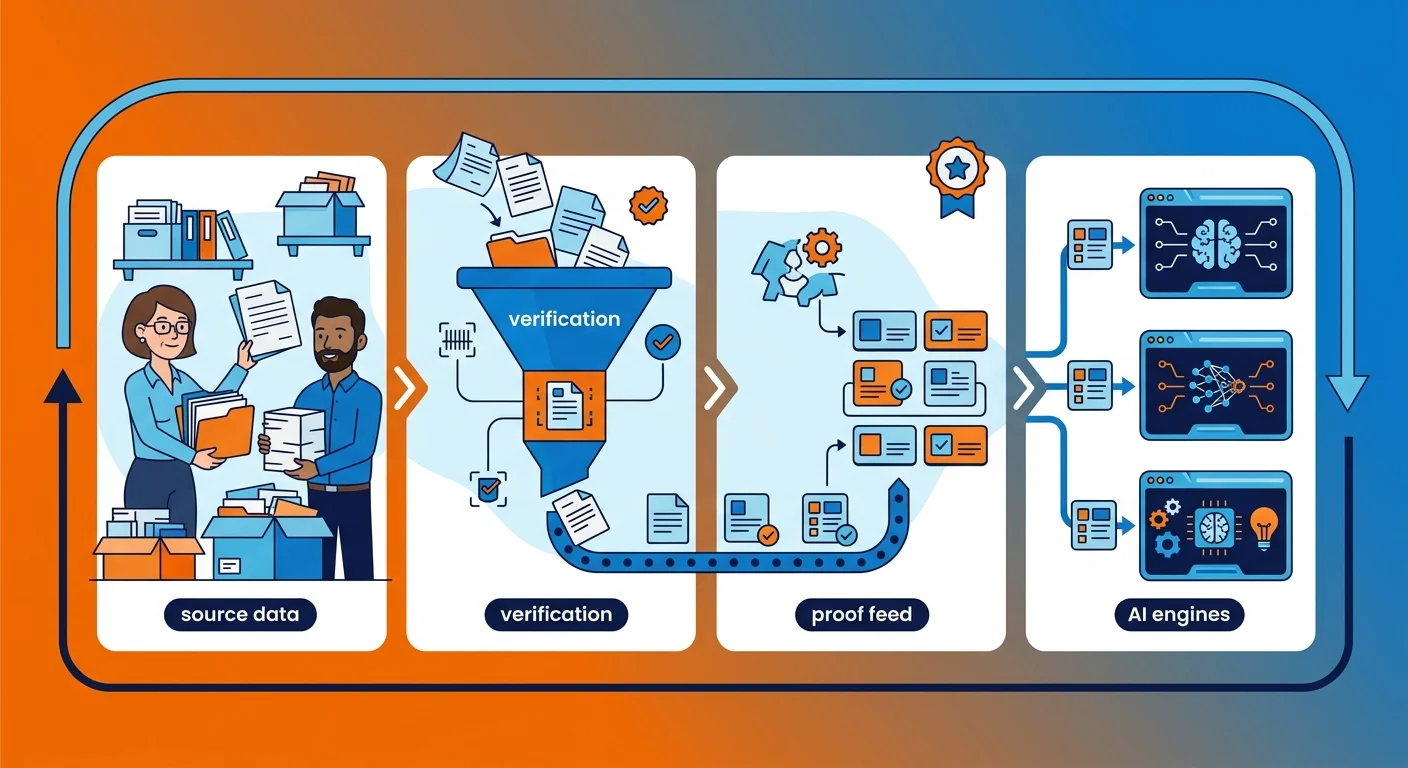
Knowing why proof decays doesn't hand you a system that stops it. That's what a continuous proof submission workflow is for — it runs on a schedule, not a whim.
Think of a produce manager working a shelf. Somebody checks it, restocks it, and pulls what's gone bad — on a rhythm that never actually stops.
| Workflow Stage | What Happens | Who Owns It | Frequency |
|---|---|---|---|
| Mapping | Every location where a business fact lives gets identified, from schema markup to review platforms to directory listings. | The proof workflow owner, working from the business's own records and live web presence | Once, at setup, then revisited whenever a new proof source appears |
| Cadence Assignment | Each mapped source gets a check-in rhythm matched to how fast that category of fact actually changes. | The proof workflow owner, in coordination with whoever manages the underlying business data | Set once per source category, then adjusted as decay patterns become clear |
| Verification Pass | Current facts get checked against what is published across the web, flagging anything stale or contradicted. | A dedicated reviewer or an automated checking process feeding a human decision-maker | Continuous, on a rolling basis rather than a fixed calendar date |
| Correction and Resubmission | Flagged conflicts get corrected at the source and the fresh version gets pushed back out to every location that carries the old one. | The proof workflow owner, coordinating across schema, listings, and profile updates | Triggered by the verification pass, not by a preset schedule |
| Structural Reinforcement | Knowledge graph triples and schema markup get updated alongside the underlying fact, so structure and content never drift apart. | Whoever maintains the technical implementation of schema and structured data | Every time a correction or resubmission happens |
Mapping Your Proof Sources and Submission Cadence
Start by mapping every place a fact about the business lives. Hours, credentials, service areas, reviews, schema markup — each sits somewhere different, and each one spoils at its own pace.
A credential barely moves. A service area might shift with the season, and reviews pile up new entries all the time.
Lump all of that onto one blanket update schedule and the workflow quietly fails. Fast-moving proof needs a tighter cadence than slow-moving proof — mash them together and one category always goes stale.
So build the cadence around how fast each source decays, not around one annual pass. That means checking reviews and listings far more often than credentials — and it means the schedule itself becomes part of the proof.
Handling Conflicting or Outdated Data Across the Web
Even a sharp cadence won't stop every conflict from popping up somewhere on the web. Old directories, cached pages, and dead profiles keep stale facts alive long after you've moved on.
Hand a generative engine two conflicting versions of a fact and it won't guess in your favor. It weighs source strength, and a structured, current claim generally beats an unstructured, stale one.
This is where pairing extracted relationship data with the surrounding web text pulls its weight. Efficient extraction methods tie knowledge graph triples to web text directly, without needing a large language model call just to pull the graph out — an approach laid out in a knowledge graph extraction study hosted on arXiv.
Point that same pairing at a business's proof footprint and the workflow can flag a stale listing against a verified triple, instead of trusting whichever page ranks first. The conflict gets caught before a generative engine ever has to guess which version is real.
Frequently Asked Questions
Same questions come up every time we walk through this. Here are the straight answers.
What exactly is 'proof decay' in the context of AI search engines?
Proof decay is what happens when a business's factual data goes stale or gets contradicted somewhere else online. Trust and visibility slip away, slowly. A generative engine re-checks those facts constantly, so anything you don't maintain keeps losing citation ground.
How is 'citation velocity' different from traditional site visits?
Citation velocity is how often, and how consistently, AI engines cite a business as an authoritative source in their answers. Site visits count who lands on a page. Citation velocity counts whether the engine trusts that page enough to keep quoting it.
Can't I just update my website content regularly to prevent proof decay?
Here's the catch: periodic manual updates leave gaps between checks, and decay creeps in inside those gaps. A generative engine verifies facts around the clock. Any schedule built on occasional edits will always trail what it's actually asking for.
What kind of structured data is most important for maintaining citation velocity?
Local business schema, FAQ schema, and review schema each carry a different category of fact in a vocabulary generative engines already trust. Knowledge graph triples back that up. They tie an entity to its attributes as discrete, checkable claims instead of narrative prose.
How long does it take to see results from implementing a machine-readable proof architecture?
There's no fixed timeline, and refusing to promise one is honest. Citation velocity is a frequency that builds as fresh, verifiable data stacks up, not a switch that flips. What matters is that the proof supply never quits.
Does a Machine-Readable Proof Architecture replace the need for traditional search optimization entirely?
No, and nobody's claiming it does. Traditional search optimization still governs how a page gets discovered. But it says nothing about whether a generative engine can verify what that page claims once it arrives.
Where This Leaves Your Business in 2026
Citation velocity isn't something you win once and walk away from. It's a frequency. And frequency only holds up if you keep feeding it.
Treat your factual footprint like a monument, and you'll keep losing ground to the business treating it like a shelf. The monument cracks quiet. The shelf gets restocked before anything goes bad.
Traditional search optimization was built for a static web that's already gone. What generative engines reward now is a Machine-Readable Proof Architecture that keeps verifiable, fresh data flowing, not a page that ranked once and quit. iTech Valet built its work around that exact restocking rhythm, and the fastest way to spot where your own proof has already spoiled is to run an AI visibility check.