
What Actually Happens When a Review Gets Old in the Eyes of an AI Engine
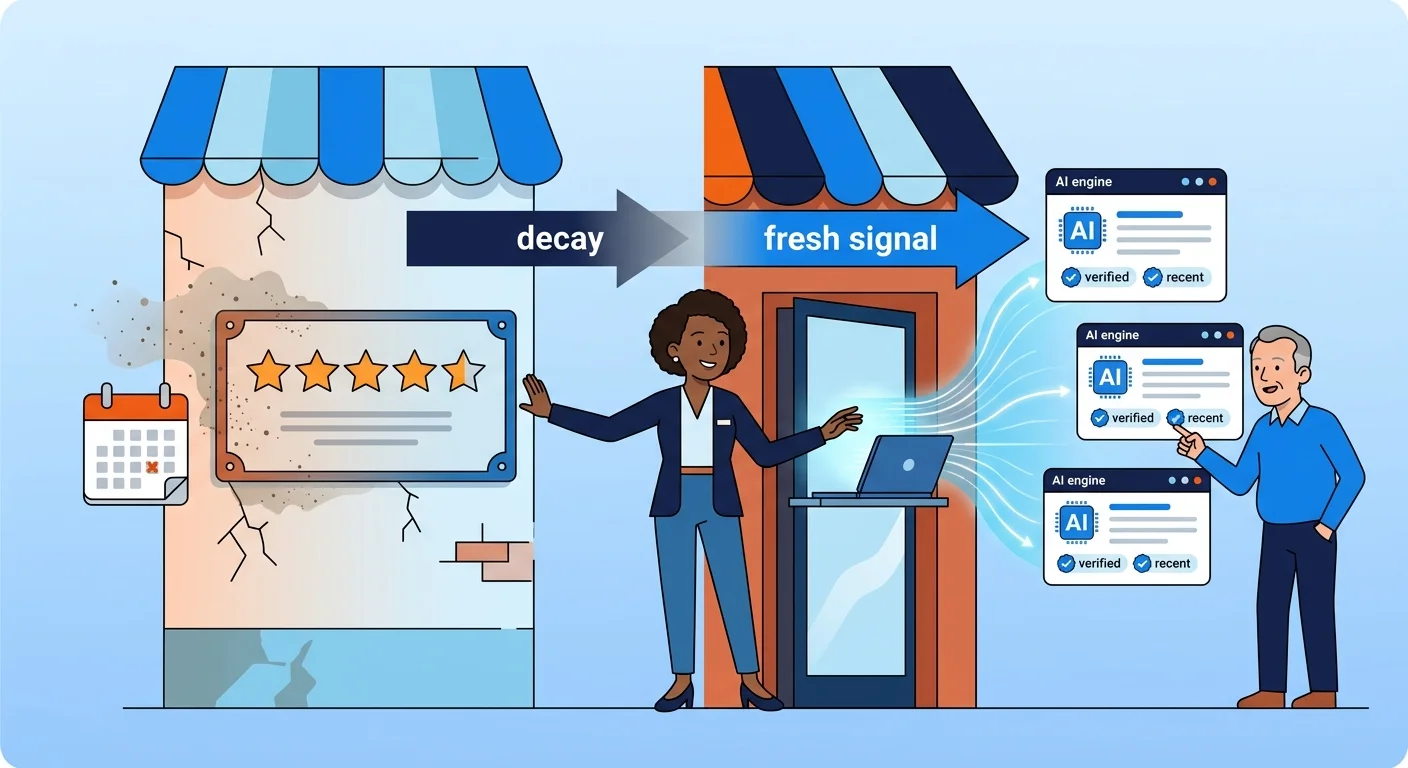
Decay means the proof underneath stops matching reality — even though the words on the page never move. A review, a citation, a listing entry: all of it starts aging the moment nobody comes back to it.
Here's the habit that ignores all this. Most businesses still treat proof collection as a one-time event, filed away like a photograph tucked in a drawer. That made sense under traditional search optimization, where piled-up volume alone signaled authority.
Look at the open web and you'll see how fast unattended content rots. Per Pew Research Center, 25% of all webpages collected from 2013 through 2023 were dead by October 2023. A review left untouched follows the same path, just slower and quieter. The risk isn't that it was wrong when written; it's that nothing has confirmed it since, and that gap is exactly what generative engines are built to catch.
This is the moment proof decay stops being a content issue and becomes a structural business problem. Old reviews keep their words but lose their signal of current validity — the same way a photograph keeps its image but loses its accuracy the longer it hangs untouched on the wall. Why that bites harder in 2026 than it did a year ago is exactly what makes the case for continuous machine-readable citation so urgent for any business still leaning on a historical stack of five-star reviews.
Why Chasing Review Volume Stopped Being a Winning Bet

Chasing volume was never the mistake. It was a smart bet under a system that has since changed the rules.
Under traditional search optimization, piling up reviews was a durable play. Stack enough stars and the algorithm read the pile as proof, no matter when any single review was written.
Generative engines don't work that way. They weigh the recency, relevance, and verifiability of the data underneath before they decide what to trust.
The Problem With Treating a Review Like a Trophy Instead of a Signal
So the rejected method is easy to name: treating a five-star tally like a trophy case instead of a live signal.
Here's the thing about a trophy case — it gets dusted, not updated. Nobody stops to check whether the trophy still reflects who the business is today.
That's exactly the posture that dies in front of a generative engine. The engine isn't impressed by the count on the shelf — it wants to know the count is still true.
Businesses stuck in this mindset keep collecting the same way they always did, then wonder why visibility slips even as the number climbs. Volume was the old proxy for trust. Verifiability is the new one.
Fixing that starts with a workflow, not another round of review requests. Businesses ready to ditch the trophy-case habit can work through a practical framework for keeping citations current instead of stacking more static stars onto an already aging pile.
What Google and the Generative Engines Are Actually Grading You On

So if it isn't the size of the pile, what are the ranking systems actually grading? Google's automated systems score content quality on a mix of factors built to read experience, expertise, authoritativeness, and trustworthiness.
Of those four, trust carries the most weight. That one fact reorders the whole conversation about static reviews — because trust is exactly what fades first when proof sits untouched.
| Quality Signal | What It Measures | Static Review Performance | Continuous Proof Performance |
|---|---|---|---|
| Trustworthiness | Whether the claim can be confirmed as currently accurate by a real, checkable source | Assumed to hold indefinitely once posted, with no mechanism to reconfirm it | Reconfirmed continuously through fresh, verifiable data the engine can re-check on demand |
| Experience and Expertise | Whether the source demonstrates real, first-hand familiarity with the subject | Demonstrated once at the moment of writing, then left to age without update | Reinforced over time through ongoing, attributable proof rather than a single historical entry |
| Authoritativeness | Whether other machine-readable signals corroborate the claim | Isolated text with no structured data tying it to present-day context | Cross-referenced against timestamped, structured signals that confirm current standing |
| Recency and Relevance | Whether the underlying data still matches the question being asked right now | Frozen at the point of publication, growing less relevant with every year untouched | Fed on an ongoing basis, so relevance is measured against present conditions, not the past |
How Trustworthiness Outweighs the Other Three E-E-A-T Signals
Here's the thing about trust: it's not a fixed attribute. It has to be re-earned, again and again, against present-day evidence — that's straight from Google's documentation on how automated ranking systems judge content quality.
Experience, expertise, and authoritativeness get proven once and cited forever. Trust doesn't work that way. A credential from five years ago still counts, but a five-star review from five years ago proves nothing about who the business is today.
That asymmetry is why proof decay bites trust harder than the other three signals. Clinics trying to keep that one signal alive can look at a continuous proof submission workflow built for local clinics instead of treating trust as something settled once and filed away.
Why a Silent Search Result Can Still Mean You Won
Now picture the flip side — the engine answers the question outright and never sends the reader anywhere. A significant share of all abandoned searches, on both desktop and mobile, are moments where the user's need was already met by the results on the screen.
No click happened. But that silence doesn't mean the business lost the moment.
It means the answer engine trusted the proof underneath enough to surface it straight — a pattern backed by published research data on query abandonment. Freshness alone won't buy that spot, though. Chasing recency with no regard for relevance doesn't reliably help, and can make the engine's answer feel stale instead of current.
Turning Proof Into a Living Process Instead of a One-Time Event
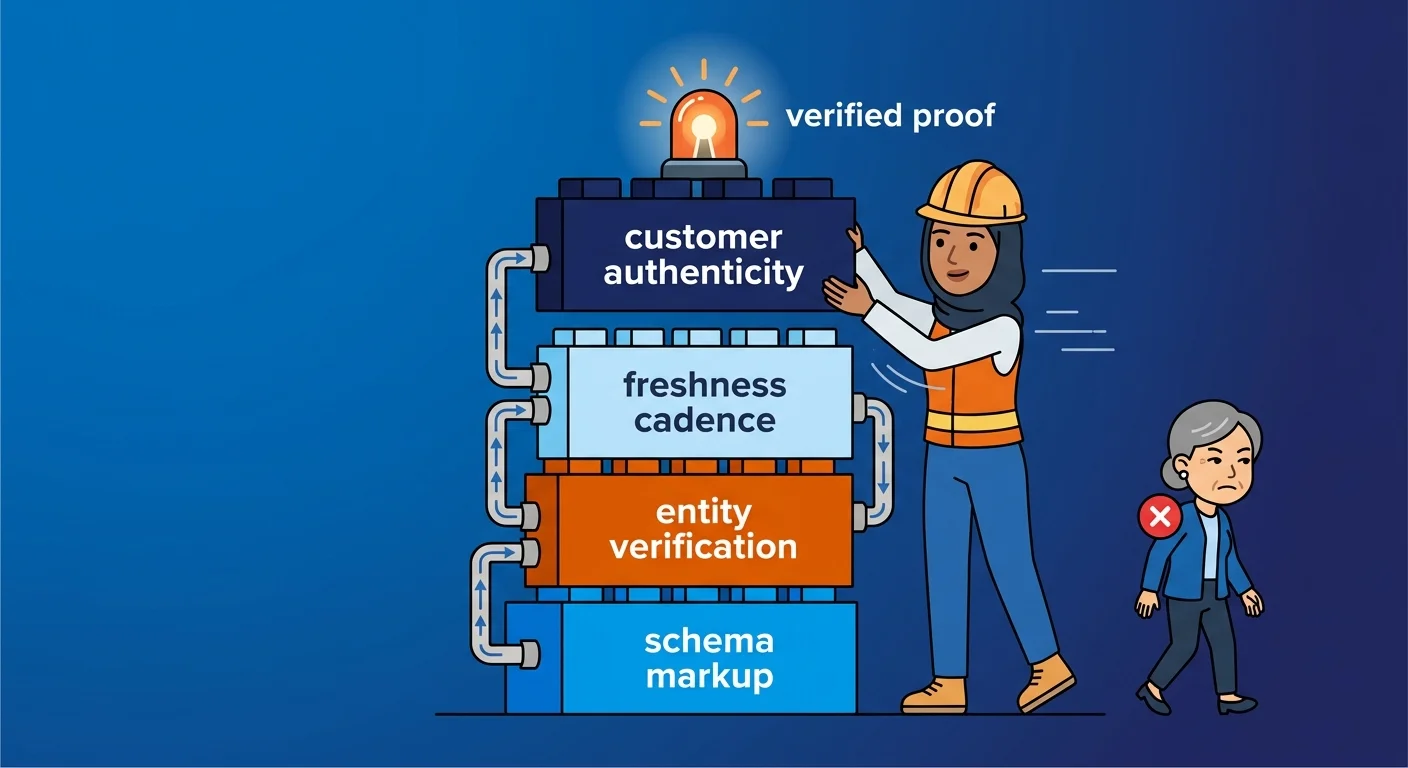
Fixing proof decay isn't about writing better reviews. It's about building a system that keeps proof alive long after it's published.
Here's the flaw baked into most review strategies: they treat proof as a one-time event instead of a continuous, machine-readable signal. Collect it, post it, move on — that's the whole workflow for most businesses.
A Machine-Readable Proof Architecture throws that workflow out. Instead of one static snapshot, it treats proof as a stream generative engines can keep reading, checking, and citing.
| Component | Function | Why It Prevents Decay |
|---|---|---|
| Structured Data Markup | Labels a review as a review, tagged with its rating, date, and source in a format a generative engine can parse without guessing | Removes ambiguity about what the content is and when it happened, so the engine never has to infer freshness |
| Timestamp Attribution | Attaches a verifiable date to every piece of proof, including updates or reconfirmations after the original post | Gives the engine a concrete signal for how current the proof still is, instead of treating every review as equally recent |
| Genuine Source Verification | Confirms the reviewer is a real, identifiable customer rather than an anonymous or fabricated entry | Satisfies the standard that reviews truly reflect feedback from genuine customers, so the engine can trust the source, not just the words |
| Continuous Submission Workflow | Replaces a single collection push with an ongoing process that keeps adding fresh, attributed proof over time | Directly corrects the fundamental flaw of treating proof as a one-time event instead of a continuous, machine-readable signal |
The Building Blocks of a Machine-Readable Proof Architecture
So what actually makes proof machine-readable instead of just published? It starts with structure, not sentiment.
Structured data markup tells a generative engine what a review is, who gave it, and when it happened — in a format the engine parses without guessing. Text alone can't do that.
Timestamps matter almost as much as the structure itself. A review with no date context reads the same to an engine whether it's a week old or five years old — and that ambiguity is exactly what breeds proof decay.
Attribution closes the loop. Anyone weighing this against How to Map Claim-to-Evidence Wiring for AI Search Engines in 2026 will spot the same principle repeating: a claim with no traceable source carries almost no weight with a generative engine, no matter how well it reads.
Verifying That a Review Actually Came From a Real Customer
Structure and timestamps solve the freshness half of the problem. Attribution solves the other half — proving the review came from somebody real.
And this isn't cosmetic. Platforms featuring online reviews should have processes in place to make sure those reviews truly reflect feedback from genuine customers — a standard laid out directly by the Federal Trade Commission.
That standard exists because fabricated and anonymous reviews are indistinguishable from real ones once decay sets in. An engine that can't verify the source treats the whole review as unreliable, no matter what it says.
Who Proof Decay Actually Repels and Who It Was Never Built For
Now, none of this is built for a business that wants a one-time fix. If the goal is a quick batch of five-star reviews to post and forget, this architecture isn't your tool.
It's also not built for anyone chasing volume over verification. Stacking anonymous, undated reviews to pad a count only speeds up the exact decay this section is solving.
This is built for businesses willing to treat proof as infrastructure. A continuous, verifiable signal beats a bigger pile every time an AI engine decides what to trust.
Where Continuous Proof Fits Into an Everyday Review Workflow

So how does a Machine-Readable Proof Architecture actually run day to day? Not in one dashboard visit. Not in a quarterly review sweep.
It runs on a rhythm. Structure, timestamps, and attribution only keep working if somebody keeps feeding them — which turns the whole thing from a one-time build into a standing habit.
| Workflow Step | Cadence | Who Owns It | Signal It Produces |
|---|---|---|---|
| Capture new proof | Weekly | Front-line staff or intake team | A tagged, timestamped review ready for structured markup |
| Structure and publish | Weekly, same cycle as capture | Whoever manages the business's structured data | A machine-readable entry a generative engine can parse without guessing |
| Verify attribution | Ongoing, checked each cycle | A designated reviewer or manager | Confirmation the proof traces to a genuine customer |
| Audit for staleness | Monthly sweep across the full proof stream | Whoever owns the Machine-Readable Proof Architecture | A flagged list of aging entries that no longer reflect current standing |
| Retire or refresh flagged proof | As staleness is found, not on a fixed delay | Same owner as the audit step | A stream that keeps reading as current instead of quietly decaying |
Building the Weekly Rhythm That Keeps Proof From Going Stale
Here's the pattern that actually holds up: a fixed weekly checkpoint where new proof gets captured, tagged, and pushed live before it has a chance to sit idle.
And it doesn't need to be elaborate. It just needs to happen on a schedule instead of whenever someone remembers.
Look at the alternative. Without a rhythm, proof collection slides right back into that one-time posture this article keeps flagging — filed away and forgotten until it quietly stops reflecting the business at all.
A weekly rhythm closes that gap before it opens. Every cycle re-confirms the signal instead of letting it fade — the whole difference between a photograph aging on a wall and a feed that keeps updating itself.
Frequently Asked Questions
Same questions keep coming up once businesses see what proof decay actually costs them. Here are the straight answers.
How does an AI search engine determine if a review is fresh or outdated?
Recency alone doesn't settle it. The engine cross-checks a review's timestamp against structured data and other relevance signals before it decides the review still reflects who the business is today.
Can structured data alone make an old review seem trustworthy to an AI?
No. Structure tells an engine what a review is — but it can't manufacture trust an old, unverifiable review never earned in the first place.
What is proof decay and how does it affect local business visibility in AI Overviews?
It's the loss of signal value that hits when static reviews age with no renewal. In AI Overviews, that means your older proof just stops getting cited — even though it's still sitting there, published.
Is it better to have fewer recent verifiable reviews or many old static reviews for AI search?
Fewer, verifiable reviews win. A generative engine trusts a small stream it can confirm over a giant pile it can't.
What is the first step to creating a continuous proof workflow for a business's reviews?
Start with a fixed schedule for capturing, tagging, and publishing new proof. A one-time cleanup won't hold. The habit is what stops the next round of decay.
How do AI search engines handle anonymous versus attributed reviews?
Attributed reviews carry far more weight. An anonymous one gives the engine no traceable source, so it has no way to confirm a real customer ever wrote it.
Where This Leaves You
So where does this leave a business still sitting on a stack of old five-star reviews? Proof decay never announces itself. It just quietly chews through the trust signal until a generative engine stops citing what it can no longer verify.
Think about that photograph again — warped, faded, still hanging on the wall, telling nobody the truth about today. A live feed doesn't have that problem, because it never stops confirming itself. That's the whole difference between a Machine-Readable Proof Architecture and the reviews strategy it replaces: one keeps proving itself, the other just keeps aging.
Nobody fixes proof decay by writing better reviews. You fix it by building the structure, the timestamps, and the attribution that let proof keep speaking long after it was first posted. And if a stack of static reviews is the only proof your business has left, check what your current visibility actually looks like to an AI engine right now.