
What a Local Pack and a National Pack Actually Are
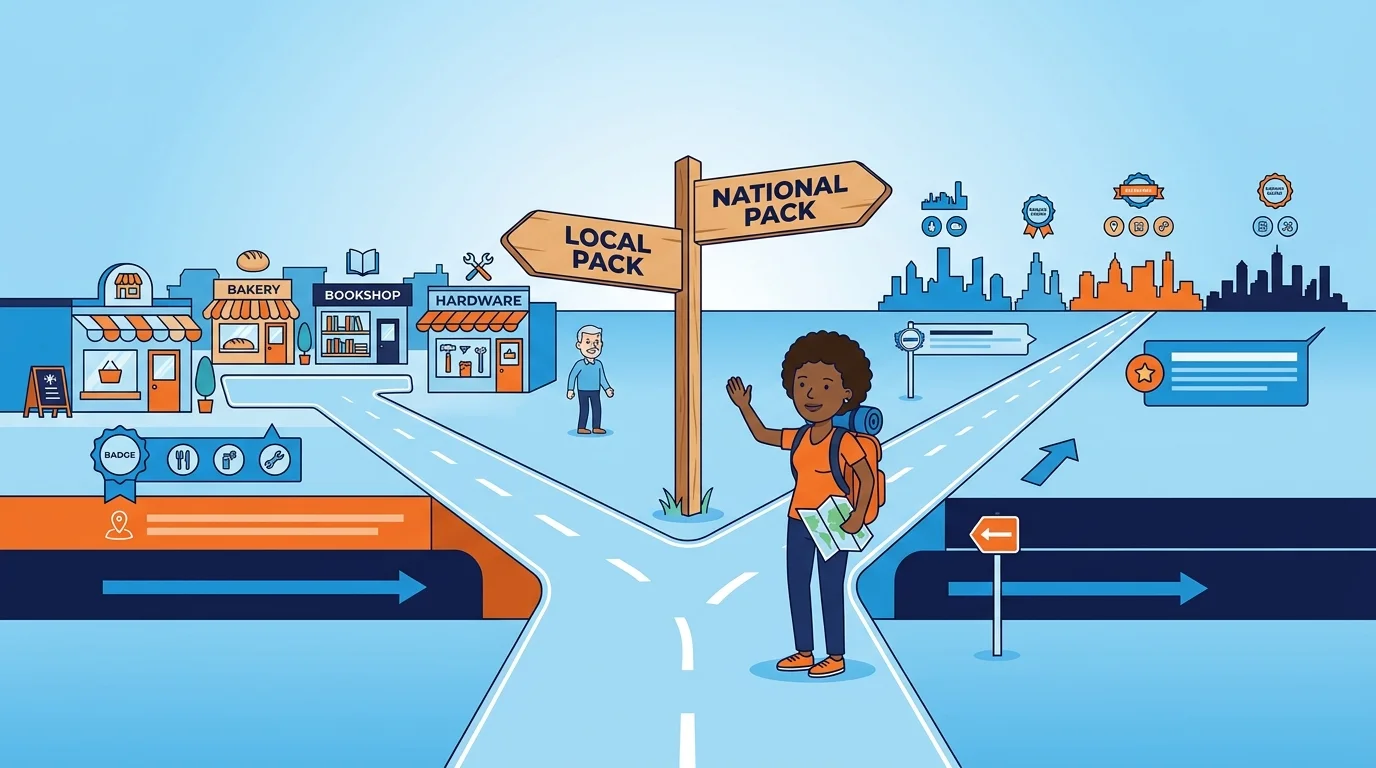
Here's the thing: a Local Pack and a National Pack aren't two sizes of the same tool. They're two different instruments, and each one is built to answer a different kind of question.
The assumption that more content automatically produces more visibility doesn't hold once the content is scoped against the wrong question. A geographically dense Local Pack answers a topic question poorly, and a sprawling National Pack answers a location question just as poorly. Volume without precise scope doesn't convert into citations — it dilutes the signal generative systems are trying to match.
| Dimension | Local Pack Scope | National Pack Scope |
|---|---|---|
| Primary Signal | Relevance, prominence, and proximity concentrated around a defined service area | Topical depth and subject comprehensiveness, independent of geography |
| Content Architecture | Location-anchored pages paired with structured data tying the entity to a specific place | A body of subject-matter content broad enough to cover a topic from multiple angles |
| Citation Goal | Become the cited answer for a city, region, or service area query | Become the cited reference point for an industry-wide or subject-wide query |
| Geographic Markup | Central to the strategy — structured data must tie the business to a defined geography | Secondary or absent — the goal is subject authority, not location signals |
| Best Suited For | A business whose customers search within one metro area or service radius | A business competing on a topic that spans locations or serves a national audience |
Defining the Local Pack
A Local Pack lives or dies on geographic saturation. It stacks relevance, prominence, and proximity signals around one service area, so generative AI treats the business as the answer for that exact place.
That saturation happens through location-anchored pages paired with structured data that ties the business entity to a defined geography. The scope is narrow by design — not thin, narrow.
Defining the National Pack
A National Pack is defined by topical dominance instead. It builds depth across a subject broad enough that a generative system can treat the business as a reference point on that topic, independent of where the searcher sits.
That dominance comes from covering the subject completely, not from geographic markup. Let's keep it real: a business weighing first steps toward AI citations on an existing website is really deciding which of these two scopes its existing pages are missing.
Why Generative Answers Changed the Scoping Decision
Scoping decisions used to lean on keyword position tracking. Then generative answers started forming before a ranked list ever loaded, and that whole foundation shifted under everyone's feet.
How Often AI Overviews Intercept the Query
Grossman et al. (NJIT) reports for 51.5% of representative, real-user queries, AI Overviews may be generated and displayed above the organic search results. Now… this part matters: the same study puts the figure at 48.8% for "near me" searches. That still says plenty, because a generated answer, not a ranked list, is now the first thing a lot of searchers see.
The Query Fan-Out Mechanism Behind the Answer
As Google's documentation says, Google's AI Overviews and AI Mode may use a "query fan-out" technique, issuing multiple related searches across subtopics and data sources to develop a response. That fan-out process pulls from multiple subtopics and data sources to assemble one answer. A business weighing content pack pricing versus site replacement pricing is weighing how much its existing pages need to change.
Why 'More Content' Is the Wrong Scoping Instinct
Picking a Local or National scope is one of the bigger visibility calls a business makes online. And the reflex to just pile on more content misreads what that call actually asks for.
The Volume Assumption and Where It Breaks
Agencies selling a game that ended still price projects by page count and article volume. Here's the kicker: volume was never the variable this scope decision measures.
How a Generic National Push Fails a Local Query
A National Pack built for industry-wide reach rarely nails a city-specific question, no matter how big it gets. Its depth is topical, not geographic, so a generative system has nothing location-anchored to cite. A business can see how assistants begin citing new articles over time and still miss local citations entirely if nobody ever fixed scope (volume was never the problem).
What Breaks When a Pack Is Scoped Wrong

A wrong-scoped pack doesn't fade quietly. It breaks in a specific, traceable way, and the break tells you exactly which signal went missing.
| Missing Signal | Failure Mechanism | Citation Cost |
|---|---|---|
| Geographic anchor | A business entity has no defined place for a generative system to anchor it, so location-specific questions find no page to cite. | The business disappears from location-anchored answers even when its broader content is strong. |
| Topical depth | A pack holds every local signal but never builds subject coverage, so broader industry questions route to intermediary platforms instead. | The business loses the citation for any question that extends past its immediate service area. |
| Structured data consistency | Listing details go unclaimed or incomplete, so the entity record a generative system reads stays thin or contradictory. | Maps and knowledge panel surfaces skip the business even where the written content is accurate. |
| Scope-to-query match | Content built for one kind of question gets stretched to answer the other, diluting the signal instead of sharpening it. | Neither the local nor the topical query gets a precise enough match to earn the citation. |
What Breaks When Geographic Signals Are Missing
Without geographic signals, a business entity has no defined place for a generative system to anchor it. Claiming and completing a Google Business Profile matters here. As Google's documentation says, claiming a local business profile lets an owner verify the listing and provide or edit address, contact information, business type and photos, which can then appear in Google Maps and the Google knowledge panel.
What Breaks When Topical Depth Is Missing
Without topical depth, a business can hold every local signal and still lose the citation for broader industry questions. Health-related answers show this clearly. Zha & Chang (Dartmouth) report Google's AI Overview citations for health queries may be concentrated on intermediary platforms, with YouTube appearing as the most-cited domain in the US, ahead of established health authorities. Intermediary platforms outranked established authorities in that case. There is more on AI visibility services if this is the part that matters to you.
How the Signals Stack Differently for Each Pack
So why does a wrong-scoped pack break? Because it was built on the wrong signal stack from day one, and each pack pulls from a completely different set of inputs.
| Signal Layer | Local Pack Role | National Pack Role |
|---|---|---|
| Business Profile Data | Anchors the entity to a verified address, phone number, category, and photo set a generative system can match against a near-me question. | Carries little weight; profile data describes a single location, not a subject area. |
| Location-Specific Pages | Reinforces the geographic anchor with service-area detail, structured data, and locally scoped language. | Plays no direct role; location pages narrow scope rather than broaden it. |
| Subject-Matter Depth | Stays narrow by design, covering only what a local searcher in that service area needs. | Carries the entire weight of the strategy, building coverage broad enough to read as a reference point on the topic. |
| Entity Consistency | Ties name, address, and category together so the same local entity resolves across every mention. | Ties authorship and topical focus together so the same subject-matter entity resolves across every page. |
| Structured Data Role | Marks up geography — service area, location, business type — for a system matching a place-based question. | Marks up topic and content relationships, supporting a system matching a subject-based question instead. |
The Local Signal Stack
The Local Signal Stack runs on geography. A completed, verified business profile pins the entity to a place. Then location-specific pages reinforce that pin with structured data a generative system can match against a near-me question.
The National Signal Stack
The National Signal Stack runs on topical coverage instead. It builds a body of work broad and deep enough that a generative system treats the business as a reference point for the subject itself. No single page carries that weight, and no single place does either.
Building and Sequencing the Right Pack
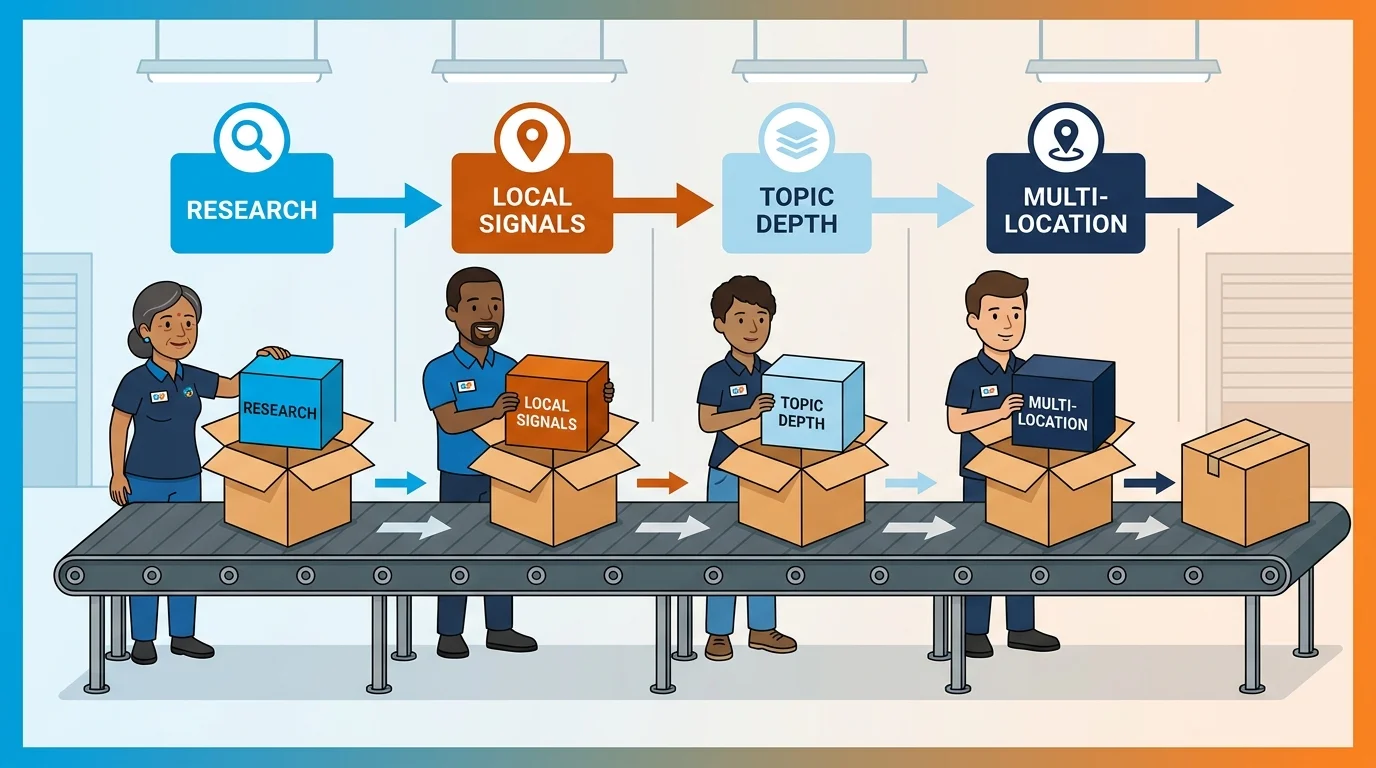
Architecture only pays off when it gets built in the right order. Sequence a pack wrong and you've wasted the scope decision you just made.
| Build Stage | Local Pack Sequence | National Pack Sequence |
|---|---|---|
| Foundation Stage | Claim, verify, and complete the business profile before any location page goes live | Map the full subject's range before any single article ships |
| Core Build | Publish location-anchored pages that reinforce proximity and prominence signals | Layer subject depth piece by piece so the body of work reads as comprehensive |
| Structural Reinforcement | Pair each location page with structured data tying the entity to that geography | Interlink coverage so no page competes against the next for the same question |
| Maturity Signal | Geographic saturation across the defined service area | Topical dominance broad enough to stand as a reference point on the subject |
Sequencing a Local Pack Build
A Local Pack build starts with the business profile, not the website. The profile gets claimed, verified, and completed before a single location page goes live. Location-anchored pages follow, each one reinforcing the proximity and prominence signals the profile already established.
Sequencing a National Pack Build
A National Pack build starts with topic mapping instead of a single profile. Coverage gets planned across the subject's full range before any one article ships, so no page competes against the next one for the same question. Depth gets layered in afterward, piece by piece, until the body of work reads as comprehensive rather than scattered.
Scoping Content for Multi-Location and Hybrid Cases
A multi-location business needs both stacks running at once, scoped to different pages. Agencies pricing by page count miss this, because the sequencing question was never about volume. It was always about which signal stack a given page serves — and building the geographic layer and the topical layer as two separate instruments, not one oversized one, is what keeps either from diluting the other.
Frequently Asked Questions
A few mechanical questions tend to surface once both architectures are on the table. Here's where those get settled.
Does my business need both local and national content?
Most businesses with a physical service area and a broader subject expertise need both. The two packs get scoped to different pages, not blended into one.
How long does it take for a local content pack to start working?
No verified figure backs a timeline here. So nobody gets one. What matters is sequencing the profile and location pages right before judging results.
Can a national content strategy help with local visibility at all?
A national pack builds topical depth, not geographic anchoring, so it rarely resolves a city-specific question on its own. Local visibility still depends on the geographic signal stack being built separately.
What's more important for AI search: my Google Business Profile or my website's content?
Neither wins outright — they answer different parts of the same question. A completed business profile anchors location; the website content supplies the depth a generative system matches against the query.
If I serve multiple cities, should I use a local or national content strategy?
A multi-location business usually needs a local signal stack built for each service area, paired with topical coverage running across the whole site. Treating every page the same way wastes the scope decision.
How does query fan-out affect which pages get cited?
Query fan-out means a generative system is pulling from several subtopics and data sources to build one answer, not reading a single page in isolation. A page scoped narrowly to its intended question has a clearer shot at being one of those sources than a page trying to cover everything at once.
The Bottom Line
Here's the verdict: scope decides this, not word count. A Local Pack and a National Pack are two separate instruments built for two different questions. Pick the wrong one and the content's wasted, no matter how much of it you publish.
Match the instrument to the question before a single page gets written. A clinic anchored to one service area needs the geographic signal stack built first. A business competing on a broad industry topic needs comprehensive subject coverage instead, and most businesses need both, scoped to different pages rather than blended into one.
Reaching for more content before you've answered the scope question is how visibility budgets quietly burn. Find out which instrument your existing pages are missing with an AI Visibility Check. Right-sized tool, not the biggest one.