
What A Content Pack Actually Buys You

Before weighing cost, it helps to define the product itself. For years, the standard advice for chiropractors wanting to improve their online presence was to add more content, often through monthly content packs or blog packages.
A content pack typically refers to a bundle of pre-written articles or pages designed to target specific keywords, sold as an add-on to an existing website. It is a patch applied to a wall, not a change to what the wall is made of.
Why Content Packs Were Built
Content packs were built for a search era that rewarded volume. More pages meant more shots at showing up for more keyword variations. That logic held up fine when results-page position numbers were the scoreboard.
But that scoreboard has changed. If a practice is deciding whether to patch the old structure or pour a new slab, this overview of adding AI-citable content to a current site spells out what new content on an unchanged foundation can do, and what it can't.
The Boilerplate Problem Hiding Inside Pre-Written Pages
Here's the kicker: pre-written pages carry a problem that has nothing to do with keywords. They read like boilerplate, structurally interchangeable with thousands of other pages stamped out of the same template.
Generative engines read a page hunting for real semantic signal, not phrases dropped in the right spots. So if a page looks like every other content pack page on the internet, why would an AI system treat it as a distinct authority?
| Signal | Content Pack Approach | Rebuilt Site Approach |
|---|---|---|
| Semantic uniqueness | Text repeats structurally across pages, recognizable as the same template with swapped keywords | Each page is built against its own service and location context, with no recurring template skeleton underneath |
| Internal linking | Pages are added onto an existing link structure without revisiting how that structure connects them | Linking architecture is designed from the foundation up, built so related pages reinforce each other |
| Schema and markup | Markup is inherited from whatever template the pack was built on, rarely reassessed per page | Schema is structured as part of the rebuild itself, aligned to what each page actually says |
| What an AI system reads | Structurally interchangeable with other sites on the same template | A distinct structure the system can parse as a dedicated source rather than a copy of a template |
| What the approach was built to win | Volume for the old results-page game, where more pages meant more chances to match a query | Structural trust generative engines evaluate before they ever consider what content sits on top of it |
Why More Pages Stopped Being More Visibility
More pages used to mean more visibility. Every extra page was one more shot at matching a search query. That math only worked because a human was scrolling a results list.
Generative answers do not scan a list. They synthesize a single response from whichever sources demonstrate structural trust.
The Real Cost Of Boilerplate At Scale
Now… this part matters. Spotting boilerplate isn't some hypothetical worry for AI systems, because researchers have already built the machinery to do it. Hao Zhang and Jie Wang found a hierarchical neural network model called SemText can detect HTML boilerplate by using a novel semantic representation of text blocks, and it achieves state-of-the-art accuracy on the CleanEval and GoogleTrends-2017 datasets.
That detection work targeted boilerplate on news pages. For a practice deciding how much pre-written content actually fits its footprint, this matching content pack size to a clinic's service area breaks down the sizing question directly. The underlying structure a site is built on determines whether any volume of content gets treated as signal or as noise.
What A Full Rebuild Actually Changes Underneath The Page
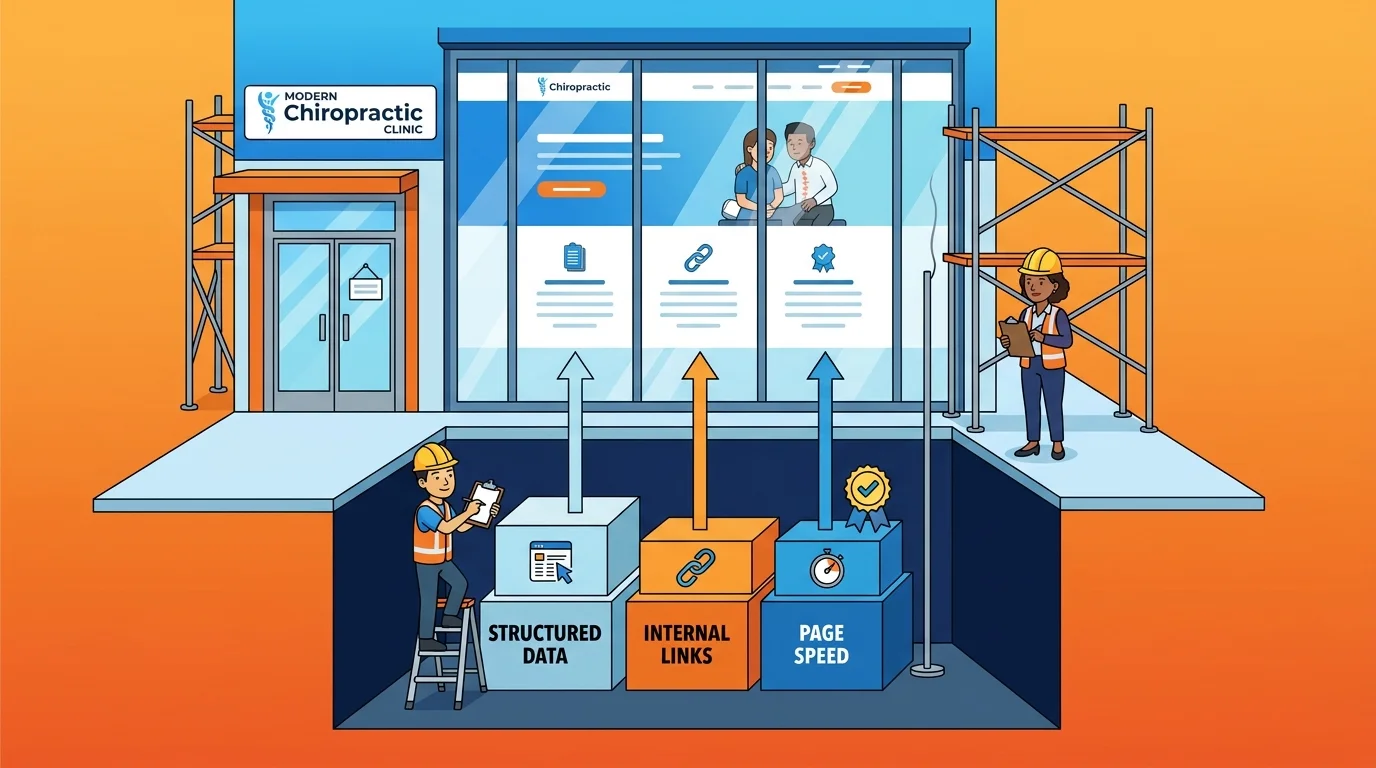
Let's keep it real: a full rebuild changes what the domain is made of. That goes all the way down to the markup a crawler reads before a human ever sees the design.
And that's exactly the part cost comparisons skip. A content pack sits on top of a structure, while a rebuild swaps out the structure itself, including the parts a generative engine checks first.
Structured Data And Internal Linking As Load-Bearing Elements
Schema markup and internal linking hold the whole thing up. They're how a site tells an AI system what each page means and how every page connects to the rest.
A content pack almost never touches either one, so new articles land on a linking structure that was never rebuilt to carry topical weight. They arrive without the wiring that lets an engine trust what they claim (kinda like hanging a TV on drywall with no stud behind it). For anyone weighing what that gap costs over time, here's why delaying a rebuild carries real costs and how the damage compounds when nobody fixes it.
Performance As A Structural Signal, Not A Design Preference
Page speed and stability are not cosmetic either. Google's documentation says Core Web Vitals may be used to measure real-world user experience for loading performance, interactivity, and visual stability of a page.
A content pack built on a slow, shaky foundation inherits that shakiness, no matter how well the new pages are written.
How Answer Engines Decide What To Cite
Here's the thing: citation isn't luck.
Local Signals Answer Engines Weigh Beyond The Page
Review volume and consistency feed the trust signals a generative engine checks right alongside the page itself. For a practice weighing what closes that gap, our managed AI visibility programs are built around the whole structure underneath, with the pages on top treated as one part of it.
Sequencing A Rebuild Without Starting From Zero

Good news: a rebuild doesn't mean torching what already works. It means sequencing: audit first, replace what the audit flags, then rebuild content as the new structure can actually support it.
| Rebuild Phase | What Gets Reviewed | What Gets Replaced |
|---|---|---|
| Audit | Existing pages, current linking structure, schema markup presence, and page speed under real-world load | Nothing yet — the audit only identifies what the next phases will touch |
| Foundation Replacement | Site architecture, internal linking logic, and the markup a crawler reads before rendering | The technical structure the domain sits on, including how pages relate to each other |
| Content Triage | Every existing page, sorted by whether it carries genuine topical depth or only ever chased results-page position numbers | Pages that exist solely as keyword targets, once the new structure is in place to receive their replacements |
| Structured Rebuild | How new and preserved content maps to entities and topics rather than isolated keywords | Content pack style pages, rewritten to sit on the rebuilt foundation instead of on top of the old one |
Auditing What Exists Before Replacing It
Not every existing page is dead weight. Some already carry real topical depth and just need a stronger slab underneath them. So the audit sorts the pages worth keeping from the ones that only ever existed to chase results-page position numbers.
Rebuilding Content As Entity-Anchored Pages, Not Keyword Targets
Replacing content pack pages means writing to entities and topics, not keywords.
Frequently Asked Questions
A few mechanical questions always pop up before the bigger call gets made. Here are the straight answers.
Is it better to update my existing chiropractic site or start over with a new one for AI search?
Start over if the site was built from templated pages chasing results-page position numbers. That foundation needs replacing, not patching. So check what the site is actually built from first.
How much should a chiropractor budget for a full website replacement versus ongoing content updates?
Let the audit set the budget, not the other way around. Some pages already carry real topical depth and just need a stronger foundation. That swings the invoice in either direction.
Can a simple content pack really improve visibility in AI-powered search results?
A content pack can add pages, but it rarely changes what a generative engine finds underneath those pages. Pre-written, keyword-targeted pages often read as boilerplate rather than distinct authority.
What specific website features matter most for getting cited as an authority by answer engines?
Schema markup, internal linking, and genuine topical depth matter most.
How long does a full website rebuild take compared to adding a content pack?
A rebuild takes longer because it replaces the structure before content goes back on. A content pack is faster precisely because it skips that structural work entirely.
What is HTML boilerplate and why does it matter for a chiropractic website?
HTML boilerplate is repetitive, templated markup.
The Bottom Line
Here's the verdict: a patch can't fix a foundation it was never built to touch. Add one content pack page or fifty, and every single one still sits on the same old structure, unchanged.
So the real question was never which option costs less. It's what a generative engine finds underneath the page when it decides whether a chiropractic site deserves a citation at all, and a structure built to chase results-page position numbers was never built to earn one.
Pour the slab first, and the content built on top of it finally has something load-bearing to stand on. iTech Valet treats that sequencing as the work itself, not an upsell on top of it. If a practice must keep its current site, iTech Valet reworks it instead, rewriting the sales copy on what it already has, and every practice is looked at case by case. Start with an AI Visibility Check.