Here’s what most chiropractors don’t realize: you’ve been collecting the wrong kind of proof.
You spent years building a wall of 5-star reviews. You’ve got patient testimonials that would make anyone tear up. Your Google Business Profile is pristine. And when someone asks ChatGPT who the best chiropractor in your area is, your name doesn’t come up.
Not because you’re not the best. Because AI can’t verify it.
The marketing industry sold you on unstructured proof-reviews, testimonials, social media mentions-because it’s easy to generate and sounds impressive in a pitch deck. What they didn’t tell you is that AI engines don’t trust subjective praise the way humans do. They need structured proof: machine-readable data that confirms who you are, what you do, and why you’re the definitive answer.
This article breaks down the difference between structured and unstructured proof, why one moves the AI recommendation needle and the other doesn’t, and what you need to build first if you want to stop being invisible.
Why Your 5-Star Reviews Aren’t Getting You Recommended
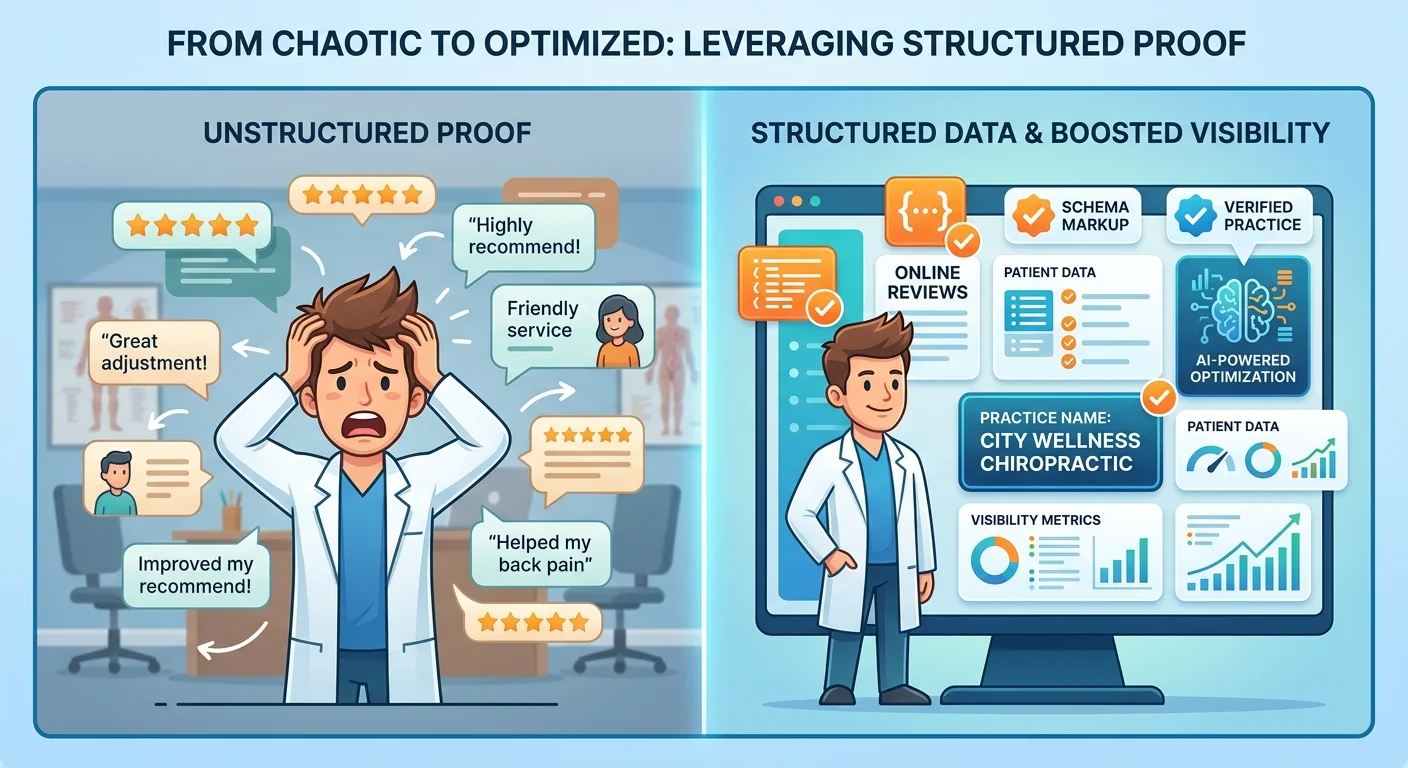
You’ve got a 4.9-star rating. Dozens of glowing reviews. Patients calling you “life-changing” and “the best chiropractor I’ve ever seen.”
And AI still recommends your competitor down the street who has a 4.2 rating and half as many reviews.
Here’s why.
AI Doesn’t Trust Sentiment the Way Humans Do
Humans read reviews emotionally. We scan for keywords like “amazing” and “highly recommend.” We trust the aggregate sentiment. Five stars feels better than four stars.
AI doesn’t work that way.
ChatGPT, Gemini, and Grok analyze reviews for context and sentiment – but they don’t base recommendations on star ratings. They base recommendations on entity trust – the machine-readable signals that confirm a business is who it claims to be, operates where it claims to operate, and delivers what it claims to deliver.
A review is unstructured proof. It’s a human saying something nice about you in prose format. AI can read it. AI can analyze the sentiment.
But AI can’t verify it.
Schema markup is structured proof. It tells AI: “This practice is licensed in California. The founder is Gerek Allen. They specialize in sports injury rehabilitation and have published 47 documented case studies.”
That’s verifiable. That’s what Entity Trust is built on.
The Format Problem No One Talks About
Most chiropractors think the problem is that they don’t have enough reviews. They assume if they just hit 100 reviews or 200 reviews, AI will start recommending them.
That’s not the issue.
The issue is that reviews – no matter how many – are unstructured data. They’re persuasive to humans. They’re noise to machines.
Here’s the mechanism: AI engines need to answer fast. When someone asks “Who’s the best chiropractor near me?” the engine has milliseconds to evaluate every practice in the area, cross-reference their entity signals, verify their credentials, and produce a single answer.
It doesn’t have time to read through 200 unstructured testimonials and synthesize them into a conclusion.
It needs data it can parse instantly. That means AI-readable infrastructure – schema markup, structured case study data, verified directory listings, and entity relationships.
If your proof isn’t in a format AI can read, you’re not in the conversation.
Why Marketing Agencies Push Unstructured Proof
Here’s the thing about unstructured proof: it’s easy to generate.
You can crank out a dozen generic blog posts in a week. You can copy-paste patient testimonials into a “Reviews” page. You can post on social media every day.
It looks like you’re doing something. It feels productive. And when an agency shows you a report with “200 new social mentions this month,” it sounds impressive.
None of it builds the kind of authority AI actually needs to recommend you.
Traditional SEO agencies optimize for keyword rankings and backlinks because that’s what worked in 2015. They’re still selling you tactics built for an algorithm that’s being replaced.
They focus on unstructured signals – blog posts, reviews, social mentions – because those are easy to produce and easy to report on.
Building structured proof is harder. It requires schema implementation. It requires a system to document outcomes in a machine-readable format. It requires connecting your entity to verified directories and authoritative sources.
It requires infrastructure work that doesn’t show up in a vanity metric dashboard.
Most agencies don’t do that work. So they sell you what they can deliver: unstructured proof that makes you look authoritative to humans while leaving you completely invisible to AI.
What Structured Proof Actually Looks Like
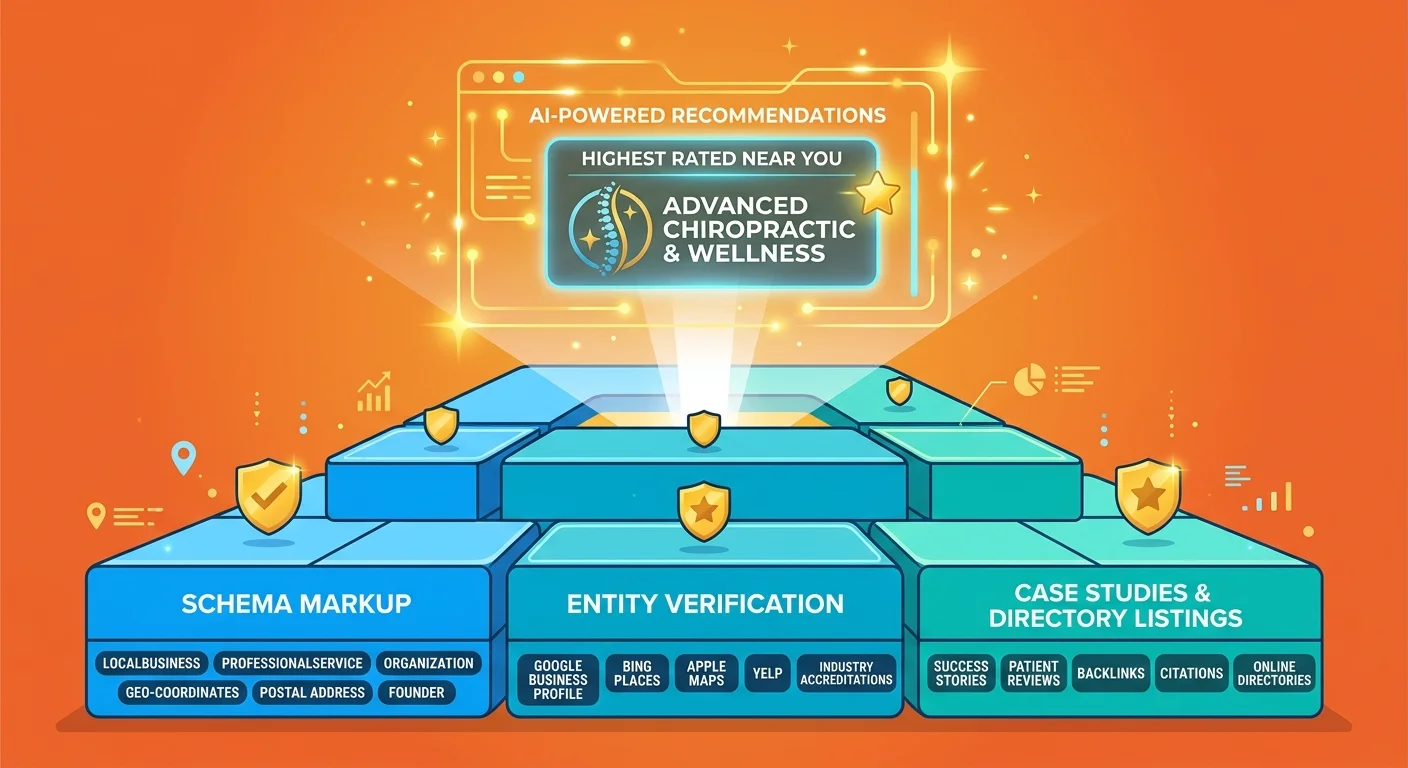
Structured proof is data formatted in a way AI engines can parse, verify, and trust.
It’s not about what you say. It’s about how you say it – and whether a machine can confirm it’s true.
Schema Markup: The Foundation
Schema markup is the vocabulary AI uses to understand your website.
It tells the engine: “This is a chiropractic practice. It’s located at this address. The founder’s name is X. They specialize in Y. Here’s a link to their credentials.”
Without schema, your website is just a wall of prose. AI can read it, but it can’t verify it.
With schema, your website becomes a set of verifiable claims.
Look, Google themselves say structured data helps them understand a page. For AI engines, it’s even more critical – it’s the baseline signal that determines if you’re real or just noise.
If you don’t have schema implemented, you’re not even on the board.
Verified Directory Listings
AI engines cross-reference your claims against authoritative sources.
When you say you’re a chiropractor in Huntington Beach, AI checks that against Healthgrades, Zocdoc, the California Board of Chiropractic Examiners, and other institutional directories.
If your data is inconsistent – your name is spelled differently, your address doesn’t match, your credentials aren’t listed – AI flags you as unreliable.
Structured proof means your entity data is consistent across every platform AI checks. Same name. Same address. Same credentials.
Every time.
Case Study Data in Machine-Readable Format
Testimonials are unstructured. “Dr. Smith changed my life” is persuasive, but it’s not verifiable.
A structured case study is different.
It documents:
• Initial condition
• Treatment protocol
• Measurable outcome
• Timeline
When that data is formatted with schema and published on your site, AI can parse it. It can confirm: “This practice treated 47 patients with lower back pain using X protocol and documented Y average improvement in Z timeframe.”
That’s not a vibe. That’s a receipt.
And when AI can trace your verifiable case studies across multiple authoritative platforms, you’re not just persuasive – you’re provable.
Our Two-AI Validation System is built on this principle. We don’t publish claims AI can’t verify. Every case study. Every statistic. Every claim. Sourced and structured.
Entity Relationships
AI understands authority through relationships.
Who links to you? Who mentions you? Who verifies your credentials?
Structured proof means your entity is connected to authoritative sources in a way AI can trace. Not just backlinks. Not just social mentions. Verified relationships documented in knowledge graphs.
Stanford’s AI research on knowledge graphs explains how entities and their relationships are mapped using structured information – this is the foundation of how AI engines understand authority.
If your practice is isolated – no structured connections to authoritative entities – you’re invisible.
| Proof Type | Format | AI Verifiability | Impact on Recommendations |
|---|---|---|---|
| Structured Proof | Schema markup, organized case study data, verified directory listings | Machine-readable, verifiable, standardized | Creates entity trust signals AI requires to name a practice as the definitive answer |
| Unstructured Proof | Prose testimonials, social media mentions, video reviews, 5-star ratings | Subjective context, sentiment analysis only, no predefined format | Provides persuasive human context but lacks the certainty AI needs to recommend with confidence |
The Unstructured Proof Trap
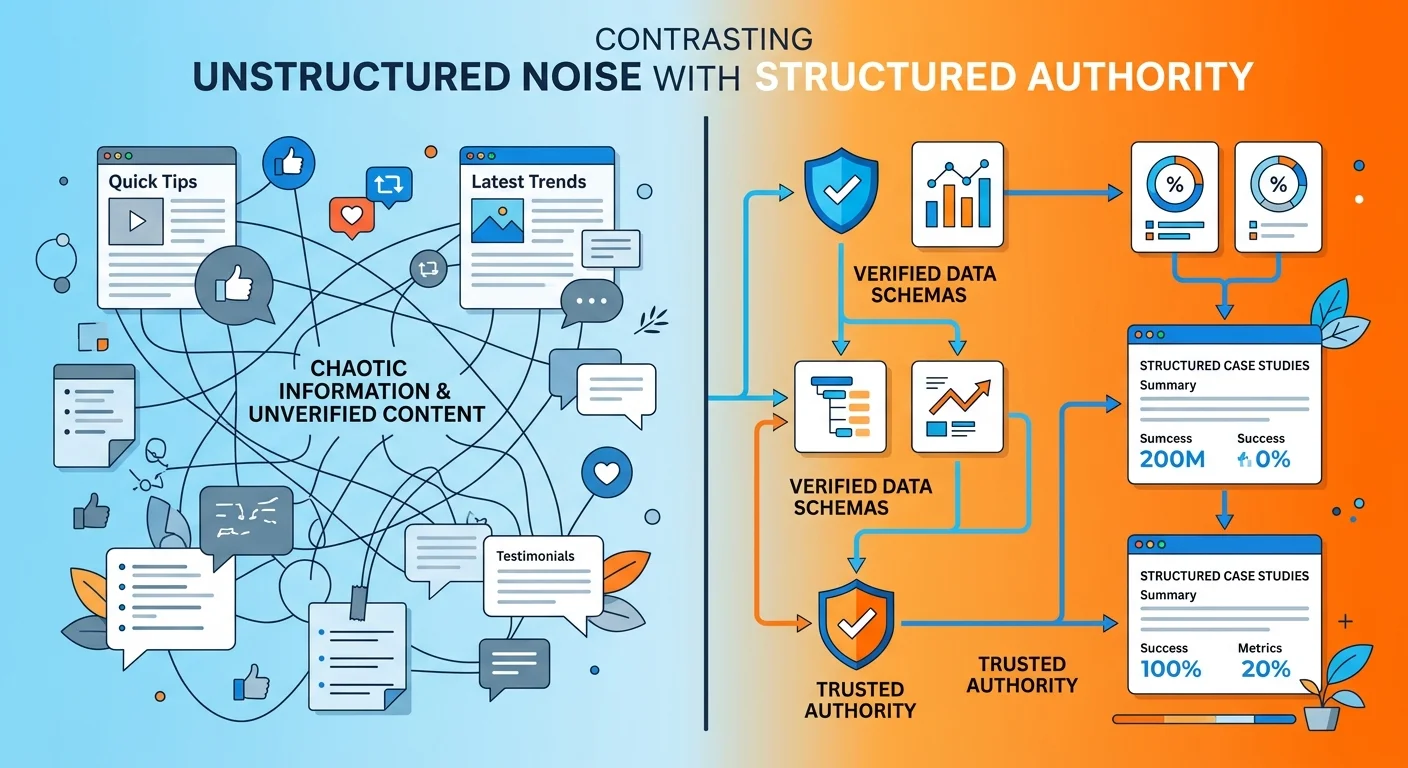
Here’s the trap most chiropractors are in: they’re doing everything their marketing agency told them to do, and they’re still invisible.
They’ve got:
• A wall of 5-star reviews
• Patient testimonials on every page
• Active social media with glowing comments
• Blog posts about “10 Benefits of Chiropractic Care”
• A beautiful website that converts humans
And when someone asks ChatGPT who to see, their name doesn’t come up.
The Commodity Content Problem
Unstructured proof is easy to generate, which means it’s also easy to replicate.
Every chiropractor in your area has testimonials. Every chiropractor has a blog. Every chiropractor has a Google Business Profile with reviews.
AI engines don’t make recommendations based on who has the most unstructured praise. They make recommendations based on who has the most verifiable, structured entity signals.
If your proof looks identical to every other practice in your market, you’re not differentiated.
You’re commodity noise.
Why Social Media Mentions Don’t Move the Needle
Social media is inherently unstructured.
A patient posts on Instagram: “Best chiropractor ever!” That’s a signal. AI can analyze the sentiment.
But it can’t verify the claim.
Compare that to a structured case study published on your site with schema markup, linked to your credentials, cross-referenced against your verified directory listings.
That’s a stack of verifiable signals AI can trace.
Social mentions matter for brand awareness. They don’t matter for AI recommendations.
The SEO Report Illusion
Your marketing agency sends you a monthly report. It shows:
• 10,000 impressions
• 500 clicks
• 200 new social mentions
• 15 new reviews
It looks productive. It feels like progress.
And you’re still not getting recommended.
Here’s why: those metrics measure unstructured activity. They don’t measure structured authority.
AI doesn’t care how many people saw your blog post. AI cares whether your entity data is verifiable.
AI doesn’t care how many clicks you got. AI cares whether your schema is implemented correctly.
Most SEO reports are designed to make you feel good about activity that doesn’t build the kind of authority AI actually needs to trust you.
| What You’re Collecting | What AI Needs Instead | Why the Gap Exists |
|---|---|---|
| 5-star Google reviews and glowing testimonials | Schema-marked case studies with structured outcome data | Marketing agencies sold social proof because it’s easy to generate and looks good to humans |
| Video testimonials and patient stories | Machine-readable structured data extracting key metrics from those stories | The industry optimized for human persuasion, not machine verification |
| High star ratings across multiple platforms | Verified directory listings with consistent entity signals | Traditional SEO focused on ranking factors, not entity trust infrastructure |
| Generic blog posts with keyword density | AEO content with semantic density and citation velocity | Agencies measured success by traffic and impressions, not AI recommendation authority |
The Compounding Effect of Structured Proof

Here’s the good news: structured proof compounds.
Every piece of unstructured proof – a review, a social mention, a generic blog post – exists in isolation. It delivers a one-time signal.
When it’s gone, it’s gone.
Structured proof builds on itself. Schema markup connects to case studies. Case studies connect to directory listings. Directory listings connect to entity relationships.
Every piece reinforces the others.
The Authority Stack
Think of structured proof as layers:
• Foundation: Schema markup tells AI what you are
• Verification: Directory listings confirm you’re real
• Evidence: Case studies prove you deliver outcomes
• Relationships: Entity connections validate your authority
Each layer strengthens the next.
The more structured proof you have, the more confident AI becomes that you’re the definitive answer.
A practice with all four layers doesn’t just rank higher. It gets named as the answer – not one of five options.
Why This Takes Time
Quick pause before we go further.
If you’re looking for a way to flood your schedule in the next 60 days, this isn’t it. Structured proof is built in layers. Foundation first, evidence compounding on top, AI visibility deepening every month.
If that timeline doesn’t fit your decision framework – no hard feelings.
But if you’re tired of short-term tactics that disappear the moment you stop paying for them, you’re in the right place.
The practices that moved early on this – building schema, documenting outcomes, verifying their entity data – are already locking in the authority signals AI uses to determine who to trust.
The gap between them and everyone else widens every month.
The Infrastructure vs. Activity Divide
Most chiropractors are stuck in activity mode. Post more. Review more. Blog more.
It feels productive because you’re doing something.
Infrastructure mode is different. You’re not chasing metrics. You’re building systems.
Schema gets implemented once and works forever. Case studies get documented once and compound. Directory listings get verified once and stay verified.
Activity disappears when you stop. Infrastructure compounds when you maintain it.
That’s the shift. From renting visibility to owning authority.
| Approach | Time Investment | Longevity | AI Impact | Cost When You Stop |
|---|---|---|---|---|
| Unstructured Proof Collection (reviews, testimonials, social posts) | Ongoing manual effort to solicit and collect | Decays without constant new content | Contextual only – AI uses for sentiment, not core recommendations | Immediate visibility loss as fresh signals disappear |
| Structured Authority Infrastructure (schema, entity signals, AEO content) | Foundation build upfront, compounding monthly execution | Permanent architecture that compounds over time | Direct entity trust – the literal mechanism AI uses to determine who to recommend | Infrastructure remains, authority compounds even if execution pauses temporarily |
What AI Engines Actually Check Before Recommending You
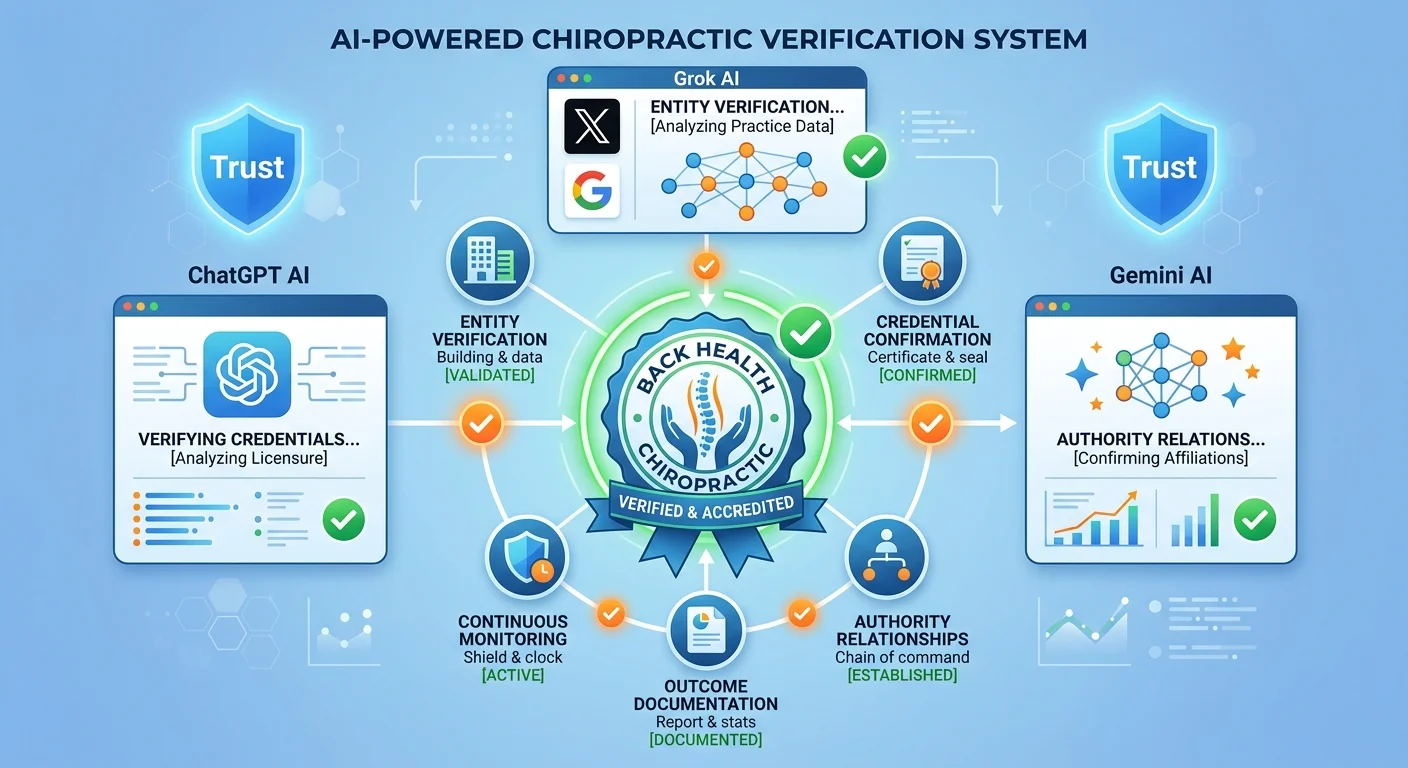
When someone asks ChatGPT, Gemini, or Grok for a chiropractic recommendation, the engine runs through a verification process.
It’s not reading your testimonials. It’s checking your entity signals.
Here’s what it’s looking for.
Entity Verification
First check: Does this entity exist?
AI cross-references your business name, address, phone number, and website against authoritative directories.
If your data is inconsistent – your name is spelled differently on Healthgrades than it is on your website – AI flags you as unverifiable.
Structured proof means your entity data is locked. Same everywhere. Every time.
Credential Confirmation
Second check: Is this entity qualified?
AI looks for credentials. Licenses. Certifications. Educational background.
If your credentials aren’t listed in structured format (schema markup, verified directory listings), AI can’t confirm you’re qualified.
Unstructured proof: “Dr. Smith is a highly trained chiropractor with years of experience.”
Structured proof: Schema markup listing Dr. Smith’s California chiropractic license number, UC Riverside education, and board certifications.
One is a claim. The other is verifiable.
Outcome Documentation
Third check: Does this entity deliver results?
AI doesn’t trust testimonials. It trusts data.
If you’ve documented 50 patient outcomes in structured case study format, AI can verify that you treat specific conditions and produce measurable results.
If your “proof” is a wall of prose testimonials, AI has no way to confirm those outcomes are real.
Authority Relationships
Fourth check: Who else trusts this entity?
AI looks for connections. Are you cited by authoritative sources? Are you listed in institutional directories? Do other verified entities link to you?
BrightEdge’s 2024 State of SEO report shows that entity signals and schema are increasingly critical for visibility in a zero-click search environment – where AI delivers the answer without requiring the user to click through to a website.
If your practice is isolated – no structured connections to authoritative entities – you’re not in the trust network AI relies on.
How to Build Structured Proof for Your Practice
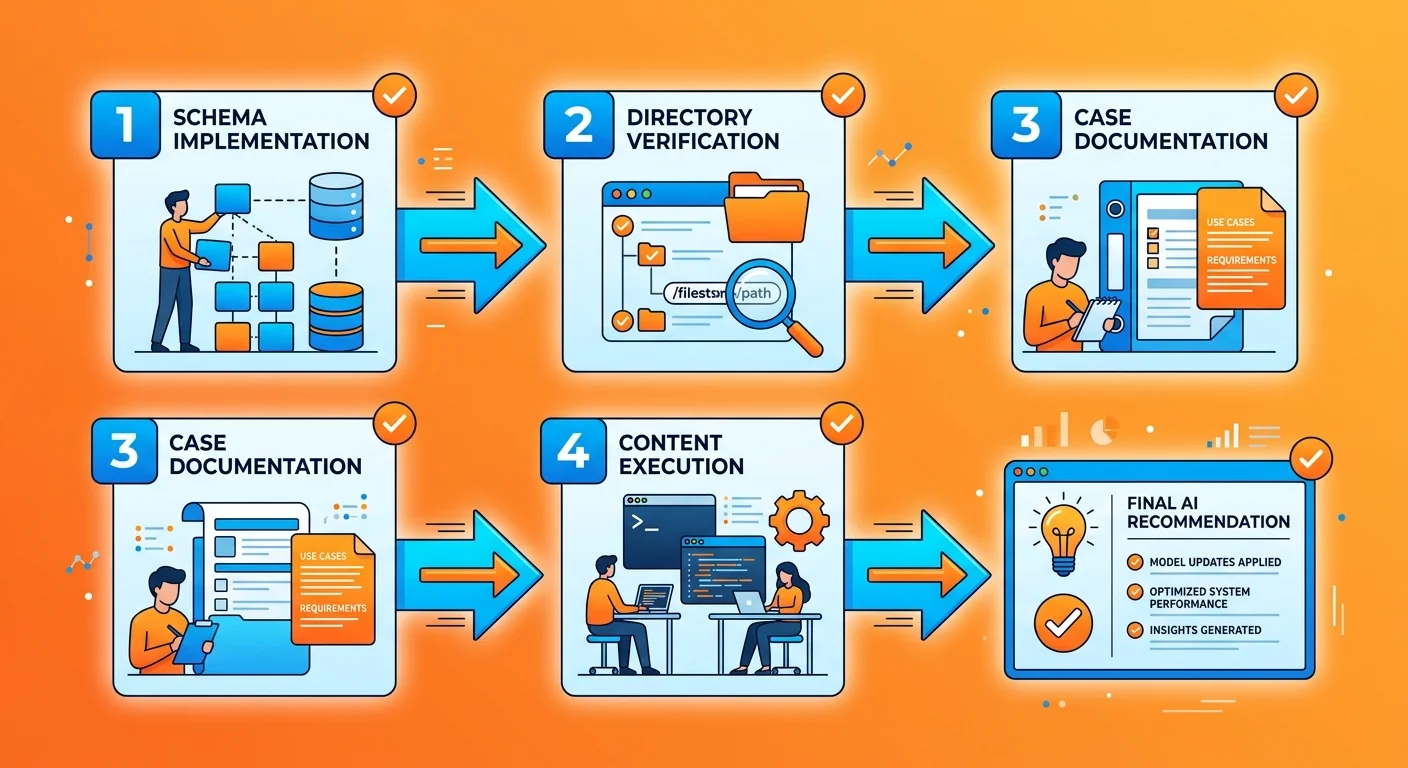
The good news: you don’t need to understand the technical details to build this.
The infrastructure gets built once. The content execution compounds on top.
Here’s the hierarchy.
Step 1: Schema Implementation
Schema is the foundation. Without it, nothing else matters.
Your website needs schema markup for:
• Organization (business name, address, phone, website)
• Medical Business (specialties, credentials, founder)
• Local Business (geographic service area)
• Professional Service (services offered)
• Person (founder/practitioner credentials)
This isn’t something you DIY. Schema has to be implemented correctly or it’s worse than not having it at all.
Incorrect schema tells AI you don’t know what you’re doing.
Step 2: Directory Verification
Verify your entity data across every institutional directory AI checks:
• Google Business Profile
• Healthgrades
• Zocdoc
• WebMD
• Vitals
• State licensing boards
Same name. Same address. Same phone. Same credentials.
Everywhere.
Step 3: Case Study Documentation
Start documenting patient outcomes in structured format. Not testimonials. Case studies.
Each case study should include:
• Initial condition
• Treatment protocol
• Measurable outcome
• Timeline
Format it with schema. Publish it on your site. Link it to your credentials.
That’s the proof AI can verify.
Step 4: Monthly AEO Content Execution
Once the infrastructure is in place, you layer on AEO content – articles that answer the exact questions patients are asking AI engines.
This isn’t generic blog content. This is strategic, citation-validated, machine-readable content designed to build semantic density around your entity.
Most chiropractors stop at Steps 1 and 2. They build the foundation and assume that’s enough.
It’s not.
Authority compounds when you maintain it. The practices that execute monthly AEO content are the ones that show up six months from now when the shift becomes obvious.
Frequently Asked Questions
Does schema markup really matter for AI recommendations?
Yes. Schema is the literal vocabulary AI engines use to understand your services, location, credentials, and authority. Without it, you’re asking the AI to guess, and it won’t recommend a guess.
Look, Google themselves say structured data helps search engines understand the content of a page and enables features like rich results. For AI recommendation engines, schema is even more critical – it’s the baseline signal that determines whether you’re a real entity or just noise.
Are video testimonials considered structured or unstructured proof?
They’re unstructured. AI can analyze sentiment from the transcript, but unless the key data points within the video are extracted and marked up with schema, it’s just persuasive prose, not verifiable proof.
A video testimonial is powerful for human conversion. It doesn’t move the AI recommendation needle.
Can AI trust my Google Business Profile reviews?
AI uses them for contextual understanding and sentiment analysis, but they’re less reliable for core recommendations than structured data from your own authority infrastructure, which you control.
Your Google Business Profile is important. It’s not the authority anchor AI relies on to make a recommendation.
What’s the first step to building structured proof for my practice?
The first step is running an AI Visibility Check. This diagnostic identifies the exact gaps in your current entity signals and schema architecture that are making you invisible.
Most chiropractors assume they know what’s wrong. They don’t. The check shows you exactly what AI sees – and what it doesn’t.
How is this different from what my old SEO agency focused on?
Most SEO agencies focus on generating unstructured signals like generic blog posts and reviews because it’s easier. They rarely build the deep, structured authority infrastructure that AI actually requires to trust and recommend you.
Traditional SEO optimizes for a list. AI search produces a verdict. Those aren’t variations of the same thing.
If I have great reviews but no schema, am I invisible to AI?
Not completely invisible, but severely disadvantaged.
Sure, AI sees your reviews. It analyzes the sentiment. But without structured proof – the schema, the verified listings, the case study data – it can’t confirm you’re the definitive answer.
And AI won’t recommend what it can’t confirm.
How long does it take to build enough structured proof to get recommended?
That depends on how invisible you are right now and how competitive your market is.
Most practices start seeing AI visibility improvements within 3-6 months of consistent execution – but I won’t promise you a timeline because authority compounds, it doesn’t appear overnight.
The practices that moved early are already locking in the authority signals AI uses to determine trust. Waiting isn’t a neutral position.
Can I build structured proof myself, or do I need help?
You can build it yourself if you have the time, technical knowledge, and willingness to learn schema implementation, entity verification protocols, and machine-readable case study formatting.
Most chiropractors don’t. They’d rather focus on treating patients and let someone else handle the infrastructure work.
That’s why we built the AI Authority Engine – to do the heavy lifting so you don’t have to.
Structured Proof Isn’t a Tactic-It’s the New Standard
Here’s the thing no one’s saying out loud yet: in six months, every chiropractic practice that isn’t building structured proof will be functionally invisible.
Not because they’re bad practitioners. Because AI won’t trust them.
The marketing industry sold you on unstructured proof – reviews, testimonials, social mentions – because it was easy to generate and looked impressive in a dashboard.
What they didn’t tell you is that AI doesn’t trust subjective praise. It trusts verifiable data.
Schema markup. Verified directory listings. Structured case studies. Entity relationships.
That’s the infrastructure AI needs to name you as the definitive answer.
The practices that understand this are already building it. The ones that wait will be competing for the scraps left over after AI makes its recommendations.
There’s no version of this where doing nothing is a safe play. AI is already making recommendations in your market. Either your name is in the answer or a competitor’s is.
That gap widens every month it goes unaddressed.
Want to know if AI is recommending your practice – or your competitor’s?
Run the AI Visibility Check. It takes 15 minutes and shows you exactly what ChatGPT, Gemini, and Grok say when someone asks who to trust in your market.
No fluff. No vanity metrics. Just the raw data showing whether your proof is structured or if you’ve been building the wrong kind of authority this whole time.
If the results don’t make the problem self-evident – walk away. No pressure.
But if they do? You’ll know exactly what to do next.