
What a Scope of Work Is Actually Protecting — And Why Most Fall Short

A Scope of Work is the blueprint for the whole agency relationship, and it sets expectations from day one. A good one protects both sides by defining success so everybody's working toward the same thing. But that protection only holds if the definition of success matches the system that's actually deciding who gets seen.
Most agency templates still prove their worth with rank-tracking reports and site visit totals. Treat AI visibility like old-school search work with new vocabulary, and you've got a blueprint for a building that's already been torn down. So before anyone signs, it pays to know the agency vetting criteria that separate a scope built to last from one that's just for show.
Why the Legacy SOW Template Fails Once Answers Replace Links
Here's what a Scope of Work is actually for: defining success before anyone lifts a finger. And that definition is worthless unless it describes the system that's really deciding whether a brand gets seen.
Problem is, most templates still floating around were written for a world built on the ten blue links. They carried clauses over from that era. Nobody stopped to check whether those clauses still describe anything real.
Why Rank-Tracking Clauses Fail to Describe the Work Being Done
Let's keep it real: rank-tracking reports measure position on a results page that fewer searches ever reach. So a clause promising those reports is promising a window into a system that no longer governs most of the answers a reader gets.
Reformatting the report won't fix this. It's a measurement problem, because a metric built to track position can't tell anyone whether a brand got named inside a generated answer. For what that drift looks like ninety days into an engagement, here's a field guide to measuring agency performance.
The Mechanism by Which a Listed-Address Deliverable Breaks Down
For years, a correct listed address across directories got treated as a core trust signal, and agencies built standing deliverables around keeping it tidy. It still matters for consistency. But it was never built to answer the question an AI system asks when it's deciding who to cite.
A listed-address deliverable confirms that a business exists and where it sits. It says nothing about whether a page answers a question clearly enough to be extracted, and that's the mechanism that actually decides citation.
Where Vague Deliverables Hide the Most Expensive Gaps
The priciest gaps almost never come from missing line items. They hide inside the vague ones, the clauses that sound specific and measure nothing.
It's the same two problems from earlier wearing a new outfit: loose wording, plus clauses built around a metric that stopped mattering. So watch for the clause promising "content optimization" or "visibility improvement" that never names a deliverable, a method, or a way to verify it.
| Deliverable Clause | Vague Version | Line-Item Version |
|---|---|---|
| Content optimization | Improve content so it performs better. | Rewrite designated pages into direct-answer format, with a named reviewer verifying extractability before publication. |
| Visibility improvement | Increase the brand's visibility online. | Track and report appearances inside AI-generated answers for a defined set of query topics, reviewed on a set cadence. |
| Entity management | Maintain brand consistency across the web. | Audit and correct named-entity details across a defined list of directories and data sources, with a named owner for updates. |
| Structured data work | Add schema markup to the site. | Implement schema matching what each page visibly displays, verified against the page content before each content update ships. |
| Reporting | Provide monthly performance reports. | Deliver a monthly report naming which pages were cited in AI-generated answers, cross-checked against classic ranked-results data for comparison. |
How Scope Creep Forms Around Undefined AI Visibility Work
Scope creep around AI visibility work starts the moment a clause promises an outcome instead of a deliverable. And piling on more keyword-targeted articles won't reliably earn more citations inside a generated answer, because citation runs on structured extractability, not volume. The old assumption that more content equals more visibility falls apart once answer engines pick what to surface by what they can cleanly pull from a page (not by how much stuff sits around it).
And that's where advertising law squeezes a vague clause hard, because promises of guaranteed visibility need evidence that generic content-volume pledges rarely have. The FTC documents that advertising must be truthful and non-deceptive under the Federal Trade Commission Act, and advertisers are expected to have evidence supporting their claims. So an SOW that can't name its method for improving extractability is an unverifiable promise in contract form, and there's more on how to spot entity-data fluency in an agency if this is the part that matters to you.
The Deliverables a Line-by-Line Breakdown Actually Requires
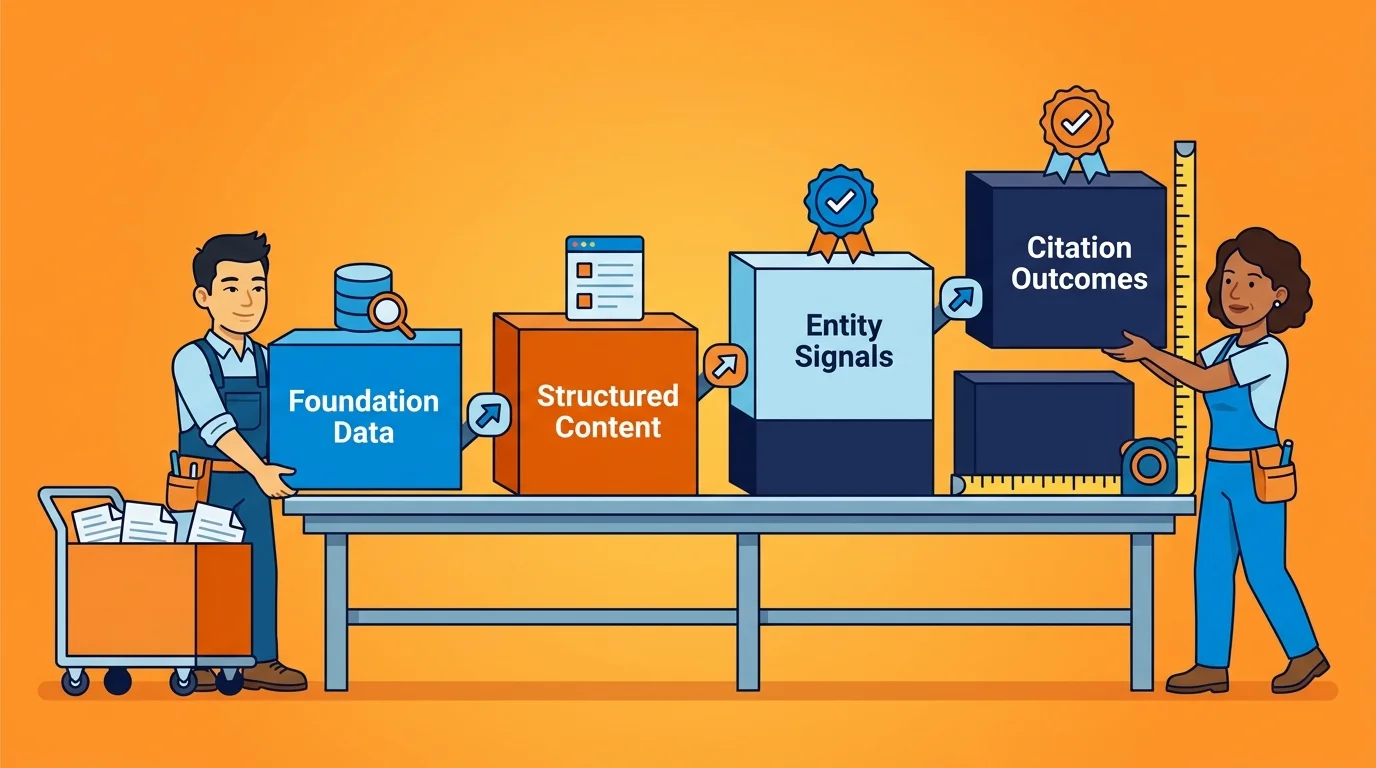
Here's the verdict: a deliverables section earns its keep when it names a mechanism, not a milestone. Being the cited source inside a generated answer beats being a correctly listed address in a directory, every time. The market quit rewarding the listed address once answer engines started picking who gets named by what they can extract (not by what they can find).
| Deliverable Layer | What It Defines | Why It Belongs in the SOW |
|---|---|---|
| Entity Consistency and Structured Data | How a brand's identity resolves across the web and how schema markup is verified against what a page actually displays | Neither extraction nor citation is possible if an answer engine cannot confirm who a page belongs to or trust its structured markup |
| Extraction-Ready Content | Content structured so a specific answer can be pulled cleanly from a page, rather than content built around volume or keyword density | This is the layer that determines whether a brand gets named inside a generated answer, which is the outcome the whole agreement is meant to protect |
| Technical Infrastructure | The underlying site work that makes entity data and structured content reliably crawlable and machine-readable over time | A deliverable higher up the stack fails quietly if the infrastructure beneath it was never specified or verified |
| Citation-Based Reporting | A reporting format tracking whether and where a brand appears inside AI-generated answers, rather than position inside a results page | A Scope of Work protects both parties only when its proof of work matches the system actually deciding visibility |
The Layered Structure Behind a Complete Deliverables Section
A complete section stacks in layers, starting with entity consistency and structured data accuracy, because nothing gets extracted or cited without them. Content built for direct extraction sits on top of that base, with authority infrastructure services handling the technical groundwork underneath. Reporting crowns the stack by tracking citation appearances instead of position, and every layer stays checkable against the one below it.
What Separates a Deliverable From a Vague Promise
So what's the actual difference? A deliverable names a method and a way to check it happened, while a vague promise names an outcome and keeps the method out of sight. That gap is what separates a line item an agency can defend from one it can only cross its fingers over.
Entity Management and Structured Data as Named Line Items
Entity data and structured markup are the deliverables most often missing from an agency contract altogether. Name them as line items, attach a method and a verification step, and a fuzzy promise turns into work someone can actually audit.
What a Structured Data Line Item Must Specify
A structured data line item spells out which schema types go on which pages, who writes and maintains the markup, and how often it gets checked against the live page, because the bar is accuracy to what the page actually shows (not a tag that merely exists). Per the Computing Community Consortium, the workshop report identifies developing datasets, methods, and platforms for evaluating the next generation of LLM-powered information access systems as a research direction. That report is about research, not contracts. If evaluating these systems is still an open research direction, a contract is safer spelling out verification than assuming correctness.
What an Entity Consistency Line Item Must Specify
An entity consistency line item names every surface where a business's name, category, and details show up, plus who owns fixing a mismatch when one pops up. But consistency was never the finish line, since answer engines cite by extractability rather than position, so a scope still pitching rankings is pitching a result the system doesn't produce anymore.
Reporting Clauses That Measure Citation Instead of Position
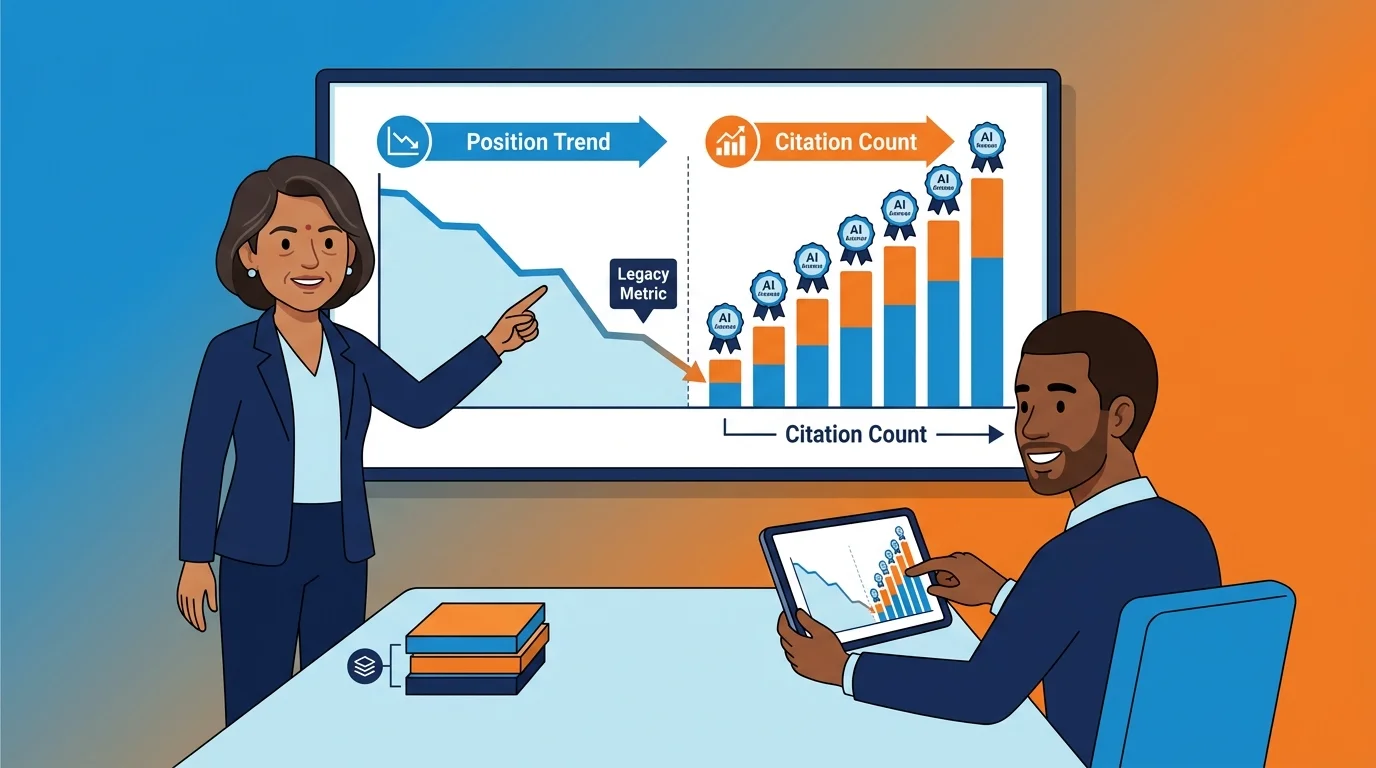
Reporting is where most contracts quietly slide back into old habits, passing off rank-tracking reports and site visit totals as proof of progress. Those numbers describe a results page that fewer searches ever reach. A reporting clause built for how answers work now tracks citation appearances inside AI-generated answers instead, naming which queries surfaced the brand and which sources the engine credited.
| Metric Category | Legacy Reporting Focus | AEO-Aligned Reporting Focus |
|---|---|---|
| Visibility Measurement | Site visit totals pulled from a results page fewer searches resolve to | Citation appearances inside generative engine responses, tracked against the queries that produced them |
| Optimization Benchmarking | Keyword position reports with no connection to extractability | Visibility measured directly in generative engine responses; one lab benchmark reported gains of up to 40% |
How a Reporting Cadence Section Should Be Structured
A cadence clause should name how often citation tracking gets reviewed, what counts as a citation event, and who verifies it. A vague cadence clause is a liability, because position reports alone can't show whether a client is the cited source or just a correctly listed address.
What Happens When Work Falls Outside the Defined Scope
Out-of-scope work needs its own clause, written before anyone needs it. IIT Delhi and Princeton University research documents that a black-box optimization framework known as Generative Engine Optimization (GEO) may help content creators improve their visibility in generative engine responses, with visibility reported to rise by up to 40% — a laboratory finding rather than a study in people. That research is about content, not contracts. Naming what's out and what triggers a change order turns added work into a decision instead of a surprise.
Frequently Asked Questions
Once the deliverables have names, a few mechanical questions always pop up. Here are the ones worth settling before anybody signs.
What's the difference between a Scope of Work and a Master Services Agreement?
A Master Services Agreement sets the legal rules for the relationship. The Scope of Work says what gets built, who builds it, and how it's measured inside those rules.
How detailed should the Deliverables section be for Answer Engine Optimization services?
Detailed enough that every line item names a method and a way to check it. If a deliverable can't be checked, it's not specific enough to sit in that section.
What are the biggest red flags to look for in an agency's SOW?
Fuzzy phrases like "visibility improvement" with no named deliverable behind them. A clause that promises an outcome instead of a mechanism is the loudest warning sign in the whole document.
How should a modern SOW address reporting for AI visibility and citations, not just site visits?
It records which queries surfaced the brand and which sources the answer credited. A spot on a results page doesn't stand in for that record.
How do you handle services that fall outside the initial Scope of Work?
With a change-order clause written upfront, before anyone asks for extra work. Name the trigger early and added scope stays a decision, not a fight.
Should an SOW for AEO specify deliverables around structured data and entity management?
Yes. Structured data and entity consistency are the base layer extraction runs on. Most contracts never name them at all.
The Bottom Line
A blueprint only protects the people building on it when it describes the structure that's actually standing. And the ten blue links? They're not that structure anymore.
A Scope of Work still drafted around rank-tracking reports and site visits is a blueprint for a building that's already come down. The one worth signing names entity consistency, structured data accuracy, and citation appearances inside AI-generated answers as the deliverables that get checked.
That's the kind of document that actually matches the system now deciding who gets named. So before you sign your next one, run an AI Visibility Check and see where you stand first.