
What Ninety Days Of Real Groundwork Actually Looks Like

The 90 mark is a foundation inspection. Nobody checks the paint on a house at that stage. They check the footings, because footings decide whether the house stands.
So when an agency hands over rank-tracking reports instead of footings, it's measuring the wrong structure. A ranking quit being a reliable sign of citation the day generative answers replaced links as the thing people actually see. If you want to separate real deliverables from activity reporting, how to pick an AEO agency is the place to start.
Why Rank-Tracking Reports Stopped Meaning Anything
A ranking tells you very little now. Once generative answers replaced links as the thing a client actually sees, position stopped predicting who gets cited. That number is a scoreboard for a game fewer systems are still playing.
Nobody's being sentimental here. The shift is structural. When an AI engine composes an answer instead of listing ten blue links, a page's position in old-school search work has no mechanism left to act through.
How A Position Report Creates A False Sense Of Progress
A rank-tracking report can show upward movement every single week. Activity is cheap to generate. It's even cheaper to chart.
But movement in a results-page position number is not the same as movement toward citation. Vanity metrics are reports on activity that don't translate to business outcomes, and they exist specifically to create a false sense of progress when the underlying foundation work is thin or missing.
What A Position Number Never Measures
Now… this part matters. A position report can't tell you whether a business's entity data agrees across directories. It can't tell you whether schema markup matches what the page actually shows.
It cannot measure whether a content structure is built so an answer engine can extract a definition, a comparison, or a procedure from it. Those are the deliverables worth inspecting, and a full breakdown of what should be listed in a scope of work for this kind of engagement is covered in agency deliverable requirements.
How Generative Engines Actually Pick What To Cite
Generative engines don't reward a page for simply existing. They reward a page they can actually use as evidence inside an answer, and that usability gets measured, not assumed.
| Citation Signal | What It Measures | Why Early Agency Work Affects It |
|---|---|---|
| Repeated Reference | Whether a page's facts get echoed more than once across a generated answer | Content architecture built around extractable facts gives an answer engine more reason to pull the same page twice |
| Early Appearance | Whether a page's evidence shows up near the start of the composed answer | Clear headings and front-loaded answers, set during the foundation phase, position evidence where an answer engine reaches it first |
| Paragraph Coverage | How many distinct sections of the generated answer draw on a single page | A page organized into modular, well-labeled sections gives an answer engine more surface area to cite from |
| Textual Overlap | How closely a page's phrasing matches the language the answer engine ultimately generates | Entity-consistent terminology and structured markup set early make a page easier to match against the answer's own wording |
| Indexing Eligibility | Whether a page even qualifies to appear as a supporting link in the first place | Google's stated bar is only that a page is indexed and eligible to show a snippet; entity and structured data work is built on top of that bar, not a condition of it |
The Weighted Score Behind An AI Citation
Citation influence runs on a weighted score, and it tilts hard toward pages built as reference material instead of pages built to rank. How often and how early a page gets referenced, how much of the answer it covers, and how closely its wording overlaps the generated text all count. Per a preprint by Zhang Kai and Yao Jingang, citation influence in generated answers may be measured by a weighted score that rewards repeated reference, early appearance, paragraph coverage, and textual overlap with the answer, and highly influential pages are associated with greater length, modularity, and extractable evidence such as definitions, numerical facts, comparisons, and procedural steps.
High-influence pages share a shape. They run longer, read as modular, and carry extractable evidence: definitions, numerical facts, comparisons, procedural steps. A rank-tracking report cannot measure any of that structure. Position numbers describe a game current answer engines have mostly stopped playing, because the output a client sees is a composed answer, not a ranked list. The distinction between an agency built for that older game and one built for this one is covered in specialist versus generalist selection.
The Eligibility Floor Google Sets For AI Overviews
Eligibility sits on a lower floor than most agencies imply, and here's the floor in plain words. In its documentation, Google states that a page must be indexed and eligible to be shown in Google Search with a snippet to be eligible to appear as a supporting link in AI Overviews or AI Mode, with no additional technical requirements. There's no schema bonus or AI-only tier stacked above it.
Where Knowledge Graph Construction Breaks Down

More content has never meant more visibility, and that myth dies fastest inside automated graph construction. Volume without structure just piles noise on a system trying to figure out who an entity actually is. That's exactly the damage an agency's entity work is supposed to catch before it compounds.
Why Automated Graph Building Produces Noisy Entities
Automated graph building leans on language models to extract entities and relationships at scale, and that process is not clean.
Research from Nanyang Technological University shows most Graph-based RAG systems may rely on LLMs for automated knowledge graph construction, which can yield noisy knowledge graphs with redundant entities and unreliable relationships.
Redundant entities and unreliable relationships are the direct cost. That study is about knowledge graphs built inside retrieval systems, not business listings. The parallel is limited but useful: clean, consistent entity data gives any system less to untangle, which is the work our AI search optimization services are built to do.
What Structured Data Work Has To Clear Before It Counts
Structured data work has a checkpoint, and it's a simple one. Did the agency actually finish it, and does it match what's on the page?
| Implementation Step | What It Establishes | Typical Processing Window |
|---|---|---|
| Entity Data Correction | Consistent business identity across directories and data aggregators | Varies by number of listings and how frequently each directory refreshes its own index |
| Schema Markup Implementation | Structured data that accurately matches what a page visibly displays | Dependent on when crawlers next revisit the page after deployment |
| Site Name Updates | Recognition of a corrected site name by Google | Several days to several weeks, depending on how often the system determines content needs refreshing |
| Content Architecture Rebuild | Pages structured around extractable headings, tables, and direct answers | Ongoing, since indexing and crawl eligibility must clear before deeper evaluation begins |
How Long A Site Name Update Takes To Process
A site name fix won't show up overnight, and that lag is processing, not proof the work failed. Per Google, updated site name structured data can take several days to several weeks to be recrawled and processed, depending on how often content needs to be refreshed.
The Sequence An Implementation Should Follow
Google's own bar for AI Overviews and AI Mode is lower than site name updates make it look: a page has to be indexed and able to show a snippet. So crawl eligibility clears first, and only then does deeper schema work get judged.
Building Entity Trust Across The Sources AI Actually Checks
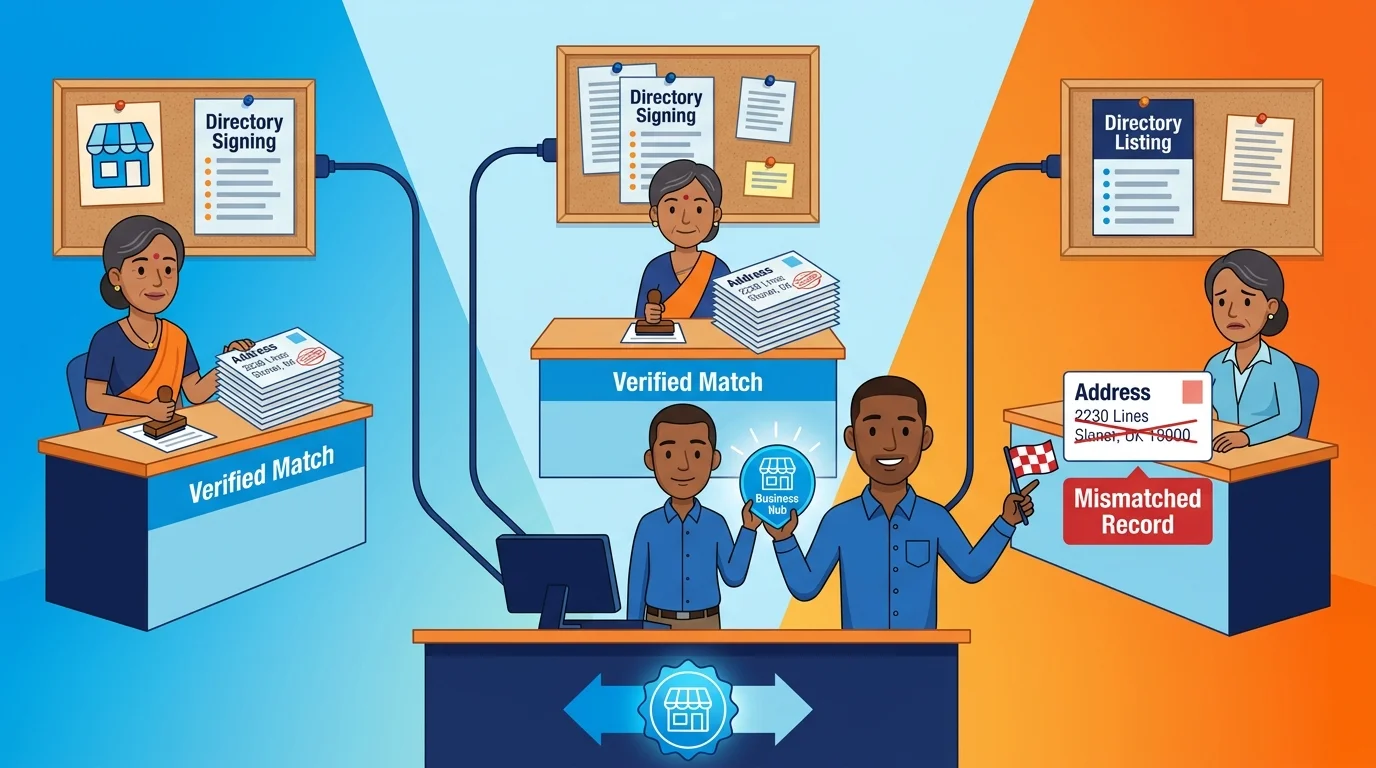
Now… on-page structure only counts once the records around it agree with it. Entity authority also runs through directories, data aggregators and citation sources the business never directly controls.
Why Consistent Business Records Carry More Weight Than Volume
One accurate business record beats a dozen scattered ones with conflicting details, because consistency outweighs sheer volume of mentions every time.
How Mismatched Records Undercut An Entity Profile
Mismatched records fracture an entity profile instead of reinforcing it. A business listed under three different phone numbers forces a system to guess which one is current.
That guesswork is exactly what a resolved, trustworthy entity profile is supposed to eliminate.
Frequently Asked Questions
A few mechanical questions tend to surface once the footing inspection is done. Here's what operators ask next.
What foundational work should be finished within the first 90 days for answer engine optimization?
Corrected entity data, matching schema markup, and content built for extraction. Notice what's missing? Rank-tracking reports don't make the list.
How does Google determine when an updated site name actually appears in results?
Google's systems recrawl and reprocess the change on their own schedule. That cycle runs several days to several weeks depending on how often the system decides the content needs refreshing.
What does a weighted citation score measure in an AI-generated answer?
It rewards repeated reference, early appearance in the answer, and coverage across multiple paragraphs. Pages with heavier textual overlap to the generated response score higher, and those pages tend to be longer and built around extractable evidence.
What makes a knowledge graph noisy, and why does that matter for entity data?
A noisy graph is one built with redundant entities and unreliable relationships between them. That happens when automated construction leans on a language model to extract structure at scale, and nobody corrects the output by hand.
What technical requirements does a page need to meet to appear inside AI Overviews?
Less than most agencies imply. The page must be indexed and eligible to show a snippet in Google Search. That's it, nothing more is required to qualify as a supporting link.
Why do consistent NAP records matter more than they used to?
Citation sources now shape how an entity gets resolved, often across directories a business never directly controls. One accurate record beats a dozen scattered ones with conflicting details.
The Bottom Line
So here's where the foundation inspection lands, right back where it started. At 90 days, you check the footings, not the paint.
An agency handing over rank-tracking reports at this mark is showing you paint. One handing over corrected entity data, matching schema and content an engine can actually pull from is showing you footings, and only footings decide whether the house stands once generative answers pick who gets cited.
That is the verdict, not a hedge. If the first quarter produced activity instead of structure, the gap will not close by waiting longer. The place to confirm which one you got is the AI Visibility Check.