
Why Most Agency Report Cards Are Measuring the Wrong Thing
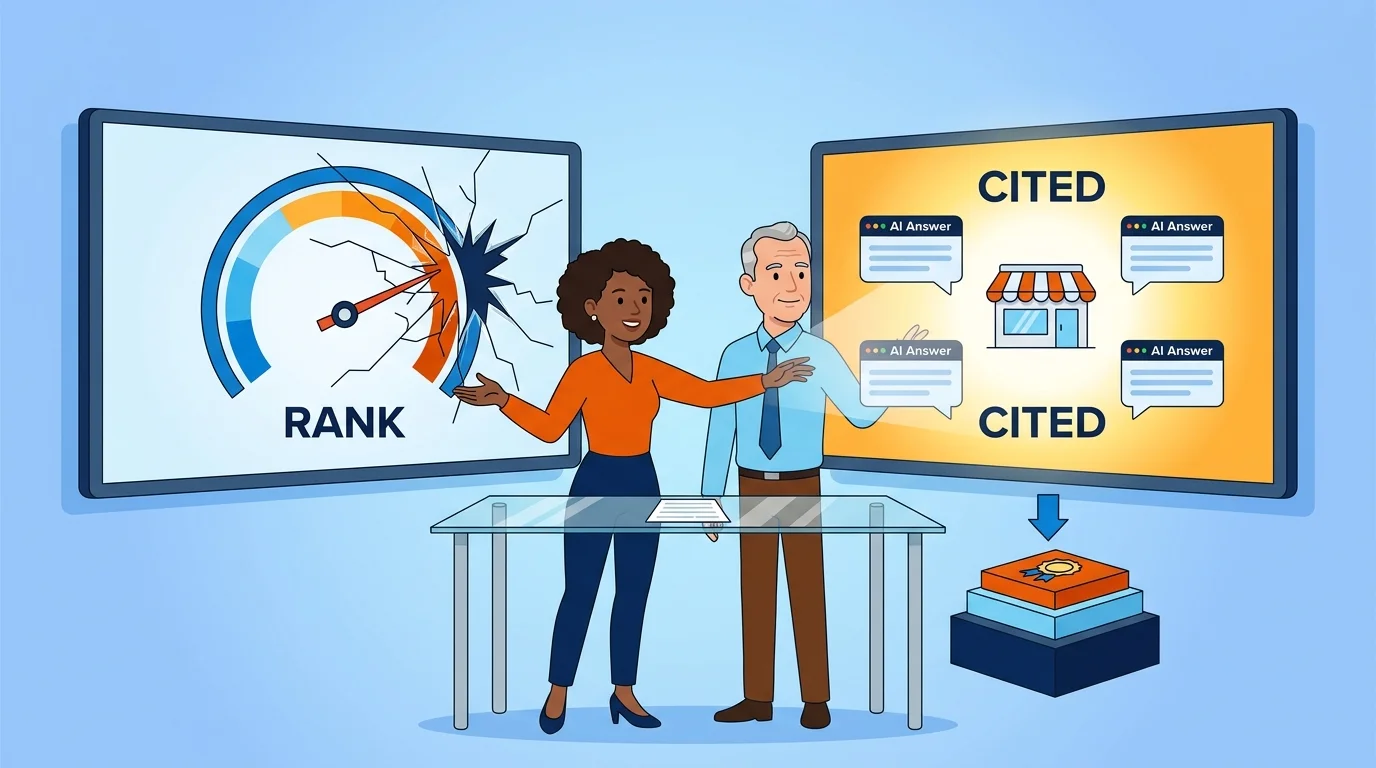
Here's the thing: the report is where the gap shows up first. The gauges on that dashboard don't measure how answers get picked anymore.
A red flag is simply any agency deliverable built around results-page position numbers instead of becoming a citable entity inside generative answers. The shift from keyword position tracking to AI-generated answers has made it harder for a business owner to judge whether an agency is still effective, because the old scoreboard still produces numbers even when those numbers no longer predict anything. Choosing who manages that visibility is a high-stakes decision, which is exactly why evaluating agencies for AI search citation work matters before the relationship starts. AI visibility work dressed up with new vocabulary is still traditional search optimization underneath if the gauge never changed.
The Problem With Chasing Rank-Tracking Reports
Rank-tracking reports feel like evidence because they produce numbers. A number on a page reads as proof, even when it measures nothing a generative engine cares about.
The dashboard still has a gauge for position. But the engine underneath switched fuel. That gauge is now reading a system that stopped running.
How a Cheap Retainer Produces an Invisible Client
A cheap retainer survives by producing the report, not the result. The cost of the report is far lower than the cost of restructuring a site for machine readability, so the report becomes the product.
And that's how you end up with an invisible client. Position numbers hold steady while citation inside generative answers never happens, because those two stopped being the same contest.
The Mechanics of a Thin Retainer
A thin retainer spends its hours on whatever's cheapest to measure. Checking a position number? That takes minutes.
Restructuring entity data, schema, and content clarity for machine parsing takes sustained work. More content is often the substitute offered instead, and that substitution is the mechanism behind the belief that more content equals more visibility — a belief the data doesn't support once answers replace links as the destination. Publishing volume looks like effort, but volume without structural clarity doesn't change whether a generative engine can parse or trust a source.
What Gets Cut First
Structured data work gets cut first, because it's slow and it never shows up on a monthly report. Entity consistency across the site goes next, for the exact same reason. For a fuller framework on separating a generalist retainer from specialist work built around citation, check out the generalist versus specialist decision guide.
A recent industry report found that 80% of consumers rely on zero-click results in at least 40% of their searches, a pattern that may reduce organic site visits by an estimated 15% to 25%.
Work available through the Medill Spiegel Research Center indicates 80% of consumers may rely on zero-click results in at least 40% of their searches, which can reduce organic web traffic by an estimated 15% to 25%.
That erosion matters because zero-click results are already a regular part of how most consumers search. A report that keeps tracking position numbers while this shift happens is measuring the wrong gauge.
How Generative Engines Actually Pick What to Cite

So the scoreboard's busted. Now the real question shows up: what do these systems actually look for when they pick a source to cite?
A position number has nothing to do with it. What matters is how easy a piece of content is for the model to read, and how much it can trust what it reads.
| Signal | Traditional Search Focus | Generative Engine Focus |
|---|---|---|
| Position Signal | Placing in the classic ten blue links for a target phrase | Whether the content is predictable and semantically consistent enough for a model to cite with confidence |
| Content Volume | Publishing more keyword-targeted articles to widen results-page position numbers | Whether entity data and structure stay consistent across the site, not how many pages exist |
| Trust Signal | Inbound link counts used as a proxy for authority | Clarity and parseability of the content itself, judged directly by the model doing the choosing |
| Success Metric | Rank-tracking reports showing movement in classic ten blue links | Appearing as the cited source inside a generated answer, regardless of position reports |
| Visibility Measure | Site visits attributed to a ranked listing | Presence inside a zero-click answer where no listing or click ever occurs |
What Governs Citation Selection
Research from UNC Charlotte, USTC and the University of Washington indicates generative search engines may favor citing content that is more predictable to underlying LLMs and more semantically similar across selected sources, and AI Overview appears to predominantly cite content with lower perplexity than conventional search rankings prioritize.
That is a finding about how text reads to a model, not about entity data, and it does not say how a site earns the preference. What a site controls is clear, consistent writing and clean records (the ground covered in entity data readiness).
How Often a Generated Summary Shows Up
As the Pew Research Center reports, about 58% of sampled U.S. adults conducted at least one Google search in March 2025 that produced an AI-generated summary. That scale alone makes the citation mechanism worth understanding instead of shrugging off.
What a Structured Data Program Actually Looks Like
So what does the fix look like? A sound program picks up right where the broken one stopped measuring, and it builds structure before it adds volume, because a model can't trust what it can't parse.
| Report Element | What It Should Show | Why It Matters for Citation |
|---|---|---|
| Schema Coverage | Every page type carrying the structured data markup appropriate to its content, rendered and visible, not just documented in a slide deck. | Structured data lets a generative engine parse what a page is about without guessing, which is the baseline condition for citation. |
| Entity Consistency | The same name, description, and identifying details appearing identically across every listing, profile, and page tied to the business. | A model that encounters conflicting versions of the same entity has less reason to trust any single version enough to cite it. |
| Content-to-Question Mapping | A clear line from the questions a reader actually asks to the content that answers them, organized so the structure itself signals relevance. | One study found generative engines favor content that is more predictable to the model and more consistent across sources; a mapped structure keeps a page's answers easy to follow. |
| Render Verification | Confirmation that markup described in a report actually appears in the page's rendered output, checked against the live site rather than assumed. | Markup that exists only in a report changes nothing about how a machine reads the page, which makes verification the difference between evidence and paperwork. |
Entity Signals an Agency Should Be Reporting
The gauges that matter are schema coverage, entity consistency across every listing, and how cleanly a site's content maps to the questions it answers. A cheap retainer skips all of it because it's slow to build and invisible on a monthly summary, which is exactly why cheap retainers are a trap, not a shortcut. A real program gets built around these signals instead of a position number.
Reading a Structured Data Report Without Getting Fooled
Alright, quick reality check: a report full of charts isn't a report full of evidence, so check whether the structured data it describes actually renders on the page or only lives in the PDF. Google's rules say structured data (schema) must match what's actually visible on the page. Anything sold as professional AEO implementation that can't show you that is still reading the wrong gauge.
Auditing the Deliverables Already on Your Desk

The dashboard doesn't lie. It just reads the wrong gauge. Every report an agency sends already carries its own warning signs, and they're sitting right inside the numbers, not hiding in what's missing.
| Audit Step | What to Look For | Red Flag If Missing |
|---|---|---|
| Request the last three monthly reports | Metrics tied to structured data, entity consistency, or content clarity that a generative engine can parse | Every metric centers on results-page position numbers or site visits with no mention of citation readiness |
| Ask what each gauge actually predicts | A plain explanation of how the metric connects to being cited inside AI-generated answers | A defensive or vague answer that treats the question as unusual rather than routine |
| Check whether structured data is described or shown | Schema and entity markup that can be verified as live on the page, not just mentioned in a summary | Structured data referenced in the report but absent from the actual pages |
| Review how new content gets prioritized | Work sequenced around machine readability and entity clarity before volume | A steady stream of keyword-targeted articles offered as the main proof of effort |
| Compare this quarter's report to last quarter's | A shift in language and focus that tracks the move from traditional search optimization toward citation-based visibility | The same report format, the same gauges, quarter after quarter, regardless of what changed underneath |
A Five-Step Sequence for Reviewing Any Agency Report
Pull the last three reports and ask one blunt question of every metric: what does this actually predict? A number with no line to citation inside generative answers is a vanity figure wearing a business-metric costume. Position lost its link to citation the day answers replaced links as the destination.
What a Legitimate Progress Update Contains
A legitimate update names structure before it ever names position, and it talks about entity consistency, schema coverage, and content clarity in terms tied to machine parsing. Can't explain how a page earns trust from the system picking it? Then that update isn't measuring the engine that's actually running.
Frequently Asked Questions
A few specific questions come up again and again once the dashboard starts looking suspect. Here's what those questions actually mean, and what a straight answer should sound like.
What specific metrics should I ignore from my current agency's reports?
Ignore any number built on results-page position numbers or site visits alone. Neither one tells you if a generative engine can read the source or trust it.
How can I tell if my agency is building for AI Overviews or just old-school search listings?
Ask if the agency brings up entity consistency and schema before it brings up position. Structure never comes up? Then the work is still aimed at old-school search listings.
Is a long-term contract with an agency a red flag in itself?
A long contract alone isn't the red flag. A long contract with no structural deliverable attached to it is.
What kind of structured data reports should a competent agency be providing?
Expect reports on schema coverage, entity consistency across listings, and content clarity mapped to real questions. A report missing those is still reading the old gauge.
My agency guarantees page-one rankings. Why is that a problem?
Google itself says AI Overviews only show up when its systems decide they add value, and often they don't trigger at all. So a promise of placing in the classic ten blue links is a promise about something the agency doesn't control.
How quickly should I expect to see results from answer engine optimization work?
There's no fixed timeline, and refusing to promise one is the honest answer. Structural work compounds, and the reader already knows how many searches now end in a generated summary instead of a click.
The Bottom Line
The dashboard metaphor only matters because of what it reveals. A gauge that reads position numbers while the engine runs on citation isn't broken equipment. It's the wrong instrument for the system actually in front of it.
Traditional search optimization built its entire case on a gauge that no longer connects to the dashboard. Becoming a citable source inside generative answers is the only reading that still predicts anything. That's the verdict, not a hedge.
An agency relationship worth keeping names the right gauge and shows its work against it. If the current one still points at rank-tracking reports, the fix starts with a clear read on where the site actually stands, and that starts with iTech Valet's AI Visibility Check.