
The Silent Shift: Why 'Ranking High' No Longer Means Getting Found
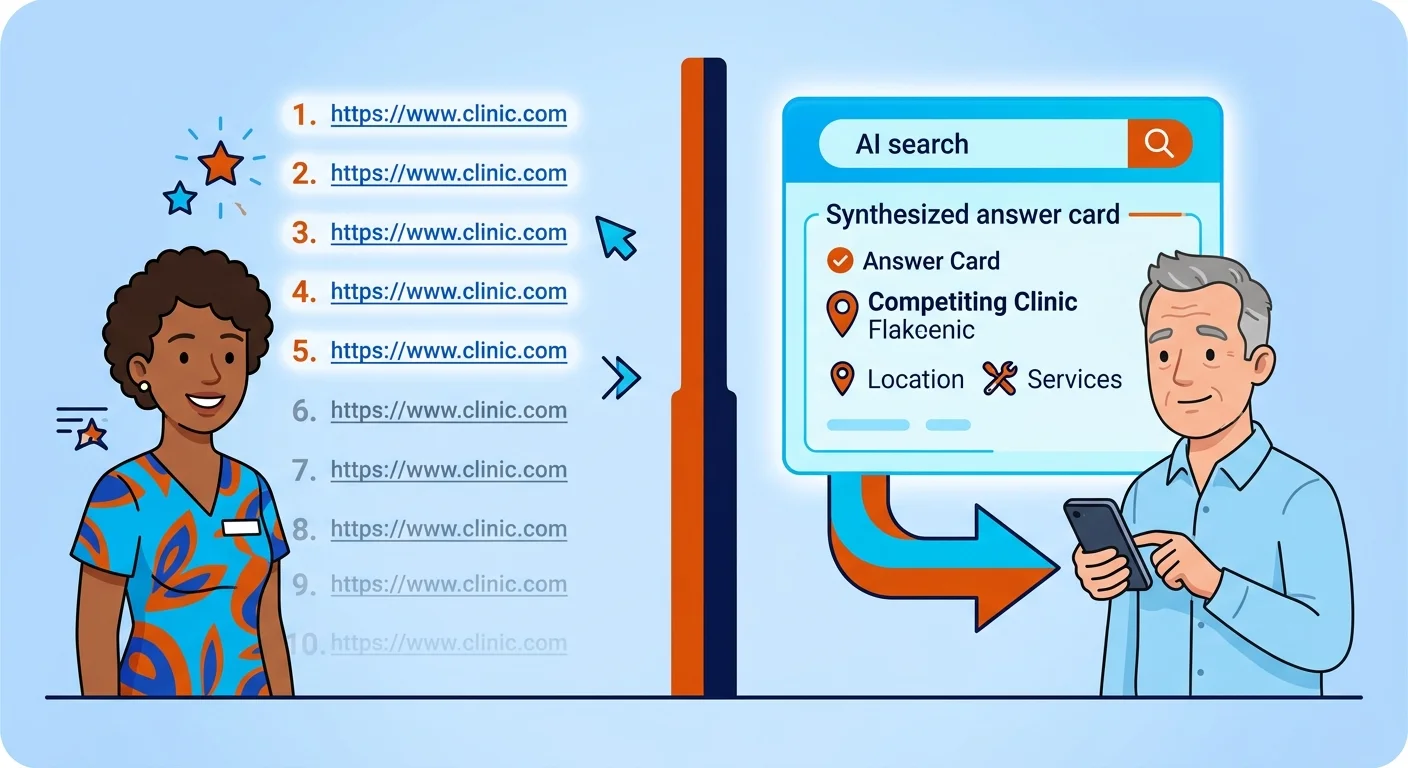
Here's the thing about the old model. It worked so well for so long that nobody bothered to ask how it actually worked.
For years, the playbook was dead simple: rank high on Google, and the calls came in. Clinics built whole budgets on that one assumption.
So the entire industry chased one visible scoreboard. Placing in the classic ten blue links was the finish line, and every move pointed at it.
But generative AI search broke that model, and it put an invisible wall between your clinic and the patients looking for you. The scoreboard's still there. It just stopped being where the game gets decided.
Picture your clinic's digital presence as a witness called to testify before an AI judge. The judge doesn't care how loud the witness talks — it cares whether the testimony holds up. If the story is inconsistent, incomplete, or unverifiable everywhere it's told, the judge cites someone else as the answer.
The Old Playbook Everyone Was Taught
Look at how the old playbook was actually taught. Rank first, and visibility, credibility, and calls would follow — in that exact order.
That sequence made intuitive sense in a world where search results were a list of links a person scanned and clicked. A clinic that mastered keyword position tracking and acquiring inbound links controlled its own fate. If you wanted proof the model was cracking, the clearest diagnosis sits in this breakdown of what is your clinic invisible to chatgpt the psychology of the zero-click search gap, which names the exact moment the old scoreboard stopped matching what patients actually saw.
Why the Old Model Quietly Stopped Working
So why did a model that ran for over a decade quietly quit? Because the thing being ranked changed.
Generative AI search doesn't hand a patient ten links to sort through. It hands them one answer — already vetted, already decided.
And that shift moves the whole contest upstream. A clinic doesn't need to win the click anymore — it needs to win the citation that happens before a click was ever on the table. Missing that earlier contest is what makes a clinic invisible while its traditional search optimization numbers look untouched.
How Generative Search Actually Picks Who Gets Cited
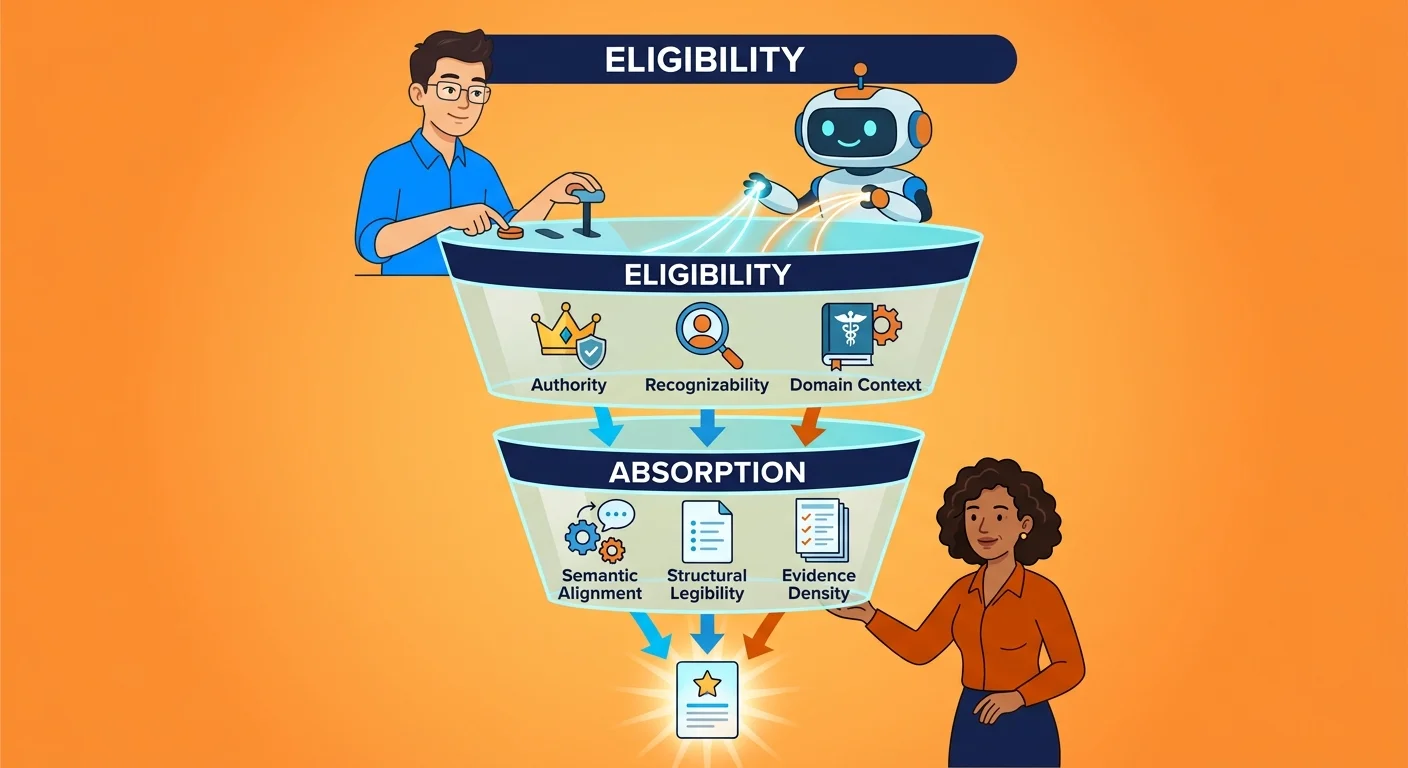
So how does a generative engine actually pick who gets cited? It runs two separate passes, not one.
First pass is eligibility. Before it reads a single sentence, the engine asks whether a source even qualifies — screening for authority, recognizability, and domain context.
Only sources that clear that filter reach the second pass. Now the engine weighs semantic alignment, structural legibility, and evidence density to decide whose content actually gets pulled into the answer.
This two-pass structure is why a clinic can have excellent content and still lose the citation. Content quality never gets read if the entity flunks the eligibility pass first.
| Selection Filter | What It Evaluates | Why It Matters to a Clinic |
|---|---|---|
| Authority | Whether other trusted sources already treat the clinic as a real, established entity worth referencing. | A clinic with no corroborating footprint outside its own website never clears the first filter, regardless of content quality. |
| Recognizability | Whether the clinic's identity reads as the same consistent entity everywhere it appears online. | Small variations in name, address, or service description fracture the match and push the engine toward a cleaner competitor. |
| Domain Context | Whether the source sits inside the right topical neighborhood for a healthcare-related question. | A clinic buried under unrelated categories or thin directory listings never registers as a healthcare authority to begin with. |
| Semantic Alignment | How closely the language on a page matches the shape and intent of the answer being generated. | Content written for a human skimmer rarely maps cleanly to the phrasing an AI engine needs to lift and reuse. |
| Structural Legibility | How cleanly a page's information is organized into machine-readable structure rather than dense narrative blocks. | A page with no clear structure gives the engine nothing to parse, even when the underlying information is accurate. |
| Evidence Density | How much of the page consists of usable proof, such as definitions, comparisons, or procedural detail, versus filler. | Thin, generic pages fail this test even after clearing every earlier filter, which is why volume alone never fixes AI Invisibility. |
Eligibility Filters: Authority, Recognizability, Domain Context
Eligibility is a gatekeeping question. The engine is deciding whether this business is even a legitimate candidate to answer the question at all.
Authority asks whether other trusted sources treat this clinic as real and established. Recognizability asks whether the entity's identity is consistent enough to match confidently across the web.
Domain context asks whether the source sits in the right topical neighborhood for a healthcare query. Weak on any one of those three, and a clinic never reaches the second pass — no matter how strong its content is — which is exactly the gap examined in why traditional authority visibility reporting misses this loss entirely.
Absorption Filters: Semantic Alignment and Evidence Density
Once a source clears eligibility, the engine starts reading. Here's where semantic alignment and evidence density decide whether the content earns a place in the synthesized answer.
Semantic alignment measures how closely a page's language matches the shape of the answer being built. Evidence density measures something else entirely — how much of the page is real, usable proof instead of filler.
Generative engines favor pages built from extractable evidence genres: definitions, numerical facts, comparisons, and procedural steps, according to the arXiv preprint server. A page written as loose narrative gives the engine nothing clean to lift.
Why 'Helpful Sounding' Answers Aren't Always Accurate
Now here's the uncomfortable part. An answer that sounds helpful to a patient is not the same as an answer built on accurate citations.
Stanford research on four commercial generative search engines found citation precision inversely correlated with how helpful the answer felt, per published research data. The most convincing-sounding answer is often the least verifiable one — proof that a clinic's testimony has to be accurate, not just persuasive.
Why 'More Blog Posts' Won't Fix an Authority Problem
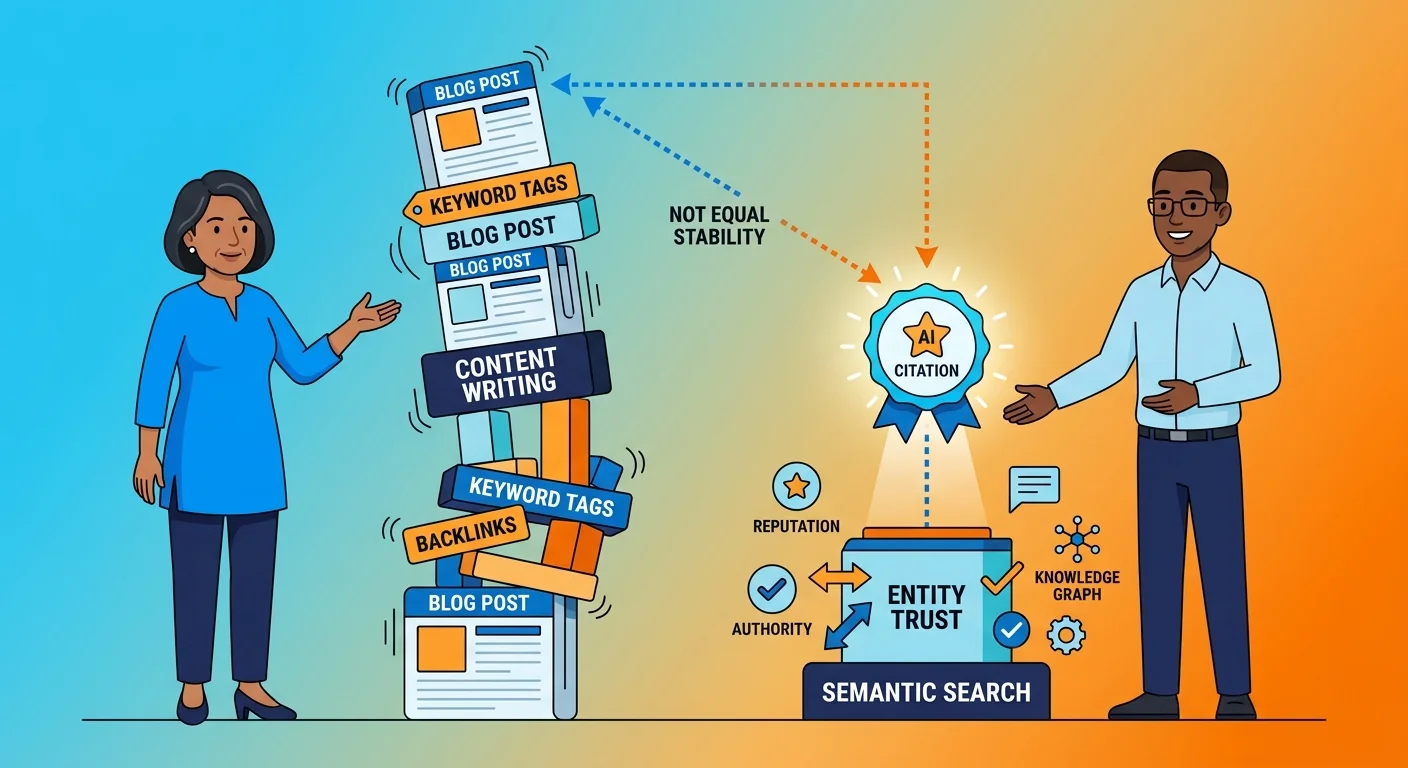
Here's the move almost every clinic makes first. If AI wants more content, give it more content.
That instinct is dead wrong, and it's wrong for a reason baked into how these systems work.
Volume was the currency of the old game. Out-publish a competitor, and you slowly climbed toward placing in the classic ten blue links, because more indexed pages meant more chances to get found.
Generative engines don't play that game. They already decided whether your clinic is a legitimate witness before a single new article ever gets read.
Piling more testimony onto a witness the judge already distrusts doesn't change the verdict. It just drags the shaky story out longer.
The Content-Volume Myth
So why won't the volume instinct die? Because it worked once, under a completely different rulebook.
Keyword-targeted articles built topical breadth for traditional search optimization, and breadth used to mean authority. Ranking systems rewarded coverage, so publishing became the lever every clinic yanked.
But coverage is just one of three proxies a modern system leans on, and it's the weakest one when your entity data is unverified. A dozen fresh pages stacked on an inconsistent name, address, and credential record doesn't fix the record. It buries it deeper, which is exactly the mechanism dug into in how AI engines pull recommendations from scattered web signals.</br>
How Coordinated Signals Fake Authority Without Fixing It
Now here's where it gets uglier than a simple wrong instinct. Some clinics, or the vendors selling to them, try to shortcut authority altogether by flooding the signals themselves.
Most systems approximate authority using computational proxies. Centrality measures how connected a source looks, consistency measures how often a claim repeats, and coverage measures how broadly a source touches related topics, according to published research data.
Those proxies are heuristics, not evidence, and heuristics get gamed. Coordinated signals can saturate a knowledge graph and its retrieval surfaces until a wrong source starts to look canonical, which is just a faster route to the same dead end, because a citable answer built on manufactured consistency still collapses the second a patient calls and the testimony doesn't match reality. It's the same shortcut trap researchers describe when they note that generative tools offer real shortcuts around defining an information need, weighing credible sources, and synthesizing scattered information, according to published research data, shortcuts meant for the searcher, not a loophole for the business being searched for.
The Entity Authority Gap: What AI Engines Actually Verify
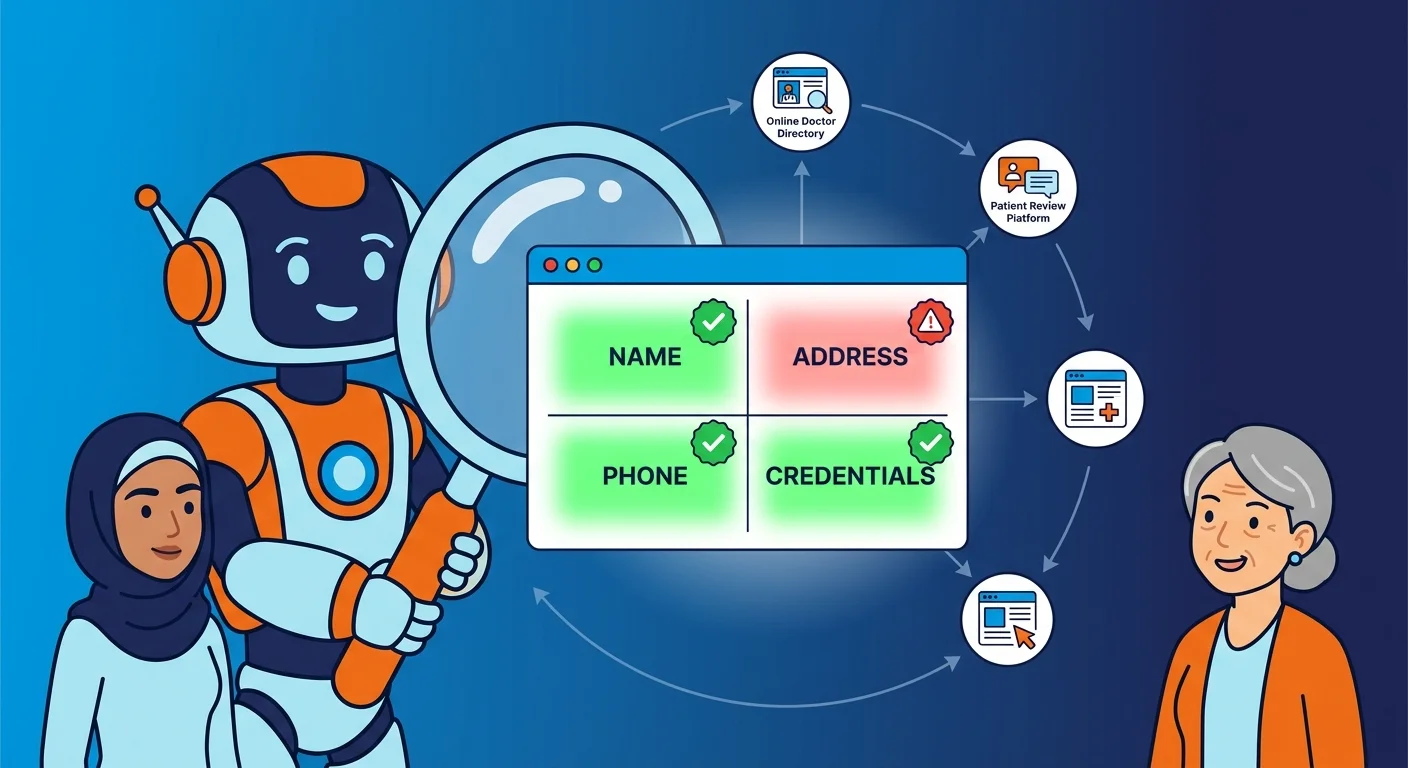
So what does a generative engine actually verify once the volume myth is dead? Not your word count. Not how often you hit publish.
It checks whether the entity behind the content is real, consistent, and current on every surface it shows up on. That's what this article calls entity authority — the trust layer sitting underneath your content, not next to it.
Here's the part that stings for clinics feeling good about their digital presence. You can be genuinely great at patient care and still be entity-invisible to the systems now recommending care to strangers. Plenty of clinics are already AI Invisible — a solid traditional search presence, but none of the entity authority an AI engine needs before it'll cite them. A fifteen-minute look at what these systems actually see surfaces that gap fast, and that's exactly the diagnostic walked through in a short check that surfaces why a clinic's phone has gone quiet.
What 'Entity Authority' Actually Means
Entity authority isn't a ranking score, and it's not one number a clinic can chase. It's a composite judgment an AI engine builds from three separate signal groups before it'll ever treat a business as citable.
Those three groups are Signal Consistency, Structural Legibility, and Third-Party Reputation Signals. Each one answers a different question the engine is quietly asking. Flunk any single one, and the testimony stops being credible — no matter how strong the other two look.
The Building Blocks of Machine-Readable Trust
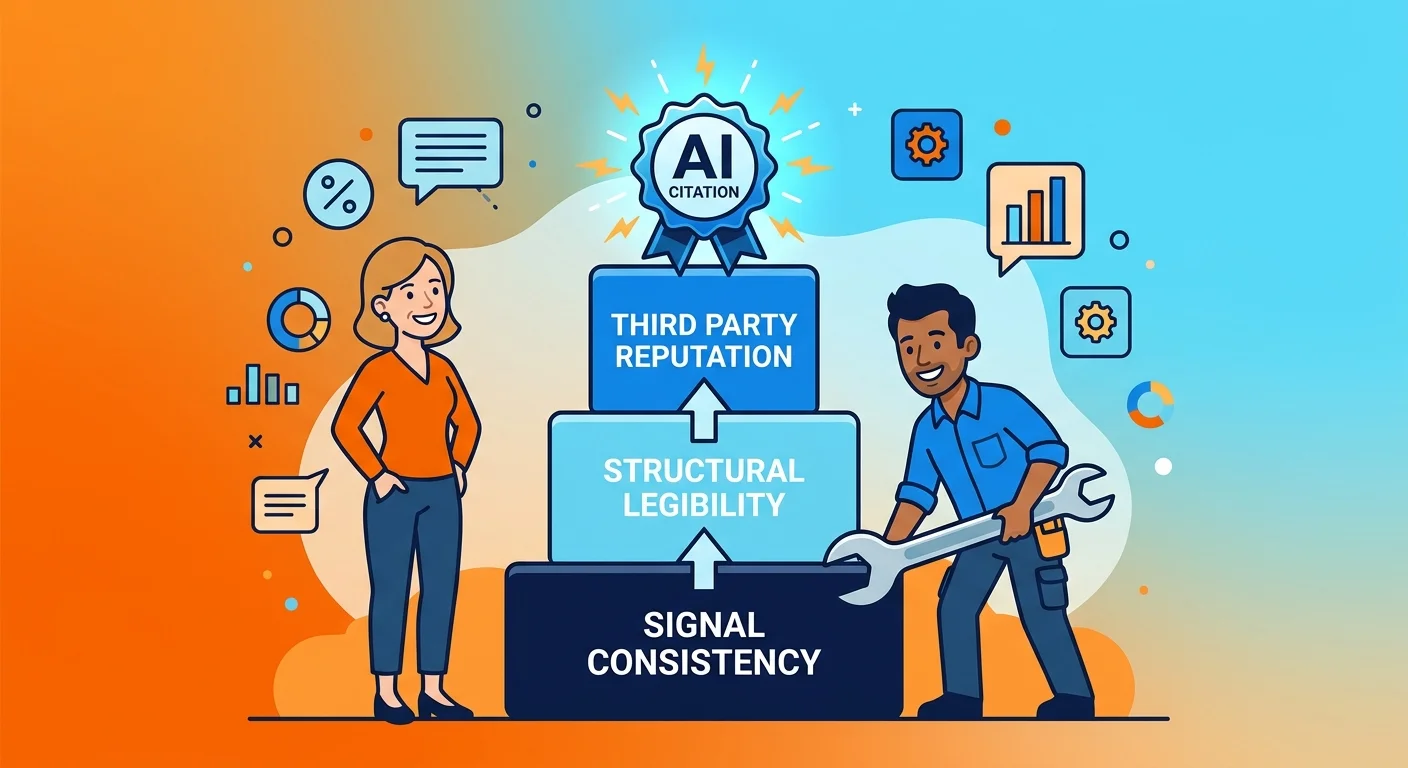
So what actually builds machine-readable trust? Three signal groups — each one a different piece of sworn testimony the engine cross-examines before it'll cite a clinic as the answer.
Nail all three and the witness holds up. Miss one and the whole account looks shaky, no matter how solid the other two are.
| Trust Layer | What Breaks It | What Fixes It |
|---|---|---|
| Signal Consistency | Name, address, phone number, or credential data that differs across directories, profiles, and the clinic's own site | A single verified record pushed identically to every surface the clinic appears on, with no variant left standing |
| Structural Legibility | Service and expertise information buried in loose narrative text a machine has to interpret and guess at | Structured data and clear headings that hand the engine pre-formatted facts it can lift directly into an answer |
| Third-Party Reputation Signals | A thin or inconsistent Google Business Profile and scattered, unmanaged directory listings | A complete, actively maintained profile and consistent listings that reinforce the same testimony everywhere |
Signal Consistency
Signal Consistency is the most basic testimony a clinic gives. Does the name, address, phone number, and credential data match everywhere it shows up online?
Here's why this matters more than clinics assume. People spot a mismatch instantly, and the reaction is anything but neutral.
Among US consumers hunting for local businesses online, 80% lose trust the second they spot wrong or inconsistent contact details or business names, according to published research data. A clinic with three different phone numbers scattered across directories isn't just confusing an algorithm — it's flunking the same trust test with the humans that algorithm serves.
Structural Legibility
Structural Legibility asks a different question. Can a machine actually parse what this clinic offers, without a person translating the page first?
This is where structured data earns its keep. Schema markup, clear headings, and organized service pages hand the engine pre-formatted facts instead of prose it has to interpret and guess at.
A page built on loose narrative makes the engine infer meaning. A page built on legible structure hands it an answer it can lift straight off — the exact distinction explored in what separates a routine scan from a full multi-engine visibility diagnostic.
Third-Party Reputation Signals
Third-Party Reputation Signals are the testimony a clinic never writes itself. Reviews, directory listings, and business profile data live on platforms the clinic doesn't own.
Google Business Profile carries real weight here. Profile score shows the strongest positive correlation with LLM citation ranking of any GBP signal measured, according to published research data — a modest but real link between overall profile quality and whether an engine treats a clinic as citable.
None of these three groups work alone. A clinic can win Signal Consistency and still lose the citation when Structural Legibility or Third-Party Reputation Signals fall short — and that's the diagnostic work an AI Invisibility Diagnostic exists to run.
Who This Diagnostic Approach Isn't For
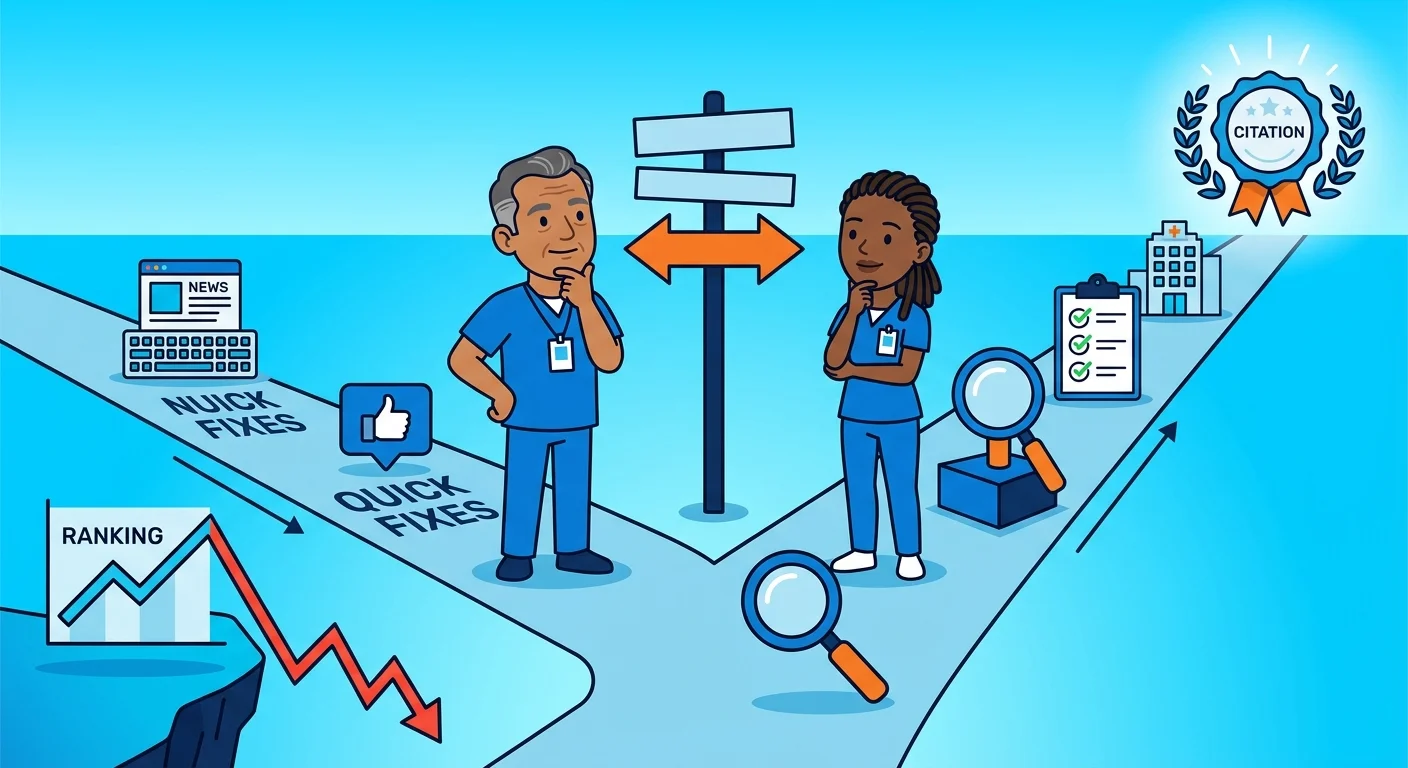
Let's be direct about who this diagnostic isn't built for.
If a clinic wants another round of keyword-targeted articles chasing a spot in the classic ten blue links, this isn't that engagement. That instinct answers a question generative engines already stopped asking.
This isn't for a clinic hunting a quick fix for the symptom instead of the record underneath it. AI search doesn't rank websites the way traditional search optimization once did — it synthesizes an answer and cites whichever source it trusts, usually skipping the clinic's own website altogether. A witness with mismatched testimony doesn't get more credible by talking louder or publishing more.
So if the goal is a vanity metric — more site visits, more indexed pages, zero change in whether the engine calls the clinic citable — this diagnostic will feel like the wrong tool. It was built for clinics ready to fix the testimony itself, not dress up the same unreliable witness.
Diagnosing AI Invisibility: What Actually Gets Measured
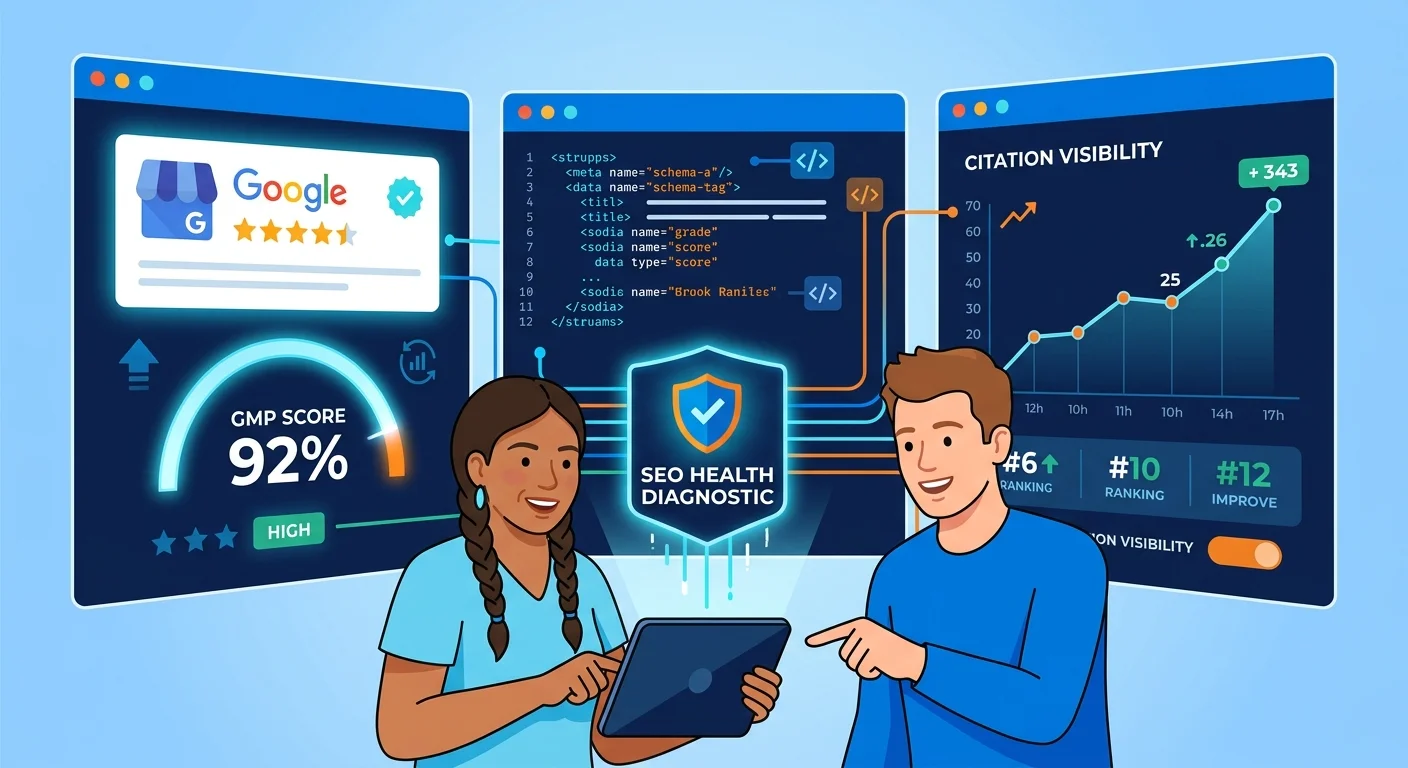
So what does a real diagnostic actually inspect? Not vibes. Not a gut check on how the website looks.
A proper AI Invisibility Diagnostic scores the exact signal groups an AI engine already scores — Signal Consistency, Structural Legibility, and Third-Party Reputation Signals. And it reads each one from the inside, the way the engine itself would.
Two of those groups leave a paper trail before a diagnostic even starts. Google Business Profile is one. Structured data is the other.
| Diagnostic Layer | What It Measures | Signal Strength |
|---|---|---|
| Google Business Profile Score | Overall profile quality and completeness across categories, services, and review responses | Strongest positive correlation of any GBP signal with LLM citation ranking |
| Citation Accuracy vs. Perceived Helpfulness | Whether an AI-generated answer's cited sources actually match the claims made | Citation precision inversely correlated with perceived utility across four commercial generative search engines evaluated |
| Overall GBP Profile Quality | Composite completeness and consistency of a business's Google Business Profile data | Modest association with better LLM citation ranking |
Google Business Profile Signals
Look, a Google Business Profile isn't a passive listing sitting there collecting dust. It's ongoing testimony a clinic gives every time it updates a category, a service line, or a review response.
So a diagnostic checks whether that testimony is complete and current. Overall profile quality carries a real, measured link to whether an engine treats a business as citable — the same modest correlation this article already walked through when it named Google Business Profile as the strongest single signal in that dataset.
A thin or stale profile isn't a cosmetic problem. It's a credibility gap the engine spots before a human ever does — and it's one of the fastest to close once somebody actually names it.
Schema and Structured Data Readiness
Structural Legibility gets tested next, and structured data is where that test kicks off. Schema markup is the cleanest way a clinic hands an engine pre-formatted facts instead of paragraphs it has to decode on its own.
So a diagnostic checks whether service pages, credentials, and location data are actually marked up. Or whether they're sitting in plain prose the engine has to guess its way through.
Here's the distinction that matters. A page can read beautifully to a person and still be illegible to a machine, because legibility and quality aren't the same test — and a diagnostic exists to catch exactly that gap before a competitor's better-structured page keeps winning the citation instead.
Frequently Asked Questions
A handful of objections come up every single time a clinic hears this diagnostic explained for the first time.
So here are the straight answers. No hedging.
If my website site visits haven't changed, why are my calls dropping?
Because site visits only track whether people reach your website. They say nothing about whether an AI engine names your clinic as the answer before anyone visits at all. Two scoreboards now, and only one still predicts phone calls.
Can't I just write more keyword-targeted articles to show up in AI answers?
No. More keyword-targeted articles solves a keyword problem, and a keyword problem isn't what's keeping this clinic uncited.
Without Signal Consistency and Structural Legibility underneath it, fresh content just piles more words onto an unreliable witness.
How is visibility in AI search different from placing in the classic ten blue links on Google?
Placing in the classic ten blue links pits one webpage against other webpages. AI search skips that contest entirely, synthesizes one answer, and cites whichever source it already trusts.
So a clinic can win the old game and still never get named in the new one.
What is the first step to diagnosing why competitors are appearing in AI answers and my clinic is not?
Start by finding out what the engines actually see, not what the clinic assumes they see. That's the whole point of an AI Invisibility Diagnostic.
Guessing at the gap just burns effort the diagnostic was built to save.
How long does it take to fix AI invisibility for a local clinic?
It hangs on how far apart the three signal groups sit right now, so no two clinics get the same timeline. That's not a dodge — it's the honest read.
What never changes is the order: Signal Consistency and Structural Legibility close first, because Third-Party Reputation Signals only compound on top of them.
Does having a Google Business Profile automatically mean AI engines will cite my clinic?
Nope. A profile can exist and still be thin, stale, or inconsistent — and a thin profile makes a lousy witness. Quality is what carries the citation, not just showing up.
The Bottom Line
An AI judge doesn't care how loud the witness talks. It cares whether the testimony holds up consistent, structured, and verifiable across every surface it checks. So the clinics winning AI answers right now aren't better at care — they're simply better witnesses.
Signal Consistency, Structural Legibility, and Third-Party Reputation Signals are the sworn testimony an engine cross-examines before it cites anyone as the answer. Fix only one of the three, and a clinic is still an unreliable witness.
Fix all three, and the citation follows because the testimony finally holds up.
So the real question was never whether a clinic deserves to be found. It's whether its digital record can testify on its own behalf when no human's there to explain it.
An AI Invisibility Diagnostic is how a clinic finds out what its testimony actually says before another competitor gets cited in its place.