Why AI Search Engines Stopped Trusting What Your Website Says About Itself
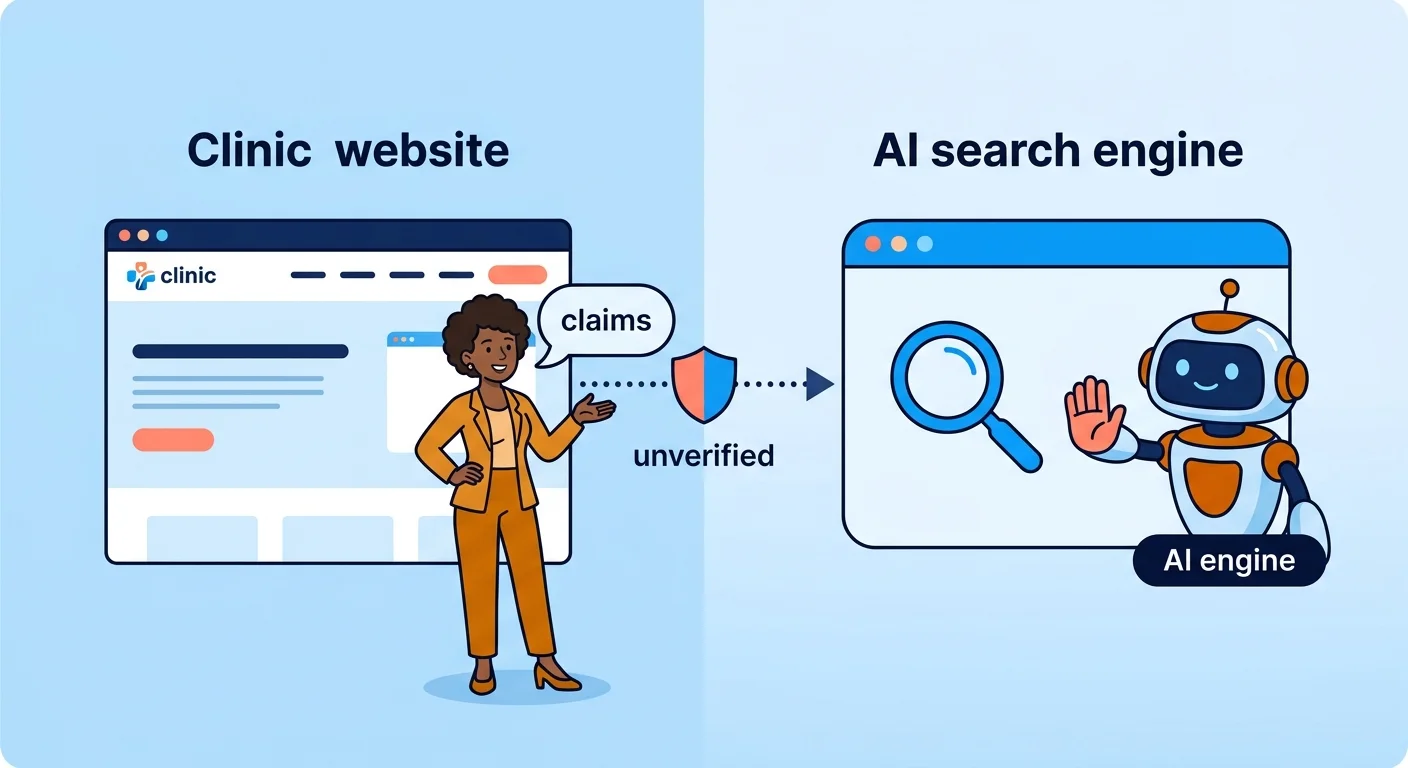
So why did the old model break? For years, a clinic's website worked like a witness on the stand. It made a claim, and search systems mostly took that claim at face value.
That worked fine when a human made the final call. But generative AI doesn't read the way people read. It extracts, compares, and stitches answers together from dozens of sources at once, and a single unproven claim buried in prose counts for no more than a competitor's louder one.
Here's the thing: static marketing claims on your website just aren't enough to earn trust from generative AI anymore. A paragraph describing a provider's credentials isn't evidence. It's testimony, and testimony can be wrong, outdated, or flat-out impossible to verify at scale.
Answer engines changed the rules: clinics now have to prove their legitimacy, not just claim it. That's the deeper story behind why machine-readable proof architecture is reshaping how clinics earn AI citation. A witness can be cross-examined and still be wrong, but a notarized document carries its own proof.
The Trust-By-Assertion Problem: Why Static Marketing Claims Fail Modern AI Search
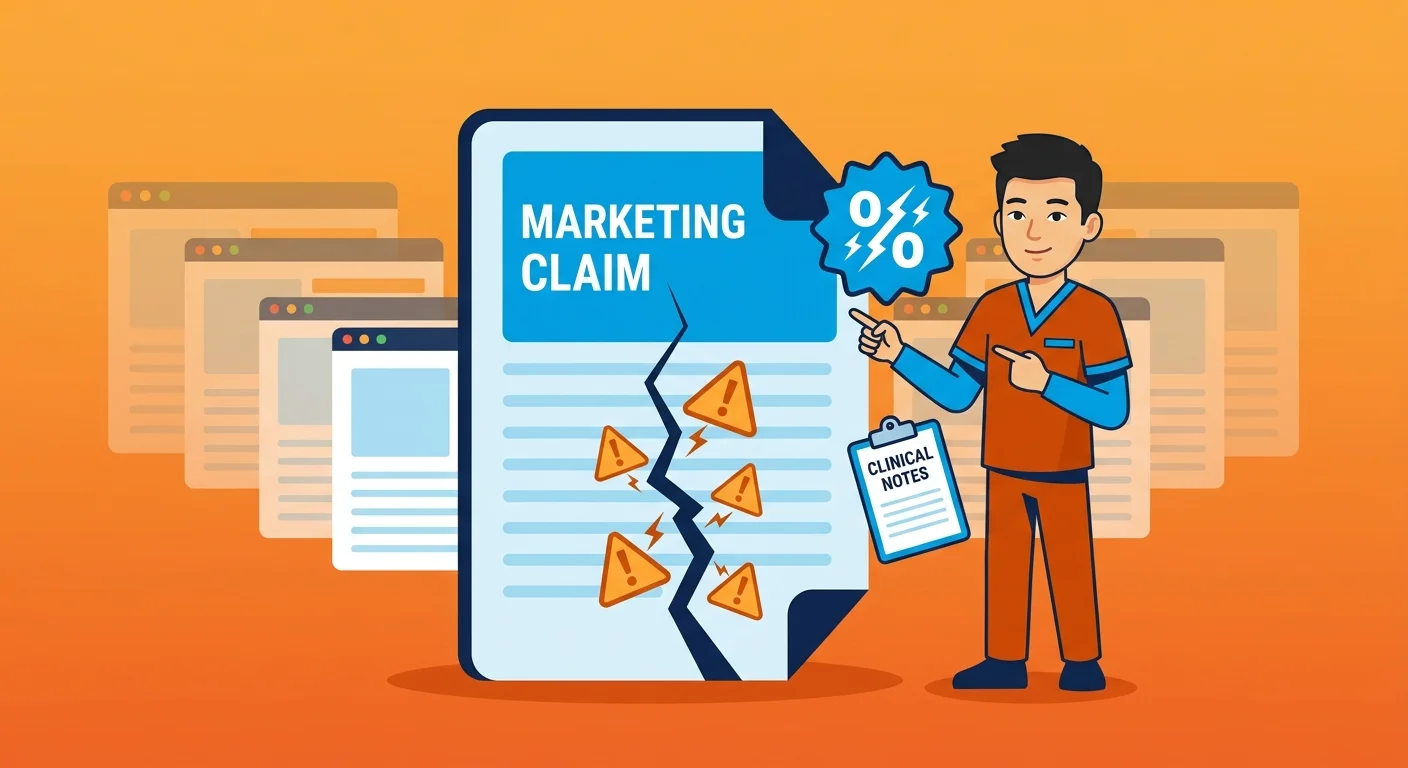
So what actually breaks when a clinic leans on trust-by-assertion? The model bets that an AI system reads prose the way you do, weighing tone and context before it accepts a claim.
That bet loses at scale.
An AI system chewing through thousands of clinic pages has no time to weigh a sentence for sincerity. It hunts for a structure it can confirm, and unstructured prose hands it nothing.
Here's the thing: a claim with no verification path is just noise to a machine built to pull facts, not vibes. That gap is exactly what verifiable proof objects solve that plain website copy cannot, and it's why the assertion model is now the weakest link in a clinic's whole online presence.
| Trust Signal Type | Who Verifies It | Machine-Readable | Failure Mode |
|---|---|---|---|
| Website Prose Claim | No independent verifier; the clinic asserts it about itself | No | Statement is treated as unconfirmed testimony and easily outweighed by conflicting or louder claims elsewhere |
| Verifiable Credential | An issuing authority such as a licensing board or accrediting body signs the credential | Yes | None under normal conditions; failure only occurs if the issuing authority itself is compromised |
| Structured Metadata Markup | Automated crawlers and AI systems parse and cross-reference the markup directly | Yes | Fails only if the markup is missing, malformed, or inconsistent across a clinic's digital properties |
| Third-Party Directory Listing | A platform operator maintains the listing, not the clinic and not a credentialing body | Partial | Data can drift out of date or conflict with the clinic's own records, with no cryptographic path to resolve the discrepancy |
Why Self-Published Claims Fail As Proof
Look at what a self-published claim really holds. A page says a provider is board-certified, names a specialty, and lists years in practice.
None of that carries a verification path. No signature to check. No issuing authority attached. No way for a machine to confirm the sentence against anything beyond the page itself.
But a credential built on open, interoperable standards behaves nothing like that. It shows up with its issuing source baked in, so an AI system can trace the claim straight back to whoever certified it.
That traceability is the whole point.
A clinic can write anything it wants about itself. What it can't do is forge a cryptographic signature from a licensing board, and that asymmetry is exactly why self-published prose keeps losing ground to structured proof.
The Cost of Getting It Wrong: Hallucination in Clinical Contexts
So what happens when an AI system has to paper over the gap that unverifiable prose leaves behind? It guesses, and sometimes it guesses wrong in ways that matter.
A manual review of LLM-generated clinical notes in primary care clocked a hallucination rate of 1.47%, and 44% of those hallucinations were flagged as major errors capable of affecting patient diagnosis and management, per published research data. That's not a rounding problem.
Now scale that error rate across an AI system stitching claims from an entire clinic website with no verification layer beneath it. One unconfirmed sentence about a provider's credentials can spread the same way, and nothing stops it from becoming the answer a patient reads as fact.
The Building Blocks: What Actually Makes a Credential Machine-Readable
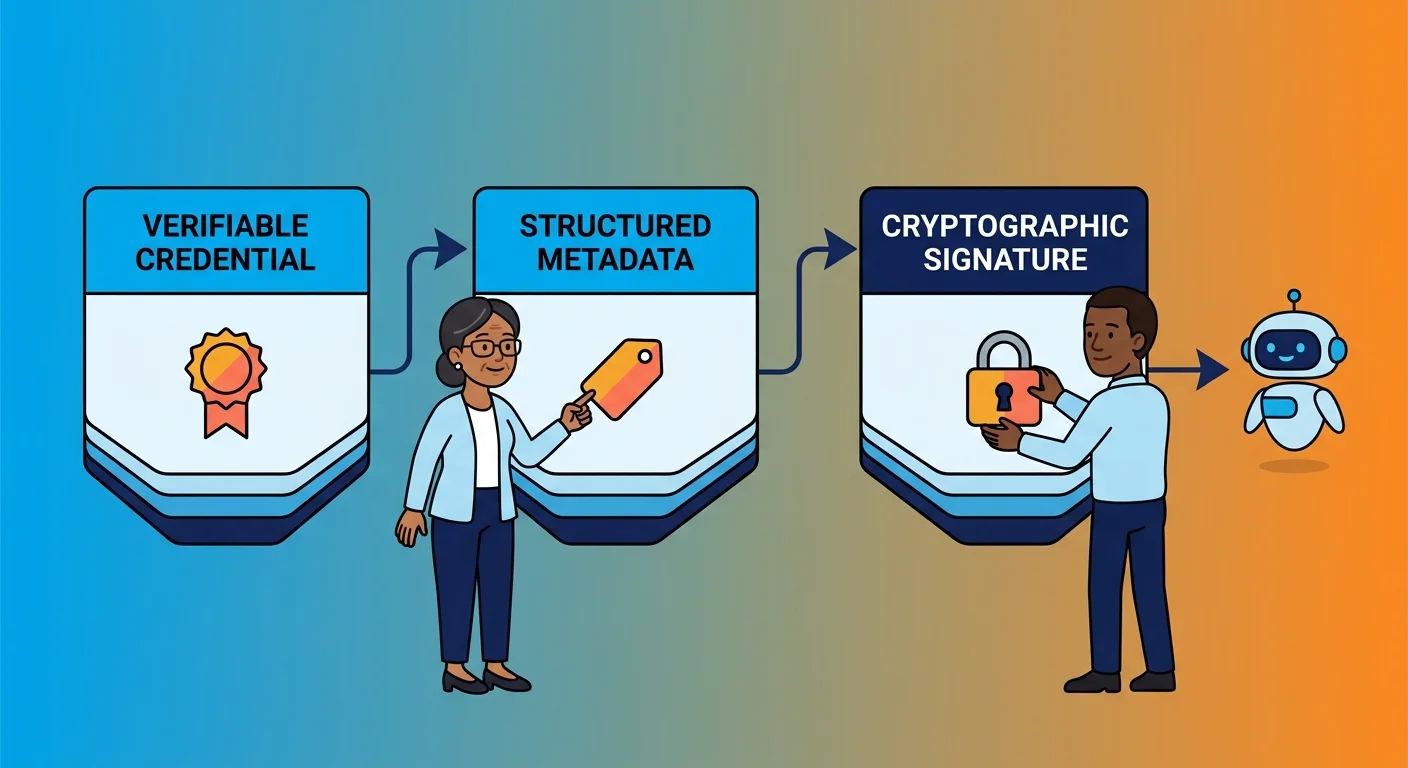
So what does a machine-readable credential actually look like once it drops the marketing prose? It breaks into four working parts, each with its own job. None of them is decoration.
The credential itself carries the qualification. Structured metadata makes it findable. And cryptographic signatures plus policy enforcement confirm nobody tampered with it.
| Component | Function | Standard Referenced | Adoption Signal |
|---|---|---|---|
| Verifiable Credential | Carries a digitally signed record of a real qualification, such as a license or board certification, in a machine-parseable format | W3C Verifiable Credentials | Nearly half of credential platforms surveyed already support this open standard, showing convergence toward interoperable formats |
| Structured Metadata Markup | Makes a credential discoverable so automated systems can locate and cross-reference entity information on a digital property | Schema.org vocabularies | Research data repositories already embed this markup in landing pages to enable commercial search engines to discover and access records |
| Cryptographic Signature Verification | Confirms a credential has not been altered by checking its digital signature before it reaches an AI system's context | Public key trust store validation | A policy enforcement point intercepts incoming sequences and verifies signatures against a configurable trust store before granting access |
| Policy Enforcement Layer | Enforces access policies on incoming and outgoing data, acting as the gate that stops unverified content from entering an answer | Signed artifact validation | This layer intercepts sequences and enforces access policies before content enters the LLM's context, closing the gap assertion-based claims leave open |
Verifiable Credentials
A verifiable credential is a digitally signed record of a real qualification. A license, a board certification, a specialty designation, all issued in a format a machine can read without guessing.
Here's the thing: this isn't a niche experiment anymore. Nearly half of the credential platforms surveyed already support the open W3C standard, and that adoption shows the ecosystem converging on interoperable formats instead of splintering into competing proprietary systems, according to published data on standards adoption.
That convergence matters for any clinic deciding where to put its money. Build toward an open standard, and a credential you issue today keeps working as more AI systems adopt the same verification framework.
Structured Metadata and Schema Vocabularies
But a verifiable credential still has to be found before it can be checked. That's what structured metadata handles, and Schema.org vocabularies are the shared language most systems already read.
This pattern isn't new to healthcare. Research data repositories already proved the model works, embedding structured metadata built on Schema.org vocabularies right into dataset landing pages so commercial search engines can discover and surface the underlying data, per published data on discovery standards.
A clinic can run the identical logic on its own digital footprint. Provider credentials, affiliations, and certifications get marked up the same way. The result is an entity profile that resolves the same no matter which system is asking.
Cryptographic Signatures and Policy Enforcement
So credentials and metadata solve discovery. What they don't solve is forgery, and that's where cryptographic verification and enforcement take over.
An earlier layer already does the checking on its own. A policy enforcement point sits between the incoming data and the AI system, cryptographically verifying a credential's signature against a trusted set of keys before that credential gets anywhere near an answer.
That verification step is what separates a proof object from a claim wearing a badge icon. For a deeper look at how this reaches clinical outcomes data specifically, see how patient outcomes get converted into machine-readable schema formats. Nothing enters the trust chain without clearing that gate first.
Not Everyone Is Ready for This: Who This Framework Actually Serves
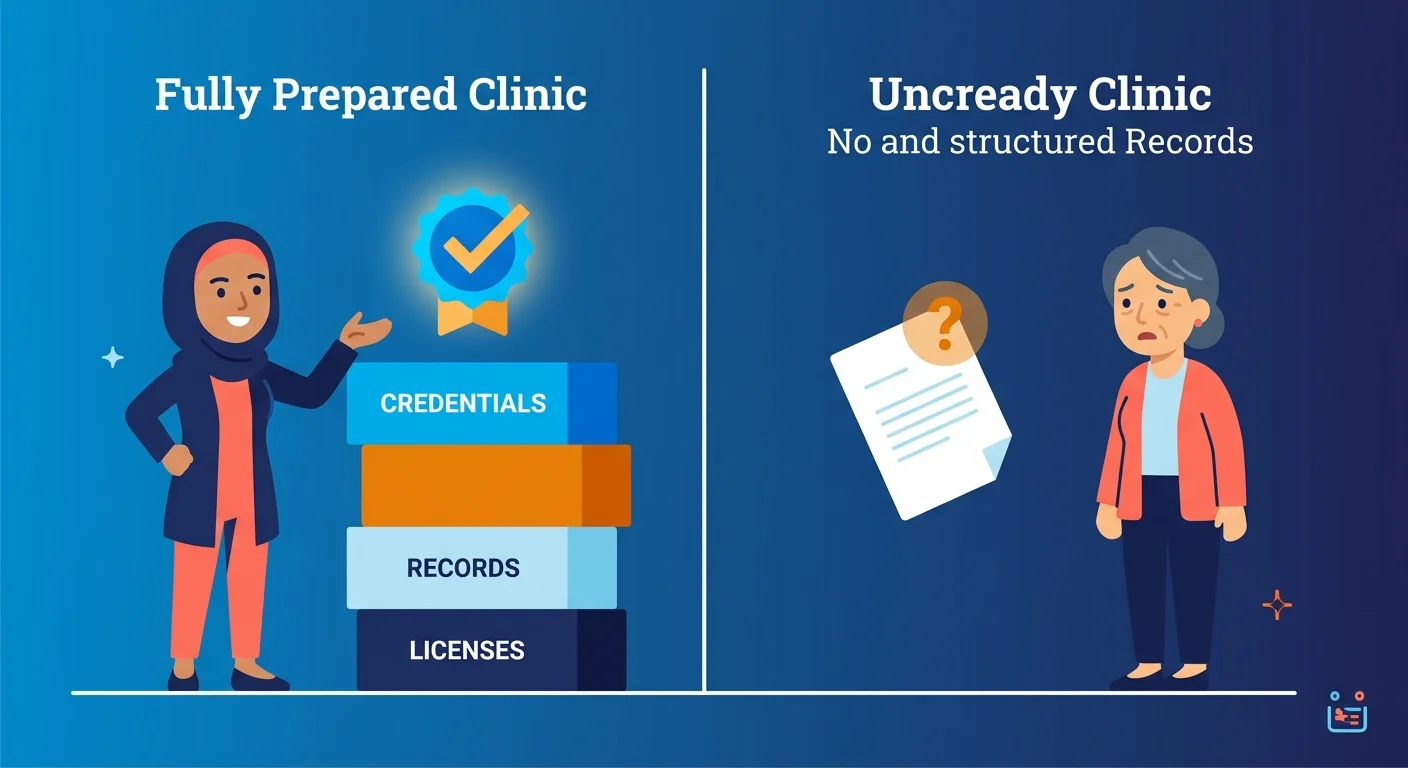
Not every clinic needs this framework today. That's not a hedge. It's a qualification, and it matters.
A machine-readable governance framework takes a clinic's real-world credentials and authority and turns them into a format AI search engines can cryptographically verify. But that translation only pays off once there's enough substance underneath worth translating.
So the real question isn't whether the tech works. It's whether your clinic has hit the point where trust-by-assertion is already costing you visibility.
Clinics This Framework Is Built For
This framework is built for multi-provider clinics carrying real licensing, certification, and specialty depth across several practitioners. More credentials means more for an AI system to either verify or ignore.
It also fits clinics already fighting for citation in generative answers, not just for placing in the classic ten blue links. Different battlefield. Prose alone doesn't win it.
And it fits any clinic that's watched a competitor's unverified claim outrank its own accurate one. Here's the thing: an AI system can't tell the two apart without a proof path attached.
When a Governance Framework Is Premature
A governance framework is premature for a solo practice with one provider and a narrow service line. There just isn't enough entity complexity yet to justify the build.
It's also premature for a clinic that hasn't nailed down its basic structured metadata. Cryptographic verification protects a credential a machine can already find. Build discoverability first, then layer verification on top.
The Rollout Path: Sequencing a Governance Framework Without Breaking What Already Works
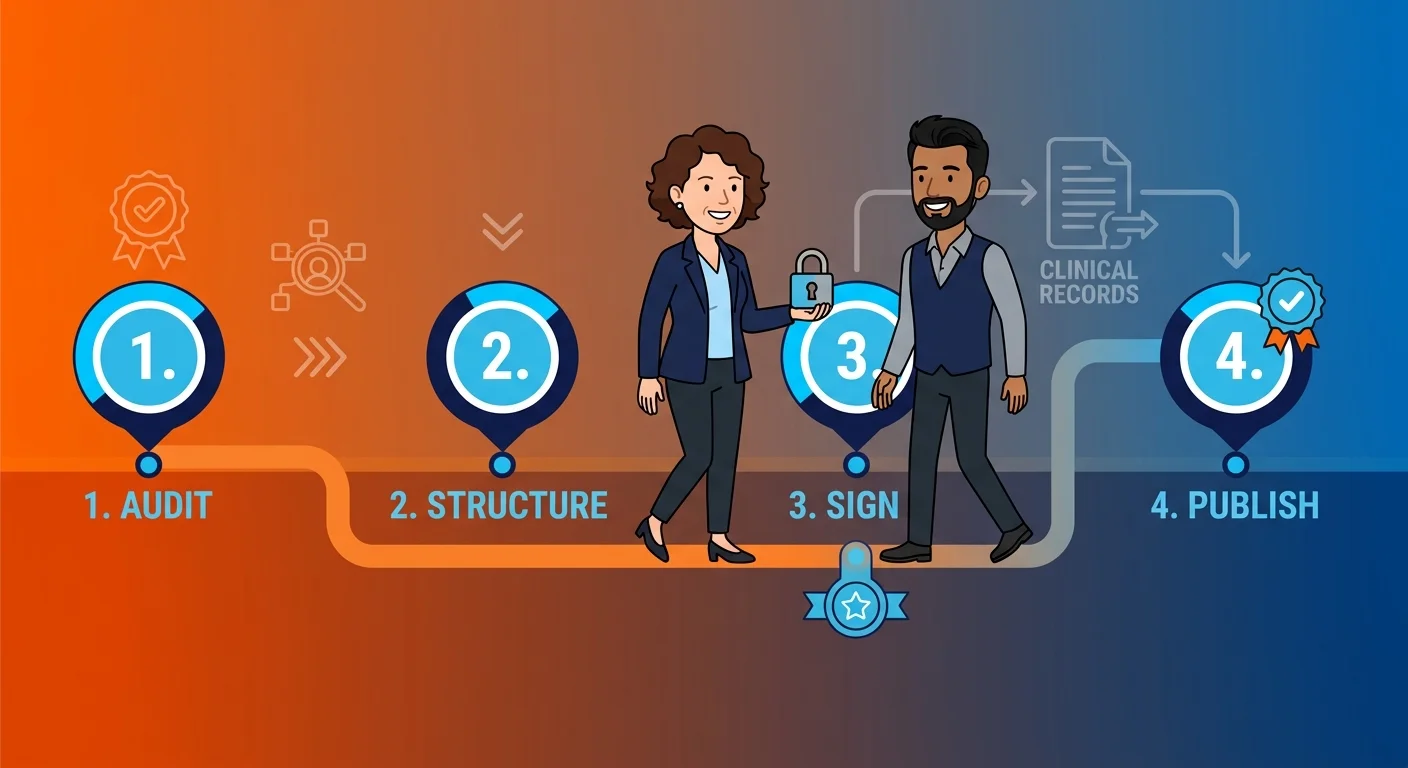
So how does a clinic move from static claims to a real governance framework without breaking the site that already works? The sequencing matters more than the technology.
Here's the thing: nothing gets ripped out on day one. A clinic layers verifiable structure on top of what's already there, and each layer has to hold before the next one goes on.
| Phase | Objective | Primary Standard | Readiness Check |
|---|---|---|---|
| Structured Metadata | Make provider credentials, affiliations, and certifications discoverable to AI systems before anything gets verified | Schema.org vocabularies | Every provider profile and credential claim on the site resolves to consistent, machine-readable markup |
| Verifiable Credential Issuance | Convert structured claims into signed, checkable records tied to an issuing authority | W3C Verifiable Credentials | Metadata is already stable and discoverable, with no unresolved gaps in provider or specialty data |
| Cryptographic Enforcement | Intercept incoming data and confirm each credential's signature before it reaches an AI system's context | Policy enforcement point verification | There is at least one verified credential in place worth protecting through active enforcement |
| Clinical Data Interoperability | Extend the same verification logic to outcomes data and clinical narratives, not just credential badges | FHIR-based structuring | Credential and metadata layers are functioning, and free-text clinical records exist that need conversion |
Sequencing the Rollout
Start with structured metadata, not cryptographic signing. Markup for provider credentials, affiliations, and certifications comes first, because a policy enforcement point has nothing to verify against a credential nobody structured yet.
Once metadata resolves cleanly, verifiable credentials get issued against it. This is where a license or board certification stops being a sentence on a page and becomes a signed, checkable record.
Cryptographic enforcement comes last, not first. An enforcement point intercepts incoming sequences and checks an artifact's signature against a configurable trust store of public keys before that content reaches an AI system, and that gate only earns its place once there's a verified credential worth protecting.
Clinical Data Interoperability as the Proving Ground
Clinical data interoperability is where this sequencing gets tested against something harder than a credential badge. Turning free-text clinical narratives into structured, machine-readable formats is a known, solvable problem. Not a theory.
FHIR-GPT converted free-text clinical narratives into FHIR MedicationStatement resources with an exact match rate above 90% across a test set of 3,671 clinical text snippets, a result reported through PubMed Central. That's not a marginal bump over manual structuring.
And that result matters way beyond medication records. It proves free text can be converted into a verifiable format at scale, which is exactly the mechanism a governance framework needs for provider credentials and outcomes data alike. A policy enforcement point can only check what's already structured, and published research data shows how signature verification and access policy enforcement work together before content ever hits an AI system's context.
Frequently Asked Questions
The mechanics and the rollout answer most of the how. But a few sharper questions keep coming up, and they deserve a straight answer instead of another lap through the framework.
What is a machine-readable governance framework in simple terms?
It's the structured, cryptographically checkable layer sitting underneath a clinic's credentials. It lets an AI system verify a qualification instead of trusting the sentence that describes it.
How do verifiable credentials prove a clinic's legitimacy to an AI search engine?
A verifiable credential is a signed record an AI system can check against a trusted issuing source. That check is what turns a claim into something a machine can actually confirm.
Why can't generative AI just trust the information published on my clinic's official website?
Because your website prose was written to persuade a person, not to prove anything to a machine. An AI system can't confirm a sentence unless something behind it is signed and checkable.
What is the actual difference between a static marketing claim and a machine-readable proof object?
A marketing claim states something and asks to be believed. A proof object carries its own verification path, so belief never has to enter the picture.
Is implementing a verifiable trust framework a one-time project or an ongoing process?
Ongoing. Credentials change, providers turn over, certifications lapse and renew. The framework gets maintained the same way any credentialing record does.
Can smaller independent clinics implement this, or is it only feasible for large hospital systems?
Feasible for either, but the payoff scales with entity complexity. A solo practice with one provider has far less to verify than a multi-provider clinic carrying licensing depth across several practitioners.
Where This Leaves Your Clinic's Standing With AI Search
Your clinic's website was never built to testify under cross-examination. It states its case and waits to be believed. That worked fine when a human reader brought the skepticism a machine now has to bring instead.
So here's where it lands: the website stops testifying and starts handing over a notarized document. Real credentials, bound to a real identity, signed against a real source any AI system can check without the clinic vouching for itself. This was never a traditional search optimization problem. It was a proof problem, and proof is the only thing that survives a system built to verify instead of trust.
So the choice in front of a clinic isn't whether AI search engines start demanding verification. That's already happened. The real question is whether your authority gets rendered non-negotiable on your terms, or gets guessed at by a system filling gaps it never should have had to fill, and the way to see where you actually stand is to run an AI visibility check.