
Why Unstructured Testimonials Stopped Working the Moment AI Started Reading

The old proof format quietly stopped registering with the new reader. For decades, healthcare providers have leaned on text testimonials and case studies to show how good their care is. That worked when a human read every word and decided, on gut instinct, whether to believe it.
But the reader changed. Once AI-driven search engines took over, your human-readable proof started going invisible. A generative model has no instinct to lean on — it needs labeled data it can parse, not paragraphs it has to interpret.
Here's the thing about a locked filing cabinet: the evidence inside is real, but nobody outside can verify it without opening the drawer. Your unstructured testimonials sit in that exact cabinet. So the outcome data behind them stays true, yet stays unconfirmable to any system that can't open the file itself.
Look at what shifts once a provider explores why machine-readable proof architecture is becoming the standard for AI citation instead of leaning on the story alone. The cabinet becomes an open vault. Machines can walk in, check what's there, and cite what they find without asking a human to vouch for it first.
The Vocabulary Machines Actually Understand: Schema.org for Health and Medical Content
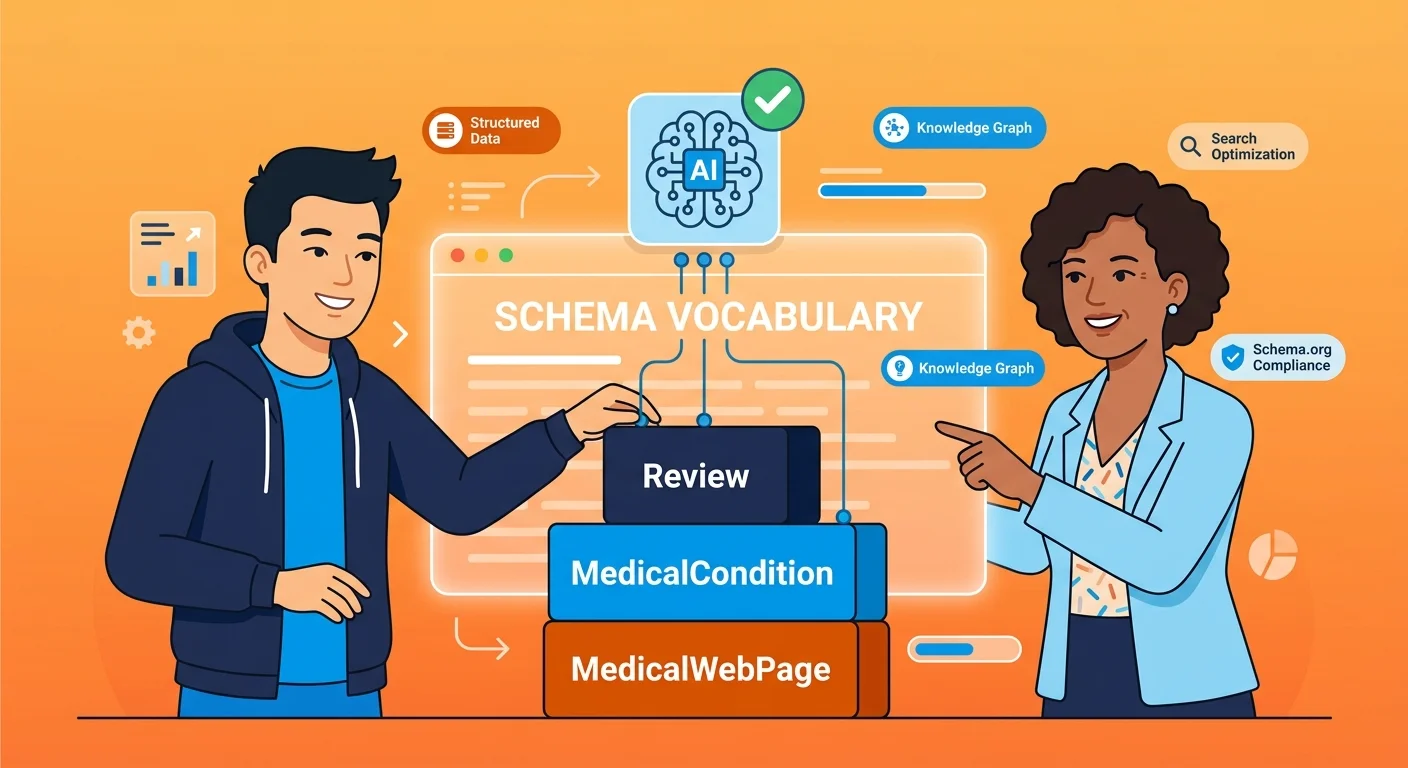
Schema.org hands healthcare providers a vocabulary built for exactly this handoff. Its health and medical schema exists for web markup that helps search engines and applications find medical content, not for clinical data exchange or medical records coding. That distinction matters more than it sounds.
A hospital's internal records system speaks a whole different language, one built for clinicians and compliance. Schema.org markup talks to a different crowd entirely: the crawlers and generative models scanning the public web. Mix the two up, and you either over-engineer your outcome data or leave it sitting there as plain text no machine can trust.
So the job is narrower than it looks at first. You're not translating a patient's chart into code. You're translating the public claim about that outcome into a structure a machine can verify on its own.
That structure is what turns a locked cabinet into an open vault. It's the vocabulary that lets a machine read a patient outcome, check its labeled parts, and cite it as fact instead of taking a stranger's word for it.
| Schema Type | Primary Use Case | What It Signals to AI Engines |
|---|---|---|
| MedicalWebPage | Marking a page as reviewed medical content covering an outcome, procedure, or condition | Tells the model the page is medical in nature and has been reviewed for accuracy, not just generic content |
| Review and AggregateRating | Structuring patient satisfaction data as labeled, machine-parsable fields instead of narrative praise | Signals a specific rated experience tied to a specific subject, rather than an unverifiable claim of quality |
| MedicalProcedure | Attaching the clinical specifics of what was actually done to a patient outcome page | Gives the model a named, categorized procedure to link the outcome to, rather than a vague description |
| MedicalCondition | Identifying the diagnosis or condition an outcome or procedure addressed | Lets the model connect an outcome claim to a recognized condition entity instead of inferring it from prose |
Why the Text Testimonial Is a Dead Format for Machine Readers
Here's the thing about a written testimonial: it was never built for a machine to read. It was built for a human who could weigh tone, context, and trust on instinct.
A generative model has none of that instinct. It can't infer sincerity from phrasing. It can't tell a real recovery story from a fabricated one just by reading sentence structure.
Providers who explore the difference between unstructured reviews and structured proof stacks usually hit the same wall. Plain text testimonials carry no labeled fields the machine can pull. A name, a procedure, an outcome, a date, all buried inside a paragraph the model has to guess at instead of parse.
And guesswork is exactly what generative systems are built to dodge. Ambiguous input gets deprioritized. Labeled, structured input gets cited.
MedicalWebPage and Beyond: Choosing the Right Schema Type for an Outcome
Once the plain-text failure is clear, the fix comes down to picking the right vocabulary for the claim you're making. MedicalWebPage is the workhorse for most outcome pages, flagging a page as medical content reviewed for accuracy. Review and AggregateRating handle patient satisfaction data, while MedicalProcedure or MedicalCondition properties attach the clinical specifics the outcome is actually about.
Choose wrong and the page doesn't break. It just goes invisible to the system meant to read it.
A satisfaction score marked up as generic Article schema tells a machine nothing about what that score measures. The same score marked up as AggregateRating nested inside MedicalWebPage tells the machine exactly what it is, what it rates, and where it came from. That precision is confirmed in the Schema.org vocabulary itself, which was purpose-built for this exact kind of web-facing medical markup.
Where Clinical Data Standards End and Web Schema Begins
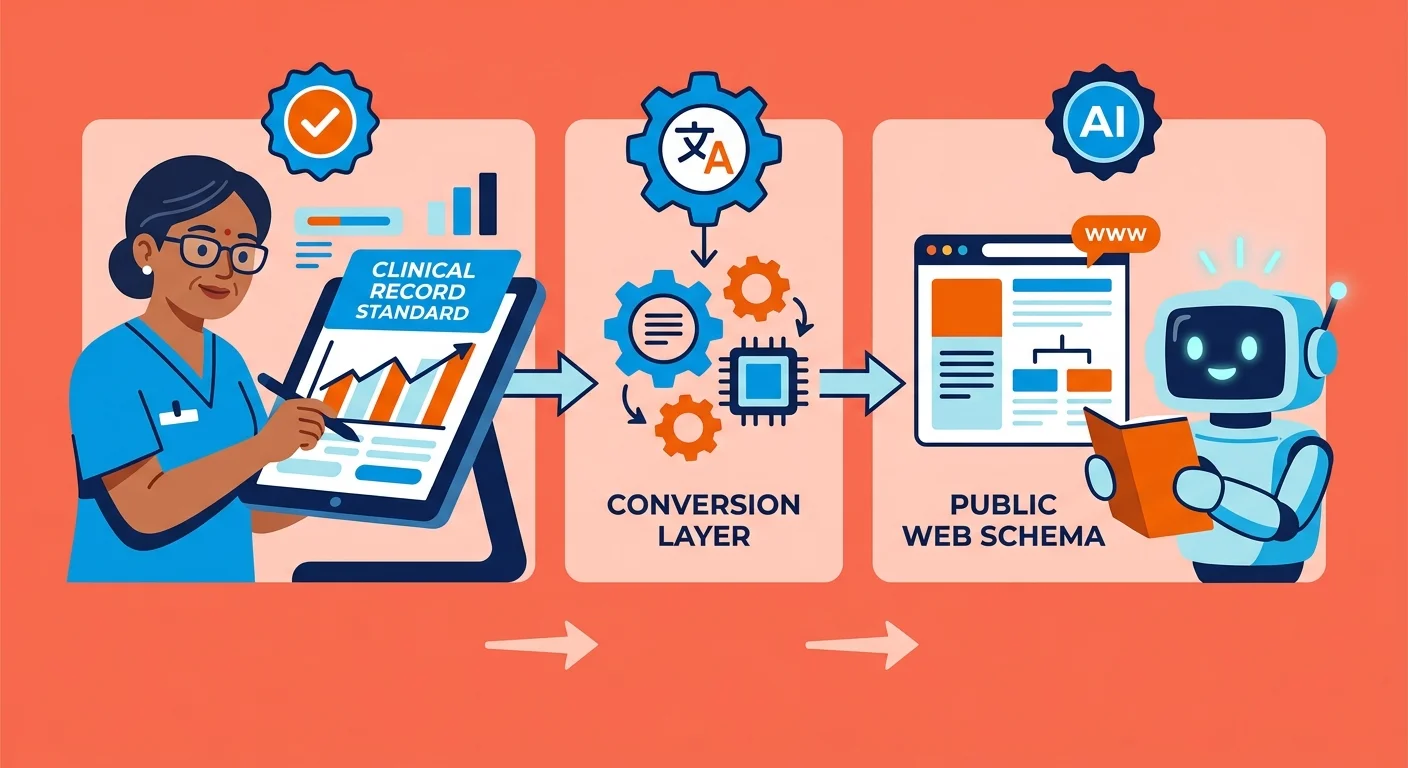
Clinical interoperability standards and public web markup solve two completely different problems. Mix them up, and that's exactly where most implementations stall. A hospital's internal data exchange format was built for one thing: letting one clinical system talk to another, safely and precisely, inside a closed network.
Schema.org markup lives in a different room entirely. It exists so a public webpage can speak to a crawler or a generative model, never to another clinical database.
So the line between the two isn't a technical footnote. It's the boundary that decides whether a provider's outcome data ever reaches the system choosing what gets cited.
| Layer | Data Standard | Where It Lives |
|---|---|---|
| Clinical Record | Internal interoperability formats built for one clinical system to exchange patient data with another | Closed hospital networks and electronic health record systems, never exposed to the public web |
| Public Claim | Schema.org markup built to describe a provider's public-facing outcome claim in labeled, machine-readable terms | Webpages, crawled and parsed by search engines and generative models scanning the open internet |
| Retrieval Layer | Semantic and ontological search methods that pull relevant records out of large clinical collections | E-health search environments where keyword, semantic, and ontological methods work side by side |
| Trust Signal | Structured markup treated as an explicit expertise and trustworthiness signal for sensitive topics | Automated ranking systems evaluating health content against elevated scrutiny for YMYL categories |
Turning a Verifiable Outcome Into a Trust Signal Machines Can Cite
Turning a verifiable outcome into a trust signal starts by treating the claim itself as the unit of proof, not the story wrapped around it. A recovery outcome, a satisfaction score, a procedure result, each one needs its own labeled property before a machine can do a thing with it.
Here's the thing about labeled data: it doesn't beg for trust the way a testimonial does. It hands a machine something checkable, and that's a completely different kind of credibility.
That checkability is exactly what search engines say they reward. Google's automated systems apply extra scrutiny to what they call YMYL topics, content that could meaningfully affect a person's health, finances, safety, or well-being, and health outcome pages sit dead center in that category, a position confirmed in Google's documentation on how those systems weigh trust signals. A provider who wants that weight has to give the system something more concrete than a warm paragraph.
This Is Not for Providers Chasing a Cosmetic Testimonial Page
This isn't for providers chasing a cosmetic testimonial page. If the goal is a prettier quote carousel, structured markup will feel like overkill, because it's solving a problem that reader never had.
Look at what semantic retrieval systems already do inside clinical search, where keyword, semantic, and ontological methods work side by side to pull the right records out of huge e-health collections, an approach detailed by National Institute of Standards and Technology research into e-health retrieval design. That same layered logic is exactly what a generative model brings to a public healthcare page, and a provider exploring how semantic retrieval logic applies to public-facing outcome data will find the same principle at work outside the clinical record. A page built only to convince a human was never built to survive that kind of parsing.
The providers this actually serves are the ones ready to treat outcome data as an asset to be verified, not a narrative to be polished. That's a different commitment, and it's the one the new proof stack demands.
Building the Proof Stack: From Raw Outcome Data to Cited Schema
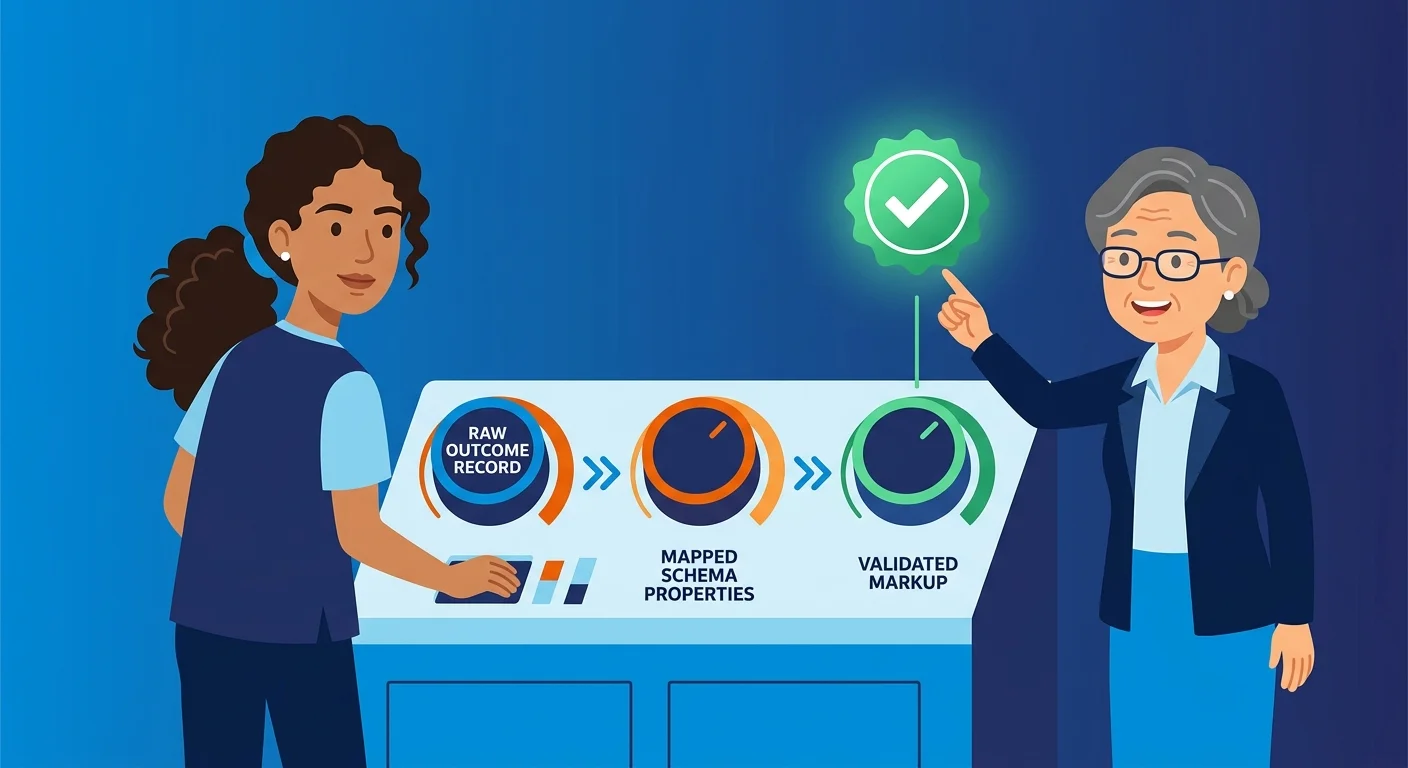
So the concept's settled and you know who this is for. Now comes the part that actually moves the needle: turning one outcome record into markup a machine can read.
Here's the thing about that shift. It's not a copywriting exercise anymore. It's a mapping exercise.
Every claim a provider wants a generative model to trust has to land inside a specific, labeled property. Get the mapping right and the outcome becomes citable. Get it wrong and it stays as invisible as the paragraph it replaced.
| Build Stage | Action | Output |
|---|---|---|
| Raw Record Audit | Pull the plain-facts version of each outcome, stripped of narrative framing, and separate procedure, result, date, and verification source into distinct fields | A clean inventory of discrete facts ready for property mapping, with no claim left blended into another |
| Property Mapping | Assign each isolated fact to its correct schema property, routing procedures under MedicalProcedure, conditions under MedicalCondition, and satisfaction data under AggregateRating | A structured draft where every claim sits inside a labeled field a machine can parse independently |
| Page-Level Assembly | Nest the mapped properties inside a MedicalWebPage container so the page itself is identified as reviewed medical content | A publishable page that reads as a single verifiable entity rather than a collection of separate tags |
| Validation Scheduling | Set a recurring check against the live page to confirm each figure and label still matches the current outcome record | A maintenance rhythm that catches drift before a machine cites an outdated version of the claim |
Mapping an Outcome Record to Schema Properties
Start with the record itself, stripped down to plain facts. What procedure happened, what the measured result was, when it got recorded, and who or what verified it.
Every fact gets its own home in the schema. The procedure name sits under MedicalProcedure, the satisfaction figure under AggregateRating, the condition treated under MedicalCondition.
So this work is less about writing and more about sorting. One fact, one property, and never two claims crammed into a single field, because that ambiguity is exactly what a machine can't parse.
Providers deciding what to tackle first should look at what causes citation velocity to slow down after launch before assuming the mapping step is the finish line. A record mapped once doesn't stay accurate forever, and the next section builds straight off that problem.
Validating and Maintaining the Proof Stack Over Time
Publishing the markup isn't the end of the work. It's the start of an obligation to keep it accurate.
An outcome record changes over time. A satisfaction score shifts, a procedure gets renamed, a review gets added, and a proof stack built once and never touched starts drifting from what it claims to represent.
That drift is quiet. Nothing breaks where you can see it, but the machine reading it eventually starts citing a version of the truth that no longer matches reality, which is exactly why validation has to be scheduled, not assumed.
Frequently Asked Questions
Once the mapping and validation work makes sense, the same practical questions come up every time. Here are the ones providers ask most before they commit.
What specific schema types are used for patient outcomes?
MedicalWebPage carries the page itself. Review and AggregateRating handle the satisfaction data, while MedicalProcedure and MedicalCondition properties attach the clinical specifics underneath.
Does using schema for patient outcomes affect our HIPAA compliance?
No. Schema markup describes public web content, not protected clinical records, so it sits outside HIPAA's data exchange scope entirely. The compliance work happens before markup, in what a provider chooses to publish.
Can I mark up patient reviews and testimonials with schema?
Yes, but only the published, de-identified version qualifies. Review and AggregateRating properties were built for exactly that kind of patient-facing content.
How is MedicalWebPage schema different from a standard Article schema for this purpose?
Standard Article schema tells a machine nothing about clinical accuracy or medical review. MedicalWebPage signals the content was built and reviewed as medical information, and that's the distinction a generative model checks for.
What's the first step to take if our patient outcome data is currently in unstructured text documents?
Start by pulling every outcome claim out of its paragraph and listing it as a standalone fact. That list becomes the map for which property each fact belongs under.
How does this structured data get used by AI Overviews in Google Search?
AI Overviews pull from structured, verifiable sources first, because labeled data can be checked instead of trusted blindly. A properly marked-up outcome page becomes a citation candidate, not a guess the system has to skip.
Where This Leaves You
This isn't a tweak to how digital healthcare marketing already works. It's the single biggest shift happening in the field right now, a hard turn away from human-first content and straight toward machine-readable proof.
That cabinet from the opening was never just a picture. A patient outcome sitting in plain text is a fact locked behind a door only a human can open, and every generative model that walks past holds no key. Structured entity trust proof stacks turn that cabinet into a vault a machine strolls into on its own, verifies, and cites without asking a soul to vouch for it.
So the real choice isn't whether you eventually adopt structured markup. It's whether you keep publishing outcomes a machine can't open, or you start building the vault today. Here's where that call gets tested against the record you already have: see how iTech Valet approaches machine-readable proof for healthcare providers.