
A paper on arXiv says fast adoption of AI search tools like ChatGPT, Perplexity, and Gemini is moving search from ranked lists to written answers that combine sources and cite them. Google says structured data is a standard format for giving information about a page and sorting its content into types. Research on entity pages found that basic JSON-LD markup alone gave only modest gains (0.17 on the study’s own scale, adjusted p-value 0.024). The authors’ enhanced entity page format added llms.txt-style agent instructions, breadcrumbs, and neural search capabilities. It improved accuracy by 29.6% for the standard AI system and by 29.8% for the full agentic pipeline. Google also lists a step that supports appearing in its AI features: make sure your structured data matches the visible text on the page.
Why AI Answers Change What a Condition Page Has to Do
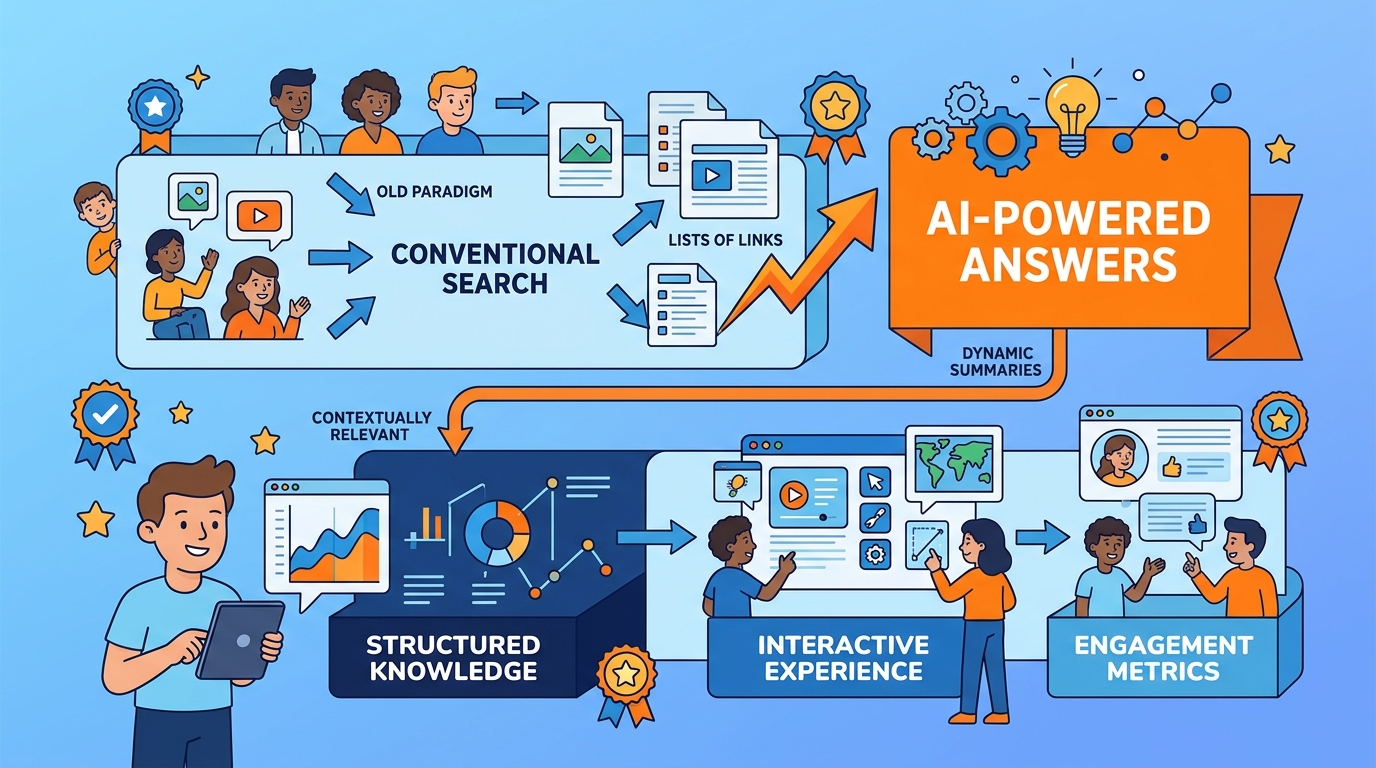
One paper explains how the new tools work. Generative engines, the artificial intelligence (AI) tools that write answers, typically answer a query by pulling together information from several sources. Then they summarize it using large language models (LLMs).
A paper on arXiv says the fast adoption of AI search engines like ChatGPT, Perplexity, and Gemini is fundamentally reshaping information retrieval, moving “from traditional ranked lists to synthesized, citation-backed answers.”
A study from Dartmouth College describes what that looks like on the page. A ranked list gives you a row of links. An AI Overview gives a single pre-synthesized answer, one already put together by the AI. It sits above every organic result. The citations in an AI Overview show the authorities and sources the system draws on to synthesize its answers. At times it quotes directly from the referenced material.
The Dartmouth paper also cites research on clicks. When the feature appears, Google’s AI Overviews reduce outbound organic clicks by roughly 39.8%. They also raise the rate of zero-click searches by 34.5%.
I no longer use a rank report as a success measure. Once one synthesized answer replaced the list of links, a spot in that list stopped telling me whether your practice gets found. I treat position tracking as outdated. To me it measures something that looks good but doesn’t drive outcomes.
Want to see grouped topics versus single pages? Read Why Grouping Neck Pain Topics Outperforms Single Articles. The content side of this work is on the AEO Content Writing page. And how the work gets done is explained on the iTech Valet Service Plans & Pricing page.
Where AI Health Answers Get Their Sources Today
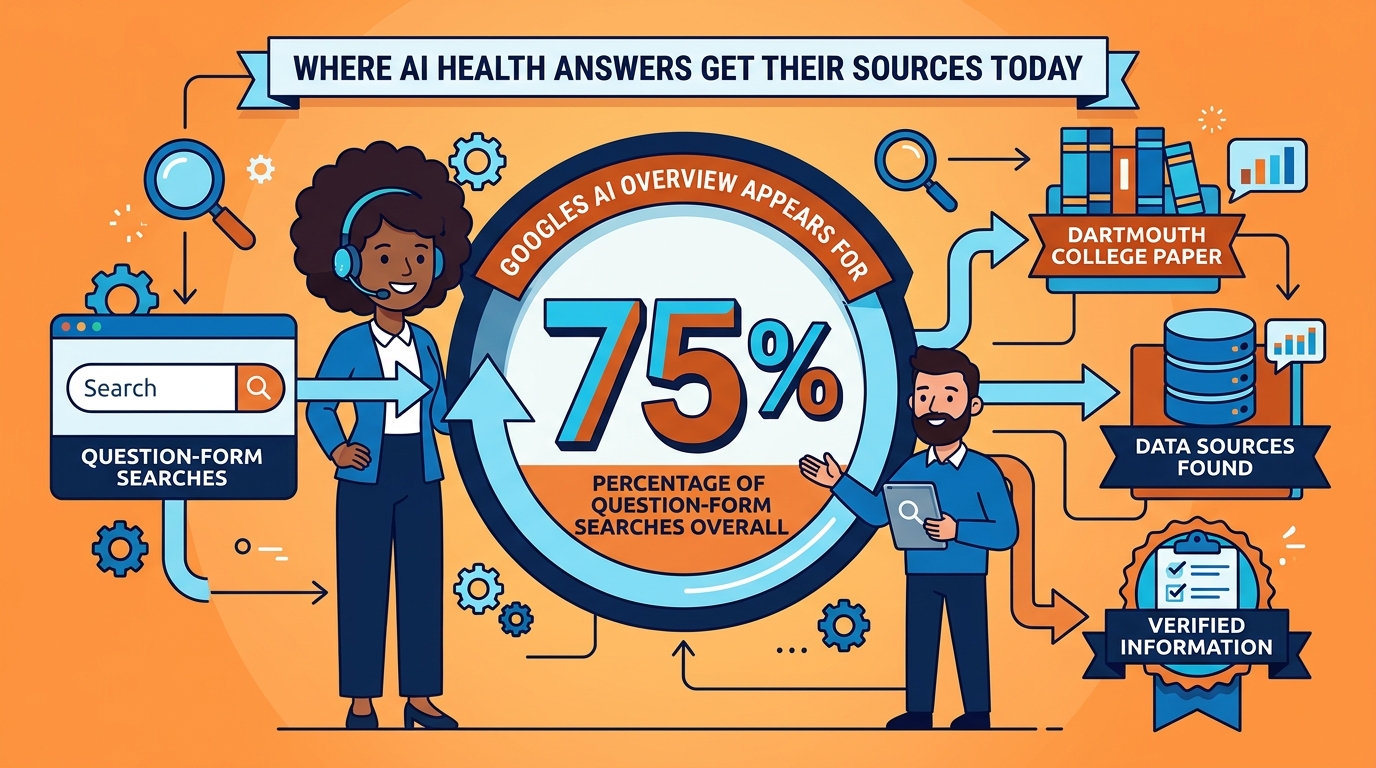
A Dartmouth College paper on health AI Overviews reports that as of early 2026, Google’s AI Overview appears for 64.7% of question-form searches overall.
Now look at where the answers come from. The paper audited health questions in the United States, and YouTube was the most frequently cited domain. YouTube was cited more than established health authorities such as Mayo Clinic, the Centers for Disease Control and Prevention (CDC), and the World Health Organization (WHO).
The study also found that both Google’s and Baidu’s AI Overviews concentrated their citations on a fairly small set of intermediary platforms. They did not spread them across a wide range of primary sources.
The paper reports that after OpenAI launched ChatGPT Search, quotes were misattributed to their original sources in 134 of 200 attempts, roughly 67% of the time.
The audit also measured localization, which is the share of cited sources from the same country as the person asking. This was for health questions in English:
- Highest for Australia (48.2%) and the United Kingdom (41.3%).
- Intermediate for the United States (33.7%) and Canada (27.7%).
- Lowest for Singapore (11.5%), Norway (8.5%), India (2.3%) and Nigeria (0.2%).
I’d rather your practice be the source an AI names and draws on than one more entry in a list of businesses. I aim for being relied on, not merely being present.
Want the patient side of this? It’s in What Patients Ask First When Searching for Sciatica Relief. And the full study is here: Who Anchors AI Overviews in Health? Baidu, Google, and the Geography of Authority.
The Schema.org Vocabulary a Condition Hub Uses
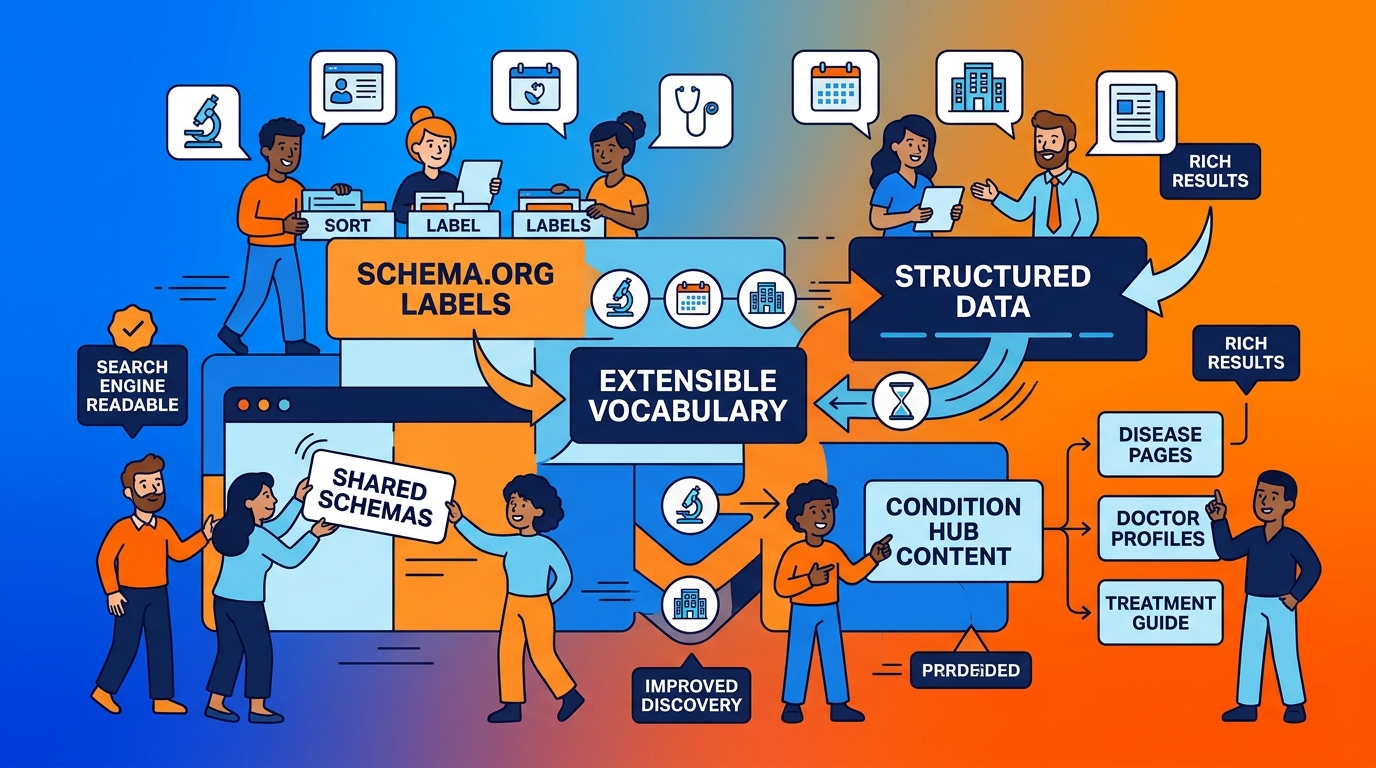
Schema.org is a set of extensible schemas, which are shared label formats. They let website owners put structured data, meaning labeled facts about a page, on their pages for search engines and other programs to use.
The health-lifesci section of Schema.org defines many medical terms, such as MedicalCondition, AnatomicalStructure and MedicalSpecialty. Schema.org says these terms may be considered moderately stable. But some changes are still likely, including renaming and restructuring, through ongoing community collaboration.
Here are the properties your hub page can fill, and what each one records:
| Property | What it records |
|---|---|
| lastReviewed | The date the page’s content was last reviewed for accuracy and/or completeness |
| reviewedBy | The people or organizations that reviewed the page’s content for accuracy and/or completeness |
| specialty | One of the domain specialities to which the page’s content applies |
| speakable | Sections of the page especially appropriate for text-to-speech conversion |
Want to see how these labels point to your practice’s focus? Read How a Condition Hub Signals Specialization to an Assistant. The source pages are MedicalWebPage – Schema.org Type and Health-lifesci – Schema.org.
Google’s Rules for Markup on Hub Pages
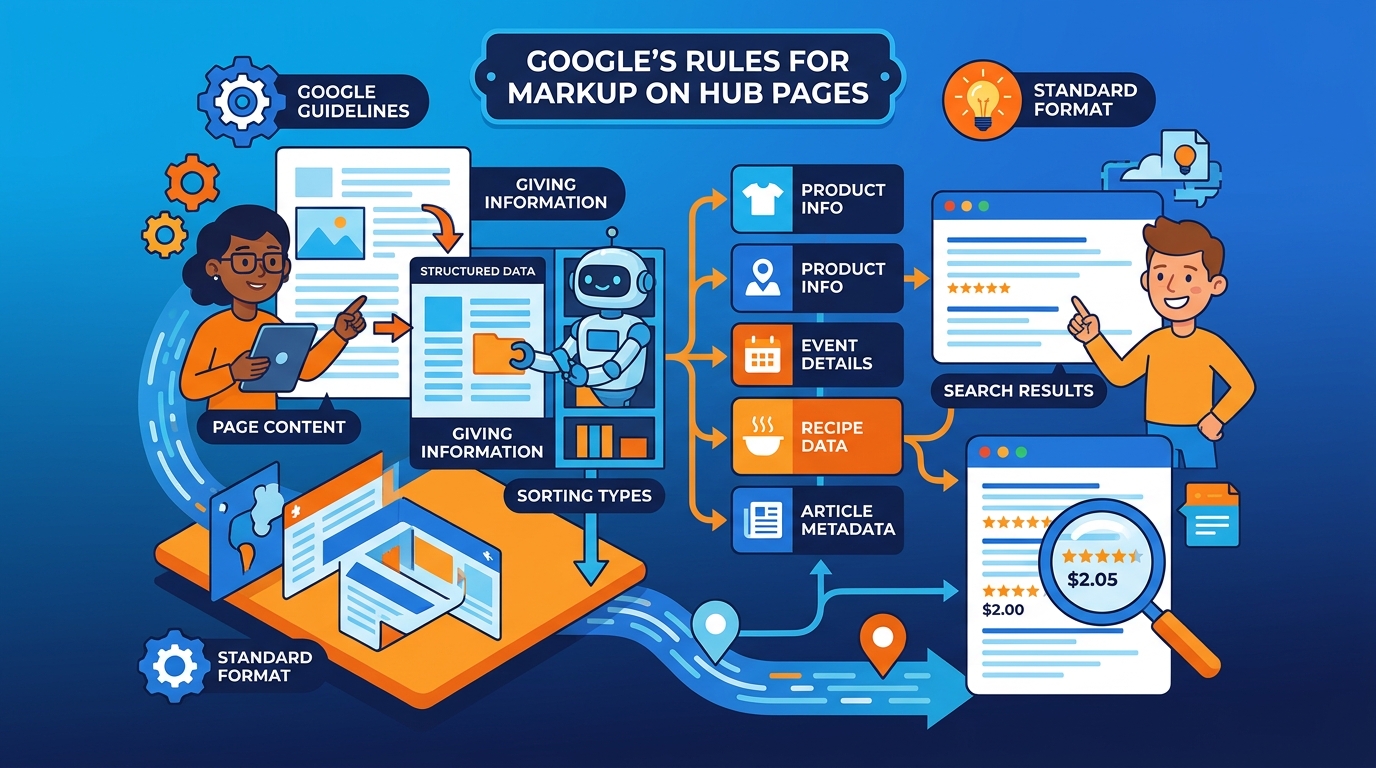
Google says structured data is a standard format for giving information about a page and sorting its content into types. Most Search structured data uses schema.org vocabulary. Google says to rely on the Google Search Central documentation as definitive for Google Search behavior, rather than the schema.org documentation.
Here are the rules I work from:
- Match the visible text. Google says to make sure your structured data matches the visible text on the page. It lists this among the steps that support appearing in its AI features.
- Show what you mark up. Google says not to create blank or empty pages just to hold structured data. It also says not to add structured data about information the user can’t see, even if the information is accurate.
- Include the required properties. Google says you must include all the required properties for an item to be eligible to appear in Google Search with enhanced display.
- Keep recommended properties complete. Google says it’s more important to supply fewer but complete and accurate recommended properties than to try to provide every possible one with less complete, badly-formed, or inaccurate data.
Google also says it can make general use of the sameAs property and other schema.org structured data. Schema.org says sameAs also links a thing to a page that points to it indirectly, and that sameAs stresses well-known pages.
The mainEntityOfPage property does a different job. It’s used more to make clear which of several entities is the main one for that page.
I’ll take a few complete properties over many poor ones. I don’t chase publishing frequency or volume. I build clear, factual content in a sensible order, because as I see it, AI favors businesses whose information it can grasp easily.
For what goes on the page itself, read What Belongs in a Spinal Condition Hub, and What Does Not. And Google’s own page is Introduction to structured data markup in Google Search.
What Research Links to Being Cited: Entity Pages, Freshness and Clean HTML
Markup alone only helps a little. One study found that JSON-LD markup by itself gave modest gains: 0.17 on the study’s own scale, with an adjusted p-value of 0.024. (A p-value is a measure of how likely chance alone is to explain a result.)
The authors then built an enhanced entity page format. It added llms.txt-style agent instructions, breadcrumbs, and neural search capabilities. That version improved accuracy by 29.6% for the standard version of the AI system, known as RAG. The p-value was below 10 to the power of minus 21, with an effect size d of 0.60. For the full agentic pipeline, accuracy improved by 29.8%, with a p-value below 10 to the power of minus 21 and a d of 0.61.
A paper on linked data gives its key insight in one line: structured linked data works like an outside memory layer for the agent.
Research on arXiv also points out that many real-world domains are inherently dynamic. Facts change. Things pick up new attributes. Relations that used to be valid become outdated.
An audit of six page pillars reports four things for each one: a correlation with citation (how closely two things move together), a p-value below 0.001, a 95% confidence range, and a citation impact.
- Metadata & Freshness: correlation 0.68, range 0.64 to 0.72, citation impact +47%.
- Semantic HTML: 0.65, range 0.61 to 0.69, +42%.
- Structured Data: 0.63, range 0.59 to 0.67, +39%.
- Evidence & Citations: 0.61, range 0.57 to 0.65, +37%.
- Authority & Trust: 0.59, range 0.55 to 0.63, +35%.
- Internal Linking: 0.57, range 0.53 to 0.61, +33%.
In this audit, the pillars most strongly linked to getting cited were Metadata & Freshness, Semantic HTML, and Structured Data.
The 0.70 figure is a different measure from those correlations. In section 5.4, the Threshold Analysis, a score of 0.70 or more on the study’s own scale marks a strong turning point. At that cutoff, the study reports a sensitivity of 0.78, a specificity of 0.84, and a Youden’s index (J) of 0.62.
One more finding: putting a clear price and a recent date and time stamp on a page helps, and it helps consistently.
I treat getting picked by AI answer tools as its own discipline, not classic search work with a new name. I don’t chase keywords, inbound links or ranking position here. To me, that aims at the wrong target. These systems are working out who a company is and whether it’s credible. So I build entity pages that make your practice’s identity easy to read.
Wondering about one deep page versus many thin ones? The tradeoff is laid out in One Condition Hub vs a Handful of Short Posture Tips.
Checking That Crawlers Reach the Hub and Read Its Markup
Google says Google Search works hard to understand the content of a page. When crawling for Google Search, Googlebot crawls the first 2 megabytes (2MB) of a supported file type and the first 64 megabytes (64MB) of a PDF file.
OpenAI has its own crawler, a program that visits websites. It’s called OAI-SearchBot, and it’s used to show websites in search results in ChatGPT’s search features.
URL Inspection is a tool in Google Search Console that tests how Google sees a page. Google suggests you put a few pages with your structured data live, then use the tool to check how Google sees them.
Google says to check your structured data with the Rich Results Test during development, and with the Rich result status reports after deployment. Pages might break after deployment because of templating or serving issues.
Frequently Asked Questions
Will adding structured data get a condition page shown as a rich result?
It can, but nothing is promised. Google says adding structured data can enable search results that are more engaging to users and might encourage them to interact more with your website. Google calls these rich results.
How can a clinic tell whether its markup changed anything?
Run a before-and-after test. Google says that’s the best way to measure the effect of structured data, and you can do it on just a few pages on your site.
How common is Schema.org markup on the web?
Common. Today, over 40% of web pages include Schema.org markup. That’s more than 4 in 10.
Why does Schema.org markup end up with errors?
Mistakes in Schema.org annotations (extra notes added to a page) may be caused by missing guidelines, not enough expertise, and technical or human errors.
Do the same optimization tactics work for every subject area?
No. One study shows that how well these optimization strategies work differs from one domain to another. The authors say that’s why you need methods built for a specific domain.
From Vocabulary to Monthly Content
The build order runs in four steps: the vocabulary, then Google’s rules, then entity-rich pages, then crawl checks.
I put your practice’s effort and money into clear, credible information you control. To me, that keeps paying off and grows over time. Visibility bought through ads or paid placements stops the moment the spending stops. So I favor infrastructure you own, built on month by month.
iTech Valet’s main service, the Local AI Authority Engine, is a full-stack authority infrastructure rebuild plus new Answer Engine Optimization (AEO) content every month, for local service businesses, primarily chiropractors. Before we write a single word of copy or touch your website, we run 14 steps of research across four phases. The infrastructure is front-loaded, and the monthly work builds on that foundation every single month.
Want to know where AI stands on your practice today? Run My AI Visibility Check.