
ChiroMatrix vs. AI Authority Engine: The High Cost of Renting Your Reputation
The core difference between ChiroMatrix and an AI Authority Engine is the difference between renting a commodity presence and owning a permanent digital asset. ChiroMatrix provides template-based websites that function as digital brochures — built for human visitors, structurally invisible to AI engines because they lack the machine-readable authority infrastructure required for citation.
An AI Authority Engine restructures your practice's digital hierarchy from the ground up. Deep schema markup, entity clarity, intent-layered content — these are the architecture layers that determine whether AI recommends your practice or your competitor when a patient asks "who's the best chiropractor near me?" in ChatGPT, Gemini, or Grok.
The investment gap is real. ChiroMatrix runs a low monthly retainer. A Local AI Authority Engine starts at $15,000. But the honest comparison isn't about which costs less per month. It's about what you actually own.
One is a monthly operating expense. The infrastructure belongs to ChiroMatrix. The authority signal — limited as it is — is attached to their platform. When you stop paying, it disappears. You walk away with nothing.
The other is an authority asset that belongs to your practice permanently. The content compounds. The entity signals deepen. The authority you build in year one creates a foundation that makes year two more powerful.
There's also a shift in the environment that makes this comparison increasingly urgent. Gartner projects traditional search engine volume will drop by 25% as users move to AI chatbots. The ten-link Google results page is being replaced by a single conversational answer. In a zero-click environment, you either get cited or you don't exist.
This article breaks down exactly where these two models diverge — what you're actually buying, what AI can and can't see, what the math actually looks like over time, and who the AI Authority Engine is genuinely the right call for.
Last Updated: April 10, 2026
The Two Models: Rented vs. Owned
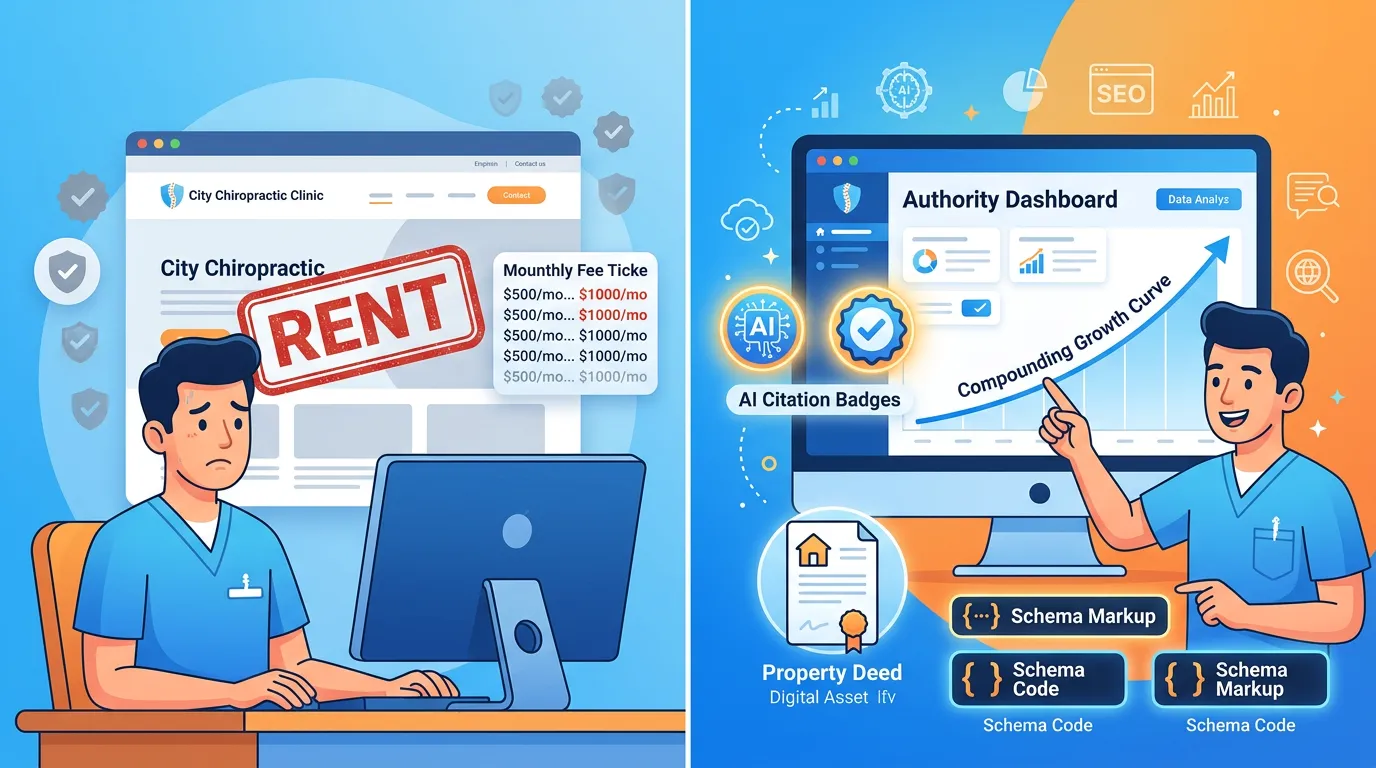
A doc I talked to had been with a template platform for three years. Good practice. Solid reputation in the community. She typed "best chiropractor in [her city]" into ChatGPT one afternoon just to see where she stood. Somebody else's name came up. Not close to hers. Three years of monthly payments. Zero AI citation signal to show for it.
That's not a flaw in the model. That's the model.
Template platforms were built for one type of patient: the one who already decided to search. Someone who typed "chiropractor near me," scanned the results, and clicked. That was the whole game.
But that patient is moving. They're asking ChatGPT "who should I see for my back" instead. And ChatGPT doesn't click links. It reads infrastructure — schema markup, entity signals, structured content depth. If those signals don't exist, the practice doesn't show up. Doesn't matter how the site looks.
That's the Digital Brochure Fallacy. A beautiful site that AI can't read is a brochure. Zero equity. Invisible where the decision actually gets made.
We built iTech Valet as an AI authority agency for exactly this problem.
Let's be straight about this. ChiroMatrix does what it says it does.
You get a website. It looks decent. It loads fast. Support exists when you need it. The monthly cost is predictable enough that most practices don't think twice about it — which is part of the problem, but we'll get to that.
Here's what you're actually paying for:
- Shared infrastructure, not ownership — Your site runs on a framework that thousands of other practices also run on. Same code structure. Same template layout. Same technical baseline. It belongs to ChiroMatrix. You're a tenant paying monthly rent.
- Design for humans, not AI engines — Template platforms build for click-through. Nobody in their client base was asking for deep schema markup or entity architecture. They're not hiding something — they just built for a world where AI wasn't the gatekeeper.
- Optimization for the shrinking game — Traditional SEO for the ten-link Google results page. A position on page one. That was the whole game in 2018. It matters less every year.
- No equity, no exit value — Stop paying and the presence disappears. In many contracts, the domain stays with them. You leave with nothing — no asset, no authority carry-over, no compounding foundation to build on.
The contract isn't obscuring this. It's the product.
What ChiroMatrix Actually Provides
What the AI Authority Engine Builds
The deliverable isn't a website.
It's authority infrastructure — the architecture that tells AI your practice is the verified answer for your specialty in your geography. Different product. Different problem entirely.
Here's what that includes:
- Entity clarity — Structured data that makes your practice unmistakable wherever AI looks for you. Consistent. Unique. Verifiable. AI can't recommend who it can't identify with certainty. This is what fixes that.
- Deep schema markup — FAQPage, LocalBusiness, MedicalBusiness, BreadcrumbList, AuthorSchema. Not one. All of them. AI engines that decide who gets cited have learned what real verification looks like. This is it.
- AI Authority content — Articles built around how patients actually ask AI questions. Not keyword targets. Not word count goals. Architecture designed to earn citations.
- Proprietary two-AI validation system — Gemini validates research. Claude executes writing. Every article goes through a verification loop that no other agency runs before it publishes.
- Permanent ownership — The infrastructure belongs to your practice. The content belongs to your practice. You stop working with us and you keep everything. No ransom. No restart.
This isn't a premium version of ChiroMatrix. It's a completely different category of investment.
| Feature | ChiroMatrix | AI Authority Engine |
|---|---|---|
| Primary Goal | Patient-facing website presence | AI engine recommendation and citation |
| Infrastructure Type | Shared template platform | Custom entity architecture |
| Schema Depth | Basic or generic | Deep: FAQPage, LocalBusiness, AuthorSchema + more |
| Content Strategy | Traditional SEO keyword articles | Intent-layered AI Authority articles |
| Ownership Model | Rented access | Permanent client asset |
| What Happens When You Stop | Site and authority presence disappear | Authority compounds; practice owns it |
| Optimized For | Traditional search results pages | AI citation and zero-click environment |
| Business Model | Monthly operational expense | One-time authority asset investment |
Why AI Can't See Template Websites
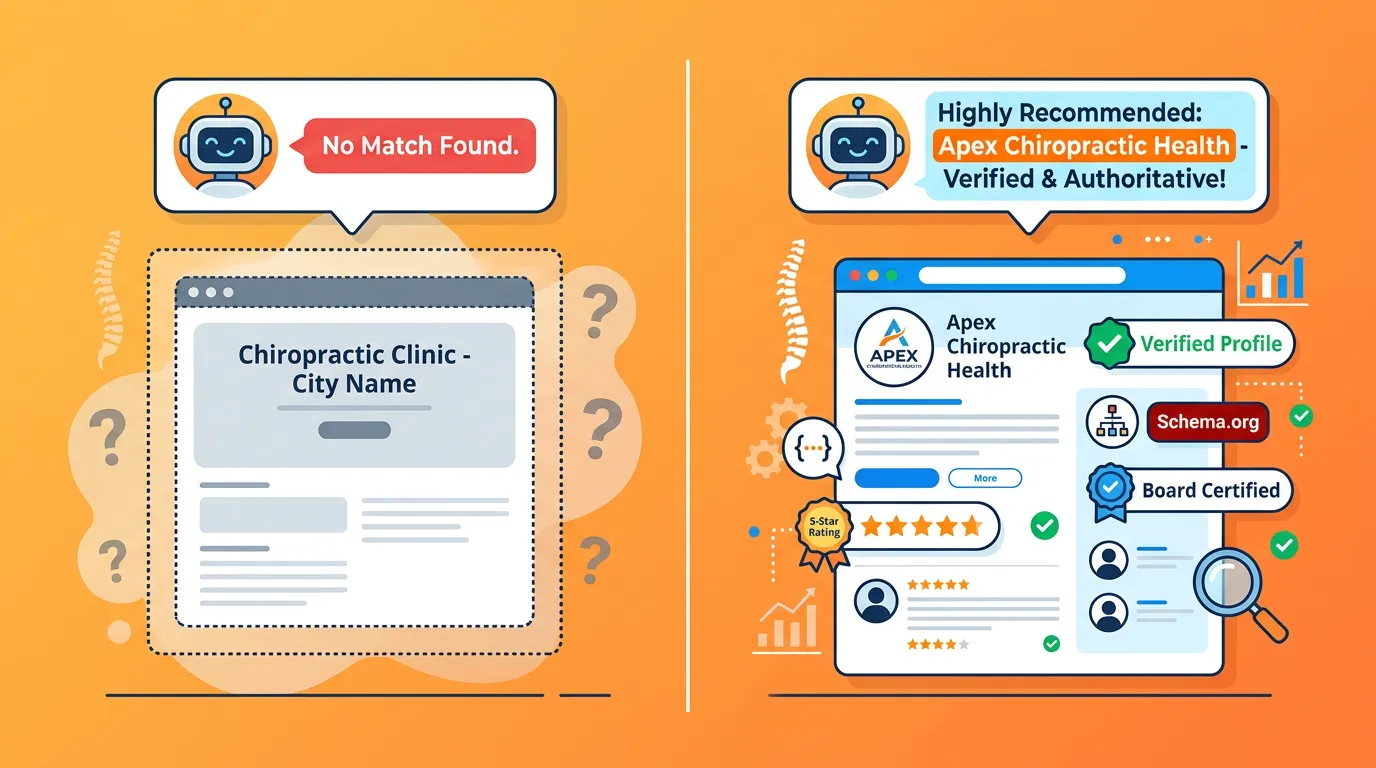
AI doesn't scroll your homepage the way a patient does.
No hero image. No "welcome to our practice" paragraph. It's looking for evidence — consistency, structure, depth — enough to trust you. If that evidence isn't there, you don't get cited. Doesn't matter what the site looks like.
That's not a design problem. It's an infrastructure problem template platforms were never built to solve.
The Problem With Template-Based Design
I've watched this wreck practices that had no business being invisible.
Fifteen-year clinics. Packed schedules. Hundreds of five-star reviews. Real reputations. And when you ask AI for a chiropractor recommendation in their market, their name doesn't come up. Sometimes a competitor shows up. Sometimes the AI recommends a practice from the next city over. The doc has no idea it's happening.
Here's what's actually going on.
When thousands of clinics run on the same template, AI can't tell them apart. Same code. Same structure. Same auto-generated signals. There's nothing in that footprint that says your practice is distinct from the 800 others built on the same framework. No distinction means no recommendation.
We call this entity blur. And you can't fix it by choosing a different template.
There's another layer, and it's sneaky. Template platforms don't build schema — they generate it. Same boilerplate, pushed across thousands of sites automatically. AI engines have learned to recognize that pattern. Auto-generated reads as noise. Custom-built reads as verified. They're not the same thing.
What template-based design actually produces from an AI's standpoint:
- Shared technical fingerprints — Near-identical code across thousands of practices creates an entity pool where individual clinics blur together. Your signal gets lost in the crowd before AI even evaluates you.
- Minimal entity differentiation — Without distinct structured data separating your practice from every other site on the same template, AI can't lock in your unique identity with confidence. Ambiguity gets skipped.
- The wrong optimization target entirely — Template platforms were built for traditional search. AI citation requires fundamentally different infrastructure. And template companies have zero incentive to rebuild for a model that would require scrapping their entire product line.
- Zero compounding authority signal — Years on the platform accumulate almost nothing that AI can use as a citation marker. Flat is generous. Invisible is more accurate.
Not getting cited is frustrating. But it's not the worst outcome.
When AI Makes Up Your Owner
Low entity clarity doesn't just make AI skip your practice.
Sometimes it makes AI invent one.
We call this the Michael Walen problem at iTech Valet. It's a documented hallucination pattern: AI pulls fragmented signals from directories, review platforms, and third-party data — and assembles a "best guess" identity for your practice. Wrong owner's name. Wrong credentials. Delivered confidently.
The AI isn't malfunctioning. It's doing exactly what it was built to do — make the most probable call from available data. When that data is noisy, unverified, and shared with hundreds of other practices on the same template, the call is going to be wrong.
A patient asks AI who runs your clinic. AI gives them a name that doesn't exist.
That's not a quirk to wait out. That's what weak entity clarity actually looks like in the real world.
The Math Nobody Runs

Most docs run the same comparison: low monthly retainer versus $15,000. The retainer wins. Case closed.
That math isn't wrong. The comparison is wrong.
Zero-Click Search Changes the Formula
Start with what's actually happening to search.
Gartner projects traditional search engine volume will fall 25% as users shift to AI chatbots. That's already underway — not a future projection anymore.
BrightEdge is tracking double-digit monthly growth in AI search visits, replacing traditional discovery paths faster than the industry anticipated.
And PracticeBeat puts the number on the table that actually matters for this conversation: 65-70% of healthcare searches now end without a click. Patient asked AI. AI answered. Patient acted. No Google results page. No traffic event. No link click to count.
So here's the problem with the comparison.
Your ChiroMatrix site might rank #4 on Google. If AI doesn't cite you as the trusted answer, that ranking is irrelevant for the patient who asked ChatGPT first. Traffic is a vanity metric in a zero-click environment. The only number that matters is whether AI says your name when a patient asks for a recommendation in your market.
And Joint Commission guidance on responsible AI in healthcare confirms that standards for AI recommendation systems are going up, not softening. The bar to get cited is rising every quarter. Every month you're not building authority infrastructure, that bar gets further away.
Monthly Expense vs. Compound Asset
Now run the actual comparison.
Low monthly retainer. Four years of payments. Decent-looking site. Some traffic. What do you own when you stop?
Nothing. The site disappears. The domain, in many contracts, stays with the platform. Whatever thin authority signal existed — attached to their infrastructure, gone when you leave. You restart from zero.
An AI Authority Engine at $15,000 builds differently. The content compounds. Entity signals deepen. Year one builds the foundation. Year two builds on it. Year three creates a competitive moat that's genuinely hard to close from the outside. And when the engagement ends, you own what was built. No ransom. No restart.
According to Digiworld Solution, EEAT trust signals in 2026 — clear business information, consistent branding, verified entity signals — are the baseline AI engines use to evaluate which local providers get cited. That bar is going up. Waiting doesn't keep you neutral. It compounds against you.
This is exactly why the true cost of AI Authority infrastructure for chiropractors looks completely different once you run the full picture — not just the monthly line item.
| Comparison Point | Low Monthly Retainer (4 Years) | AI Authority Engine |
|---|---|---|
| Total Spend | Accumulates quickly | $15,000 one-time |
| What You Own at the End | Nothing — resets if you leave | Full authority asset, permanently |
| Authority Compounds Over Time | No | Yes — deepens with each content layer |
| AI Citation Readiness | Low — template-limited infrastructure | High — custom entity architecture |
| Zero-Click Optimization | Not built for it | Core deliverable |
| Optimized Environment | Declining traditional search | Growing AI citation landscape |
Who This Is — And Isn't — For
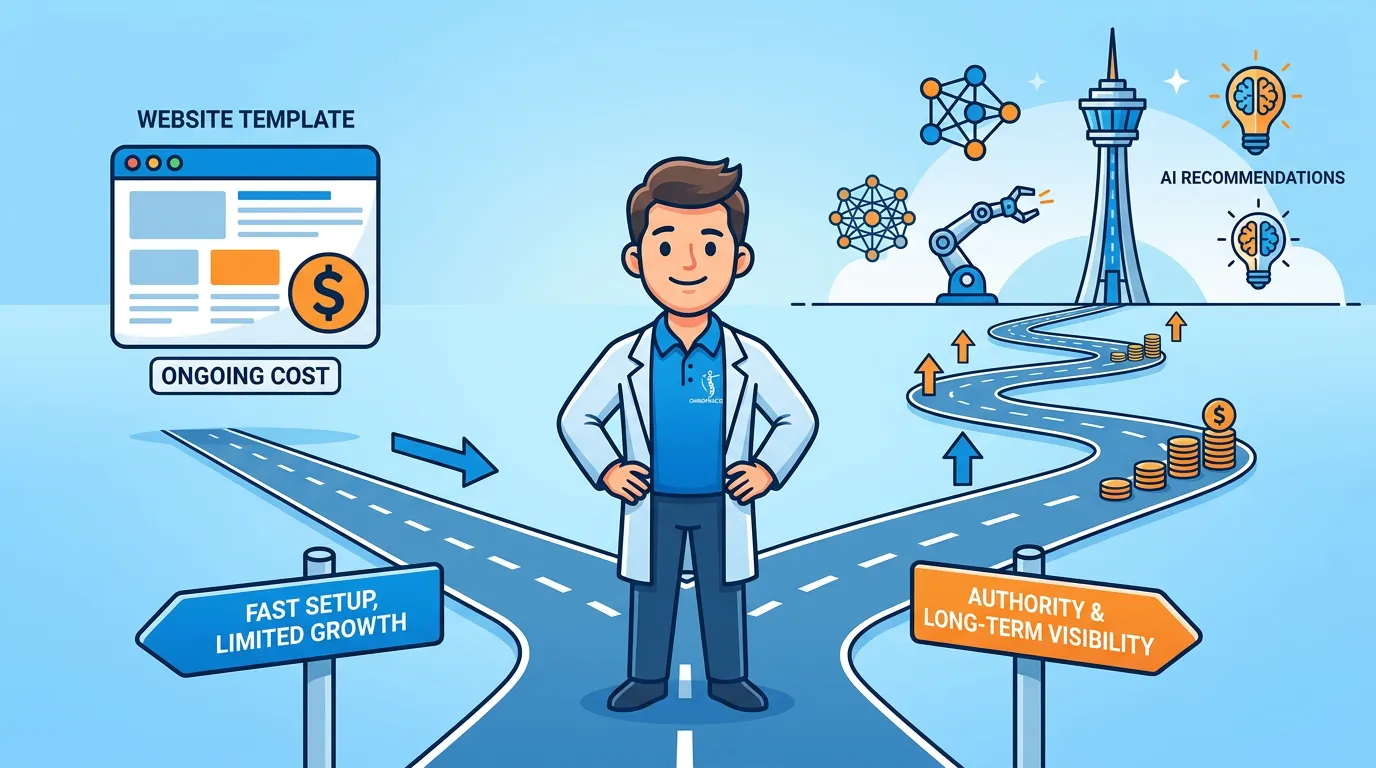
The AI Authority Engine is not the right investment for every practice.
I'd rather say that now than waste both our time.
If Your First Question Is the Price, Stop Here
This is the Budget-First Buyer pattern. I've seen it enough times to name it.
It goes like this: "Why would I pay $15,000 when I can pay a low retainer?" If that's where you are, the AI Authority Engine isn't the right call for you right now. Not a judgment — just an honest read.
The low-cost option is real. It works for what it's designed to do. If the goal is a website that lists your services and address, a template platform delivers it at a price that's hard to argue with.
What it doesn't deliver: authority. Compounding AI visibility. An asset your practice owns when you're done paying. None of that is on the menu at a low monthly retainer.
Here's what I tell every doc who leads with the price line. You're not comparing two services. You're comparing two economic models. One is an operating expense — pay monthly, receive access. The other is an asset acquisition — invest once, own what gets built. Those require a completely different frame before the numbers make sense.
If you're still in the first frame, the second doesn't compute yet. That's okay. Come back when the question changes.
The Practices That Get the Most Out of This
The docs who fit tend to share a few things.
- They're done with the Hopium Cycle — Two agencies. Three agencies. Each one showing up with reports that looked busy and changed nothing. They're not interested in a fourth variation on that experiment.
- They think in years, not quarters — Authority is compound growth. Infrastructure first. Content depth second. Competitive moat third. They're not shopping for a 90-day win. They understand the timeline and they're good with it.
- They want to own something — They've been renting their reputation long enough. They want a clinical asset that belongs to their practice — not a dependency that evaporates the moment they stop paying.
- They've seen the gap firsthand — They asked AI for a chiropractor recommendation in their own market. Their name wasn't there. That bothered them enough to actually do something about it rather than assume it would sort itself out.
A free AI Visibility Check is where most of those docs start. It shows exactly where your practice stands in the AI citation environment — before any commitment.
| Scenario | AI Authority Engine Fit? |
|---|---|
| "I just need a website so people can find our address" | Not the right fit — a template platform covers this need |
| "I'm comparing you to my current monthly website plan" | Not the right fit — these are different categories of investment |
| "My name doesn't show up when I ask AI for a chiropractor near me" | Yes — this is the core problem we solve |
| "I've been through 2-3 agencies and nothing has changed" | Yes — authority infrastructure is what those agencies skipped |
| "I want to build something permanent that compounds over time" | Yes — permanent ownership is built into the design |
| "I need to see measurable ROI within 90 days" | Not the right fit — authority builds over months, not a quarter |
Frequently Asked Questions
If I leave ChiroMatrix, do I keep my website and my rankings?
No. This is the part of the rental model most docs don't think about until they've already left.
The site belongs to ChiroMatrix. Templates, code framework, underlying architecture — it's their infrastructure. In many contracts the domain is theirs too. Stop paying and it stops existing.
Whatever authority signal you built — thin as it tends to be on a shared template — is attached to their platform. You don't carry it out the door with you.
Pay for years. Build something that looks like a presence. Leave. Start over. That's not a loophole in the model. That's the model.
Why does AI ignore template-based websites?
AI looks for entity signals that distinguish your practice from every other practice — name, address, specialty, content depth, schema markup, citation patterns — all consistent, unique, and machine-readable.
Template platforms are shared infrastructure. Thousands of clinics on the same framework create an identity pool where individual practices blur together. AI can't pick you out of that crowd with confidence — so it doesn't try.
That's not template companies failing. They built for human visitors who navigate differently than AI does. Serving AI citation requires completely different infrastructure — and that's not what template companies were hired to build.
Our breakdown of what AI needs to see before it can trust your practice goes deep on what actually changes this if you want the full picture.
Is the AI Authority Engine just a more expensive version of SEO?
No.
Traditional SEO optimizes for a ranked list of links. A patient types a query. Google returns ten results. SEO determines which position you land in. The patient clicks through.
The AI Authority Engine optimizes for the verdict. Patient asks ChatGPT, Gemini, or Grok for a chiropractor recommendation. AI gives one name. AEO determines whether that name is yours.
Those aren't variations of the same game. Different rules. Different win conditions. Different infrastructure requirements. The practices still optimizing for ranked lists are solving a problem that's contracting every quarter. The ones building AI citation infrastructure are solving the one that's expanding.
Does ChiroMatrix offer Answer Engine Optimization?
Most commodity website platforms — including template-based providers — are still building for traditional SEO signals. Their product roadmaps optimize for keyword rankings and Google results page placement. That's what they were built for, and that's what their existing client base knows to ask for.
AEO requires a completely different technical architecture. EEAT trust signals in 2026 — verified business identity, consistent branding, structured authority depth — are the baseline AI engines use to evaluate clinical recommendations. Template platforms don't build for those signals because their existing code base doesn't support it without a rebuild they have no incentive to do.
A practice optimizing for a contracting environment versus one building for an expanding one. Those aren't equivalent strategies regardless of the price difference.
How does iTech Valet's two-AI system differ from standard agency content?
Standard agencies use freelance writers, generic AI prompts, or interchangeable content templates. The output looks like everything else on the internet. AI engines have been trained on that content — they recognize it as commodity and weight it accordingly.
Our two-AI system isn't a process refinement. It's a different goal entirely. Gemini validates research. Claude executes writing and content architecture. Every article goes through a research brief, a draft, a validation round, a voice pass, and a full structural check before it publishes. Nobody else runs content through that loop.
We're not publishing to rank for keywords. We're building AI Authority content designed to create entity trust depth. AI engines that cite practices as trusted clinical answers respond to that architecture in ways that generic content doesn't produce — and never will.
One Answer.
AI gives one answer.
Not a list. Not five options for the patient to weigh. One name, delivered with confidence to someone who trusted the platform enough to act on it without checking anywhere else.
If that name is yours, you get that patient. If it's your competitor's name — or if nobody from your market gets cited at all — you don't hear about it. It doesn't show up in any report. You just wonder why new patients have slowed down.
And here's what I keep coming back to every time I talk to a doc about this. The gap isn't static. It compounds. Every month the practice building authority infrastructure adds another layer — another content depth signal, another entity confirmation, another citation probability marker. Every month the practice on a rental model stays flat. At some point the doc on the flat side starts asking what changed, and the honest answer is that nothing changed for them — everything changed around them.
The practices that own the AI recommendation window in 2028 are building the infrastructure for it right now. Not when it shows up in a traffic report. Not when a third agency finally brings it up. Now — before the gap becomes permanent.
If your practice name doesn't show up when someone asks AI for a chiropractor recommendation in your market, that's the only data point that actually matters. Not your Google position. Not your monthly sessions report.
Your current platform can't show you that gap. And it can't close it.
Find out where your clinic actually stands in the AI citation environment before your competitor runs the same diagnostic first.
See where AI ranks your practice — no pitch, no commitment, just the data.

621 Enterprises, Inc. | Copyright 2026 | All rights reserved