
Inconsistent information across directories weakens the prominence signal because Google has a harder time confirming the business’s identity. Google Search Central says structured data must be a true representation of the page content. BrightLocal says on-page signals remain the most important group for AI search visibility, and that a dedicated page for each service should be a key priority for any local business that wants to perform well across the board.
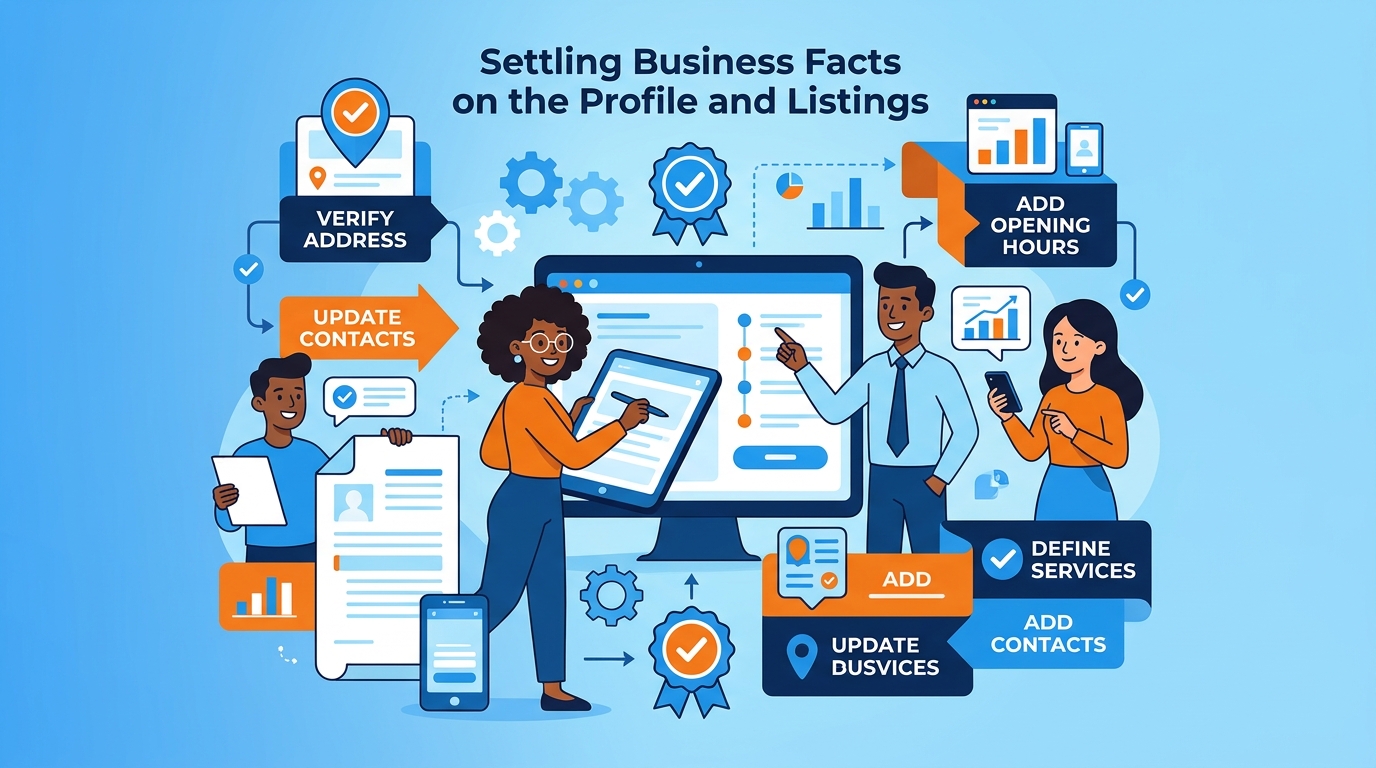
Step 1: Settle the Business Facts on the Profile and Listings
Here’s where I start.
I fix the practice’s name, address, phone, category, services and hours first. Every later repair has to match them.
I don’t treat getting picked by AI answer tools as classic search work with a new name.
I don’t chase keywords, inbound links or ranking position. They aim at the wrong target.
Here’s how I see it. These systems are trying to work out who a practice is and whether it’s credible. So I make that easy for them. I start with the facts they use to confirm who the practice is. I use the AI Visibility Check to look at those facts.
Here’s what moved.
The table below shows four profile and citation factors from Whitespark’s 2026 survey, and where each one landed. The source is Whitespark’s Official 2026 Local Search Ranking Factors Report.
| Factor | Change in the 2026 survey |
|---|---|
| Citations’ weight | Lost about half a percentage point, continuing the downward trend from previous editions |
| Proper hours set on the Business Profile | Up 64 positions, from 85 to 21 |
| Keywords in Business Profile services | Up 75 positions, from the bottom of the list at 110 to 35 |
| Google’s predefined services present | New factor this year, #22 most impactful ranking factor |
Match name, address and phone character for character
BrightLocal says Google’s local search algorithm uses three key components to decide which businesses show up in local results. Proximity. Relevance. Prominence.
Google says prominence is also based on info like how many websites link to your business and how many reviews you have.
Inconsistent information across directories weakens the prominence signal. Google has a harder time confirming who the business is.
BrightLocal calls an accurate name, address and phone number on your Google Business Profile and other listings a good start. Just a start.
blckalpaca puts it plainly.
What matters isn’t volume. It’s character-for-character consistency across all listings.
So a citation audit that cleans up contradictory data usually beats creating lots of new listings.
Whitespark’s author wrote that he was surprised to see citations lose about half a percentage point. That continues the downward trend from previous editions.
Plenty of agencies still sell citation volume. I won’t build a plan on it. To me, that’s an offer aimed at conditions that have changed.
Keep the business name real.
Keywords can go in it only if they’re part of the real name. Google prohibits adding unnecessary information to the business name. And it can suspend the profile for violations.
Set the primary category, services and hours correctly
Here’s the big one.
BrightLocal reports that in the 2026 Local Search Ranking Factors survey, the primary category is the top factor influencing rankings in Google’s Local Pack.
Extra categories matter too.
A 2023 BrightLocal category study found that businesses using four additional categories on their profiles had the highest average map ranking. That ranking was 5.9.
Services moved up.
Whitespark added a new factor this year: the presence of Google Business Profile predefined services. It scored as the #22 most impactful ranking factor.
Keywords in profile services climbed 75 positions. From the bottom of the list at 110 up to 35.
Hours need to be true.
Proper hours on the profile climbed 64 positions, from 85 to 21.
Whitespark says don’t list hours other than what they actually are. That applies to any brick-and-mortar business where people might show up during the stated opening hours.
It frustrates customers. It could lead to negative reviews. And it’s against Google’s guidelines.
Step 2: Make the Site’s Structured Data Match Those Facts
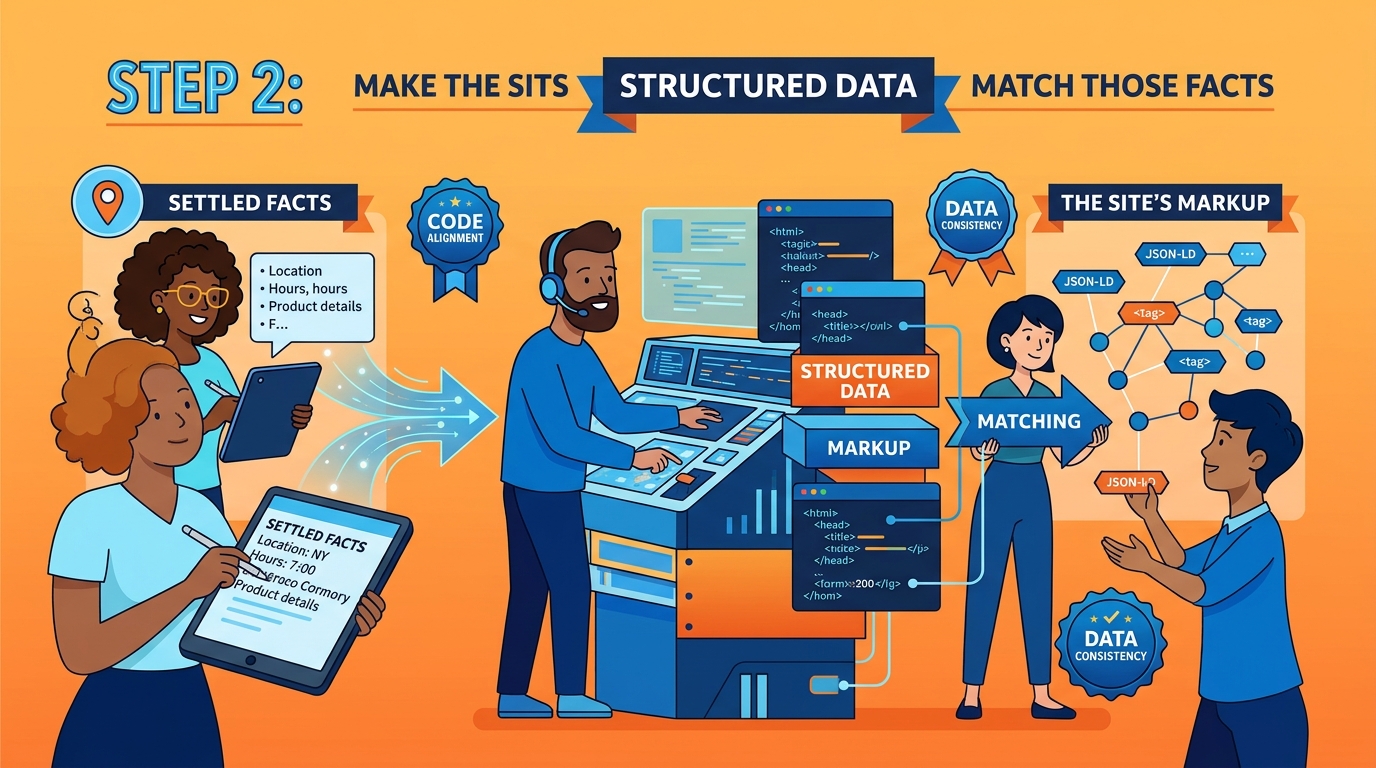
Once the facts are settled, the site’s markup carries the same facts.
And Google holds that markup to what the page itself shows. After a low rating, the technical repairs to do first are in The Three Technical Breaks to Repair First After a Low Rating.
Keep markup true to the page and complete
Here’s what structured data is.
Google’s Introduction to structured data markup in Google Search describes it as a standardized format for providing information about a page and classifying the page content. Take a recipe page. The ingredients, the cooking time and temperature, and the calories.
Google also says adding organization structured data to your home page can help Google better understand your organization’s administrative details. It can also help Google disambiguate your organization in search results.
Here are the rules.
Google’s General Structured Data Guidelines set them.
Your structured data must be a true representation of the page content.
Don’t mark up content that isn’t visible to readers of the page.
Be complete where it counts.
Specify all required properties listed in the documentation for your rich result type. Items missing required properties aren’t eligible for rich results.
And try to use the most specific applicable schema.org type and property names.
Don’t try to fill in everything.
Google says it’s more important to supply fewer but complete and accurate recommended properties. Not every possible recommended property with less complete, badly formed or inaccurate data.
Test it before launch and watch it after
Google says you can test compliance using the Rich Results Test and the URL Inspection tool. They catch most technical errors.
Use the Rich Results Test during development.
After deployment, watch the Rich result status reports. Pages might break after deployment because of templating or serving issues.
Here’s good news.
Google can read JSON-LD data when it’s dynamically injected into the page’s contents. That includes JavaScript code or embedded widgets in your content management system.
Want to see what the markup did?
Run a before and after test on a few pages on your site.
What structured data changes, and what it doesn’t
Adding structured data can enable rich results.
Those are search results that are more engaging to users. They might encourage people to interact more with your website.
Here’s what a penalty does and doesn’t do.
A structured data manual action means a page loses eligibility for appearance as a rich result.
It doesn’t affect how the page ranks in Google web search.
Google shares two company results.
Rotten Tomatoes added structured data to 100,000 unique pages. They measured a 25% higher click-through rate for pages enhanced with structured data, compared to pages without it.
Nestlé measured an 82% higher click-through rate for pages that show as rich results than for non-rich result pages.
Don’t line those two up as if they’re the same thing. They aren’t.
Rotten Tomatoes compared pages with and without structured data. Nestlé compared pages that show as rich results with pages that don’t.
Step 3: Close the Content Gaps on Service Pages
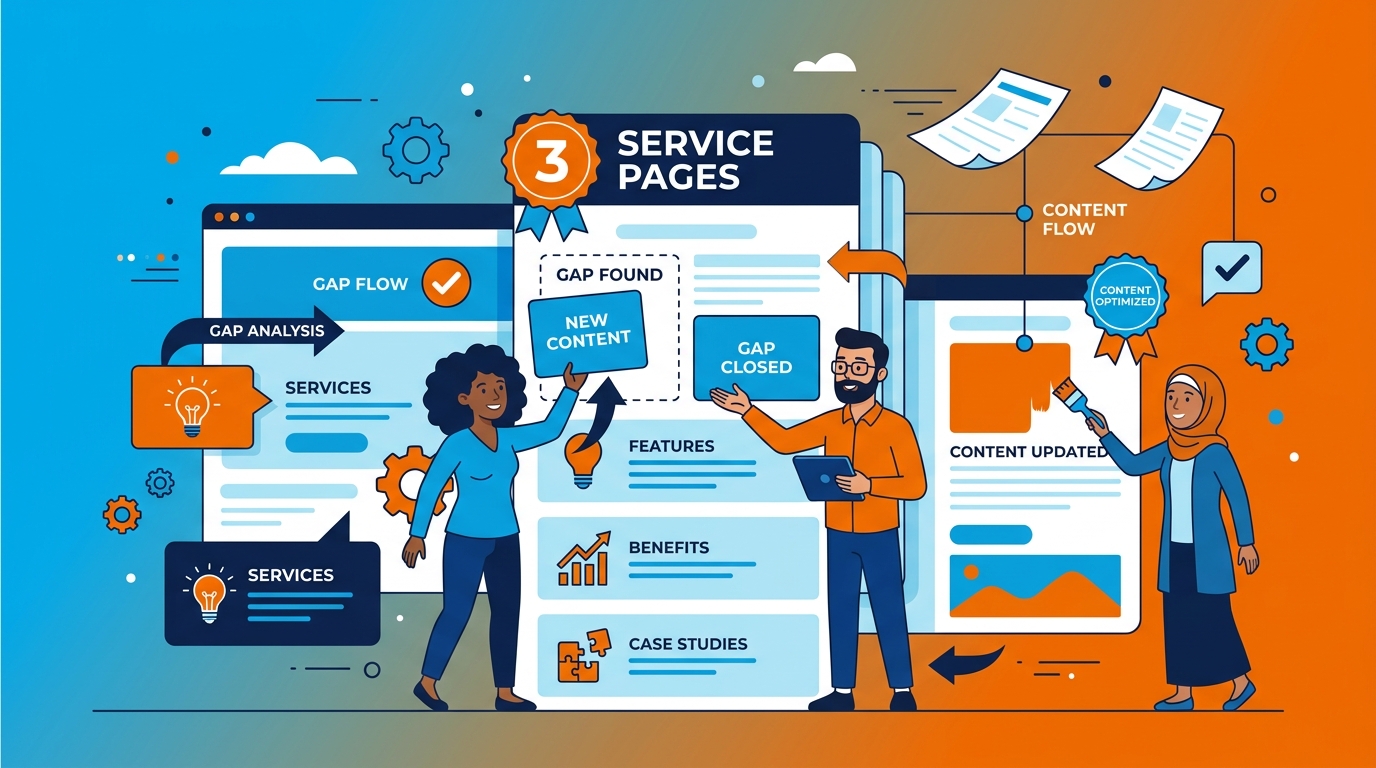
Identity’s settled. Now the service pages.
BrightLocal says that like with local organic, on-page signals remain the most important group for AI search visibility.
A dedicated page for each service should be a key priority for any local business that wants to perform well across the board.
The source is Google’s Local Algorithm and Local Ranking Factors.
I don’t believe publishing more makes AI recommend a practice.
I write so a practice’s information is easy for AI to grasp. One clear, factual answer on each service page, in a sensible order. I’d do that before I’d add ten more pages.
Whitespark says the new way is simple. Write clear, concise, quality content that answers the user’s questions. No fluff.
Give them the recipe right at the start.
Whitespark adds that this will help in AI search as well.
Here’s what Google says.
Its automated ranking systems are designed to prioritize helpful, reliable information created to benefit people. Not content created to manipulate search engine rankings.
Link the pages together.
Every page you care about should have a link from at least one other page on your site.
The better your anchor text, the easier it is for people to navigate your site. And for Google to understand what the linked page is about.
What Audits of AI Citations Show About Structure and Listings
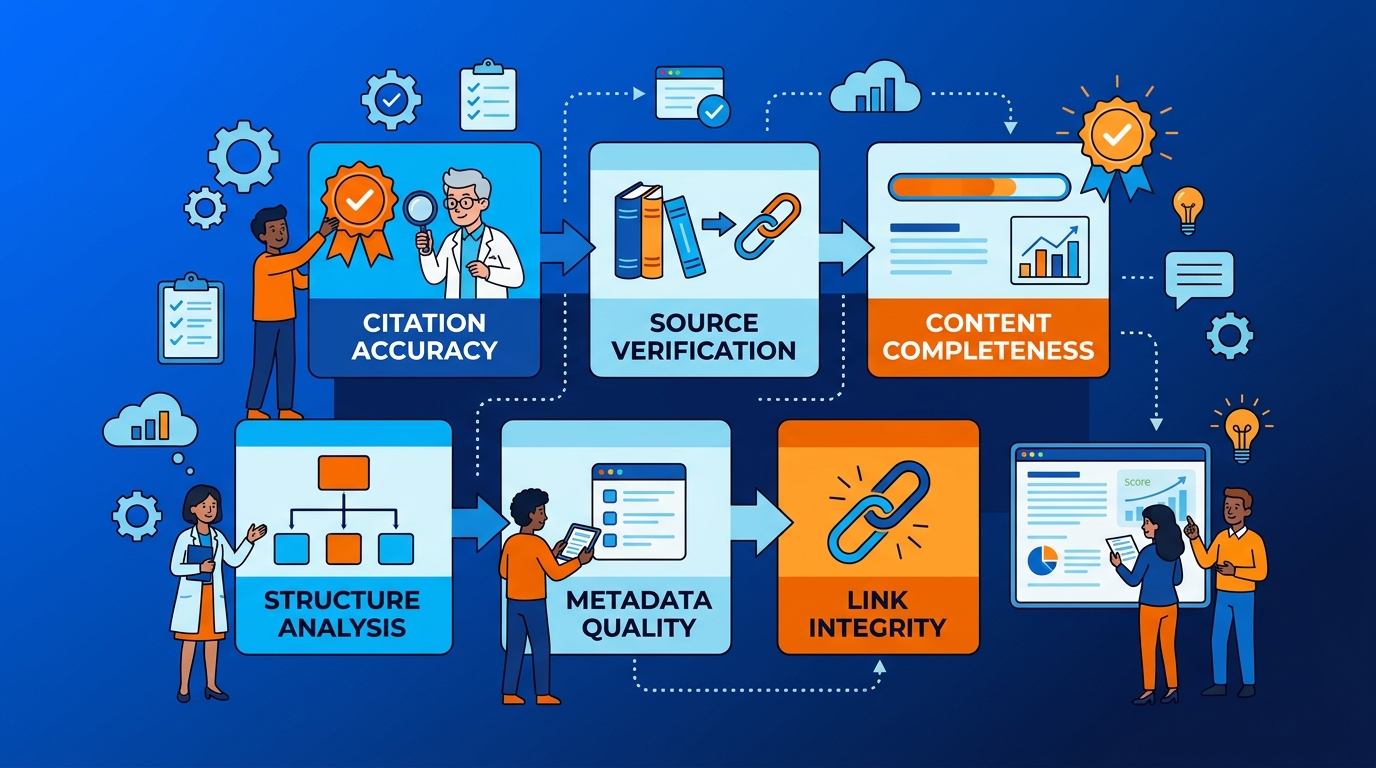
One audit published on arxiv.org scored pages on six pillars. It reported each pillar’s correlation with citation.
These are correlations. They show what travels together with citation.
Three pillars led the pack. Metadata & Freshness, Semantic HTML, and Structured Data were the most strongly associated with citation.
Here are all six, with the correlation (r) and the citation impact the audit reported:
- Metadata & Freshness: r 0.68, +47%
- Semantic HTML: r 0.65, +42%
- Structured Data: r 0.63, +39%
- Evidence & Citations: r 0.61, +37%
- Authority & Trust: r 0.59, +35%
- Internal Linking: r 0.57, +33%
All six had a p-value under 0.001.
The audit’s threshold analysis found that GEO ≥ 0.70 marks a strong inflection. Sensitivity of 0.78. Specificity of 0.84. A Youden’s index of 0.62.
Separately, it names a practical operating point. Pages with G ≥ 0.70 and at least 12 pillar hits achieve a 78% cross-engine citation rate. That’s nearly four in five.
The first is an inflection threshold on the score alone. The second adds the pillar-hit count.
BrightLocal research found that LLMs use local citations, reviews and social media channels for local searches.
BrightLocal says structured and unstructured citations and mentions on third-party “best of” lists have a significant impact on AI search visibility.
Whitespark says citations have been decreasing in importance as a local search strategy for the past decade. But optimizing for AI search is breathing new life into them. Three of the top five AI search visibility factors are citation factors.
I’d rather a practice be the source an AI names and draws on. Not one more name in a directory.
So I aim the work at being relied on, not just listed. For help reading a diagnostic result, see Interpreting Practice Diagnostic Results: A Complete Guide.
How to Tell a Slow Fix From a Stuck One
Here’s a caveat from Gary at Google, relayed by Search Engine Roundtable. Many of these processes are linked.
A page can’t be indexed until it has been crawled. So delays stack up.
Search Engine Roundtable also reports that core updates take 2–4 weeks to roll out. Spam updates roll out in 1–2 days.
The source is Google Search Data On Crawling, Indexing & Serving Timelines.
Three of the processes in Google’s timings, for sitemap processing, end-to-end indexing and structured data, add “(quality)”: a URL Google judges not worth indexing may never complete the process, however fast the technical work was done. That comes from The traditional search optimization Handbook’s write-up, Google Shows How Long Crawling, Indexing and Search Result Changes Take.
Check the last-crawl date first.
The URL Inspection tool in Search Console shows when Google last crawled a URL. Its request indexing option is Google’s documented way to ask for a recrawl of an individual page.
Then compare the wait to the slowest column.
Something still unresolved past the slowest column is more likely stuck than slow. Worth investigating.
For common wrong conclusions about a low rating, see Common Misreadings of a Low Diagnostic Rating, Corrected.
I don’t judge a fix by a rank check.
AI tools now give direct answers instead of lists of links. So I treat where a site sits in a results list as telling me little about whether a practice gets found. I’ve dropped rank reports as a measure of success.
I judge a fix by where it sits in the pipeline. Crawled. Indexed. Served.
Reviews Gained Weight, and What Patients Look For in Them
Reviews matter more now.
Whitespark says the biggest changes for 2026 are an increased importance of review signals and behavioural signals.
BrightLocal reports that reviews have grown in importance for local pack rankings. From 16% in 2023 to 20% today.
Here’s what patients actually look for. The figures below come from international studies reported in Local Ranking Factors 2026: The Complete Overview:
- Recency: Nearly three-quarters (74%) of consumers specifically look for reviews written within the last three months.
- Rating: More than nine in ten (92%) of consumers pay attention to star ratings. Nearly a third (31%) only use businesses with 4.5 stars or more, up from 17%.
- Response: Four in five (80%) consumers are more likely to use a business that responds to all reviews. And 81% expect a response within a week.
- Where they search: Nearly half (45%) of consumers use Google by default for local searches. 1 in 5 (20%) searches directly in map services such as Google Maps, Apple Maps or Bing Maps.
Frequently Asked Questions
Will rewriting meta descriptions help a clinic’s rankings?
No. Changing a meta description won’t affect your rankings. BrightLocal says it might affect your clickthrough rates, if Google lets you keep what you wrote. So write it to earn clicks. Don’t count on it to move you up.
Does being open at the time someone searches matter?
Yes. Whitespark added this factor to its survey. It has already skyrocketed to position #5 in ranking impact. Keep the hours on your profile true, so the open status people see is right.
How reliable are the expert surveys behind local ranking factors?
They’re informed opinion. Not inside knowledge. Whitespark invites 47 local search experts to complete a 2-hour survey. They weigh and score 187 factors and answer open-ended questions about what they see driving local search rankings. None of them has special access to the internal workings of Google’s local search algorithm. Use the results to set the order of your repairs. Don’t treat them as rules.
How reliable are Google’s own timing estimates for processing changes?
Treat them as rough guides. Google gives a typical time and a slowest time for 23 processes across crawling, indexing and serving. Each carries the footnote “Times expressed on the diagram are estimations based on internal analysis.” And there’s no sample size or measurement period in the slides or the recap. No word on how “typical” was calculated either. Median, mean or judgement. You can’t tell.
Settle the Facts, Mirror Them, Then Fill the Gaps
Here’s the order.
Settle the business facts on the profile and listings. Mirror them in markup. Then fill the service-page gaps.
In our work the infrastructure is front-loaded. The monthly execution builds on that foundation every single month.
I put effort and money into assets the business controls. Clear, credible information about itself.
I back that work because it keeps paying off and grows over time. Visibility bought through ads or paid placements stops the moment the spending stops.
I also steer practices away from cheap monthly agency deals for getting these fixes done. They look like a bargain. They usually cost more. Thin work, little real progress, and money tied up in a contract that builds nothing.
iTech Valet Service Plans & Pricing explains how the work is done.
Ready to see where your practice stands? Run My AI Visibility Check.