


AI Blog Ideas for Chiropractors in 2026: 50 Topics That Drive Traffic & New Patients
 by Gerek Allen ~ Last Updated: January 30th, 2026 ~ 11 Min Read
by Gerek Allen
~ Last Updated: January 30th, 2026 ~
~ 11 Min Read ~
Here's the deal. The best chiropractic blog topics in 2026 aren't about keywords anymore.
They're about answering the exact questions patients ask AI.
Patients don't type "chiropractor near me" into Google like they used to. They ask ChatGPT things like "Which chiropractor in Denver specializes in chronic sciatica for people who sit all day?"
If your blog doesn't answer that? You're invisible.
This article gives you 50 proven blog topics. Each one targets high-intent patient searches that AI loves to cite. You'll also learn how to find topics specific to your practice and local market using free tools.
But first... let's talk about why your current blog strategy probably isn't working.
If you're still cranking out generic wellness content or stuffing keywords into 500-word posts, you're playing a game that ended two years ago. The practices winning right now understand chiropractic AI content automation and how to create comprehensive, answer-ready content.
The 50 topics below are divided into four categories: Symptom-Based, Technology & Modern Care, Trust & Decision-Making, and Economics & Practical. Each one targets a different stage of the patient journey.
Together? They create what's called "entity authority." That's the thing that makes AI engines trust your practice enough to recommend you.
Let's get into it.
Why Traditional Blog Topics Don't Work Anymore


The game changed when AI search went mainstream.
Here's the kicker. AI-powered search tools now influence over 60% of healthcare decisions. That means more than half your potential patients are getting recommendations from sources that traditional SEO doesn't even touch.
Think about what happens when someone wakes up with lower back pain.
They're not typing fragmented keywords into Google anymore. They're asking their phone: "Hey ChatGPT, I've had lower back pain for three months. Can you recommend a good chiropractor near me who specializes in disc problems?"
Big difference.
The Shift from Keywords to Conversations
Traditional SEO was built for a world where people typed keywords and scrolled through blue links.
That world is disappearing fast.
Google's AI Overviews now appear in roughly half of all search results. That's doubled in the past year. And platforms like Perplexity AI are exploding because they deliver conversational answers with cited sources.
Here's what this means for your blog:
- Generic topics get ignored - "Benefits of Chiropractic Care" doesn't answer anyone's specific question. Too broad for AI to cite.
- Question-based content wins - "How Long Does It Take for Chiropractic to Help Sciatica?" directly matches what patients ask. AI can cite this as a clear answer.
- Depth beats frequency - One 3,500-word comprehensive guide outperforms ten 400-word posts. AI needs enough content to extract complete answers.
Local specificity matters - "Best Chiropractor for Tech Workers in Austin" targets a specific audience AI can recommend you for.
What AI Systems Actually Look For
Here's the thing. AI answer engines don't rank content the same way traditional search did.
They're looking for comprehensive authority on specific topics.
According to HubSpot's AEO Grader research, AI systems evaluate content based on:
- Direct answer quality - Does it immediately answer the question in the first paragraph?
- Comprehensiveness - Does it cover all related questions a patient might have?
- Structure - Can AI easily parse the content with clear headings, tables, and FAQ sections?
- Trust signals - Is it from an authoritative source with consistent information across the web?
This is why finding chiro keywords with AI requires a completely different approach. You're not looking for search volume anymore. You're looking for the questions patients actually ask and the comprehensive answers that establish your expertise.
How to Find Blog Topics That AI Actually Recommends

Before we dive into the 50 topics, let's cover the three tools you'll use to find topics specific to your practice.
These aren't just for validating my suggestions. They're for finding the unique questions patients in YOUR area are asking.
Tool 1: AnswerThePublic
AnswerThePublic is your starting point.
It pulls autocomplete data from Google, Bing, YouTube, and even TikTok. Shows you exactly what people search for around any keyword.
Here's how it works.
Type in a seed keyword like "chiropractor" or a condition like "sciatica treatment." The tool generates a visual wheel of questions organized by who, what, when, where, why, and how.
For example, searching "chiropractic" might reveal:
- "What does a chiropractor do on your first visit?"
- "How often should I see a chiropractor for lower back pain?"
- "Why do chiropractors require so many visits?"
- "Can chiropractors help with migraines?"
Each of these? A potential blog topic that directly matches patient intent.
The questions visualization is gold. It shows you real searches, not guesses.
Tool 2: Perplexity AI for AEO Audits
Perplexity AI is both a research tool and an audit tool.
Use it to see exactly which practices AI recommends for specific queries in your area.
Try searching: "Who is the best chiropractor in [Your City] for [Specific Condition]?"
Look at who gets cited. Study their content. What makes their pages worthy of AI recommendation?
Usually it's comprehensive condition-specific pages. Clear answers. Patient testimonials. Detailed treatment explanations.
This competitive intelligence tells you exactly what gaps exist in your local market. If nobody in your area has comprehensive content on "chiropractic for post-pregnancy back pain," that's your opportunity.
Tool 3: AnswerSocrates
AnswerSocrates is a free alternative that mines "People Also Ask" questions from Google.
These are the expandable question boxes in search results. And they're exactly what AI systems use to understand related questions.
The tool organizes questions in a tree structure. Shows you how one question leads to another.
Perfect for planning comprehensive pillar content.
For instance, "Can a chiropractor help with sciatica?" leads to:
- "How many sessions does it take?"
- "What techniques work best?"
- "Is it better than physical therapy?"
- "Will the pain come back?"
One comprehensive article answering all these questions? That's the depth that earns AI citations.

NEED MORE CLIENTS?
Free conversion-focused analysis uncovers the 3 biggest problems killing your bookings — we'll walk you through your results personally
Category 1: Symptom-Based Blog Topics (15 Topics)

Symptom-based topics are your highest-intent content. Period.
When someone searches "why does my lower back hurt when I sit," they're actively in pain. Looking for solutions. Ready to book.
They just need to know you can help.
Lower Back Pain Topics
Lower back pain is still the most searched chiropractic condition.
But generic "lower back pain treatment" content is too competitive. You'll never outrank WebMD or Mayo Clinic on that.
Win by targeting specific variations instead:
| 1 | How Long Does It Take for Chiropractic to Help Lower Back Pain? | New patients researching timeline expectations |
| 2 | Why Does My Lower Back Hurt After Sitting All Day? (And How Chiropractic Helps) | Desk workers and remote employees |
| 3 | Chiropractic vs. Physical Therapy for Lower Back Pain: Which Is Right for You? | Comparison shoppers evaluating options |
| 4 | Can Chiropractic Prevent Lower Back Pain from Coming Back? | Patients seeking long-term solutions |
| 5 | What Causes Lower Back Pain to Flare Up at Night? | Patients with sleep-disrupting pain |
See the difference? Each topic has a specific question and a specific audience.
That specificity is what AI systems need to recommend your content.
Sciatica and Nerve Pain Topics
Sciatica queries tend to be higher intent. The pain is often more severe. More disruptive.
Patients with sciatic pain are motivated to find relief.
| 6 | How Many Chiropractic Visits Does It Take to Fix Sciatica? | Patients planning treatment commitment |
| 7 | What's the Fastest Way to Relieve Sciatica Pain? | Urgent pain seekers |
| 8 | Can Sciatica Cause Permanent Nerve Damage? (What Chiropractors Want You to Know) | Worried patients seeking reassurance |
| 9 | Sciatica Treatment Without Surgery: Your Complete Options Guide | Patients avoiding surgical intervention |
| 10 | Why Does Sciatica Get Worse When I Drive? | Commuters with specific trigger |
Headache and Migraine Topics
Here's the thing about headache patients. Many don't even realize chiropractic is an option.
Educational content here captures patients who never considered you:
| 11 | Can a Chiropractor Really Help With Migraines? | Skeptical migraine sufferers |
| 12 | Tension Headaches vs. Migraines: How Chiropractic Treatment Differs | Patients unsure of their condition |
| 13 | What Causes Headaches That Start in the Neck? | Patients experiencing cervicogenic headaches |
| 14 | How Often Should I See a Chiropractor for Chronic Headaches? | Patients establishing care frequency |
The key with symptom topics? Specificity.
"Headache treatment" is too broad. "What causes headaches that start in the neck?" is searchable, answerable, and matches exactly how patients talk.
Category 2: Technology & Modern Care Topics (10 Topics)

Technology topics serve two purposes.
First, they attract tech-savvy patients who research online. Second, they position your practice as modern and progressive.
These also perform well for local AEO because they differentiate you from older practices still running like it's 2015.
AI and Automation in Chiropractic
Patients are curious about how AI affects their healthcare. Content on this topic positions you as forward-thinking:
| 16 | How AI Is Changing Chiropractic Care in 2026 | Tech-curious patients |
| 17 | Can AI Help Chiropractors Diagnose Problems Faster? | Patients interested in diagnostic accuracy |
| 18 | What Is a Digital-First Chiropractic Practice? | Patients seeking modern care experience |
The best chiropractic AI automation tools are transforming how practices operate. From scheduling to documentation to patient communication.
Writing about these shows patients you're investing in their experience.
Treatment Technology Topics
Modern treatment tech gives patients confidence in your methods:
| 19 | Spinal Decompression Therapy: What to Expect and Does It Work? | Patients researching non-surgical options |
| 20 | Cold Laser Therapy for Pain: Is It Worth It? | Patients evaluating new treatments |
| 21 | What Is the Gonstead Technique? (And Is It Right for You?) | Patients researching specific techniques |
| 22 | Activator Method vs. Manual Adjustments: Which Is Better? | Patients nervous about traditional adjustments |
Practice Experience Topics
These address what modern patients expect. Convenience:
| 23 | How to Book a Chiropractor Online (And What to Know Before Your First Visit) | New patients seeking convenience |
| 24 | What to Expect from Virtual Chiropractic Consultations | Remote or initial consultation seekers |
| 25 | How Modern Chiropractic Offices Use Technology to Reduce Wait Times | Time-conscious patients |
Ready to See How We Fix Chiropractic Websites?
We've transformed 150+ service-based websites using our proven 4-step system. See exactly how we combine premium design with conversion science.
Category 3: Trust & Decision-Making Topics (15 Topics)

Now... this part matters.
Trust topics address the objections and concerns patients have before booking. These are often your highest-converting topics.
Why? They target patients in the decision phase. They've already decided they need help. They're just not sure you're the right choice.
Choosing a Chiropractor Topics
Help patients make informed decisions and you become the obvious choice:
| 26 | How to Choose the Right Chiropractor for Your Needs | First-time patients |
| 27 | Questions to Ask Before Your First Chiropractic Visit | Cautious researchers |
| 28 | What Credentials Should a Chiropractor Have? (And How to Verify Them) | Trust-focused patients |
| 29 | Red Flags to Watch for When Choosing a Chiropractor | Skeptical patients |
| 30 | Why Do Some Chiropractors Require X-Rays? (And Is It Necessary?) | Patients questioning protocols |
These work because they demonstrate transparency.
By addressing concerns openly, you build trust before the patient ever walks through your door.
First Visit Anxiety Topics
Fear of the unknown prevents a lot of bookings. Address it head-on:
| 31 | What Happens During Your First Chiropractic Visit? (Step-by-Step Guide) | First-timers with appointment anxiety |
| 32 | Does Chiropractic Adjustment Hurt? Honest Answer from a Chiropractor | Pain-anxious patients |
| 33 | Is Chiropractic Safe? What the Research Actually Says | Safety-conscious patients |
| 34 | Why Do Chiropractors Recommend Multiple Visits? (The Real Reason) | Patients suspicious of upselling |
| 35 | Can Chiropractic Make Things Worse? When to Be Cautious | Worried patients seeking honesty |
Notice how several address negative concerns.
Might seem counterintuitive. But here's the reality. Stopping no-shows with automated reminders starts with building trust before the appointment. Patients who feel informed are patients who show up.
Comparison and Alternative Topics
Patients compare options. Help them compare fairly:
| 36 | Chiropractor vs. Massage Therapist: When to See Each | Patients weighing options |
| 37 | Should I See a Chiropractor or Go Straight to an Orthopedist? | Patients unsure of care pathway |
| 38 | Chiropractic vs. Acupuncture for Back Pain: Which Works Better? | Alternative medicine seekers |
| 39 | Can My Primary Care Doctor Refer Me to a Chiropractor? | Insurance-minded patients |
| 40 | Physical Therapy, Chiropractic, or Both? How to Decide | Multi-treatment planners |
Category 4: Economics & Practical Topics (10 Topics)

Alright, quick reality check.
Money questions are often the final barrier to booking. Patients wanna know what they're getting into financially before they commit.
Addressing cost and insurance openly removes this friction.
Cost and Insurance Topics
Transparency about money builds enormous trust:
| 41 | How Much Does a Chiropractor Cost Without Insurance? | Uninsured patients |
| 42 | Does Insurance Cover Chiropractic Care? (2026 Guide) | Insurance-curious patients |
| 43 | What's the Average Cost of Chiropractic Treatment for Back Pain? | Budget planners |
| 44 | Is Chiropractic Care Worth the Money? (How to Calculate Your ROI) | Value-focused patients |
| 45 | Medicare and Chiropractic: What's Covered in 2026? (Hint: Only Subluxation) | Senior patients |
Practical Planning Topics
Help patients plan their care practically:
| 46 | How Many Chiropractic Visits Will I Need? (Realistic Expectations by Condition) | Treatment planners |
| 47 | Can I Use My HSA or FSA for Chiropractic Care? | Tax-advantaged account holders |
| 48 | What to Wear to a Chiropractic Appointment | Practical first-timers |
| 49 | How to Get the Most Out of Every Chiropractic Visit | Value maximizers |
| 50 | When Should You Stop Seeing a Chiropractor? (Signs You've Achieved Your Goals) | Long-term care planners |
These practical topics might seem mundane.
But they're frequently searched and rarely well-answered. Comprehensive guides on practical matters earn AI citations because they fully address common patient concerns that nobody else bothers to cover properly.
Building Your Content Calendar from These Topics
Having 50 topics is great.
Knowing how to prioritize them is better.
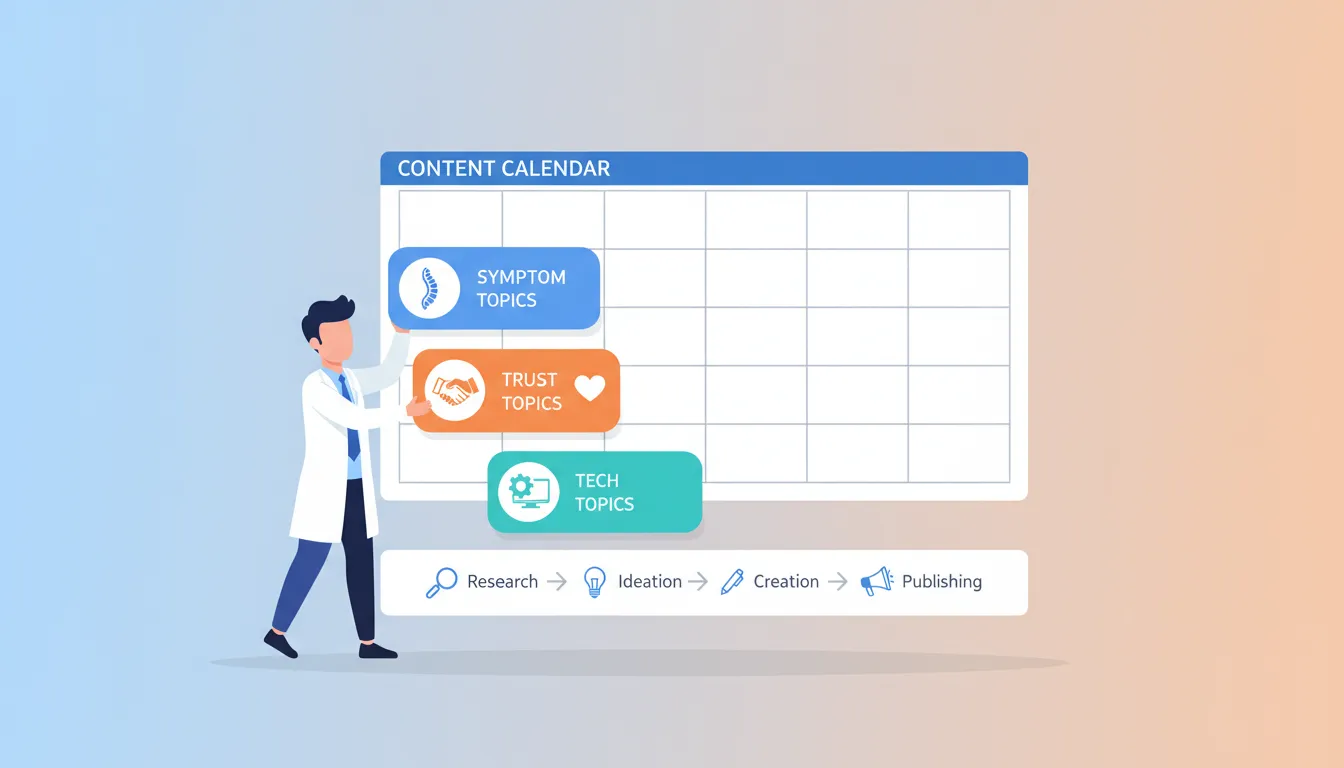
Here's how to build a content calendar that maximizes your AEO impact.
Start with High-Intent Symptom Topics
Your first 4-6 articles should be symptom-based content targeting your most common patient conditions.
These have the highest conversion potential. They reach patients actively seeking treatment.
If most of your patients come in for lower back pain, start with topics 1-5. If you specialize in migraines, start with topics 11-15.
Match your content to your actual patient base. AI systems recognize when your content aligns with your practice specialties.
Add Trust Topics Monthly
Sprinkle trust and decision-making topics throughout your calendar. One per month maintains balance between attracting new searches and converting visitors into patients.
Topics like "What happens during your first visit" and "Does chiropractic adjustment hurt" should be evergreen content. Publish early in your strategy. Update annually.
Use Technology Topics for Differentiation
Technology topics work best if you actually use modern tools and techniques.
Don't write about spinal decompression if you don't offer it.
But if you DO offer advanced treatments or use modern scheduling and communication systems, these topics differentiate you from traditional practices. They attract patients who value innovation.
Economics Topics Build Trust
Cost and insurance topics should be comprehensive and frequently updated.
Medicare coverage changes. Insurance policies evolve. HSA rules shift.
Having current, accurate financial information makes you the trustworthy choice. And these pages convert well because patients who reach them are in decision-making mode.
Measuring What Works: The AEO Metrics That Matter

Traditional metrics like keyword rankings don't tell the whole story anymore.
Here's what to track when building an AEO-focused content strategy.
AI Citation Tracking
The most important metric? Whether AI systems recommend your content.
This requires manual checking.
Every week, ask ChatGPT, Perplexity, and Google's AI Overview questions your content answers. Include your city name. See if you get cited or recommended.
Tools like HubSpot's AEO Grader automate some of this tracking across multiple AI platforms. Shows whether your brand appears in AI-generated results and how you stack up against competitors.
Engagement Metrics
AI systems consider user engagement signals when determining content quality:
- Time on page - Comprehensive content keeps visitors longer. Target 3+ minutes for pillar content.
- Scroll depth - Are visitors reading your entire article or bouncing after the intro?
- Bounce rate - Lower is better. Engaging content keeps visitors exploring your site.
Pages per session - Internal linking to related content increases this metric.
Conversion Tracking
Ultimately, blog content should drive appointments. Track:
- Form submissions - How many readers request appointments or consultations?
- Phone calls - Use call tracking to attribute calls to specific content.
- Online bookings - If you offer online scheduling, which pages drive bookings?
- Return visits - Are blog readers coming back to your site before booking?
If you're generating traffic but not appointments, your content might be attracting the wrong audience. Or lacking clear calls-to-action.
Want to scale your chiropractic practice in 2025? Start by tracking what actually converts.
Common Mistakes That Kill Your AEO Efforts
Knowing what to do matters.
Knowing what NOT to do matters just as much.
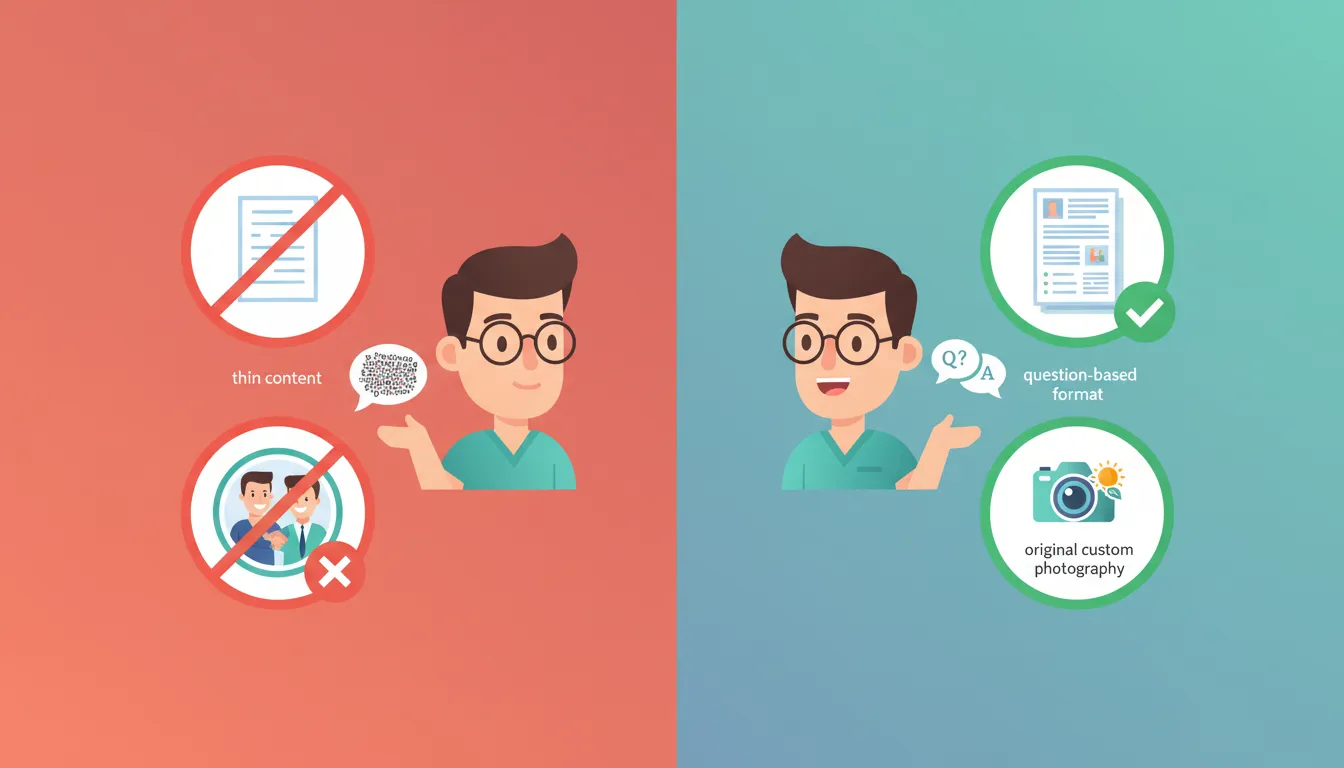
Here are the mistakes that kill AEO performance.
Mistake 1: Writing Thin Content
Short posts under 1,000 words rarely earn AI citations.
AI systems need comprehensive content to extract complete answers.
This doesn't mean padding with fluff. It means thoroughly answering every related question a patient might have about a topic.
If your article on sciatica treatment doesn't cover causes, symptoms, treatment timeline, cost expectations, and when to seek other care... it's incomplete.
Mistake 2: Targeting Keywords Instead of Questions
"Chiropractor back pain treatment" isn't how patients search anymore.
They ask: "Can a chiropractor fix my herniated disc without surgery?"
Every blog title should be either a question or directly answer an implied question. The question format matches how AI systems process queries and return results.
Mistake 3: Ignoring Local Context
Generic national content competes with massive health websites. You'll lose that fight.
Local content competes with other local practices. Often practices with weaker content strategies.
Include your city, neighborhood, and regional context naturally throughout your content. Mention local landmarks, local patient demographics, and regional health trends when relevant.
Mistake 4: Inconsistent Publishing
Publishing 10 articles in January and then nothing until June?
That signals to AI systems that your site isn't actively maintained.
Consistency matters more than volume. Two comprehensive articles per month, published regularly, outperforms sporadic publishing binges.
Mistake 5: No Internal Linking Strategy
Each blog post should link to related content on your site.
This helps AI systems understand your topic authority. And helps patients find related information.
When you write about sciatica treatment, link to your pages on spinal decompression, your first-visit guide, and your insurance information. Create a web of related content that demonstrates comprehensive expertise.
Frequently Asked Questions
How do I find high-intent chiropractic blog topics in 2026?
Use AI-powered tools like AnswerThePublic, Perplexity AI, and AnswerSocrates to discover what patients are actually asking AI assistants.
Focus on conversational queries. Specific symptoms. Conditions. Local treatment options. Not generic keywords.
The key is matching patient language. Search for seed terms like "chiropractor" or specific conditions and look at the question variations. Then validate by checking if AI systems currently have good answers for those questions.
If they don't? That's your opportunity.
What are patients asking AI assistants about chiropractic care?
Patients ask complex, conversational questions.
"Which chiropractor near me specializes in chronic sciatica for desk workers?" or "Can chiropractic help my migraines without medication?"
They want specific answers about conditions, techniques, insurance acceptance, and local expertise. The queries are longer and more detailed than traditional keywords because AI can process natural language.
Do blog posts still help with chiropractic SEO in 2026?
Yes. But the strategy has evolved significantly.
Blog posts now need to be optimized for Answer Engine Optimization (AEO), not just traditional SEO.
AI systems cite comprehensive, question-focused content that establishes entity authority. Blogs that answer specific patient questions get recommended by ChatGPT, Perplexity, and Google AI Overviews.
The key difference? Depth and structure. AI needs complete, well-organized answers it can cite confidently.
How many blog posts should a chiropractor publish each month?
Quality beats quantity. Every time.
Publishing 2-4 comprehensive, AEO-optimized articles per month outperforms daily thin content.
Focus on 2,500-4,000+ word pillar content that comprehensively answers patient questions. One thorough article that earns AI recommendations is worth more than ten short posts that get ignored.
What are the best blog topics for sciatica and lower back pain?
High-intent topics include:
- "How long does it take for chiropractic to help sciatica?"
- "What causes sciatica to flare up at night?"
- "Chiropractic vs. physical therapy for lower back pain"
- "Can chiropractic prevent sciatica from coming back?"
Focus on specific patient concerns and treatment outcomes. Avoid generic "sciatica treatment" content that competes with major health sites. Target the specific variations and questions patients actually ask.
Can I use AI to brainstorm blog ideas for my specific neighborhood?
Absolutely.
Use Perplexity AI to search what questions patients in your area are asking. Combine location-specific queries with condition-based topics.
"Best chiropractor for tech workers in [City]" or "Chiropractic care for runners in [Neighborhood]" creates locally relevant content that AI systems cite for local queries.
Local context is your competitive advantage against national health websites.
How does AEO change the way I choose blog topics for my clinic?
AEO shifts focus from keywords to entities and questions.
Instead of targeting "chiropractor Atlanta," you target "Who is the best chiropractor in Atlanta for sports injuries who uses the Gonstead technique?"
Topics need to be comprehensive. Question-focused. Structured for AI parsing with clear answers, tables, and FAQ sections.
The goal? Becoming the definitive authority on specific topics that AI systems trust enough to cite.
What is the most searched chiropractic condition in 2026?
Lower back pain and sciatica consistently rank highest. Followed by neck pain, headaches/migraines, and sports injuries.
But here's the thing. The most valuable topics are condition-specific variations.
"Chiropractic for desk worker back pain" or "chiropractic treatment for post-pregnancy sciatica" target specific patient segments. Specificity reduces competition and increases conversion.
Your Next Steps
You've got 50 proven blog topics organized by patient intent and search behavior.
Now what?
Start by picking five topics that match your practice specialty. If you primarily treat sciatica patients, start with topics 6-10. If you serve a tech-heavy area with desk workers, prioritize topics 2 and 16-18.
Then use the research tools. AnswerThePublic, Perplexity, and AnswerSocrates. Validate these topics in your local market. Look for question variations specific to your city and patient base.
Build a content calendar with one comprehensive article every two weeks. Consistency matters more than speed. Each article should be 2,500-4,000 words, thoroughly answering every related question.
Finally, track your AI citations. Check weekly whether ChatGPT and Perplexity recommend your content for relevant local queries.
That's the metric that matters in 2026.
The practices dominating their local markets this year are the ones that stopped guessing what to write. They started answering the questions patients actually ask AI.
These 50 topics give you the roadmap.
Now it's time to execute.
Look, I get it. You're thinking "this all makes sense, but who has time to create all this content while running a practice?"
You're not alone.
Most successful chiropractors we work with felt the same way. Then they realized their website was quietly costing them 15-20 qualified patient leads every single month.
That's why we created our Free Website Conversion Analysis. It's not a sales pitch. It's a genuine walkthrough of the 3 biggest problems killing your bookings, delivered personally via Loom video within 24 hours.
We'll show you exactly:
- Why visitors leave without booking
- What's broken on mobile devices (where most searches happen)
- Missing trust signals costing you patients
- Where you rank vs. local competitors
- Simple fixes that drive more calls this month
You'll also get an instant case study while you wait. Real examples of how other chiropractors fixed these exact problems.
Get your free analysis here — no credit card, no obligation, just actionable insights you can use whether you work with us or not.
Because every day you wait to implement a content strategy is another day AI assistants are recommending your competitors instead of you.

Gerek Allen
Co-Owner iTech Valet
Entrepreneur, patriot, CrossFit junkie, IPA enthusiast, loves to travel to tropical destinations, and knows way too many movie quotes.


About iTech Valet
iTech Valet specializes in web design and content marketing for online entrepreneurs who want to share their expertise.
Services Include:
- Web Design
- Graphic Design
- Sales Copy
- Funnel Building
- Authority Sites
- Membership Sites
- Course Creation
- Email Systems
- Content Marketing
- Competitive Analysis
- Tech Integrations
- Strategic Planning
NEED MORE CLIENTS?
Free conversion-focused analysis uncovers the 3 biggest problems killing your bookings — we'll walk you through your results personally

621 Enterprises, Inc. | Copyright 2022 | All rights reserved