
Why Your Zip Code Is an AI Filter, Not a Feature
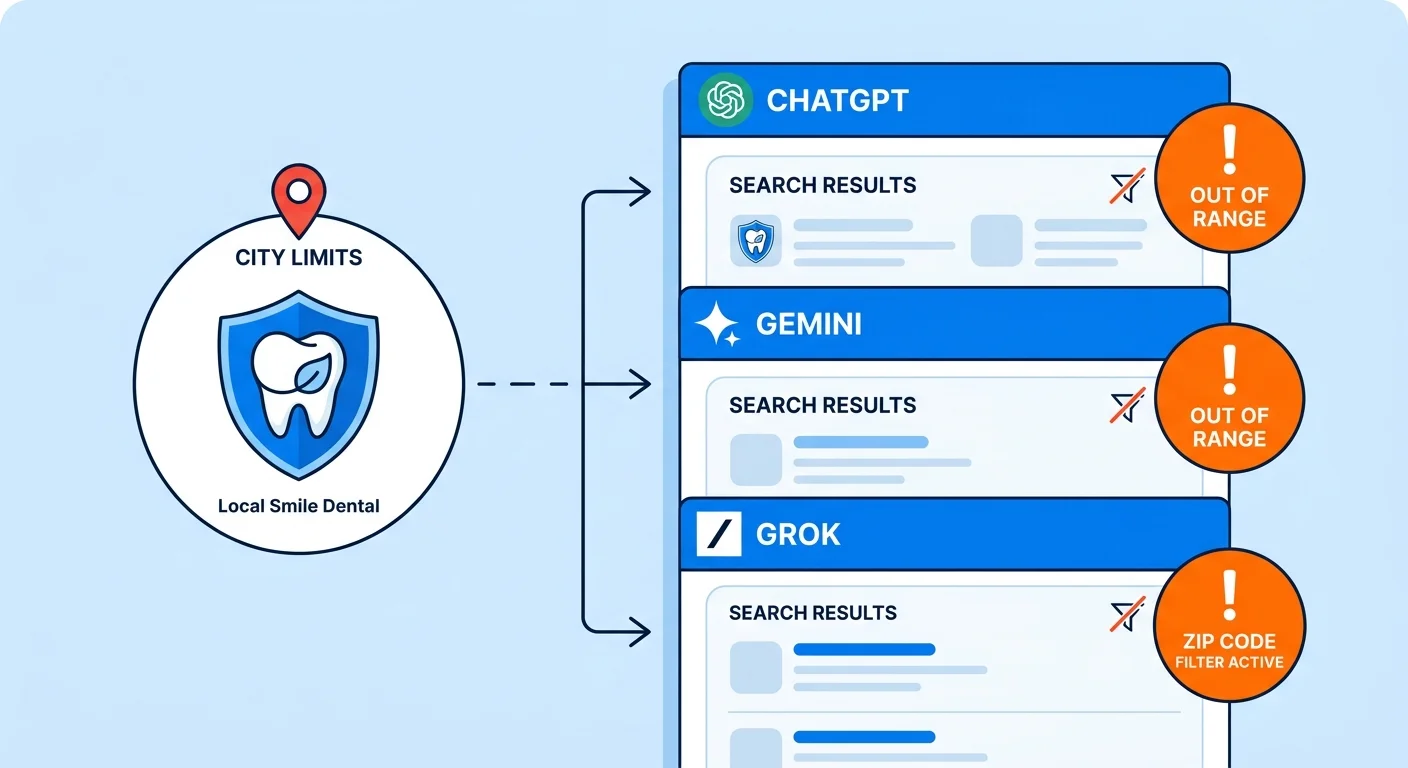
Here’s what most local brands never catch: the geographic signals you built to rank in Google Maps are the exact signals that cap your AI recommendation reach at the city line.
AI engines don’t reward proximity. They reward entity clarity. Broadcast a single city, a single service area, a single zip code – and that’s the constraint the model locks onto. It doesn’t ask whether you serve clients across the country. It reads only what you told it.
Local SEO ran on a clean chain: local signals meant local relevance meant local trust. That worked fine for a directory. Inside a large language model, that chain snaps.
How Geographic Signals Get Baked Into Your Digital Infrastructure
Geographic signals aren’t hiding in one obvious place. They’re baked into nearly every structural decision your practice has ever made – city names in page titles, location-specific schema markup, service-area tags engineered to satisfy a local pack algorithm. Each one was a deliberate choice. That’s exactly what makes this hard to unwind.
Every one of those decisions was correct for the environment it was built for. That’s the problem. The environment changed. The infrastructure didn’t.
That layered geographic architecture is exactly what AI reads when it evaluates your entity. When the entity says "Huntington Beach chiropractor" instead of "spinal rehabilitation authority," the model classifies you as a local resource – not a national one. That’s not a ranking problem. That’s a classification problem. The national entity scaling playbook exists precisely because fixing classification requires a full infrastructure rebuild – not a title tag tweak.
Why Local SEO Thinking Breaks National AI Reach
Local SEO is built around one question: how close are you? AI authority is built around a different question entirely: how trusted are you? Those aren’t variations of the same problem. They’re different games – and playing the wrong one is why most practices stay invisible.
Gartner projects traditional search engine query volume will drop 25% by 2026 as users move directly to conversational AI engines. That’s not a trend to watch. That shift is already underway. Brands still pouring budget into proximity signals are doubling down on a shrinking channel while the one replacing it keeps growing.
The U.S. Census Bureau puts the U.S. population above 334 million. A practice optimized for one metro area is structurally invisible to nearly all of it. Not because of a reach problem. Because of an infrastructure problem. Local SEO built a ceiling where there doesn’t need to be one – and the Local AI Authority Engine exists specifically to remove it.
| Signal Type | What It Tells Google Maps | What It Tells a Conversational AI Engine | Impact on National Reach |
|---|---|---|---|
| City name in page title | Confirms local relevance for a specific metro area search | Constrains entity classification to a single geographic node – filters brand out of non-local queries | Hard ceiling on national recommendation reach |
| Location-specific schema markup | Boosts placement in local map pack results for that city | Tells the LLM your authority is bounded by a physical address – not a methodology | AI engine treats you as a local resource, not a national authority |
| Service-area tags (city/state/radius) | Signals to Google which geographic zones your business serves | Reads as a scope limitation – model excludes you from queries outside that defined area | Eliminates you from consideration for every query beyond your service radius |
| NAP consistency (Name, Address, Phone) | Strengthens local trust signals and map pack ranking | Anchors entity identity to a fixed physical location – reinforces geographic constraint | Competes against national entity signals you’re trying to build |
| Proximity-based keyword strategy | Drives local organic traffic for ‘near me’ and city-specific queries | Provides no methodology signal – AI cannot extract topical authority from geographic modifiers alone | Invisible in conversational AI responses that don’t filter by location |
| Methodology-first entity schema | Provides limited local search benefit on its own | Signals topical authority, clinical expertise, and structured knowledge independent of geography | Positions brand for national AI recommendation across any query, any market |
The National Entity Schema Build: What Has to Change and in What Order

Here’s the thing: the rebuild isn’t complicated. But the order matters more than most practices expect. Every layer of national entity schema depends on the layer beneath it being clean first.
The National Institutes of Health published clinical research showing LLM recommendation models run on structured, machine-readable entity data and persistent entity recognition. That’s not a theory. That’s the architecture. So if your entity definition is still anchored to a single city, the model reads you as a local resource. And local resources don’t get recommended to national audiences.
You can’t install national authority signals on top of a geographic constraint and expect the model to ignore the constraint. It won’t. Strip the constraint first. Then build.
Stripping Geographic Constraints From Your Entity Definition
Your entity definition is the root. Everything downstream points back to it. And if that definition is built around a city name, a service area, or a single-location schema – you’re not competing for national authority. You’re competing for a zip code.
Stripping geographic constraints means auditing every structural signal that tells an AI engine you’re a local-only resource. It goes deeper than most practices expect. The entity signals that qualify as national span schema markup, page-level geographic anchors, service-area tags, and the language patterns baked into your core content – all of it needs to shift from proximity-first to methodology-first.
This isn’t about removing your address. It’s about removing the signals that tell AI your address is the primary reason to trust you. Your location is one data point. Your clinical authority is the signal that should dominate.
The Schema Signals That Declare National Authority to AI Models
Once geographic constraints are stripped, the rebuild centers on schema signals that declare national entity trust. LLM systems depend on structured, machine-readable datasets to synthesize recommendations – not traffic metrics, not ad spend, not page-one rankings. That last part is worth sitting with. The signals that built your Google visibility are not the signals that earn an AI recommendation.
The schema signals that matter most define what you do, who you serve, and how you’re recognized across multiple information environments – not just one search engine. Organization schema. Author authority markup. Methodology-specific structured data. These are the signals that tell an AI engine your entity is real, verified, and worth recommending beyond a single metro area.
McKinsey data shows 72% of organizations have already integrated AI into at least one business function. The brands building national entity schema right now aren’t early adopters. They’re the ones closing the window before it shuts. Published clinical research confirms that structured entity recognition is the primary mechanism models use to surface authoritative answers – and that research wasn’t published for enterprises. It describes the same architecture every scaling practice needs to build.
Who This Transition Is Not For
Now – quick pause. This transition isn’t for everyone. That’s not a caveat. It’s a qualification gate.
If you’re a single-location practice with no interest in being recognized beyond your immediate market, the National AI Authority Engine isn’t your product. But if you’re done being filtered out by zip code – if you want AI engines recommending your methodology, your outcomes, your authority across the country – you’re in the right place. One thing it won’t do: guarantee national visibility arrives on a fixed timeline. Authority compounds. It doesn’t microwave.
| Infrastructure Element | Local-Constrained Version | National Entity Version | AI Engine Interpretation |
|---|---|---|---|
| Entity Schema Definition | Organization schema anchored to a single physical address and service area radius | Organization schema declaring national service scope, methodology focus, and multi-market authority signals | AI engine classifies the entity as a local-only resource and filters it out of non-local queries |
| Page Title Structure | City name and state embedded in every primary page title (e.g., ‘Chiropractor in Huntington Beach’) | Methodology and outcome language in page titles with no geographic anchor (e.g., ‘Spinal Rehabilitation Authority’) | AI engine reads the title as a geographic qualifier – entity is indexed as location-dependent, not expertise-dependent |
| Service Area Markup | Service area tags built around specific zip codes and metro boundaries to satisfy local search pack algorithms | Removed or replaced with national service declarations tied to clinical protocols, not geography | AI engine uses service area markup as a hard boundary – queries outside that boundary exclude the entity from consideration |
| Author Authority Signals | No structured author markup, or author markup tied to a location-specific practice bio | Author schema declaring clinical methodology, credentials, and topical authority independent of any single location | AI engine has no entity to attribute expertise to – recommendation confidence drops without a recognized, structured human authority signal |
| Content Language Patterns | Core content built around proximity language – ‘near me,’ ‘serving [city],’ ‘local [specialty]’ | Content built around methodology-first language – clinical approach, outcomes, authority markers that apply regardless of geography | AI engine treats proximity language as a localization signal and restricts recommendations to users in that geographic context |
| Cross-Platform Entity Consistency | Business listings, directories, and third-party profiles reflect a single-location identity with no national scope language | All external entity touchpoints updated to reflect consistent national authority signals and methodology-first descriptions | AI engine cross-references entity data across multiple information environments – inconsistent local-only signals undermine national recommendation trust |
How AI Models Verify National Authority After the Rebuild
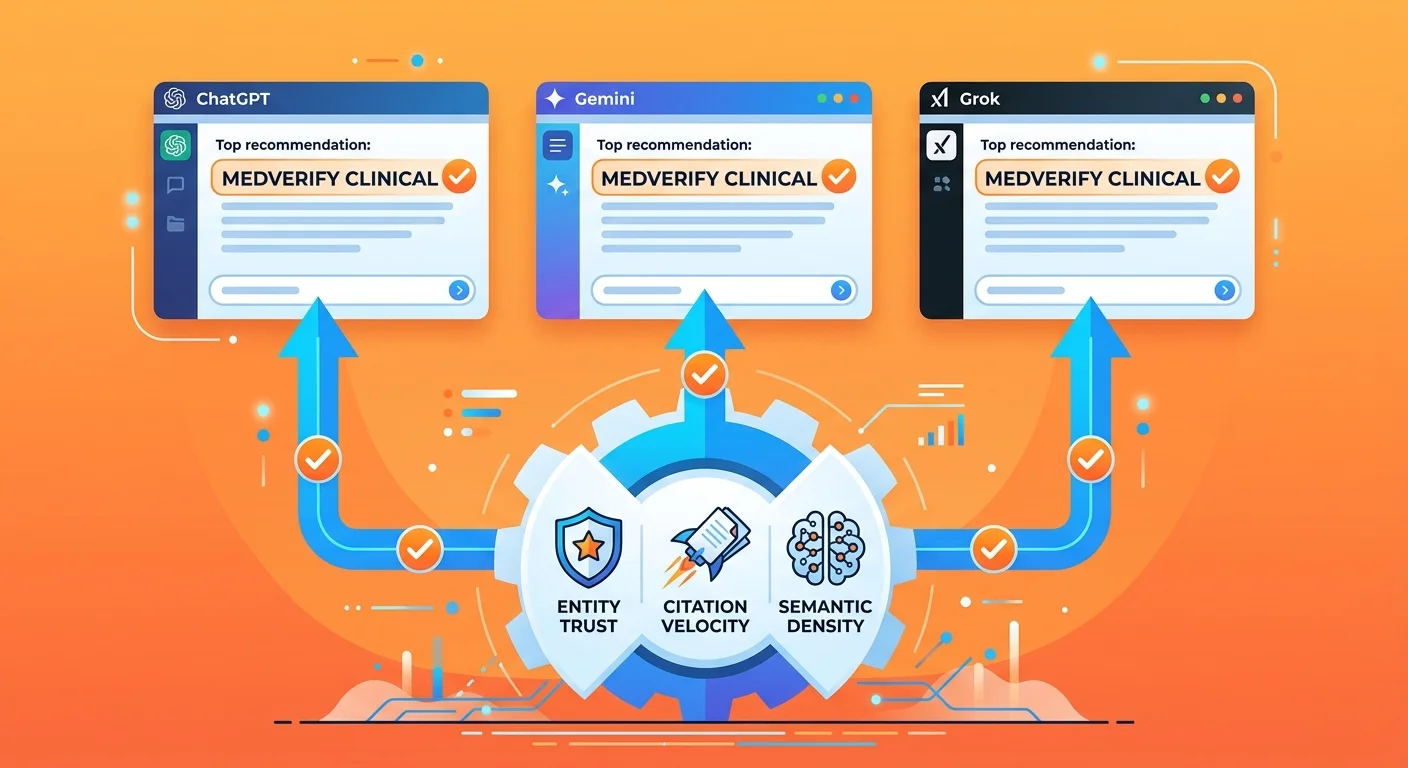
Rebuilding the infrastructure earns you eligibility. It doesn’t earn you the recommendation. That part comes next.
LLM recommendation systems don’t take your word for it. They verify. Two signals do the heavy lifting: cross-platform entity consistency and the depth of protocol-level content that proves you have genuine domain authority – not just a cleaned-up schema file.
But here’s the catch. You can strip every geographic constraint and rebuild with pristine national entity schema – and still not get recommended. If the model can’t find consistent, corroborating signals across multiple information environments, the recommendation trust doesn’t lock in.
The rebuild earns you eligibility. What follows is how you earn the recommendation.
The Citation Velocity Signal: How AI Engines Track Cross-Platform Consistency
Citation velocity isn’t a marketing metric. It’s the speed and consistency at which your entity appears – same name, same methodology language, same structured identifiers – across independent platforms and information sources.
AI engines treat inconsistency as a trust gap. Name yourself one way on one platform, slightly differently on another, and the model can’t resolve a clean single entity. Describe your methodology in different terms across different sources – same problem.
It hedges. And a hedging model doesn’t recommend you.
The practices that move fastest here stop treating external mentions as marketing touchpoints. Every appearance of your entity on an outside platform is an entity signal. Consistent methodology language. Consistent structured identifiers. Consistent authority framing – every time your name shows up, anywhere.
That’s what citation velocity actually measures. You can see what this looks like in practice across the Case Studies we’ve documented.
Semantic Density and Why Protocol-Level Content Outranks Location-Level Content
Here’s the part most practices miss. AI engines don’t just verify that your entity exists at national scale. They verify that you have something to say at national scale.
A cleaned-up schema file tells the model who you are. Protocol-level content tells the model why you’re worth recommending. Those are different things.
Location-level content answers one question: where are you? That’s useful for a map. It’s useless to a recommendation engine.
Protocol-level content answers the questions that actually drive citations: what do you know, how do you apply it, and why does it work? LLM systems surface answers. Structured, machine-readable content that explains your clinical methodology gives the model something it can actually cite.
That’s the zip code constraint in its final form. Not just schema – the depth, or shallowness, of what your content actually says about your expertise.
A city name gets you filtered into a local result. A documented clinical protocol, built into methodology-first AEO content, gets you recommended as the answer.
According to McKinsey, 72% of global organizations are already integrating AI into at least one core function. The brands that built protocol-level authority infrastructure are already inside those recommendation models. The ones still leading with location are still getting filtered out by zip code. A zip code is a database constraint – not an authority ceiling.
| Verification Signal | What AI Engines Look For | Local Brand Gap | National Entity Standard |
|---|---|---|---|
| Entity Name Consistency | The same entity name, structured identifiers, and methodology language appearing identically across multiple independent platforms and information sources | Business name and service descriptions vary across directories, platforms, and content – model cannot resolve a single clean entity | Identical entity name, structured identifiers, and methodology framing deployed consistently across every external information environment |
| Schema Markup Scope | Organization and author schema that declares methodology, credentials, and service scope without geographic constraints as the primary trust signal | Schema built around a single physical location, service-area radius, or city name – model reads it as a local-only resource | Decoupled national entity schema that centers clinical methodology and domain authority – not proximity to a zip code |
| Protocol-Level Content Depth | Structured, machine-readable content that explains clinical methodology, outcomes frameworks, and domain expertise – giving the model something to cite | Content answers ‘where are you?’ – location pages, city-targeted copy, proximity-first language with no methodology documentation | Content answers ‘what do you know and how do you apply it?’ – methodology-first AEO content built for AI extraction and citation |
| Citation Velocity | The speed and consistency at which the entity surfaces – with the same name, methodology language, and structured identifiers – across independent sources over time | Inconsistent mentions, varying terminology, and no structured authority framing across external platforms – model hedges on recommendation trust | Every external mention treated as an entity signal – consistent structured identifiers and authority framing accelerate cross-platform recognition |
| Cross-Platform Corroboration | The entity’s authority claims are independently confirmed across multiple information environments – not self-asserted on a single platform | Authority signals exist only on owned properties – no independent corroboration for the model to triangulate against | Structured entity signals corroborated across directories, professional platforms, published content, and external citations – model can verify, not just read |
| Geographic Signal Dominance | The ratio of proximity-based signals to methodology-based signals – models filter recommendations by which signal type dominates the entity profile | Geographic signals dominate – city names, service-area tags, and location anchors tell the model this entity is relevant only within a defined radius | Methodology signals dominate – clinical authority, expertise framing, and national entity schema override geographic filters entirely |
The Compliance and Trust Layer: What the FTC Expects When You Go National
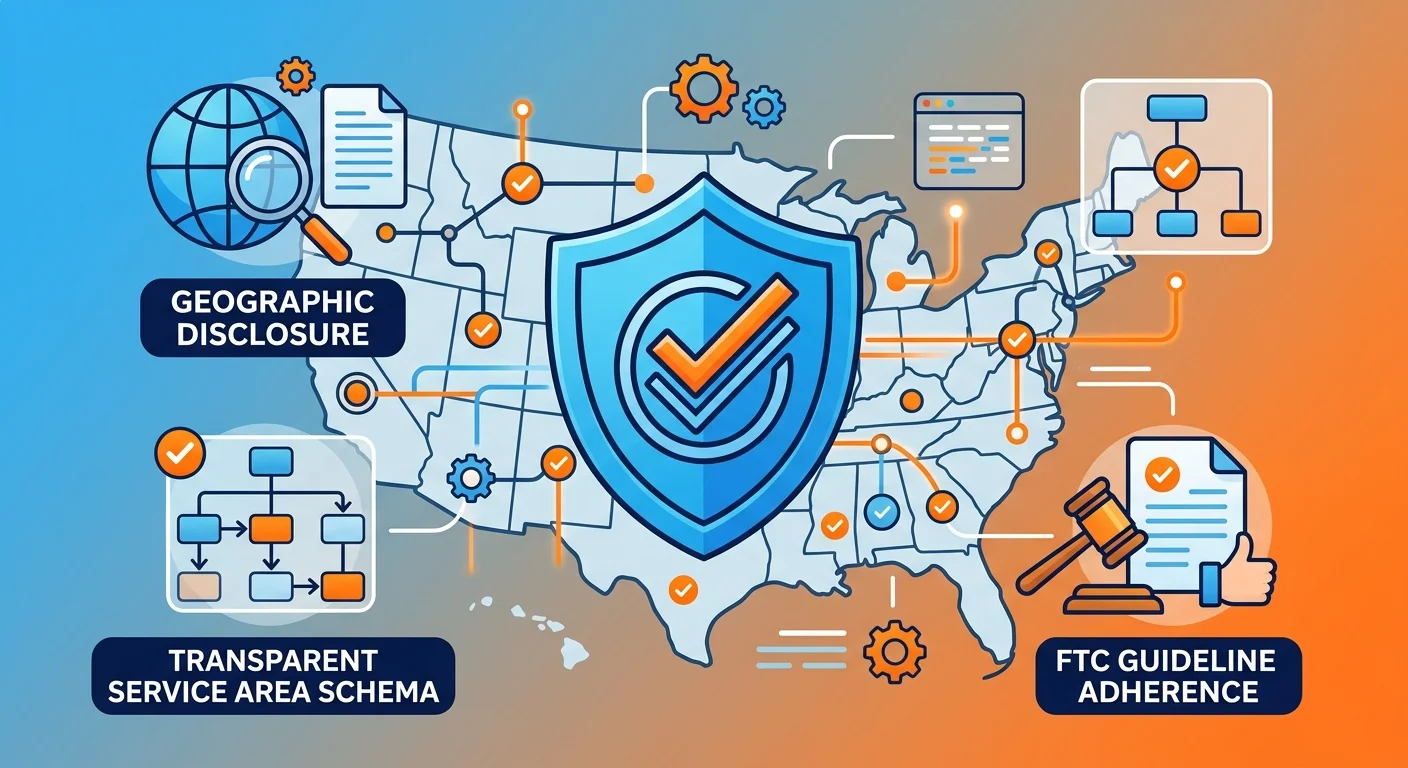
Going national isn’t just a schema decision. It’s a compliance decision. And most practices don’t see the exposure until they’re already inside it.
The FTC guidelines are direct on this: projecting national reach while your infrastructure still signals a single-location operation isn’t just a positioning gap. It’s a deceptive practices problem. Brands that claim national authority without the entity architecture to back it up can run afoul of federal advertising law. That’s not a hypothetical.
So you do both moves at once. Strip the geographic constraints from your infrastructure. Make sure your public-facing claims about reach match what you’ve actually built. Compliance and trust aren’t separate workstreams. They’re the same move.
Geographic Disclosure Requirements for National Digital Claims
Here’s what catches most practices off guard. The FTC doesn’t just care about your ad copy. It cares about what your entire digital presence communicates – schema markup, service-area declarations, the geographic framing baked into your core content. All of it counts.
If your structured data still declares a single service area but your homepage copy claims national reach, that’s a discrepancy. The FTC mandates that geographic constraints be disclosed clearly in digital environments – so consumers aren’t misled about where a company actually operates. An AI engine and a federal regulator will catch the same mismatch. Transparent architecture isn’t a best practice. It’s the baseline.
This is where the content strategy shift pays off beyond AI recommendations. When you adjust how your AEO content addresses national versus local audience intent, you’re not just optimizing for a different recommendation trigger. You’re aligning your public claims with the infrastructure you’ve actually built. That alignment is what keeps you on the right side of both AI engines and federal advertising law.
How Transparent Entity Architecture Builds AI Trust and Regulatory Safety Simultaneously
Here’s why transparent entity architecture solves two problems at once. When your schema, your content, and your service-area declarations all say the same thing – national operation, documented methodology, verifiable authority – AI engines trust the signal. And regulators have nothing to challenge. That consistency isn’t a branding preference. It’s structural proof that your claims match your infrastructure.
A local-only infrastructure isn’t just an AI visibility problem. It’s a credibility gap your entire digital presence is advertising. Strip it cleanly. Rebuild with accurate national entity signals. The compliance layer takes care of itself. The model recommends you. The FTC has nothing to flag. Your authority stops being anchored to a city.
| Compliance Requirement | What It Prohibits | What It Requires | AEO Infrastructure Alignment |
|---|---|---|---|
| Geographic Representation Accuracy | Claiming national reach while infrastructure signals a single-location operation | Schema, service-area declarations, and content must all reflect the same geographic scope | National entity schema must be built before national claims appear anywhere in public-facing content |
| Service Area Disclosure | Omitting or obscuring the actual geographic limits of your services | Clear, consistent disclosure of where and how your services operate | Service-area markup in structured data must match what your AEO content and homepage copy state |
| Advertising Claim Alignment | Running digital advertising that implies broader reach than your infrastructure supports | All paid and organic claims about scope must be backed by verifiable entity architecture | Entity authority signals – schema, structured identifiers, platform consistency – must exist before claims are published |
| Structured Data Consistency | Schema markup that contradicts public-facing copy about service scope or methodology | Every layer of your digital architecture must communicate the same message about who you are and where you operate | Organization schema, author markup, and methodology-level structured data must be internally consistent and nationally scoped |
| Consumer-Facing Transparency | Creating the impression of a nationally established brand without the operational infrastructure to support it | Public presence must accurately represent actual capabilities, scope, and methodology | Protocol-level AEO content documents genuine expertise – it doesn’t perform it; transparent authority is the compliance baseline |
| Cross-Platform Signal Integrity | Allowing entity descriptions, service-area language, or methodology framing to vary across platforms | Consistent entity language across every information environment where your brand appears | Citation velocity depends on signal consistency – what you claim nationally must read the same way on every platform an AI engine or regulator checks |
Frequently Asked Questions
Here’s what the agency pitching you this work won’t answer: the questions that actually determine whether this move makes sense for your practice.
So let’s run them.
How do conversational AI engines determine geographic versus national authority for a healthcare brand?
AI engines don’t search by radius. They match entities to queries using trust signals – structured schema, cross-platform entity consistency, and protocol-level content that proves genuine domain authority.
A healthcare brand with clean national schema and documented methodology gets recommended nationally. One with location-locked schema gets filtered into local results – even if the clinical authority behind it is exceptional.
Geography is a field in the database. Authority is the signal that overrides it.
Why does traditional local SEO fail when a practice tries to transition to a national AI recommendation footprint?
Traditional local SEO wins by being the closest result. Proximity signals, service-area declarations, city-tagged content – the whole game is map-pack dominance.
AI recommendation models don’t rank by proximity. They surface by entity trust. Every local signal you’ve built anchors your entity to a geography. That anchor doesn’t disappear when you decide to go national. It becomes a filter.
You’re not building on that local foundation when you make this move. You’re fighting it.
What specific schema markups signal to ChatGPT and Gemini that your brand is decoupled from a single physical location?
The critical shifts: areaServed set to national scope instead of a single city, serviceType structured around methodology rather than location, and @type declarations that frame your entity as a professional service authority – not a local business.
Consistent name, url, and sameAs identifiers across every structured data instance reinforce cross-platform entity resolution. The model needs to find the same entity everywhere it looks.
The schema doesn’t announce national authority. It removes the geographic constraint that was filtering you out.
Will removing local geographic tags from my digital infrastructure harm my existing Google Maps pack visibility?
It can – if you strip local signals without replacing them correctly. Google Maps pack visibility runs on proximity and local entity signals. Remove local schema without maintaining a properly structured local presence, and you risk losing map-pack placement.
The right move isn’t erasure. It’s layering.
National entity schema handles AI recommendation authority. A distinct, maintained local presence handles map-based discovery. Both can coexist – but only if you build them as separate, intentional layers instead of trying to serve both with one signal.
How long does it take for AI model indexes to shift recommendation trust from a physical location to a national authority model?
Anyone who gives you a fixed timeline is guessing. Don’t buy it.
What’s documented: AI model indexes update as new structured data and cross-platform entity signals accumulate. The shift isn’t a switch flip. It’s a compounding process.
Practices that build consistently – clean schema, citation velocity, protocol-level AEO content – see recommendation trust deepen over time. Practices that build once and stop see it stall. The variable isn’t time. It’s execution consistency.
Can a single-location practice realistically compete for national AI recommendations against multi-location brands?
Yes. And this is where most single-location practices underestimate themselves.
Multi-location brands have physical scale. They don’t automatically have methodology authority or entity trust. AI engines aren’t counting your offices – they’re reading your structured data, your citation consistency, and the depth of your protocol-level content.
A single-location practice with clean national entity schema and documented clinical methodology can absolutely earn AI recommendations against a brand with ten locations and shallow authority infrastructure. Scale doesn’t win here. Structure does.
The Bottom Line on Geographic Decoupling
Here’s the whole thing in one sentence.
Your physical location is not what’s holding you back. Your infrastructure is.
The zip code doesn’t measure your clinical expertise. It doesn’t reflect your protocols or your outcomes. But if your schema is still broadcasting local-only signals, that’s the only data AI engines have. And they’ll filter you out of every national recommendation – before anyone even finishes typing the question.
Every change this article covers is really one move.
Strip the geographic anchors. Rebuild with national entity signals. Align your content to protocol-level authority. Get your citations consistent across every platform that matters. That’s not five projects. That’s one constraint, removed five different ways.
The model isn’t complicated. Remove what’s excluding you – and the recommendation follows.
So here’s the binary.
You either remove the constraint from your entity architecture – or you stay filtered out. AI engines don’t reward proximity. They reward entity trust. Build it, and the recommendation follows. Don’t, and your competitor’s name keeps appearing where yours should.
A zip code is a database constraint – not an authority ceiling.
Here’s the thing: you don’t know if your infrastructure is filtering you out of national AI recommendations right now. That’s the problem. And it’s the first question worth answering.