Why Multi-Location Clinics Are Invisible to AI in 2026
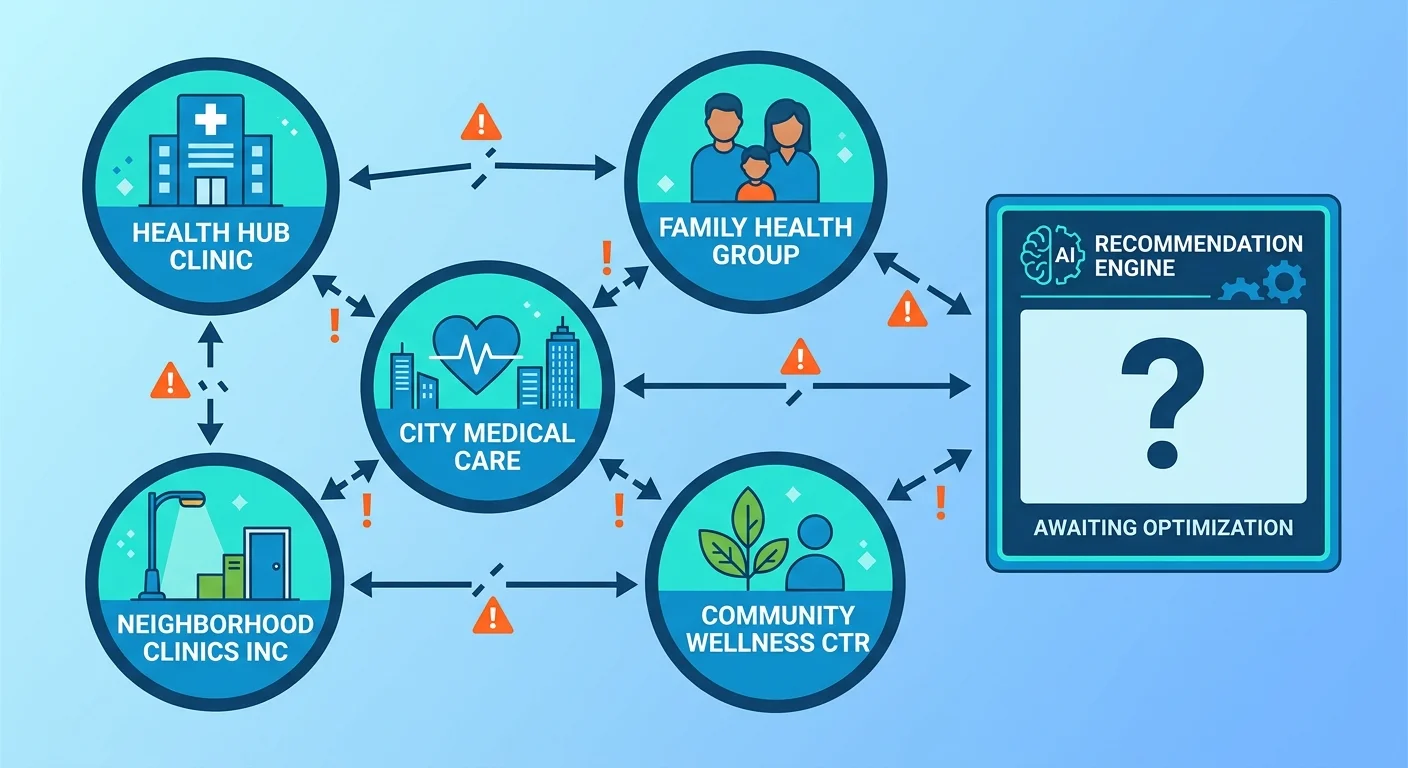
Multi-location clinics aren’t invisible to AI because they lack content.
They’re invisible because AI can’t confirm who they are.
Over 72% of internet users search for health information online. 77% of those searches start at a search engine. That was already a big number. But in 2026, the search doesn’t end with a list of ten results.
It ends with a verdict. One name. The practice an AI engine can validate as a coherent, trustworthy entity across multiple independent data sources. If that’s not you – you don’t place second. You don’t place at all.
Here’s the picture. A group practice with five locations but five different names in five different directories isn’t a system. It’s five solo practices sharing a logo.
AI engines don’t resolve that ambiguity in your favor. They skip it. Entity mismatches across localized digital lookup systems lead directly to referral leakage – the engine moves on to a practice whose identity holds up under cross-registry validation. Yours gets filtered out before the response is even assembled.
How AI Engines Decide Who Gets Recommended
Here’s how AI engines actually decide who to recommend.
Entity validation. Not keyword matching.
When a patient asks ChatGPT who the best orthopedic group in their region is, the engine cross-references structured data from national directories, review platforms, and public health registries. It’s hunting for signal consistency – a provider name, address, specialization, and affiliation that matches cleanly across every source it checks.
The challenge of scaling entity trust without sacrificing location identity is exactly why this breaks at scale. A system that looks like five separate practices to an AI engine is, for all practical purposes, five separate practices.
The practices that resolve cleanly get recommended. That’s it. That’s the whole decision tree.
The ones that don’t get filtered out before the AI even assembles its response. No ranking. No runner-up. No ‘close enough.’ Just absent.
The Fragmented Entity Problem Hiding in Plain Sight
So where does the fragmentation come from?
For most multi-location practices, it’s already baked into how they grew.
Think about how most group practices actually expand. One location becomes three, then five, over a few years. Each new location gets onboarded separately – different intake vendor, different Google Business Profile set up by a different office manager, different directory listings built by whoever had the login that week.
The result is a patchwork identity. Slight name variations. Mismatched suite numbers. Specializations listed differently across platforms. To a human reading each profile one at a time, it looks fine. But published research on provider selection confirms what the data shows – regional provider name drift disrupts direct clinical lookup matches, and the engine moves on.
And here’s the thing – this isn’t an edge case. It’s the default state for almost every multi-location practice that scaled organically.
The National AI Authority Engine exists specifically to dismantle it. The architecture to validate clinical authority at scale already exists inside national directory infrastructure. The question is whether your practice’s data meets that standard – or whether you’re still five disconnected nodes that AI engines cannot recognize as one.
| AI Engine | Primary Trust Signal Used | Impact of Entity Mismatch | Visibility Outcome |
|---|---|---|---|
| ChatGPT | Cross-registry entity consistency – name, address, specialization, and affiliation must match cleanly across national directories and public health databases | Mismatched location names or inconsistent specialization listings trigger entity ambiguity – the engine cannot confirm a single coherent provider identity | Practice is excluded from the recommended answer entirely; no ranking, no runner-up, simply absent from the response |
| Gemini | Structured schema data and Knowledge Graph coherence – the engine validates entity signals against Google’s own indexed data layers and public registry sources | Conflicting suite numbers, duplicate profiles, or schema gaps across locations fracture the entity signal – Gemini cannot resolve which version of the practice is authoritative | Competitor with clean, unified schema architecture captures the recommendation; fragmented practice remains invisible regardless of content volume |
| Grok | Real-time data validation against live public sources – the engine cross-references social signals, directory listings, and current review platform data simultaneously | Entity drift across platforms (slight name variations, outdated affiliations, inconsistent hours) produces conflicting signals that Grok reads as low-trust or unverifiable | Practice is deprioritized in favor of providers whose entity data resolves consistently across every live source the engine touches |
| Perplexity | Citation-forward sourcing – the engine pulls from authoritative directories, review platforms, and structured health databases, then surfaces the source alongside the recommendation | If a practice appears differently across Zocdoc, Healthgrades, and public licensure boards, Perplexity cannot confidently attribute the recommendation to a single validated entity | Recommendation goes to a competitor whose directory presence is uniform and citable; the fragmented practice loses the citation before it ever enters the response |
Why the Regional SEO Silo Model Fails Multi-Site Clinics
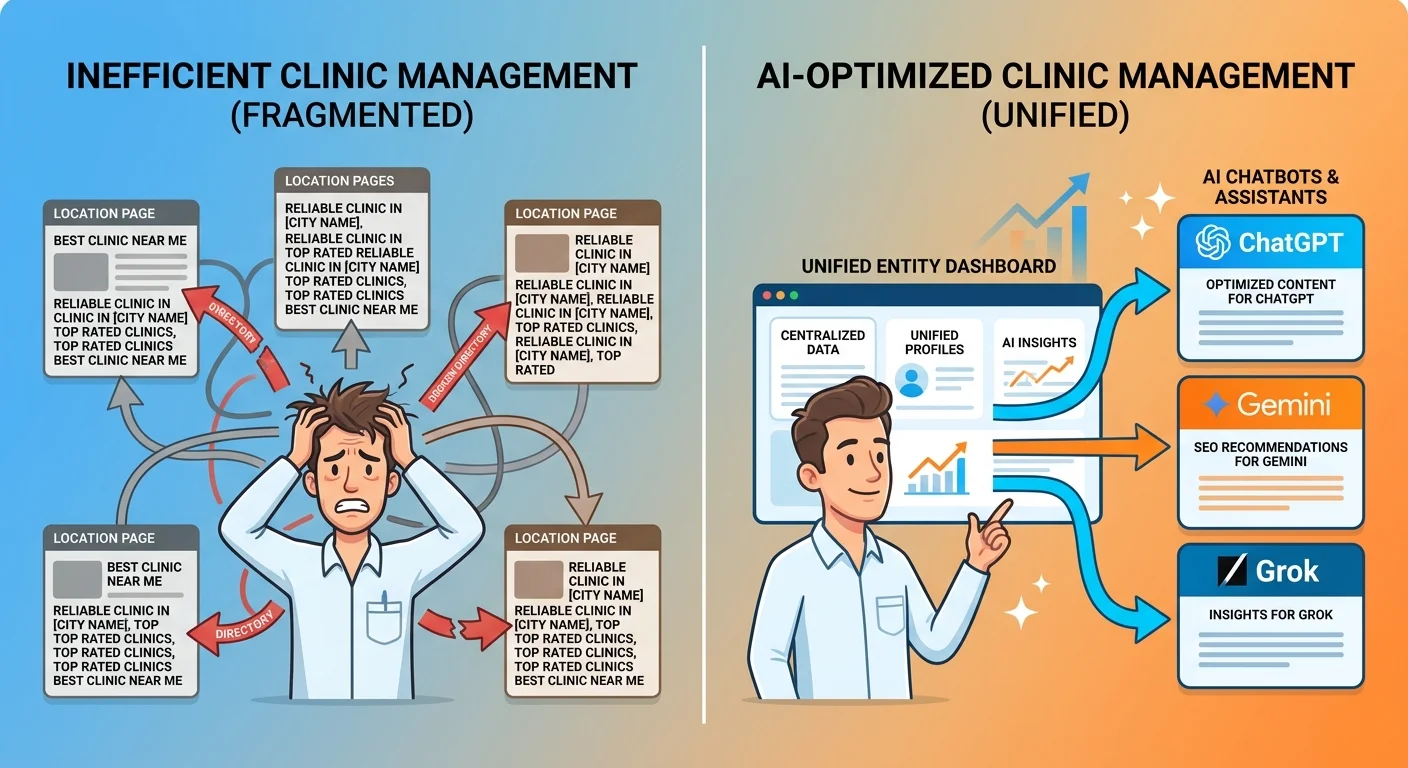
This isn’t bad luck. It’s a methodology the marketing industry sold as the right answer – and charged good money for.
Here’s how it works. Each clinic location gets its own isolated directory listings, its own localized keyword pages, its own Google Business Profile – managed independently from every other location in the group.
The agency calls it a multi-location strategy. What it actually produces is five separate digital identities that happen to share a logo.
That model was imperfect but survivable when search engines returned ranked lists and humans did the disambiguation. It breaks completely when the entity doing the lookup is an AI engine running cross-registry validation.
And the gap isn’t minor. Calculating the return on a national entity strategy makes the stakes explicit: this is the difference between existing in AI responses and being structurally excluded from them.
Why Traditional SEO Fails Multi-Location Healthcare in 2026
Here’s what traditional keyword strategy was actually built for. A patient typed a query. Got a list. Clicked through. Compared options. That chain worked.
That chain is breaking – fast – for healthcare searches.
Regional keyword strategy optimizes for a ranked list that AI engines increasingly skip entirely. McKinsey pegs generative AI’s value potential in US healthcare at $200 billion to $360 billion – but that pipeline runs on structured directory data. Practices that don’t meet that standard get filtered out before the AI even assembles its response.
No keyword density fixes that. The AI engine doesn’t drop you in its ranking. It removes you from its consideration set before the ranking question ever comes up.
Regional provider name drift is what actually pulls the trigger. And it’s more common than most operators realize.
A practice listed as "Lakeside Orthopedic Group" at one location, "Lakeside Ortho & Sports Medicine" at a second, and "Lakeside Orthopedics, LLC" at a third is – in the data model AI engines use – three unrelated entities. No algorithm resolves that ambiguity in your favor. The engine moves to the competitor whose identity holds up cleanly across every source it checks.
The silo model doesn’t just fail to build authority. It erodes the authority the practice already earned.
Every inconsistency is a trust discount. And in a system where generative AI depends on standardized entity inputs to prevent translation drift, fragmentation isn’t a manageable liability. It’s a disqualifier.
Who This Playbook Is Not For
This playbook is not for everyone. That’s not a disclaimer. It’s a filter.
Single-location practices with no near-term expansion plans – this isn’t your next move. The methodology here is built for multi-site systems: groups already operating across more than one location, or practices actively planning that expansion inside a defined window.
Entity Unification, Schema Architecture, Citation Velocity, Semantic Density – these are engineered for that scale. Running them on a standalone practice is overhead with no proportional return.
Want results in 60 days? Wrong playbook. Need a guarantee before you’ll move? Also wrong playbook.
And if your current agency is handing you keyword ranking reports as the primary success metric – you’re not in the right conversation yet. The AI engines making patient recommendations right now don’t operate on keyword lists.
The practices this is built for already sense something structurally changed. They just haven’t had the architecture to respond to it. That’s what this is.
| Regional SEO Silo Approach | National Entity Architecture Approach | AI Engine Outcome |
|---|---|---|
| Each location gets its own isolated directory listings, built and managed independently with no coordination across the group | All locations operate under a single unified entity profile – one canonical identity synchronized across every national directory and registry | AI engine encounters conflicting name variations and treats each location as an unrelated provider – practice is excluded from cross-registry validation |
| Google Business Profiles created separately by different office staff, producing mismatched suite numbers, phone formats, and specialization labels | Schema Architecture standardizes structured data across every location – address format, specialization taxonomy, and affiliation signals are locked and consistent | AI engine finds signal inconsistency during entity validation and moves to a competitor whose identity resolves cleanly across every source it touches |
| Localized keyword pages built for each location with no shared entity architecture – optimized for a ranked list that AI engines increasingly bypass | Citation Velocity builds a coordinated citation footprint that reinforces one group identity across independent national platforms simultaneously | AI engine rewards the practice with the highest signal consistency – not the highest keyword density – and returns it as the single recommended verdict |
| Authority compounds per location in isolation – a strong profile at Location 1 contributes nothing to the entity trust of Locations 2 through 5 | Semantic Density layers condition-specific, specialization-level content under one recognized clinical entity, compounding authority across the entire group | AI engine recognizes a coherent, machine-readable system and recommends the group – not a single location, and not a competitor who filled the vacuum |
The Four Pillars of National Entity Architecture
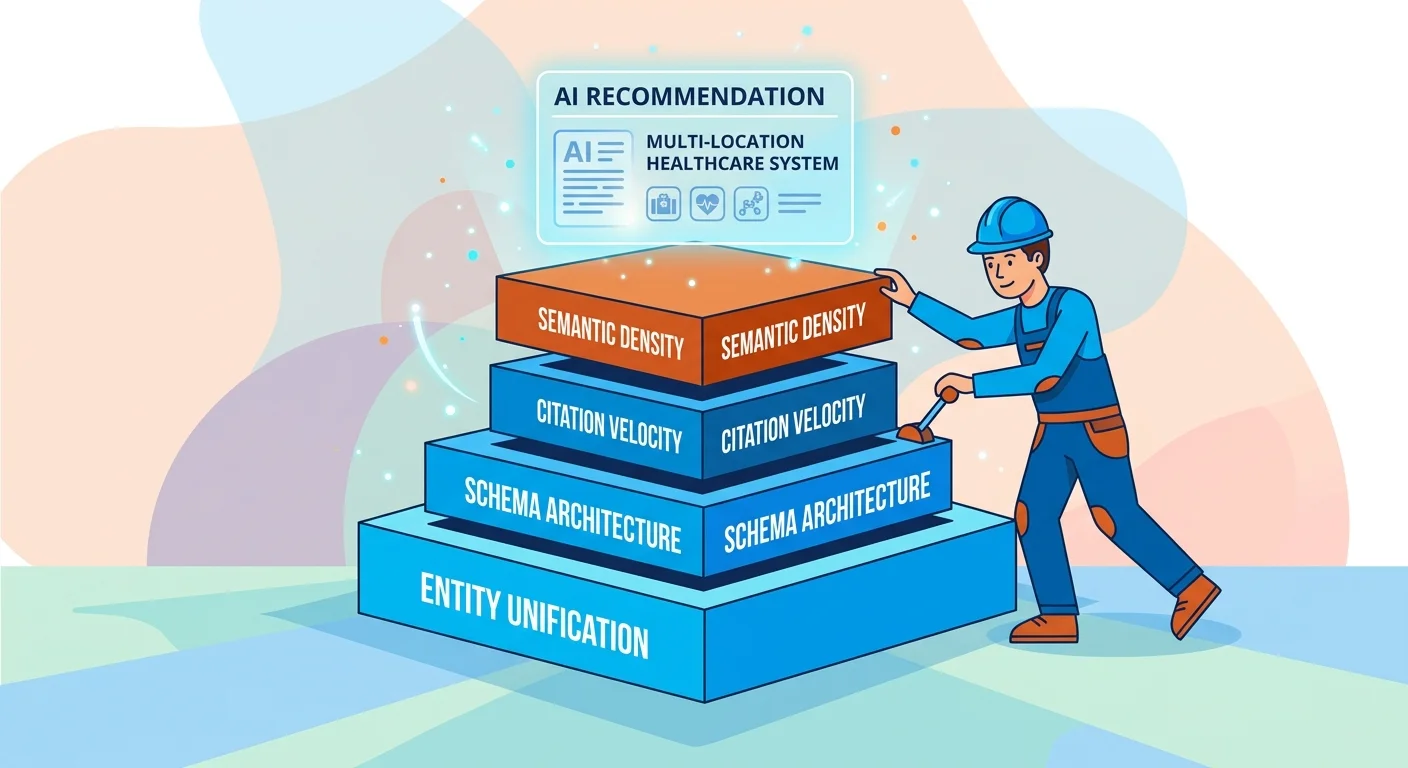
Four pillars. That’s the whole system.
Entity Unification, Schema Architecture, Citation Velocity, and Semantic Density – these aren’t marketing categories. They’re the structural requirements AI engines use to recognize a multi-location healthcare system as one trusted clinical entity.
McKinsey puts the value of generative AI integration in US healthcare between $200 billion and $360 billion. But that pipeline runs on one thing: standardized entity inputs.
Without highly structured directory data, the system experiences translation drift – and the clinical entity falls out of the recommendation set entirely.
The four pillars exist to make sure your system never falls out.
Each pillar is sequential. You can’t build Citation Velocity on a fragmented identity. You can’t build Semantic Density on unstructured schema.
The architecture compounds. The order matters as much as the execution.
Pillar 1: Entity Unification – One Identity Across Every Registry
Entity Unification is the foundation. Not a starting point – the foundation.
Crack it, and everything built on top is compromised before a single AI engine ever reads your name.
One name. One address format. One specialization taxonomy. One affiliation structure – consistent across every national directory, public health registry, and review platform your system touches.
Structured healthcare CRMs depend on centralized provider identity directories to synchronize public and private registry data across health networks. Lookup precision is tied directly to standardization on external endpoints.
If your data isn’t consistent at the source, no downstream system can resolve it cleanly. The engine doesn’t guess. It moves on.
Get this right and those five disconnected nodes collapse into one machine-readable signal.
The AI engine stops seeing five solo practices sharing a logo. It starts seeing one clinical system with five verified locations.
That’s the shift. Everything downstream depends on it.
Pillar 2: Schema Architecture – Making Your System Machine-Readable
Schema Architecture takes a unified identity and translates it into something AI engines can actually read.
Structured data markup – applied systematically across every location page in your authority infrastructure – tells the engine exactly what your system is, where it operates, what it treats, and how its locations relate to each other.
Without it, your unified identity is still invisible to the machines doing the validation.
Most practices have no schema at all. The ones that do have it applied inconsistently – different schema types, incomplete fields, no parent-child relationship declared between the system entity and its individual locations.
That’s not a minor gap. To an AI engine running entity validation, an incomplete schema reads the same as no schema.
The engine cannot confirm what it cannot read. So it doesn’t.
Schema Architecture is also where scale stops being an advantage.
The engine doesn’t favor large systems. It favors clarity. Which means solo and small-group practitioners who deploy structured schema correctly can establish machine-readable authority that competes directly with systems ten times their size.
Structured beats big. Every time.
Pillar 3: Citation Velocity – How AI Learns to Trust Your Network
Here’s how AI engines learn to trust your network: repetition across independent sources.
One directory listing is a data point. Consistent, validated mentions of your system’s identity across dozens of national platforms – clinical directories, review networks, public health registries, accreditation databases – is a pattern.
AI engines are pattern-recognition systems. They trust patterns. That’s Citation Velocity.
Lookup precision is tied to standardization on external endpoints – and those endpoints need to reinforce each other.
A practice validated in one directory and absent from six others sends a weak signal. A practice validated consistently across a broad network of authoritative sources sends a signal the engine weights heavily when assembling a recommendation.
Breadth matters. Consistency matters more.
Here’s what most multi-location groups miss: Citation Velocity isn’t about volume. It’s about consistency at scale.
A hundred inconsistent citations are worse than twenty clean ones. Every mismatched entry undermines the pattern the engine is trying to confirm.
The architecture has to be right before the velocity can build.
Pillar 4: Semantic Density – Teaching AI What Your System Does
So far, you’ve told the engine who you are, how you’re structured, and that independent sources agree. Semantic Density is the fourth piece – it tells the engine why you’re the authoritative answer for a specific set of clinical needs in a specific geography.
That’s what closes the loop. All four pillars together.
Semantic Density is built through AI Authority content – articles, topic clusters, and structured content assets that reinforce the clinical specializations, geographic coverage, and service categories your system owns.
The content doesn’t chase keywords. It maps the semantic territory AI engines use to classify clinical expertise and match it to patient queries.
That’s a fundamentally different assignment than what most agencies are producing – and most of them don’t know the difference.
When all four pillars are in place, you stop being five practices sharing a logo. You become one recognized clinical system – unified identity, machine-readable structure, validated citation network, semantic authority in the categories that drive patient recommendations.
That’s what AI engines recommend.
Not the biggest system. The clearest one.
| Pillar | What It Controls | What Breaks Without It | Execution Priority |
|---|---|---|---|
| Entity Unification | How AI engines identify your system across every external registry and directory | AI treats each location as a separate, unrelated entity – no cross-registry validation is possible, and the system is excluded from recommendation sets before scoring even begins | First – the foundation every other pillar builds on; nothing downstream functions without it |
| Schema Architecture | How AI engines read and classify your system’s structure, specializations, and location relationships | The engine cannot confirm what it cannot read – incomplete or absent structured data markup is functionally identical to no schema, leaving the system unclassifiable | Second – deployed after identity is unified; converts that unified identity into a machine-readable format AI engines actively parse |
| Citation Velocity | How AI engines learn to trust your system’s identity through independent, cross-platform validation | A single validated source is a data point, not a pattern – without consistent reinforcement across authoritative national platforms, the trust signal is too weak to weight in a recommendation | Third – built after schema is in place; requires structural accuracy before volume has any compounding effect |
| Semantic Density | How AI engines classify your system’s clinical expertise and match it to specific patient queries | Without mapped semantic territory, the engine has no basis to recommend your system for specific clinical needs – authority without context produces generic, low-confidence recommendations | Fourth – the compounding layer; requires the first three pillars to be structurally sound before content authority can accumulate meaningfully |
Building the National AI Authority Engine: Infrastructure Before Content
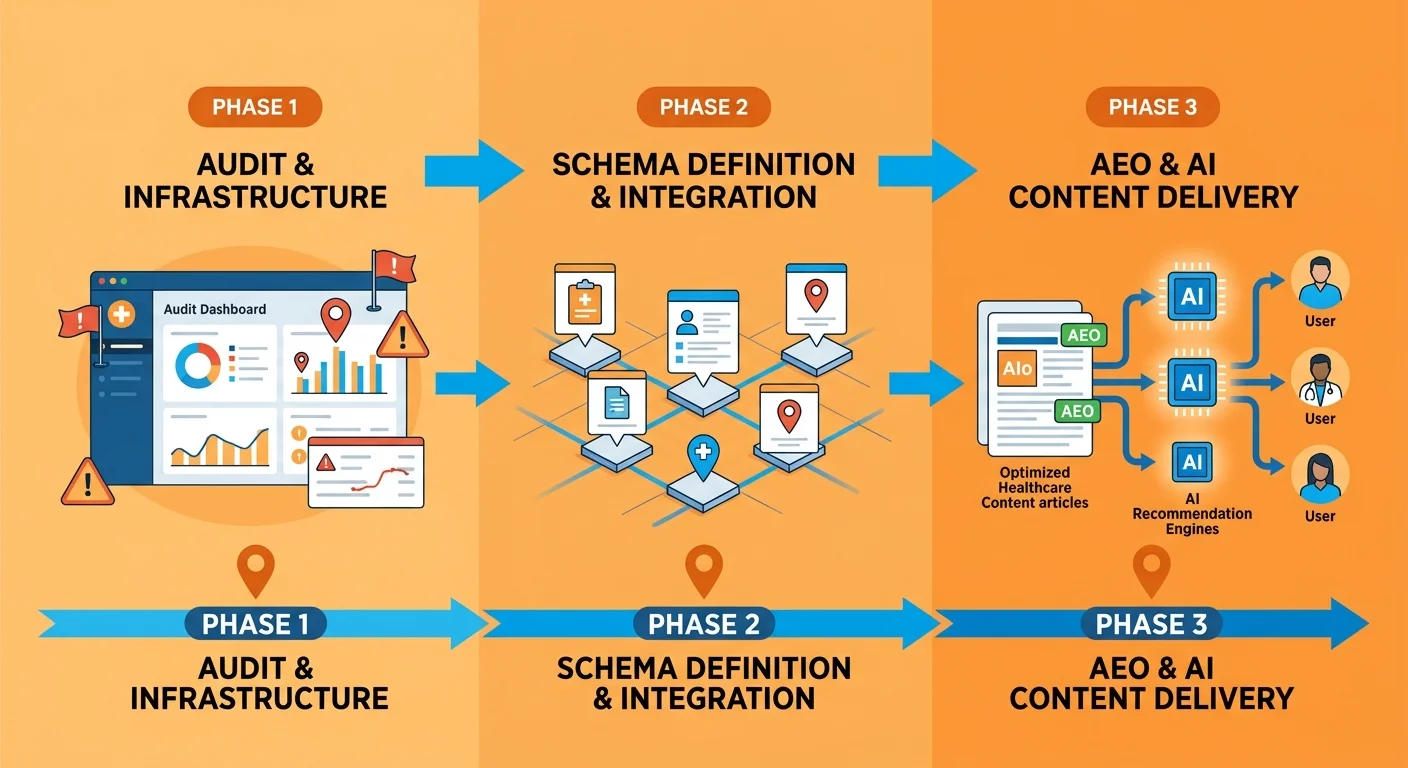
Understanding the pillars is table stakes. Building the National AI Authority Engine is where clinics either get it right or waste the next 18 months.
And the sequence matters. Not as a preference. As a hard constraint.
Here’s the mistake I see constantly with multi-location groups: they start with content.
They hire a writer, build out a blog calendar, and publish 20 articles – all before the infrastructure exists to support any of it. AI Authority content built on a fragmented entity foundation doesn’t compound. It disappears. The engine can’t attribute that content to a coherent clinical system because the system hasn’t been made machine-readable yet.
Content without infrastructure is noise. Expensive, time-consuming noise.
The build sequence doesn’t move. Entity audit first. Schema deployment and directory synchronization second. AEO content execution third.
Skip a phase and you don’t accelerate results – you guarantee structural failure. Each phase unlocks the next. That’s not a suggestion.
Phase 1 – Centralized Entity Audit Across All Locations
You can’t fix what you haven’t mapped. Phase 1 starts with brutal honesty about the current state.
That means pulling every directory listing, every public health registry entry, every review platform profile, and every accreditation database record – across all locations – then stacking them against a single master identity record.
Name variants surface. Address formats conflict. Phone numbers don’t match. Specialization taxonomies get inconsistent. All of it comes out.
The shift from a fragmented local footprint to a unified national presence begins at the level of Knowledge Graph entity resolution – where every data point either confirms the entity or contradicts it. There’s no middle ground.
The audit output is a gap map. Every inconsistency documented. Prioritized by the authority weight of the platform carrying it.
High-authority clinical directories and public health registries go to the top of the queue. Nothing moves to Phase 2 until that queue is resolved.
Here’s the part most clinics miss: every unresolved discrepancy isn’t a backlog item. It’s an active liability. The AI engine uses those contradictions to discount your system’s trust signal – and it does it automatically, at query time, every time.
Phase 2 – Schema Deployment and Directory Synchronization
Phase 1 unified the entity at the data level. Phase 2 makes it machine-readable.
Schema Architecture translates that unified identity into structured markup – the format AI engines parse at scale when they’re deciding who to recommend.
This isn’t a one-page schema job. Every location in the system gets its own structured data deployment – with a parent organization entity sitting above it and explicit relationship declarations connecting each location to the network.
That parent-child hierarchy is what tells the engine this isn’t a collection of independent practices. It’s a system. And the engine doesn’t infer that from shared branding or geographic proximity.
If you don’t declare the hierarchy explicitly in structured markup, the engine doesn’t see it. It sees five solo practices. Which is exactly the problem Phase 2 is designed to fix.
Directory synchronization runs concurrently. The unified identity from Phase 1 gets pushed to every authoritative external endpoint – clinical directories, review networks, accreditation databases, public health registries – with consistent formatting, consistent categorization, and consistent affiliation structure across all of them.
Lookup precision lives or dies on that standardization. Not as a best practice. As the operational requirement for staying inside the engine’s recommendation set.
The AEO validation results confirm what the data predicts: practices that complete full directory synchronization see measurably stronger entity resolution across every platform the engine queries.
Phase 3 – AEO Content Execution at the Network Level
Infrastructure is ready. Now the content does its job.
And it’s a different job than most clinics expect.
AI Authority content at the network level isn’t about generating volume. It’s about claiming semantic territory.
Every content asset is engineered to reinforce a specific clinical specialization, geographic coverage area, or service category the system owns – and to connect that coverage explicitly to the unified entity built in Phases 1 and 2.
The content doesn’t chase queries. It builds the semantic surface area AI engines use to classify clinical expertise and match it against patient intent. That’s a different objective than anything a traditional content calendar is designed to accomplish.
This is where the transformation completes.
Five disconnected locations – operating under five inconsistent identities, five siloed content strategies, five uncoordinated citation footprints – collapse into one recognized clinical system. Unified entity. Structured schema hierarchy. Validated citation network. Semantic authority in the categories that drive patient recommendations.
Five locations, one identity – or five practices sharing a logo. When all three phases execute in sequence, that choice gets made for you. The engine doesn’t see five solo practices. It sees one system. And that’s the system it recommends.
| Build Phase | Core Action | Deliverable | AI Trust Signal Generated |
|---|---|---|---|
| Phase 1 – Entity Audit | Pull every directory listing, registry entry, review profile, and accreditation record across all locations and compare against a single master identity record | Centralized gap map documenting every name variant, address discrepancy, phone mismatch, and taxonomy inconsistency prioritized by platform authority weight | AI engine recognizes a single, consistent clinical entity across independent data sources – no conflicting signals, no identity fragmentation |
| Phase 2A – Schema Architecture | Deploy structured markup at every location with a parent organization entity sitting above each site and explicit relationship declarations connecting each location to the network | Parent-child schema hierarchy with complete field coverage, consistent taxonomy, and declared affiliation structure across the full system | AI engine can parse the system as one unified clinical network – not a collection of independent practices sharing a logo |
| Phase 2B – Directory Synchronization | Push the unified identity to every authoritative external endpoint – clinical directories, review networks, accreditation databases, and public health registries – with consistent formatting and affiliation structure | Validated, uniform system identity across all high-authority external platforms | Independent sources reinforce each other – the citation pattern the AI engine needs to weight the system’s recommendation heavily |
| Phase 3 – AI Authority Content Execution | Engineer content assets that reinforce specific clinical specializations, geographic coverage areas, and service categories – each connected explicitly to the unified entity established in Phases 1 and 2 | Topic clusters and structured content assets mapped to the semantic territory the system owns | AI engine classifies the clinical system as the authoritative answer for specific categories of patient intent across the defined geography |
Directory Integrity and Compliance at Scale
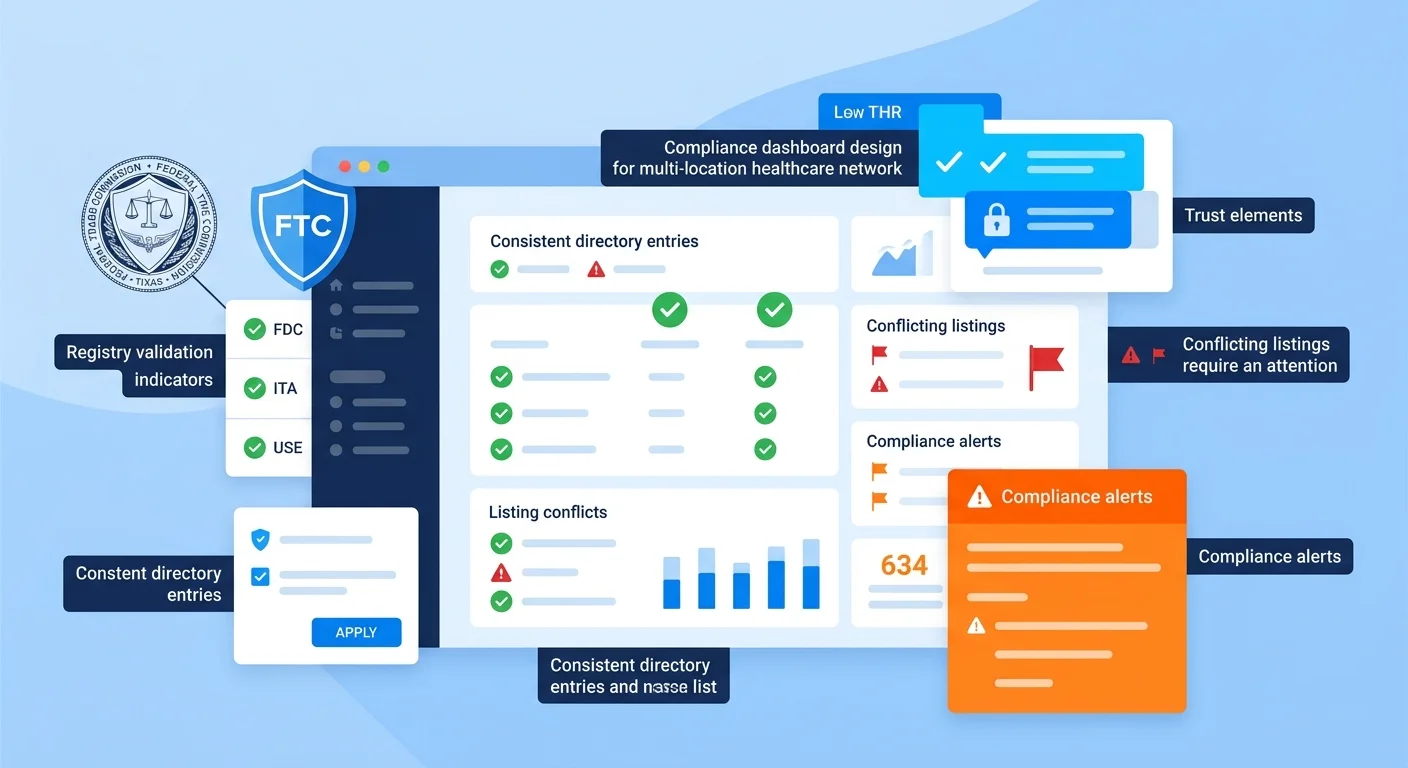
Infrastructure gets you in the room.
It doesn’t keep you there. The directories feeding AI engines have to meet accuracy standards AND regulatory standards. Miss one, and the system leaks authority the moment a patient query triggers cross-registry validation.
Most multi-location groups treat directory integrity as a one-time cleanup project.
It isn’t. CDC guidelines confirm that health information exchanges are bound by administrative and statutory directory protocols specifically designed to enforce registry integrity and prevent entity fragmentation. That’s not a recommendation. That’s the operating standard every AI engine queries against when it’s deciding which clinical system to trust.
Compliance isn’t a separate workstream. It’s baked into the authority signal itself.
Clean registry data produces a clean entity signal. Dirty data doesn’t trigger an error message – the engine just routes the recommendation to whoever has cleaner data.
Why Conflicting Listings Across Locations Destroy AI Authority
Five locations. Five different names in five different directories. That’s not a system – that’s five solo practices sharing a logo.
AI engines don’t recommend logos. They recommend entities they can validate across independent sources. If the entity can’t be confirmed, it doesn’t get named.
Name variants. Mismatched phone numbers. Inconsistent address formatting. Conflicting specialization taxonomies. None of that just confuses patients – it fractures the entity signal the engine is trying to confirm across platforms.
And the old playbook made it worse. The city-specific landing page approach pushed each location into its own siloed identity instead of reinforcing a unified system. More pages, more fragmentation, less authority. Every location you added made the problem harder to solve.
Public health statutes require network listings to validate against state licensure registry boards. That validation process is exactly what AI engines replicate when they run entity confirmation across platforms.
A listing that contradicts the licensure registry doesn’t just fail the compliance check – it tanks the engine’s confidence in the entire network. Not just that location. The whole system.
One bad entry poisons the pattern.
FTC and Regulatory Compliance in Multi-Location Review Profiles
Most multi-location groups have never thought seriously about review profiles as a compliance surface. That’s a mistake.
FTC endorsement guidelines prohibit deceptive formatting of consumer reviews and mandate disclosure of material connections between endorsers and health sellers. For a clinical network across multiple locations, that means every location’s review profile must meet the same formatting and disclosure standards – consistently, not selectively. One location handling it correctly doesn’t protect the network.
One non-compliant location is a liability. Five locations with inconsistent review formatting across five platforms is a pattern.
Regulators recognize patterns. So do AI engines. A clinical network that signals internal inconsistency in its public-facing review data hands the engine a concrete reason to route the recommendation somewhere else.
Gerek Allen’s methodology treats regulatory compliance as an authority signal – not a legal checkbox to hand off to a paralegal.
When review profiles are formatted consistently, disclosures are applied correctly, and every location’s public record reflects the same standards, the engine reads coherence. Coherence is trust. And trust is what converts a fragmented franchise into the system AI engines recommend without hesitation.
| Directory Signal Type | AI Engine Interpretation | Compliance Requirement | Risk If Ignored |
|---|---|---|---|
| Consistent NAP across all locations | Confirms a unified, trustworthy clinical entity across independent registry sources | Name, address, and phone must match exactly across every authoritative directory and public health registry | Entity fragmentation – AI engine cannot confirm the network exists as a single system and routes recommendations elsewhere |
| Review profile formatting and disclosure | Signals internal coherence and regulatory alignment across the clinical network | FTC endorsement guidelines require consistent formatting and mandatory disclosure of material connections on all consumer-facing review profiles | Compliance exposure across multiple locations; AI engine reads inconsistency as a credibility signal against the network |
| State licensure registry alignment | Validates that each location’s public record matches the authoritative legal identity on file with regulatory boards | Network listings must validate against state licensure registry boards per statutory directory protocols | One mismatched listing undermines confidence in the entire network – a single bad entry poisons the entity pattern |
| Specialization taxonomy consistency | Allows AI engines to classify clinical expertise and match it accurately to patient intent across all locations | Every location must use the same structured specialization categories across clinical directories and accreditation databases | Conflicting taxonomies fracture the semantic surface area the engine uses to categorize and recommend the system |
| Parent-child affiliation declarations in directories | Signals that individual locations belong to a recognized clinical system rather than operating as independent practices | Affiliation structure must be explicitly declared and consistent across all external directory endpoints | Without declared affiliation, the engine treats each location as a standalone entity – destroying the network-level authority signal |
Frequently Asked Questions About National Entity Scaling
Good. Now let’s get into the questions that actually matter.
These aren’t softball questions. They’re the ones that expose exactly where the old model breaks – and what has to replace it.
How does AEO help medical practices scale to a national footprint?
AEO builds the infrastructure AI engines use to validate a clinical system – not just one location. Here’s the reality: over 72% of internet users search for health information online, and 77% of those seekers start at a search engine. That’s the audience AI engines are now answering for. And when that patient asks which clinic to trust, the engine doesn’t scroll a list – it names one. AEO positions a multi-location group as the system that gets named. That means unifying the entity, deploying structured schema, building citation velocity, and establishing semantic density across every location at once. Traditional local tactics optimize one practice in isolation. AEO builds the entire network as a single, machine-readable authority signal. That’s a different game entirely.
Why are traditional SEO keyword strategies failing multi-location clinics in 2026?
Keyword strategies are built for ranked lists. AI engines produce verdicts. Those aren’t variations of the same thing. When a patient asks an AI engine which clinic to trust, keyword density is irrelevant. Entity trust is everything. Regional provider name drift disrupts direct clinical lookup matches – and keyword-first strategies ignore that entirely. They optimize content without fixing the entity data the engine queries first. The result: a clinic that shows up in a search list but gets excluded from AI recommendations completely.
What is Entity Trust and why does ChatGPT require it to recommend my practice?
Entity Trust is the confidence an AI engine has that a named clinical entity is real, consistent, and validated across independent sources. That’s it. ChatGPT doesn’t recommend practices it can’t confirm. If your name, address, phone number, specialization, and affiliation data conflict across directories – even slightly – the engine can’t resolve a clean match. And no clean match means no recommendation. It doesn’t matter how good the practice is. It doesn’t matter how many five-star reviews are sitting on Google. If the data feeding the engine contradicts itself, the engine routes its answer somewhere else. Entity Trust isn’t a nice-to-have. It’s the prerequisite. Everything else in the authority build sits on top of it.
How do conflicting directory listings across clinic locations damage AI visibility?
Conflicting listings fracture the entity signal AI engines are trying to confirm. One mismatch introduces doubt. Multiple mismatches across multiple locations create a pattern the engine reads as structural incoherence. Entity mismatches lead directly to referral leakage. That leakage isn’t a traffic problem – it’s an authority problem. The engine routes its recommendation to whichever clinical system it can validate cleanly. If that system isn’t yours, you’re invisible. Not because your practice isn’t strong. Because the data feeding the engine says otherwise.
What are the direct compliance risks under FTC endorsement guidelines when scaling clinical profiles?
The exposure is real and it compounds at scale. FTC endorsement guidelines prohibit deceptive formatting of consumer reviews and mandate disclosure of material connections between endorsers and health sellers. A multi-location clinical group must apply those standards consistently across every location – not selectively. One non-compliant review profile is a liability. Five inconsistent review structures across five platforms is a pattern regulators recognize. It’s also a pattern AI engines recognize. Inconsistency in public-facing review data signals internal incoherence. And incoherence erodes the entity trust that drives recommendations.
How long does it take for a multi-location clinic to see AI visibility improvements after building entity infrastructure?
There’s no microwave schedule for authority. Anyone promising one is selling something that doesn’t exist. What’s directional and consistent: practices that complete full entity unification, schema deployment, and citation synchronization see measurably stronger entity resolution across the platforms AI engines query. How long it takes depends on how fragmented the starting point is. Five locations with five conflicting identities have more ground to cover than a two-location practice with clean existing data. But the compounding effect doesn’t change – every phase of the infrastructure build makes the next phase more powerful. The practices that start now are the ones AI engines will be naming when competitors finally decide to move. Waiting isn’t neutral. It’s a choice to let someone else take the spot.
The Bottom Line on National Entity Scaling
Here’s the blunt truth. A multi-location clinic that can’t be validated as a single entity across independent registries isn’t a national system.
It’s noise.
Five locations with five inconsistent identities don’t add up to a network. They add up to five separate authority problems – each one making the others harder to solve.
Entity Unification, Schema Architecture, Citation Velocity, and Semantic Density aren’t four separate projects. They’re four phases of one infrastructure build – and every phase depends on the one before it.
Skip the audit and the schema breaks. Skip the schema and the citations reference nothing. Skip the citations and the content floats with no entity to anchor it.
The fragmented franchise that opened this conversation only becomes a recognized clinical system when all four pillars point at the same source of truth. That’s what AI engines actually respond to.
The practices that own AI recommendations in their markets aren’t the ones with the most locations. They’re the ones with the most coherent entity signal – unified, structured, validated, and dense enough that an AI engine has no reason to look anywhere else.
That’s what the National AI Authority Engine builds. Not visibility. Authority. The kind AI engines confirm independently, across every registry they query, every time a patient asks.
Five locations, one identity – or five practices sharing a logo. That’s the only choice on the table. And every month without a unified entity architecture is a month a competitor gets named instead of you.
You’ve got five locations. The question is whether AI engines see one authoritative practice – or five strangers sharing a logo. Run the AI Visibility Check and find out exactly where your entity signal stands across every directory that matters.