What National Entity Signals Actually Are (And What They’re Not)
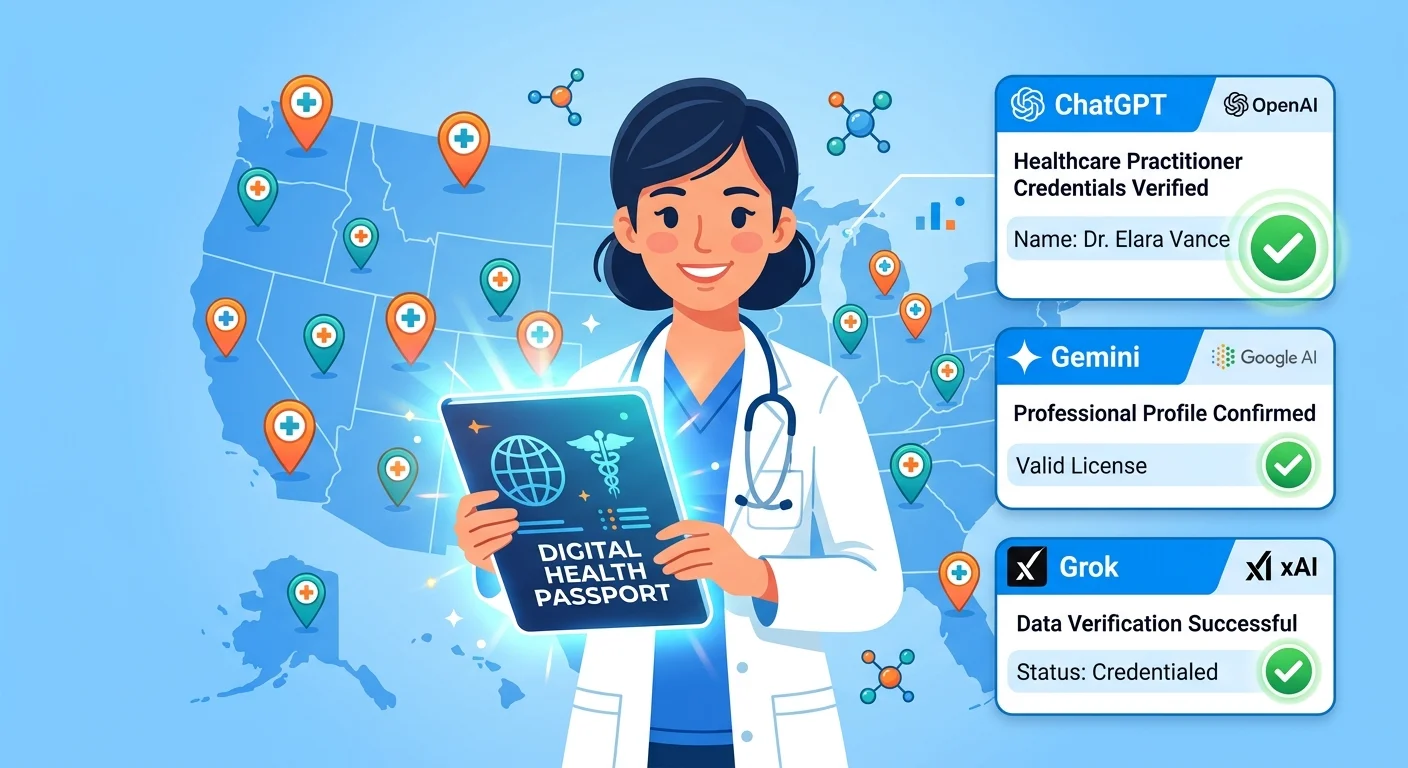
Most practitioners think they already have national presence. They’re listed in a dozen directories.
They don’t. A directory listing is not a national entity signal – and treating them as the same thing is exactly why practices go invisible the moment a patient steps outside their metro area.
Think of it this way: a city ID card proves you exist somewhere. A passport proves who you are.
Local citations are city ID cards. National entity signals are the passport. AI engines don’t validate your address – they validate your identity.
So what are national entity signals, exactly? They’re structured, machine-readable data points that define a provider’s credentials, specialties, and clinical authority in a form that knowledge graphs can read and cross-reference – no physical location required.
They aren’t marketing assets. They’re infrastructure. And that distinction is the whole game.
The Difference Between a Citation and an Entity Signal
Here’s the actual difference. A citation tells an AI engine you exist somewhere.
An entity signal tells an AI engine who you are – and hands it structured data to verify that claim against authoritative sources.
Here’s what’s happening under the hood. When an AI engine encounters a provider’s name in a query, it doesn’t match text strings. It maps that mention to a validated entry in a structured knowledge base – confirming credentials, specialty, and clinical authority before it surfaces any recommendation.
Stanford University’s NLP research on entity linking documents exactly this process. The engine is resolving identity. Not scanning pages. Not counting citations.
A bare citation can’t survive that resolution process. It doesn’t carry credentials. It doesn’t bind to a verified identifier. It just says a name existed somewhere on the web.
But a fully built national entity signal – NPI-bound schema, consistent institutional directory presence, credential verification layers – passes the check every time. Practices that have committed to a disciplined national entity scaling strategy are the ones AI engines resolve. Everyone else gets passed over.
Why Local-Only Infrastructure Fails at Scale
Local-only infrastructure wasn’t built for this. It was built to rank an address in a city.
AI engines don’t need your address. They need a clean, consistent identity they can validate across multiple authoritative systems – at the same time.
Local citation stacking has a hard ceiling. Stack every directory in your metro area and you still go invisible the moment a patient in another state asks an AI engine for the best specialist in your field.
That infrastructure was never designed for national resolution. It just wasn’t.
The Local AI Authority Engine is built to solve exactly this – replacing a local-only citation stack with a national entity architecture that AI engines can resolve anywhere, not just in your zip code.
Once you understand that citations and entity signals aren’t the same thing, the question shifts. It’s not whether you need national infrastructure. It’s how much authority you’ve already left on the table.
| Signal Type | What It Tells AI Engines | Geographic Scope | Primary Format |
|---|---|---|---|
| NPI-Bound Provider Schema | Confirms the provider’s licensed identity, specialty, and credentials against a regulatory identifier | National – validates across any state or region where the query originates | Structured schema markup tied to CMS NPI registry data |
| Local Citation Listing | Confirms a business name exists at a physical address in a specific city or metro area | Local – resolves only within the geographic context of the listing | Directory entry (NAP data – name, address, phone) |
| Institutional Directory Citation | Signals clinical authority by associating the provider with a recognized medical or professional institution | National – institutional affiliations carry authority across geographic boundaries | Profile or listing on accredited health directories and hospital systems |
| Credential Verification Signal | Tells AI engines the provider holds specific qualifications recognized by authoritative licensing bodies | National – credentials are state-issued but validated against national databases | Schema-marked credential data cross-referenced with licensing authorities |
| Specialty-Specific Content Architecture | Establishes topical authority in a defined clinical area across multiple patient populations and query types | National – AI engines resolve specialty authority independent of location | AEO content structured around clinical topics, conditions, and treatment areas |
| Structured Address Schema Only | Confirms a physical service location – nothing about credentials, specialty, or clinical authority | Hyper-local – AI engines cannot extend this signal beyond the immediate geography | LocalBusiness schema with address and geo-coordinates |
The National Entity Signal Checklist: What AI Engines Actually Read
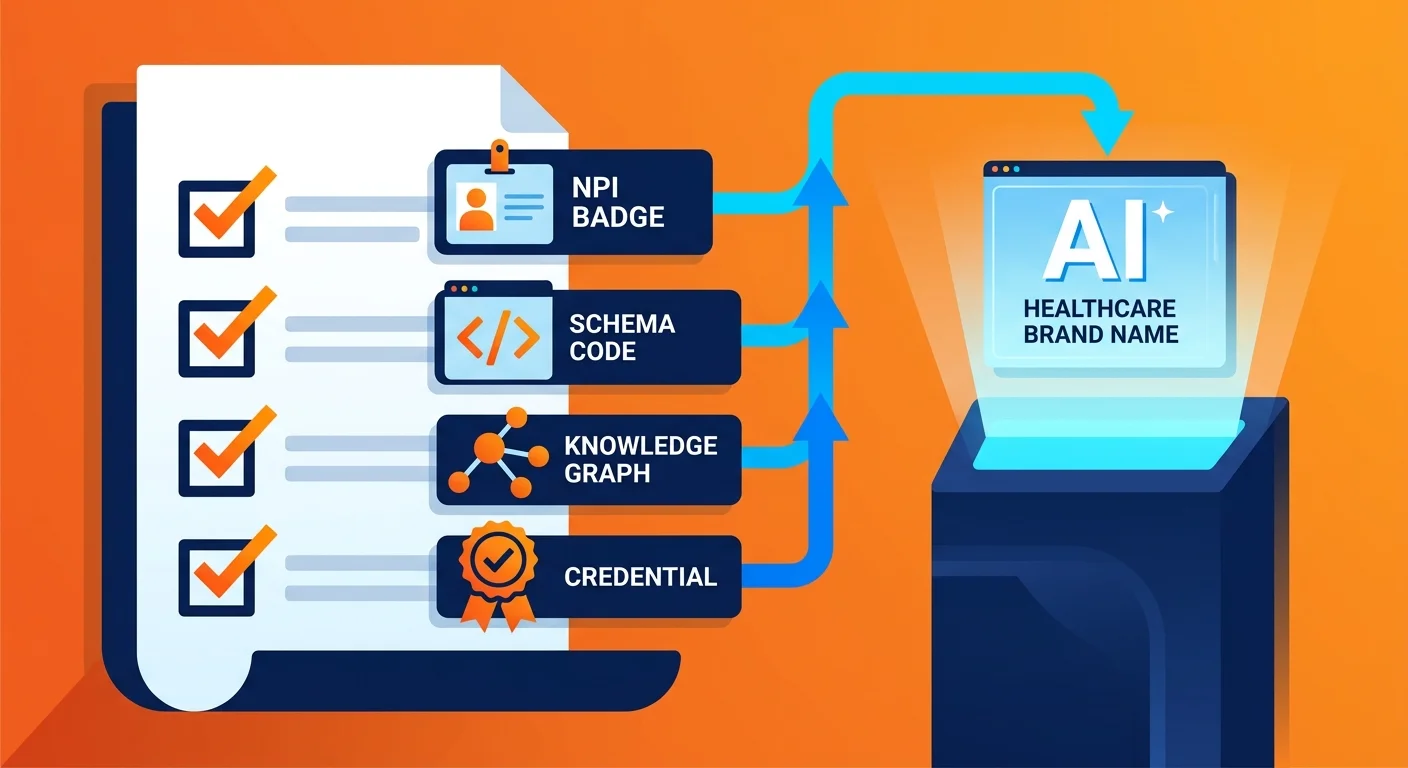
Here’s the checklist nobody gave you. Not because it’s hard – because it was never part of the conversation.
National entity signals break into six core layers: credential and identifier signals, schema markup, multi-state directory consistency, specialty content architecture, institutional citation anchors, and structured data that handles the work of decoupling your brand from geography entirely. Each layer does a specific job in the resolution stack. Miss one, and you hand AI engines a gap they will find every single time.
Here’s what each layer actually does. And why the sequence matters more than most people realize.
Credential and Identifier Signals: Starting With Your NPI
Your NPI is the anchor. The National Provider Identifier is the primary national administrative standard for identifying healthcare providers under HIPAA – a 10-digit numeric identifier required for electronic transactions since May 23, 2007. That makes it the single most credible machine-readable identity coordinate a healthcare provider holds. Everything else in the stack connects back to it.
But most practices stop the moment they have an NPI on file. They assume possession equals activation. It doesn’t. The NPI becomes a national entity signal only when it’s bound – structurally, in schema markup – to your practice name, specialty, service scope, and every directory where your name appears. Unbound, it’s a number in a government database. Bound to consistent, structured data, it becomes published provider verification data that AI engines can cross-reference to confirm you are exactly who you claim to be.
That binding process is what turns a regulatory requirement into an authority signal. And almost nobody does it correctly by default.
Schema Markup: The Machine-Readable Layer AI Engines Trust
Schema markup is what AI engines actually read. Not your page copy. Not your meta descriptions. The structured data underneath – the layer that tells a knowledge graph your specialty, your service area scope, your credentials, and the relationship between your individual providers and your practice entity as a whole.
Research published in the NIH repository confirms that semantic web technologies – including the RDF and OWL ontology standards that underpin modern schema formats – are critical for structural interoperability in medical data environments. That’s not an abstract finding buried in an academic journal. That’s the exact technical layer AI engines use to validate clinical authority at scale. So when a practice skips schema, it isn’t just missing a feature. It’s invisible at the infrastructure level.
The FTC compliance framework reinforces why this matters beyond AI visibility alone. Any health-related claims made across digital channels – including what your schema asserts about your services and scope – must be substantiated. Schema that overstates a specialty or misrepresents what you treat isn’t just an authority risk. It’s a compliance exposure. Clean schema serves both masters at once.
Why Most Practitioners Skip the Infrastructure Step and Stay Invisible
Here’s where most practices lose ground. The infrastructure step – NPI binding, schema deployment, directory normalization – looks technical. So it gets skipped. Or handed off to someone who treats it like a one-time setup task, checks the box, and moves on.
This isn’t a setup task. It’s a maintenance layer. AI engines don’t cache a snapshot of your entity data and hold it permanently – they re-resolve provider identities continuously against live authoritative sources.
So the moment your NPI binding drifts, your directory listings fall out of sync, or your schema stops reflecting your current service scope – the resolution breaks. You do not get a warning. You do not get a partial result. You just stop appearing in the answer.
The practices that stay invisible aren’t the ones who never started. They’re the ones who built something once, stopped maintaining it, and assumed the work was done. National entity signals don’t stay built on their own. They stay built because someone keeps building them.
| Checklist Item | Signal Category | Why AI Engines Read It | Implementation Priority |
|---|---|---|---|
| NPI-Bound Schema Markup | Credential & Identifier Signal | AI engines cross-reference the National Provider Identifier against structured schema to confirm the provider is a verified, credentialed entity – not just a name on a page | Critical – build first |
| Multi-State Directory Consistency | Identity Coherence Signal | Knowledge graphs validate identity by comparing provider data across multiple authoritative sources simultaneously – any mismatch breaks the resolution chain | Critical – build in parallel with NPI binding |
| Credential Verification Signals | Authority & Trust Signal | Licensing boards, specialty certifications, and institutional affiliations give AI engines independent confirmation points that the provider holds the authority they claim | High – complete before content scaling |
| Specialty-Specific Content Architecture | Semantic Relevance Signal | AI engines map provider identity to clinical specialties using structured content that explicitly names conditions treated, procedures performed, and patient populations served | High – directly drives query resolution |
| Institutional Citation Anchors | External Authority Signal | Citations from hospitals, academic medical centers, and peer-recognized institutions signal to AI engines that the provider’s authority has been validated by established third parties | Medium – builds over time with ongoing execution |
| Geography-Decoupled Structured Data | National Reach Signal | Schema that defines service scope, telehealth availability, and specialty jurisdiction without tying the entity to a single physical address allows AI engines to surface the provider for national queries | Medium – required to break the local ceiling |
How AI Engines Resolve Healthcare Entities Across State Lines
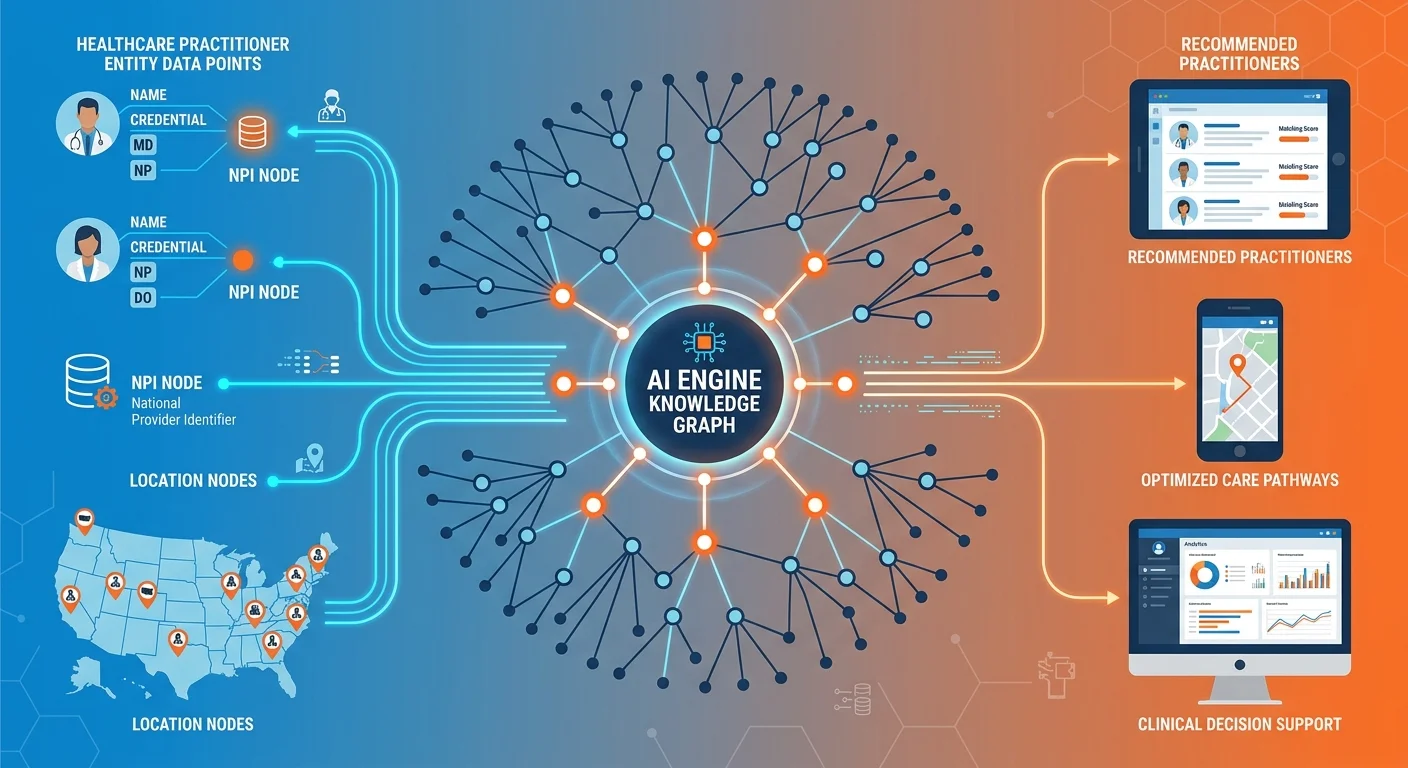
Here’s what AI engines actually do when a patient asks ChatGPT or Gemini for the best spine specialist in a given field. They don’t run a keyword search. They resolve a query against a structured knowledge graph – a model that maps entities, credentials, and relationships across systems those engines already trust.
That resolution process is the whole game. It happens entirely at the infrastructure layer. No amount of page copy or meta descriptions overrides what the knowledge graph already knows about your entity.
Here’s the part most practices miss: AI engines aren’t waiting for you to opt in. McKinsey’s research confirms AI integration in US healthcare is accelerating – with consumer centricity identified as a top driver of investment. Patients are already using these systems to find care. Your practice is being evaluated right now. The only question is whether your signals are clean enough to survive the check.
Knowledge Graphs and the Entity Linking Process
Gartner defines a knowledge graph as a model of a knowledge domain that represents entities and their semantic relationships – connecting structured and unstructured data to provide context for machine learning models. That’s exactly what ChatGPT, Gemini, and Grok use to answer healthcare queries. Not a content ranking system. An identity resolution system. Those are not the same thing.
So how does a practice get into the graph? Through entity linking. Stanford NLP research identifies entity linking as the process of mapping ambiguous textual mentions to unique, validated entries in a structured knowledge base – essential for semantic search engines to surface accurate results. When AI sees your name in a query, it doesn’t guess. It pulls your entry from the knowledge base and reads what’s there. If that entry is thin, inconsistent, or missing, the resolution fails. You don’t get named.
Think of it this way: a city ID card proves you exist somewhere. A passport proves who you are everywhere. Local citations confirm an address. National entity signals – NPI-bound schema, multi-state directory consistency, credential verification layers – prove clinical authority across markets and survive the knowledge graph resolution process intact. Practices with that infrastructure get resolved across state lines. Practices running on local citation stacks alone don’t make it through the check. That distinction is exactly what Decoupling Your Brand from Geography: The First Step to National AI Authority is built around.
This Is Not the Practitioner Who Needs This System
But this system isn’t for every practice. If you’re a single-location clinic with no plans to serve patients outside your metro area, national entity infrastructure is the wrong investment right now. Build your local foundation first. Come back when the ceiling starts showing.
And it’s not for anyone who wants a one-time setup that runs on autopilot. National entity signals require ongoing maintenance – because McKinsey’s data confirms the shift toward digital-first healthcare infrastructure keeps accelerating. The baseline moves. Practices that build once and stop maintaining fall out of the knowledge graph resolution window. Not gradually. Abruptly.
And it’s not for anyone who treats AI visibility as a shortcut to patient volume in the next 90 days. The knowledge graph resolution process Stanford identified compounds over time – signals stack, verify, and reinforce each other across authoritative sources. That is not a flaw in the system. That is the point. The practices that commit to building it correctly hold the position once it’s established. The ones who don’t can’t catch up by rushing.
| Entity Resolution Stage | What the AI Engine Does | What Breaks Without National Signals | What Success Looks Like |
|---|---|---|---|
| Query Parsing | Identifies the named entity in the query and attempts to disambiguate it from similar entities in the knowledge graph | The practice name resolves ambiguously or not at all – the engine surfaces a competitor with cleaner signals instead | The practice name maps to a unique, fully populated knowledge graph entry with no disambiguation conflict |
| Credential Verification | Cross-references the provider’s stated credentials, specialty, and identifiers against authoritative external sources it already trusts | NPI data is unbound from schema and directory listings – credentials cannot be confirmed across sources, so the entity fails the verification check | NPI is structurally bound to schema, directory listings, and credential records – every cross-reference returns consistent, confirmable data |
| Geographic Scope Determination | Evaluates whether the entity’s service scope is defined locally, regionally, or nationally – and matches it to the geographic context of the query | Service area is defined only at the local level – the engine cannot resolve the entity against queries originating outside the practice’s immediate metro area | Schema explicitly declares a national or multi-state service scope, allowing the engine to surface the practice for qualifying queries in any geography |
| Authority Signal Triangulation | Validates the entity’s authority level by triangulating signals across institutional citation sources, structured data, and directory consistency | Signals exist in isolated silos – local citation directories confirm an address but provide no authority context that transfers across state lines | Institutional citation anchors, schema-structured credentials, and consistent directory data all point to the same entity, reinforcing authority at every triangulation point |
| Relationship Mapping | Maps the relationships between the individual provider, the practice entity, affiliated institutions, and the specialty domain to build a contextual trust profile | Provider and practice exist as disconnected entities in the knowledge graph – no relational context means the engine cannot assess depth of authority in the specialty | Schema explicitly links providers to the practice entity, specialty scope, and institutional affiliations – the relationship map is complete and machine-readable |
| Resolution Confidence Scoring | Assigns an internal confidence score to the resolved entity – high confidence scores result in the practice being surfaced as a recommended answer; low confidence scores result in omission | Incomplete or inconsistent signals depress the confidence score below the threshold required to appear as a cited answer – the practice is invisible even when directly relevant | All signal layers are clean, current, and consistent across sources – the engine resolves the entity with high confidence and surfaces it as the authoritative answer to the query |
Validating and Maintaining National Entity Signals Over Time
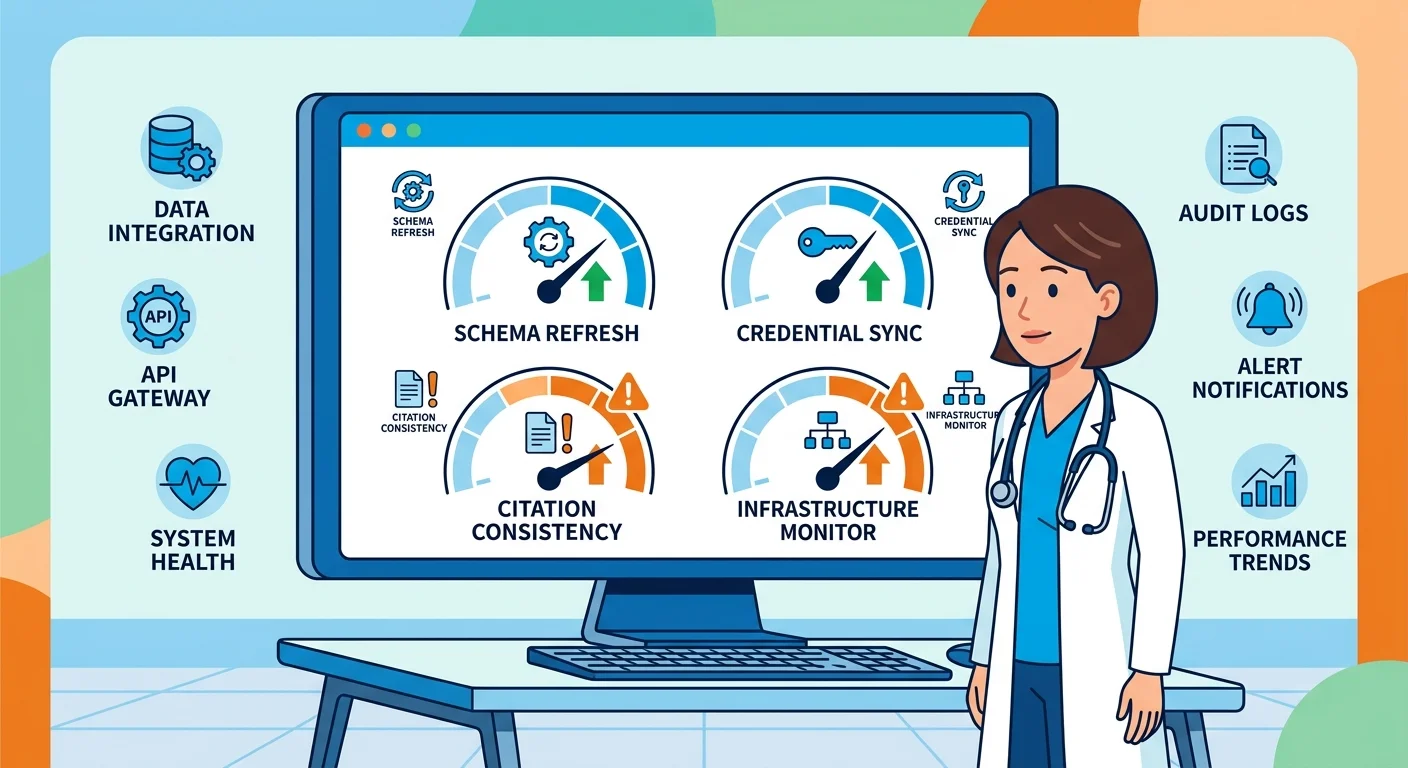
Building the infrastructure is step one. Knowing it’s holding – and catching the moment it starts to drift – is the step most practices skip entirely.
Here’s the thing about national entity signals: they don’t fail loudly. There’s no error message. No dashboard alert. No email that says your NPI binding broke or your schema stopped resolving cleanly.
The AI engine just quietly stops surfacing your name. You find out months later when a competitor is collecting the recommendations you should be getting.
That’s why validation isn’t a bonus step at the end of the process. It’s a structural requirement.
The passport doesn’t stay valid on its own. It has to be renewed, verified, and kept current against the authoritative sources AI engines are actively checking – or it stops working as one.
How to Audit Your Current Entity Signal Stack
Start with your NPI record. That 10-digit identifier needs to be bound correctly in your schema and match exactly – name, specialty, service scope – across every directory where your practice appears.
One mismatch is all it takes. A single inconsistency in how your credential is listed creates an ambiguity the knowledge graph can’t resolve. And knowledge graphs don’t round up – they fail the check.
From there, work through each layer in order. Schema markup gets checked against your current service scope – not what you offered two years ago. Directory listings get cross-referenced for consistency. Credential signals get verified against the sources that institutional healthcare databases actually trust.
This isn’t busywork. Published research on semantic interoperability in medical data makes the stakes plain: structural mismatches at the data layer don’t create minor friction. They break the entire resolution chain.
And if you built out dozens of geo-targeted location pages thinking volume equals visibility – the audit surfaces that immediately.
Those pages don’t register as entity authority. They register as noise. Clean infrastructure audits well. Fragmented page strategies don’t.
The Decay Problem: Why Entity Authority Needs Ongoing Execution
Entity authority decays for one reason: the world keeps moving and the infrastructure doesn’t.
A provider adds a new specialty. A practice opens a second location. A credential gets renewed. Any of those changes – if they don’t get reflected back into the schema, the directory stack, and the NPI binding – creates a drift between what AI engines have on file and what’s actually true. And AI engines resolve against what they have on file.
McKinsey’s research on US healthcare identifies consumer centricity as a top driver of AI investment – and that investment is accelerating, not plateauing.
So the resolution bar keeps moving. A signal stack that cleared it last year may not clear it this year without maintenance. The engines get smarter. The standards tighten. Staying still isn’t holding your position. It’s losing it slowly enough that you don’t notice until you’re already out.
The proven AI authority case studies show the same pattern every time. Practices that maintain their entity infrastructure hold their positions. Practices that build once and stop don’t lose ground gradually.
They fall out of the resolution window abruptly – right when patient demand for their specialty peaks. Ongoing execution isn’t overhead. It’s the reason the infrastructure keeps working.
| Validation Check | Signal Layer | Audit Method | Review Cadence |
|---|---|---|---|
| NPI record accuracy | Identity foundation | Cross-reference NPI name, specialty, and service scope against schema markup and every directory listing where the practice appears – flag any mismatch in formatting, abbreviation, or credential description | Quarterly |
| Schema markup currency | Structured data layer | Audit all schema blocks against current service offerings, locations, and credentials – remove outdated service types and add any specialties or locations added since the last build | Every time a practice service or location changes |
| Directory listing consistency | Citation and reference layer | Check that name, address, phone, specialty, and credential data matches exactly across all directories indexed by AI engines – prioritize authoritative healthcare and institutional sources over general directories | Bi-annually |
| Credential and license verification | Authority signal layer | Confirm all licensure, board certifications, and professional affiliations are current and reflected in the sources AI engines use to validate practitioner identity – outdated credentials create unresolvable ambiguity in knowledge graph checks | Annually or upon credential renewal |
| Knowledge graph resolution test | Entity resolution layer | Query ChatGPT, Gemini, and Grok directly for the practice’s specialty and scope – evaluate whether the practice entity is surfaced, how it is described, and whether the description matches current infrastructure signals | Quarterly |
| Content-to-entity alignment | AI Authority content layer | Verify that published AI Authority content references the same entity identifiers – name, specialty, service scope, credential signals – that are present in schema and directory infrastructure; misalignment between content and infrastructure weakens the overall signal stack | Every content publication cycle |
Frequently Asked Questions
The framework is built. The checklist is clear. Now comes the part where most practitioners stall.
These are the questions that show up the moment a practice gets serious about doing this. Not the theoretical ones – the ones that actually block implementation.
How long does it take to establish national entity signals for a healthcare practice?
Anyone who gives you a specific number of months is selling something.
The honest answer is this: timeline is driven by the depth of your infrastructure gap, not a calendar. A practice with a clean NPI record, consistent directory data, and existing structured markup compounds faster. A practice starting from zero – mismatched listings, no schema, unverified credentials – is rebuilding, not optimizing.
The compounding doesn’t start until the foundation is clean. What you control is how fast you move through the build – and whether you maintain it once it’s done.
What is the primary point of failure when clinics attempt to scale their AI visibility beyond local search?
Ambiguity at the entity layer. Every time.
Most practices try to scale by producing more content or expanding into more directories. But if the core identity record isn’t consistent, none of that effort resolves cleanly in the knowledge graph. The AI engine hits conflicting signals – a name spelled differently across listings, a specialty in schema that doesn’t match the NPI record, a credential that appears on a directory page but can’t be verified against an authoritative source.
That ambiguity doesn’t produce a partial result. It produces no result.
And the failure isn’t visible right away. You’re already losing recommendations to a competitor who built the foundation correctly before you realize the problem isn’t your content – it’s your identity record.
Do national entity signals conflict with an existing local SEO setup or Google Business Profile?
They don’t conflict. They operate at different layers.
Local visibility signals tell AI engines where you are. National entity signals tell AI engines who you are. A well-maintained Google Business Profile strengthens local resolution. But it doesn’t give the knowledge graph the machine-readable identity infrastructure it needs to resolve your entity across state lines – or in queries with no geographic modifier at all.
The concern about conflict usually comes from practitioners who’ve been told their local presence is fragile. It isn’t – as long as the national layer is built correctly. Consistent directory data, a properly bound NPI record, and structured schema don’t compete with local signals. They sit underneath them and make the whole structure more stable, not less.
What infrastructure changes are required to integrate national schema metadata with a legacy medical CMS?
The core requirement is schema interoperability – making sure your structured markup can communicate with the data formats AI engines and institutional healthcare databases actually use.
NIH-published research on semantic web technologies confirms that RDF and OWL standards are the foundation for structural interoperability in medical data environments. A legacy CMS that doesn’t natively support schema output needs either a plugin layer, a custom markup injection process, or a rebuild of the template structure that generates page-level output.
The goal isn’t a full platform migration. It’s making sure the schema layer the AI engine reads is accurate, complete, and maintained independently of whatever the CMS does with its own data. Those are two different problems. Don’t let anyone sell you a full rebuild when a targeted injection layer gets the job done.
How do AI engines validate a practitioner’s credentials across state lines without causing local authority decay?
The validation process runs through the same authoritative sources that issued the credential in the first place.
When an AI engine processes a credential claim, it maps that claim to verified entries in structured databases – licensing boards, institutional directories, administrative records – using entity linking to confirm the match is exact. The NPI system is one of those anchors: a 10-digit identifier issued under HIPAA that ties a provider’s identity to a nationally recognized administrative standard.
When the schema-level credential data matches what those sources contain, the resolution holds across state lines. When it doesn’t – even by a single character – the knowledge graph can’t confirm the identity, and the cross-state authority doesn’t register.
Local authority stays intact as long as local signals stay consistent. The risk isn’t resolution conflict. It’s sloppy data.
Can a single-location practice benefit from national entity signals even if they never plan to expand?
Yes – and the reason matters more than the answer.
National entity signals aren’t just about reaching patients in other states. They’re about becoming unambiguous to AI engines regardless of where the query originates. A patient in the same city asking ChatGPT for a specialist in your field gets an answer built from the same knowledge graph resolution process as a patient asking from across the country.
If your entity isn’t structured correctly – NPI-bound schema, verified credentials, consistent directory data connected to authoritative sources – you’re ambiguous to that engine regardless of geography.
Here’s the thing: you don’t carry a passport because you’re planning to travel. You carry it because it’s the credential that proves who you are to every system that needs to verify you. A single-location practice with clean national entity infrastructure holds its position in local AI recommendations more reliably than one running on local citations alone.
Your National Footprint Starts With a Single Infrastructure Decision
National AI visibility isn’t a content problem. It’s an infrastructure decision.
The practices showing up when a patient in another state asks ChatGPT or Gemini for the best specialist in their field didn’t get there by publishing more pages. They built a machine-readable identity – NPI-bound schema, verified credentials, consistent directory data – that survives the knowledge graph resolution process intact.
A city ID card proves you exist. A passport proves who you are.
Build the passport or don’t. Everything else is noise.
But the infrastructure doesn’t build itself. And it doesn’t hold itself together.
Every drift – an unverified credential, a directory listing that falls out of sync, a schema that stops reflecting your current service scope – hands AI engines an ambiguity they can’t resolve. And unresolved ambiguity has exactly one outcome: your name stops appearing in the answer.
Not gradually. All at once.
The practices that hold their positions treat this as ongoing execution. Not a one-time setup. Not a box to check. A layer that has to keep working – because the moment it stops, someone else fills the slot.
So the most important move isn’t understanding the system. It’s finding out where you stand inside it right now.
iTech Valet built the Local AI Authority Engine for exactly this: auditing what AI engines currently know about your practice, identifying every signal that’s missing or misaligned, and building the infrastructure layer that puts your name into the knowledge graph resolution process – correctly, completely, in a form that holds.
The first step is a 15-minute diagnostic. It shows you exactly what ChatGPT, Gemini, and Grok say when a patient asks who to trust in your specialty.
If the answer isn’t your name, you already know what’s missing. The question is whether you build the passport before a competitor does.
You just read the checklist. Now find out if your practice actually passes it. What does ChatGPT say when someone searches your specialty right now? What does Gemini cite? What does Grok recommend? That answer exists whether you look at it or not – and so does the gap.