
Why Local and National AEO Are Structurally Different Animals
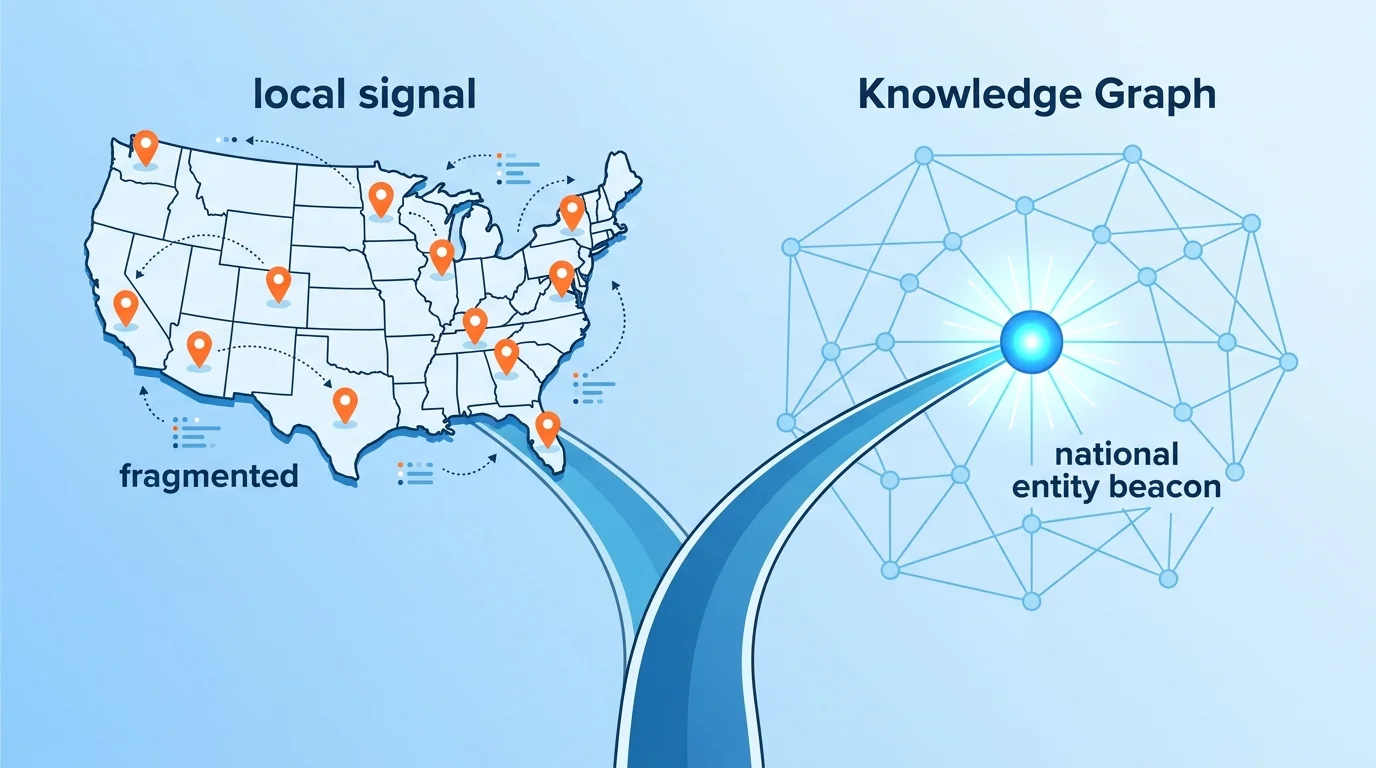
Local and national AEO aren’t different sizes of the same thing. They’re different games entirely.
The AI resolving a local query is asking a completely different question than the one resolving a national query. Same technology. Completely different logic.
Local AEO is a proximity game. National AEO is an entity validation game.
Treat them as variations of the same strategy and you get scattered signals – fragmented noise pushed into the void where a single authoritative node needs to exist.
Here’s the thing: it comes down to what the AI is actually resolving.
A local query resolves to a place. A national query resolves to a brand – a single, consolidated entity the AI has enough evidence to trust. Build your content architecture for the former, and you actively work against yourself at the national level.
What Local AEO Is Actually Optimizing For
Local AEO optimizes for Geographic Anchoring. Map pack citations, proximity data, location-tagged structured markup, directory listings – every signal points the AI toward a physical address inside a defined radius.
The strategy is territorial by design. That’s not a flaw. That’s the point.
When someone asks ChatGPT who the best chiropractor in Austin is, the AI resolves that against a geographic frame. It’s looking for the most credible entity inside that boundary.
Geographic Anchoring is the right tool for that job. The Local AI Authority Engine is built specifically to win that resolution at the local level.
But Geographic Anchoring has a ceiling.
The moment you scale beyond a defined market, proximity stops being a signal. It becomes a constraint. You can’t anchor a national brand to a zip code. The signals that built your local authority turn into noise at the national level.
What National AEO Is Actually Optimizing For
National AEO optimizes for Entity Consolidation – collapsing every brand signal you own into a single, machine-readable authority node that AI engines can resolve without a zip code.
You have to give AI one clear thing to trust. Not ten fragmented signals. One node. The brands that get this right – the ones following a national entity scaling playbook built for how AI actually works – don’t just rank. They become the default answer.
That’s where Semantic Density and Citation Velocity take over. Those are the variables that actually move the needle at the national level – not proximity, not map pack citations.
Pew Research found that 23% of U.S. adults have already used ChatGPT. Gartner projects traditional search volume drops 25% by 2026 as conversational AI absorbs those queries. The questions migrating into those engines are national and topical. No map pack was ever built to answer them.
The AI resolving those queries isn’t checking a map.
It’s asking one question: which entity has the deepest, most consistent, most externally validated signal across every topical cluster it claims to own?
Answer that clearly and you become the single trusted node in the Knowledge Graph. Fail to answer it and you’re noise.
| Dimension | Local AEO | National AEO |
|---|---|---|
| Primary Signal Type | Geographic Anchoring – proximity, map pack citations, location-tagged markup | Entity Consolidation – unified brand node in the Knowledge Graph, resolved without geographic context |
| What AI Is Resolving | A place – the most credible entity within a defined geographic radius | A brand – a single, consolidated authority the AI has enough evidence to trust |
| Performance Variables | Map pack placement, directory listings, proximity data, location-specific structured markup | Semantic Density and Citation Velocity across every topical cluster the brand claims to own |
| Content Architecture | Location-specific pages, city-tagged content, proximity-optimized structured data | Deep-path semantic content validating a single parent brand across all claimed topic categories |
| Scale Ceiling | Defined by geographic market – authority is territorial and bounded | No geographic ceiling – authority compounds as entity signals grow denser and more externally validated |
| Primary Failure Mode | Weak proximity signals, inconsistent local directory data, thin location-specific content | Scattered signals – templated city variations and keyword-stuffed pages that AI engines read as low-density noise |
| Strategic Goal | Become the most credible answer within a defined radius for proximity-based queries | Become the single unmistakable beacon in the Knowledge Graph for topical and national queries |
Why Traditional Local SEO Fails at National Scale
Most national brands didn’t choose to fail at AI authority. They inherited a playbook built for a different era.
Nobody told them that scaling meant starting over.
That assumption – that local tactics scale – is exactly where the failure starts.
Geographic anchoring works when the query has a location attached. Local signals, proximity data, location-tagged markup – those tools build real authority inside a defined market. But run those same signals at national scale and they stop being authority builders. They become noise. Undifferentiated, unfocused, unresolvable noise.
The problem isn’t effort. It’s architecture.
Local signals point AI engines toward a place. National AI authority requires pointing AI engines toward a brand – a single consolidated entity with enough depth, consistency, and external validation to be named without any geographic frame attached. Those are not the same problem. They don’t share a solution.
Why Traditional SEO’s City-Page Playbook Breaks Down
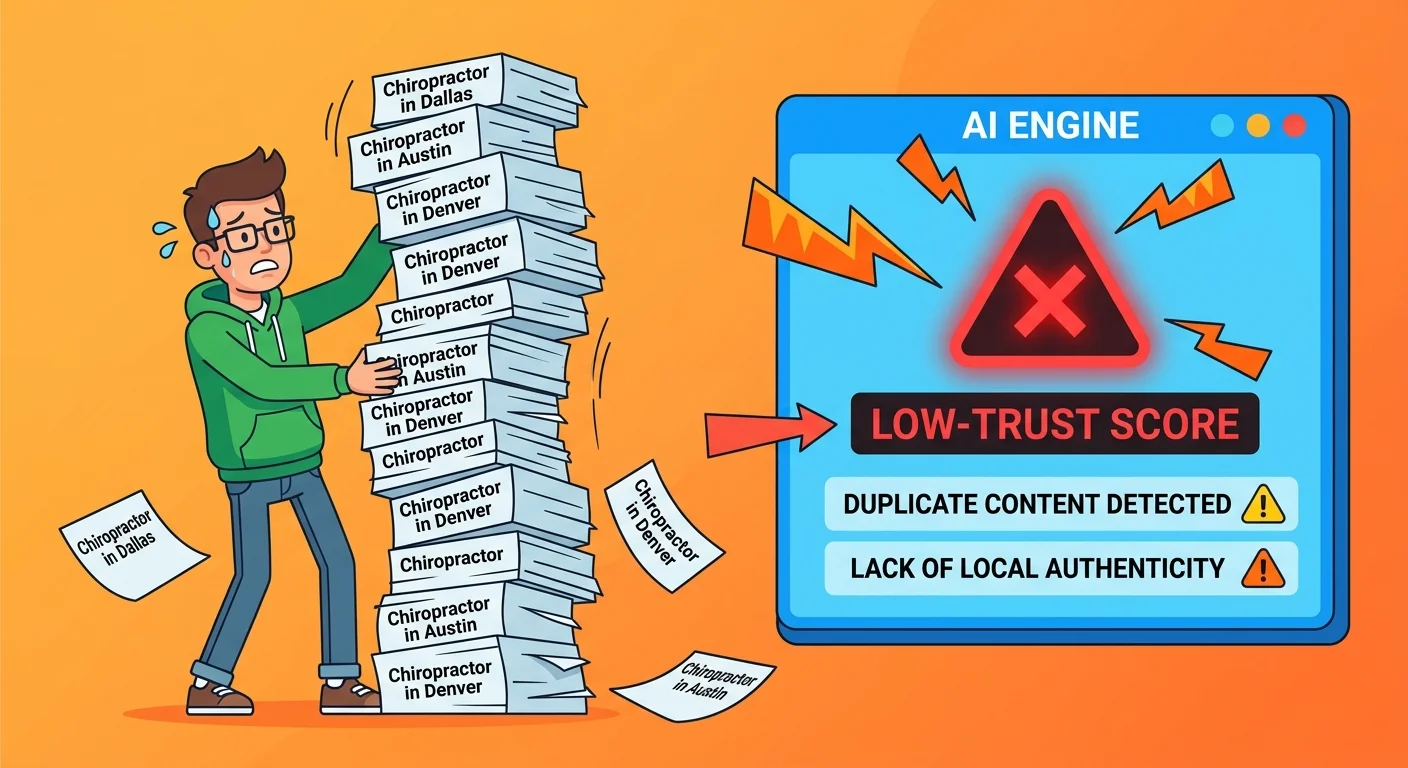
The city-page playbook made sense once. You built location-specific pages – "Chiropractor in Dallas," "Chiropractor in Austin" – layered in proximity keywords, and let the algorithm sort it out. That approach worked. It earned placements. It drove clicks.
That era is over.
Conversational AI engines don’t see those pages the way Google’s old algorithm did. Stanford researchers found unacceptable error rates in retrieval-augmented models during structured entity verification – which means AI systems actively struggle to resolve scattered, templated signals into a single trustworthy entity.
A grid of city pages doesn’t consolidate. It fragments. And a fragmented signal has no coherent center for AI to resolve to.
So the AI doesn’t get confused and pick your best city page. It resolves the query to a different brand entirely – one whose content architecture is built around Entity Consolidation instead of geographic keyword variation.
That’s the specific failure point that Why 50-City Landing Pages Is a Failed Strategy documents in full. The playbook doesn’t just underperform at scale. It actively destroys the entity trust you need to be named nationally.
Here’s what makes this expensive: the transition isn’t gradual. Moving from Google Business Profile signals to Knowledge Graph entity structure – what the technical shift from local to national AI authority covers at the architectural level – is a hard pivot, not an upgrade.
The signals that built local credibility are structurally incompatible with the signals that build national entity trust. Brands that miss this distinction don’t just stall. They spend significant budget reinforcing infrastructure that works against them.
How Conversational AI Evaluates National Queries Differently
Local queries and national queries look identical from the outside. Same interface. Same person typing a question. But the resolution logic underneath them? Completely different.
A local query asks the AI to find the best provider inside a boundary. The AI consults proximity signals, directory citations, location-tagged markup – Geographic Anchoring data. That’s the game local AEO is built to win.
But the game is shrinking. Gartner projects a 25% decline in traditional search engine volume by 2026 as conversational queries replace ranked list results entirely. The volume is migrating. And the resolution logic is migrating with it.
A national query removes the boundary entirely.
The AI isn’t looking for the best provider in Austin. It’s looking for the most authoritative entity on a topic – the single brand it can name with confidence regardless of where the query originates.
Semantic Density and Citation Velocity are what that resolution runs on. Not proximity. Not city pages. Not geographic anchoring at all.
| Tactic | What It Was Built For | Why It Fails in Conversational AI | What Replaces It |
|---|---|---|---|
| City-Specific Landing Pages | Google map pack rankings in defined geographic markets | AI engines read templated city variations as fragmented, low-density signals with no coherent entity center – they cannot resolve them to a single authoritative brand | Deep-path topical content built around Entity Consolidation – one parent brand, one authority node, consistent signals across every cluster |
| Proximity-Based Directory Citations | Local Geographic Anchoring – validating a physical address within a radius | National queries carry no geographic frame; proximity signals become noise rather than authority validators when the query has no location attached | Citation Velocity built through topical, entity-level mentions across authoritative external sources that validate the brand regardless of geography |
| Location-Tagged Structured Markup | Signaling relevance to a specific city or region for local search engines | Schema tied to a single location constrains the entity – AI engines cannot extrapolate a national authority signal from geographically scoped markup | Entity-level schema that defines the parent brand’s topical ownership, credentials, and Knowledge Graph relationships at the national level |
| Localized Keyword Variation Content | Capturing proximity-intent queries like ‘chiropractor in Dallas’ across multiple markets | Conversational AI resolves topic-first, not location-first – keyword-varied pages without Semantic Density register as thin content, not expertise | Semantic Density – comprehensive topical authority content that signals deep expertise on the subject matter, independent of any geographic modifier |
| Map Pack Optimization | Winning the three-slot local result inside a defined geographic boundary | Map pack logic is irrelevant to national conversational AI resolution – AI engines building national recommendations consult Knowledge Graph entity trust, not map proximity data | Knowledge Graph entity consolidation – collapsing all brand signals into a single, machine-readable authority node that AI can resolve without a geographic anchor |
| Review Volume in Local Directories | Building social proof and trust signals for local map pack algorithms | Directory review counts do not translate to national entity authority – AI engines evaluating national brands weight structured external validation and Citation Velocity over star-count aggregation | Citation Velocity from authoritative external sources – structured, consistent brand mentions that validate topical ownership at scale across the conversational index |
| Siloed Market-by-Market Content Execution | Maintaining separate content strategies for each geographic territory | Parallel market silos prevent the signal consolidation national AI authority requires – scattered effort produces scattered entity signals, and AI engines cannot resolve a scattered signal to a single trusted brand | Unified AEO content execution anchored to a single parent entity – one content architecture, one authority node, every topical cluster pointing back to the same brand |
Building AI-Readable Authority Signals at National Scale
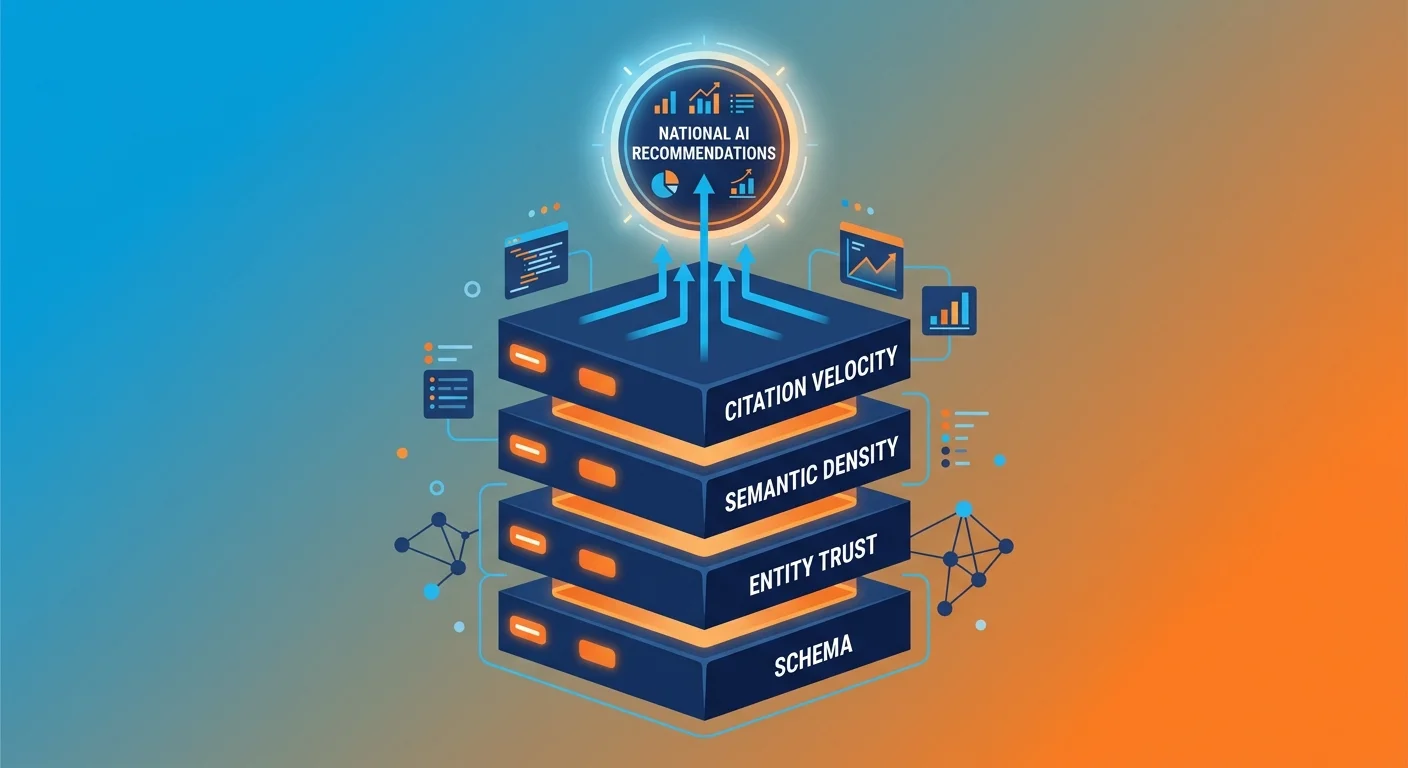
AI engines don’t reward effort. They reward clarity.
At the national level, clarity means one thing: a single, consolidated entity signal that the AI can resolve to your brand – no ambiguity, no geographic scaffolding, no guessing.
That’s the core distinction.
Local AEO plants flags in specific zip codes. National AEO builds one unmistakable node in the Knowledge Graph – a single authoritative center that AI engines can find regardless of where the query originates. These aren’t two points on the same spectrum. They’re architecturally different goals that demand structurally different signal types.
Four signal types define national AI authority: Geographic Anchoring, Entity Consolidation, Semantic Density, and Citation Velocity.
They don’t do the same job. Each one fires at a specific point in the resolution chain. Get the wrong one at the wrong stage and the whole architecture misfires – and your brand stays invisible while a competitor gets named.
Signal Type 1 – Geographic Anchoring vs. Signal Type 2 – Entity Consolidation
Geographic Anchoring is the signal stack local AEO runs on. Map citations, proximity-tagged structured markup, directory listings with consistent NAP data, location-specific schema – all of it points an AI engine toward a physical address inside a defined radius.
That’s the right architecture for a local query. It’s the wrong one for a national brand.
So what happens when a brand tries to go national by copying that local signal architecture? City pages stuffed with location keywords. Duplicated schema blocks with swapped city names. Geographic Anchoring replicated across fifty markets.
The AI doesn’t read that as national authority. It reads it as fifty low-density fragments with no coherent center.
That’s the structural mismatch. Geographic Anchoring builds credibility in a radius. Entity Consolidation builds credibility in the Knowledge Graph – period. The city-page playbook doesn’t scale. It actively destroys the national entity trust you’re trying to build.
Entity Consolidation is the replacement signal. Instead of pointing AI engines toward multiple locations, it collapses all of a brand’s digital signals into a single machine-readable authority node.
Every content asset, every external citation, every schema declaration – all reinforcing the same parent entity. Published analysis on this framework confirms that AI recommendation accuracy depends directly on the availability of clear external verification datasets. Without that consolidated structure, AI systems can’t resolve scattered signals to a single trusted answer.
Signal Type 3 – Semantic Density and Signal Type 4 – Citation Velocity
Once Entity Consolidation establishes the authority node, Semantic Density and Citation Velocity are what build on it.
Semantic Density is the depth of topical coverage – how completely a brand’s content architecture addresses every sub-topic, adjacent question, and downstream query within its claimed expertise. Thin coverage on any cluster leaves a gap. AI engines fill gaps with someone else’s answer. Every time.
Citation Velocity is the rate at which external, authoritative sources reference and validate the entity over time. Not a one-time signal. A compounding one.
Stanford researchers found unacceptable error rates in retrieval-augmented models during structured entity verification – which means AI systems actively filter for external validation signals when resolving a query to a specific brand. Brands without a consistent citation structure don’t just rank lower. They get filtered out entirely.
And the brands that get this right don’t just show up more often. They become the default answer.
Not incremental visibility. Categorical authority. That’s the difference between Semantic Density and Citation Velocity done correctly versus done halfway.
Schema Architecture for National Entity Validation
Schema architecture is where national entity validation becomes something AI can actually read.
Without it, even a well-built content library is invisible to the resolution layer AI engines use to connect content signals to a trusted entity. Schema is the language the AI reads when it’s deciding whether your brand is the answer – or just noise.
At the national level, schema has to declare the parent entity – not just a page topic. Organization schema, Author schema, BreadcrumbList, and SameAs declarations work together to tell AI engines that every piece of content belongs to a single, verified brand identity.
The technical shift from local AEO to national AI authority is fundamentally a schema architecture problem – moving from location-tagged markup to entity-tagged markup that validates the brand regardless of where the query originates.
That’s what iTech Valet builds.
Not city pages. Not proximity signals. A unified schema architecture that declares a single authoritative entity – then compounds that declaration across every content asset, every external citation, and every structured data signal in the brand’s digital footprint.
The signal doesn’t scatter. It consolidates. And the AI engines that matter resolve to it with confidence.
| Authority Signal | Local AEO Application | National AEO Application | AI Engine Outcome |
|---|---|---|---|
| Geographic Anchoring | Map citations, NAP consistency, proximity-tagged schema, and directory listings that point AI engines toward a physical address within a defined radius | Deprioritized – national entity validation does not depend on location signals; overuse of Geographic Anchoring at national scale fragments the entity node | AI resolves query to nearest local provider; brand authority is bounded by geography and cannot compound nationally |
| Entity Consolidation | Limited application – local AEO distributes signals across multiple location assets rather than collapsing them into a single parent entity | Core foundation – every content asset, schema declaration, and external citation reinforces the same parent brand identity across a single machine-readable authority node | AI resolves all topical queries to one verified entity regardless of where the query originates; brand becomes the default answer rather than a local option |
| Semantic Density | Narrow topical coverage scoped to local service categories and proximity-specific queries; depth is bounded by what the local audience searches | Deep, comprehensive coverage of every sub-topic, adjacent question, and downstream query within the brand’s claimed area of expertise at a national level | AI fills content gaps with a competitor’s answer; high Semantic Density closes those gaps and positions the brand as the authoritative source across the full topical cluster |
| Citation Velocity | Driven by local directory listings, regional publications, and map-pack citation sources – high volume, low authority weight at national scale | Driven by authoritative external sources referencing and validating the parent entity consistently over time – compounding signal strength, not one-time placement | AI filters for consistent external validation when resolving brand recommendations; brands with sustained Citation Velocity become the trusted entity; those without get filtered out |
Who National AEO Is and Isn’t For
So here’s the real question.
Not how national AEO works. Whether it’s actually the right move for your brand at this moment.
National AEO isn’t local AEO with a bigger budget. The structure is different. The timeline is different. What winning looks like is different.
And the wrong brand pursuing it doesn’t just waste money. They build the wrong infrastructure – and that infrastructure actively works against them.
Let’s name who this is for. And who it isn’t.
The Buyer Profile That Gets Results From National AEO
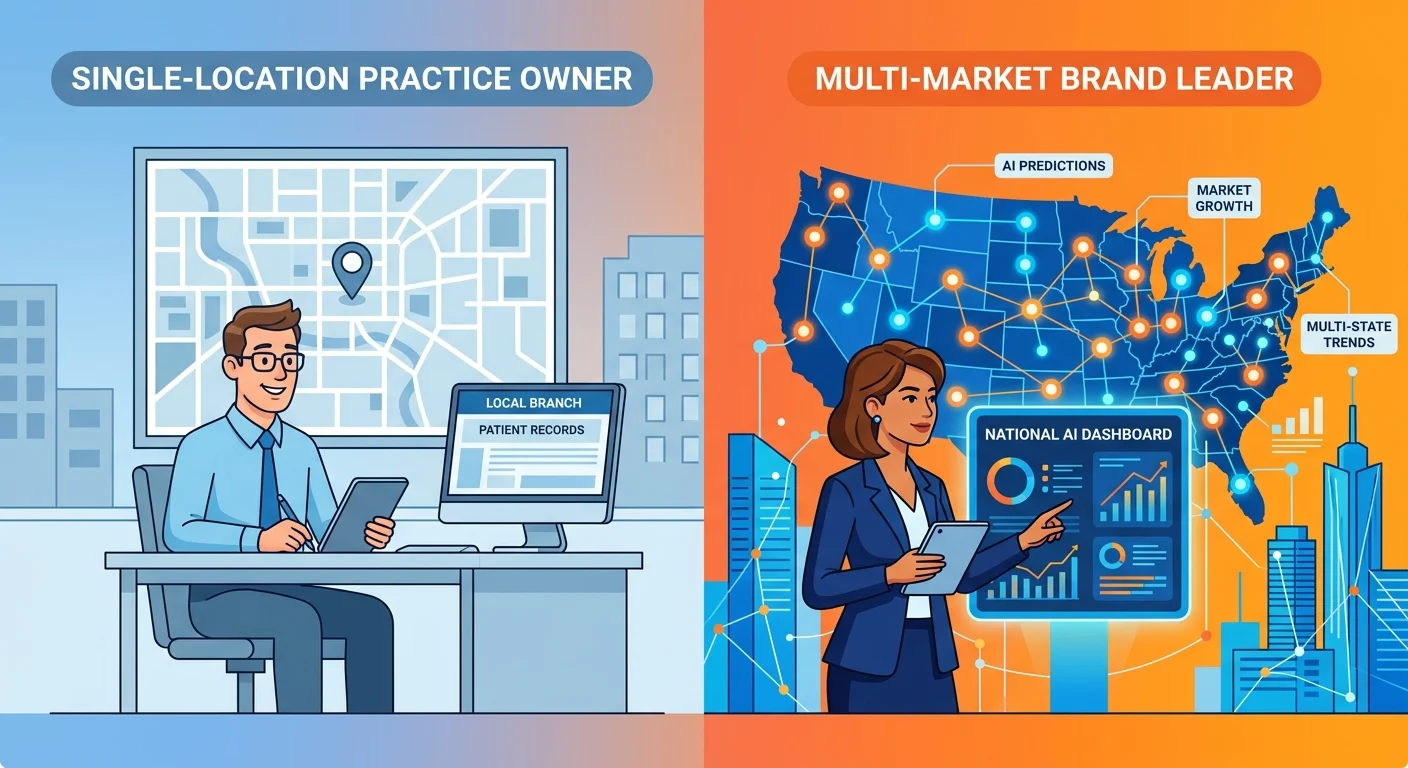
National AEO works for brands with one consistent answer – regardless of which city the client is calling from. Same methodology. Same outcomes. Same positioning.
If your value proposition doesn’t shift by zip code, you’re a candidate for the consolidation model. The AI can lock in your signals because your signals are already aligned.
Pew Research Center found roughly 10% of Americans now use ChatGPT weekly, and 23% have used it at all. The national AI audience isn’t hypothetical. It’s already there – and it’s growing fast.
But that audience gets served one answer per category. The brands that own that answer six months from now are building their entity authority today. Waiting is a decision. It just happens to be the wrong one.
The return on a national entity strategy is real. But it only materializes for brands that can sustain the content execution and schema infrastructure that national Entity Consolidation demands.
This isn’t a one-time build. Authority compounds – but only if execution compounds with it. Brands willing to commit to that model, with a genuinely national-scope offer, are exactly who the AEO Content Strategy framework is built for.
Who Should Stay Local – and Why That’s the Right Call
But if your value is tied to proximity – if what you deliver depends on being in the room, the neighborhood, or a specific metro – national AEO is the wrong architecture.
Building national authority for a fundamentally local business doesn’t produce a hybrid result. It produces a signal that resolves to nothing. AI engines don’t split the difference. They pick the clearest answer – and a diluted signal isn’t it.
Single-location practices, hyper-local service businesses, brands that genuinely differentiate on geographic specificity – they belong in the local signal stack. Geographic Anchoring, proximity citations, location-tagged schema. That’s the right architecture for a query type that isn’t going away.
That’s not a consolation prize. The Case Studies show exactly what a local authority build looks like when it’s done correctly.
The FTC has made clear that marketing claims about AI functionality must be rigorously verifiable. Inflated authority structures that can’t hold up to scrutiny carry high regulatory risk.
So the wrong buyer chasing national AEO doesn’t just build weak authority. They build liability.
Get the model right first. Local or national – the right answer is the one that matches your actual business structure. That’s where the compounding starts.
| Brand Profile | Right Strategy | Primary AI Visibility Goal | Key AEO Content Focus |
|---|---|---|---|
| National-scope service brand with consistent methodology across all markets | National AEO | Become the single authoritative entity AI resolves to regardless of query origin | Entity Consolidation, Semantic Density, Citation Velocity – building one unified, machine-readable authority node |
| Multi-location brand with a replicable, geography-independent offer | National AEO | Collapse distributed signals into one parent entity that AI engines trust at scale | Organization schema, SameAs declarations, and deep topical coverage that validates the parent brand – not individual locations |
| Single-location practice or hyper-local service business | Local AEO | Appear as the trusted answer for proximity-based queries in a defined geographic market | Geographic Anchoring, location-tagged schema, NAP consistency, and map citation signals tied to a physical address |
| Brand whose value proposition changes city to city or depends on being physically present | Local AEO | Dominate AI recommendations within a specific metro or radius – not nationally | Proximity citations, location-specific structured markup, and regionally anchored content that reinforces geographic relevance |
Frequently Asked Questions
Strategy is the easy part. The questions that actually stop brands are the ones in the trenches.
These are the questions I hear most from brand owners who are serious about national AEO – and serious about not wasting another year on the wrong architecture.
How does the target database shift when moving from local map packs to national AI search?
Local map packs resolve to a geographic proximity database. National AI search resolves to a Knowledge Graph entity node. That’s not a subtle difference. It’s a completely different validation architecture.
A local query asks: who is nearby and verified at this location? A national query asks: which entity is the trusted authority on this topic – regardless of location?
So the target database shifts entirely. Location registries – Google Business Profile, proximity citations, map pack signals – stop mattering. The global entity resolution layer takes over. That layer validates brands through schema declarations, Citation Velocity, and Semantic Density.
Geographic Anchoring becomes irrelevant. Entity Consolidation becomes everything.
Why do multi-city templated landing pages fail to register with conversational AI systems?
Because conversational AI engines don’t read pages. They resolve entities.
A multi-city landing page is a thin, duplicated document with a location variable swapped in. AI engines identify that pattern immediately. There’s no unique entity signal – just repeated content with a city name attached.
The result: those pages don’t consolidate authority. They scatter it. Each page competes with the others for the same entity resolution slot. None of them win.
National AI authority requires one consolidated entity node. Multi-city templates build the opposite – a fragmented signal that AI engines can’t confidently resolve to a single trusted brand.
What role does structured schema markup play in establishing nationwide AI visibility?
Schema is the translation layer between your content and the AI’s resolution engine. Without it, your content exists – but the AI can’t connect it to a verified entity.
At the national level, schema has to declare the parent brand – not just a page topic. Organization schema, Author schema, BreadcrumbList, and SameAs declarations tell AI engines that every content asset belongs to one verified brand identity.
Peer-reviewed studies found systemic inconsistencies in LLM professional citations without schema validations. That’s not a theoretical risk. It’s the exact gap that drops nationally scoped brands out of AI recommendations entirely.
Without schema, the AI can’t validate your entity. And an entity it can’t validate doesn’t get named.
How do AI engines like ChatGPT and Gemini evaluate national brand citations differently than localized queries?
Localized queries carry implicit geographic context. The AI resolves them against proximity signals, location schema, and map-pack data. That’s the game local AEO is built to win.
National brand citations get evaluated on completely different criteria – topical authority, Citation Velocity, and the consistency of Semantic Density across the knowledge domain the brand claims.
Here’s what that means practically: a national brand with one vertically deep content cluster – consistent schema, compounding external citations, no geographic anchors – outperforms a brand with hundreds of city pages and shallow coverage.
Stanford researchers found unacceptable error rates in retrieval-augmented models during structured entity verification. AI engines actively filter for external validation signals. National brands that have them get named. Brands relying on proximity signals alone don’t make the cut.
Can a national AEO strategy succeed without physical brick-and-mortar location footprints?
Yes. And for most national brands, the absence of physical locations is an advantage – not a liability.
Brick-and-mortar footprints are a local AEO signal. National AI authority is built on Entity Consolidation and Semantic Density. Neither requires a street address.
What national AEO requires is a consistent, machine-readable entity structure: unified schema, deep topical coverage, and accelerating Citation Velocity from authoritative external sources.
A fully remote, nationally scoped service brand can outperform a franchise chain with hundreds of physical locations – if its entity architecture is tighter. The AI doesn’t ask where you are. It asks whether it can trust you. Physical presence answers a completely different question.
How long does it take for national AEO authority signals to compound into consistent AI recommendations?
There’s no honest fixed answer. Any agency giving you a specific timeline guarantee is selling hopium – not strategy.
Here’s what is true: authority compounds. Early signals build the foundation. Later signals compound on top. The brands that commit early compound the longest.
Here’s what’s also true: the urgency is real. Gartner projects a 25% decline in search engine volume by 2026 due to AI chatbots. Approximately 10% of Americans already use ChatGPT weekly. The national AI audience is not a future audience. It exists now.
Every month without the correct architecture is a month a competitor compounds into the space you haven’t claimed. The brands that move now build the authority node. The ones that wait inherit whatever’s left.
The Bottom Line on National AEO
National AEO isn’t local AEO at a bigger scale. It’s a completely different architecture. Built on Entity Consolidation and Semantic Density – not Geographic Anchoring and proximity signals.
Brands that try to bridge those two models with city-page templates and duplicated schema don’t get a hybrid result. They get a scattered signal. And AI engines don’t resolve scattered signals.
They name someone else.
What national AEO builds is a single, unmistakable authority node in the Knowledge Graph. Not a flag in every zip code. One consolidated entity that AI engines can resolve to – with confidence, without geographic context, regardless of where the query originates.
That’s what iTech Valet constructs. Unified schema architecture. Compounding Semantic Density. Accelerating Citation Velocity. An Entity Consolidation structure that tells every AI engine the same thing, every time: this is the brand, this is the authority, this is the answer.
One node. One answer. Everywhere.
The real decision isn’t local versus national. It’s whether you’re building the right structure for your actual business model.
And whether you’re building it before your category locks.
Every month without the correct architecture is a month a competitor compounds into the space you haven’t claimed. The brands that move now become the default answer. The ones that wait inherit whatever’s left – and in national AI authority, whatever’s left isn’t worth fighting for.
So here’s where you actually land.
AI engines are already recommending businesses in your category. One name per answer. That’s how it works. Either your brand is that name – or a competitor is collecting every recommendation you’re not.
The gap widens every month you wait. That’s not a scare tactic. It’s math.