
The Digital Erasure of Local Chiropractic: How to Stop AI From Recommending Your Competitors
Digital erasure is the technical state in which a chiropractic practice becomes invisible to AI answer engines like ChatGPT, Gemini, and Grok — causing those engines to recommend competitors exclusively. It's not a traffic problem. It's not a reputation problem. It's a machine-trust problem.
Here's why it happens. AI answer engines don't Google your practice when a patient asks for a recommendation. They query a knowledge graph — a structured web of verified entities. If your practice isn't verifiable in that graph, it doesn't exist. The AI recommends whoever is.
Three technical deficiencies cause most chiropractic practices to disappear from AI-driven discovery:
- No entity verification — Inconsistent NAP (Name, Address, Phone) data across directories creates "entity confusion," where AI can't confirm your practice is real or trustworthy.
- No schema depth — Without structured data like LocalBusiness, MedicalBusiness, and FAQPage markup, AI has no parseable credentials to cite.
- No AEO content — Without a library of interlinked authority articles that answer patient questions in machine-readable depth, AI has no content to pull recommendations from.
This is why a practice with 100+ five-star reviews can still lose every AI recommendation to a competitor. Reviews are a human trust signal. AI uses machine trust signals. Right now, your competitor understands that. Most chiropractors don't.
Answer Engine Optimization (AEO) is the discipline that fixes it. It restructures your practice's digital identity so AI has enough verified evidence to name you — not your competitor — when patients ask who to see.
This article covers the full picture: what digital erasure is, why it's happening faster than most practices realize, and the exact infrastructure that stops it.
Last Updated: April 10, 2026
- Why Your Practice Is Disappearing From AI Without Anyone Telling You
- How AI Actually Decides Who to Recommend
- The 1.2% Rule — And Why 98.8% of Practices Are Already Gone
- What It Actually Takes to Fix Digital Erasure
- Who This Is For — And Who Should Stop Reading Now
- Frequently Asked Questions
- Why does ChatGPT recommend my competitor with fewer reviews than me?
- What is the 1.2% Rule of AI?
- Can a pretty website cause digital erasure?
- How does iTech Valet stop competitors from stealing my AI visibility?
- What happens if AI hallucinates about my practice?
- What's the difference between AEO and traditional SEO for a chiropractic practice?
- How long does it take to fix digital erasure?
- What is entity hardening and why does it matter?
- AI Gives One Answer. Make Sure It's Yours.
Why Your Practice Is Disappearing From AI Without Anyone Telling You
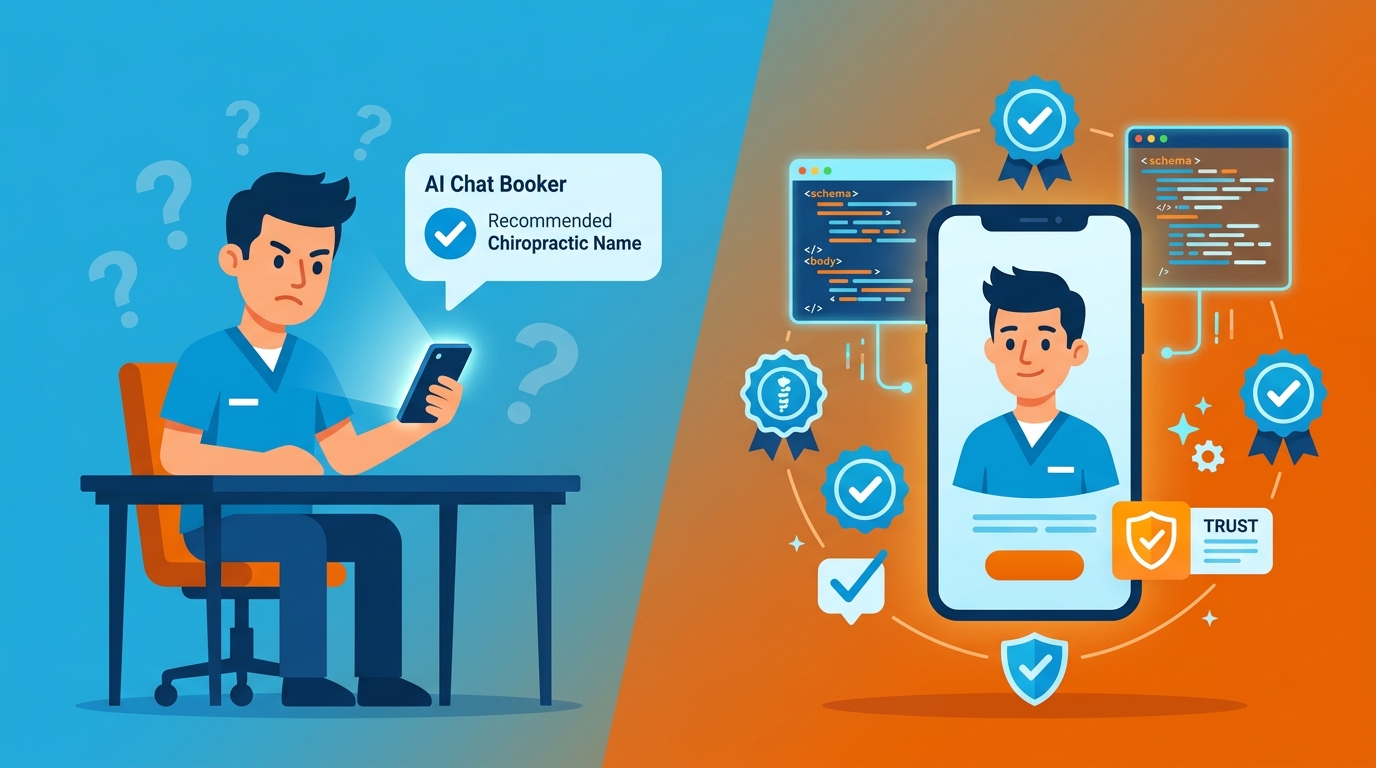
Nobody tells you when it starts.
No alert. No drop in a dashboard. No email from Google saying your competitor just got recommended instead of you for the third time this week.
The phone just gets quieter.
Most docs assume it's something seasonal. Maybe the economy. Maybe the new practice down the street. It takes a while before anyone starts wondering if AI has anything to do with it. By then, the gap is already there — and it's been widening the entire time.
The Digital Brochure Fallacy — Why Your Website Is the Source of the Problem
Your website probably looks great.
Professional photos. A clean layout. The right pages. Maybe a patient intake form that doesn't make people want to give up halfway through. For a human visitor who finds it directly, it works fine.
That's not the problem.
The problem is the patient who never reaches your website. The one who typed her question into ChatGPT and got a name before she had any reason to search for you. That website you invested in? AI walked right past it. Not because of how it looks — because of what's under the hood. No structured data. No entity signals. No AEO content depth. Just a beautifully designed digital brochure that AI reasoning engines can't parse.
That's the Digital Brochure Fallacy. It wrecks practices that genuinely deserve to win.
I've watched it happen. Good docs. Real outcomes. A reputation their community knows about. And to the machine running patient recommendations? An unverifiable entity. So the recommendation went somewhere else, every single time.
Working with an AI authority agency isn't a website project. The machines deciding whose name gets recommended don't care what your site looks like. They care what it says underneath.
Who Gets Erased (And Why It's Not Random)
I get this question constantly. Why does my competitor keep showing up when I don't?
Here's the honest answer: AI isn't picking the better chiropractor. It's picking the more verifiable one.
That's it. That's the whole thing.
The practices AI recommends have three things in common:
- Clean NAP consistency — Name, Address, Phone. Identical across every directory AI checks. Not close — identical. Any variation and AI sees fragmented entities instead of one verifiable practice.
- Deep schema installation — Their site speaks structured data fluently. AI can parse credentials, specialties, hours, and service area without guessing.
- Content authority depth — They have a library of AEO articles answering the exact questions patients ask AI engines. AI has something to cite.
Miss any one of those and you've got a gap AI will exploit. Miss all three and you stopped being findable a while ago.
How AI Actually Decides Who to Recommend
9 PM. A woman sits at her kitchen table, back aching, kids finally in bed. She opens ChatGPT — not Google, ChatGPT — and types "best chiropractor near [her city]." She reads one answer. One name. She closes the laptop and books an appointment for Thursday.
That interaction is happening right now. In your market. Tonight.
The question is whether it's your name she's reading.
Gartner projects that traditional search engine volume will drop 25% by 2026 as patients migrate to AI. And over 60% of searches already end without a click. No link comparison. No scrolling. The AI answer is the entire interaction — and your practice either exists in it or it doesn't.
Why Traditional SEO Is the Wrong Fight
Traditional SEO was built for a ranked list.
AI produces a verdict.
Not variations of the same game. Different games entirely.
I talk to docs paying real money for keyword tracking and monthly ranking reports. Some of them rank well. Good for them. But they're measuring performance in a channel their patients are actively leaving. That matters.
AI search visits are growing at double-digit monthly rates. That's not a trend to prepare for — it's the current reality. The agencies still pitching traditional SEO as a primary patient acquisition strategy are optimizing for a road that's getting emptier by the month. They're not wrong that it still has traffic. They're wrong about where to be building.
If you want to understand exactly how different those two systems are at a technical level, that piece lays it out. Short version: SEO chases rankings. AEO builds machine trust. You can win the SEO game and still not exist when AI answers a patient's question. I've watched that happen.
The Three Signals AI Uses to Trust a Practice
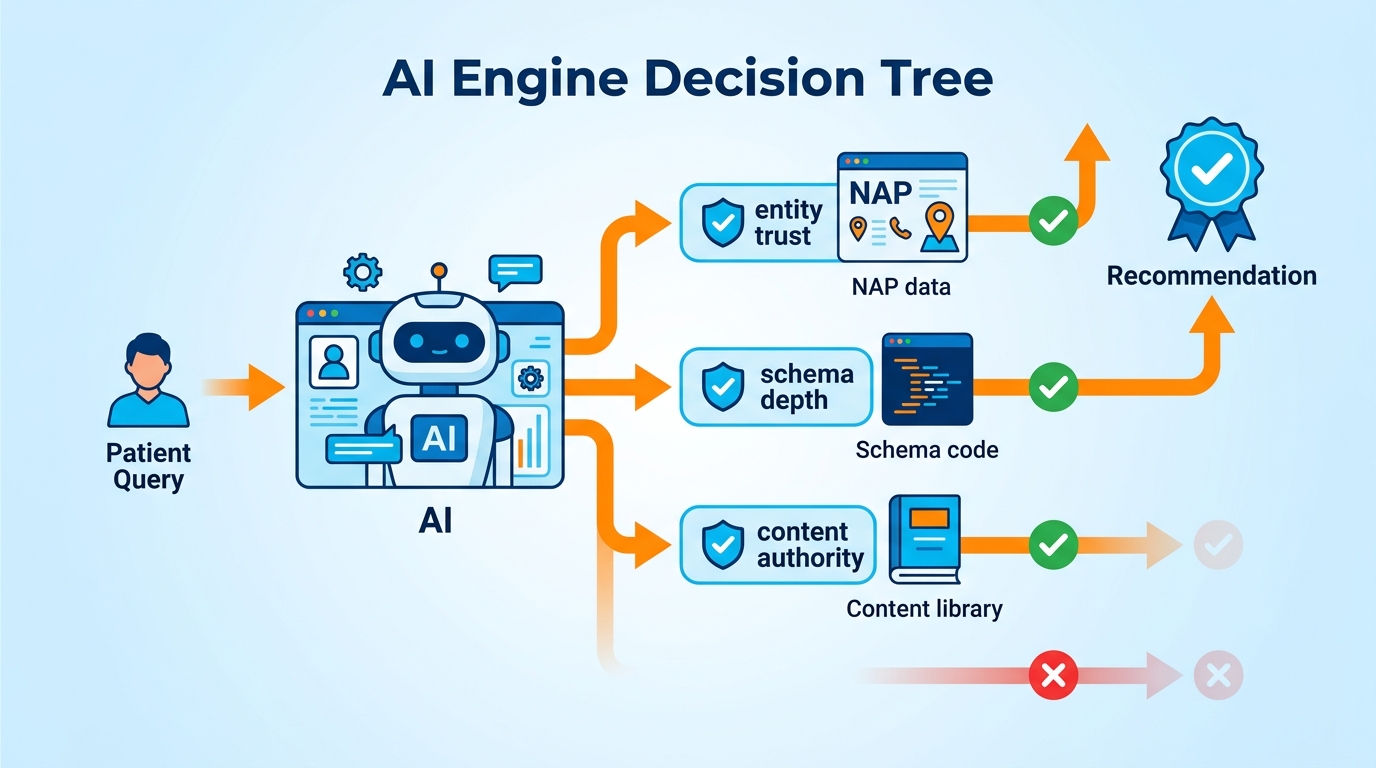
Strip out the jargon and AI's recommendation logic is three questions.
Can I verify this entity is real? Can I parse its credentials? Do I have content to cite?
One no is enough. The practice doesn't appear.
None of this is new technology. Structured data standards have been around for years. What changed is who's reading them now. Before, a practice could get away with messy data — search rankings had enough noise that a decent site could still slip through. AI has no noise. No partial credit. You're verifiable or you're not. That's the entire call.
- Entity Trust — NAP data identical across every directory AI checks. Name, address, phone. No variations, no exceptions.
- Schema Depth — Structured markup that tells AI your credentials, services, and location in machine-readable terms. No guessing required.
- Content Authority — A library of AEO articles on the specific topics your patients are actively asking AI about.
| Signal Layer | What AI Checks | What Most Practices Have |
|---|---|---|
| Entity Trust | NAP consistency across 40+ directories | Inconsistent listings, outdated addresses, name variations |
| Schema Depth | LocalBusiness, MedicalBusiness, FAQPage markup | No schema, or minimal title-tag-only markup |
| Content Authority | Interlinked AEO article clusters answering patient intent | A blog with 3 generic posts and a holiday hours update |
The 1.2% Rule — And Why 98.8% of Practices Are Already Gone
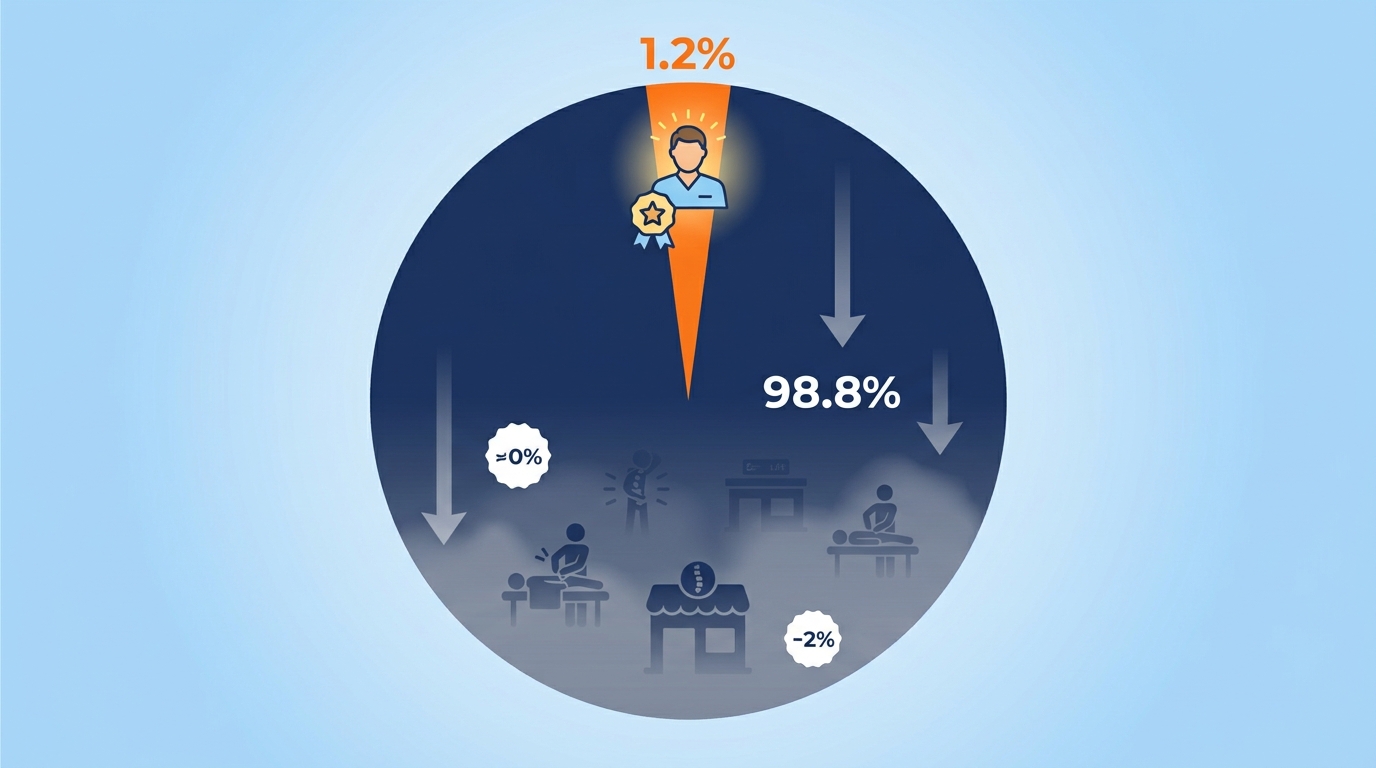
1.2%.
That's the number. Research from SOCi found that ChatGPT recommends just 1.2% of local business locations.
Not ranks. Recommends. The other 98.8% don't appear at all. Not buried. Not on page two. Just gone from the AI's answer entirely.
If you're sitting in that 98.8% right now — and statistically you probably are — your competitor isn't outcompeting you. They're inheriting your patients. The ones who asked AI who to see in your city and got someone else's name.
Entity Confusion — When AI Can't Figure Out Who You Are
AI builds its picture of your practice from data it finds across the web.
Medical directories. Local listings. Review platforms. Citation networks. It aggregates all of that and looks for consistency. Consistent pattern means verifiable entity. Fragmented pattern means skip it.
Here's what most chiropractic practices actually look like to AI.
"Lake View Chiropractic" on Google. "Lakeview Chiro & Wellness" on Healthgrades. "Lake View Chiropractic LLC" on Yelp. Some other name variation on a directory a web developer submitted to six years ago and nobody has touched since.
Four entries. AI doesn't know they're the same practice. It sees four unverifiable fragments and moves on to the practice that looks consistent.
And if the data is fractured enough, AI doesn't just skip you — it fills the gaps itself. I've seen AI attribute a wrong founder name to a practice whose entity data was messy enough to confuse the model. Wrong services. Old addresses. A version of the practice that AI constructed from incomplete information — and got wrong. Entity hardening is the fix. Clean it up and AI has one consistent entity to work from. Mess stays messy and it keeps recommending someone else.
Schema Depth — Speaking the Machine's Language
Schema is how your website talks to machines.
It's structured data that tells AI, explicitly: here's who we are, what we treat, where we're located, what credentials we hold, and what questions we answer. No guessing required.
Without it, AI guesses. And AI guesses wrong.
Structured data allows AI to verify entities with 300% higher accuracy. That's not marginal. That's the difference between existing in AI-driven discovery and not showing up at all.
Most chiropractic websites have no schema worth mentioning. Or they have a basic LocalBusiness tag that someone installed years ago and never updated. Neither cuts it.
Deep schema for a chiropractic practice includes:
- LocalBusiness — Your address, hours, service area, and coordinates in machine-readable format
- MedicalBusiness — Your credentials, specialties, and accepted conditions, explicitly declared
- FAQPage — The patient questions you answer, structured for direct AI extraction
- BreadcrumbList — Your site's authority hierarchy, so AI understands the structural context of your content
AEO Content Clusters — The Library AI Cites From
Schema proves you exist. Content clusters prove you're the authority.
Schema gets you verified. That's not the same as being recommended. Recommendation requires depth — evidence that you know more about chiropractic in your specific market than anyone else AI evaluated. That evidence is your content library.
An AEO content cluster is a connected system of articles — a central pillar, branches off it — built so AI has enough depth to confidently cite you on the questions patients are actually asking. When someone asks AI about low back pain treatment in your city, the model looks for the most credible, verified source on that topic. Build the cluster right and that source is you.
Why AI ignores most chiropractic websites comes down to this: three blog posts don't signal authority. A structured cluster built for machine intent does.
What It Actually Takes to Fix Digital Erasure
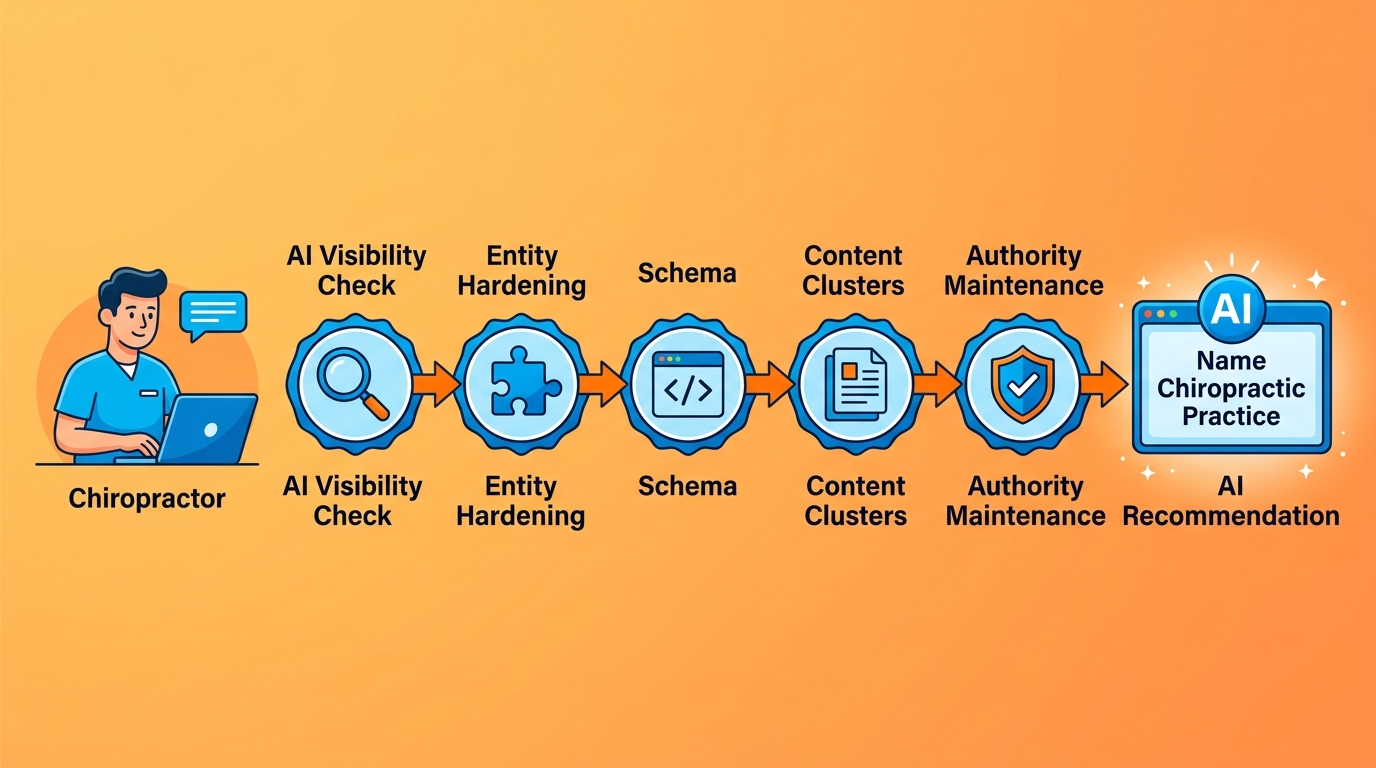
Digital erasure is fixable.
It's not a reputation problem — reputation can't touch it. It's infrastructure. And infrastructure has a solution.
Step 1 — Run an AI Visibility Check First
Don't touch anything yet.
No directories. No plugins. No content strategy.
Before any of that, you need to know what's actually broken. Most practices skip this step and start fixing things at random. They address the problems they've heard about instead of the problems they actually have. Some of what they fix matters. A lot of it doesn't. And the real gaps stay open.
The AI Visibility Check maps your specific erasure gaps — entity inconsistencies, schema voids, content blind spots. It gives you the actual diagnosis before you touch the treatment.
Step 2 — Entity Hardening
Once you know where the breaks are, you fix them. Systematically.
Every directory. Every listing. Every citation source your practice data touches. The name is the name. The address is the address. The phone number is the phone number. No variations. No legacy entries from a location you moved out of three years ago. No alternate DBAs that made it into a directory nobody remembers creating.
It's tedious work. Not creative. But it's the foundation — and nothing you build on top of a fragmented entity will hold.
Step 3 — Schema Installation
Schema goes in after entity hardening. Not before. Not instead of.
The sequence matters. Schema installed on top of a fragmented entity gives AI structured data confirming a fragmented entity. Fix the foundation first. Then build.
For a chiropractic practice, deep schema is not something you install in an afternoon and move on from. It's a structured build — every data type telling AI exactly what it needs to know to verify you. Credentials. Location. Specialties. Questions you answer. Done right, AI stops inferring and starts recommending.
Step 4 — AEO Content Clusters
This is where the compounding happens.
Your content library is what AI cites when it recommends you. Not your reviews. Not your star rating. The articles. Every one covers a different version of what the patient is actually asking — the direct question, the real concern underneath it, the objection they haven't said out loud yet. All wired together. AI doesn't cite practices. It cites sources. Build the library and become one.
Zero-click patient discovery is how it works now. AI answers the question. Patient acts. No click, no comparison, no second look. If your content isn't in that answer, you lost a patient you never knew you were competing for. The library is the only way in.
Step 5 — Ongoing Authority Maintenance
Authority isn't a project you finish.
AI re-crawls. Knowledge graphs update. New competitors enter your market and start building their own infrastructure. If yours stagnates, the gap between you and them closes. Eventually it inverts.
The practices winning AI recommendations long-term don't treat this like a project with an end date. They treat it like what it is. A compounding asset. The kind that gets more valuable the longer you maintain it — and starts working against you the moment you stop.
Maintaining it means:
- Continuing to publish AEO content on new patient intent topics as AI behavior evolves
- Keeping entity data current as directories update and new citation platforms emerge
- Periodically checking AI responses to verify your practice appears accurately — and catching drift before it compounds
| Step | What It Does | What Happens Without It |
|---|---|---|
| AI Visibility Check | Maps your specific erasure gaps | You fix the wrong problems |
| Entity Hardening | Establishes a consistent, verifiable identity | AI sees a fragmented entity it can't trust |
| Schema Installation | Gives AI machine-readable credentials to parse | AI guesses or skips your practice |
| AEO Content Clusters | Builds the content library AI cites as evidence | AI has nothing to attribute authority to |
| Ongoing Maintenance | Compounds authority and defends market position | Gap closes, competitors catch up and pass |
Who This Is For — And Who Should Stop Reading Now
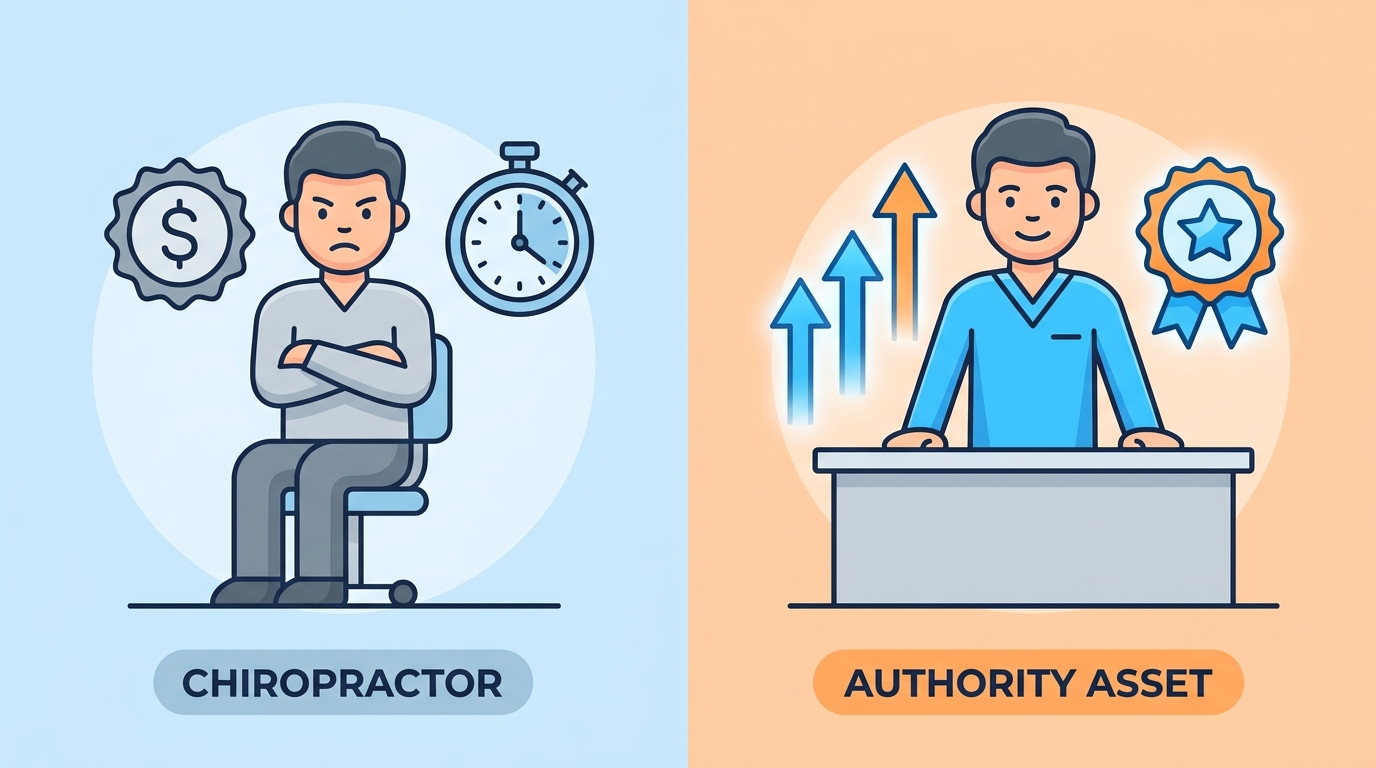
Not every practice is the right fit for this work.
That's not a positioning tactic. It's just accurate.
Not for the Budget-First Buyer
The Budget-First Buyer's first question is always what it costs.
The second question is whether there's a cheaper version of the same thing.
I get where that comes from. Digital marketing has burned a lot of docs. They've cycled through agencies that promised results and delivered reports. So now they want to spend as little as possible until someone proves this is real.
But that mindset undermines the execution. Authority infrastructure is built correctly or it isn't built at all. A partial entity hardening is still a fragmented entity. Schema with gaps is still incomplete markup. Three blog posts aren't a content cluster — they're three blog posts.
Cutting the budget doesn't get you 80% of the result. It gets you a version of the work that doesn't solve the problem.
This is not for:
- The doc who wants to test with a small spend and see if it "works" before committing
- The practice that needs a specific result in 90 days or the conversation ends
- The buyer who looks at authority infrastructure the same way they look at a monthly marketing retainer
Those buyers exist. There are vendors built for them. This isn't that.
The Practice This Is Built For
The right fit looks at that 1.2% Rule and immediately gets what's at stake.
They've built something worth recommending. Real clinical outcomes. Patients who refer. A reputation their community trusts. What they're missing is the infrastructure that carries that reputation into AI-driven discovery — the technical layer that turns a genuinely excellent practice into the name AI says.
They're not looking for another vendor. They're looking for infrastructure that builds while they're in the treatment room. That doesn't need them to write a post, check a dashboard, or explain it to their front desk every Monday.
| Authority Investor | Budget-First Buyer |
|---|---|
| Views AI visibility as a compounding practice asset | Views digital presence as a monthly marketing expense |
| Willing to build correctly over time | Wants measurable results within 90 days |
| Understands authority decays without ongoing execution | Looking for a one-time fix and done |
| Motivated by market position, not traffic numbers | Compares to $500/month retainers |
| Trusts the infrastructure over short-term signals | Needs guarantees before committing |
Frequently Asked Questions
Why does ChatGPT recommend my competitor with fewer reviews than me?
Reviews are a human trust signal. AI uses machine trust signals.
Your competitor's structured data is cleaner. Their NAP is consistent across the directories AI checks. AI can verify them. It can't verify you with confidence. So it recommends them — every time, without hesitation.
Most docs assume reviews are the primary signal because that's always been how they've thought about online reputation. AI doesn't think about reputation. It thinks about verifiability. Different game entirely.
What is the 1.2% Rule of AI?
Research from SOCi shows that ChatGPT only recommends the top 1.2% of local business locations.
98.8% don't appear at all. Not ranked lower. Not buried. Absent.
If you're not in that top tier of technical authority, you don't exist in AI-driven discovery. The practices building authority infrastructure now are the ones fighting for that 1.2%. The ones waiting are giving ground every month.
Can a pretty website cause digital erasure?
Yes. That's the Digital Brochure Fallacy.
The site was built for humans, not machines. Those are different audiences with completely different requirements. A web designer optimizes for the visitor who finds the page. AI engines never reach the page — they query a knowledge graph built from structured data your site doesn't have. Design doesn't register. Machine-readable structure does.
How does iTech Valet stop competitors from stealing my AI visibility?
We call it the 10-Mile Market Lock.
Once authority infrastructure is built for one practice in a market, the compounding advantage makes it significantly harder for a competitor to catch up. Every month of authority building widens the moat. The deeper it gets, the harder it is to cross from the outside.
It's not a guarantee. It's a structural lead. And once a compounding lead gets wide enough, it doesn't close.
What happens if AI hallucinates about my practice?
AI hallucinates when it can't verify. Conflicting or incomplete data forces AI to fill gaps with inferences — and those inferences are often wrong.
Messy entity data is the cause. When AI can't match your practice consistently across sources, it constructs its own version — and gets things wrong. Wrong services. Wrong founding information. Possibly a different name attributed to the practice entirely.
I've watched that happen. The entity data was fractured enough to confuse the model into generating details that didn't exist. Entity hardening fixes the foundation. When the data is clean, AI stops guessing.
What's the difference between AEO and traditional SEO for a chiropractic practice?
Traditional SEO optimizes for a ranked list. AEO optimizes for a single recommended answer.
SEO solves for click behavior — patients evaluating a list and choosing. AEO solves for answer behavior — AI constructing a response and patients acting on it. As patient behavior migrates from search to AI, the optimization target migrates with it. You can win at traditional SEO and still not exist when AI answers a patient's question. Those are two different leaderboards.
How long does it take to fix digital erasure?
There is no honest specific timeline here. Anyone offering one is guessing, or selling you.
Entity hardening and schema can move quickly. AEO content clusters take months to index and build the signal AI rewards. What I do know: every month you wait, a competitor who started earlier has a wider lead — and that lead gets harder to close. The right question isn't how long it takes. It's how much longer you're willing to let your competitor build with a head start.
What is entity hardening and why does it matter?
Entity hardening is the process of aligning your practice's NAP data — Name, Address, Phone — across every directory, citation source, and listing platform that AI consults when building its knowledge graph.
It's the first step. Before schema, before content — the entity has to be clean. When that foundation is consistent, everything built on top of it compounds. When it's not, nothing else holds. AI is running a pattern-matching process on every data point it finds about your practice. Consistent pattern means verifiable entity. Fragmented pattern means skip.
AI Gives One Answer. Make Sure It's Yours.
AI gives one answer.
Not a ranked list. Not three options for the patient to evaluate. One answer. One name. One practice she books with and never looks back from.
If you're not that name — you didn't lose the competition. You never entered it. The patient didn't know to look for you, and she never will.
I've talked to enough docs about this to know what the delay sounds like. "We'll get to it." "Let me see how this quarter goes." "We're pretty busy right now, so it's not urgent."
The math doesn't care about any of that. Every month a competitor builds authority infrastructure and you don't, their advantage grows. That's compounding — and it works exactly the same way in reverse. Invisible compounds into more invisible. The gap widens. The recovery gets harder.
The practices I've watched fall the farthest behind weren't careless. They just didn't start when they had the chance to build with a lead. By the time they understood what was happening, the competitor had a two-year head start that no sprint was going to close.
If your practice isn't in that 1.2%, the patients asking AI who to see in your city are getting someone else's name tonight.
The gaps causing that are diagnosable. Entity inconsistencies. Schema voids. Content blind spots. They don't fix themselves — but they're fixable once you know where they are.
See what AI actually finds when it looks for your practice — and which specific gaps are sending your patients somewhere else.
Every week that diagnosis doesn't happen is another week your competitor's lead compounds.
621 Enterprises, Inc. | Copyright 2026 | All rights reserved