The Moment You Realize the Game Changed
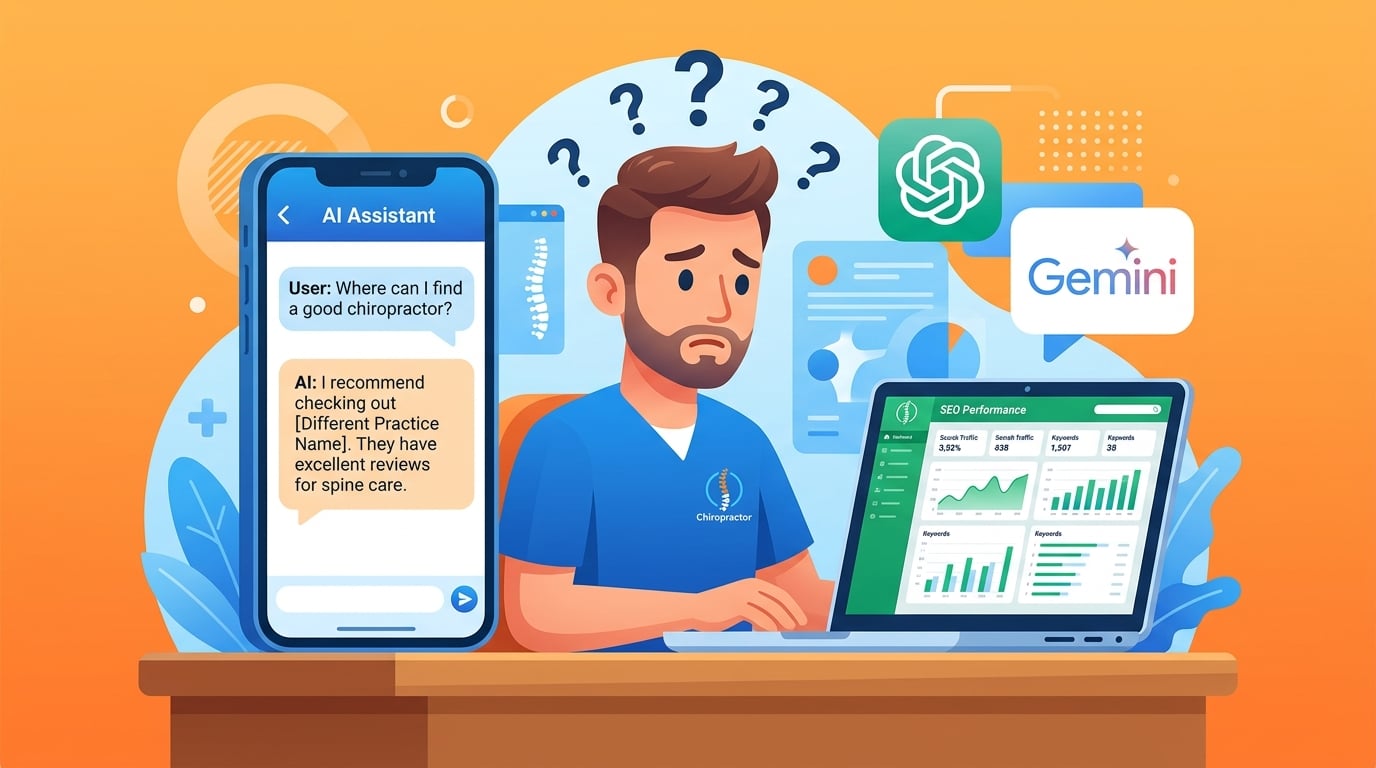
Every doc I’ve talked to about this has the same story.
Agency report hit the inbox that morning. Rankings up. Metrics green. They walk out to the front desk – schedule’s thinner than it was two years ago. Same city. Same reputation. Fewer patients from search. Nobody can explain it. Not them. Not the agency.
That’s not a rankings problem. That’s a zero-click problem. And there’s no metric on that dashboard that tracks it.
Here’s what’s actually happening while those reports look fine. A patient in their market opened ChatGPT instead of Google. Typed in a question. Got one name back – specific practice, specific location, specific reason it’s trustworthy. Closed the app. Made the call. That doc’s ranking never entered the equation because the patient never reached a search results page.
Working with an AI authority agency is a categorically different thing than what most chiropractors have been buying. Not a better version of SEO. A different solution to a different problem.
Most chiropractic sites pass every human test. Clean design. Current content. Good reviews. To a person scrolling through, they look exactly right. AI doesn’t evaluate them that way. It reads entity signals – schema markup, citation consistency, structured data. A site a human calls professional can completely fail the machine’s evaluation. That’s the Digital Brochure Fallacy. Looks right. Registers as uncertain.
Why Your Rankings Mean Less Than You Think
Being ranked #1 and being named by AI aren’t the same outcome.
Most docs assume one produces the other. That assumption is quietly costing them patients.
Gartner projects traditional search volume will drop 25% by 2026 as users move to AI chatbots. That’s not a fringe shift. The mainstream is rerouting.
Meanwhile, AI search visits are up double digits every month. The channel that uses rankings is shrinking. The channel that ignores rankings entirely is growing fast.
Your agency is getting better and better at optimizing for the first one.
What Zero-Click Actually Does to Patient Discovery
Old model gave you ten shots.
Patient searched. Got a list. Saw your name among the results. Compared reviews. Made a decision. You had a real chance to stand out.
Zero-click gives you one shot. Or none.
AI picks someone. Names them. That patient calls. If it’s not you, the conversation was over before you had a chance to show up – and you’ll never know it happened.
There’s no scrolling to the next option in a chat interface. No “let me look at a few more.” One answer. Done.
Two searches. Completely different outcomes.
- Old search – Ten results. Patient compared options. Your reviews and your description actually mattered because they were evaluating. You had a real shot at standing out.
- AI search – One name. No comparison. No alternatives. The patient calls that number or moves on. If it wasn’t yours, you were never in it.
Mobile zero-click rates hit 77.2% in early 2025. That’s the late-night patient on their phone – highest intent, most likely to convert – getting an answer before they ever reach your listing.
Why Traditional SEO Can’t Solve This
The agencies still selling keyword rankings as the answer aren’t all bad agencies.
Some of them are genuinely good at it. But good at the wrong thing doesn’t help you.
The Problem With Chasing Keyword Rankings
Here’s the version no agency is going to put in their pitch deck.
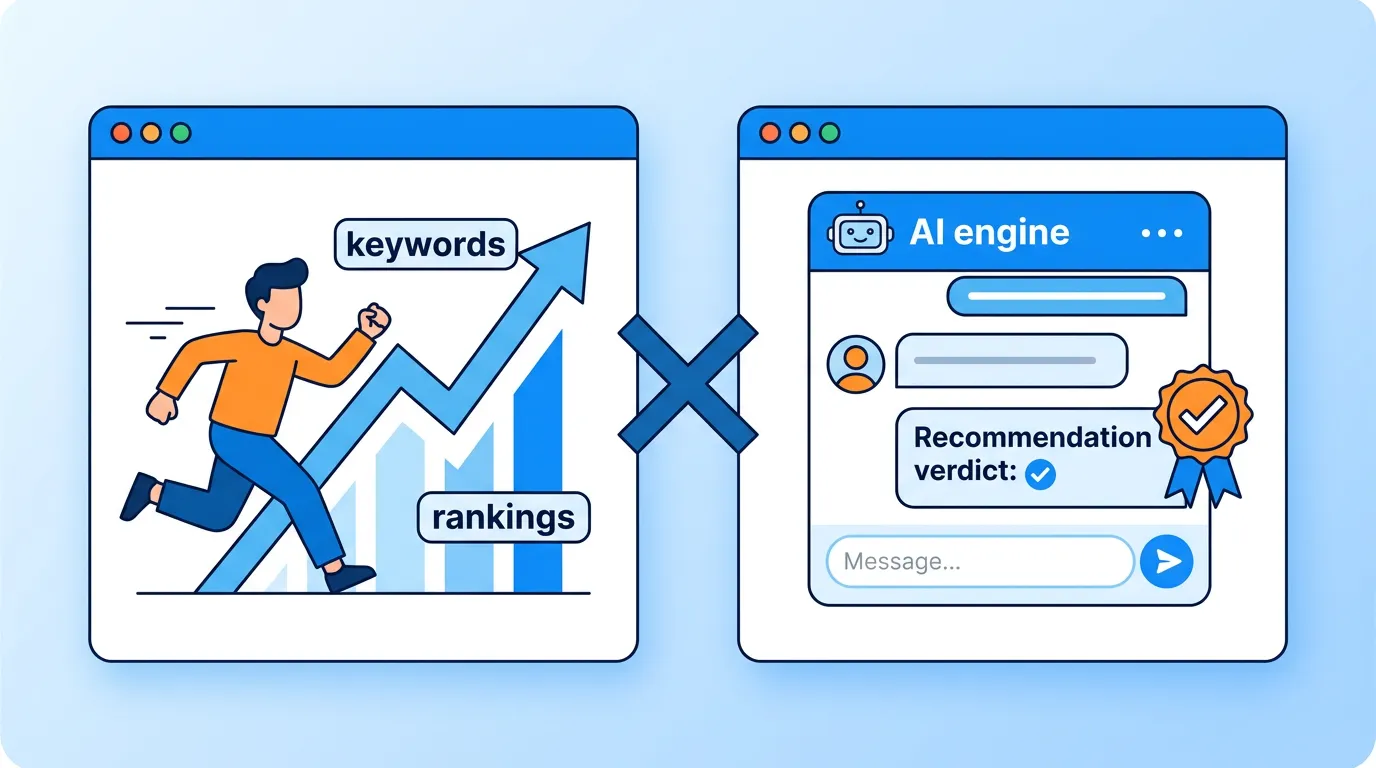
Traditional SEO optimizes for a list. AI search produces a verdict. Those aren’t variations of the same thing.
You can rank #1 on Google and still lose the AI answer to a competitor with worse reviews – because their entity data is cleaner. I’ve watched that play out with practices that had genuinely great reputations. Real reviews. Real results. Patients who referred everyone they knew. But their digital footprint was fragmented – inconsistent data across directories, no schema, content that didn’t cover the right intent layers. To an AI evaluating entity trust, that practice barely registered.
And the competitor down the street kept getting named.
The site looked right to humans. The machine read it as low-certainty. That’s the Digital Brochure Fallacy landing in real time.
Watch for the rebranding too. Some agencies are starting to call their packages “AI-ready” or “AI-compatible.” If the deliverable is still keyword reports and backlink audits – that’s a label change. Not a product change.
The Hopium Cycle: Why Docs Keep Paying for the Wrong Thing
I tell docs this pattern has a name.
Here’s how it always goes:
- The reports look good – Rankings up. Traffic stable. Metrics green. New patients from search are quietly declining. Nobody at the agency is talking about it because the dashboard doesn’t show it.
- You don’t know what to ask – Agency points at rankings. You stay another six months. The gap between your dashboard and your front desk keeps growing.
- You leave and try again – Different agency. Same reports. Same playbook with a different logo on the cover. You’re back at month one.
Sometimes the agency wasn’t even failing at SEO. Sometimes they succeeded. The problem is SEO done well doesn’t solve the zero-click problem. It solves a different one.
Ranking better in a channel that’s losing share doesn’t close the AI gap. The Hopium Cycle isn’t about bad vendors. It’s about buying a solution to a problem that no longer exists while the real problem goes unaddressed.
How AI Actually Decides Which Chiropractor Gets Named
AI doesn’t name the doctor with the most backlinks.
Doesn’t care about domain authority. Doesn’t care who’s been sitting at #1 the longest.
It names the one it can verify.
That sounds simple. It’s not. And most of what chiropractic practices have been investing in for the past decade doesn’t help with verification at all.
Entity Trust: The Factor That Actually Matters
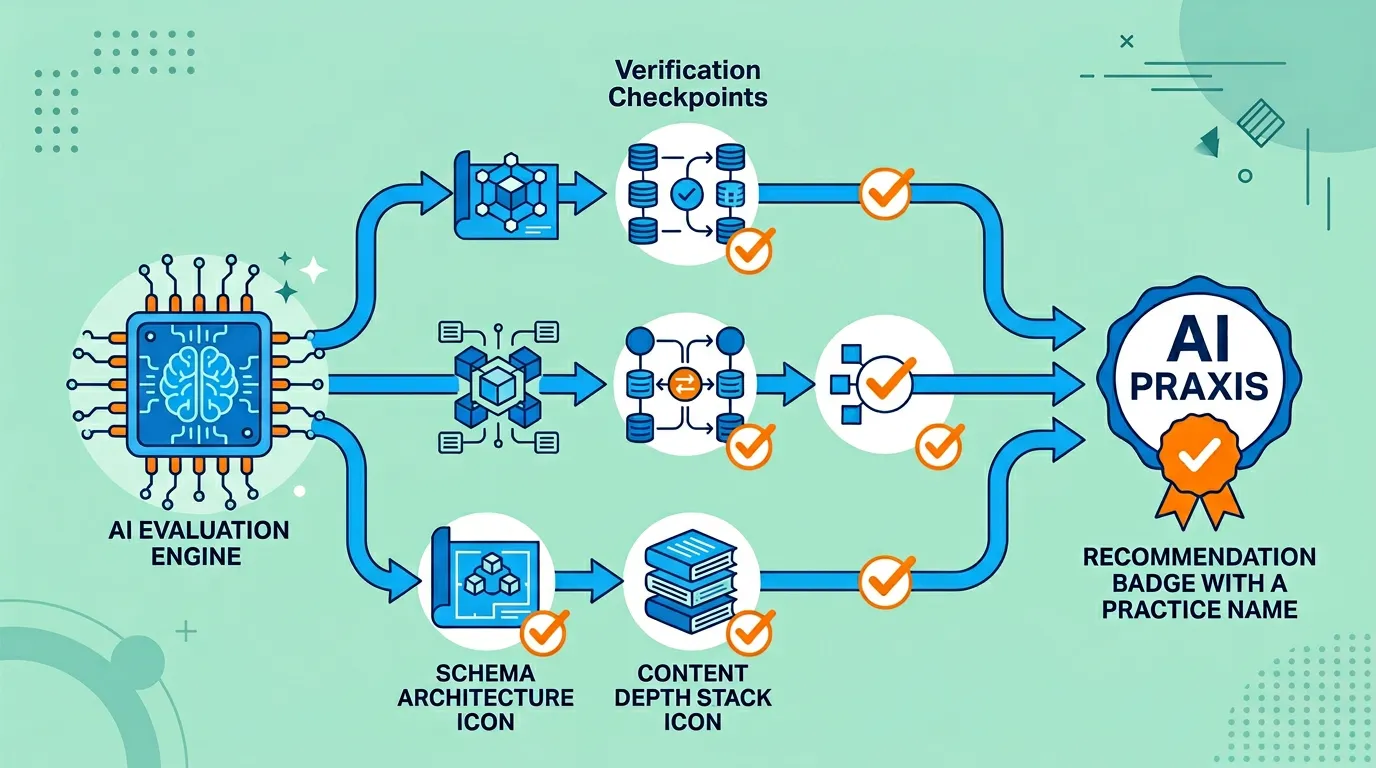
Before AI cites you, it runs a confidence check.
Most practices have never audited any of these. Most don’t know they exist.
- NAP consistency – Your practice name, address, and phone number pulled from every directory AI can access. One inconsistency across listings reads as uncertainty. AI checks more sources than most practices would think to audit.
- Schema markup – Structured data embedded in your site tells the engine specifically who you are, what conditions you treat, and how to validate your existence. No schema means AI is working from unstructured guesswork. Guesses don’t get recommended.
- Content depth – AI evaluates whether your published content covers the patient intent landscape around your specialty deeply enough to call you an authority. A single article about back pain isn’t authority. A structured cluster that covers every question a patient might ask about that condition is.
Signals align – confidence goes up. Signals are fragmented or contradictory – confidence drops. Low confidence doesn’t get cited.
Research shows AI models grounded in structured knowledge graphs achieve 300% higher accuracy in citation and verification. Not 30%. Three hundred percent. That’s the actual gap between a well-structured entity and an unstructured one.
The 1.2% Rule: AI is brutally selective. It recommends the most verified authorities. Most practices aren’t close to that threshold – and most don’t know what the threshold looks like.
What AI Evaluates vs. What SEO Measures
| What Traditional SEO Measures | What AI Actually Evaluates |
|---|---|
| Keyword rankings | Entity consistency across platforms |
| Backlink count | Cross-platform citation consensus |
| Domain authority score | Structured schema depth |
| Page traffic volume | Content specificity and intent coverage |
| Click-through rate | AI-readable infrastructure completeness |
What AI Can and Cannot Verify About Your Practice
Study this one carefully. A lot of what practices are spending money on lives in the right column.
| Practice Signal | Example | AI Can Verify? | Impact on Recommendation |
|---|---|---|---|
| Schema markup | LocalBusiness schema on site | Yes | High |
| NAP consistency | Exact match across 50+ directories | Yes | High |
| Content depth | Condition-specific article clusters | Yes | High |
| Review volume and recency | Google and Healthgrades reviews | Yes | Medium |
| Website aesthetics | Visual design, fonts, images | No | Zero |
| Paid ad spend | Google Ads, Facebook campaigns | No | Zero |
| Keyword rankings | Page 1 position in Google | No | Zero |
Understanding the layers of patient intent AI evaluates before picking a recommendation changes how you see the whole infrastructure problem. Once you see the evaluation criteria, the gap in traditional SEO stops being debatable.
This Isn’t for Everyone
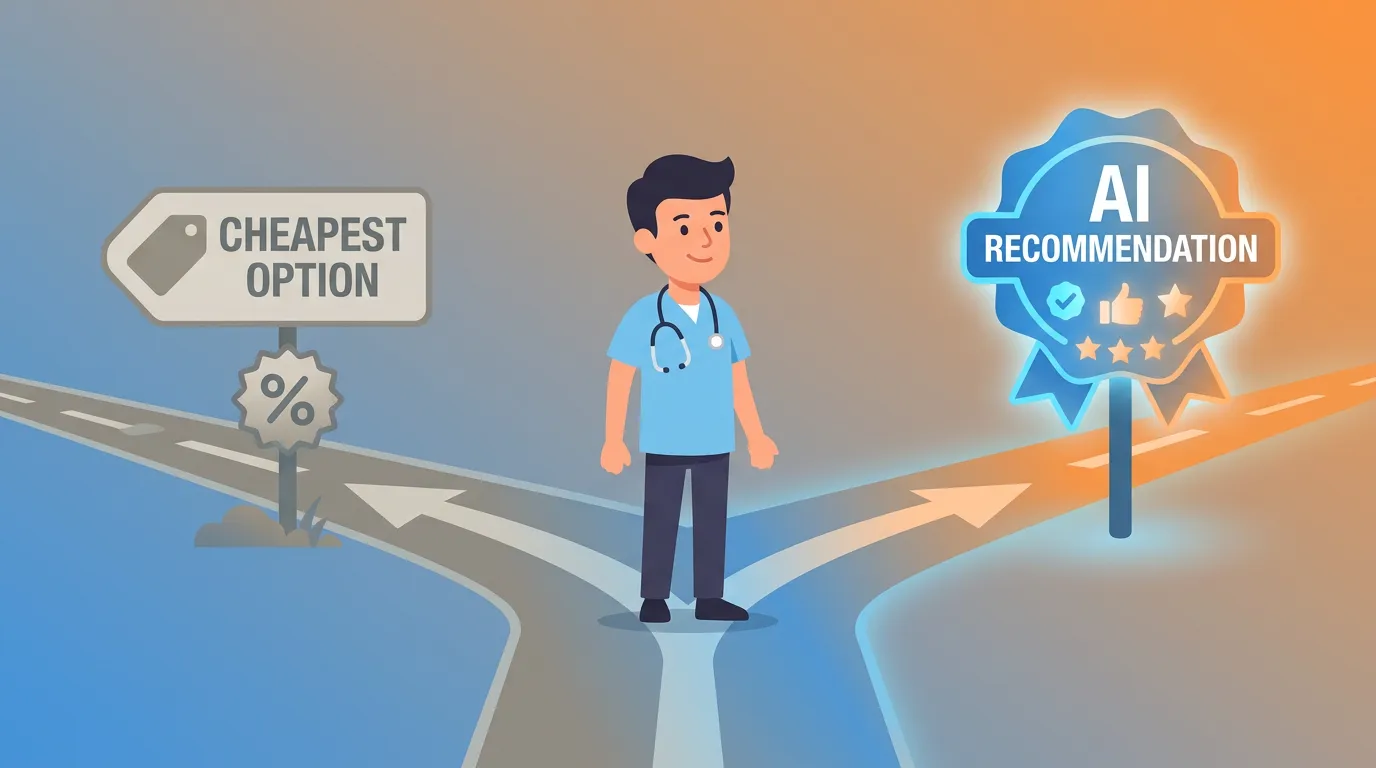
Going to be direct here.
The Budget-First Buyer and Why This Problem Will Keep Getting Worse
If the first question that comes up is “what does this cost compared to my current agency?” – that’s the wrong frame.
That question works for evaluating marketing campaigns. Authority infrastructure isn’t a campaign. Evaluating one with the criteria for the other is how docs end up buying something too shallow to work.
The Budget-First Buyer wants to know the monthly rate. Wants to compare it to competitors. Wants a guarantee. Reasonable questions for a tactical service. Wrong questions for a compound system.
The practices that get the most from the free AI Visibility Check come in asking “how far behind am I?” – not “what’s the cheapest path here?”
If you want a discounted version of AEO, you’ll find one. Twelve months from now you’ll find out exactly why the discount existed.
I’ve watched this play out with practice after practice. The gap between the ones who invested in real infrastructure and the ones who bought bargain versions of it keeps growing. And once you’re far enough behind, catching up is a completely different problem than building it right the first time.
The Infrastructure Mindset vs. the Campaign Mindset
Two kinds of docs run the AI Visibility Check. I can usually tell pretty quickly which one I’m talking to.
The first one comes in calculating. What does this cost per month? How does it compare to what they’re paying their SEO agency? Is there a 90-day trial?
Those are campaign questions. They make sense for a campaign. This isn’t a campaign.
The second one comes in asking something different. How far behind am I? What does it take to build this correctly? What does it compound into over time?
That’s the doc who gets it.
- The campaign buyer – Evaluates authority infrastructure like a monthly ad spend. Wants 90-day ROI. Gets frustrated when compound systems don’t produce fast metrics. Usually ends up cycling through vendors and calling it a failed experiment.
- The infrastructure investor – Asks about depth and execution quality. Understands they’re buying something that builds over time. Doesn’t need a citation dashboard – understands that’s not how this works.
The wrong frame doesn’t just slow you down. It sets you up to buy a version of this that can’t work.
What It Actually Takes to Win the AI Answer
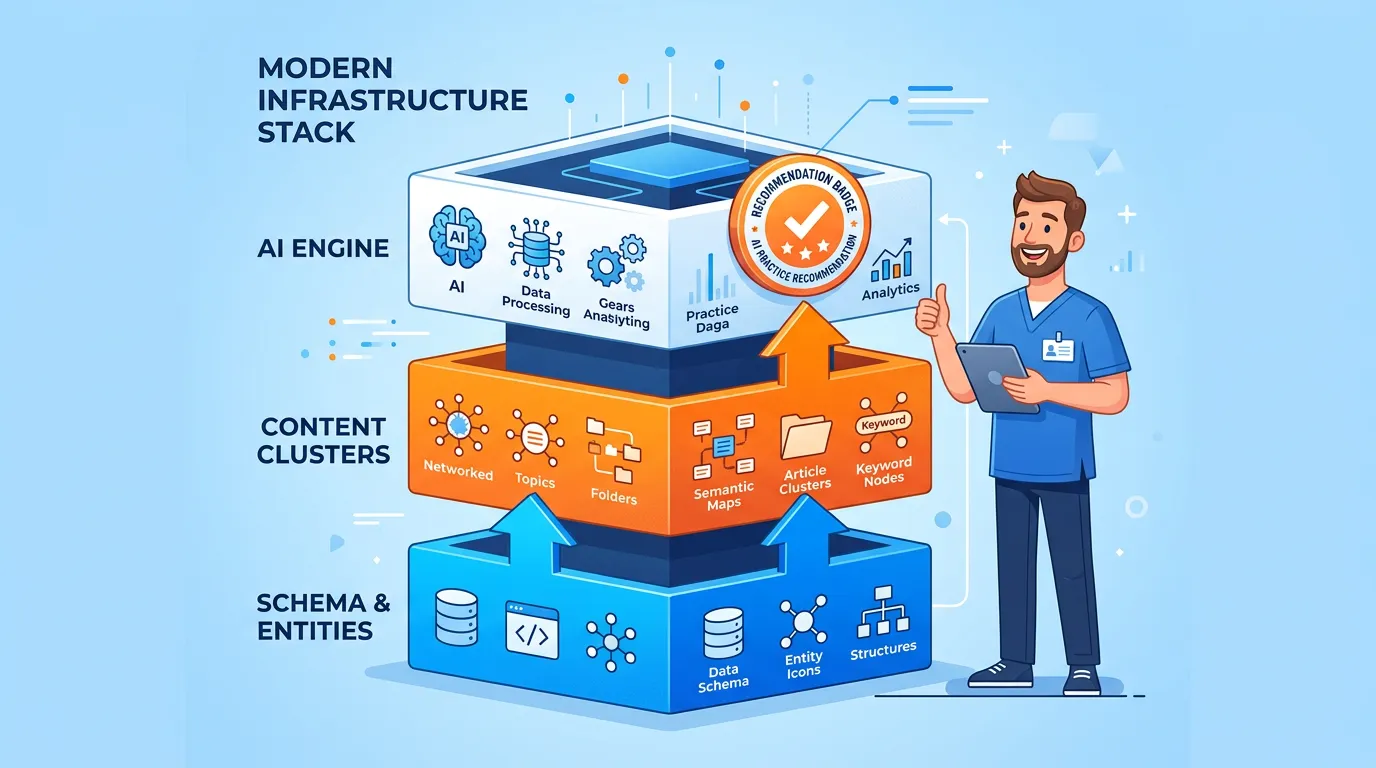
I’ve seen great practices lose the AI answer to mediocre competitors. Better reviews. Better results. Better reputation by every human measure. But the competitor had cleaner infrastructure.
That’s not an anomaly. It’s what happens when you optimize for the wrong evaluation.
How the AI Authority Engine differs from traditional SEO starts right there. Not trying to rank in a list. Building the conditions under which AI confidently chooses to name you.
The Three Pillars AI Uses to Verify Authority
Three things. All three matter.
- Entity consistency – Your name, address, phone, and specialty data has to match exactly across every directory, platform, and data source AI checks. A suite number that differs between two listings. A service described differently in two places. Small inconsistencies read as uncertainty to the machine. AI doesn’t recommend uncertainty.
- Schema architecture – Structured data embedded in your site tells AI engines specifically who you are, what you treat, where you’re located, and how to validate your existence. Without it, AI guesses from unstructured content. AI doesn’t recommend its own guesses.
- Content depth – AI evaluates whether you’ve covered a topic thoroughly enough to qualify as an authority on it. One article about back pain isn’t authority. A structured cluster of content covering every patient intent layer around that condition is. Depth creates the trust signal. Trust earns the recommendation.
These three work together. Weakness in any one reduces AI’s confidence. Strength across all three is the combination that earns the verdict.
What the Zero-Click Era Requires vs. What SEO Delivered
| Category | SEO Era | Zero-Click Era |
|---|---|---|
| Primary goal | Appear in a ranked list | Be the named AI answer |
| Optimization target | Search engine algorithm | AI entity evaluation |
| Content strategy | Keywords and backlinks | Intent coverage and schema |
| Performance measurement | Click volume and rankings | AI recommendation presence |
| Infrastructure type | Website and basic blog | Entity-verified AI-readable system |
| Authority model | Ongoing ranking maintenance | Compound authority buildup |
The practices that understand this are building right now. And how local chiropractic practices are being erased by AI – that’s the slow-motion outcome for the ones that aren’t.
Frequently Asked Questions
What is zero-click search for chiropractors?
It’s when a patient asks an AI engine for a recommendation and receives the practice name, services, and location directly in the chat response. No click required. No website visited. The AI gave the verdict, the conversation ended, and that patient made their decision without your practice ever entering the picture.
This isn’t edge-case behavior. It’s the default for AI-first searchers. That group gets bigger every month.
Why is traditional SEO failing in a zero-click world?
Traditional SEO optimizes for position on a ranked list of results. Zero-click behavior skips that list entirely.
When a patient asks ChatGPT for a chiropractor, they get one answer – not ten options. SEO doesn’t determine who that name is. AI entity evaluation does. These systems play by completely different rules.
If your agency is optimizing for one and ignoring the other, you’re paying for visibility on a channel that’s not making the recommendation. Why keyword rankings are losing to AI verdicts covers exactly where that split happens.
Does zero-click mean my website doesn’t matter anymore?
Your website still matters – but for a different reason than your current agency is focused on.
AI uses your site’s schema markup and structured content to verify your entity. It’s not reading for design. It’s extracting signals – specific, structured, and consistent across multiple sources – to decide whether you’re credible enough to name.
No schema. No proper entity data. No content depth. That’s a low-certainty result to AI. Beautiful design doesn’t solve a machine-readability problem. The Digital Brochure Fallacy lands right here.
How does AI decide which chiropractor is “the answer”?
AI evaluates three things primarily: entity consistency across platforms, schema depth on your site, and content authority around your topic area. It’s looking for the practice it can verify with the highest confidence.
Inconsistent NAP data, missing schema, thin content – each one chips away at AI’s confidence in citing you. The practice down the street with cleaner infrastructure keeps getting named instead. Not because they’re better. Because they’re more verifiable.
How local practices are being erased by AI recommendations breaks this down and shows what the gap looks like by the time most docs finally realize it’s there.
Can I survive on word-of-mouth if search volume drops?
Word-of-mouth is a powerful offline authority signal. It’s not going anywhere.
But it doesn’t scale the way AI recommendations do. A referral gets you one patient. Being named by AI to every person in your city who asks that question is a completely different volume.
They solve different problems. Counting on word-of-mouth to cover the AI gap is a quiet bet that gets riskier every month.
Isn’t my current SEO agency supposed to be handling this?
Fair question. Honest answer: probably not.
Most traditional SEO agencies aren’t set up for AEO infrastructure. Different discipline. Different technical requirements. Some are rebranding to sound AI-compatible – but if the deliverable is still keyword reports and backlink audits, the label changed. The product didn’t.
Ask them directly: “What specifically are you doing for AI entity evaluation and structured schema?” A vague answer is its own answer.
Website authority visibility is a vanity metric when AI is making the recommendation. If you’re not being named in those conversations, more traffic doesn’t close that gap. The agencies not saying that out loud have a reason.
What is an AI Authority Engine for chiropractors?
An AI Authority Engine is a content and entity infrastructure system built specifically to make AI engines recommend your practice. It combines technical entity hardening – schema architecture, citation consistency, structured data – with content clusters designed for AI extraction across the specific conditions and patient intents your practice serves.
Not a website refresh. Not a content package. A structured infrastructure play – built for how AI evaluates authority, not how Google ranks keywords.
How the AI Authority Engine works breaks down the full system layer by layer if you want to understand the mechanics before making any decisions.
The Gap Widens Every Month You Wait
AI gives one answer.
If it’s not you – you don’t exist in that moment. That patient got a name. They called. You were never in the conversation.
That’s not a marketing problem. It’s an infrastructure problem. And it compounds in one direction every month you don’t address it.
Here’s what I keep coming back to every time I talk to a doc about this. Authority compounds. The practices building it now are getting named more every month. The ones waiting are getting passed over more every month. That gap doesn’t reverse itself. I’ve watched it open with practice after practice. It accelerates.
You’re either becoming the answer AI gives. Or you’re becoming invisible. There’s no stable place in the middle.
When someone in your city asks AI for a chiropractor today – are you the name that comes back? Or has a competitor with cleaner infrastructure already claimed that verdict?
The AI authority gap check shows you exactly where you stand. Not traffic estimates. Not keyword positions. The specific gap between what AI currently knows about your practice and what it would need to confidently name you.
Fast to run. What it shows you tends to stay with you.
The practices getting named today built that position months ago. The gap is already in motion.