
A case study from LocalClarity found that only 3% of citations managed by a paid service were indexed by Google. LocalClarity also says most citations created on the 10-15 sites it usually uses do not get indexed, and a citation Google has not indexed cannot help your ranking. Ben Fisher’s citation ledger shows the business’s own website earned about half of Gemini’s local citations and about 10.5% of ChatGPT’s. Google says businesses with complete and accurate info are more likely to show up in local search results. Google’s developer documentation describes a way to enable your local business information to show up in Google Maps and the Google knowledge panel.
What Paid Citation Building Actually Delivers
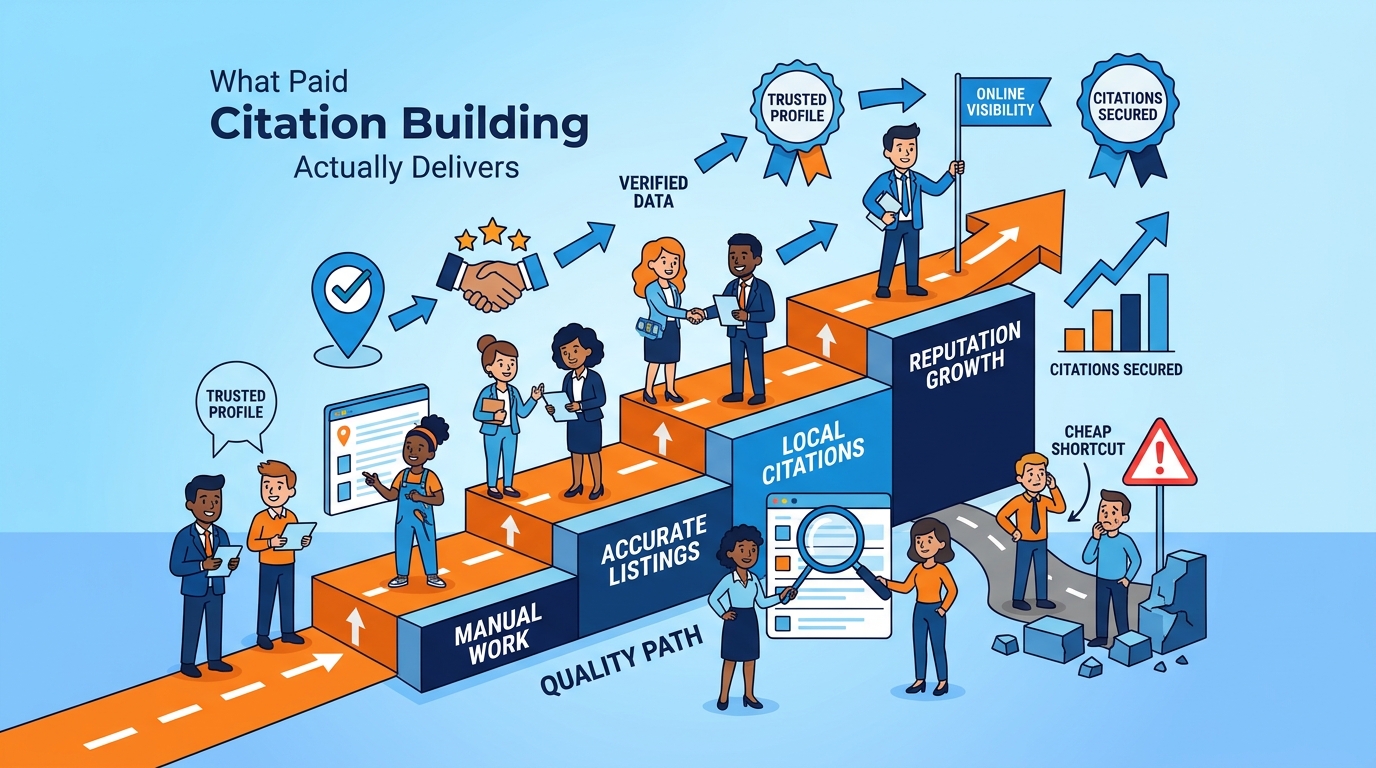
I steer practices away from cheap citation packages bought as a shortcut.
I’ve watched the low monthly price end up costing the client more. Thin work. Little real progress. Money tied up in a contract that builds nothing.
Common Misreadings of a Low Diagnostic Rating, Corrected covers what a low rating does and does not mean.
LocalClarity’s figures come from its post The Death of Citation Management as a Ranking Signal.
Here’s what was measured.
The table below sets each citation tactic next to its outcome.
| Tactic | Measured outcome |
|---|---|
| Paid citation service | In one case study, only 3% of managed citations indexed by Google |
| New citation creation | Majority not indexed by Google; unindexed citations cannot help ranking |
| Long-tail directory syndication | No measurable difference in local search ranking versus non-syndicated locations |
| Citation building overall | 7% influence on local ranking, per the Local Search Ranking Factors survey consensus |
| Directory-sourced calls | In one case study, 100% of calls from third-party directories were sales calls, not clients |
Most built citations never get indexed
LocalClarity ran a case study on a paid citation service.
Only 3% of the citations that service managed were indexed by Google.
LocalClarity took that to mean most such services may not provide the expected traditional search optimization benefits.
LocalClarity usually uses about 10-15 sites for citations. And it found the majority of the citations created don’t get indexed by Google.
Here’s why that matters.
If a citation isn’t in Google’s index, it can’t help your ranking. Google isn’t aware it exists.
Joy Hawkins at Sterling Sky ran a 2024 test.
She built 50 citations for two businesses. She saw an early organic bump. But no map pack lift.
One of them was a dentist. Google had indexed 26 of the 50 citations at first.
Six months later? Only 2.
BrightLocal Citation Builder costs from $2 to $3.20 per site.
More listings haven’t moved local rankings
LocalClarity found no measurable difference in local search ranking. It compared locations syndicated to long-tail directories with locations that weren’t.
Here’s the consensus.
The long-running industry survey Local Search Ranking Factors says professionals in traditional local search optimization now put citation building at a 7% influence on local ranking.
That’s down massively from prior years.
All other factors add up to 93%.
Whitespark’s 2026 Local Search Ranking Factors survey tells the same story. Citation signals sit at roughly 7% of local pack weight. A long slide from their 2017 peak.
Google Business Profile signals carry about a third (32%). Reviews carry about a fifth (20%).
Now look at BCC Interactive’s account.
The highest-rated citation factor for the map pack is consistency on the main search engines.
It ranks #28.
Another Sterling Sky test built 15 citations for two locations.
Rankings rose. Then they returned to where they started.
Recent insights from the Search API leak point the same way.
Google devalues links on low-quality pages. Or pages with few site visits.
Directory calls were sales calls, not clients
In @DarrenShaw_’s case study, a small business got calls from third-party directories through a call tracking number. 100% of those calls were sales calls, not clients.
Listings Decay or Revert When the Subscription Ends
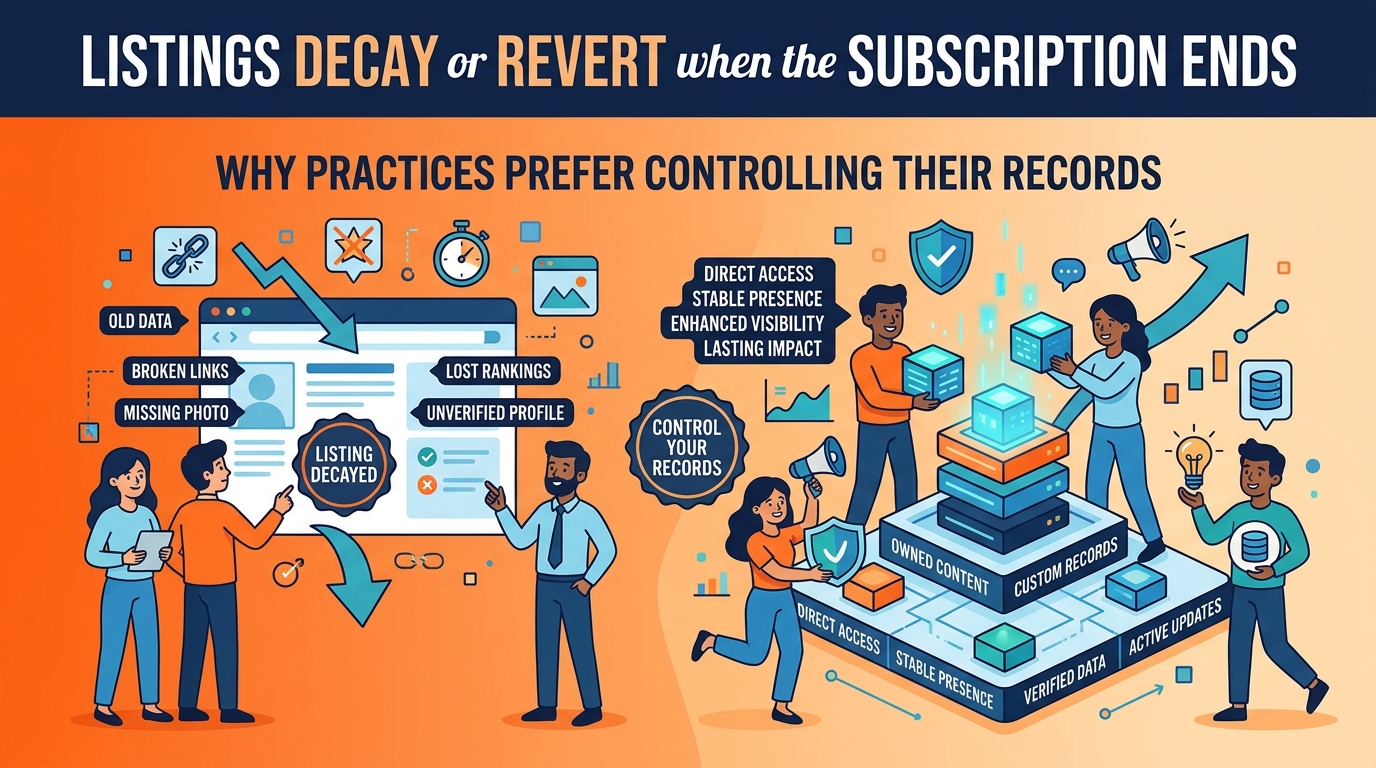
I’d rather build on records a practice controls. They keep working. They grow.
I won’t rent listings that stop when the billing stops.
Whitespark tracked one chiropractor’s 60 listings after a 2016 expiration.
A quarter (25%) had disappeared. Just over a third (35%) were incorrect.
Yext says listings aren’t deleted when you cancel.
But outcomes vary by publisher. Some keep your latest data. Some revert.
Duplicate suppression is active only while you subscribe.
Once your subscription stops, directories fed by aggregator data revert to whatever they held before.
Direction.com lays out these terms in Local Citation Services for Healthcare Practices Compared.
Here’s what happens when it ends.
The table below shows each case once a listings subscription ends.
| Provider or case | After cancellation |
|---|---|
| One chiropractor’s 60 listings (2016) | 25% disappeared and 35% were incorrect |
| Yext listings | Not deleted; some publishers keep your latest data, some revert |
| Duplicate suppression | Active only while you subscribe |
| Directories fed by aggregator data | Revert to whatever they held before |
Bad Listing Data Starts Upstream With Brokers and Aggregators
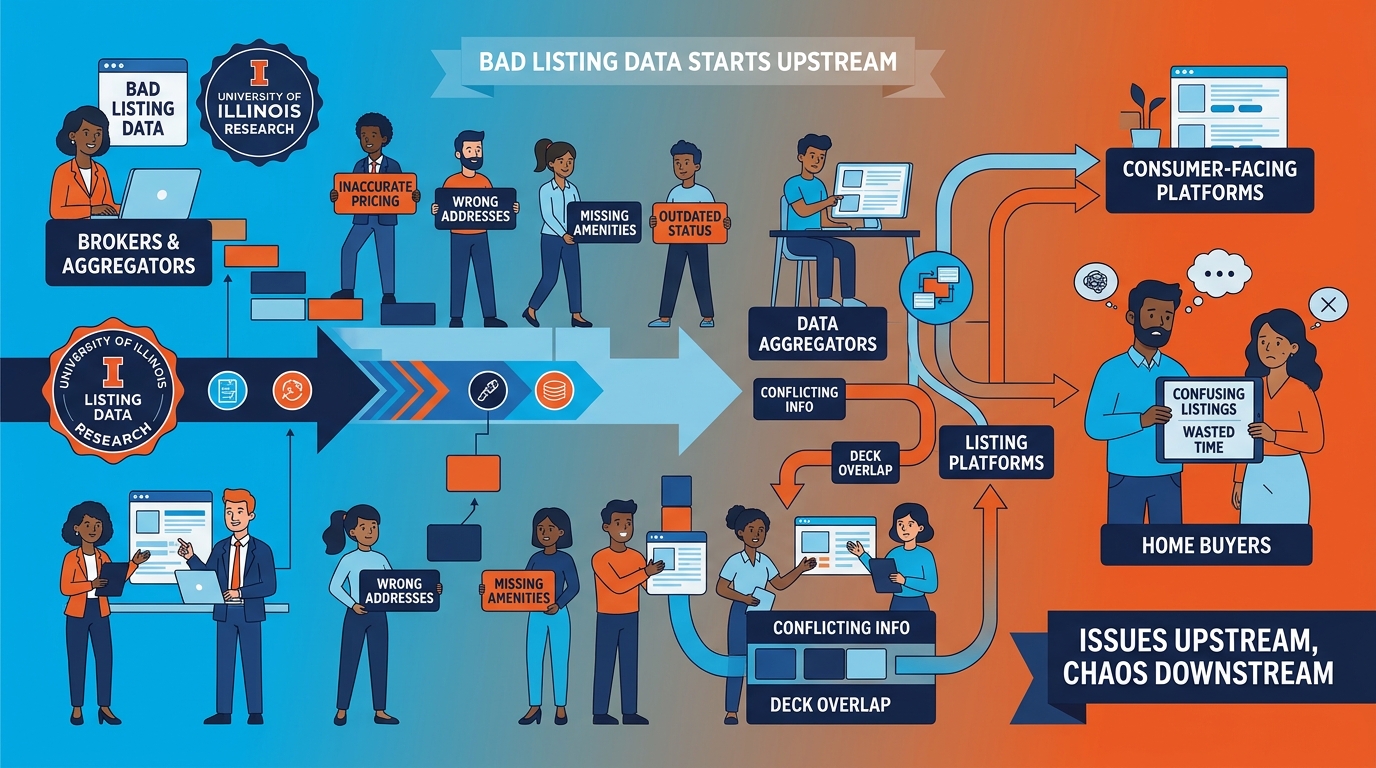
Researchers at the University of Illinois found something ugly.
Miscreants exploit problematic upstream local data brokers. Brokers with loose control on data quality. They use them to post listings that promote illicit drug business.
The researchers said their findings brought to light three things. The vulnerable, less regulated local business listing ecosystem. How pervasive these illicit activities are. And the impact on the local search audience.
Order matters here.
Direction.com sets the cleanup order. Upstream sources come first: Google Business Profile and the TransUnion and Data Axle feeds.
Duplicate suppression comes next.
The straggler directories get fixed by hand, last.
Run it downstream-first and the upstream feeds reload the wrong data within a few weeks of the fix.
TransUnion absorbed Neustar Localeze. It now runs it as the Digital Business Profile product. That’s a feed reaching 80-plus partners.
Only Data Axle, the renamed Infogroup, still works its old lane.
Polluted Pages Can Steer AI Recommendations

A study tested 12 commercial and open-weights LLMs.
All of them were vulnerable.
A single polluted page fooled them at rates of up to 27%. Replace the full top 3 results and that jumps to 73.8%.
The same study calls user-generated content (UGC) the cheapest surface for placing fake content.
Here’s why.
A UGC page is retrieved on the standing of the domain that hosts it. But its text stays open to anyone.
BrightLocal’s 2023 Local Business Discovery and Trust report surveyed 1,138 US consumers.
More than six in ten (62%) would avoid a business if they found incorrect information online.
And 35% run into wrong information at least monthly.
Verified Entity Repair Means Claiming and Correcting Your Own Records
Google says you can enhance the appearance and coverage of your official website and presence in Search. You start by establishing it with Google.
Google’s algorithms find information that’s publicly available on the web. Your site’s name. Corporate contact information. Social profiles.
Get verified as an official representative and you can update your Google knowledge panel. That overrides the information Google finds automatically.
Many knowledge panels can be claimed by the subject they’re about. A person. A company.
For local businesses, claiming is a separate process. It runs through Google My Business.
It lets a local business manage special elements in its knowledge panel. Opening hours. Contact phone numbers.
Claim your Business Profile and you manage how your business appears on Google Maps and Google Search.
Google’s developer documentation also describes a way to enable your local business information to show up in Google Maps and the Google knowledge panel.
And Google says businesses with complete and accurate info are more likely to show up in local search results.
The Three Technical Breaks to Repair First After a Low Rating covers the site-side repairs.
Want to see where your practice stands? The AI Visibility Check is where iTech Valet reviews a practice’s AI visibility.
The Business Profile Rules a Verified Practice Must Follow
Google sets the rules for a verified profile in Guidelines for representing your business on Google.
Here are the ones that bear on a practice.
Eligibility. To qualify for a Business Profile, you have to make in-person contact with customers during your stated hours.
Rent a physical mailing address but don’t operate out of it? That’s a virtual office. It isn’t eligible.
One profile. One profile per business. More can cause problems with how your information displays on Google Maps and Search.
Don’t create more than one page for each location. Not in a single account. Not in several accounts.
Individual practitioners and departments within businesses, universities, hospitals, and government buildings may have separate pages.
Name. Use your real-world name. The one on your storefront, website, and stationery. The one customers know.
Putting unnecessary information in the name isn’t permitted. It could get your Business Profile suspended.
Phone. Don’t give phone numbers or URLs that redirect or “refer” users to landing pages or phone numbers other than those of the actual business. That includes pages created on social media sites.
The phone number must be under the direct control of the business.
Hours. Certain businesses shouldn’t provide hours.
That includes those with varied hours, like schedules for showtimes, worship services, or classes. And those that operate only by appointment.
Categories. Use as few categories as possible. Pick from the provided list to describe your overall core business.
Google can also detect category information from your website. And from mentions of your business throughout the web.
Google Penalizes Manipulation Instead of Rewarding It
I won’t sell the old search playbook that many agencies still offer.
I count its tactics as aimed at conditions that have changed. And I put that on the industry’s offer. Not on the owners who bought it.
Here’s how Google catches it.
Google says it detects policy-violating practices through automated systems. And, as needed, human review that can result in a manual action.
Its policies cover common spam practices. But Google may act against any type of spam it detects.
Google also says its algorithms are extremely good at detecting spam. In most cases it automatically discovers spam and removes it from search results.
Scaled content abuse is when many pages are generated for the primary purpose of manipulating Search rankings. Not helping users.
Using generative AI tools or similar tools to generate many pages without adding value for users may violate that policy. Doing so primarily to manipulate rankings or generative AI responses in Google Search violates it.
Google’s long-standing policy is simple. Automation, including generative AI, is spam if the primary purpose is manipulating ranking in Search results.
Sites that violate the spam policies may rank lower in results. Or not appear at all.
Google lays this out in March 2024 core update and new spam policies.
What Brings a Manual Action and What Recovery Requires
If a site has a manual action, some or all of that site won’t be shown in Google search results.
Most issues in the Manual actions report work quietly. Pages or sites get ranked lower or omitted from search results. No visual indication to the user.
Google names several practices that can draw one:
- Reviews from the business. Reviews must not be written or provided by the business or content provider. Unless they’re customer, independent, and unpaid editorial reviews.
- Misleading markup. Google may detect markup that uses techniques outside its structured data guidelines. Marking up content that’s invisible to users. Marking up irrelevant or misleading content. Or other manipulative behavior.
- Bought links. Buying links or joining link schemes to manipulate ranking in Google Search results violates the spam policies. Some or all of your site can get a manual action.
Recovery has to be complete.
Fix the issue on all affected pages. Fix it on just some pages and you won’t earn a partial return to search results.
Blindly adding all backlinks to the disavow file isn’t a good-faith effort. It won’t be enough to make your reconsideration request successful.
Who May Manage a Verified Profile on a Practice’s Behalf
Google calls any individual or company that manages business information for a Business Profile it doesn’t own an authorized representative.
Google’s examples include a third-party company doing traditional search optimization or search marketing.
The rules for that role are in Business eligibility and ownership guidelines.
- Never claim a Business Profile without express consent from the business owner.
- Never make false, misleading, or unrealistic claims.
- The phone number and website should always be the single, authoritative ones for the business. The business owner must be able to verify them. Website content must be owned and managed by the business owner.
- Always respond to management access requests promptly. Always transfer Business Profile ownership to the business owner immediately upon request.
Break these policies and you may get a suspension. The Business Profile, the Google Account, or both.
Where AI Tools Pull Local Business Information From
I build for a practice to be the source an AI names and draws on. Not one more entry in a directory.
I count being relied on above being present.
Cheers’ 2026 study of 34,742 home services answers found ChatGPT cited a directory, review site, or best-of list in 84.2% of answers with citations, against 38.3% for Google AI Mode. Google AI Mode also cited Google’s own properties in 95.5% of its answers and a business’s website in 92.5%.
Ben Fisher’s citation ledger points the same way. The business’s own website earned about half of Gemini’s local citations and about 10.5% of ChatGPT’s. In that same test, Yelp appeared in the data behind ChatGPT’s business cards in 95.83% of runs, but as a visible citation only 1.04% of the time. In Fisher’s ledger, the same question asked three ways on Gemini matched sources only about 41% of the time, and ChatGPT and Gemini shared just 8.3% of cited domains.
Yext’s study of 6.8 million AI citations across Gemini, OpenAI, and Perplexity found nearly half (44%) came from websites. And a bit over four in ten (42%) from listings.
Whitespark’s survey ranks best-of lists #1 for AI visibility.
Prominence on industry sites is #3. Quality of unstructured citations is #4. The authority of third-party review sites is #5.
Direction.com reports that citation-related factors carry roughly one-eighth (13%) of the weight in AI answers. That’s nearly double their local pack share.
BrightLocal’s 2026 consumer survey found nearly half (45%) of people now use AI tools like ChatGPT to pick local businesses.
A year earlier? Just 6%.
Yext dropped aggregators entirely. It pipes data to 200-plus publishers.
In 2025 that list grew to include OpenAI.
For the scoring side, see Interpreting Practice Diagnostic Results: A Complete Guide.
BCC Interactive covers the citation side in Local Citations: Which Ones Matter And How To Build Them.
Frequently Asked Questions
Is Apple Maps worth verifying alongside Google?
It can be. BrightLocal’s 2026 consumer review survey of 1,002 US adults found about seven in ten (71%) use Google to evaluate local businesses. More than a quarter (27%) use Apple Maps. That’s up from 14% the year before.
Apple Business Connect became Apple Business on April 14, 2026. It’s free. Claimed locations moved over.
How long does a reconsideration review take, and what should the request include?
Plan on several days or weeks. Some reviews, such as link-related requests, may take longer than usual.
Google says a good request does three things. Explain the exact quality issue on your site. Describe the steps you’ve taken to fix it. Document the outcome of your efforts.
How quickly do listings from a one-time paid package go live?
Not all at once. For one $399 tier, expect about three in ten (30%) live when the report arrives. The rest trickle in over weeks.
That tier covers cleanup on the top 10 sites plus 42 new listings. Later updates are billed at $2 per listing.
Do third-party domain authority scores reflect how Google sees a site?
No. Google says some third-party services provide “reputation” or “authority” scores for sites.
They don’t correspond to any of Google’s own signals. And they don’t come from Google.
Are the older data aggregators still feeding directories?
Not all of them. Acxiom quit directory listings at the end of 2019.
Factual merged into Foursquare in April 2020. The brand vanished.
Owner-Held Records Are the Fix AI Tools Draw On
I treat getting picked by AI answer tools as its own discipline. Not classic search work with a new name.
I don’t chase keywords, inbound links, or ranking position. I put the effort into making a practice easy for these systems to verify. Who it is. And that it’s credible.
Per Ben Fisher’s ledger, the business’s own website earned about half of Gemini’s local citations. And about one in ten (10.5%) of ChatGPT’s.
Yext’s study of 6.8 million AI citations found nearly half (44%) came from websites and a bit over four in ten (42%) from listings.
Citation-related factors carry roughly one-eighth (13%) of the weight in AI answers. That’s nearly double their local pack share.
I fix a low rating with verified records the practice holds. Not with rented citations.
Here’s how the work is done: iTech Valet Service Plans & Pricing.
Want to see where your practice stands today? Run My AI Visibility Check.